
Midlands 4 Cities Application Writing Workshop for 2021


- Slides: 30
Midlands 4 Cities Application Writing Workshop for 2021 entry 14 & 7 November 2020 • • • Welcome and thank you for joining the M 4 C application writing workshop this morning. Please can you make sure that your camera and microphone are turned off. We will be recording this presentation We will not be using the chat function for questions. Any questions will be answered in the following city/university workshops Please can you refrain from moving the presentation slides forward as this moves them on for everyone not just you.
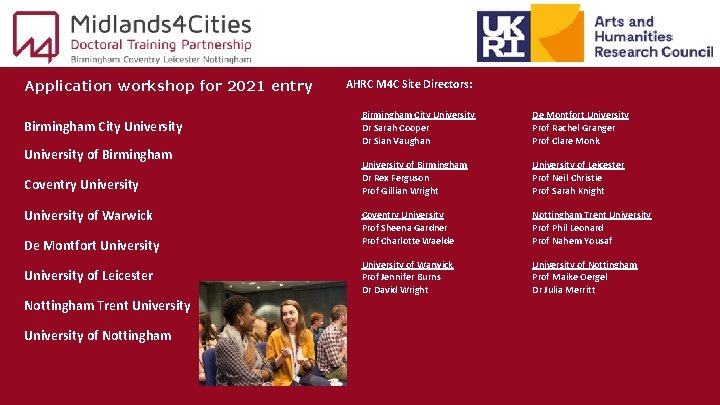
Application workshop for 2021 entry Birmingham City University of Birmingham Coventry University of Warwick De Montfort University of Leicester Nottingham Trent University of Nottingham AHRC M 4 C Site Directors: Birmingham City University Dr Sarah Cooper Dr Sian Vaughan De Montfort University Prof Rachel Granger Prof Clare Monk University of Birmingham Dr Rex Ferguson Prof Gillian Wright University of Leicester Prof Neil Christie Prof Sarah Knight Coventry University Prof Sheena Gardner Prof Charlotte Waelde Nottingham Trent University Prof Phil Leonard Prof Nahem Yousaf University of Warwick Prof Jennifer Burns Dr David Wright University of Nottingham Prof Maike Oergel Dr Julia Merritt
Application workshop for 2021 entry will cover: 1. Central Session 10. 00 – 11. 00 Introduction to M 4 C What is M 4 C? • Context and funding • Awards • M 4 C priorities • Application process • M 4 C application assessment criteria • Contact details 2. 11. 00 University City based session Sample applications Questions and concluding comments
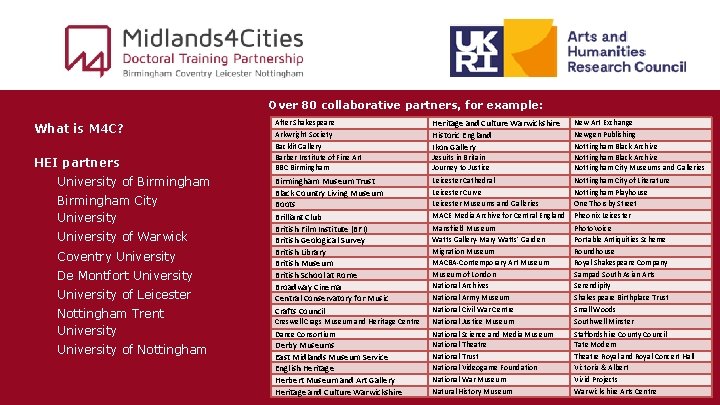
What is M 4 C? • a thriving community of postgraduate research students producing world class research • promotes collaborative postgraduate research, joint supervision and partner engagement with organisations in the cultural, creative and heritage sectors • develops professional and research training initiatives in the UK and internationally • supports training activities in areas such as policy engagement and the digital humanities • offers placement opportunities and the chance to develop cohort activities with researchers in other DTPs • provides post-completion ‘routes out’ support: M 4 C Fellows
Over 80 collaborative partners, for example: What is M 4 C? HEI partners University of Birmingham City University of Warwick Coventry University De Montfort University of Leicester Nottingham Trent University of Nottingham After Shakespeare Arkwright Society Backlit Gallery Barber Institute of Fine Art BBC Birmingham Heritage and Culture Warwickshire Historic England Ikon Gallery Jesuits in Britain Journey to Justice New Art Exchange Newgen Publishing Nottingham Black Archive Nottingham City Museums and Galleries Birmingham Museum Trust Black Country Living Museum Boots Brilliant Club British Film Institute (BFI) British Geological Survey British Library British Museum British School at Rome Broadway Cinema Central Conservatory for Music Crafts Council Leicester Cathedral Leicester Curve Leicester Museums and Galleries MACE Media Archive for Central England Nottingham City of Literature Nottingham Playhouse One Thorsby Street Pheonix Leicester Mansfield Museum Watts Gallery-Mary Watts' Garden Migration Museum MACBA-Contemporary Art Museum of London National Archives National Army Museum National Civil War Centre Photo. Voice Portable Antiquities Scheme Roundhouse Royal Shakespeare Company Sampad South Asian Arts Serendipity Shakespeare Birthplace Trust Small Woods Creswell Crags Museum and Heritage Centre National Justice Museum Southwell Minster Dance Consortium National Science and Media Museum National Theatre National Trust National Videogame Foundation National War Museum Natural History Museum Staffordshire County Council Tate Modern Theatre Royal and Royal Concert Hall Victoria & Albert Vivid Projects Warwickshire Arts Centre Derby Museums East Midlands Museum Service English Heritage Herbert Museum and Art Gallery Heritage and Culture Warwickshire
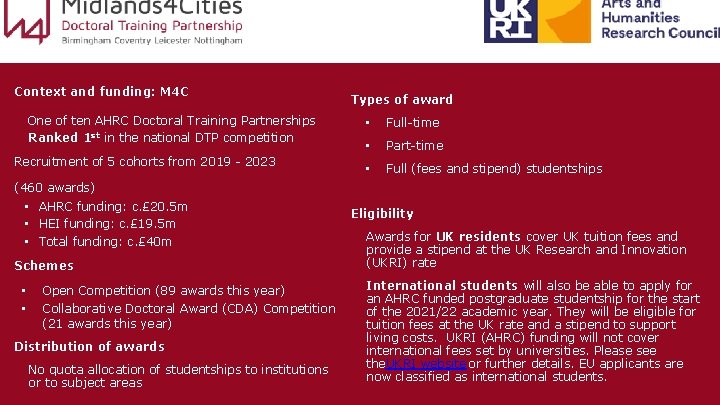
Context and funding: M 4 C One of ten AHRC Doctoral Training Partnerships Ranked 1 st in the national DTP competition Recruitment of 5 cohorts from 2019 - 2023 Types of award • Full-time • Part-time • Full (fees and stipend) studentships (460 awards) • AHRC funding: c. £ 20. 5 m • HEI funding: c. £ 19. 5 m • Total funding: c. £ 40 m Schemes • • Open Competition (89 awards this year) Collaborative Doctoral Award (CDA) Competition (21 awards this year) Distribution of awards No quota allocation of studentships to institutions or to subject areas Eligibility Awards for UK residents cover UK tuition fees and provide a stipend at the UK Research and Innovation (UKRI) rate International students will also be able to apply for an AHRC funded postgraduate studentship for the start of the 2021/22 academic year. They will be eligible for tuition fees at the UK rate and a stipend to support living costs. UKRI (AHRC) funding will not cover international fees set by universities. Please see the. UKRI website or further details. EU applicants are now classified as international students.
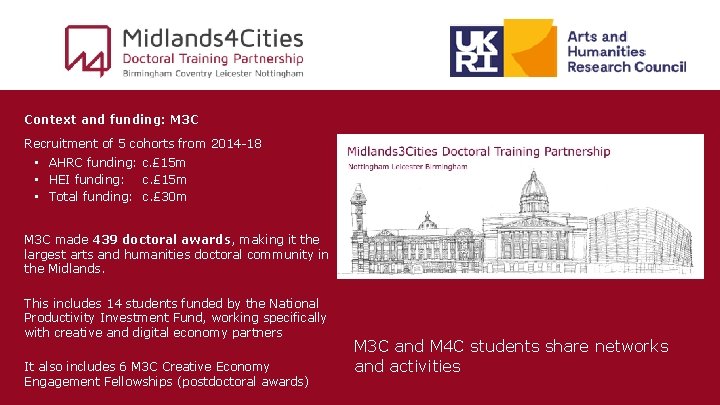
Context and funding: M 3 C Recruitment of 5 cohorts from 2014 -18 • AHRC funding: c. £ 15 m • HEI funding: c. £ 15 m • Total funding: c. £ 30 m M 3 C made 439 doctoral awards, making it the largest arts and humanities doctoral community in the Midlands. This includes 14 students funded by the National Productivity Investment Fund, working specifically with creative and digital economy partners It also includes 6 M 3 C Creative Economy Engagement Fellowships (postdoctoral awards) M 3 C and M 4 C students share networks and activities
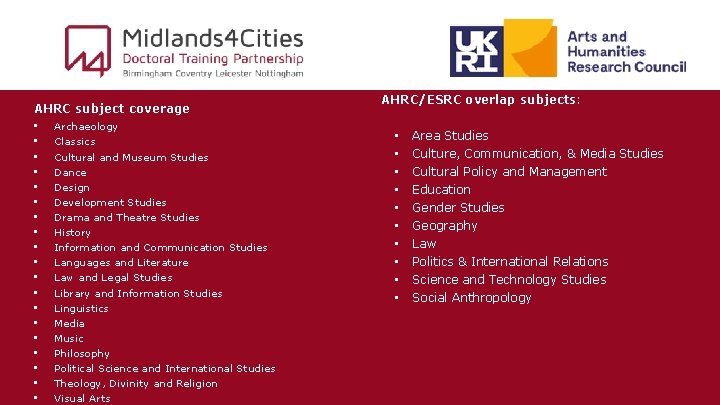
AHRC subject coverage • • • • • Archaeology Classics Cultural and Museum Studies Dance Design Development Studies Drama and Theatre Studies History Information and Communication Studies Languages and Literature Law and Legal Studies Library and Information Studies Linguistics Media Music Philosophy Political Science and International Studies Theology, Divinity and Religion Visual Arts AHRC/ESRC overlap subjects: • • • Area Studies Culture, Communication, & Media Studies Cultural Policy and Management Education Gender Studies Geography Law Politics & International Relations Science and Technology Studies Social Anthropology
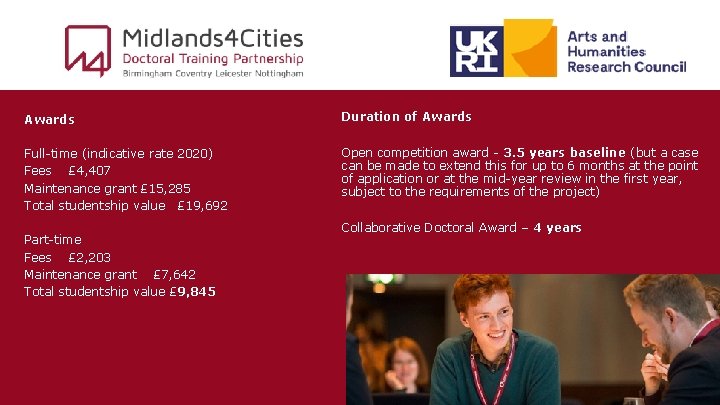
Awards Duration of Awards Full-time (indicative rate 2020) Fees £ 4, 407 Maintenance grant £ 15, 285 Total studentship value £ 19, 692 Open competition award - 3. 5 years baseline (but a case can be made to extend this for up to 6 months at the point of application or at the mid-year review in the first year, subject to the requirements of the project) Part-time Fees £ 2, 203 Maintenance grant £ 7, 642 Total studentship value £ 9, 845 Collaborative Doctoral Award – 4 years
Additional Funding Research Development Fund (RDF) The RDF is designed to support primary research activities for individual students, including: • Participation in conferences • Primary research/archive/fieldwork visits • Study visits in the UK and overseas Engagement Fund (EF) The EF will allow students who are undertaking placements and other activities that are engaged with professional development to access additional funds to support them. The Engagement Fund will cover accommodation, travel and other associated costs. Cohort Development Fund (CDF) • Devised and led by a minimum of two doctoral researchers from two or more M 4 C institutions • Conference, workshop, symposia, retreats, skills training, • Research networking training and development activities • Discipline-crossing research • Researcher-led responses to external partner challenge themes • Innovative training for language researchers
M 4 C priorities To fund and support outstanding research To enhance opportunities for PGR collaboration between partner institutions • Cohort activities, cross-institutional supervision teams To promote researcher engagement with non-university organisations • Where applicable, impact and public engagement/dissemination activities should be identified at the point of application To provide placement and training opportunities for funded researchers • Employability placements • Research placements • Training needs and potential placements should be identified at the point of application
Application process for 2021 entry Application deadline: 13 January 2021 (details live on M 4 C website on 12 October 2020) Stage one Choose between Open Doctoral Competition and CDA Open competition: identify potential supervisors CDA: select project and contact lead supervisor Under M 4 C rules, a candidate can submit applications to both the Open and CDA competitions
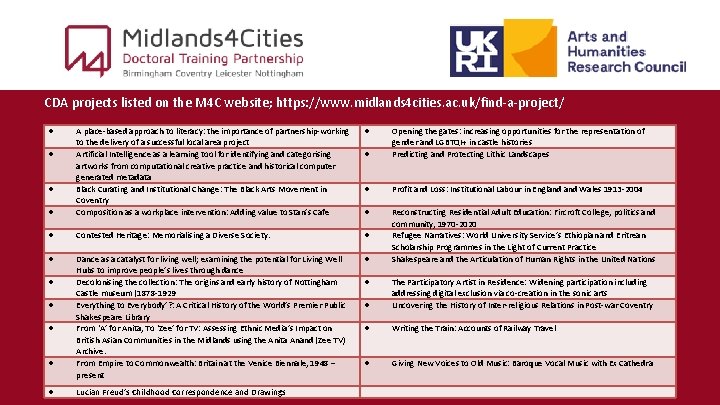
CDA projects listed on the M 4 C website; https: //www. midlands 4 cities. ac. uk/find-a-project/ A place-based approach to literacy: the importance of partnership-working to the delivery of a successful local area project Artificial Intelligence as a learning tool for identifying and categorising artworks from computational creative practice and historical computer generated metadata Black Curating and Institutional Change: The Black Arts Movement in Coventry Composition as a workplace intervention: Adding value to Stan’s Cafe Contested Heritage: Memorialising a Diverse Society. Dance as a catalyst for living well; examining the potential for Living Well Hubs to improve people’s lives through dance Decolonising the collection: The origins and early history of Nottingham Castle museum (1878 -1929 Everything to Everybody’? : A Critical History of the World’s Premier Public Shakespeare Library From ‘A’ for Anita, To ‘Zee’ for TV: Assessing Ethnic Media’s Impact on British Asian Communities in the Midlands using the Anita Anand (Zee TV) Archive. From Empire to Commonwealth: Britain at the Venice Biennale, 1948 – present Lucian Freud’s Childhood Correspondence and Drawings Opening the gates: increasing opportunities for the representation of gender and LGBTQI+ in castle histories Predicting and Protecting Lithic Landscapes Profit and Loss: Institutional Labour in England Wales 1913 -2004 Reconstructing Residential Adult Education: Fircroft College, politics and community, 1970 -2020 Refugee Narratives: World University Service’s Ethiopian and Eritrean Scholarship Programmes in the Light of Current Practice Shakespeare and the Articulation of Human Rights in the United Nations The Participatory Artist in Residence: Widening participation including addressing digital exclusion via co-creation in the sonic arts Uncovering the History of Inter-religious Relations in Post-war Coventry Writing the Train: Accounts of Railway Travel Giving New Voices to Old Music: Baroque Vocal Music with Ex Cathedra
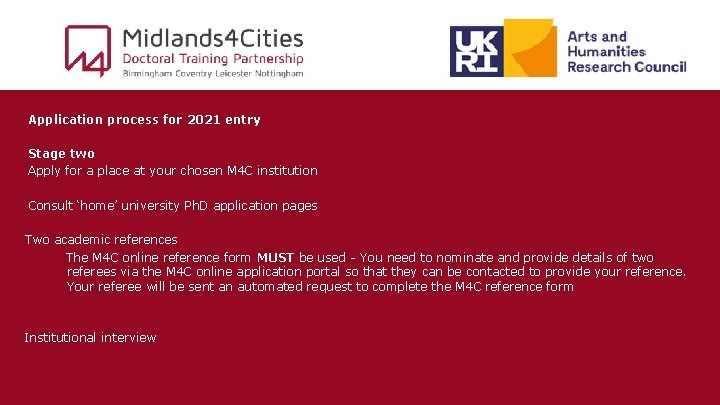
Application process for 2021 entry Stage two Apply for a place at your chosen M 4 C institution Consult ‘home’ university Ph. D application pages Two academic references The M 4 C online reference form MUST be used - You need to nominate and provide details of two referees via the M 4 C online application portal so that they can be contacted to provide your reference. Your referee will be sent an automated request to complete the M 4 C reference form Institutional interview
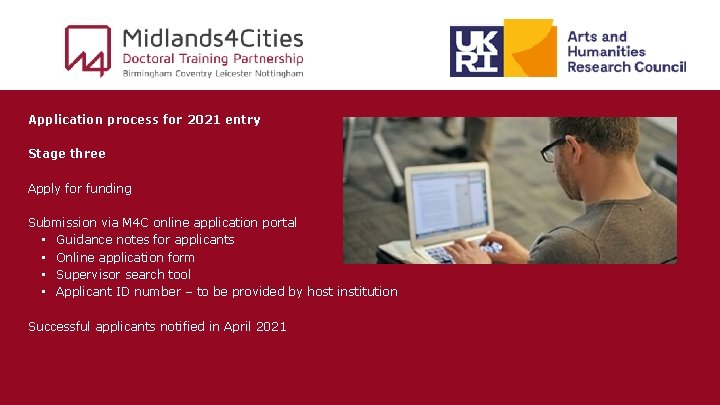
Application process for 2021 entry Stage three Apply for funding Submission via M 4 C online application portal • Guidance notes for applicants • Online application form • Supervisor search tool • Applicant ID number – to be provided by host institution Successful applicants notified in April 2021
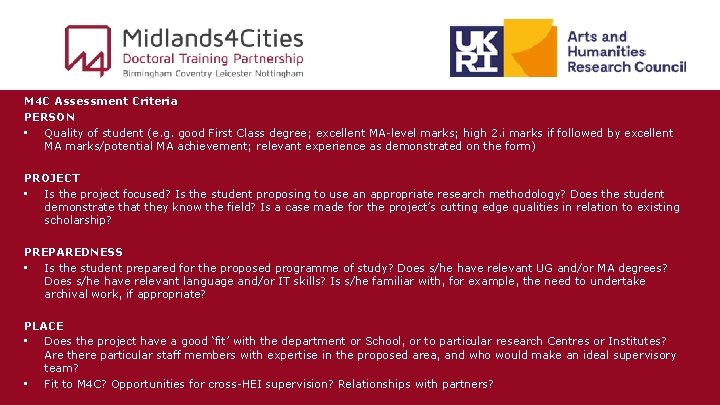
M 4 C Assessment Criteria PERSON • Quality of student (e. g. good First Class degree; excellent MA-level marks; high 2. i marks if followed by excellent MA marks/potential MA achievement; relevant experience as demonstrated on the form) PROJECT • Is the project focused? Is the student proposing to use an appropriate research methodology? Does the student demonstrate that they know the field? Is a case made for the project’s cutting edge qualities in relation to existing scholarship? PREPAREDNESS • Is the student prepared for the proposed programme of study? Does s/he have relevant UG and/or MA degrees? Does s/he have relevant language and/or IT skills? Is s/he familiar with, for example, the need to undertake archival work, if appropriate? PLACE • Does the project have a good ‘fit’ with the department or School, or to particular research Centres or Institutes? Are there particular staff members with expertise in the proposed area, and who would make an ideal supervisory team? • Fit to M 4 C? Opportunities for cross-HEI supervision? Relationships with partners?
Tips to ensure your referees submit their references on time: 1. Check that your referee has received the request. It may have been delivered to their spam. 2. Send the reference in good time. Early December at the latest to avoid Christmas vacation delays 3. Explain to your referee that the M 4 C from is the only reference they need to complete and this is completely separate from the University admissions system. 4. Referees should wait for the automated email requesting a reference and not sign up to the online platform as an applicant to submit a reference. 5. It is the applicant’s responsibility to monitor the reference progress and check that everything has been received 6. Double check that you have inputted the correct email address for your referee 7. Applications cannot be submitted without 2 completed references 8. Read and follow the guidance notes before submitting your reference request.
Source: http: //phdcomics. com/comics/archive. php? comicid=1924 Applying to Midlands 4 Cities – Advice From Experience Christopher Griffin | @quiffedliterati
What We’ll Be Covering A prompt overview of what I submitted for each section of the application, why, and my advice for approaching these sections as a result. If you would like me to expand on or clarify something, my contact details are at the end!
Think about time. Starting from next Monday, you’ll have fiftyeight days to write and submit a polished, robust proposal. Plenty of time! I wrote a total of 21 drafts of my research proposal. Or, cumulatively, 17, 075 words. Consider all your current duties, projects and responsibilities (family, coursework, extracurricular activities), and schedule regular writing sessions every week – no matter how long or short. Exhaust the little moments! ‘Exhaust the little moment. Soon it dies. And be it gash or gold it will not come Again in this identical disguise’ Gwendolyn Brooks , ‘Exhaust the little moment’ (1949),
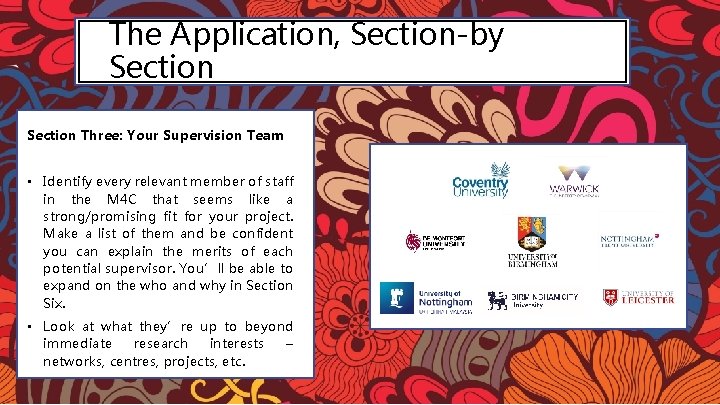
The Application, Section-by Section Three: Your Supervision Team • Identify every relevant member of staff in the M 4 C that seems like a strong/promising fit for your project. Make a list of them and be confident you can explain the merits of each potential supervisor. You’ll be able to expand on the who and why in Section Six. • Look at what they’re up to beyond immediate research interests – networks, centres, projects, etc.
The Application, Section-by Section Four: Your Career in Higher Education to Date Regarding ‘qualifications’: o Study Abroad Experience – independence & adaptability; studying modules key to your proposed project; excelling academically. o The Nottingham Advantage Award – leadership and employability skills; teaching experience. o Microsoft Office Specialist Training in Excel 2016: ‘Thanks to this qualification, I was able to produce a detailed projected budget that was instrumental in successfully gaining funding for the postgraduate academic conference I am currently organising (£ 400)’
The Application, Section-by Section Five: Professional Experience o Undergraduate Peer Mentor – another opportunity to exhibit academic community involvement, leadership, organisational skills, awareness of mental health issues in HE. o Academic Conference Organiser – my experience as a chair and treasurer and what these roles entailed – used this as a springboard for discussing the M 4 C DTP's 'Cohort Development Fund’
The Application, Section-by Section Six: Project Proposal This is the section that will require the most time and revision. : //external-content. duckgo. com/iu/? u=https%3 A%2 F%2 Fmedia. makeameme. org%2 Fcreated%2 Fi-sell-propane. Keep your title short (15 words max) and make sure it contains the essential ingredients. yzl 80 u. jpg&f=1&nofb=1 ‘The Aesthetics and Hermeneutics of the Secret in Contemporary British Fiction, 1998 -2018’ (I’ve since cut this down further)
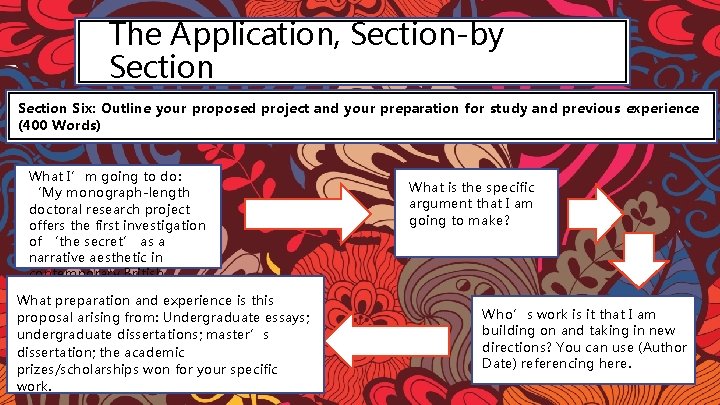
The Application, Section-by Section Six: Outline your proposed project and your preparation for study and previous experience : //external-content. duckgo. com/iu/? u=https%3 A%2 F%2 Fmedia. makeameme. org%2 Fcreated%2 Fi-sell-propaneyzl 80 u. jpg&f=1&nofb=1 (400 Words) What I’m going to do: ‘My monograph-length doctoral research project offers the first investigation of ‘the secret’ as a narrative aesthetic in contemporary British fiction’. What preparation and experience is this proposal arising from: Undergraduate essays; undergraduate dissertations; master’s dissertation; the academic prizes/scholarships won for your specific work. What is the specific argument that I am going to make? Who’s work is it that I am building on and taking in new directions? You can use (Author Date) referencing here.
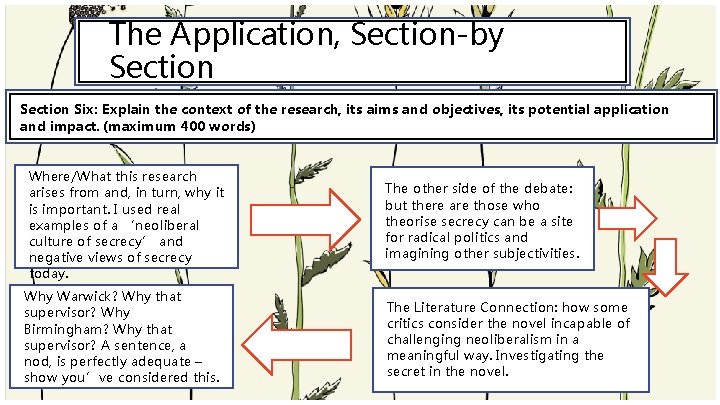
The Application, Section-by Section : //external-content. duckgo. com/iu/? u=https%3 A%2 F%2 Fmedia. makeameme. org%2 Fcreated%2 Fi-sell-propane. Section Six: Explain the context of the research, its aims and objectives, its potential application Section Six: yzl 80 u. jpg&f=1&nofb=1 and impact. (maximum 400 words) Where/What this research arises from and, in turn, why it is important. I used real examples of a ‘neoliberal culture of secrecy’ and negative views of secrecy today. Why Warwick? Why that supervisor? Why Birmingham? Why that supervisor? A sentence, a nod, is perfectly adequate – show you’ve considered this. The other side of the debate: but there are those who theorise secrecy can be a site for radical politics and imagining other subjectivities. The Literature Connection: how some critics consider the novel incapable of challenging neoliberalism in a meaningful way. Investigating the secret in the novel.
The Application, Section-by Section Six: Please identify any ethical and intellectual property issues associated with the project : //external-content. duckgo. com/iu/? u=https%3 A%2 F%2 Fmedia. makeameme. org%2 Fcreated%2 Fi-sell-propane. Section Six: and how these will be addressed. yzl 80 u. jpg&f=1&nofb=1 It is unlikely that my doctoral research project will encounter any significant ethical or intellectual property issues. However, if there is any reason to consider ethical and intellectual property issues during the development of my thesis I will consult the University of Warwick's 'Research Code of Practice’ document, which is updated annually, and complete any necessary selfassessment forms and procedures
The Application, Section-by Section Seven: Fieldwork and Study Visits o I highly recommend you complete this section. o An archive, a study visit, or fieldwork – something that would aid your research. : //external. I went for the The Hoover Institute, Stanford University, content. duckgo. com/iu/? u=https%3 A%2 F%2 Fmedia. makeame me. org%2 Fcreated%2 Fi-sell-propane-yzl 80 u. jpg&f=1&nofb=1 California: o Pertinent to the study of neoliberalism’s intellectual history; many papers that have not yet been read/unpublished. o Cited specific boxes/papers/collections to convey sincere and serious intent
Thank you! Christopher Griffin @Quiffed. Literati Christopher. J. Griffin@warwick. ac. uk
Contact details Midlands 4 Cities DTP • website: http: //www. midlands 4 cities. ac. uk • email: enquiries@midlands 4 cities. ac. uk • • University of Birmingham: ahrcapplications@contacts. bham. ac. uk Birmingham City University: M 4 C@bcu. ac. uk University of Warwick: m 4 c@warwick. ac. uk Coventry University: m 4 c. fah@coventry. ac. uk De Montfort University Leicester: M 4 C@dmu. ac. uk University of Leicester: ahrcdtp@leicester. ac. uk Nottingham Trent University: ahrcdtpapplications@ntu. ac. uk University of Nottingham: pg-funding@nottingham. ac. uk