
MiddlewareBased OS Distributed OS Application Distributed Operating System
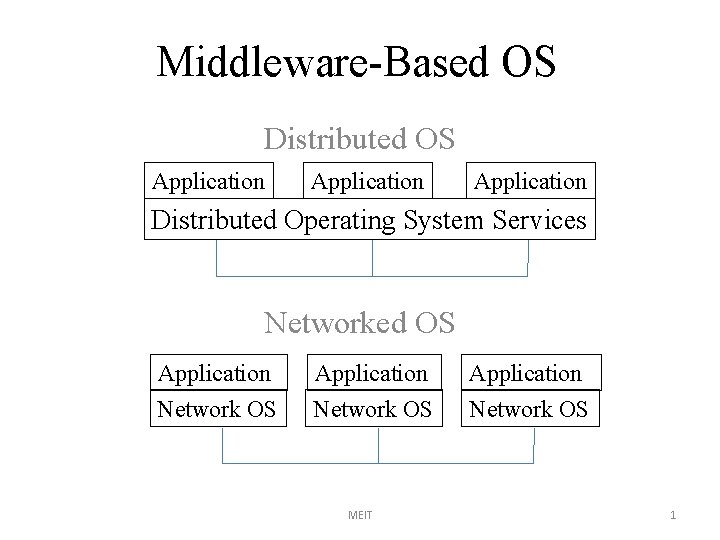
Middleware-Based OS Distributed OS Application Distributed Operating System Services Networked OS Application Network OS MEIT Application Network OS 1
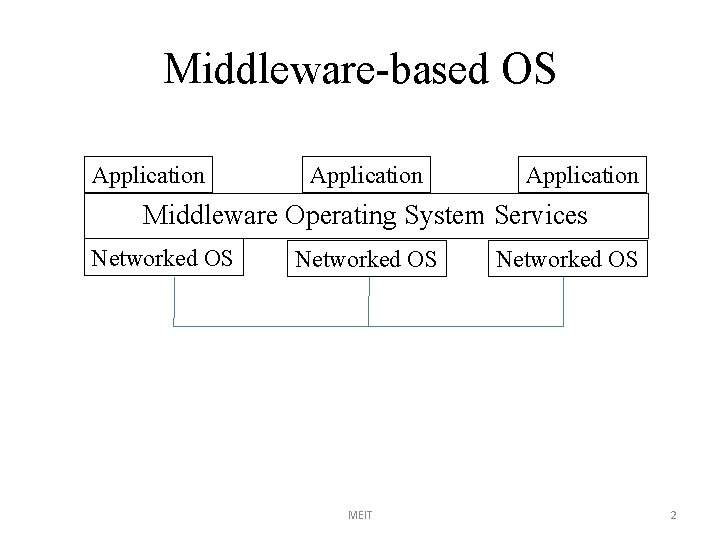
Middleware-based OS Application Middleware Operating System Services Networked OS MEIT Networked OS 2
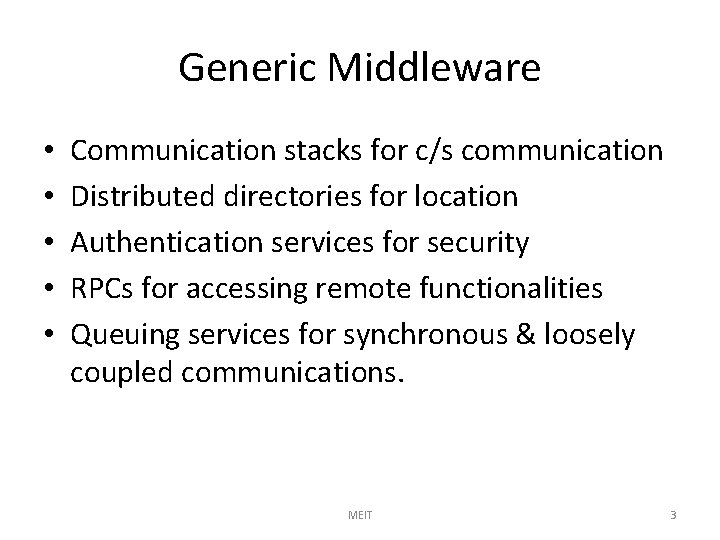
Generic Middleware • • • Communication stacks for c/s communication Distributed directories for location Authentication services for security RPCs for accessing remote functionalities Queuing services for synchronous & loosely coupled communications. MEIT 3
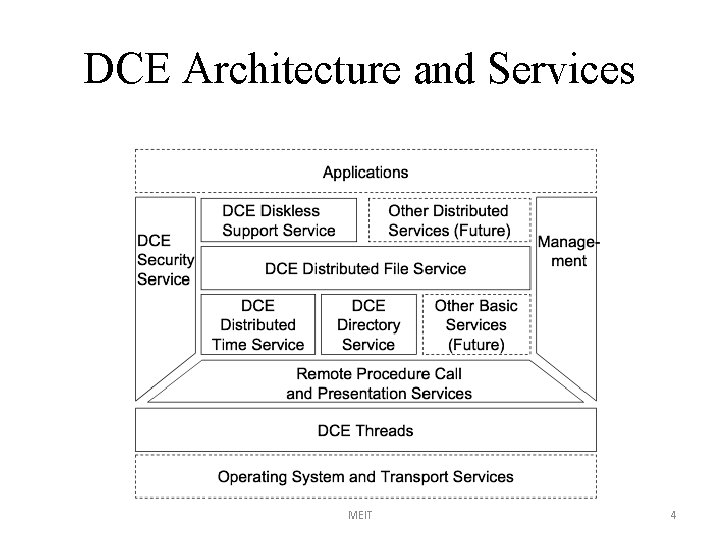
DCE Architecture and Services MEIT 4
Key services • • Remote Procedure Call Directory service Security service Time service Threading service Distributed File service IDL Compiler Diskless service MEIT 5
Directory service • • Cell Directory Service (CDS) Global Directory Service (GDS) Global Directory Agent (GDA) Directory Service Programming Interface MEIT 6
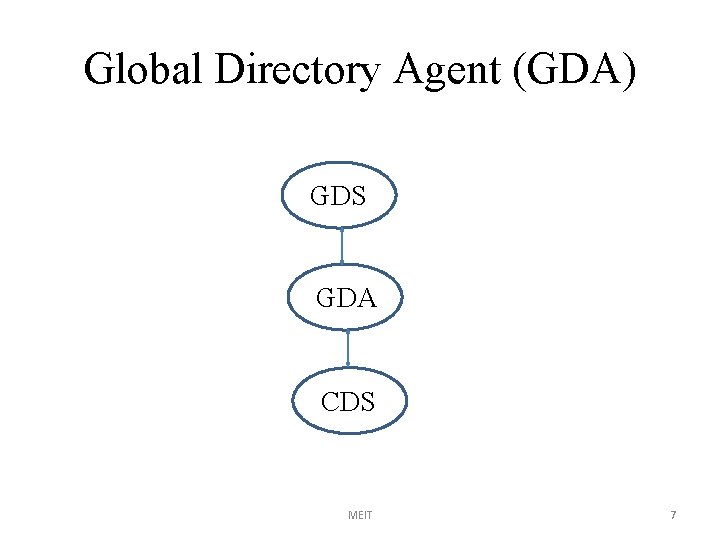
Global Directory Agent (GDA) GDS GDA CDS MEIT 7
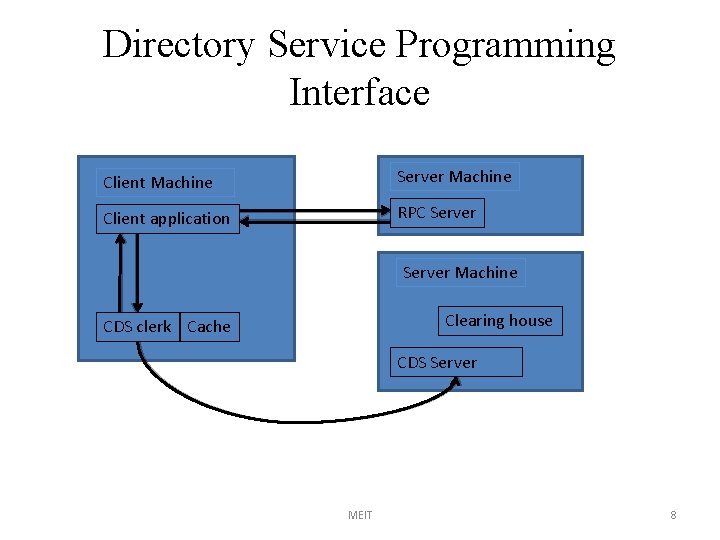
Directory Service Programming Interface Client Machine Server Machine Client application RPC Server Machine Clearing house CDS clerk Cache CDS Server MEIT 8
Service-Specific Middleware • Needs to accomplish a particular c/s type of service • OLTP middleware • Communication middleware • Object-specific middleware • Workflow management middleware • Internet-specific middleware MEIT 9
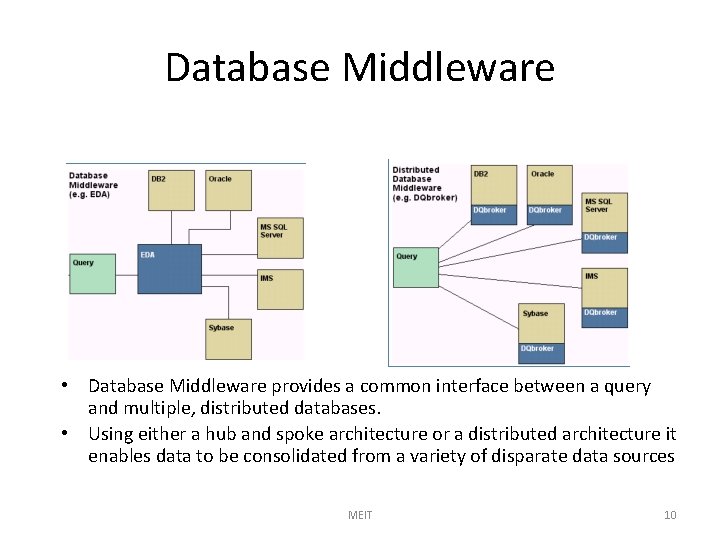
Database Middleware • Database Middleware provides a common interface between a query and multiple, distributed databases. • Using either a hub and spoke architecture or a distributed architecture it enables data to be consolidated from a variety of disparate data sources MEIT 10
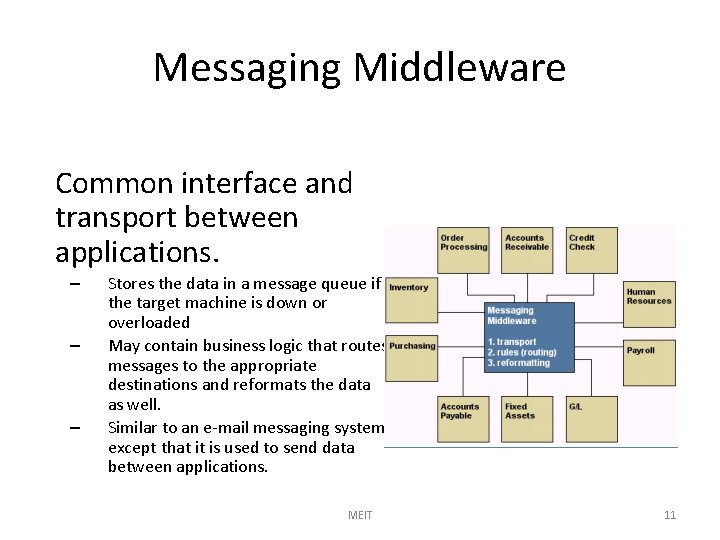
Messaging Middleware Common interface and transport between applications. – – – Stores the data in a message queue if the target machine is down or overloaded May contain business logic that routes messages to the appropriate destinations and reformats the data as well. Similar to an e-mail messaging system, except that it is used to send data between applications. MEIT 11
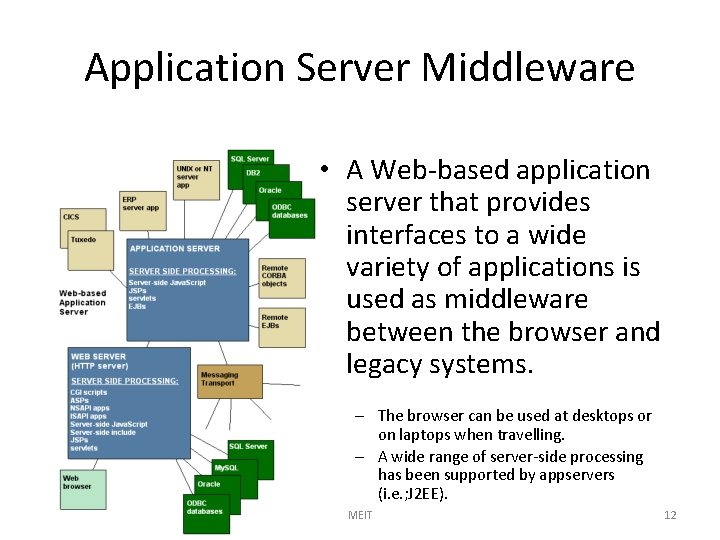
Application Server Middleware • A Web-based application server that provides interfaces to a wide variety of applications is used as middleware between the browser and legacy systems. – The browser can be used at desktops or on laptops when travelling. – A wide range of server-side processing has been supported by appservers (i. e. ; J 2 EE). MEIT 12
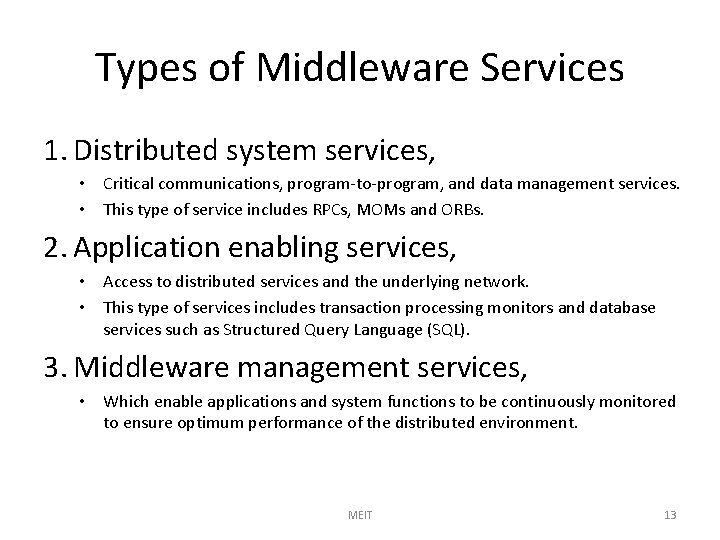
Types of Middleware Services 1. Distributed system services, • Critical communications, program-to-program, and data management services. • This type of service includes RPCs, MOMs and ORBs. 2. Application enabling services, • Access to distributed services and the underlying network. • This type of services includes transaction processing monitors and database services such as Structured Query Language (SQL). 3. Middleware management services, • Which enable applications and system functions to be continuously monitored to ensure optimum performance of the distributed environment. MEIT 13
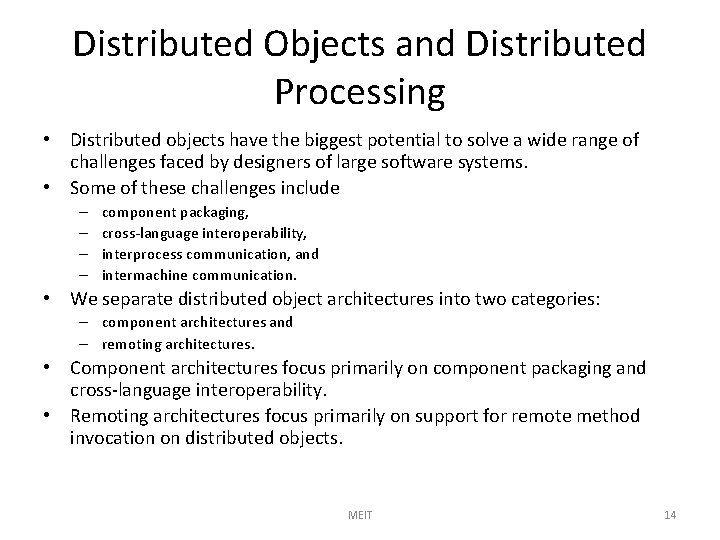
Distributed Objects and Distributed Processing • Distributed objects have the biggest potential to solve a wide range of challenges faced by designers of large software systems. • Some of these challenges include – – component packaging, cross-language interoperability, interprocess communication, and intermachine communication. • We separate distributed object architectures into two categories: – component architectures and – remoting architectures. • Component architectures focus primarily on component packaging and cross-language interoperability. • Remoting architectures focus primarily on support for remote method invocation on distributed objects. MEIT 14
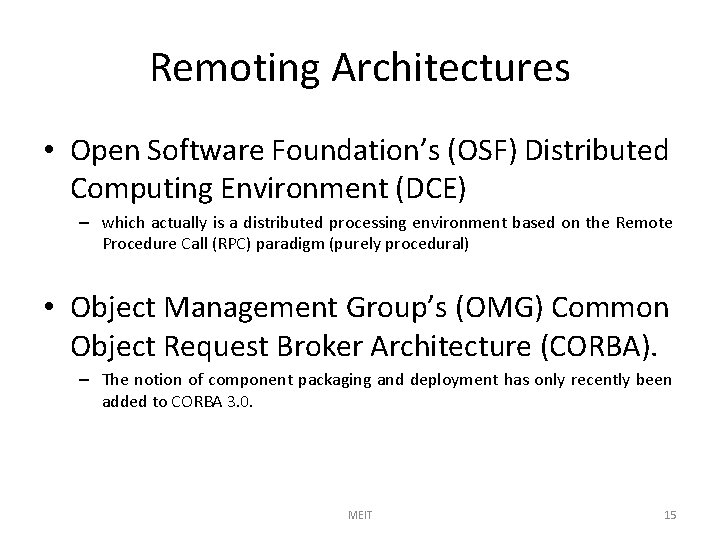
Remoting Architectures • Open Software Foundation’s (OSF) Distributed Computing Environment (DCE) – which actually is a distributed processing environment based on the Remote Procedure Call (RPC) paradigm (purely procedural) • Object Management Group’s (OMG) Common Object Request Broker Architecture (CORBA). – The notion of component packaging and deployment has only recently been added to CORBA 3. 0. MEIT 15
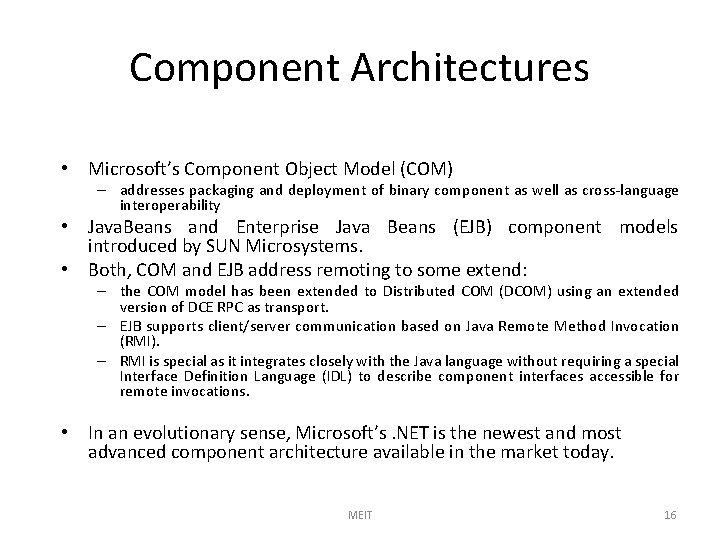
Component Architectures • Microsoft’s Component Object Model (COM) – addresses packaging and deployment of binary component as well as cross-language interoperability • Java. Beans and Enterprise Java Beans (EJB) component models introduced by SUN Microsystems. • Both, COM and EJB address remoting to some extend: – the COM model has been extended to Distributed COM (DCOM) using an extended version of DCE RPC as transport. – EJB supports client/server communication based on Java Remote Method Invocation (RMI). – RMI is special as it integrates closely with the Java language without requiring a special Interface Definition Language (IDL) to describe component interfaces accessible for remote invocations. • In an evolutionary sense, Microsoft’s. NET is the newest and most advanced component architecture available in the market today. MEIT 16
- Slides: 16