
Middleware for Scalable Realtime Multimedia Cyberinfrastructure Journal of
Middleware for Scalable Real-time Multimedia Cyberinfrastructure Journal of Internet Technology Volume 5(2004) No. 4 2005/10/27 sih-han wang Reporter: 1
Outline o o o Introduction Problems and Challenges H. 350 2
Videoconferencing Standard o o o H. 323 the ITU-T signaling standard used in most of today’s commercial video-conferencing systems SIP an IETF approved standard for voice and video communications H. 350 Directory Services Architecture for Multimedia Conferencing 3
Introduction o o Middleware 1. applications to locate people and resources 2. in the form of authentication , authorization Background and Prior Work 1. H. 320 2. directory services important 3. Access Grid (AG) 4
Introduction o Current Standards-Based Multimedia Protocols a. H. 323 1. scalability and security 2. gatekeeper hierarchy b. SIP was designed for AV communication over IP 5
Problems and Challenges o Need for Standardized Directories easily publish their multimedia address so that anyone in the world can find them and place a call. o Multimedia Security Issues and Interoperability between H. 323 and SIP has been established for the basic signaling and media transfers through the use of gateways. o Need for advanced SIP-based Videoconferencing Clients it is based on text messages very much like HTTP and email. 6
H. 350 Directory Services Architecture for Multimedia Conferencing o Lightweight Directory Access Protocol (LDAP) 1. Store all endpoint information in a canonical data source (the Directory) rather than local to the call server. Manage all real-time multimedia devices from this single store, rather than using multiple protocol-specific or vendor-specific data stores. 2. Support multiple instances of endpoints per user or per resource. 3. Represent endpoints that support more than one protocol, for example endpoints that are both H. 320 and H. 323 or endpoints that are both H. 323 and SIP. 4. Store enough information about endpoint configuration so that correct configuration settings can be documented to end users on a per -endpoint basis as a support tool, or loaded automatically into the endpoint. 7
Overview of H. 350 o o Uniform Resource Identifier (URI) H. 350 architecture consists of two core object classes: 1. comm. URIObject 2. comm. Object 8
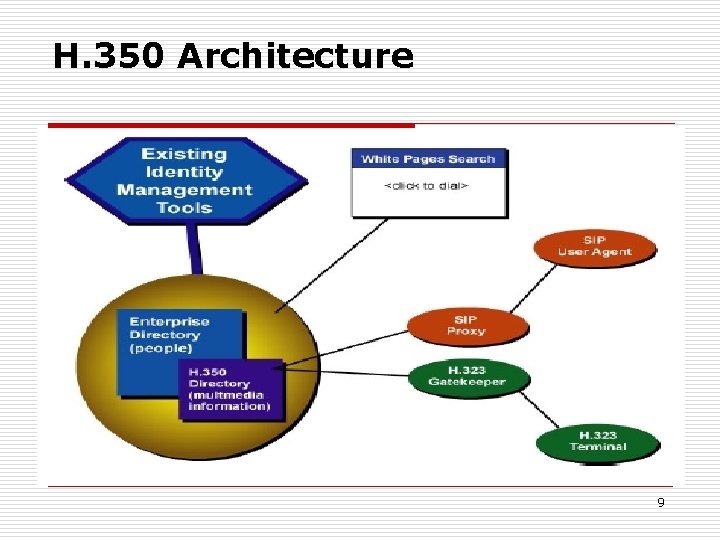
H. 350 Architecture 9
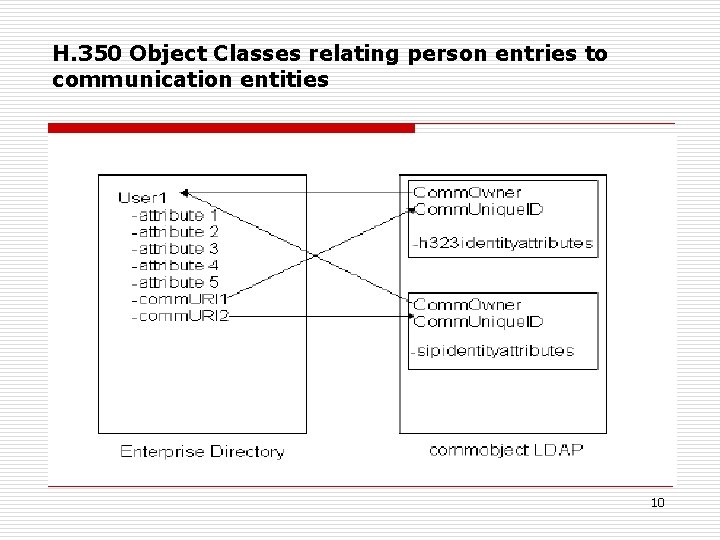
H. 350 Object Classes relating person entries to communication entities 10
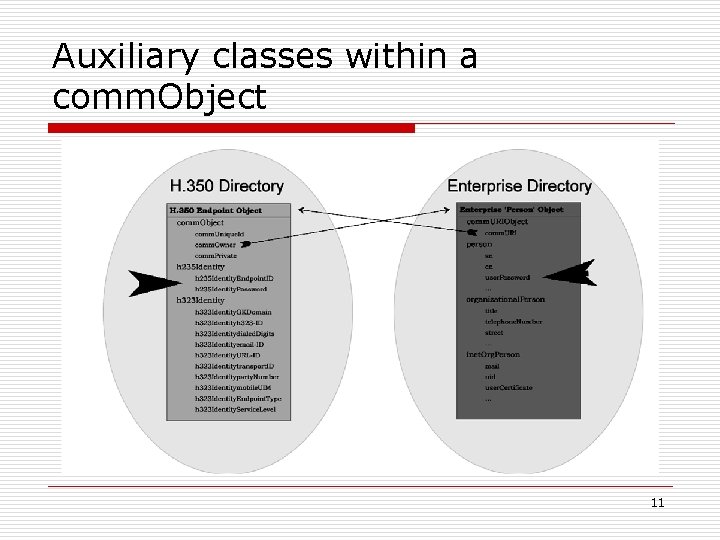
Auxiliary classes within a comm. Object 11
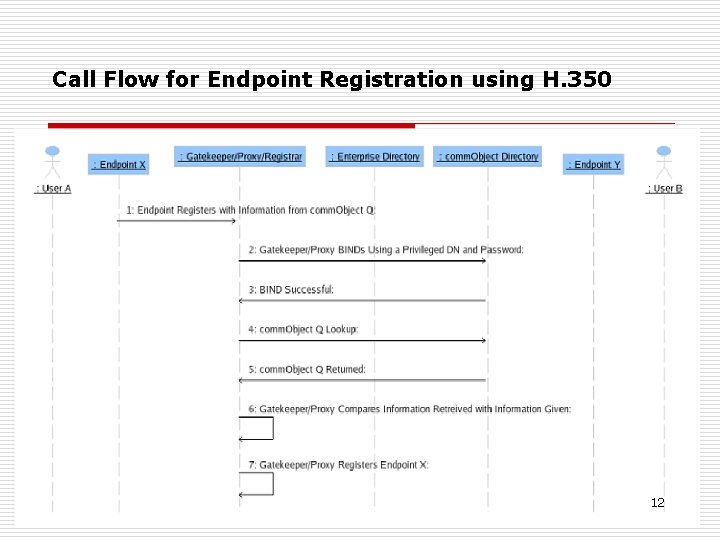
Call Flow for Endpoint Registration using H. 350 12
- Slides: 12