
Middle School Social Studies The Exit Project and
- Slides: 15
Middle School Social Studies The Exit Project and Backward Design: A Blueprint for Understanding
During this session we will: n Explore the DOE goals for Social Studies instruction and their connection to Understanding by Design n Review the 3 stages of Ub. D, differentiated instruction, and their application to the Exit Project n The implications of this work for your Network/ Cohort middle schools
Goals for Social Studies n Letter from the Director of Social Studies n 5/3/1 Activity: What is your most important goal? n How are the goals for Social Studies and Understanding by Design interdependent?
The 3 Stages of Understanding by Design n Stage 1: Identify the Desired Results n Stage 2: Determine Acceptable Evidence n Stage 3: Plan Learning Experiences and Instruction
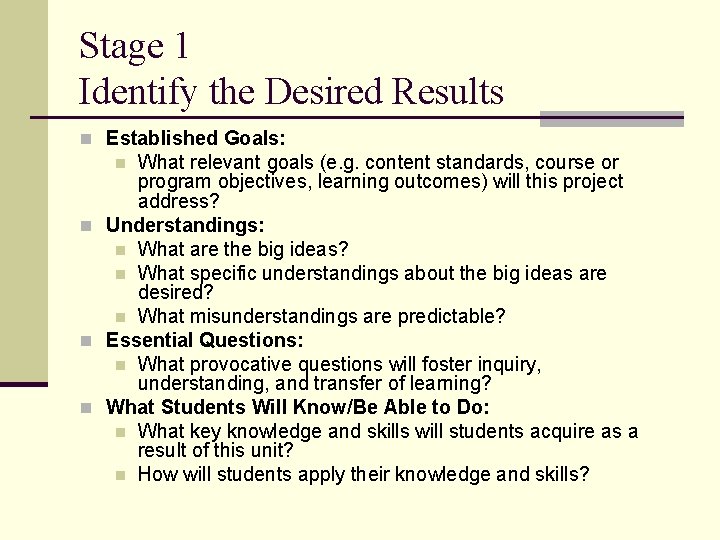
Stage 1 Identify the Desired Results n Established Goals: What relevant goals (e. g. content standards, course or program objectives, learning outcomes) will this project address? n Understandings: n What are the big ideas? n What specific understandings about the big ideas are desired? n What misunderstandings are predictable? n Essential Questions: n What provocative questions will foster inquiry, understanding, and transfer of learning? n What Students Will Know/Be Able to Do: n What key knowledge and skills will students acquire as a result of this unit? n How will students apply their knowledge and skills? n
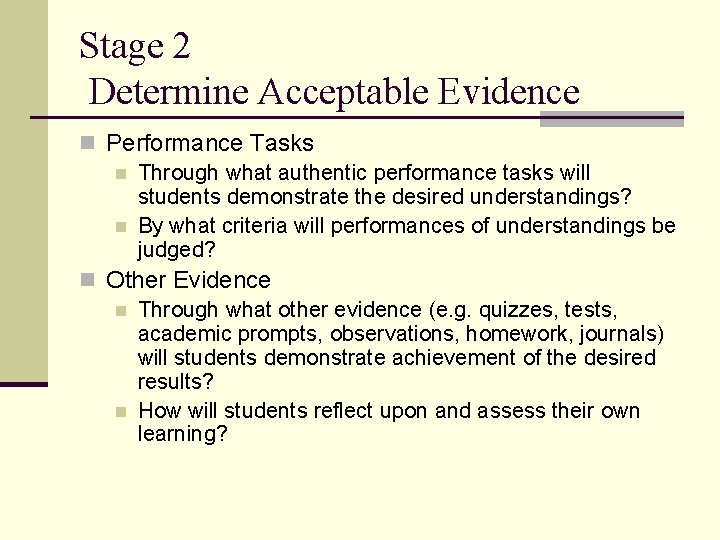
Stage 2 Determine Acceptable Evidence n Performance Tasks n Through what authentic performance tasks will students demonstrate the desired understandings? n By what criteria will performances of understandings be judged? n Other Evidence n Through what other evidence (e. g. quizzes, tests, academic prompts, observations, homework, journals) will students demonstrate achievement of the desired results? n How will students reflect upon and assess their own learning?
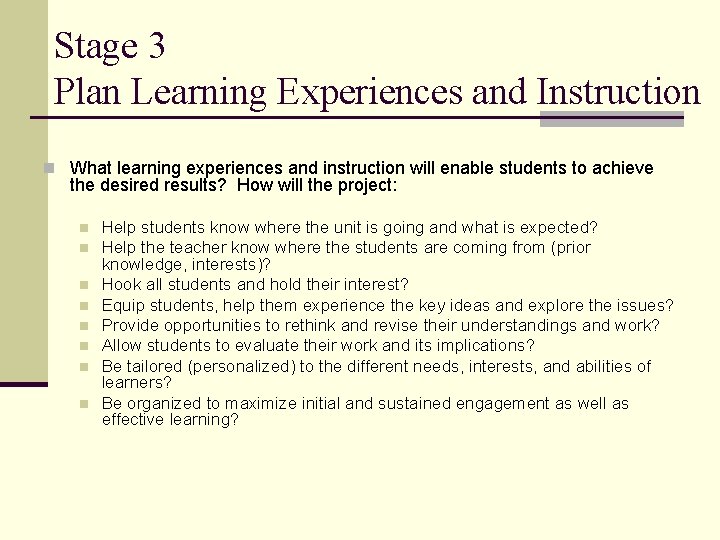
Stage 3 Plan Learning Experiences and Instruction n What learning experiences and instruction will enable students to achieve the desired results? How will the project: n n n n Help students know where the unit is going and what is expected? Help the teacher know where the students are coming from (prior knowledge, interests)? Hook all students and hold their interest? Equip students, help them experience the key ideas and explore the issues? Provide opportunities to rethink and revise their understandings and work? Allow students to evaluate their work and its implications? Be tailored (personalized) to the different needs, interests, and abilities of learners? Be organized to maximize initial and sustained engagement as well as effective learning?
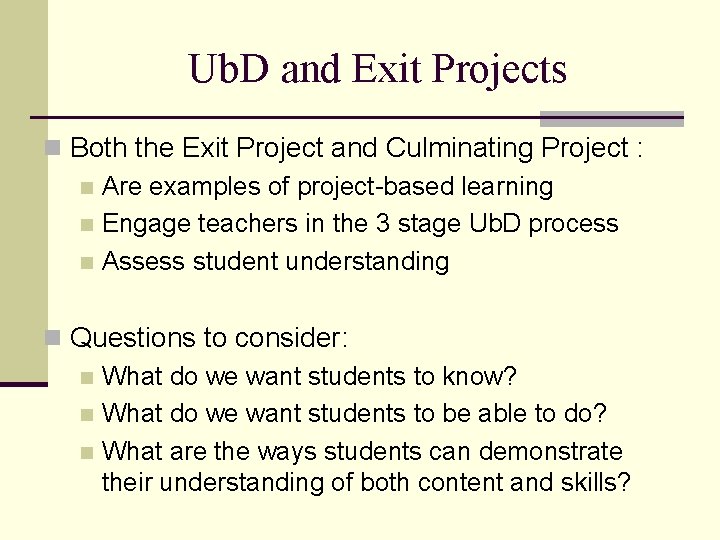
Ub. D and Exit Projects n Both the Exit Project and Culminating Project : n Are examples of project-based learning n Engage teachers in the 3 stage Ub. D process n Assess student understanding n Questions to consider: n What do we want students to know? n What do we want students to be able to do? n What are the ways students can demonstrate their understanding of both content and skills?
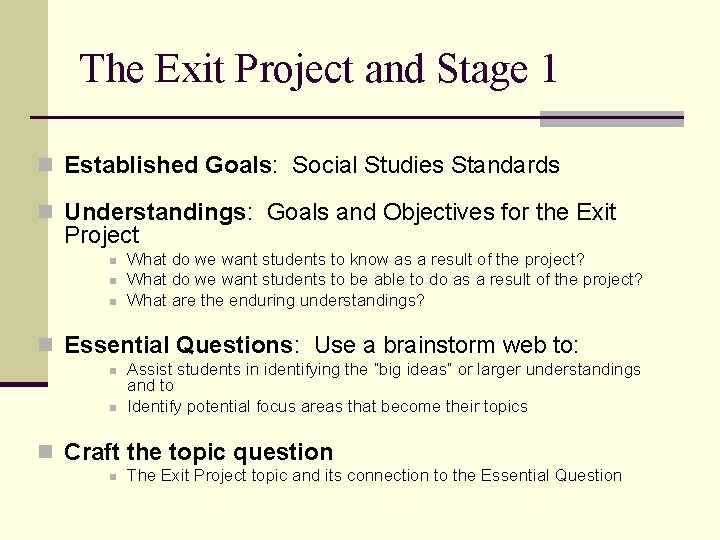
The Exit Project and Stage 1 n Established Goals: Social Studies Standards n Understandings: Goals and Objectives for the Exit Project n n n What do we want students to know as a result of the project? What do we want students to be able to do as a result of the project? What are the enduring understandings? n Essential Questions: Use a brainstorm web to: n n Assist students in identifying the “big ideas” or larger understandings and to Identify potential focus areas that become their topics n Craft the topic question n The Exit Project topic and its connection to the Essential Question
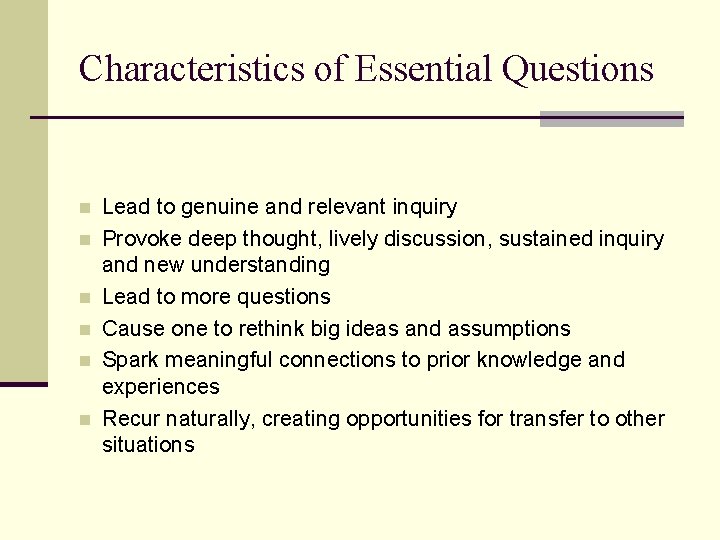
Characteristics of Essential Questions n n n Lead to genuine and relevant inquiry Provoke deep thought, lively discussion, sustained inquiry and new understanding Lead to more questions Cause one to rethink big ideas and assumptions Spark meaningful connections to prior knowledge and experiences Recur naturally, creating opportunities for transfer to other situations
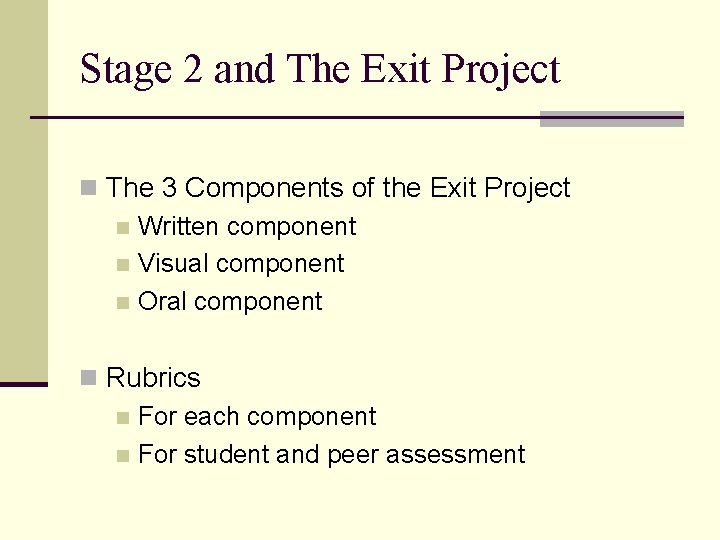
Stage 2 and The Exit Project n The 3 Components of the Exit Project n Written component n Visual component n Oral component n Rubrics n For each component n For student and peer assessment
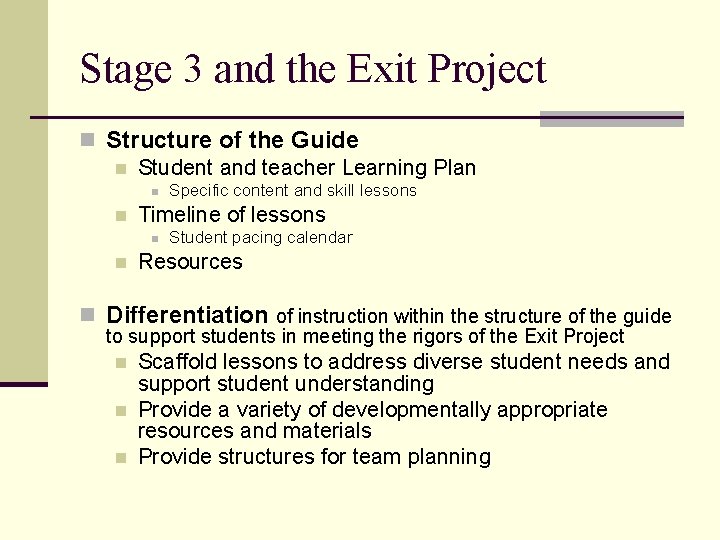
Stage 3 and the Exit Project n Structure of the Guide n Student and teacher Learning Plan n n Timeline of lessons n n Specific content and skill lessons Student pacing calendar Resources n Differentiation of instruction within the structure of the guide to support students in meeting the rigors of the Exit Project n n n Scaffold lessons to address diverse student needs and support student understanding Provide a variety of developmentally appropriate resources and materials Provide structures for team planning
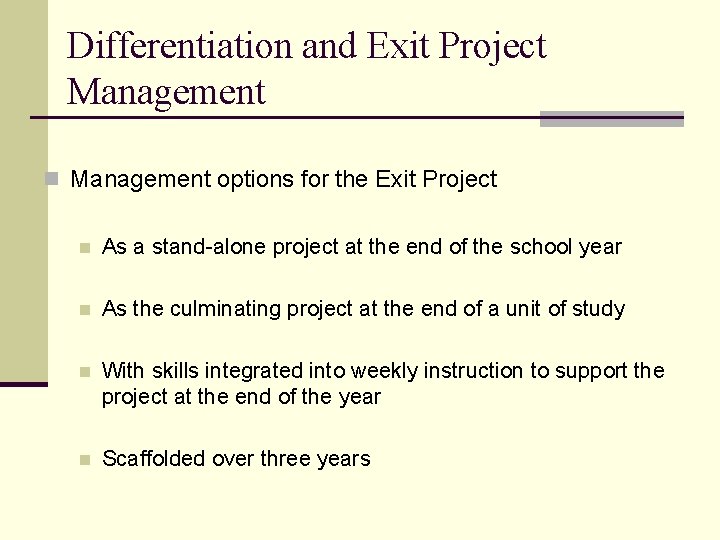
Differentiation and Exit Project Management n Management options for the Exit Project n As a stand-alone project at the end of the school year n As the culminating project at the end of a unit of study n With skills integrated into weekly instruction to support the project at the end of the year n Scaffolded over three years
Next Steps n Implications n Support n Professional Development n Resources
www. socialstudies. org www. nycenet. edu/socialstudies Elise Abegg, Director of Social Studies EAbegg@nycboe. net Lainie Leber, High School Specialist LLeber@nycboe. net Fran Macko, Middle School Specialist FMacko@nycboe. net Kyle S. Haver, Elementary School Specialist Khaver@nycboe. net