
Middle English Dialects Types of Lexical Transfer Loanword
- Slides: 7
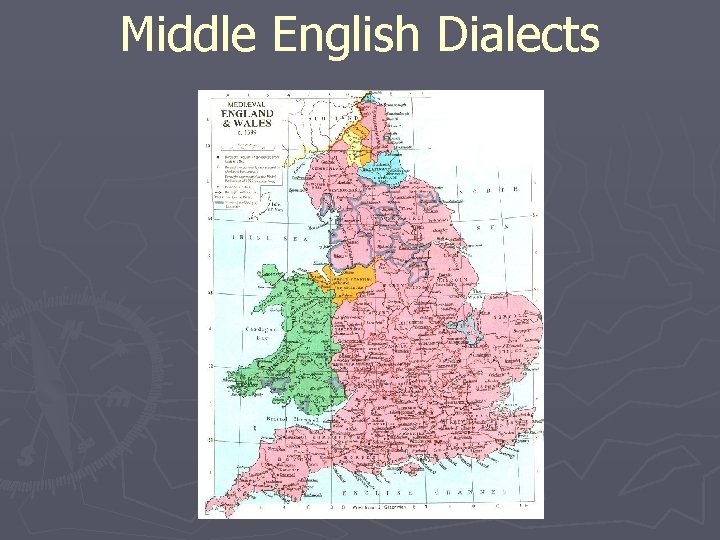
Middle English Dialects
Types of Lexical Transfer Loanword: the incorporation of a lexical item, either through borrowing or imposition, from the source language into the lexicon of the recipient language. (munuc from L. monachus) Loan Translation: elements of the lexical item in the source language are translated into corresponding elements in the recipient language; the form of the source item is not actually transferred. (anhorn from unicornis) Semantic Loan: the form of a lexical item in the recipient language does not change, but it is invested with new meaning derived from the source language. (OE synn [crime, fault] becomes synn as moral or religious transgression)
Rules? ► Ad hoc spelling systems, cf. Orm § But spelling can reveal sound clues, e. g. Scots Highly localized variations on representing sounds, cf. example of Ancrene Riwle/Wisse ► Regional attempts at local standardization, esp. in Worcestershire (southwest Midlands) ► Loo what sholde a man in thyse dayes now wryte. Egges or eyren / certaynly it is harde to playse euery man / by cause of dyuersite & chaunge of langage. For in these dayes euery man that is in ony reputacyon in his countre. Wyll vtter his commynycacyon and maters in suche maners & termes / that fewe men shall vnderstonde theym.
Shaping Moments ► Worcestershire texts of 13 th Century ► Many 14 th-C stimuli to write, esp. religious texts ► 1362 Statute of Pleading § Gave legitimacy to English as professional and literary ► Wycliffe and “Central Midlands Standard” § Lollards aimed at democratization or religion § Wycliffe from Central Midlands ► Henry V and “Chancery Standard” § English nationalism expressed in language, 1417 ff.
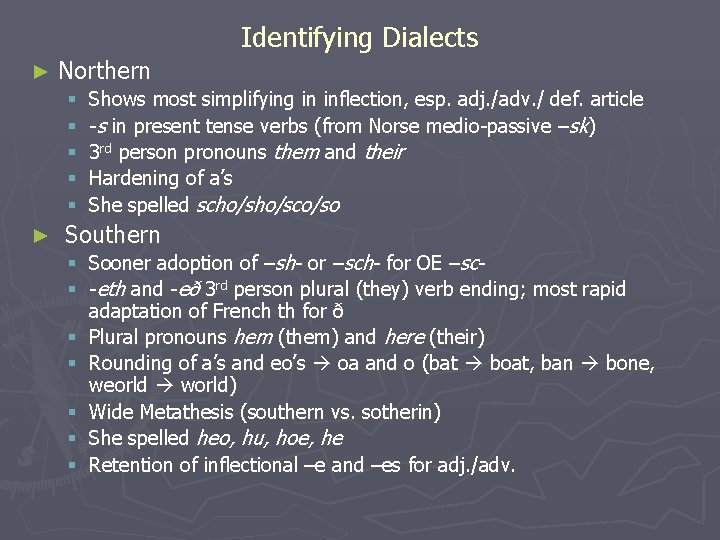
Identifying Dialects ► Northern § § § ► Shows most simplifying in inflection, esp. adj. /adv. / def. article -s in present tense verbs (from Norse medio-passive –sk) 3 rd person pronouns them and their Hardening of a’s She spelled scho/sco/so Southern § Sooner adoption of –sh- or –sch- for OE –sc§ -eth and -eð 3 rd person plural (they) verb ending; most rapid adaptation of French th for ð § Plural pronouns hem (them) and here (their) § Rounding of a’s and eo’s oa and o (bat boat, ban bone, weorld world) § Wide Metathesis (southern vs. sotherin) § She spelled heo, hu, hoe, he § Retention of inflectional –e and –es for adj. /adv.
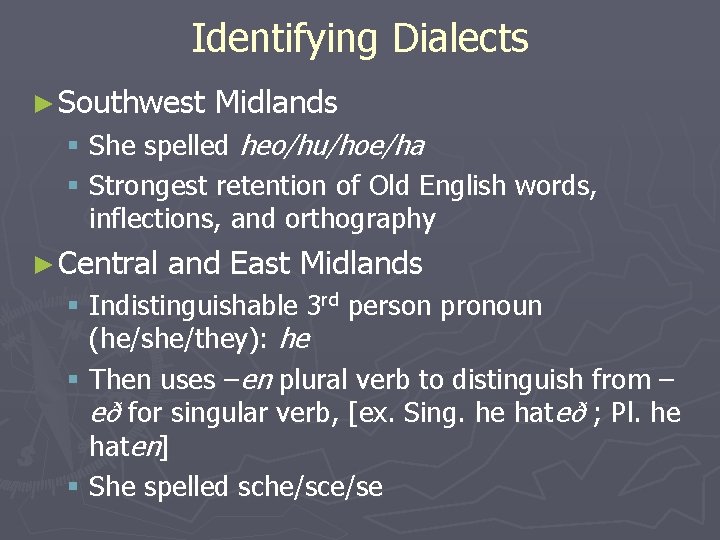
Identifying Dialects ► Southwest Midlands § She spelled heo/hu/hoe/ha § Strongest retention of Old English words, inflections, and orthography ► Central and East Midlands § Indistinguishable 3 rd person pronoun (he/she/they): he § Then uses –en plural verb to distinguish from – eð for singular verb, [ex. Sing. he hateð ; Pl. he haten] § She spelled sche/sce/se
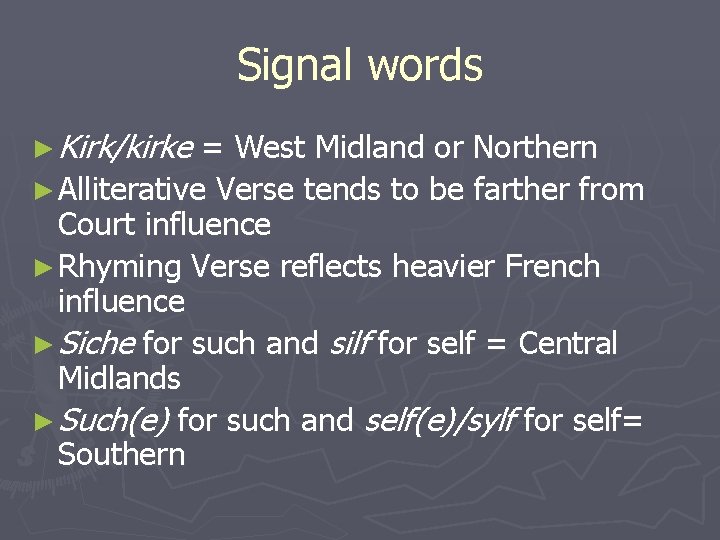
Signal words ► Kirk/kirke = West Midland or Northern ► Alliterative Verse tends to be farther from Court influence ► Rhyming Verse reflects heavier French influence ► Siche for such and silf for self = Central Midlands ► Such(e) for such and self(e)/sylf for self= Southern