
Middle East Review General Information The Middle East



- Slides: 28
Middle East Review
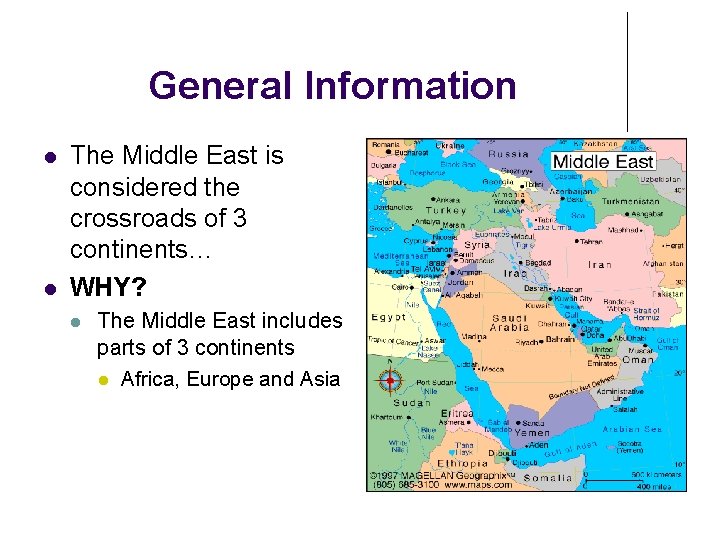
General Information The Middle East is considered the crossroads of 3 continents… WHY? The Middle East includes parts of 3 continents Africa, Europe and Asia
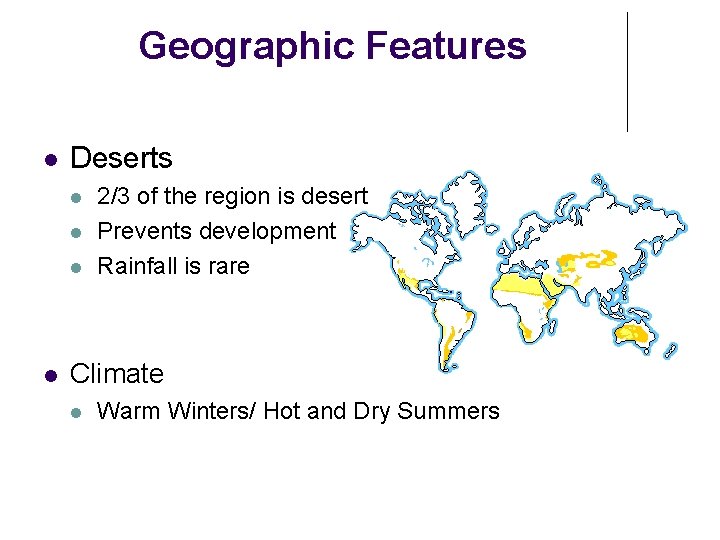
Geographic Features Deserts 2/3 of the region is desert Prevents development Rainfall is rare Climate Warm Winters/ Hot and Dry Summers
Geographic Features Oil ½ of the world’s supply World’s most used energy resource People/nations need to maintain good/strong relationships Water Supply (lack of) Less than 10% of the land receives enough water to make farming possible
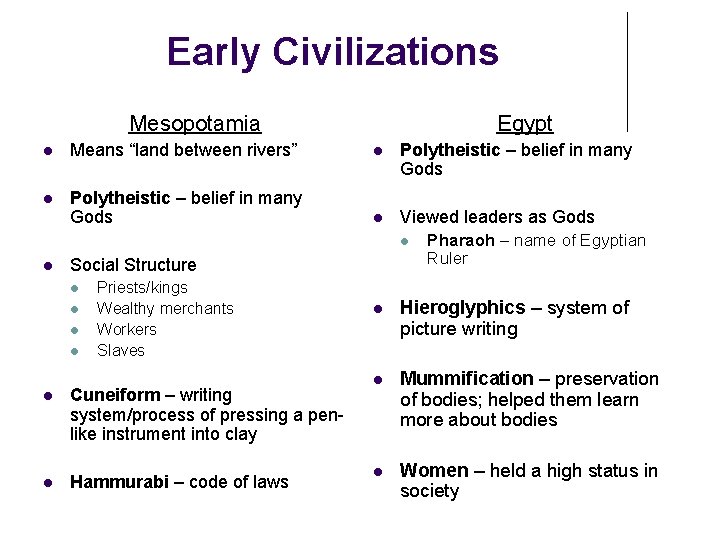
Early Civilizations Mesopotamia Egypt Means “land between rivers” Polytheistic – belief in many Gods Viewed leaders as Gods Social Structure Priests/kings Wealthy merchants Workers Slaves Cuneiform – writing system/process of pressing a penlike instrument into clay Hammurabi – code of laws Pharaoh – name of Egyptian Ruler Hieroglyphics – system of picture writing Mummification – preservation of bodies; helped them learn more about bodies Women – held a high status in society
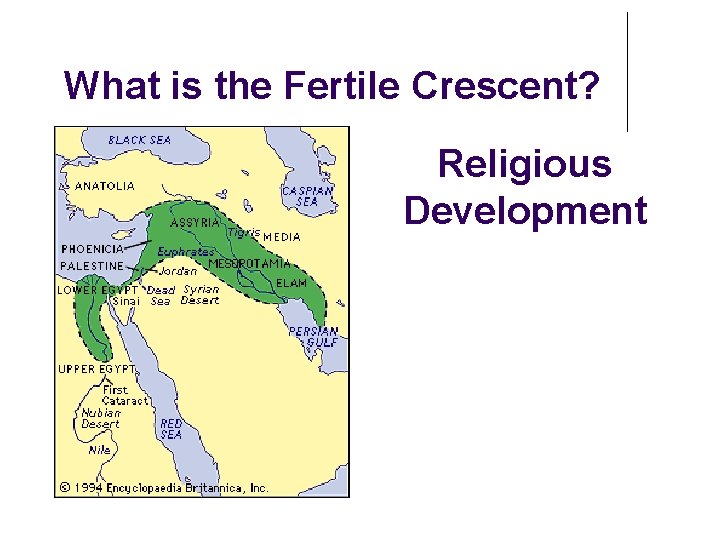
What is the Fertile Crescent? Religious Development
Religious Development In the Middle East, 3 Great World Religions Developed: Judaism, Christianity, & Islam JUDAISM
Religious Development: Christianity
Religious Development: Islam The Five Pillars of Islam
Key People and Beliefs
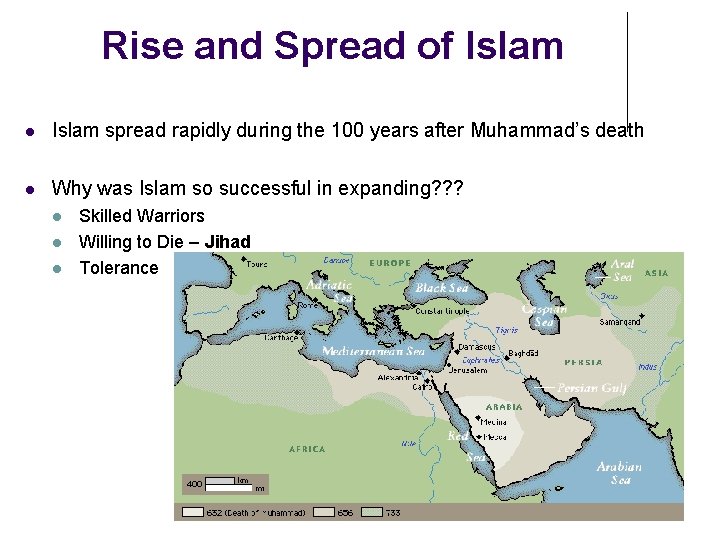
Rise and Spread of Islam spread rapidly during the 100 years after Muhammad’s death Why was Islam so successful in expanding? ? ? Skilled Warriors Willing to Die – Jihad Tolerance
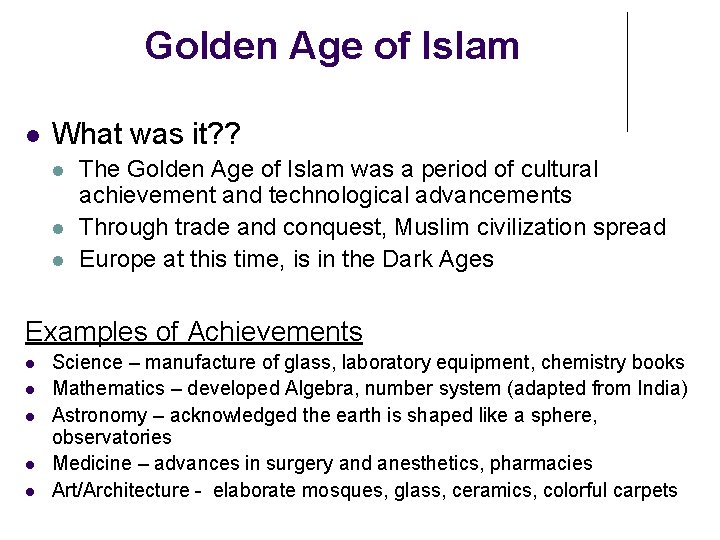
Golden Age of Islam What was it? ? The Golden Age of Islam was a period of cultural achievement and technological advancements Through trade and conquest, Muslim civilization spread Europe at this time, is in the Dark Ages Examples of Achievements Science – manufacture of glass, laboratory equipment, chemistry books Mathematics – developed Algebra, number system (adapted from India) Astronomy – acknowledged the earth is shaped like a sphere, observatories Medicine – advances in surgery and anesthetics, pharmacies Art/Architecture - elaborate mosques, glass, ceramics, colorful carpets
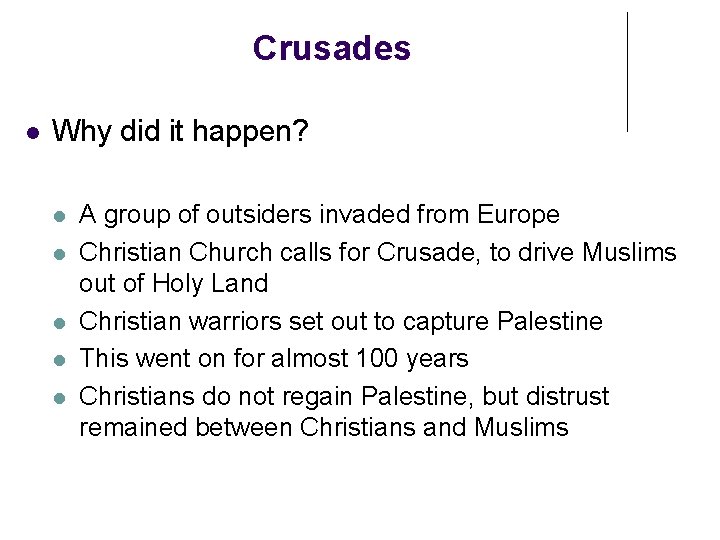
Crusades Why did it happen? A group of outsiders invaded from Europe Christian Church calls for Crusade, to drive Muslims out of Holy Land Christian warriors set out to capture Palestine This went on for almost 100 years Christians do not regain Palestine, but distrust remained between Christians and Muslims
Rise of the Ottoman Empire The Ottoman Empire became a major world power by conquering Constantinople, the capital of the Byzantine Empire The Ottomans blended Byzantine culture with Muslim culture The Ottoman Empire reached its height under Suleiman Who is Suleiman? What happened under his leadership? Improved justice system Modernized army Added to the size of his empire (spread into Africa and Europe) Great architecture Cultural achievements (art, literature, poetry, painting)
Fall of the Ottoman Empire The Ottoman Empire collapsed at the end of World War I The Ottomans had sided with Germany (Germany lost) What caused the collapse? ? ? Poor leadership/Government was corrupt European Advances – technologically & economically
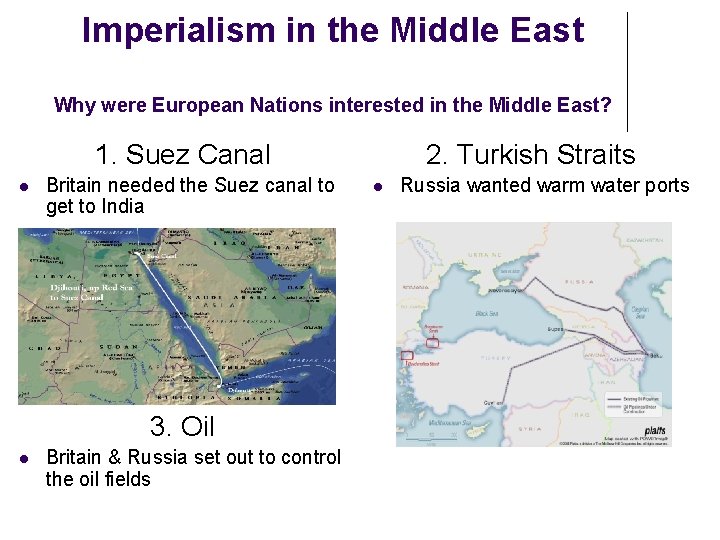
Imperialism in the Middle East Why were European Nations interested in the Middle East? 1. Suez Canal Britain needed the Suez canal to get to India 3. Oil Britain & Russia set out to control the oil fields 2. Turkish Straits Russia wanted warm water ports
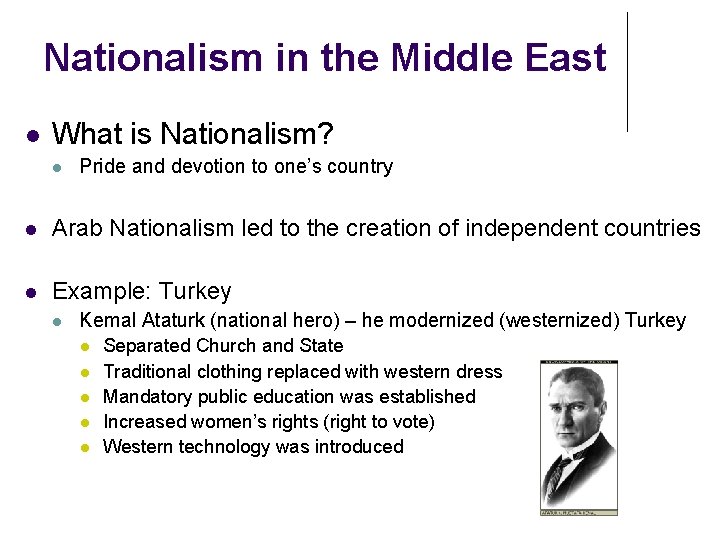
Nationalism in the Middle East What is Nationalism? Pride and devotion to one’s country Arab Nationalism led to the creation of independent countries Example: Turkey Kemal Ataturk (national hero) – he modernized (westernized) Turkey Separated Church and State Traditional clothing replaced with western dress Mandatory public education was established Increased women’s rights (right to vote) Western technology was introduced
Islamic Fundamentalism What are Fundamentals? Islamic Fundamentalism – Muslim movement against westernization that supports a return to the values of the Koran (Quran) What group of people were most affected by this movement? Women – lost rights, going back to traditional roles
Iranian Revolution (Best Example of Islamic Fundamentalism) Who is Ayatollah Khomeini? 1979 – Becomes Iran’s New Leader Religious Dictatorship Government ran according to strict Islamic Law Effects Hostility towards the West (books, music, movies were banned) Strict adherence to Muslim religious traditions Encouraged other Islamic countries to change Women lose rights
Iran/ Iraq War Iran’s neighbor, Iraq was concerned over the Iranian Revolution Iran – Khomeini 1. 90% Shiite Muslims 2. 10% Sunni Muslims 3. mostly Persian ethnicity Iraq – Saddam Hussein 1. ~60% Shiite Muslims 2. ~35% Sunni Muslims 3. Arab ethnicity 1980 – War broke out over border dispute – Iraq invaded Iran The war caused great loss of life and property Lasted until 1988 (cease fire)/ no clear winner U. S. assisted Saddam/Iraq with weapons technology
Israel Diaspora – dispersion of Jews from homeland around the world Zionism / Theodore Herzl – movement and leader for a Jewish state in Palestine Balfour Declaration – 1917 British document supporting a Jewish state _________________________________________ Why did so many nations support the formation of Jewish homeland? They felt sympathetic due to the treatment of the Jews by the Nazi’s during WWII (Holocaust)
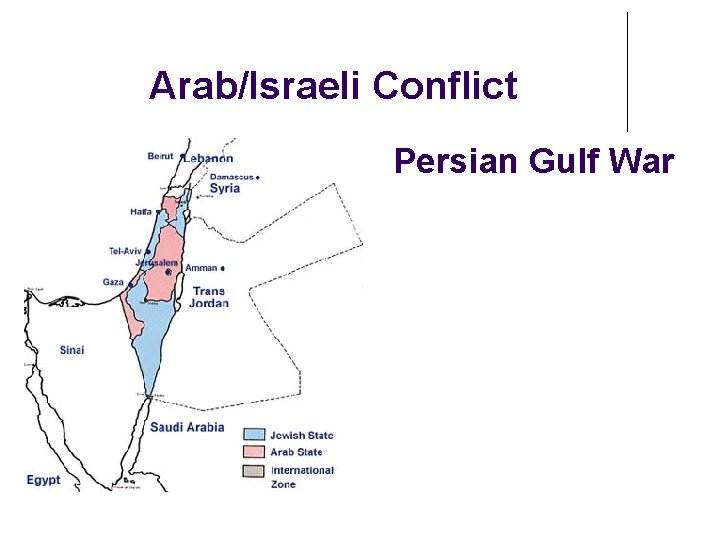
Arab/Israeli Conflict Persian Gulf War
Persian Gulf War 1990 – Iraq invades Kuwait WHY? Why would the U. S and other world leaders be concerned with this invasion? Iraq wanted to take control of Kuwait’s oil fields Saddam Hussein was the leader in Iraq Many countries depend on Kuwait for their oil supply January 16, 1991 – UN and American troops attacked and quickly drove Iraq out of Kuwait Despite defeat – Saddam remained in power
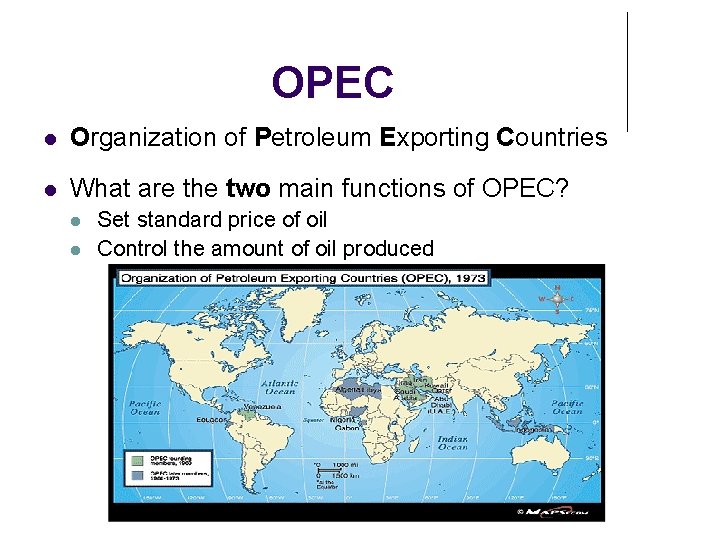
OPEC Organization of Petroleum Exporting Countries What are the two main functions of OPEC? Set standard price of oil Control the amount of oil produced
“War on Terror” What happened on September 11, 2001? Who was the leader and group behind these attacks? 4 US commercial plans were hijacked and crashed into the World Trade Center Towers, the Pentagon, and one crashed Osama bin Laden – al-Qaeda (international extremist Islamic terrorist group) What is the link to Afghanistan? The Taliban, Afghanistan's Islamic fundamentalist government, was targeted for removal by the United States after 9/11 because they allowed al-Qaeda terrorists to live and train in their country; U. S troops remain there today to keep the Taliban from regaining power
Iraq & the “War on Terror” Iraq also becomes a target – WHY? Iraq's dictator, Saddam Hussein, was believed to have weapons of mass destruction (WMD's); U. S. fears he would give them to terrorists Saddam refused to cooperate with UN weapons inspectors U. S. and Great Britain invade and remove Saddam from power Saddam Hussein captured, tried, executed for crimes against humanity No WMD's ever found; U. S. and British governments heavily criticized for war decisions and planning; U. S. Troops remain in Iraq to keep the peace between groups fighting for control while Iraq tries to establish democracy
Social Issues - Today Modernization and westernization vs. traditional Muslim values Some women expected to be subordinate, but urbanization and modernization creating tensions Women can now vote in all Middle Eastern nations except Saudi Arabia (monarchy) Many Muslim nations accept western technology, but not values and culture
Social Issues - Today Nuclear proliferation still an issue Def: the use of nuclear energy and proliferation, or spread, of nuclear weapons Iran working on nuclear program, issued threats against Israel Border disputes continue between Israel and neighbors