
Middle East Map Europe 33 Black Sea 21
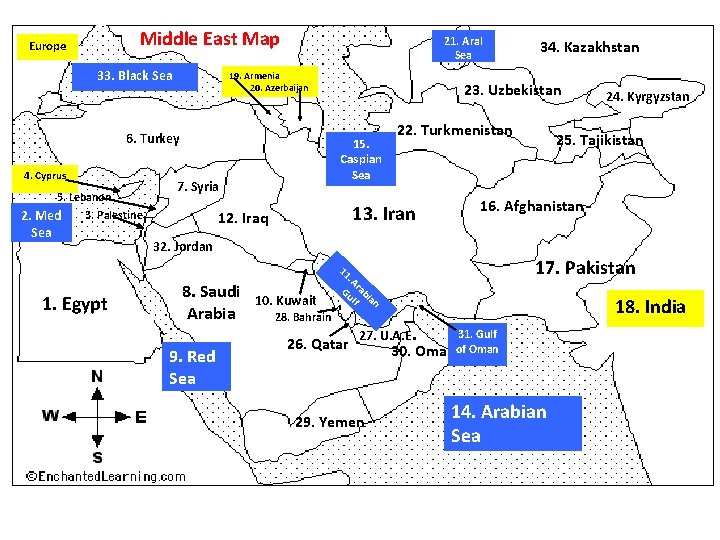
Middle East Map Europe 33. Black Sea 21. Aral Sea 19. Armenia 20. Azerbaijan 6. Turkey 4. Cyprus 5. Lebanon 3. Palestine 2. Med Sea 23. Uzbekistan 15. Caspian Sea 7. Syria 22. Turkmenistan 13. Iran 12. Iraq 24. Kyrgyzstan 25. Tajikistan 16. Afghanistan 32. Jordan 17. Pakistan 11 1. Egypt 34. Kazakhstan 8. Saudi Arabia 9. Red Sea . A 10. Kuwait Gu rab lf ian 28. Bahrain 26. Qatar 18. India 27. U. A. E. 29. Yemen 30. 31. Gulf Oman of Oman 14. Arabian Sea
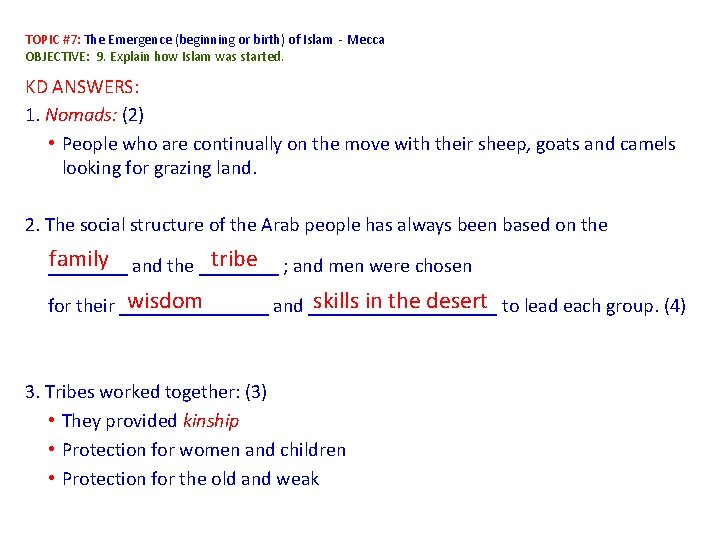
TOPIC #7: The Emergence (beginning or birth) of Islam - Mecca OBJECTIVE: 9. Explain how Islam was started. KD ANSWERS: 1. Nomads: (2) • People who are continually on the move with their sheep, goats and camels looking for grazing land. 2. The social structure of the Arab people has always been based on the family tribe ____ and the ____ ; and men were chosen wisdom skills in the desert for their ________ and __________ to lead each group. (4) 3. Tribes worked together: (3) • They provided kinship • Protection for women and children • Protection for the old and weak
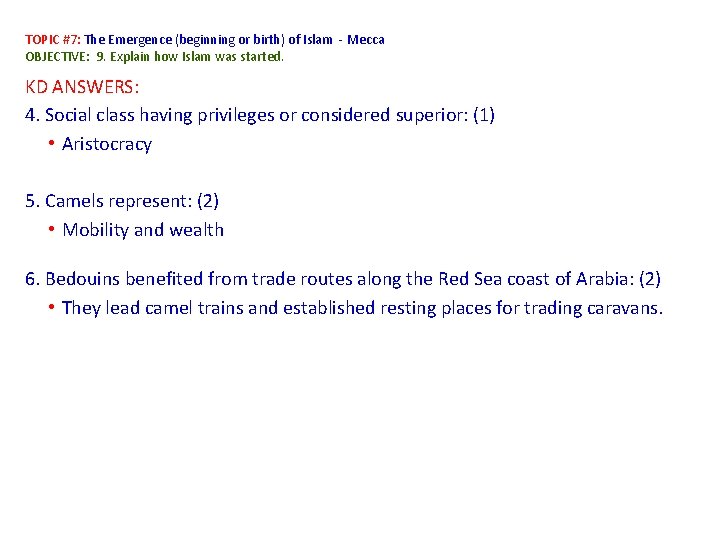
TOPIC #7: The Emergence (beginning or birth) of Islam - Mecca OBJECTIVE: 9. Explain how Islam was started. KD ANSWERS: 4. Social class having privileges or considered superior: (1) • Aristocracy 5. Camels represent: (2) • Mobility and wealth 6. Bedouins benefited from trade routes along the Red Sea coast of Arabia: (2) • They lead camel trains and established resting places for trading caravans.
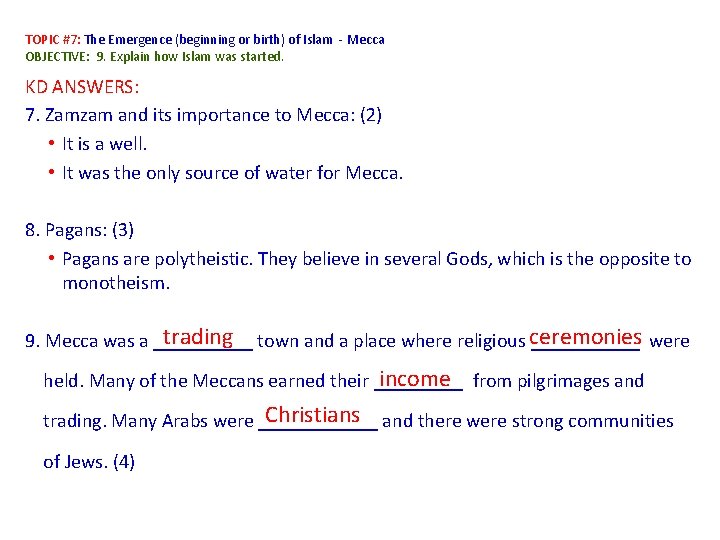
TOPIC #7: The Emergence (beginning or birth) of Islam - Mecca OBJECTIVE: 9. Explain how Islam was started. KD ANSWERS: 7. Zamzam and its importance to Mecca: (2) • It is a well. • It was the only source of water for Mecca. 8. Pagans: (3) • Pagans are polytheistic. They believe in several Gods, which is the opposite to monotheism. trading ceremonies 9. Mecca was a _____ town and a place where religious ______ were income held. Many of the Meccans earned their _____ from pilgrimages and Christians trading. Many Arabs were ______ and there were strong communities of Jews. (4)
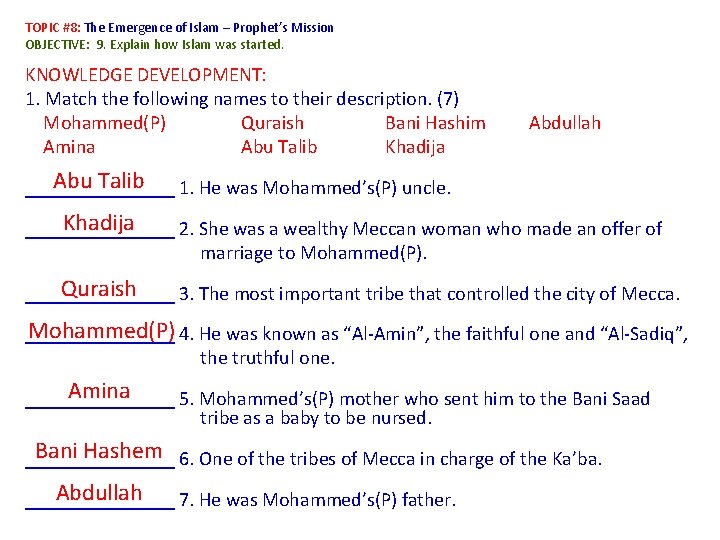
TOPIC #8: The Emergence of Islam – Prophet’s Mission OBJECTIVE: 9. Explain how Islam was started. KNOWLEDGE DEVELOPMENT: 1. Match the following names to their description. (7) Mohammed(P) Quraish Bani Hashim Amina Abu Talib Khadija Abdullah Abu Talib ________ 1. He was Mohammed’s(P) uncle. Khadija ________ 2. She was a wealthy Meccan woman who made an offer of marriage to Mohammed(P). Quraish ________ 3. The most important tribe that controlled the city of Mecca. Mohammed(P) ________ 4. He was known as “Al-Amin”, the faithful one and “Al-Sadiq”, the truthful one. Amina ________ 5. Mohammed’s(P) mother who sent him to the Bani Saad tribe as a baby to be nursed. Bani Hashem ________ 6. One of the tribes of Mecca in charge of the Ka’ba. Abdullah ________ 7. He was Mohammed’s(P) father.

TOPIC #8: The Emergence of Islam – Prophet’s Mission OBJECTIVE: 9. Explain how Islam was started. KD ANSWERS: 1. Concerns Mohammed (P) developed: (4) • Decline in morals (honesty), greed, selfishness, ill-treatment of women and girls, drunkenness, gambling and lack of religion 2. Mohammed ‘s(P) spare (extra) time: (2) • Meditating in the Hira Cave and the mountains surrounding Mecca.
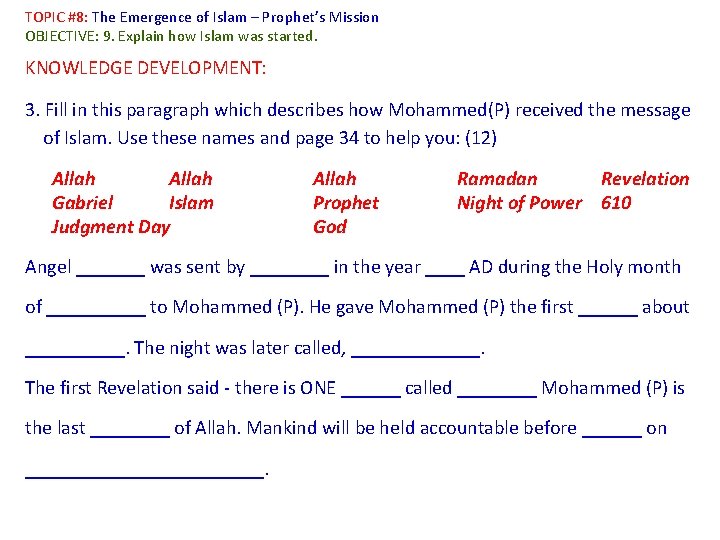
TOPIC #8: The Emergence of Islam – Prophet’s Mission OBJECTIVE: 9. Explain how Islam was started. KNOWLEDGE DEVELOPMENT: 3. Fill in this paragraph which describes how Mohammed(P) received the message of Islam. Use these names and page 34 to help you: (12) Allah Gabriel Islam Judgment Day Allah Prophet God Ramadan Revelation Night of Power 610 Angel _______ was sent by ____ in the year ____ AD during the Holy month of _____ to Mohammed (P). He gave Mohammed (P) the first ______ about _____. The night was later called, _______. The first Revelation said - there is ONE ______ called ____ Mohammed (P) is the last ____ of Allah. Mankind will be held accountable before ______ on ____________.
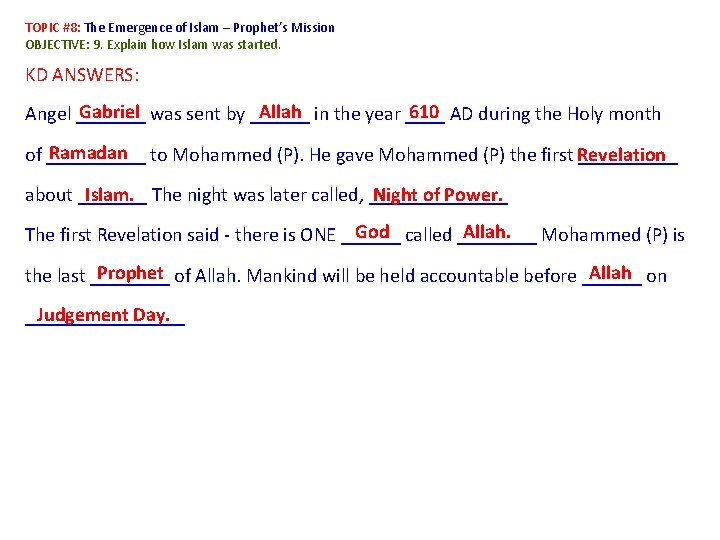
TOPIC #8: The Emergence of Islam – Prophet’s Mission OBJECTIVE: 9. Explain how Islam was started. KD ANSWERS: Gabriel Allah 610 Angel _______ was sent by ______ in the year ____ AD during the Holy month Ramadan of _____ to Mohammed (P). He gave Mohammed (P) the first _____ Revelation Islam. Night of Power. about _______ The night was later called, _______ God Allah. The first Revelation said - there is ONE ______ called ____ Mohammed (P) is Prophet Allah the last ____ of Allah. Mankind will be held accountable before ______ on Judgement Day. ________
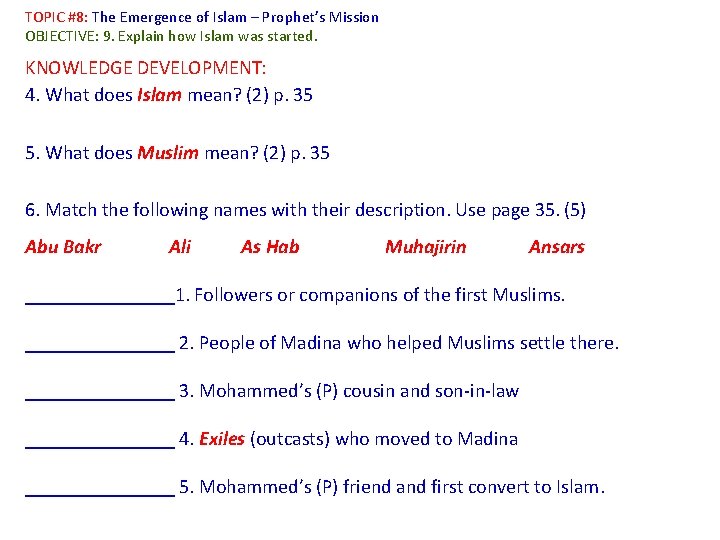
TOPIC #8: The Emergence of Islam – Prophet’s Mission OBJECTIVE: 9. Explain how Islam was started. KNOWLEDGE DEVELOPMENT: 4. What does Islam mean? (2) p. 35 5. What does Muslim mean? (2) p. 35 6. Match the following names with their description. Use page 35. (5) Abu Bakr Ali As Hab Muhajirin Ansars ________1. Followers or companions of the first Muslims. ________ 2. People of Madina who helped Muslims settle there. ________ 3. Mohammed’s (P) cousin and son-in-law ________ 4. Exiles (outcasts) who moved to Madina ________ 5. Mohammed’s (P) friend and first convert to Islam.
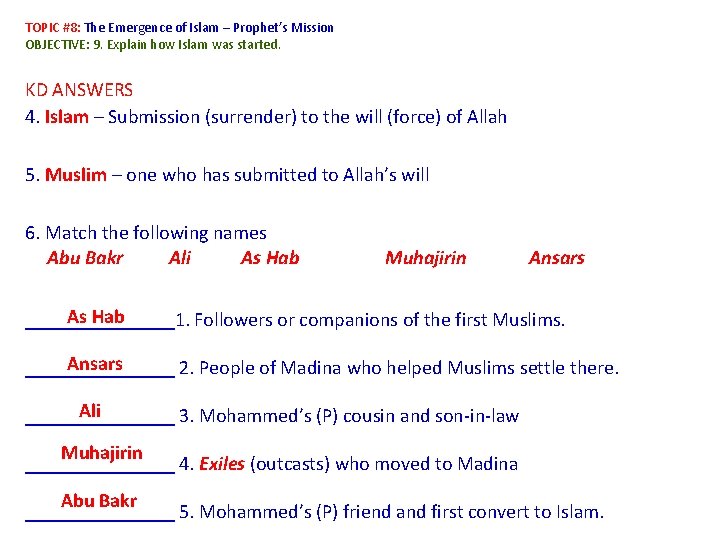
TOPIC #8: The Emergence of Islam – Prophet’s Mission OBJECTIVE: 9. Explain how Islam was started. KD ANSWERS 4. Islam – Submission (surrender) to the will (force) of Allah 5. Muslim – one who has submitted to Allah’s will 6. Match the following names Abu Bakr Ali As Hab Muhajirin Ansars As Hab ________1. Followers or companions of the first Muslims. Ansars ________ 2. People of Madina who helped Muslims settle there. Ali ________ 3. Mohammed’s (P) cousin and son-in-law Muhajirin ________ 4. Exiles (outcasts) who moved to Madina Abu Bakr ________ 5. Mohammed’s (P) friend and first convert to Islam.
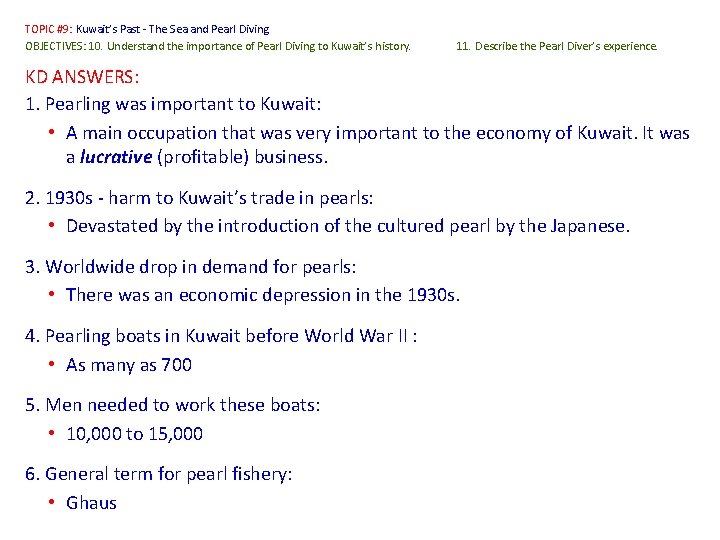
TOPIC #9: Kuwait’s Past - The Sea and Pearl Diving OBJECTIVES: 10. Understand the importance of Pearl Diving to Kuwait’s history. 11. Describe the Pearl Diver’s experience. KD ANSWERS: 1. Pearling was important to Kuwait: • A main occupation that was very important to the economy of Kuwait. It was a lucrative (profitable) business. 2. 1930 s - harm to Kuwait’s trade in pearls: • Devastated by the introduction of the cultured pearl by the Japanese. 3. Worldwide drop in demand for pearls: • There was an economic depression in the 1930 s. 4. Pearling boats in Kuwait before World War II : • As many as 700 5. Men needed to work these boats: • 10, 000 to 15, 000 6. General term for pearl fishery: • Ghaus
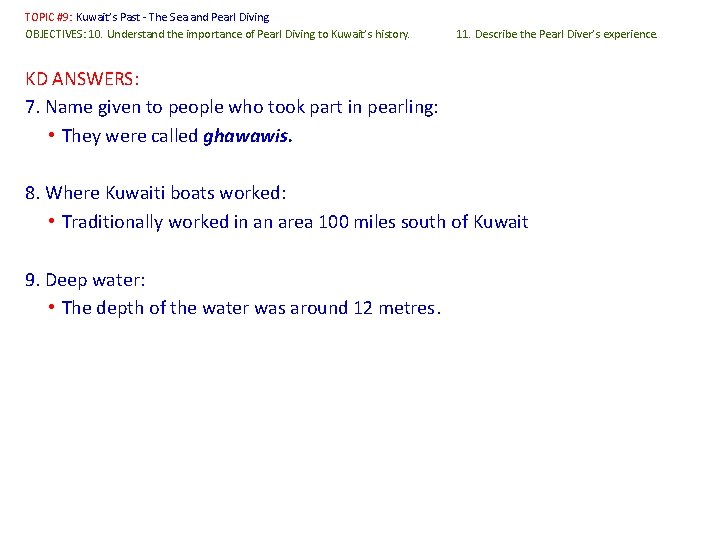
TOPIC #9: Kuwait’s Past - The Sea and Pearl Diving OBJECTIVES: 10. Understand the importance of Pearl Diving to Kuwait’s history. 11. Describe the Pearl Diver’s experience. KD ANSWERS: 7. Name given to people who took part in pearling: • They were called ghawawis. 8. Where Kuwaiti boats worked: • Traditionally worked in an area 100 miles south of Kuwait 9. Deep water: • The depth of the water was around 12 metres.
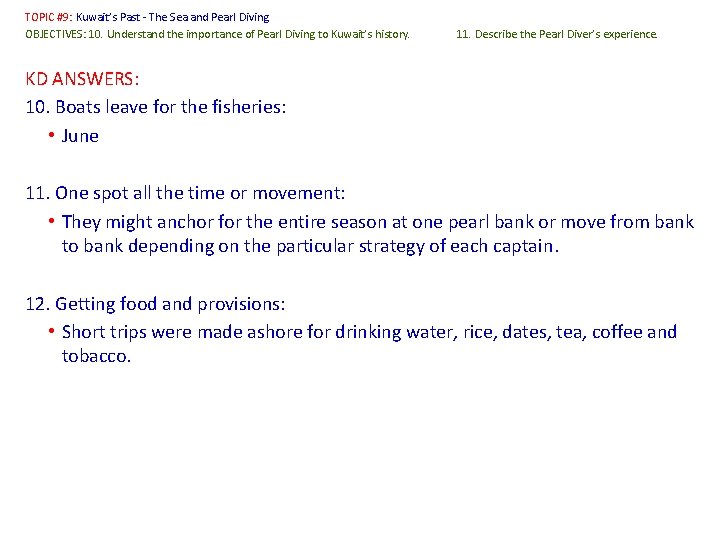
TOPIC #9: Kuwait’s Past - The Sea and Pearl Diving OBJECTIVES: 10. Understand the importance of Pearl Diving to Kuwait’s history. 11. Describe the Pearl Diver’s experience. KD ANSWERS: 10. Boats leave for the fisheries: • June 11. One spot all the time or movement: • They might anchor for the entire season at one pearl bank or move from bank to bank depending on the particular strategy of each captain. 12. Getting food and provisions: • Short trips were made ashore for drinking water, rice, dates, tea, coffee and tobacco.
TOPIC #9: Kuwait’s Past - The Sea and Pearl Diving OBJECTIVES: 10. Understand the importance of Pearl Diving to Kuwait’s history. 11. Describe the Pearl Diver’s experience. KD ANSWERS: 13. Average crew of a pearling vessel: • Was 18 -20 men: 8 divers, 10 haulers (siyub) and a young apprentice boy, who fished, cooked, cleaned and made coffee and tea. 14. Diver’s day - from breakfast to night-time: • Diving commenced one hour after sunrise, after the divers had a light breakfast of dates. The divers worked until one hour before sunset except for prayers, coffee or tea and a short rest at midday. • • Diving - one hour after sunrise Light breakfast of dates Worked until one hour before sunset. Took breaks for prayers, coffee or tea and a short rest at midday.
TOPIC #9: Kuwait’s Past - The Sea and Pearl Diving OBJECTIVES: 10. Understand the importance of Pearl Diving to Kuwait’s history. 11. Describe the Pearl Diver’s experience. KD ANSWERS: 15. Diver worked (mention information about nose, ears, diving and fingers): • His nose was pegged with clips of turtle shell or wood and ears plugged with wax. • He was dropped to the bottom with the aid of a stone attached to his foot. This was pulled up later by his attendant hauler on board ship. • His fingers were protected by leather caps. • The diver quickly filled an attached basket with as many shells as possible while his breath lasted, signaling by a tug on his rope that he needed to be hauled to the surface. • Upon reaching the surface, his basket was emptied into the communal heap on deck and he descended into the deep again.
TOPIC #9: Kuwait’s Past - The Sea and Pearl Diving OBJECTIVES: 10. Understand the importance of Pearl Diving to Kuwait’s history. 11. Describe the Pearl Diver’s experience. KD ANSWERS: 16. Main comfort for the crew: • Singing was the main source of comfort for the crew, helping them to bear the rigours of life on board, compounded by long and painful separation from their families. 17. Oysters opened: • The pile of oysters were not opened until the following morning under the watchful eye of the captain.
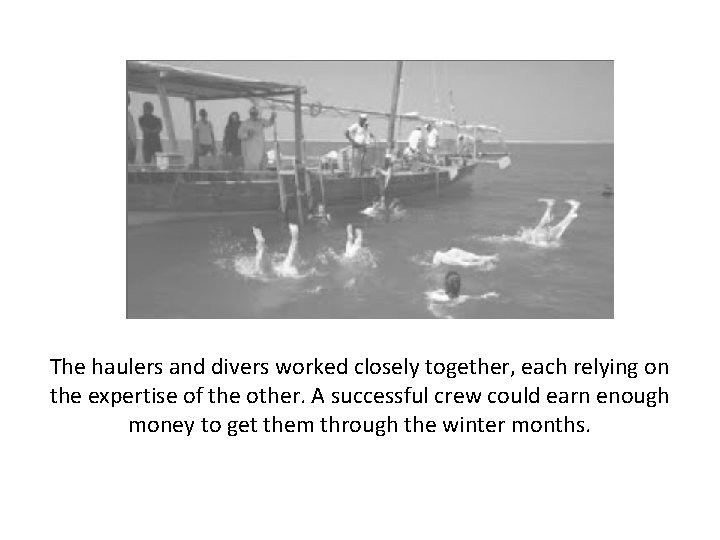
The haulers and divers worked closely together, each relying on the expertise of the other. A successful crew could earn enough money to get them through the winter months.
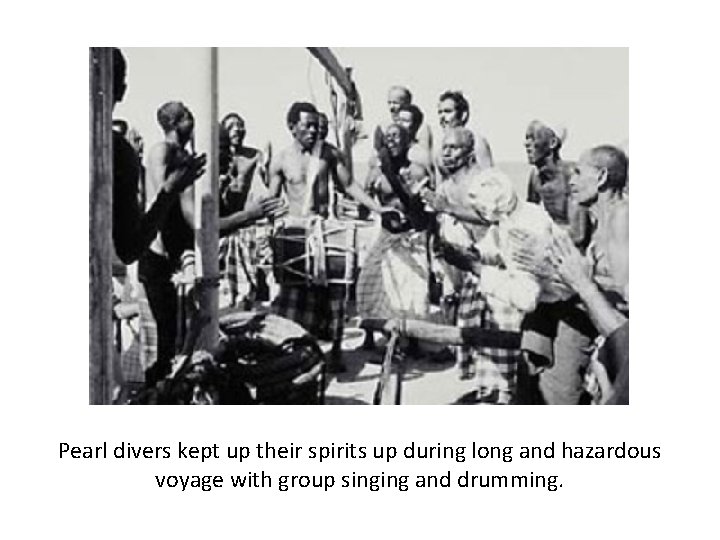
Pearl divers kept up their spirits up during long and hazardous voyage with group singing and drumming.
TOPIC #9: Kuwait’s Past - The Sea and Pearl Diving OBJECTIVES: 10. Understand the importance of Pearl Diving to Kuwait’s history. 11. Describe the Pearl Diver’s experience. KD ANSWERS: 18. Signaled the end of the pearl season: • The Sheikh’s arrival on the pearl banks 19. Pearling season finished: • September 20. Profits distributed: • After the pearls were sold, the profits were distributed among the crew, ship’s owners and financiers. Expenses were paid back before distribution of profits.
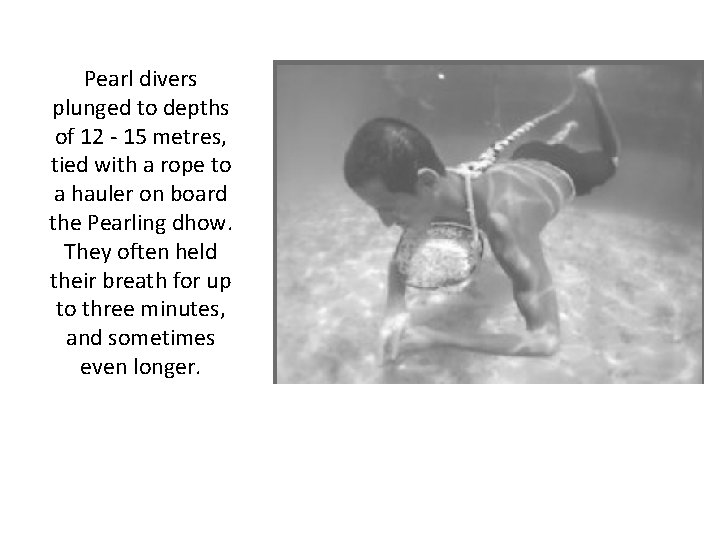
Pearl divers plunged to depths of 12 - 15 metres, tied with a rope to a hauler on board the Pearling dhow. They often held their breath for up to three minutes, and sometimes even longer.
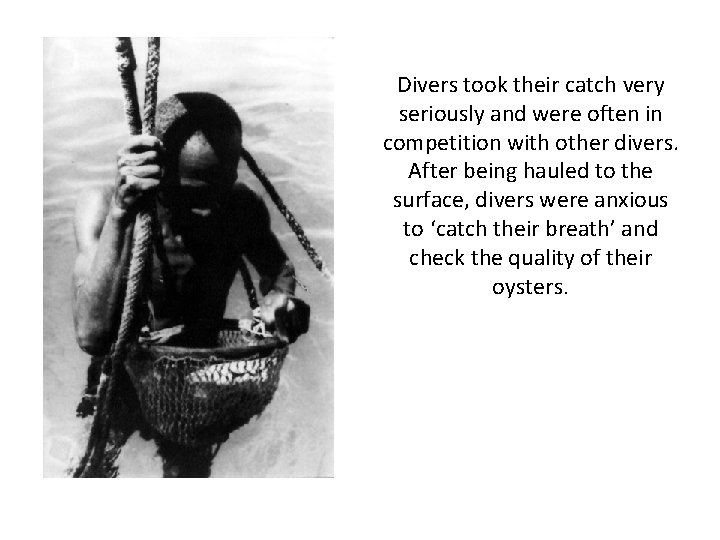
Divers took their catch very seriously and were often in competition with other divers. After being hauled to the surface, divers were anxious to ‘catch their breath’ and check the quality of their oysters.
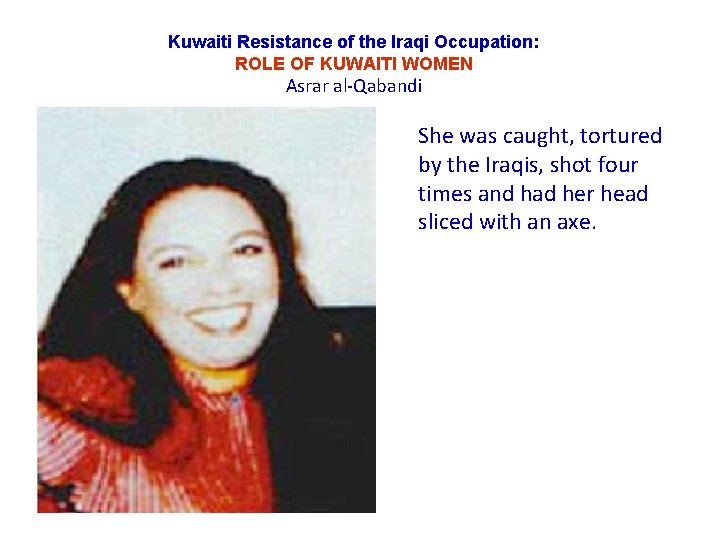
Kuwaiti Resistance of the Iraqi Occupation: ROLE OF KUWAITI WOMEN Asrar al-Qabandi She was caught, tortured by the Iraqis, shot four times and had her head sliced with an axe.
- Slides: 22