
MIDDLE CHILDHOOD DEVELOPMENT Life Span and the Environment




- Slides: 17
MIDDLE CHILDHOOD DEVELOPMENT Life Span and the Environment College of Public and Community Service University of Massachusetts at Boston © 2011 William Holmes 1
PHYSICAL DEVELOPMENT Growth rate slows Body proportions become more adult like Facial structure becomes less babyish Bone growth exceeds muscle growth Coordination gradually improves Skills emerge 2
BRAIN DEVELOPMENT Brain connections continue increasing Memory improves Attention sharpens Decision making more sophisticated Problem solving more complex Perceptions increase 3
NUTRITION Caloric needs decrease Less need for fats, sugars, and salt More need for complex carbohydrates Children make more choices Obesity risk factors may develop 4
SPECIAL NEEDS BECOME MORE OBVIOUS School entrance screening Comparisons with classmates Teacher observations and assessment Need for least restrictive inclusion Need for least restrictve opportunities 5
THINKING SKILLS ELABORATE Knowledge Comprehensio n Application Analysis Synthesis Evaluation 6
PROBLEM SOLVING IMPROVES Determining problems Understanding problems Planning solutions Evaluating plans Carrying out plans Responding to Results 7
ERRORS IN PROBLEM SOLVING REDUCE Facts observed better Systematic procedures adopted Perception of key relationships improves Sloppiness in knowledge acquisition declines 8
MORAL BEHAVIOR AND REASONING GROWS Rule learning Imitation Authority influences Observation of consequences Role modeling of firm reasonableness Differentiation of caring versus justice 9
READING DEVELOPS Components versus process Richness of linguistic environment Role modeling Peer interaction Developmentally appropriate literature use 10
SELF-CONCEPT ELABORATES Actions Feelings Reflected images of self Imagined images of self Variable competencies 11
MORE SELF-REGULATION Choices seen as moral Choices seen as effective Greater use of strategies for regulation Impulsivity replaced by reflection Less egocentrism Weighing of delayed gratification 12
PEER SOCIETY EMERGES Play more in groups Reference standard more in groups Other perspectives perceived Relationships more reciprocal Friendships develop Schools foster interaction and group formation 13
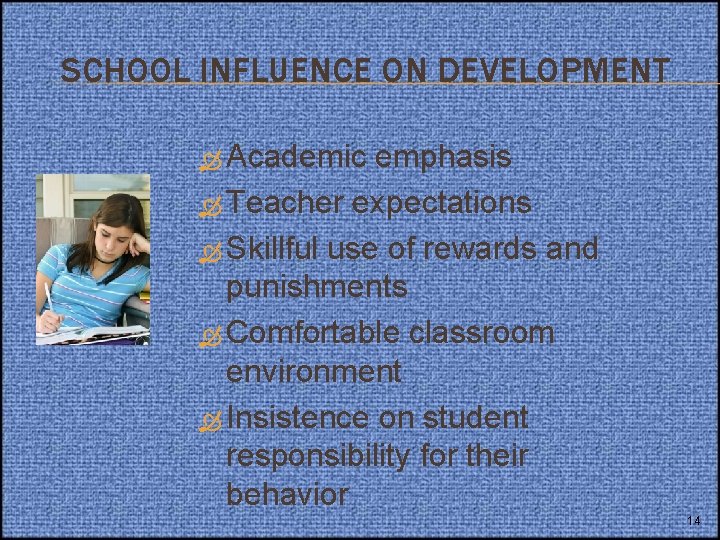
SCHOOL INFLUENCE ON DEVELOPMENT Academic emphasis Teacher expectations Skillful use of rewards and punishments Comfortable classroom environment Insistence on student responsibility for their behavior 14
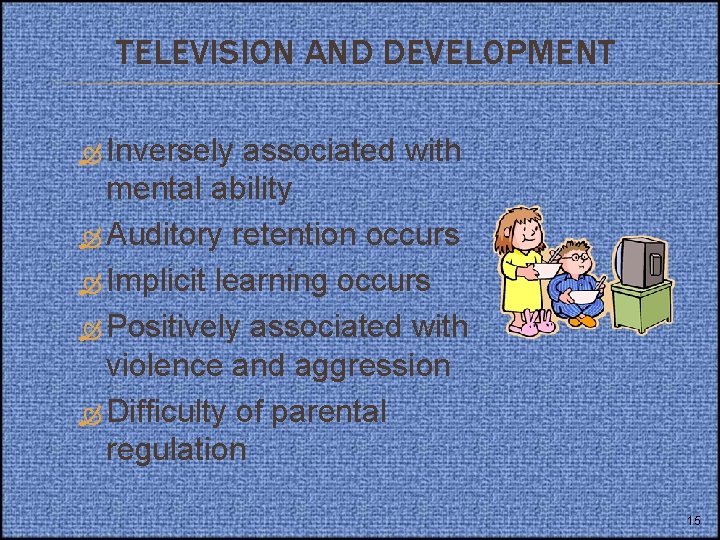
TELEVISION AND DEVELOPMENT Inversely associated with mental ability Auditory retention occurs Implicit learning occurs Positively associated with violence and aggression Difficulty of parental regulation 15
INFLUENCES ON ABUSE AND NEGLECT Family isolation Family history Denial Belief in harsh punishment Unreasonable expectations Impulsivity Substance abuse 16
DEVELOPING RESILIENT CHILDREN Easy temperament Special interest or talent Good problem solving skills Nurturing figure present Bonding with adults Experience with solving problems 17