
Middle Ages Germanic Kingdoms Unite Under Charlemagne Middle


- Slides: 56
Middle Ages Germanic Kingdoms Unite Under Charlemagne
Middle Ages n After the fall of the Roman Empire n 500 --1500
Changes in Western Europe Disruption of Trade—invasions made trade business collapse, money becomes scarce Downfall of Cities—cities abandoned as centers of administration Population Shifts—lords and commoners leave cities and move to suburbs
Decline of Learning Germanic invaders could not read and write Use oral history more important Greek learning lost Language changes—mixture of Germanic and Latin languages make it hard to understand different regions—French, Spanish, etc.
Changes in Government n Church survives Fall of Roman Empire n Germanic people loyal to lord who gives them food and land n Not loyal to a emperor or king they had never met
The Franks under Clovis Leader of the Gauls Converts to Christianity after battle against another Germanic army The Church supports Clovis’ military campaigns 511—Clovis unites Franks into one kingdom Clovis and Church make powerful partnership
Christianity Spreads to Germanic People n Rulers helped Church convert Germanic people n Missionaries n Threat of Muslim invasion on coasts
Monasteries and Convents 520—Benedict writes rules for monks and adopted by sister Scholastica 731 --Venerable Bede—writes history of England Become Europe’s best educated communities Opened schools, libraries, and copy books
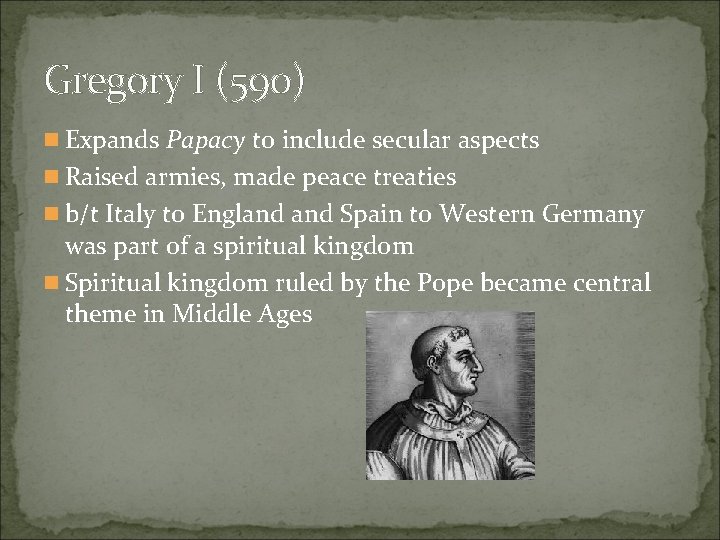
Gregory I (590) n Expands Papacy to include secular aspects n Raised armies, made peace treaties n b/t Italy to England Spain to Western Germany was part of a spiritual kingdom n Spiritual kingdom ruled by the Pope became central theme in Middle Ages
Carolingian Dynasty 751 --987 Clovis’ decedents Charles Martel 719—defeats Muslim army in 732 and becomes Christian hero Pepin the Short (son)—anointed king by pope (“king by the grace of God”) becomes king Fights on behalf of the Church
Charlemagne Takes Charge Pepin dies 768 Two sons—Carloman and Charlemagne Carloman dies 771 Charlemagne takes over 6 foot 4 inches imposing
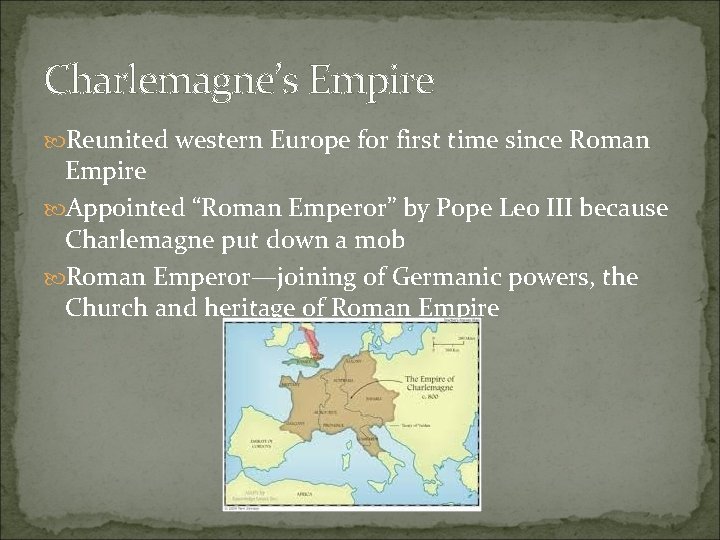
Charlemagne’s Empire Reunited western Europe for first time since Roman Empire Appointed “Roman Emperor” by Pope Leo III because Charlemagne put down a mob Roman Emperor—joining of Germanic powers, the Church and heritage of Roman Empire
Charlemagne’s Government n Limited authority of nobles n Sent royal agents to help govern empire n Made sure landowners ruled fairly n Traveled around his empire n Encouraged learning Created a palace school Ordered monasteries to open schools to train monks
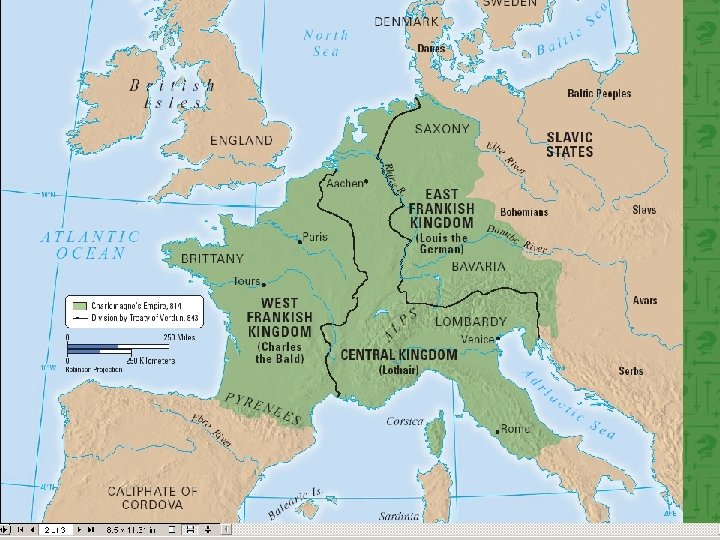
814—Charlemagne dies Louis the Pious (Charlemagne's son)—religious, better monk than king Lothair, Charles the Bald, Louis the German—fight for control, civil war ends 843 Treaty of Verdun—divides the kingdom among the three rulers
How did these people spread Christianity? n Clovis n Benedict n Gregory I n Charles Martel n Charlemagne
How did these people spread Christianity? Clovis—converted himself and army Benedict—wrote rules for monasteries Gregory I—expanded Papal powers combined Church and Government authority Charles Martel—defeated Muslim army Charlemagne—conquered land anointed Roman Emperor
Section Two Feudalism in Europe
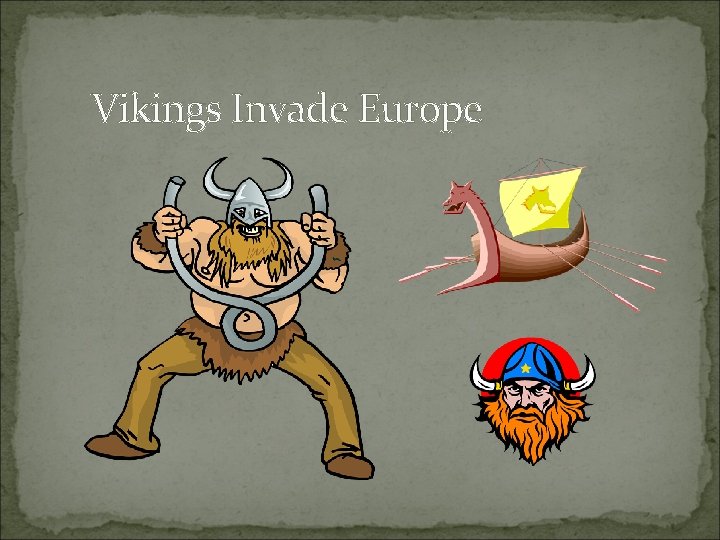
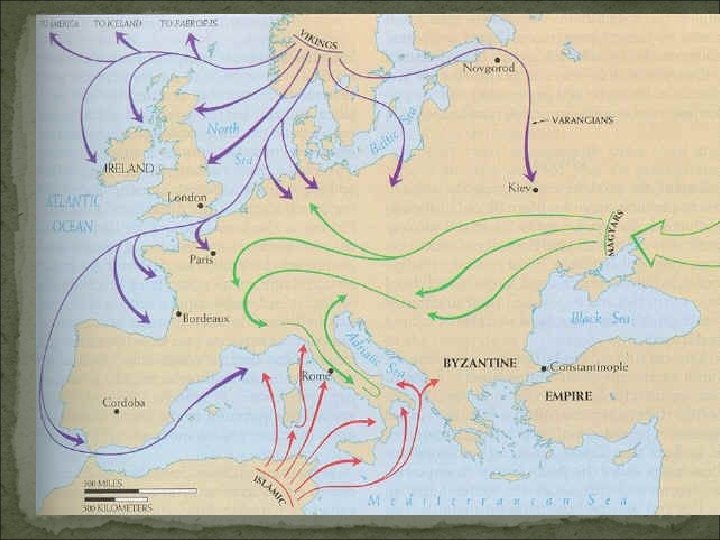
Vikings Invade Europe
Vikings n From Scandinavia n Fearless and Mean n Great sailors n Probably the first to discover North America (Leif Eriksson)
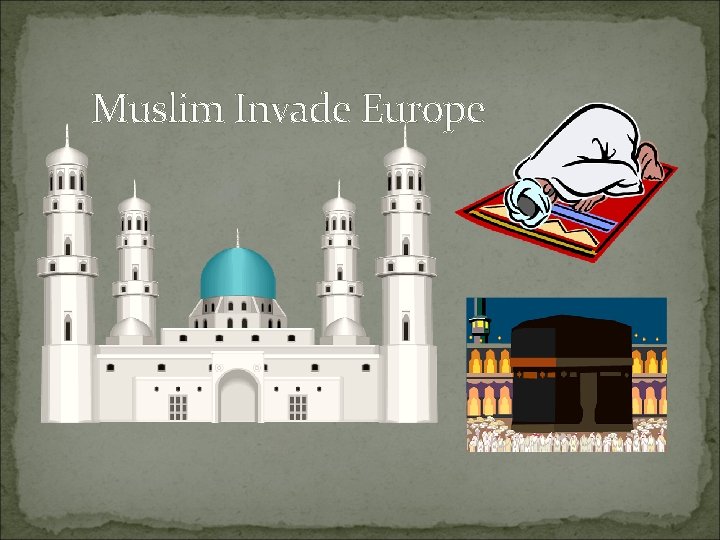
Muslim Invade Europe
Muslim n From south n Disrupted trade n Plundered towns and villages along the coast
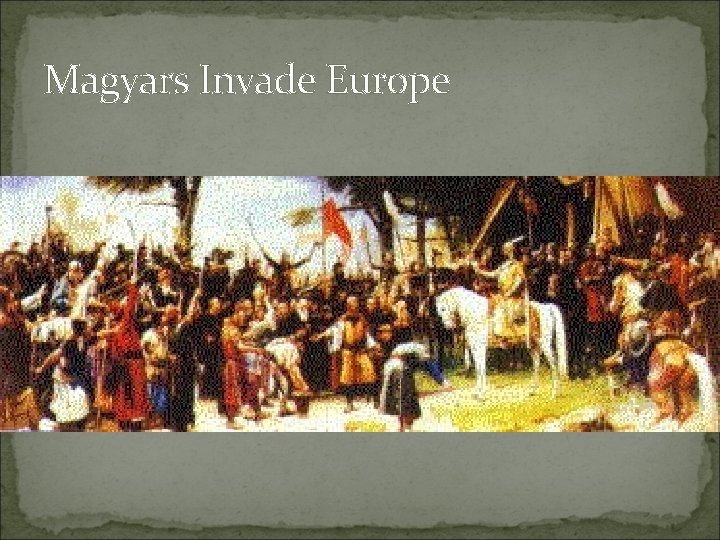
Magyars Invade Europe
Magyars n From East (Hungary) n Great Horsemen n Attacked not for control, only to capture people for slavery
Results of Invasions Widespread disorder Europeans in constant danger Central Authority powerless People looked to local rulers with armies for protection ENTRENCHES FEUDALISM
Peace n Viking leader (Rollo) and King of France (Charles the Simple) n French gave Vikings land in France (Normandy) n Viking pledge loyalty to French
Feudalism n Based on control of land mutual obligations
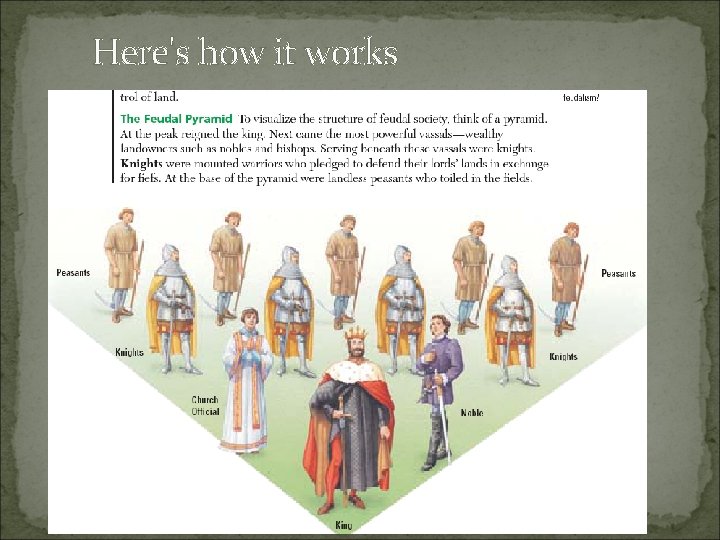
Here's how it works
Class System Strict Those who fought—nobles and knights Those who prayed—men and women of the church Those who worked—peasants (largest class and mostly serfs These classes were usually inherited
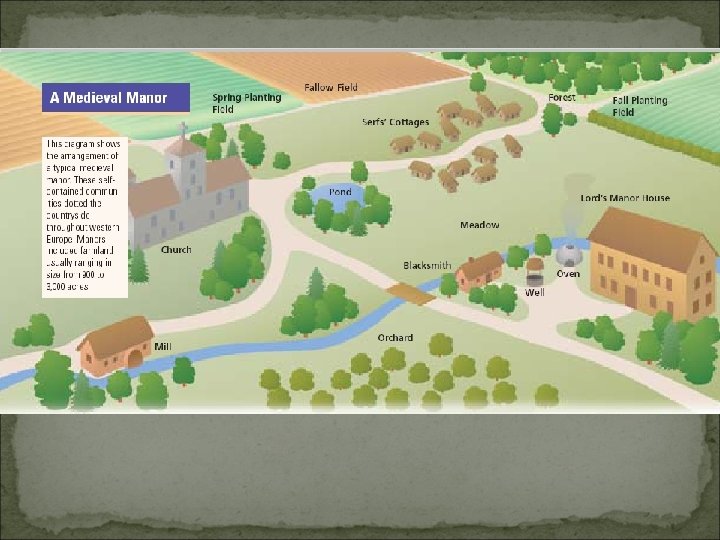
Manor System Lord’s Duties Housing Farmland protection Serf’s Duties Tend land Care for animals Maintain estate Owed few days labor and portion of grain
Manors Self Contained and Self Sufficient Only place peasants knew Fields Streams forests Manor house Church Workshops Raised all food needed Made tools Leather goods Wood
Peasant’s Life Paid tax on grain ground at Lord’s mill (only place they could grind it) Paid tax on marriage (only be married with lord’s consent) Paid tithe to village priest (10% of peasant’s income) Brought pigs in the house to warm the house
Section Three The Age of Chivalry
Warriors on Horseback n Idea taken from Muslims n Saddles Developed in Asian Steppes Stirrups developed in India Ability to stay on horse and stand up to maneuver weapons
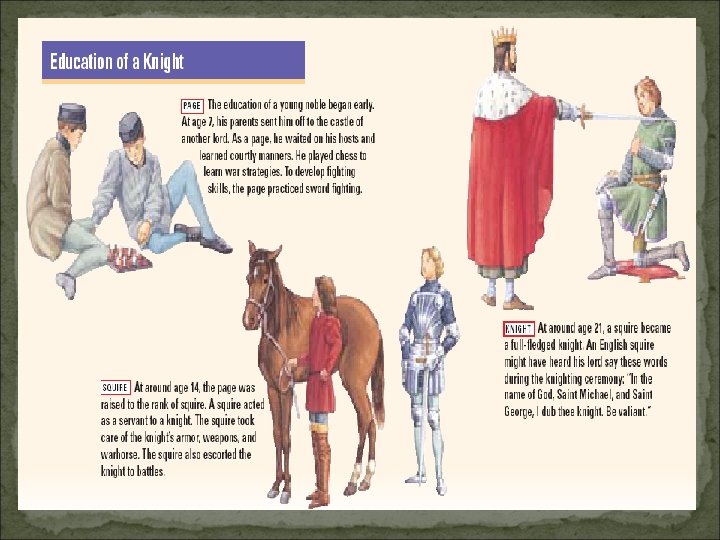
Warrior’s Role in Feudalism n Given land in return for fighting for lord n Knight could afford expensive weapons n Obligated to about 40 days of service to lord n Spent rest of time training and hunting
Chivalry Complex set of ideals Had to fight in defense of three masters Earthly feudal lord Heavenly Lord His chosen lady
War Games for Glory n Young knights practiced in tournaments n Winners demanded large ransoms from defeated knights
War is no game. Reality Castles guarded palaces and important buildings Awesome battles Boiling water, lead and oil used Crossbows
Literature, Poetry, and Song The Song of Roland—about Charlemagne’s battle a/g Muslims Troubadours—poet-musicians at castles (love songs) Eleanor of Aquitaine—later becomes queen of England—troubadours all come to see her
Women’s Role Church’s view—women inferior to men Women could not receive land but could inherit from husband Fought to defend her castle while husband off fighting
Section Four The Church Wields Power
Pope Gelasius I n Recognized 300 years before Charlemagne there would be conflict between Pope and King n Solution: King allow Pope to rule in religious matters and Pope allow King to rule in political matters
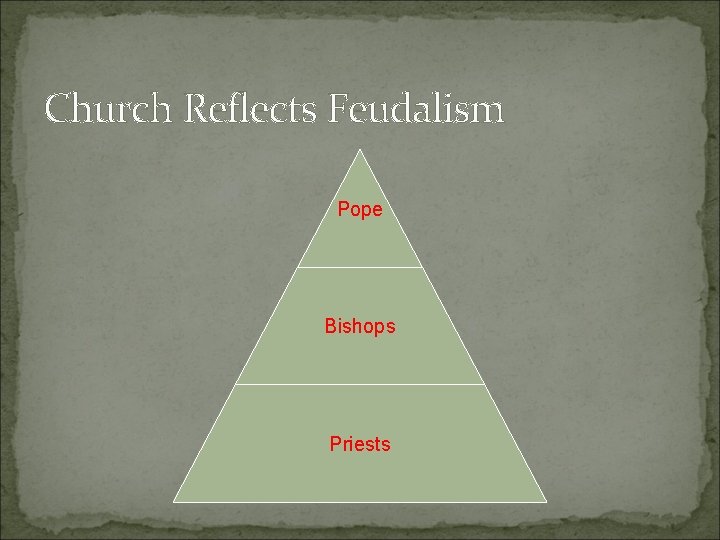
Church Reflects Feudalism Pope Bishops Priests
Religion was Uniting Force for Peasants In a time of war and trouble, Church was the calming force Sense of security All people follow same path…nobles and peasants alike
Church Justice and Power Over Emperor n Excommunication Banishment from church Ruler denied salvation Released vassals from their duty Interdict Sacraments could not be preformed in the king’s lands His people would suffer
Otto I German ruler Charlemagne was his hero Fought on Pope’s behalf and gained support from the Church
Emperor and Pope Clash n Over Lay Investiture n Henry IV sent a nasty letter to Pope Gregory VII n Gregory excommunicated Henry IV n Henry traveled to Canossa to beg forgiveness n Gregory made him wait but finally lifted his excommunication
Concordat of Worms n Meant to end conflict over Lay Investiture n Compromise: only pope can appoint and grant bishops position but emperor could veto the selection
Conflict Resume under Frederick I 1152 Frederick elected Called “Barbarosa” (red beard) Forceful personality and military skills Angered the pope because of brutal tactics against Italian merchants Enemies formed the Lombard League to oppose Frederick
Battle of Legnano 1176 n Lombard League defeated Fredericks knights n 1177 Frederick made peace with pope but defeat had undermined his authority with German princes who elected him n 1190 Frederick drowns n Empire breaks down into many feudal states
Problems with German State Never unite Election of king not as effective as those who take power…explain Opens the door for French and English rulers to assert power
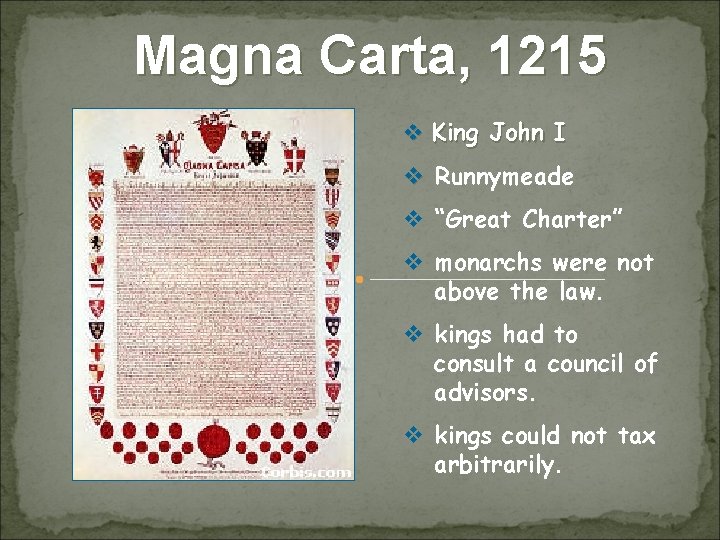
Magna Carta, 1215 v King John I v Runnymeade v “Great Charter” v monarchs were not above the law. v kings had to consult a council of advisors. v kings could not tax arbitrarily.