
Micturition Prof K Sivapalan Ureters Collecting ducts open
![Bladder Volume and Pressure • Initially, pressure increases [about 50 ml]. • Second phase](https://slidetodoc.com/presentation_image_h/86c74a6184d8915d3251eee32985f613/image-4.jpg "Bladder Volume and Pressure • Initially, pressure increases [about 50 ml]. • Second phase")
- Slides: 11
Micturition Prof. K. Sivapalan.
Ureters. • Collecting ducts open into the renal pelvis which goes down as ureters. • The walls contain smooth muscles. • Regular peristaltic contractions, 1 – 5 times per minute, move urine from renal pelvis to the bladder. • The ureters pass obliquely into bladder musculature so that the pressure in the bladder keeps it closed without reflux. 02 -12 -07 Micturition 2
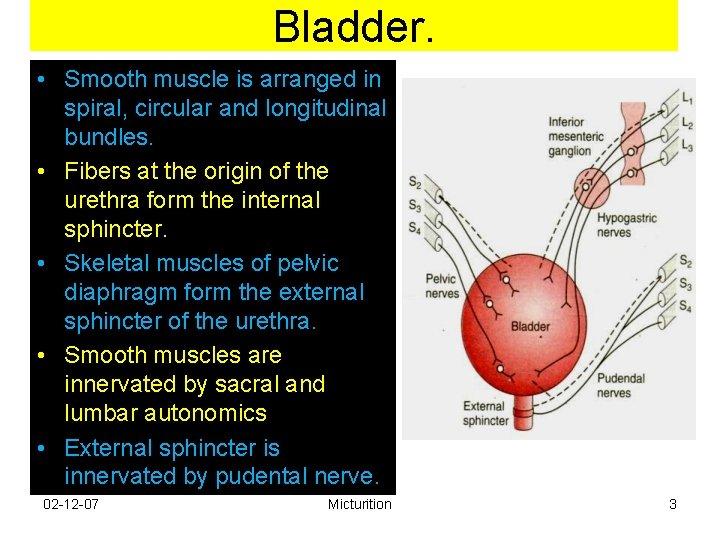
Bladder. • Smooth muscle is arranged in spiral, circular and longitudinal bundles. • Fibers at the origin of the urethra form the internal sphincter. • Skeletal muscles of pelvic diaphragm form the external sphincter of the urethra. • Smooth muscles are innervated by sacral and lumbar autonomics • External sphincter is innervated by pudental nerve. 02 -12 -07 Micturition 3
Bladder Volume and Pressure • Initially, pressure increases [about 50 ml]. • Second phase shows no appreciable increase of pressure [about 400 ml] – plasticity. • Third phase- voiding occurs or pressure increases. • Further increase causes pain. 02 -12 -07 Micturition 4
Bladder Sensation • Afferents in the pelvic parasympathetic nerves mediate sense of volume. • This is transmitted to higher centers when the intensity goes above critical level. • First urge to pass urine is sensed at about 150 ml. • Second urge occurs with sense of fullness at 300 -400 ml. • In further distention of bladder sympathetic afferents mediate pain 02 -12 -07 Micturition 5
Reflex Control of Micturition • Bladder smooth muscle has some inherent contractile activity. • With intact nerve supply, distention causes reflex contraction • Center- sacral segments • Efferent- sacral parasympathetics - contraction of detrusor muscles and relaxation of internal sphincter. • The center can be facilitated or inhibited by higher centers. 02 -12 -07 Micturition 6
Higher Control of Micturition • Brain stem- pons facilitatory and mid brain inhibitory. • Posterior hypothalamus- facilitatory. • Superior frontal gyrus- involved with desire to pass urine. • Voluntary facilitation of the reflex occurs probably through these pathways. • Voluntary contraction of abdominal muscles also aids micturition. • Sympathetic nerves relax detrusor muscles and contract internal sphincters. 02 -12 -07 Micturition 7
Micturition • Urge to urinate by filling or voluntary facilitation activates the sacral center. • Parasympathetic outflow contracts detrusor muscles and relaxes internal sphincter. • Voluntary relaxation of the external sphincter results in voiding. • Female urethra empties by gravity and male urethra by contraction of bulbocavernosus muscle. 02 -12 -07 Micturition 8
Effects of Deafferentation • Loss of afferents as in tabes dorsalis • Reflex contraction is abolished. • Bladder is distended, thin walled, hypotonic and hypotonic. • Occasional week inherent contraction causes expulsion of little urine. 02 -12 -07 Micturition 9
Effects of Denervation • As in tumor of cauda equina. • The bladder is flaccid and distended for some time. • It becomes active and frequent contractions expel dribbles of urine. • The bladder becomes shrunken and hypertrophied. • The efferents destroyed are preganglionic. 02 -12 -07 Micturition 10
Effects of Spinal Cord Transection • The bladder is flaccid and nonresponsiveoverflow incontinence- during spinal shock. • After 2 weeks voiding reflex returns without voluntary control. • Mass reflex may help- pinching or stroking medial aspect of thighs. • Emptying is not complete. 02 -12 -07 Micturition 11