
Microwave Thermography RTM Principles The RTM01 RES radiometer


- Slides: 36
Microwave Thermography
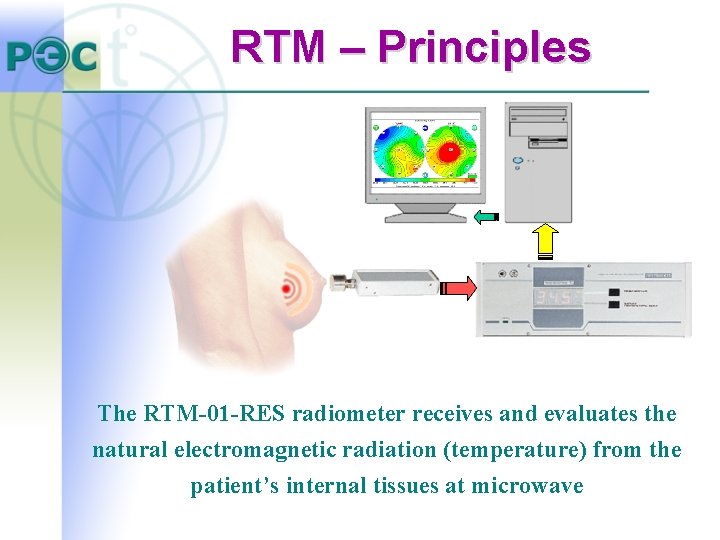
RTM – Principles The RTM-01 -RES radiometer receives and evaluates the natural electromagnetic radiation (temperature) from the patient’s internal tissues at microwave
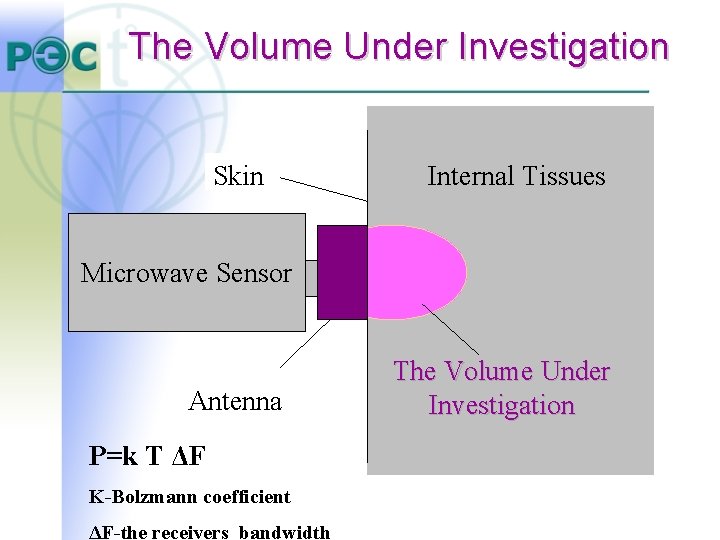
The Volume Under Investigation Skin Internal Tissues Microwave Sensor Antenna P=k T ΔF K-Bolzmann coefficient ΔF-the receivers bandwidth The Volume Under Investigation
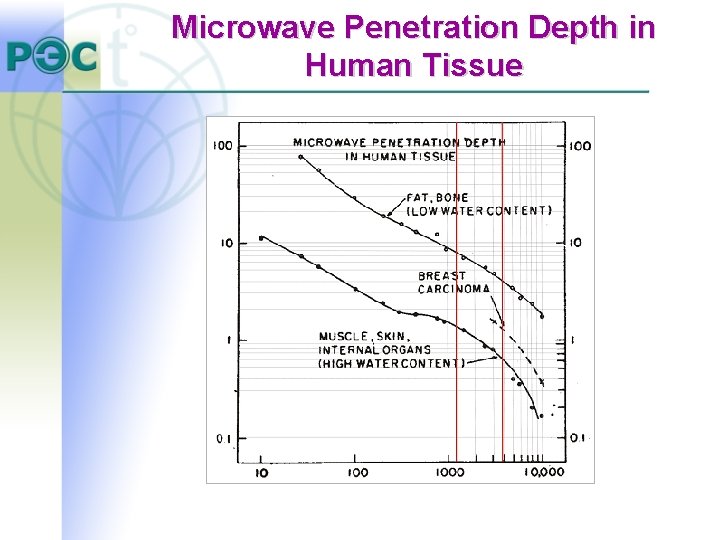
Microwave Penetration Depth in Human Tissue
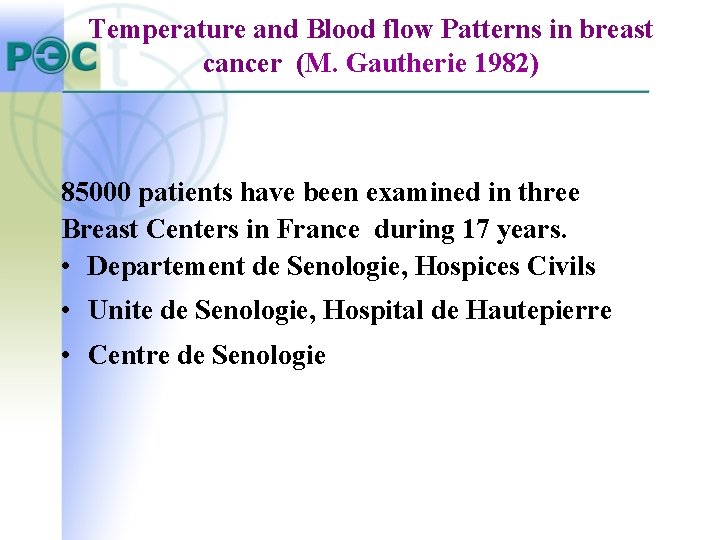
Temperature and Blood flow Patterns in breast cancer (M. Gautherie 1982) 85000 patients have been examined in three Breast Centers in France during 17 years. • Departement de Senologie, Hospices Civils • Unite de Senologie, Hospital de Hautepierre • Centre de Senologie
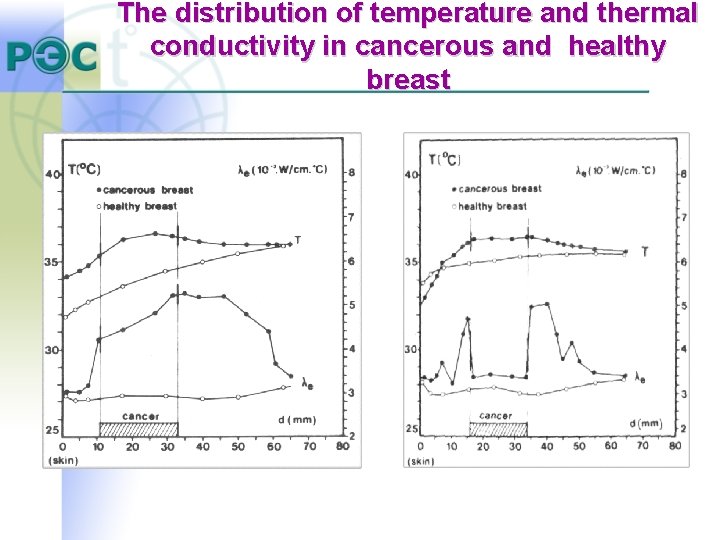
The distribution of temperature and thermal conductivity in cancerous and healthy breast
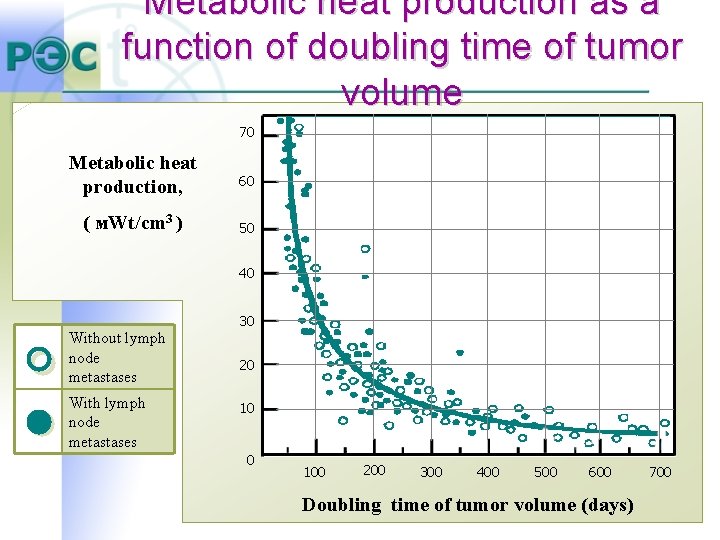
Metabolic heat production as a function of doubling time of tumor volume 70 Metabolic heat production, 60 ( м. Wt/cm 3 ) 50 40 30 Without lymph node metastases With lymph node metastases 20 100 200 300 400 500 600 Doubling time of tumor volume (days) 700
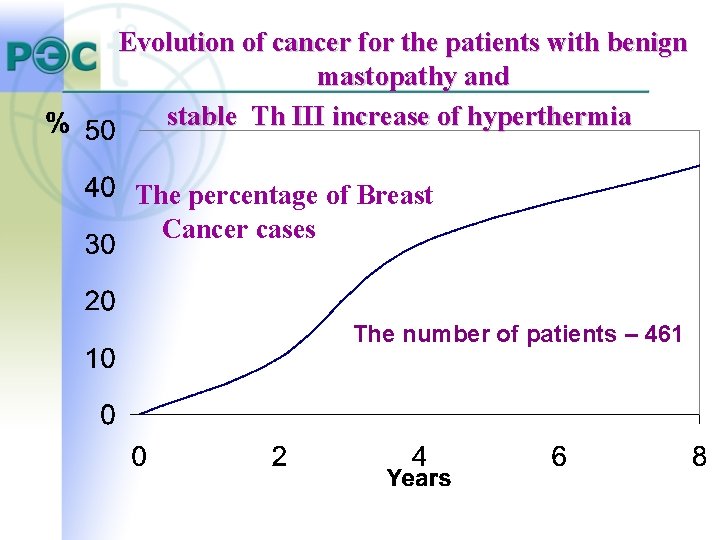
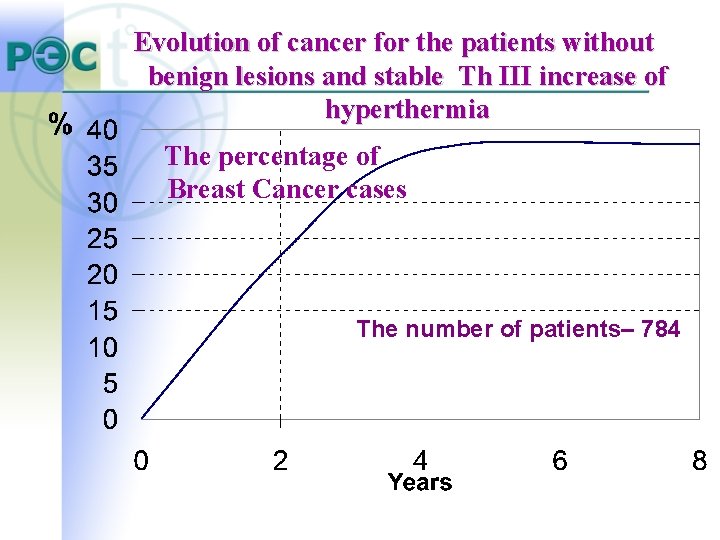
M. Gautherie monitoring of 1245 women with Th III increase of hyperthermia during 12 years 784 patients without benign lesions 461 patients with benign mastopathy
Evolution of cancer for the patients with benign mastopathy and stable Th III increase of hyperthermia The percentage of Breast Cancer cases The number of patients – 461
Evolution of cancer for the patients without benign lesions and stable Th III increase of hyperthermia The percentage of Breast Cancer cases The number of patients– 784
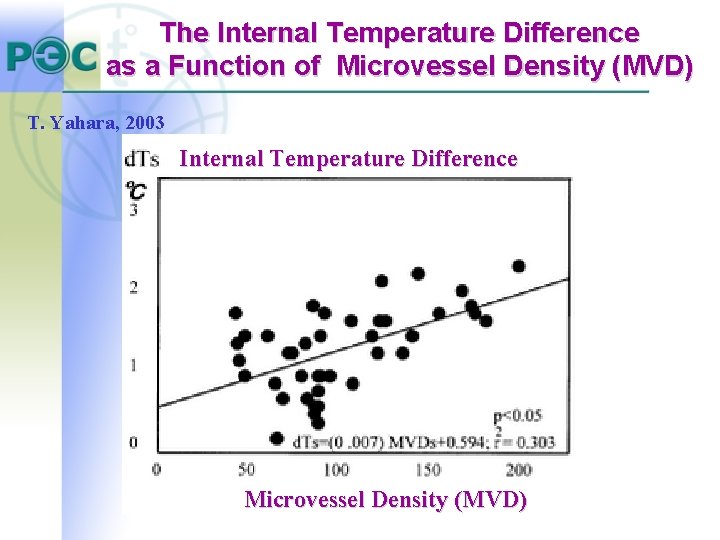
The Internal Temperature Difference as a Function of Microvessel Density (MVD) T. Yahara, 2003 Internal Temperature Difference Microvessel Density (MVD)
Angiogenesis of Breast Cancer • Angiogenesis, the process of new blood vessel formation, play the central role in both local tumor growth and distant metastasis in breast cancer. • Angiogenesis precedes transformation of mammary hyperplasia to malignancy B. P. Schneider, 2005
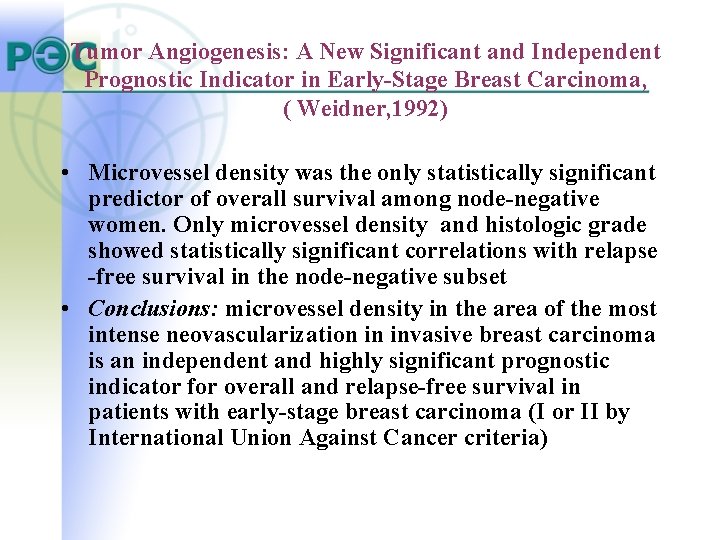
Tumor Angiogenesis: A New Significant and Independent Prognostic Indicator in Early-Stage Breast Carcinoma, ( Weidner, 1992) • Microvessel density was the only statistically significant predictor of overall survival among node-negative women. Only microvessel density and histologic grade showed statistically significant correlations with relapse -free survival in the node-negative subset • Conclusions: microvessel density in the area of the most intense neovascularization in invasive breast carcinoma is an independent and highly significant prognostic indicator for overall and relapse-free survival in patients with early-stage breast carcinoma (I or II by International Union Against Cancer criteria)
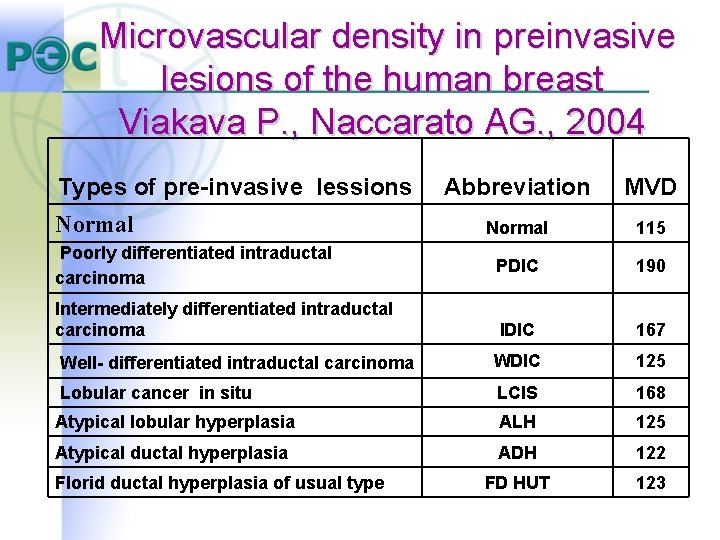
Microvascular density in preinvasive lesions of the human breast Viakava P. , Naccarato AG. , 2004 Types of pre-invasive lessions Abbreviation MVD Normal 115 PDIC 190 IDIC 167 Well- differentiated intraductal carcinoma WDIC 125 Lobular cancer in situ LCIS 168 Atypical lobular hyperplasia ALH 125 Atypical ductal hyperplasia ADH 122 FD HUT 123 Normal Poorly differentiated intraductal carcinoma Intermediately differentiated intraductal carcinoma Florid ductal hyperplasia of usual type
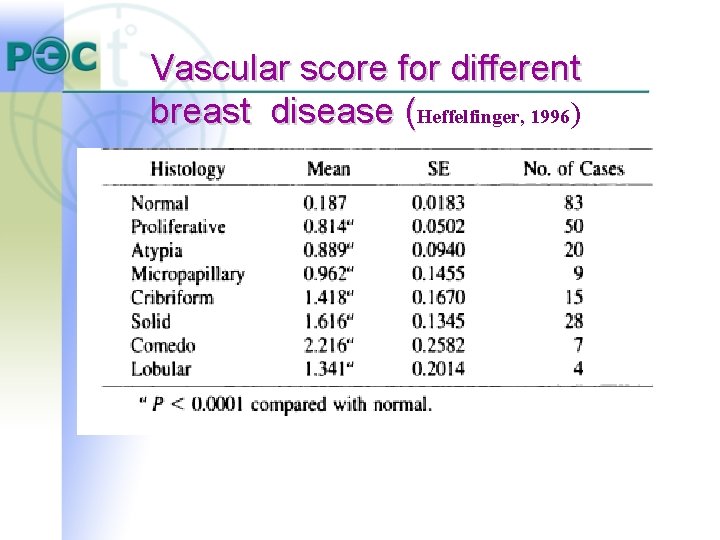
Vascular score for different breast disease (Heffelfinger, 1996)
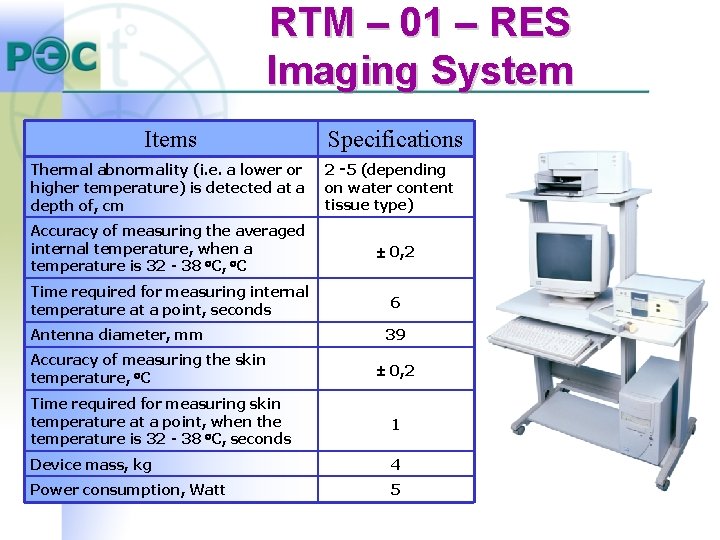
RTM – 01 – RES Imaging System Items Thermal abnormality (i. e. a lower or higher temperature) is detected at a depth of, cm Specifications 2 ‑ 5 (depending on water content tissue type) Accuracy of measuring the averaged internal temperature, when a temperature is 32 ‑ 38 C, C 0, 2 Time required for measuring internal temperature at a point, seconds 6 Antenna diameter, mm Accuracy of measuring the skin temperature, C 39 0, 2 Time required for measuring skin temperature at a point, when the temperature is 32 ‑ 38 C, seconds 1 Device mass, kg 4 Power consumption, Watt 5
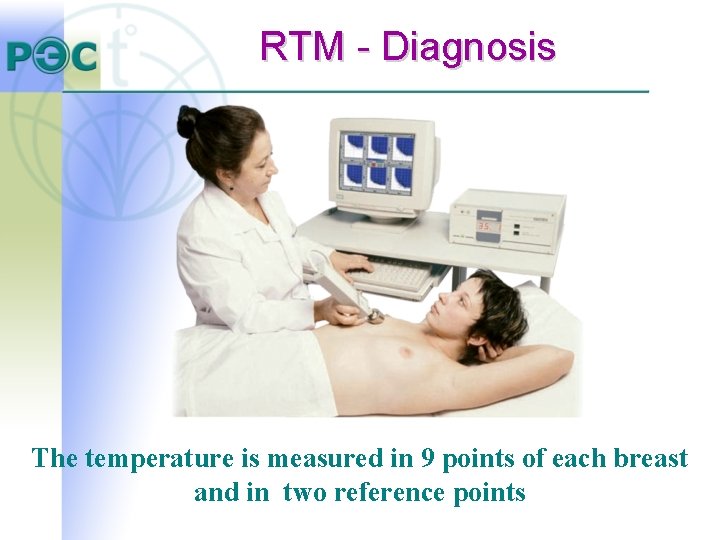
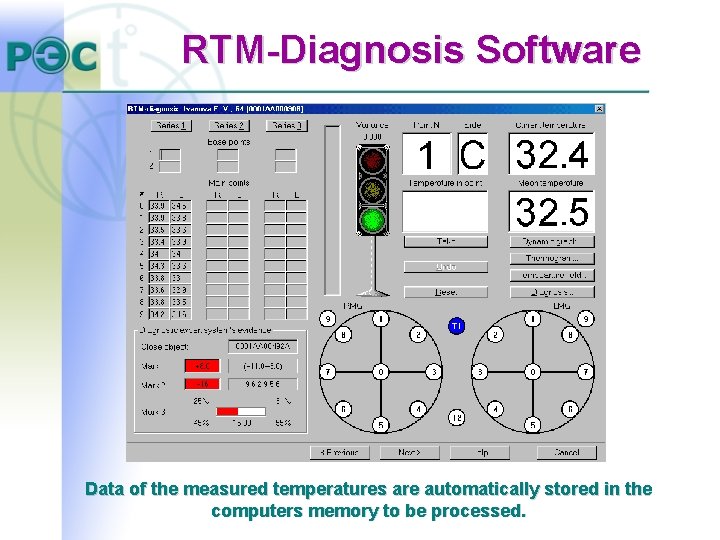
RTM - Diagnosis The temperature is measured in 9 points of each breast and in two reference points
RTM-Diagnosis Software Data of the measured temperatures are automatically stored in the computers memory to be processed.
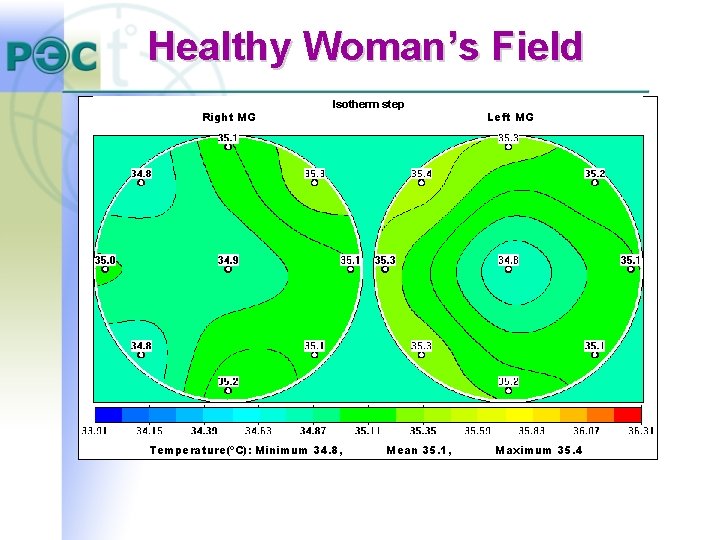
Healthy Woman’s Field Right MG Isotherm step Temperature(ºC): Minimum 34. 8, Mean 35. 1, Left MG Maximum 35. 4
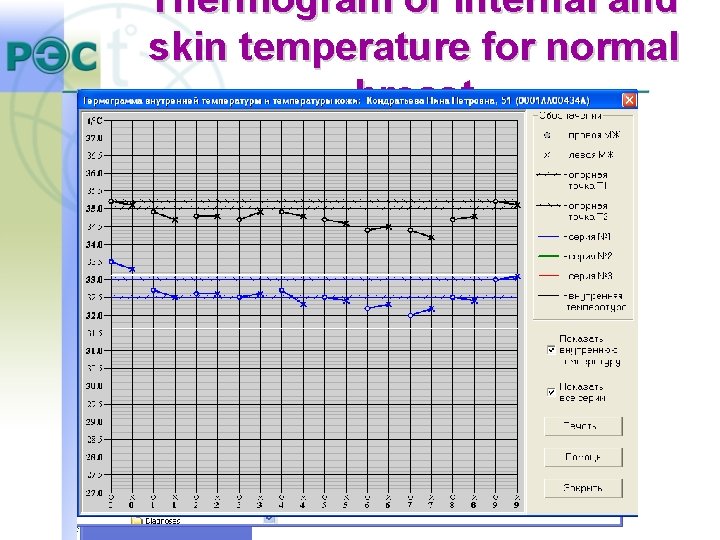
Thermogram of internal and skin temperature for normal breast
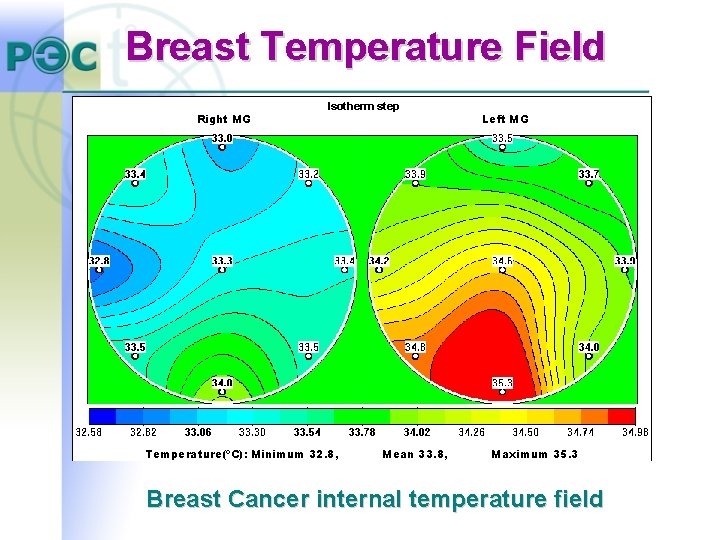
Breast Temperature Field Right MG Isotherm step Temperature(ºC): Minimum 32. 8, Mean 33. 8, Left MG Maximum 35. 3 Breast Cancer internal temperature field
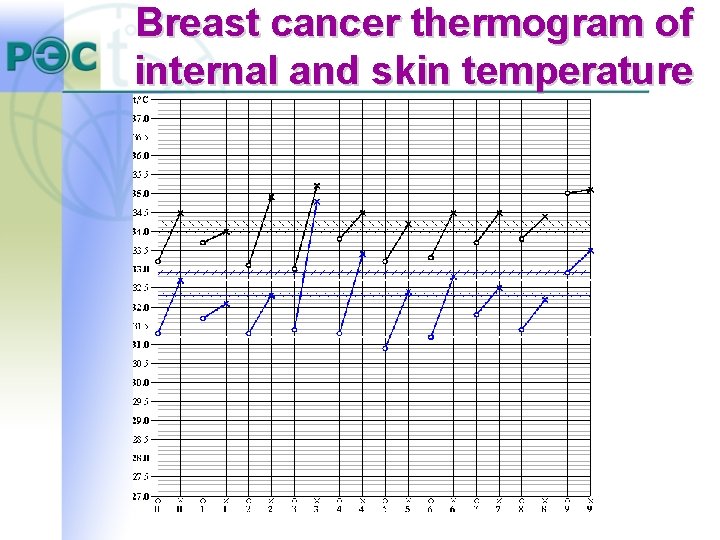
Breast cancer thermogram of internal and skin temperature
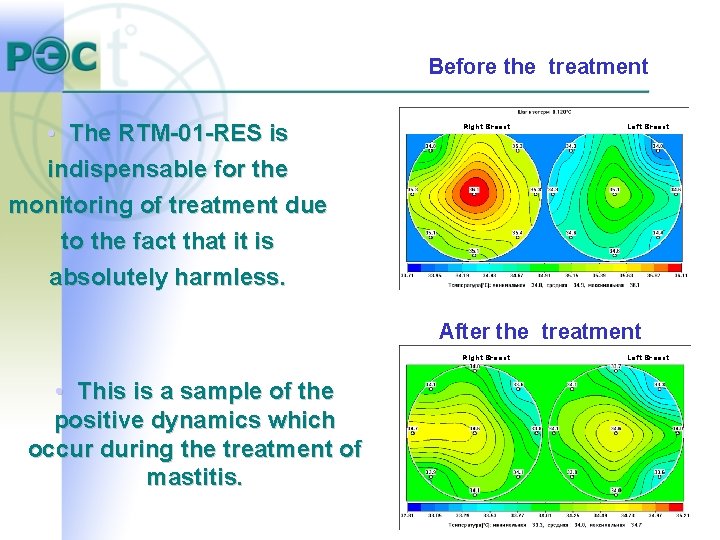
Before the treatment • The RTM-01 -RES is indispensable for the monitoring of treatment due to the fact that it is absolutely harmless. Right Breast Left Breast After the treatment Right Breast • This is a sample of the positive dynamics which occur during the treatment of mastitis. Left Breast
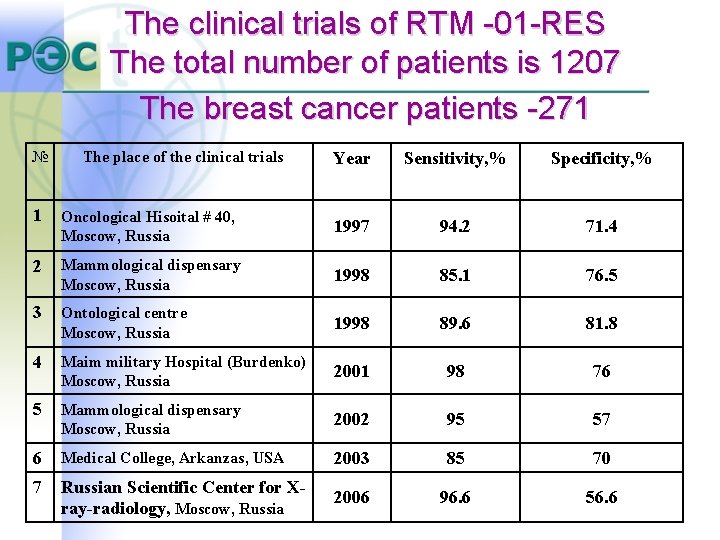
The clinical trials of RTM -01 -RES The total number of patients is 1207 The breast cancer patients -271 № The place of the clinical trials Year Sensitivity, % Specificity, % 1 Oncological Hisoital # 40, Moscow, Russia 1997 94. 2 71. 4 2 Mammological dispensary Moscow, Russia 1998 85. 1 76. 5 3 Ontological centre Moscow, Russia 1998 89. 6 81. 8 4 Maim military Hospital (Burdenko) Moscow, Russia 2001 98 76 5 Mammological dispensary Moscow, Russia 2002 95 57 6 Medical College, Arkanzas, USA 2003 85 70 7 Russian Scientific Center for Xray-radiology, Moscow, Russia 2006 96. 6 56. 6
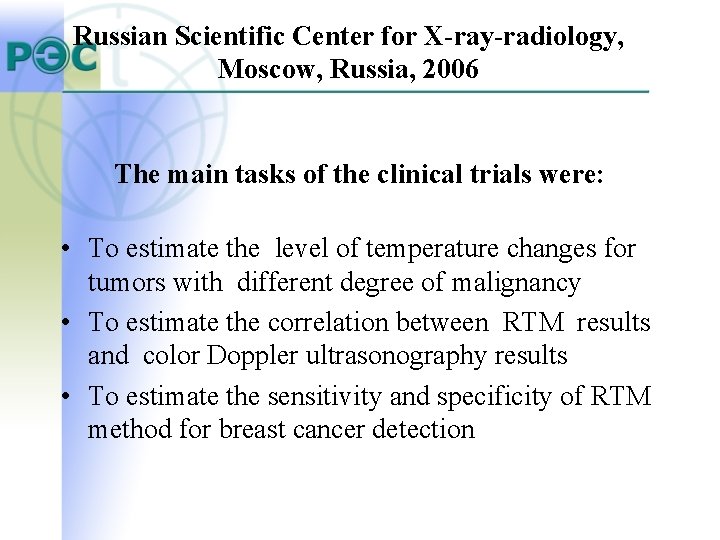
Russian Scientific Center for X-ray-radiology, Moscow, Russia, 2006 The main tasks of the clinical trials were: • To estimate the level of temperature changes for tumors with different degree of malignancy • To estimate the correlation between RTM results and color Doppler ultrasonography results • To estimate the sensitivity and specificity of RTM method for breast cancer detection
Method and Materials • • Clinical examination Mammography Ultrasonography Doppler ultrasonography Mamma stintigraphy examination RTM method Biopsy Histology
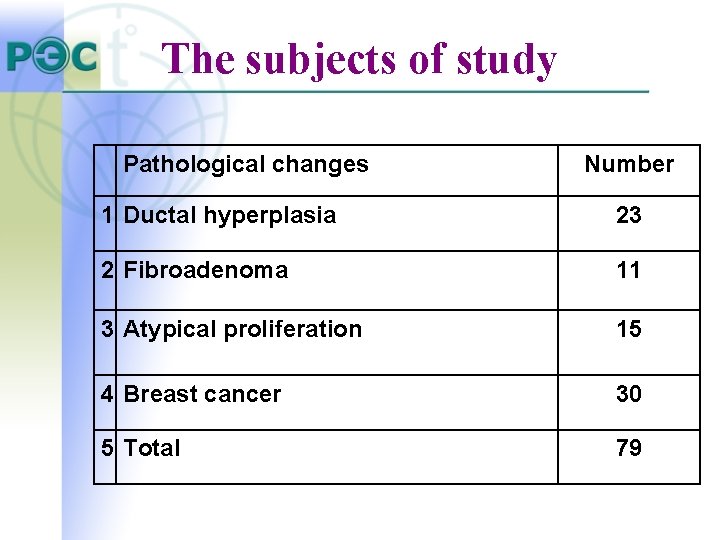
The subjects of study Pathological changes Number 1 Ductal hyperplasia 23 2 Fibroadenoma 11 3 Atypical proliferation 15 4 Breast cancer 30 5 Total 79
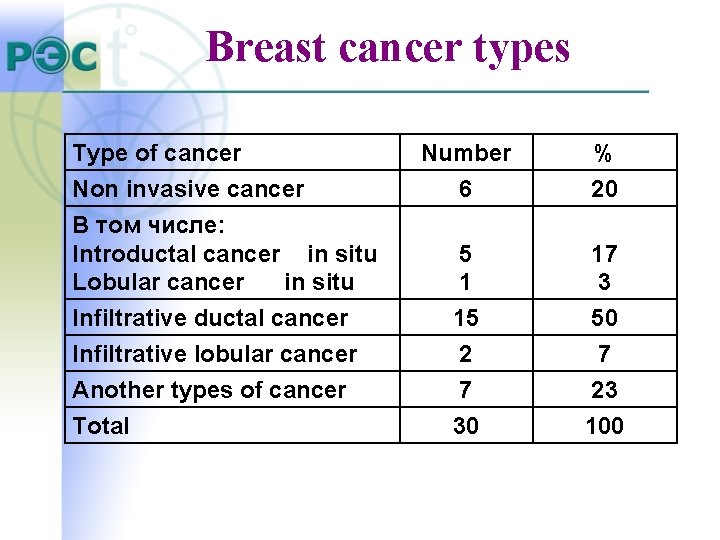
Breast cancer types Type of cancer Non invasive cancer В том числе: Introductal cancer in situ Lobular cancer in situ Infiltrative ductal cancer Infiltrative lobular cancer Another types of cancer Total Number 6 % 20 5 1 15 2 7 30 17 3 50 7 23 100
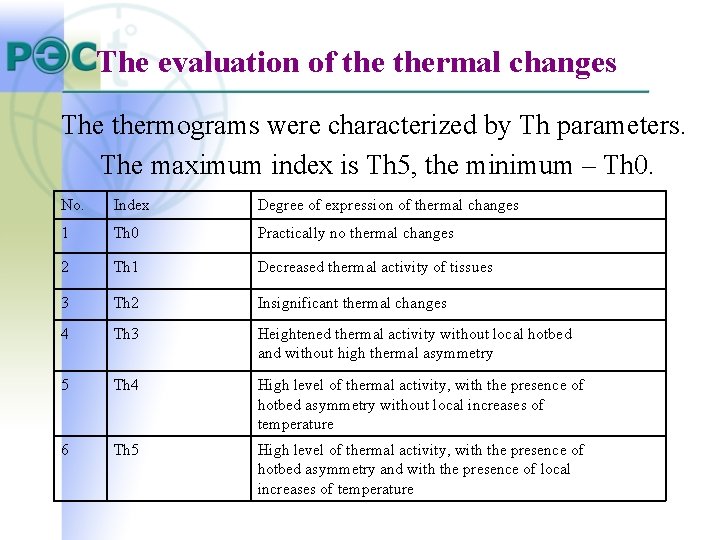
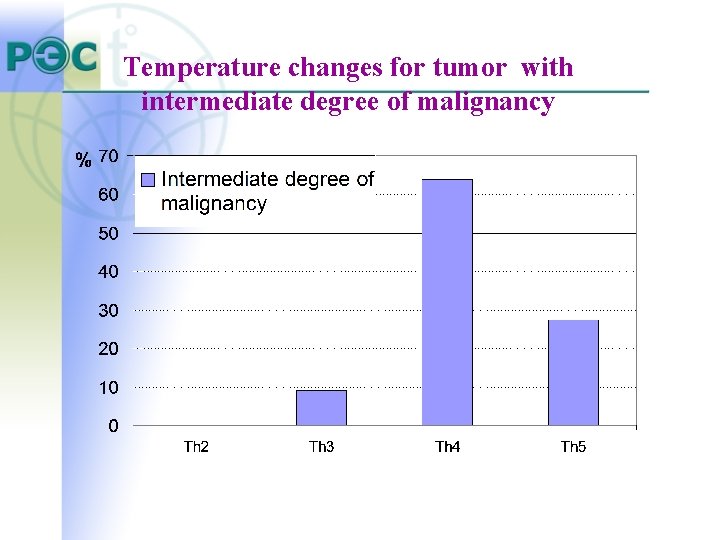
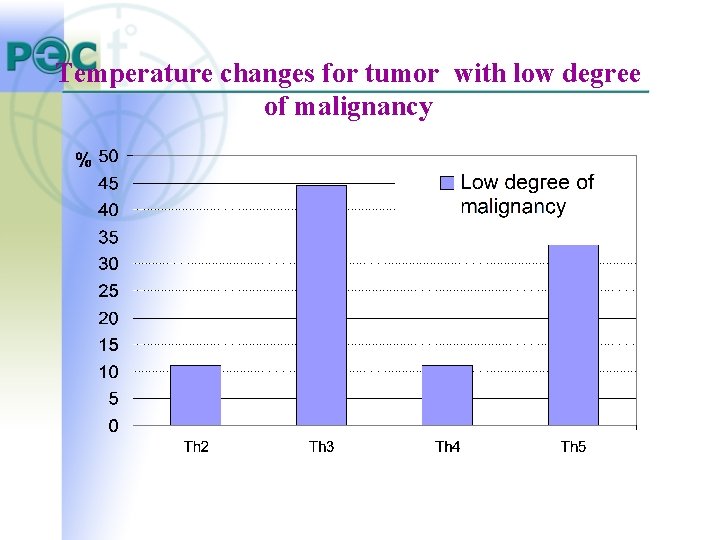
The evaluation of thermal changes The thermograms were characterized by Th parameters. The maximum index is Th 5, the minimum – Th 0. No. Index Degree of expression of thermal changes 1 Th 0 Practically no thermal changes 2 Th 1 Decreased thermal activity of tissues 3 Th 2 Insignificant thermal changes 4 Th 3 Heightened thermal activity without local hotbed and without high thermal asymmetry 5 Th 4 High level of thermal activity, with the presence of hotbed asymmetry without local increases of temperature 6 Th 5 High level of thermal activity, with the presence of hotbed asymmetry and with the presence of local increases of temperature
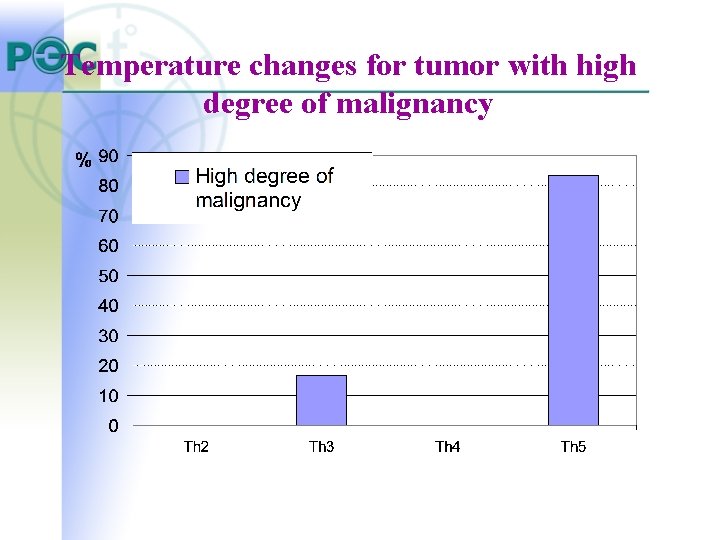
Temperature changes for tumor with high degree of malignancy
Temperature changes for tumor with intermediate degree of malignancy
Temperature changes for tumor with low degree of malignancy
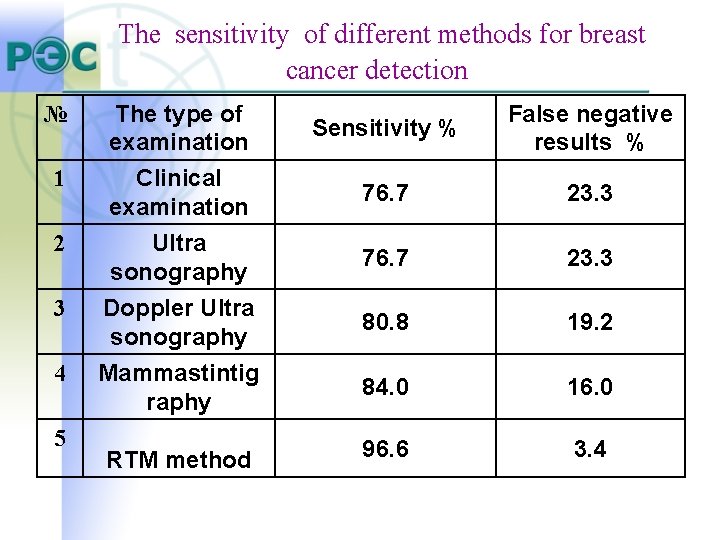
The sensitivity of different methods for breast cancer detection № 1 The type of examination Clinical examination 2 Ultra sonography 3 Doppler Ultra sonography Mammastintig raphy 4 5 RTM method Sensitivity % False negative results % 76. 7 23. 3 80. 8 19. 2 84. 0 16. 0 96. 6 3. 4
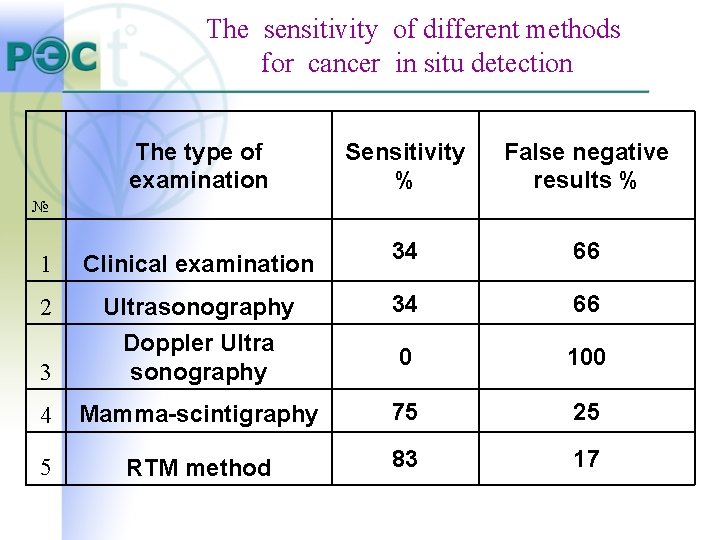
The sensitivity of different methods for cancer in situ detection The type of examination Sensitivity % False negative results % 34 66 № 1 Clinical examination 2 34 66 3 Ultrasonography Doppler Ultra sonography 0 100 4 Mamma-scintigraphy 75 25 5 RTM method 83 17
Conclusion: • In 90% of breast cancer patients have significant thermal changes. • 80% patient with breast cancer in situ have thermal changes captured with the RTM-01 -RES. • In 50% of cancer in situ cases are accompanied by very strong thermal changes (Th 5). • 80% of patients with the atypical hyperplasia have thermal changes of mammary glands • At the high degree of malignance predominate the maximal thermal changes (Th 5), at the intermediate degree of malignance predominates the Th 4 thermal changes, at the low degree of malignance over half of the patients have the index Th 3 and Th 2. • The RTM method allows to identify patients having high risk of malignization and needing further examination.
Conclusion RTM method is very promising method for to identify patients with the increase risk of breast cancer. Combination RTM method and mammography increase sensitivity of breast cancer diagnosis to 98%