
Microwave SQUID multiplexer for the readout of large
![The microwave SQUID multiplexer amp Software defined radio (in development) [MHz] [GHz] DAC FPGA](https://slidetodoc.com/presentation_image_h2/ae5083d17e2763ea8513369add837bf4/image-21.jpg "The microwave SQUID multiplexer amp Software defined radio (in development) [MHz] [GHz] DAC FPGA")
- Slides: 35
Microwave SQUID multiplexer for the readout of large MMC arrays Mathias Wegner 01. 06. 2016
Contents • Metallic magnetic calorimeters • From single detectors to very large arrays • Microwave SQUID multiplexer • Multiplexer chip design • Experimental results • Summary and outlook
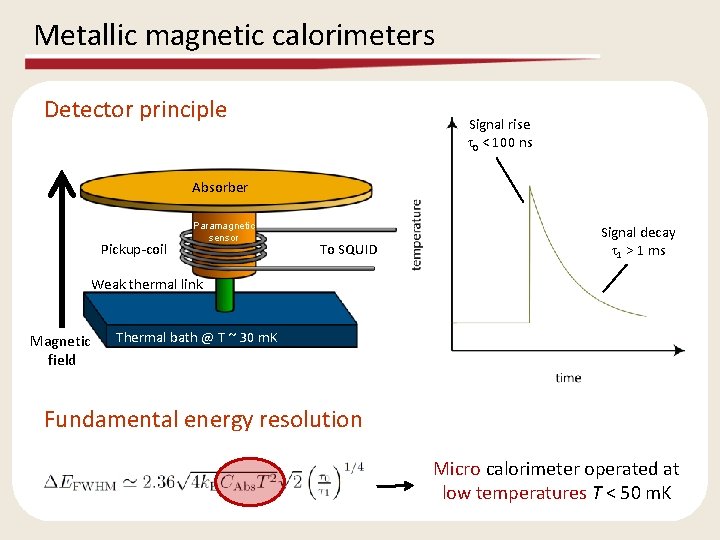
Metallic magnetic calorimeters Detector principle Signal rise t 0 < 100 ns Absorber Pickup-coil Paramagnetic sensor To SQUID Signal decay t 1 > 1 ms Weak thermal link Magnetic field Thermal bath @ T ~ 30 m. K Fundamental energy resolution Micro calorimeter operated at low temperatures T < 50 m. K
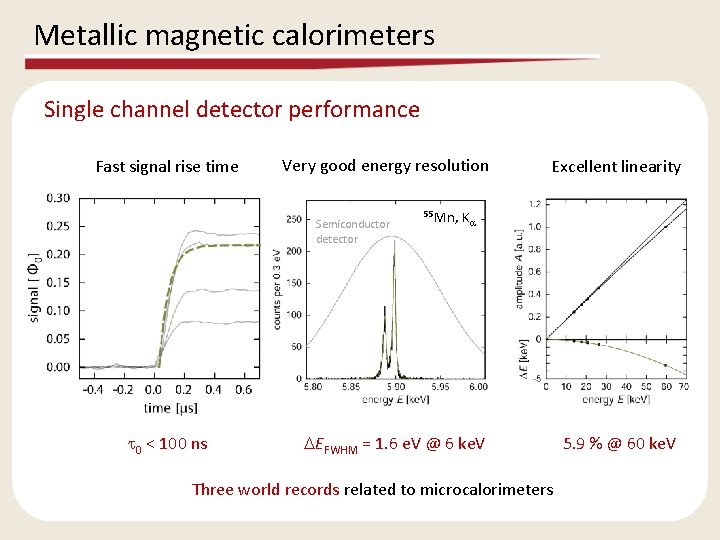
Metallic magnetic calorimeters Single channel detector performance Fast signal rise time Very good energy resolution Semiconductor detector t 0 < 100 ns 55 Mn, Excellent linearity Ka DEFWHM = 1. 6 e. V @ 6 ke. V Three world records related to microcalorimeters 5. 9 % @ 60 ke. V
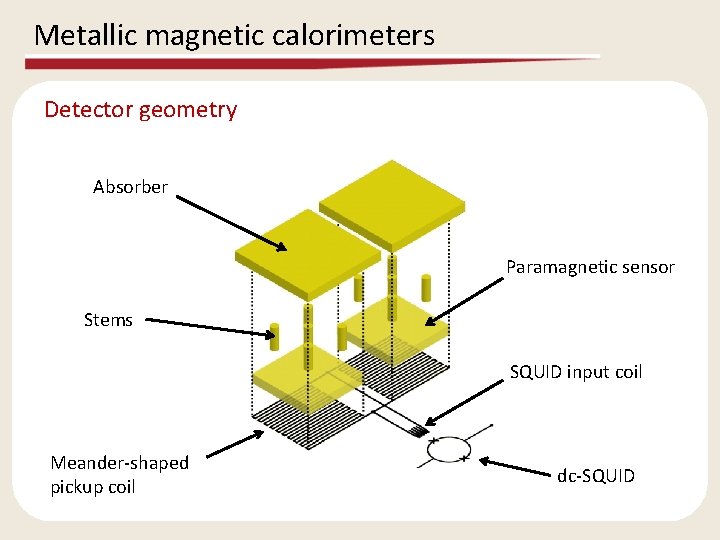
Metallic magnetic calorimeters Detector geometry Absorber Paramagnetic sensor Stems SQUID input coil Meander-shaped pickup coil dc-SQUID
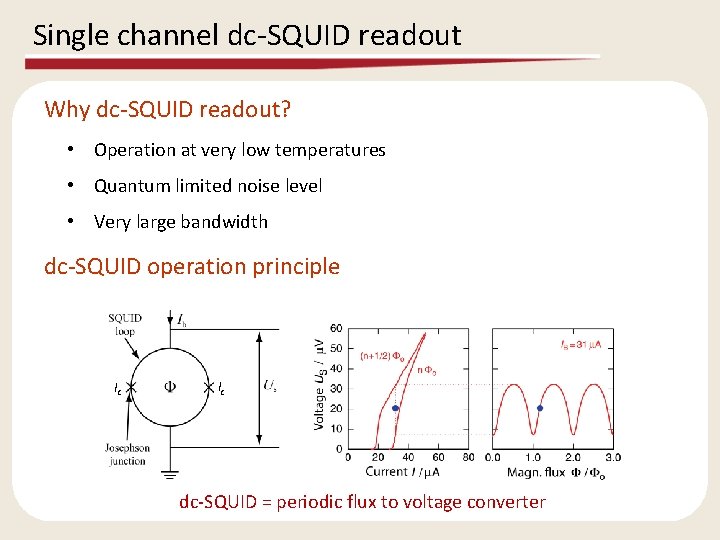
Single channel dc-SQUID readout Why dc-SQUID readout? • Operation at very low temperatures • Quantum limited noise level • Very large bandwidth dc-SQUID operation principle Ic Ic dc-SQUID = periodic flux to voltage converter
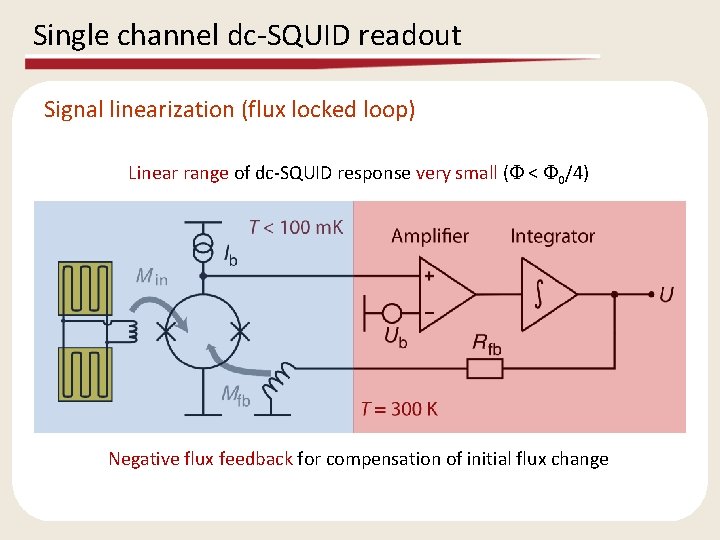
Single channel dc-SQUID readout Signal linearization (flux locked loop) Linear range of dc-SQUID response very small (F < F 0/4) Negative flux feedback for compensation of initial flux change
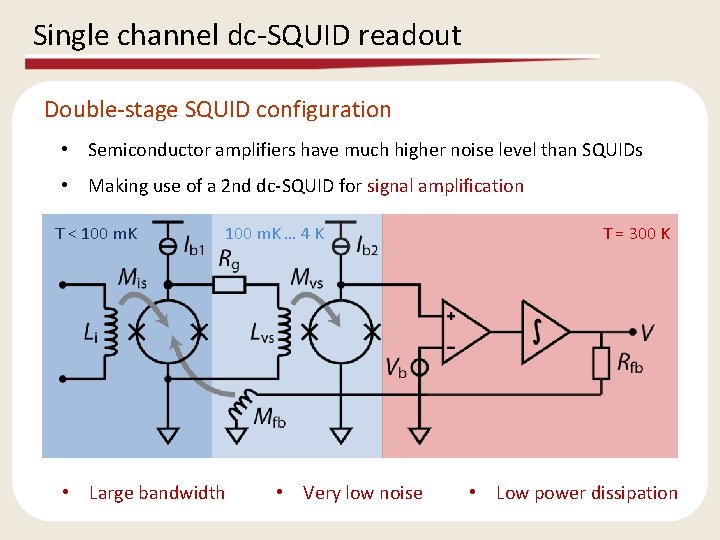
Single channel dc-SQUID readout Double-stage SQUID configuration • Semiconductor amplifiers have much higher noise level than SQUIDs • Making use of a 2 nd dc-SQUID for signal amplification T < 100 m. K … 4 K • Large bandwidth • Very low noise T = 300 K • Low power dissipation
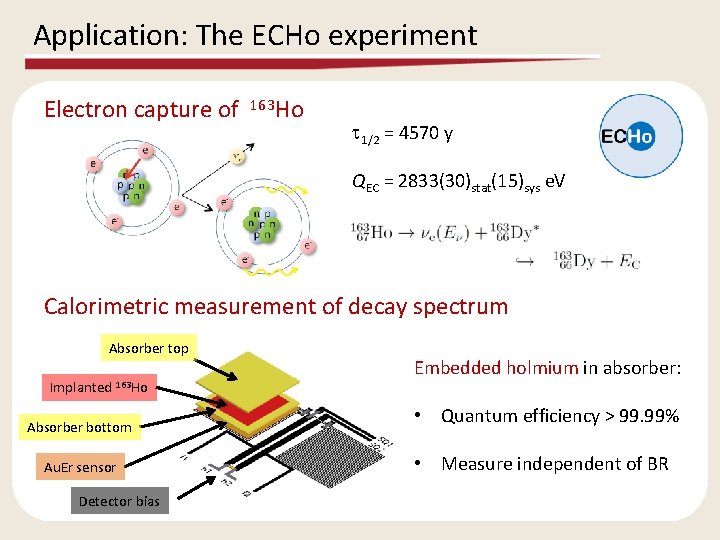
Application: The ECHo experiment Electron capture of 163 Ho t 1/2 = 4570 y QEC = 2833(30)stat(15)sys e. V Calorimetric measurement of decay spectrum Absorber top Implanted 163 Ho Absorber bottom Au. Er sensor Detector bias Embedded holmium in absorber: • Quantum efficiency > 99. 99% • Measure independent of BR
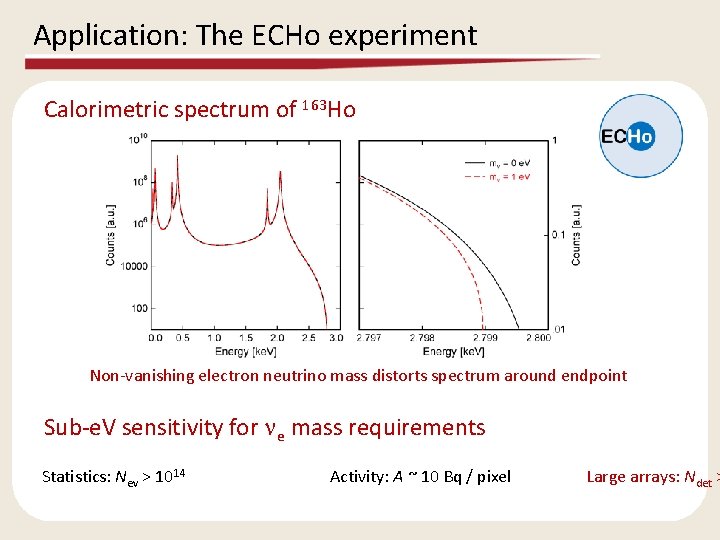
Application: The ECHo experiment Calorimetric spectrum of 163 Ho Non-vanishing electron neutrino mass distorts spectrum around endpoint Sub-e. V sensitivity for ne mass requirements Statistics: Nev > 1014 Activity: A ~ 10 Bq / pixel Large arrays: Ndet >
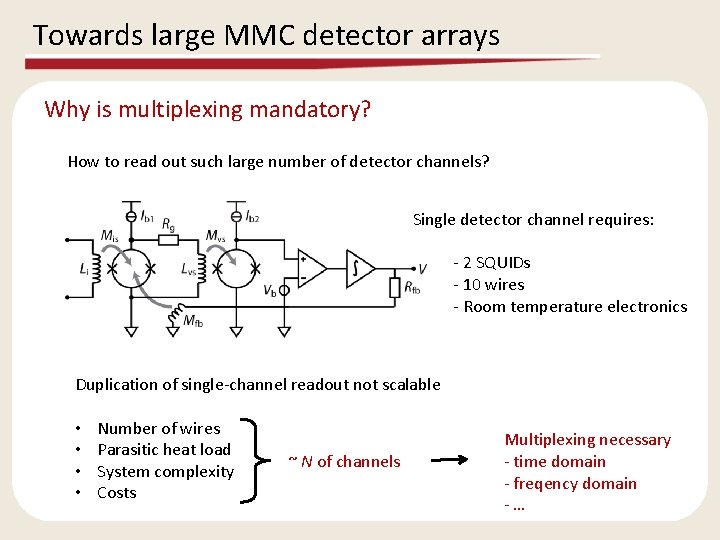
Towards large MMC detector arrays Why is multiplexing mandatory? How to read out such large number of detector channels? Single detector channel requires: - 2 SQUIDs - 10 wires - Room temperature electronics Duplication of single-channel readout not scalable • • Number of wires Parasitic heat load System complexity Costs ~ N of channels Multiplexing necessary - time domain - freqency domain -…
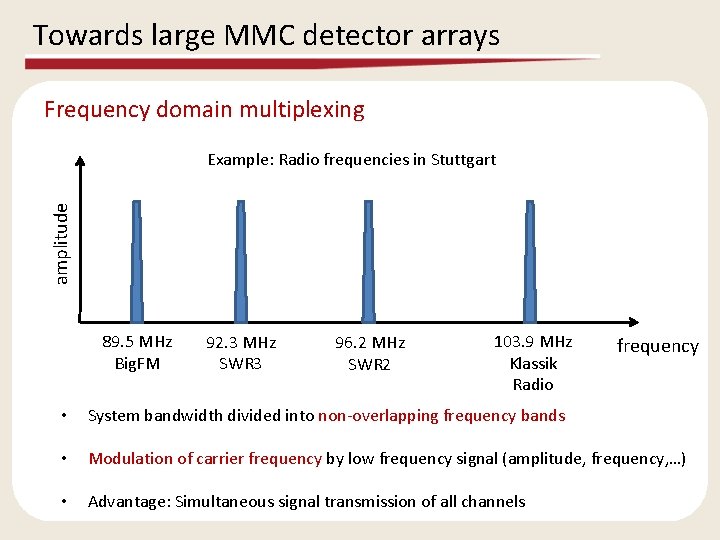
Towards large MMC detector arrays Frequency domain multiplexing amplitude Example: Radio frequencies in Stuttgart 89. 5 MHz Big. FM 92. 3 MHz SWR 3 96. 2 MHz SWR 2 103. 9 MHz Klassik Radio frequency • System bandwidth divided into non-overlapping frequency bands • Modulation of carrier frequency by low frequency signal (amplitude, frequency, …) • Advantage: Simultaneous signal transmission of all channels
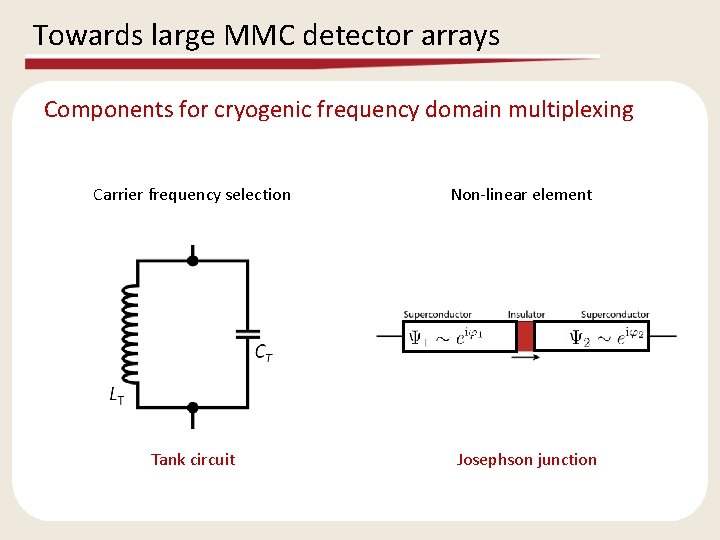
Towards large MMC detector arrays Components for cryogenic frequency domain multiplexing Carrier frequency selection Tank circuit Non-linear element Josephson junction
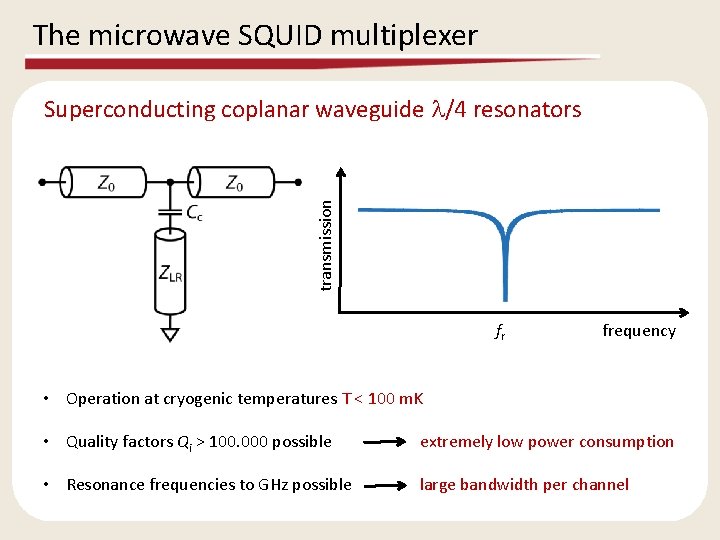
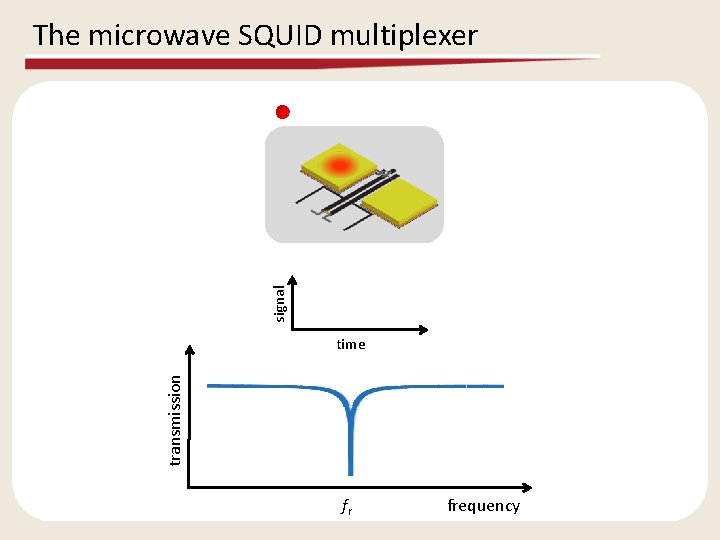
The microwave SQUID multiplexer transmission Superconducting coplanar waveguide l/4 resonators fr frequency • Operation at cryogenic temperatures T < 100 m. K • Quality factors Qi > 100. 000 possible extremely low power consumption • Resonance frequencies to GHz possible large bandwidth per channel
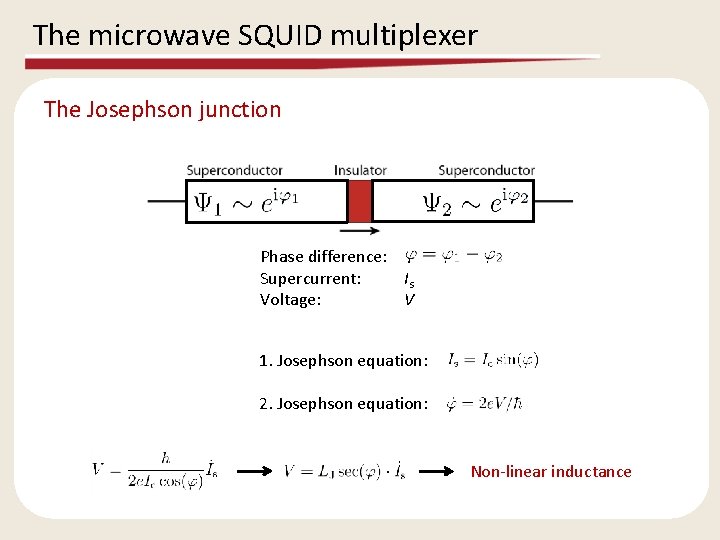
The microwave SQUID multiplexer The Josephson junction Phase difference: Supercurrent: Is Voltage: V 1. Josephson equation: 2. Josephson equation: Non-linear inductance
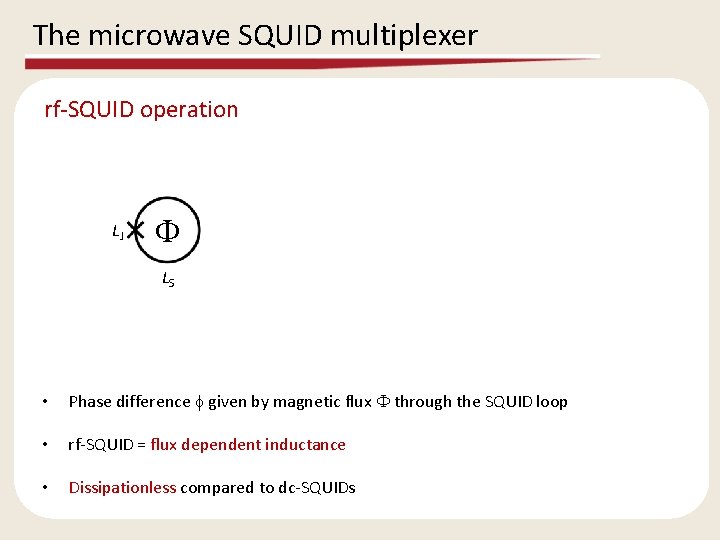
The microwave SQUID multiplexer rf-SQUID operation k LJ Tank circuit F LS Ltot CT Tank circuit LT • Phase difference f given by magnetic flux F through the SQUID loop • rf-SQUID = flux dependent inductance • Dissipationless compared to dc-SQUIDs
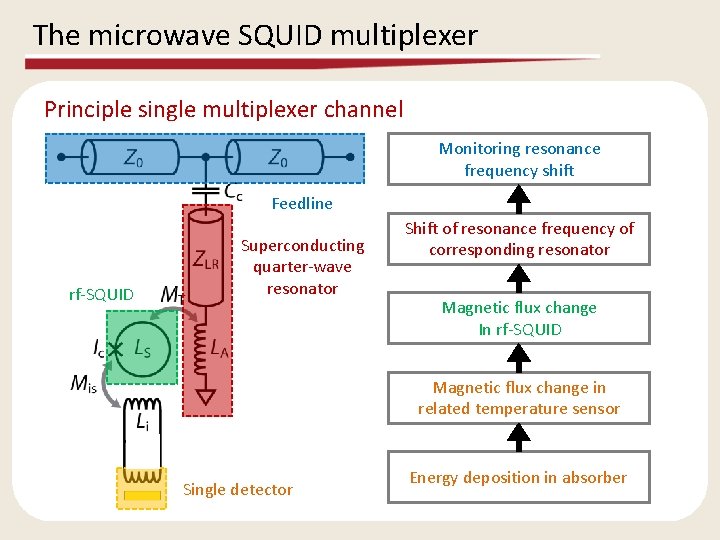
The microwave SQUID multiplexer Principle single multiplexer channel Monitoring resonance frequency shift Feedline rf-SQUID Superconducting quarter-wave resonator Shift of resonance frequency of corresponding resonator Magnetic flux change In rf-SQUID Magnetic flux change in related temperature sensor Single detector Energy deposition in absorber
signal The microwave SQUID multiplexer transmission time fr frequency
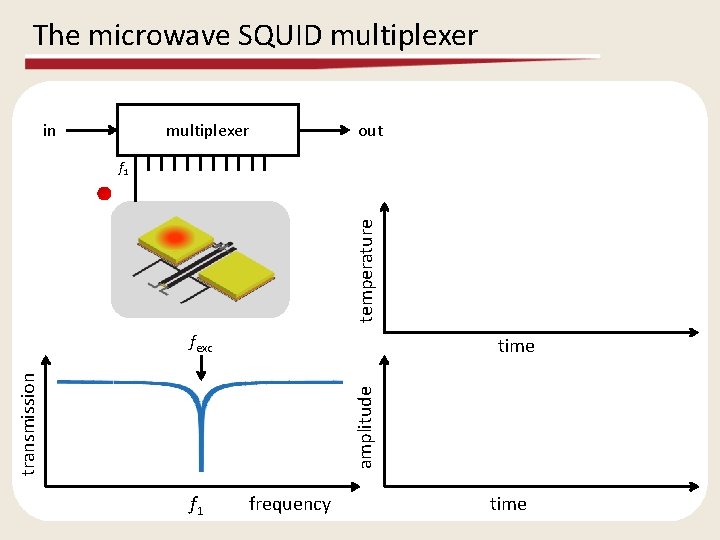
The microwave SQUID multiplexer in out temperature f 1 fexc amplitude transmission time f 1 frequency time
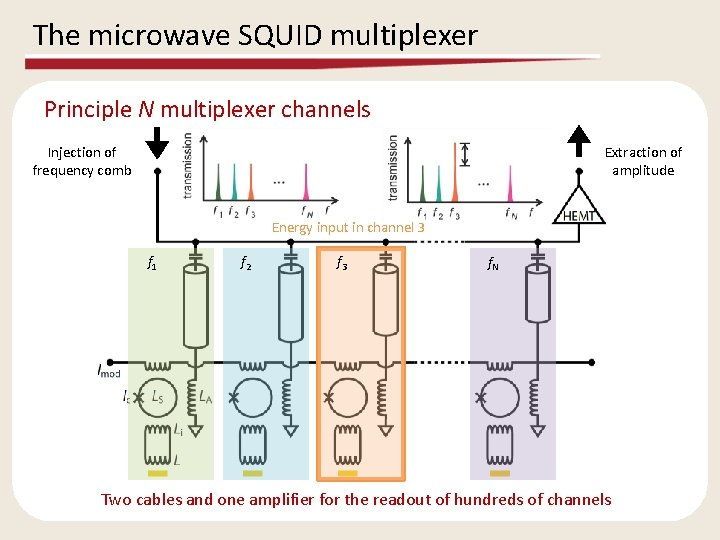
The microwave SQUID multiplexer Principle N multiplexer channels Injection of frequency comb Extraction of amplitude Energy input in channel 3 f 1 f 2 f 3 f. N Two cables and one amplifier for the readout of hundreds of channels
The microwave SQUID multiplexer amp Software defined radio (in development) [MHz] [GHz] DAC FPGA µMUX amp ADC [MHz] [GHz] Signal modulation
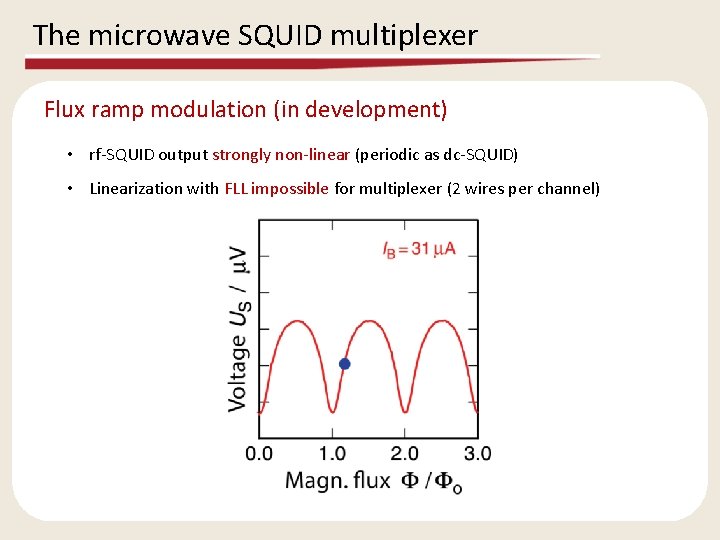
The microwave SQUID multiplexer Flux ramp modulation (in development) • rf-SQUID output strongly non-linear (periodic as dc-SQUID) • Linearization with FLL impossible for multiplexer (2 wires per channel)
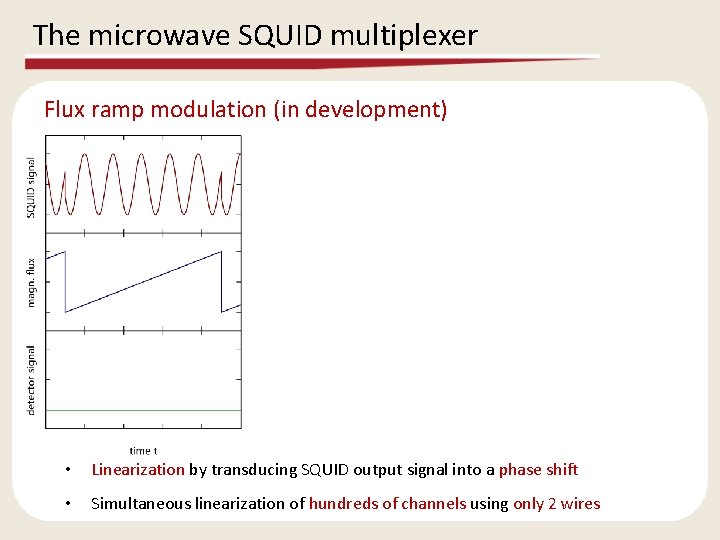
The microwave SQUID multiplexer Flux ramp modulation (in development) • Linearization by transducing SQUID output signal into a phase shift • Simultaneous linearization of hundreds of channels using only 2 wires
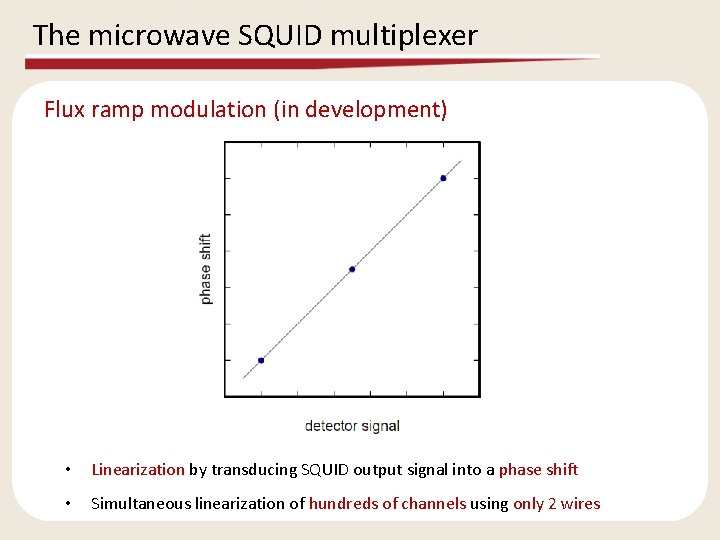
The microwave SQUID multiplexer Flux ramp modulation (in development) • Linearization by transducing SQUID output signal into a phase shift • Simultaneous linearization of hundreds of channels using only 2 wires
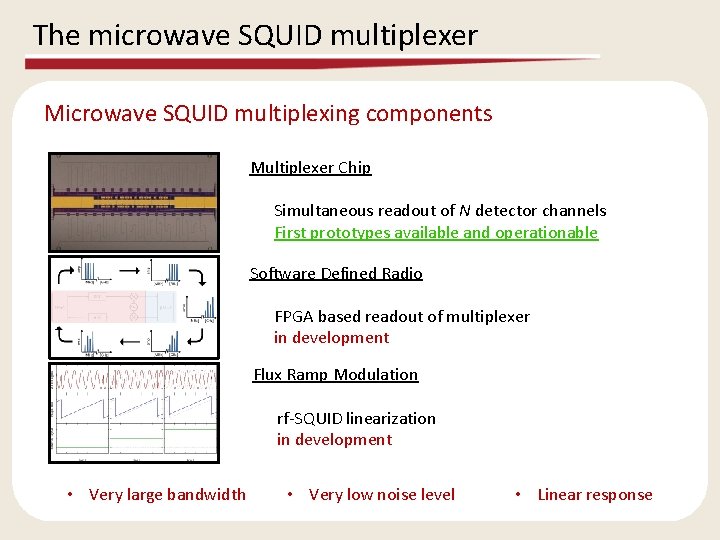
The microwave SQUID multiplexer Microwave SQUID multiplexing components Multiplexer Chip Simultaneous readout of N detector channels First prototypes available and operationable Software Defined Radio FPGA based readout of multiplexer in development Flux Ramp Modulation rf-SQUID linearization in development • Very large bandwidth • Very low noise level • Linear response
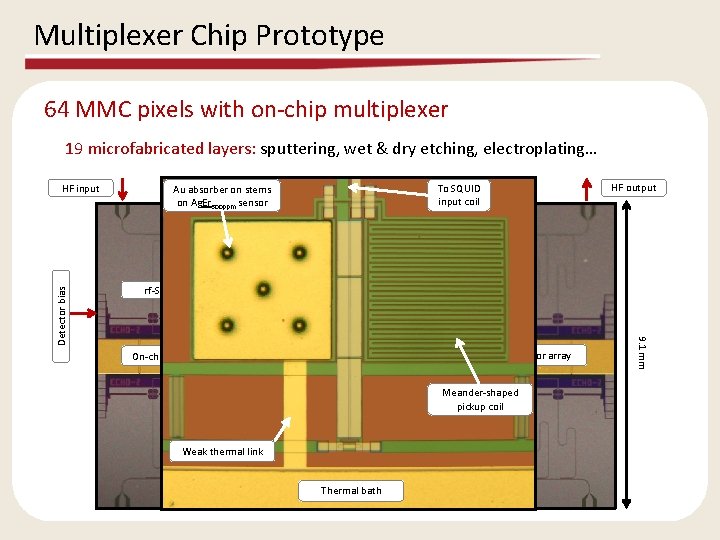
Multiplexer Chip Prototype 64 MMC pixels with on-chip multiplexer 19 microfabricated layers: sputtering, wet & dry etching, electroplating… rf-SQUIDs HF output To SQUID input coil Au absorber on stems on Ag. Er 300 ppm sensor Superconducting microwave resonators Detector array On-chip heat bath Meander-shaped pickup coil Weak thermal link Thermal bath 9. 1 mm Detector bias HF input
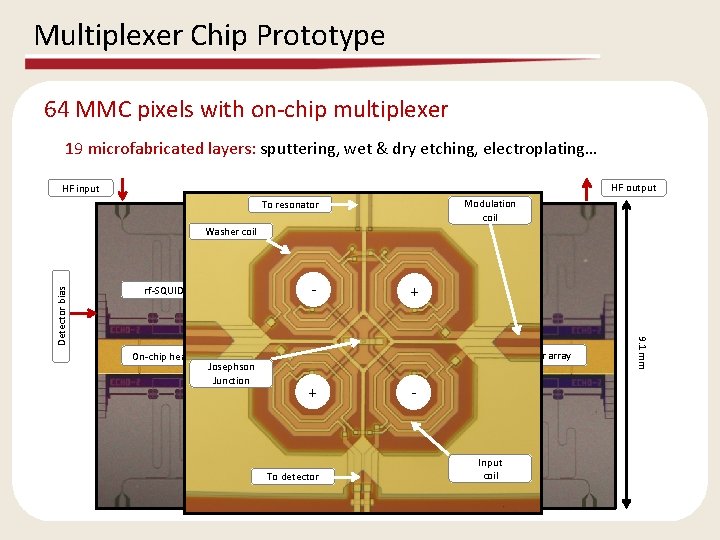
Multiplexer Chip Prototype 64 MMC pixels with on-chip multiplexer 19 microfabricated layers: sputtering, wet & dry etching, electroplating… HF output HF input Modulation coil To resonator rf-SQUIDs On-chip heat bath Josephson Junction Superconducting microwave resonators - + Detector array + To detector - Input coil 9. 1 mm Detector bias Washer coil
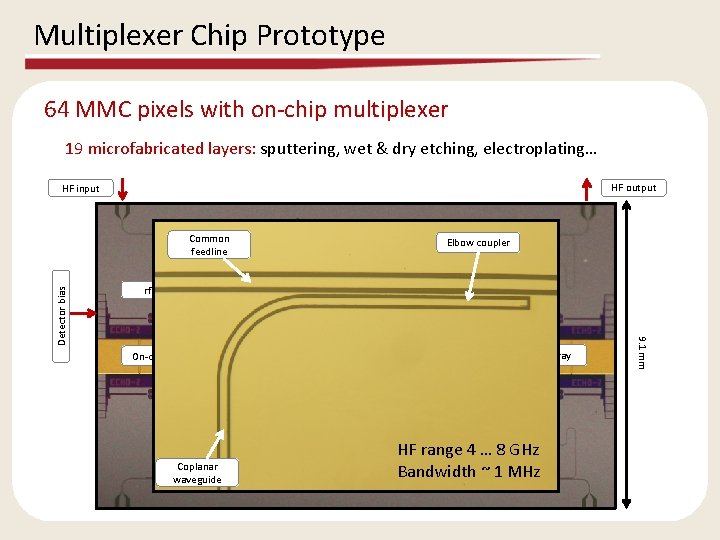
Multiplexer Chip Prototype 64 MMC pixels with on-chip multiplexer 19 microfabricated layers: sputtering, wet & dry etching, electroplating… HF output HF input rf-SQUIDs On-chip heat bath Coplanar waveguide Elbow coupler Superconducting microwave resonators Detector array HF range 4 … 8 GHz Bandwidth ~ 1 MHz 9. 1 mm Detector bias Common feedline
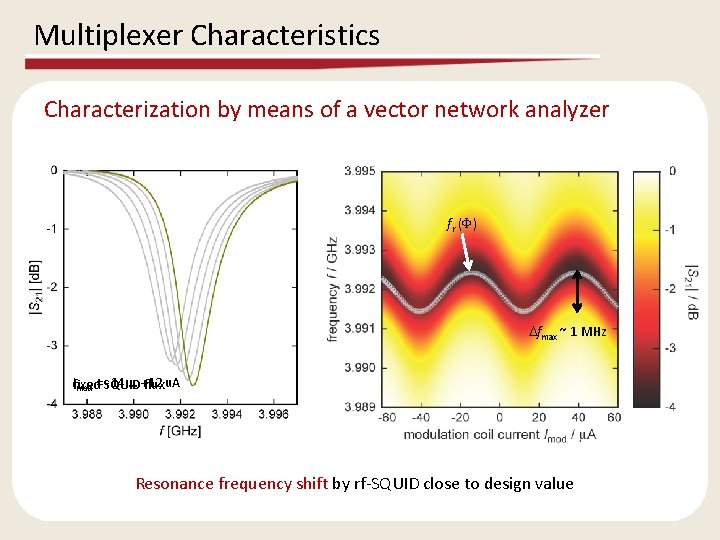
Multiplexer Characteristics Characterization by means of a vector network analyzer fr (F) Dfmax ~ 1 MHz Ifixed -14 … +12 fluxu. A mod = SQUID Resonance frequency shift by rf-SQUID close to design value
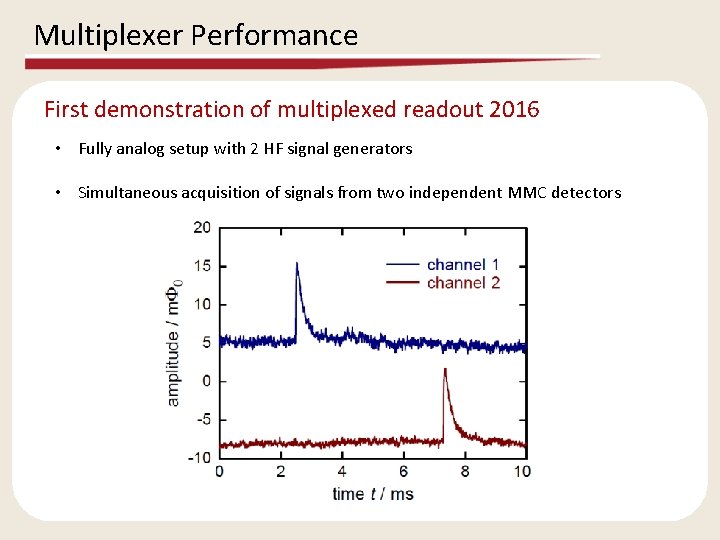
Multiplexer Performance First demonstration of multiplexed readout 2016 • Fully analog setup with 2 HF signal generators • Simultaneous acquisition of signals from two independent MMC detectors
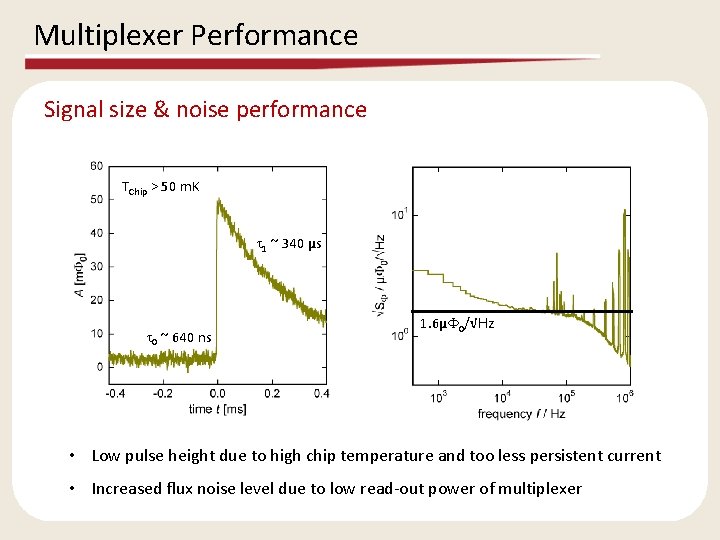
Multiplexer Performance Signal size & noise performance TChip > 50 m. K t 1 ~ 340 µs t 0 ~ 640 ns 1. 6µF 0/√Hz • Low pulse height due to high chip temperature and too less persistent current • Increased flux noise level due to low read-out power of multiplexer
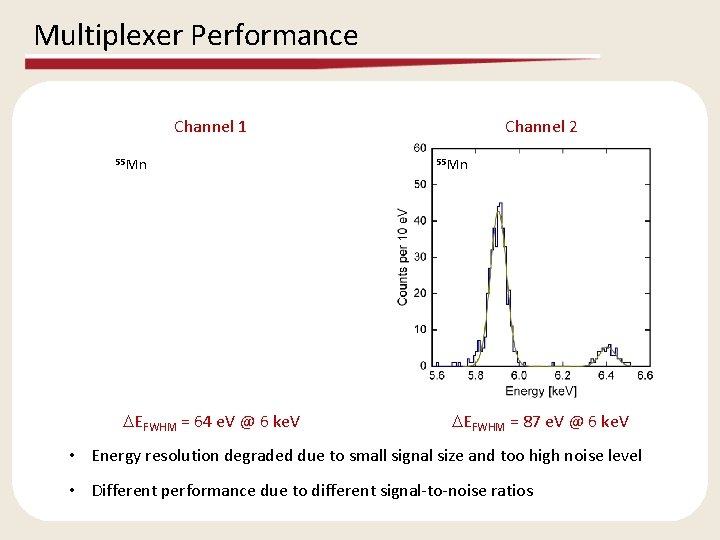
Multiplexer Performance Channel 1 55 Mn DEFWHM = 64 e. V @ 6 ke. V Channel 2 55 Mn DEFWHM = 87 e. V @ 6 ke. V • Energy resolution degraded due to small signal size and too high noise level • Different performance due to different signal-to-noise ratios
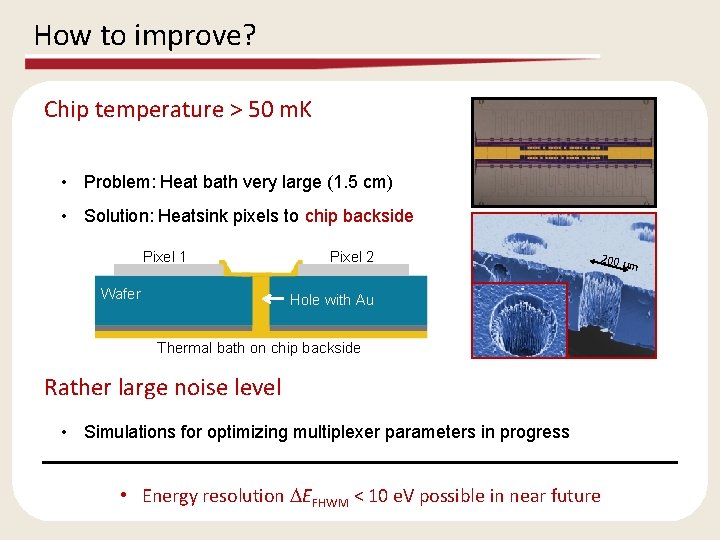
How to improve? Chip temperature > 50 m. K • Problem: Heat bath very large (1. 5 cm) • Solution: Heatsink pixels to chip backside Pixel 1 Wafer Pixel 2 Hole with Au Thermal bath on chip backside Rather large noise level • Simulations for optimizing multiplexer parameters in progress • Energy resolution DEFHWM < 10 e. V possible in near future 200 µ m
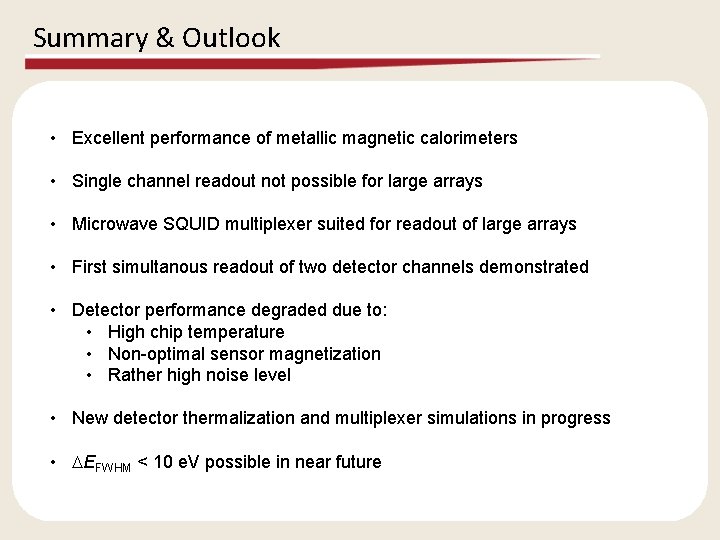
Summary & Outlook • Excellent performance of metallic magnetic calorimeters • Single channel readout not possible for large arrays • Microwave SQUID multiplexer suited for readout of large arrays • First simultanous readout of two detector channels demonstrated • Detector performance degraded due to: • High chip temperature • Non-optimal sensor magnetization • Rather high noise level • New detector thermalization and multiplexer simulations in progress • DEFWHM < 10 e. V possible in near future
Thank you for your attention