
Microwave Radiometry Outline Introduction l Thermal Radiation l

![Spectral brightness Bf [Planck] 9](https://slidetodoc.com/presentation_image/ccc70c20b8cdbc003af382b8ddc82ac7/image-9.jpg "Spectral brightness Bf [Planck] 9")
![Blackbody Radiation given by Planck’s Law l Measure spectral brightness Bf [Planck] For microwaves,](https://slidetodoc.com/presentation_image/ccc70c20b8cdbc003af382b8ddc82ac7/image-14.jpg "Blackbody Radiation given by Planck’s Law l Measure spectral brightness Bf [Planck] For microwaves,")
![Total power measured due to objects Brightness, Bf B=Brightness=radiance [W/m 2 sr] Bf =](https://slidetodoc.com/presentation_image/ccc70c20b8cdbc003af382b8ddc82ac7/image-16.jpg "Total power measured due to objects Brightness, Bf B=Brightness=radiance [W/m 2 sr] Bf =")

- Slides: 28
Microwave Radiometry
Outline Introduction l Thermal Radiation l Black body radiation l – Rayleigh-Jeans Power-Temperature correspondence l Non-Blackbody radiation l – TB, brightness temperature – TAP, apparent temperature – TA, antenna temperature l More realistic Antenna – Effect of the beam shape – Effect of the losses of the antenna 2
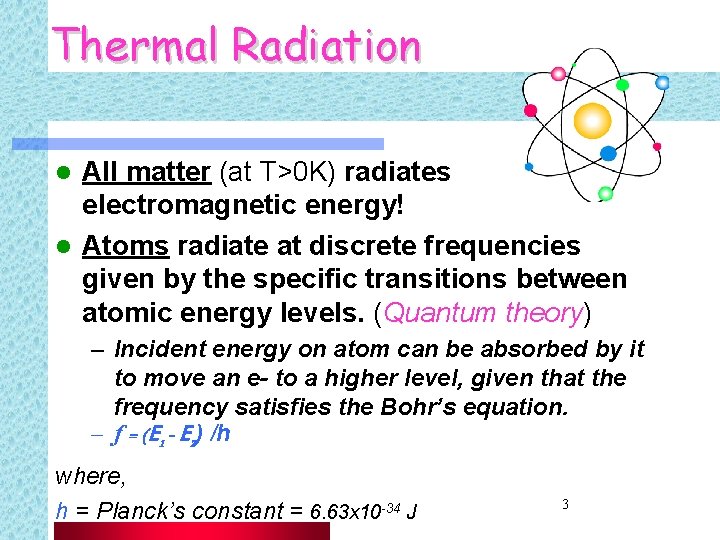
Thermal Radiation All matter (at T>0 K) radiates electromagnetic energy! l Atoms radiate at discrete frequencies given by the specific transitions between atomic energy levels. (Quantum theory) l – Incident energy on atom can be absorbed by it to move an e- to a higher level, given that the frequency satisfies the Bohr’s equation. – f = (E 1 - E 2) /h where, h = Planck’s constant = 6. 63 x 10 -34 J 3
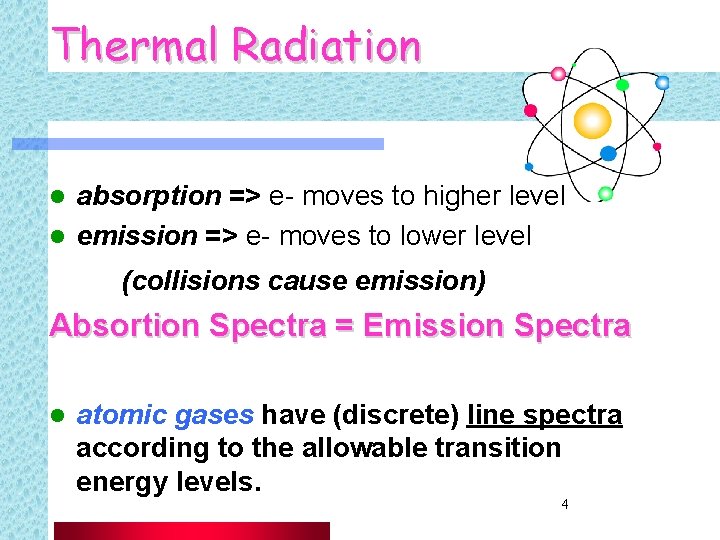
Thermal Radiation absorption => e- moves to higher level l emission => e- moves to lower level l (collisions cause emission) Absortion Spectra = Emission Spectra l atomic gases have (discrete) line spectra according to the allowable transition energy levels. 4
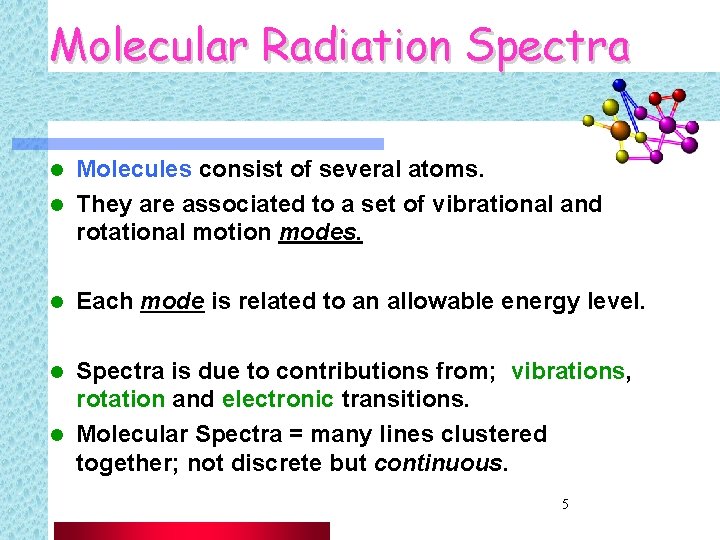
Molecular Radiation Spectra Molecules consist of several atoms. l They are associated to a set of vibrational and rotational motion modes. l l Each mode is related to an allowable energy level. Spectra is due to contributions from; vibrations, rotation and electronic transitions. l Molecular Spectra = many lines clustered together; not discrete but continuous. l 5
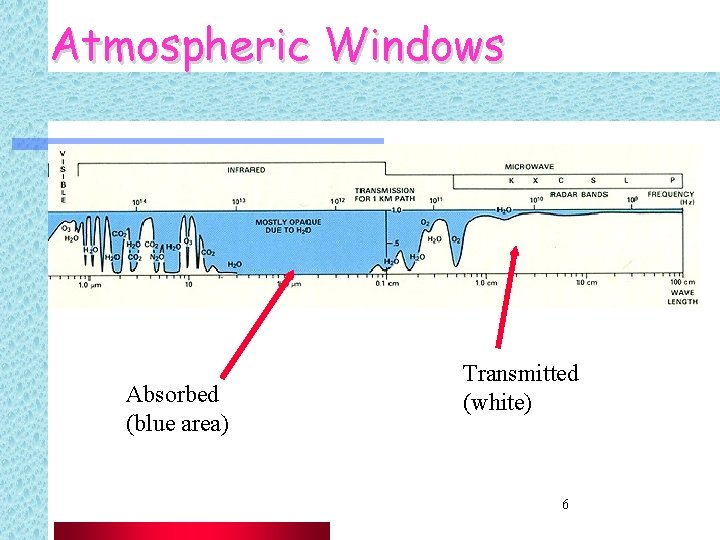
Atmospheric Windows Absorbed (blue area) Transmitted (white) 6
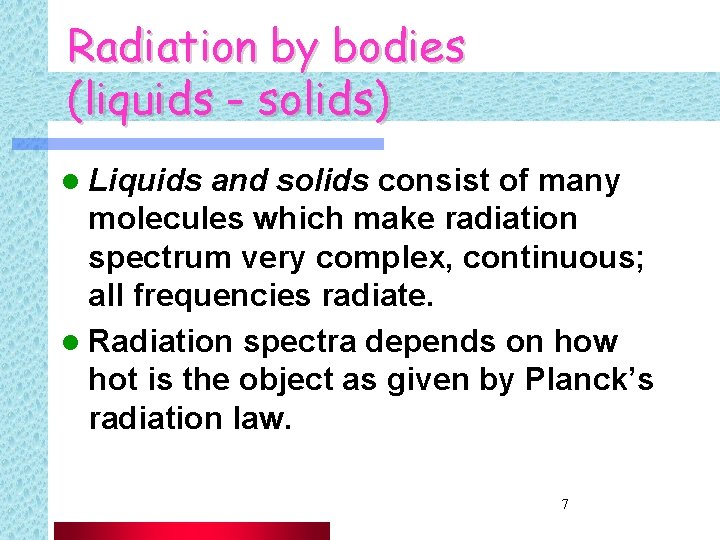
Radiation by bodies (liquids - solids) l Liquids and solids consist of many molecules which make radiation spectrum very complex, continuous; all frequencies radiate. l Radiation spectra depends on how hot is the object as given by Planck’s radiation law. 7
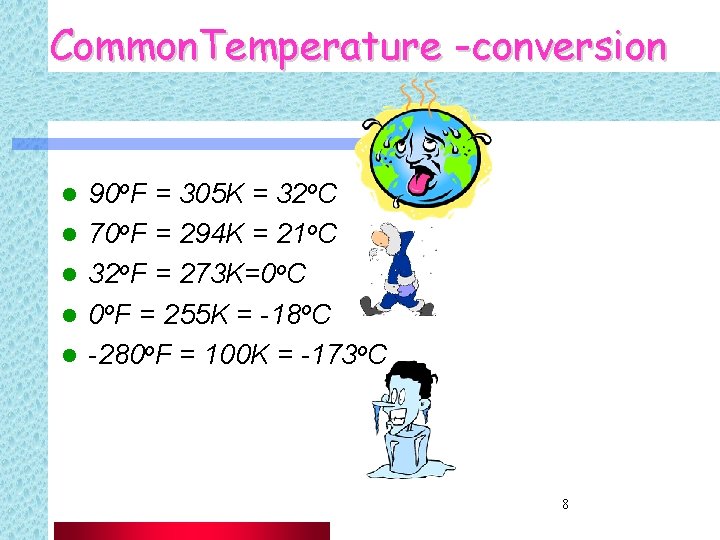
Common. Temperature -conversion l l l 90 o. F = 305 K = 32 o. C 70 o. F = 294 K = 21 o. C 32 o. F = 273 K=0 o. C 0 o. F = 255 K = -18 o. C -280 o. F = 100 K = -173 o. C 8
Spectral brightness Bf [Planck] 9
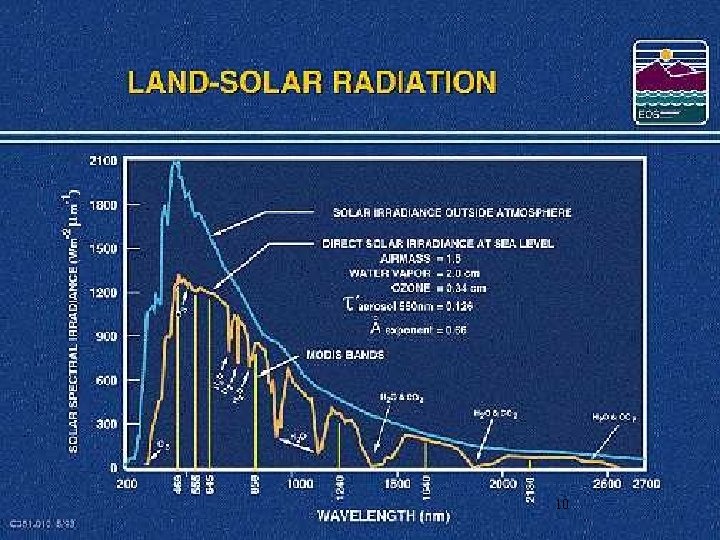
Sun 10
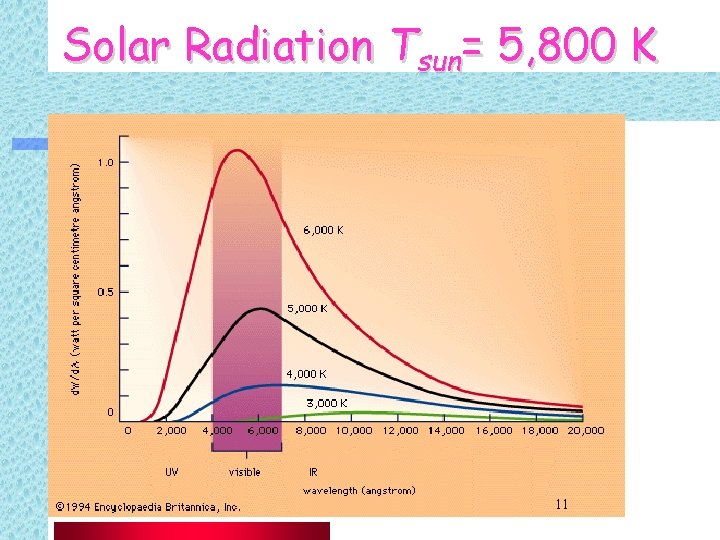
Solar Radiation Tsun= 5, 800 K 11
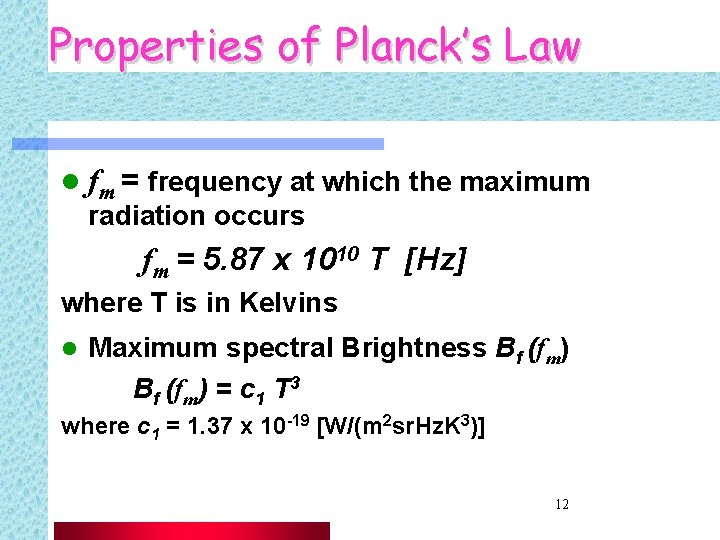
Properties of Planck’s Law l fm = frequency at which the maximum radiation occurs fm = 5. 87 x 1010 T [Hz] where T is in Kelvins l Maximum spectral Brightness Bf (fm) = c 1 T 3 where c 1 = 1. 37 x 10 -19 [W/(m 2 sr. Hz. K 3)] 12
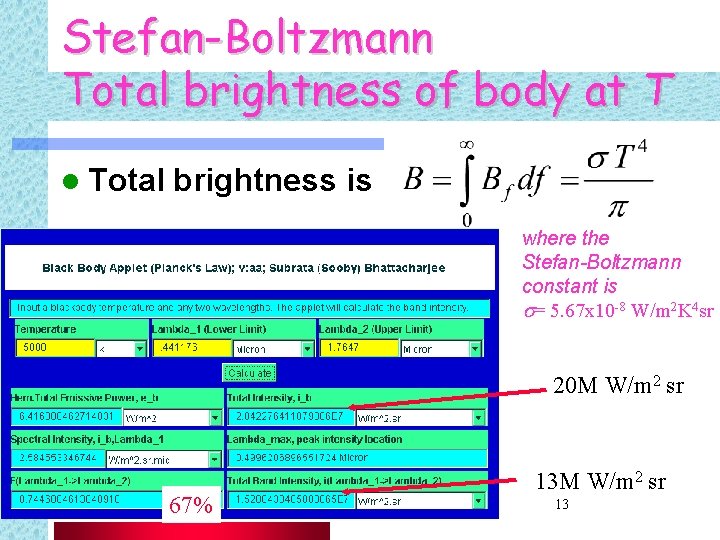
Stefan-Boltzmann Total brightness of body at T l Total brightness is where the Stefan-Boltzmann constant is s= 5. 67 x 10 -8 W/m 2 K 4 sr 20 M W/m 2 sr 67% 13 M W/m 2 sr 13
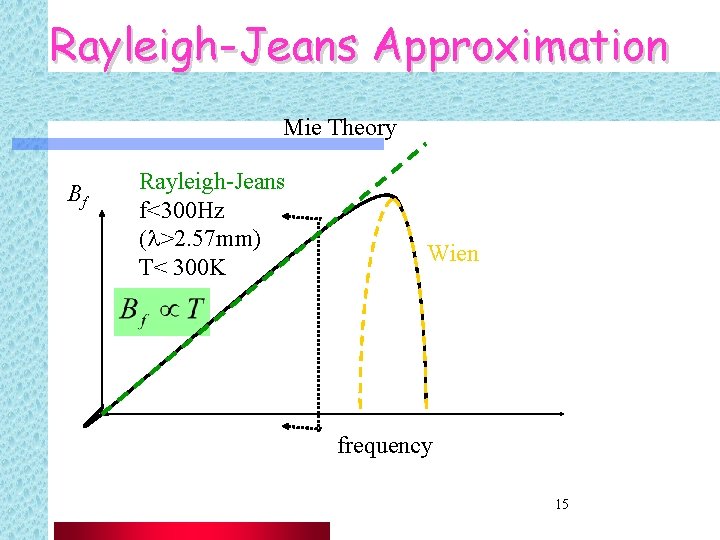
Blackbody Radiation given by Planck’s Law l Measure spectral brightness Bf [Planck] For microwaves, Rayleigh-Jeans Law, condition hf/k. T<<1 (low f ) , then ex-1 x l At T<300 K, the error < 1% for f<117 GHz), and error< 3% for f<300 GHz) 14
Rayleigh-Jeans Approximation Mie Theory Bf Rayleigh-Jeans f<300 Hz (l>2. 57 mm) T< 300 K Wien frequency 15
Total power measured due to objects Brightness, Bf B=Brightness=radiance [W/m 2 sr] Bf = spectral brightness (B per unit Hz) Bl = spectral brightness (B per unit cm) Fn= normalized antenna radiation pattern W= solid angle [steradians] Ar=antenna aperture on receiver 16
Power-Temperature correspondence 17
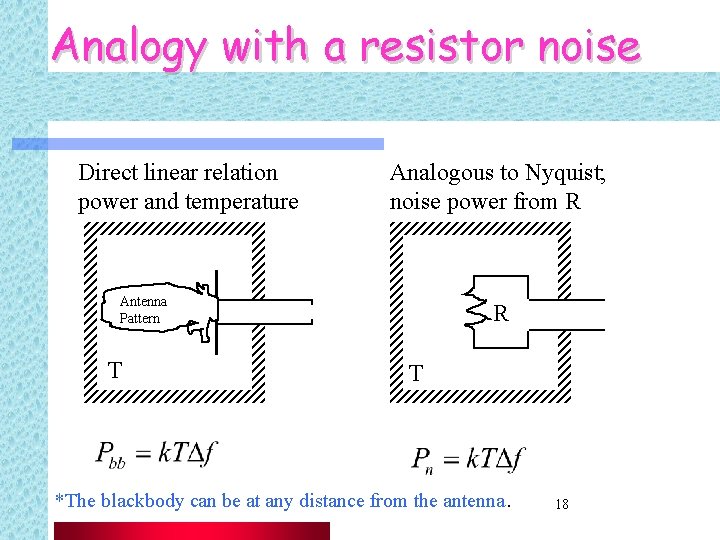
Analogy with a resistor noise Direct linear relation power and temperature Analogous to Nyquist; noise power from R Antenna Pattern T R T *The blackbody can be at any distance from the antenna. 18
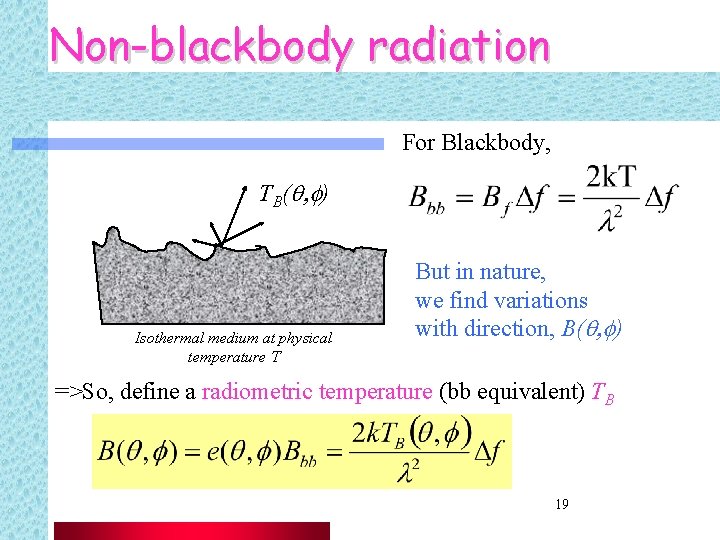
Non-blackbody radiation For Blackbody, TB(q, f) Isothermal medium at physical temperature T But in nature, we find variations with direction, B(q, f) =>So, define a radiometric temperature (bb equivalent) TB 19
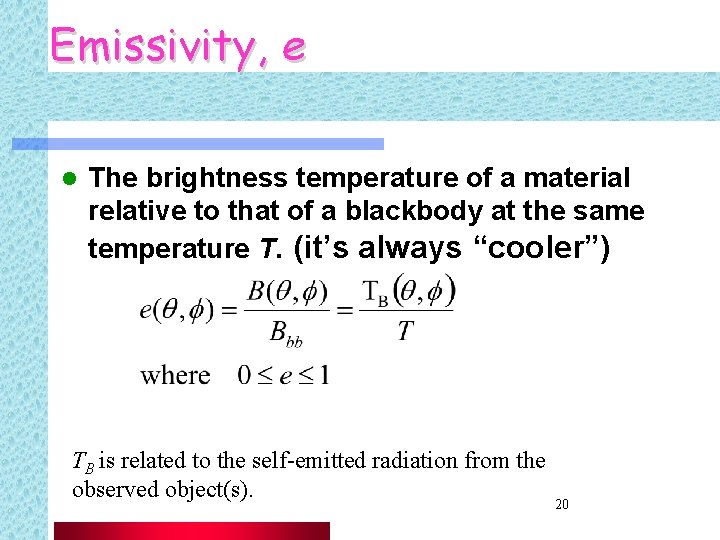
Emissivity, e l The brightness temperature of a material relative to that of a blackbody at the same temperature T. (it’s always “cooler”) TB is related to the self-emitted radiation from the observed object(s). 20
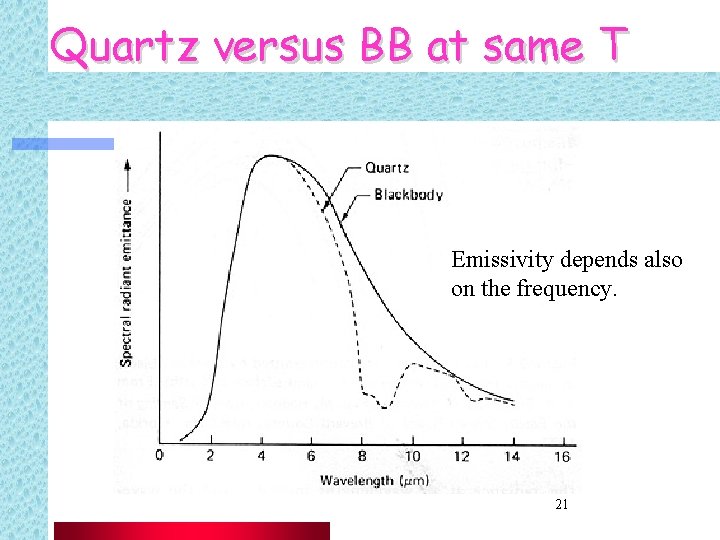
Quartz versus BB at same T Emissivity depends also on the frequency. 21
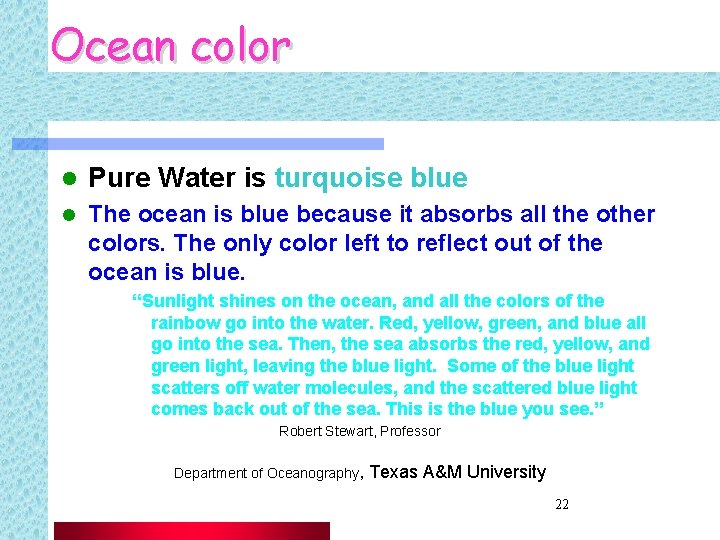
Ocean color l Pure Water is turquoise blue l The ocean is blue because it absorbs all the other colors. The only color left to reflect out of the ocean is blue. “Sunlight shines on the ocean, and all the colors of the rainbow go into the water. Red, yellow, green, and blue all go into the sea. Then, the sea absorbs the red, yellow, and green light, leaving the blue light. Some of the blue light scatters off water molecules, and the scattered blue light comes back out of the sea. This is the blue you see. ” Robert Stewart, Professor Department of Oceanography, Texas A&M University 22
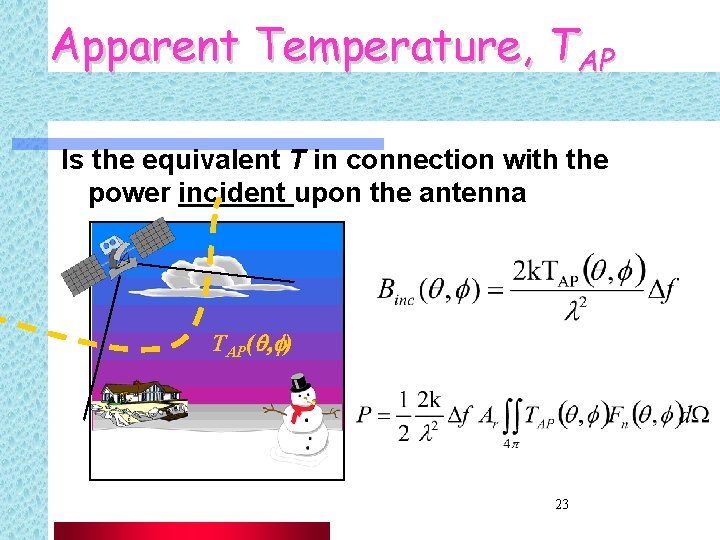
Apparent Temperature, TAP Is the equivalent T in connection with the power incident upon the antenna TAP(q, f) 23
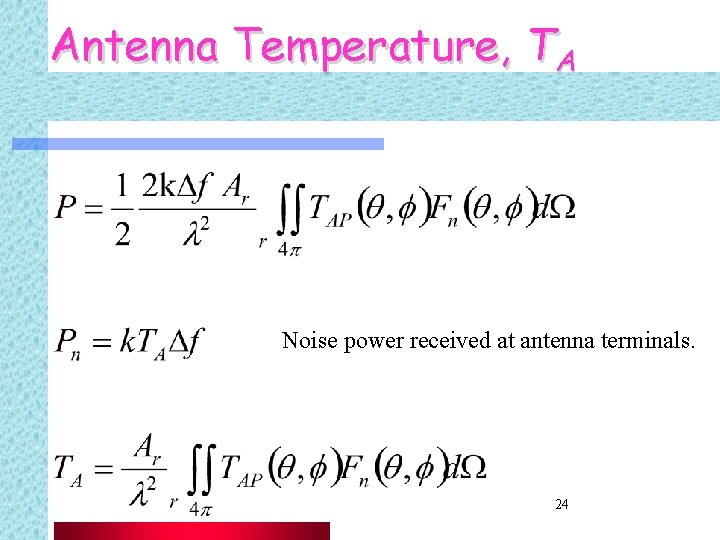
Antenna Temperature, TA Noise power received at antenna terminals. 24
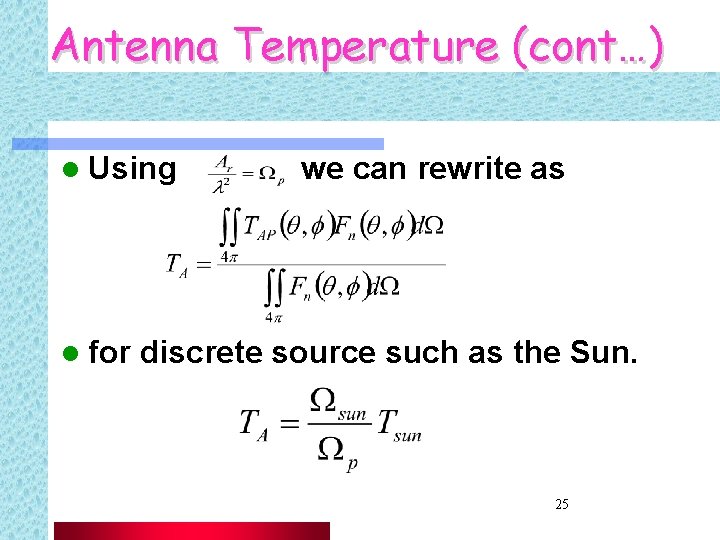
Antenna Temperature (cont…) l Using l for we can rewrite as discrete source such as the Sun. 25
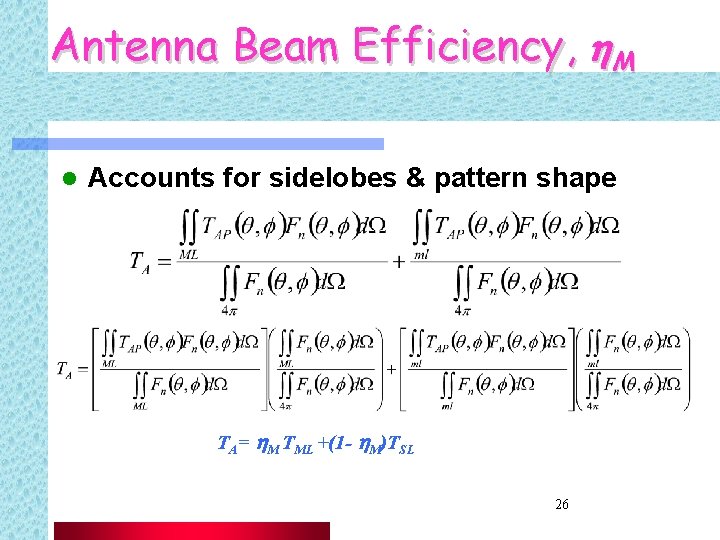
Antenna Beam Efficiency, h. M l Accounts for sidelobes & pattern shape TA= h. M TML +(1 - h. M)TSL 26
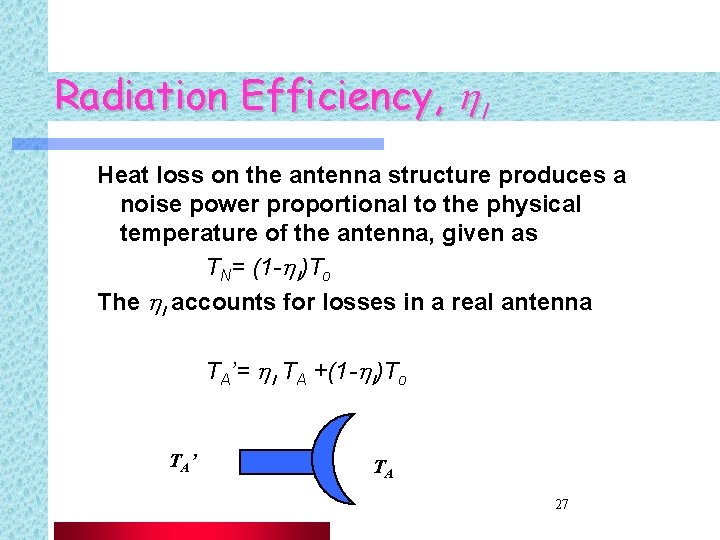
Radiation Efficiency, hl Heat loss on the antenna structure produces a noise power proportional to the physical temperature of the antenna, given as TN= (1 -hl)To The hl accounts for losses in a real antenna TA’= hl TA +(1 -hl)To TA’ TA 27
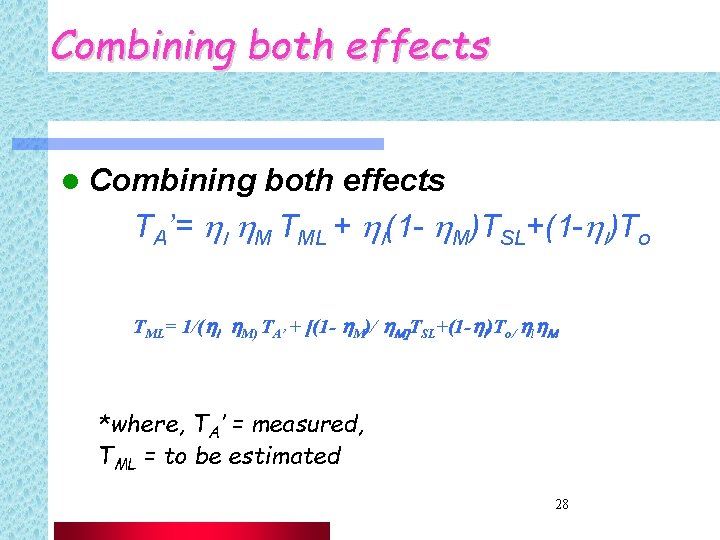
Combining both effects l Combining both effects TA’= hl h. M TML + hl(1 - h. M)TSL+(1 -hl)To TML= 1/(hl h. M) TA’ + [(1 - h. M)/ h. M]TSL+(1 -hl)To/ hlh. M *where, TA’ = measured, TML = to be estimated 28