
Microwave Plasma Discharge and Its Applications Mark Gokowski
- Slides: 12
Microwave Plasma Discharge and Its Applications Mark Gołkowski Physics 312 February 1, 2007
Outline § § § Microwave Plasma Discharge Hardware Physics of Microwave Breakdown Applications Dry Sterilization Application 2
Microwave Plasma Discharge § Gas ionization using EM waves: 1 GHz 300 GHz (~2. 4 GHz most common) § Wide range of operation over temperature and pressure § mtorr-higher than atmospheric pressure § Very high to ambient temperature § Attractive because hardware is cheap and easy to control § Safe and wear free: No high voltage electrodes 3
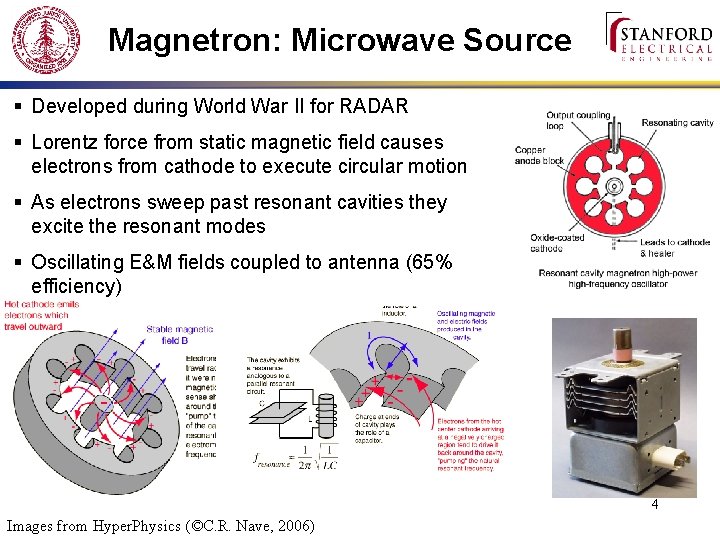
Magnetron: Microwave Source § Developed during World War II for RADAR § Lorentz force from static magnetic field causes electrons from cathode to execute circular motion § As electrons sweep past resonant cavities they excite the resonant modes § Oscillating E&M fields coupled to antenna (65% efficiency) 4 Images from Hyper. Physics (©C. R. Nave, 2006)
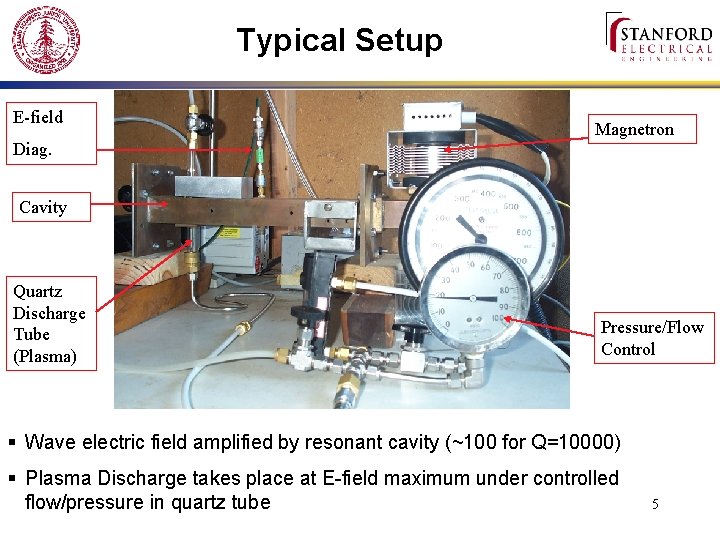
Typical Setup E-field Magnetron Diag. Cavity Quartz Discharge Tube (Plasma) Pressure/Flow Control § Wave electric field amplified by resonant cavity (~100 for Q=10000) § Plasma Discharge takes place at E-field maximum under controlled flow/pressure in quartz tube 5
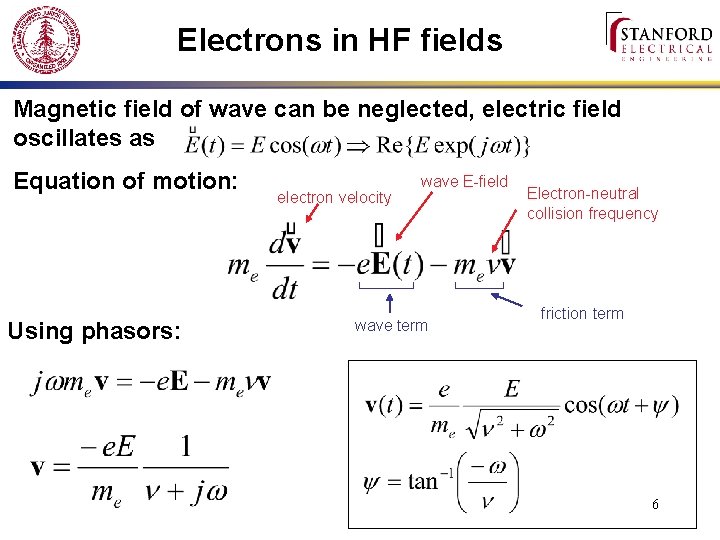
Electrons in HF fields Magnetic field of wave can be neglected, electric field oscillates as Equation of motion: Using phasors: electron velocity wave E-field wave term Electron-neutral collision frequency friction term 6
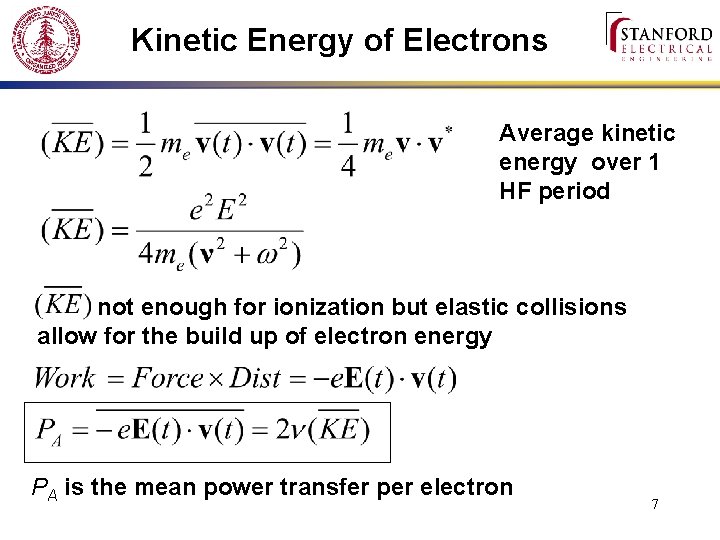
Kinetic Energy of Electrons Average kinetic energy over 1 HF period not enough for ionization but elastic collisions allow for the build up of electron energy PA is the mean power transfer per electron 7
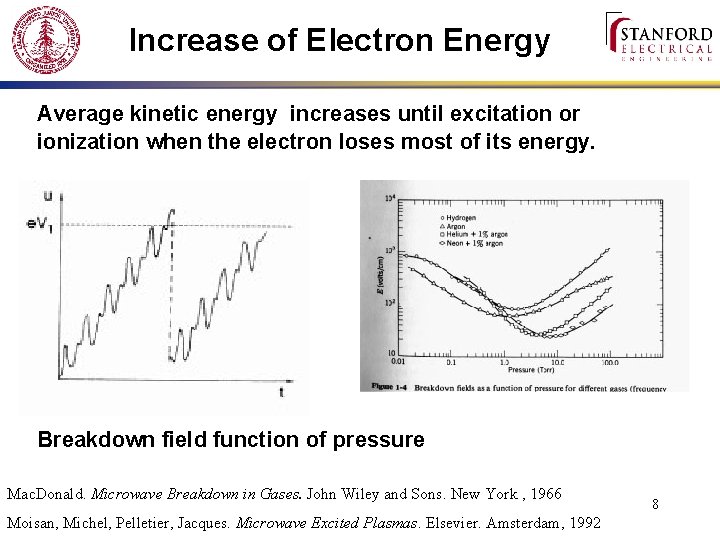
Increase of Electron Energy Average kinetic energy increases until excitation or ionization when the electron loses most of its energy. Breakdown field function of pressure Mac. Donald. Microwave Breakdown in Gases. John Wiley and Sons. New York , 1966 Moisan, Michel, Pelletier, Jacques. Microwave Excited Plasmas. Elsevier. Amsterdam, 1992 8
Applications § Applications of plasma are in general very broad § Because of low-cost, ease of control, wide temperature/pressure range, microwave plasmas well suited for enhancing chemical reactions § Since electrons are excited/ionized reaction rates normally associated with very high temperatures (>10, 000 C) are feasible at ambient temperature § Examples: Chemical Vapor Deposition (CVD), filtration/sterilization 9
Dry Sterilization § Sterilization without use of chemicals/liquids - no waste product § Ideal for sterilizing sensitive equipment, instruments (plastics, electronics) § Effective at disinfecting wounds/cuts § Achievable with microwave plasma 10
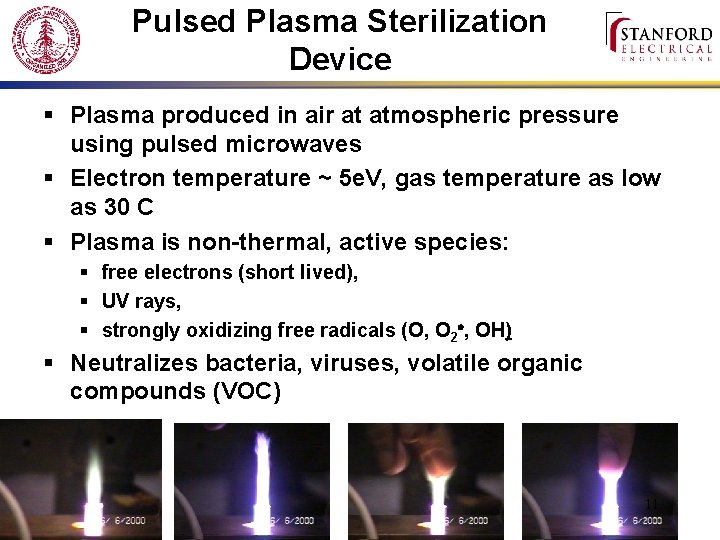
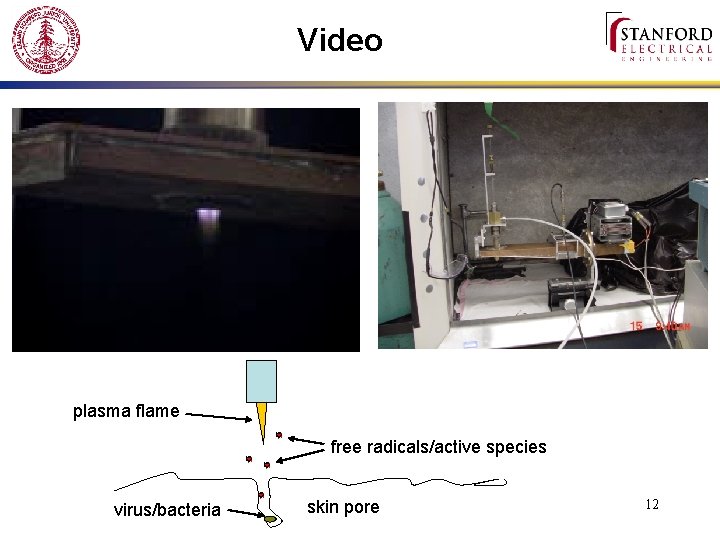
Pulsed Plasma Sterilization Device § Plasma produced in air at atmospheric pressure using pulsed microwaves § Electron temperature ~ 5 e. V, gas temperature as low as 30 C § Plasma is non-thermal, active species: § free electrons (short lived), § UV rays, § strongly oxidizing free radicals (O, O 2 , OH) § Neutralizes bacteria, viruses, volatile organic compounds (VOC) 11
Video plasma flame free radicals/active species virus/bacteria skin pore 12