
Microsoft Office 2013 Excel Chapter 1 Creating a
- Slides: 68
Microsoft Office 2013 Excel Chapter 1 Creating a Worksheet and an Embedded Chart
What is Excel • Excel is a spreadsheet program in the Microsoft Office system. • You can use Excel to create and format workbooks in order to analyze data and make more informed business decisions. • track data, build models for analyzing data, write formulas to perform calculations on that data, pivot the data in numerous ways, and present data in a variety of looking charts. 2
Common scenarios for using Excel include: • • • Accounting You can use the powerful calculation features of Excel in many financial accounting statements—for example, a cash flow statement, income statement, or profit and loss statement. Budgeting Whether your needs are personal or business related, you can create any type of budget in Excel—for example, a marketing budget plan, an event budget, or a retirement budget. Billing and sales Excel is also useful for managing billing and sales data, and you can easily create the forms that you need—for example, sales invoices, packing slips, or purchase orders. Reporting You can create various types of reports in Excel that reflect your data analysis or summarize your data—for example, reports that measure project performance, show variance between projected and actual results, or reports that you can use to forecast data. Planning Excel is a great tool for creating professional plans or useful planners—for example, a weekly class plan, a marketing research plan, a year-end tax plan, or planners that help you organize weekly meals, parties, or vacations. Tracking You can use Excel to keep track of data in a time sheet or list—for example, a time sheet for tracking work, or an inventory list that keeps track of equipment. 3
What is Microsoft Excel? • • Spreadsheet program that allows users to organize data, complete calculations, make decisions, and graph data. 4 Major Parts 1. 2. 3. 4. Work Sheets Charts Lists Web Support
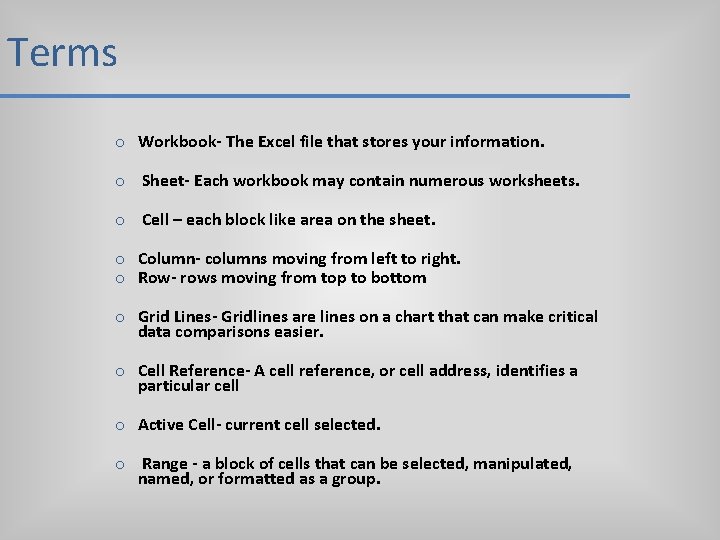
Terms o Workbook- The Excel file that stores your information. o Sheet- Each workbook may contain numerous worksheets. o Cell – each block like area on the sheet. o Column- columns moving from left to right. o Row- rows moving from top to bottom o Grid Lines- Gridlines are lines on a chart that can make critical data comparisons easier. o Cell Reference- A cell reference, or cell address, identifies a particular cell o Active Cell- current cell selected. o Range - a block of cells that can be selected, manipulated, named, or formatted as a group.
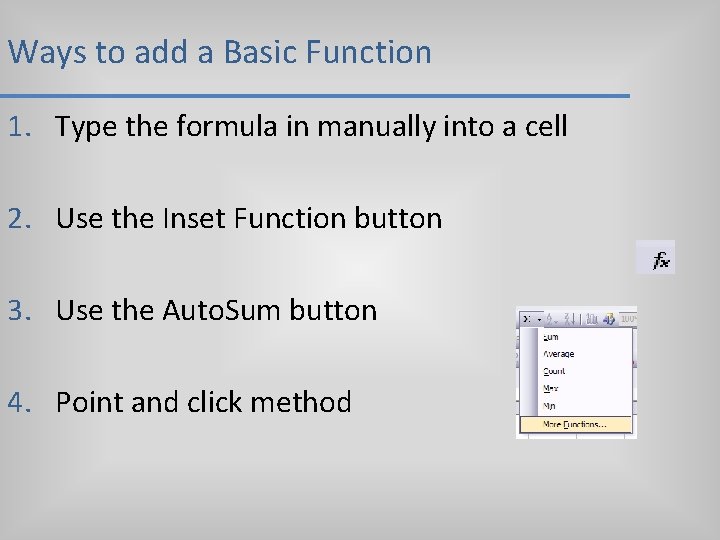
Ways to add a Basic Function 1. Type the formula in manually into a cell 2. Use the Inset Function button 3. Use the Auto. Sum button 4. Point and click method
Plan Ahead Select titles and subtitles for the worksheet Determine the contents for rows and columns Determine the calculations that are needed Determine where to save the workbook Identify how to format various elements of the worksheet • Decide on the type of chart needed • Establish where to position and how to format the chart • • • 7
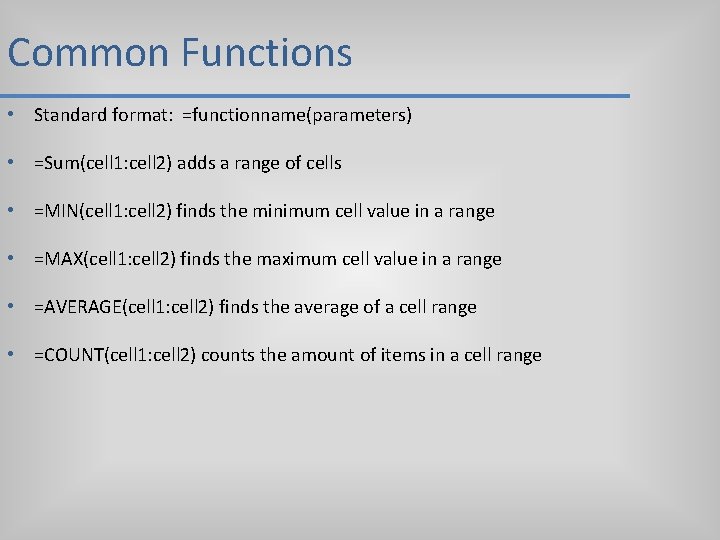
Common Functions • Standard format: =functionname(parameters) • =Sum(cell 1: cell 2) adds a range of cells • =MIN(cell 1: cell 2) finds the minimum cell value in a range • =MAX(cell 1: cell 2) finds the maximum cell value in a range • =AVERAGE(cell 1: cell 2) finds the average of a cell range • =COUNT(cell 1: cell 2) counts the amount of items in a cell range
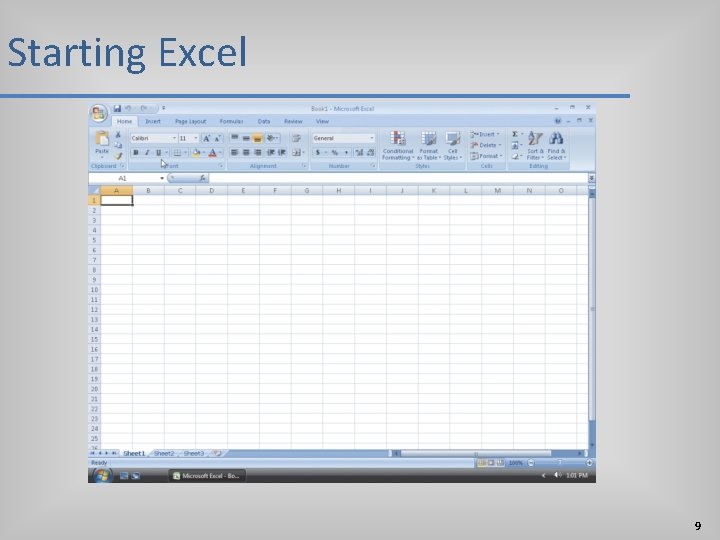
Starting Excel 9
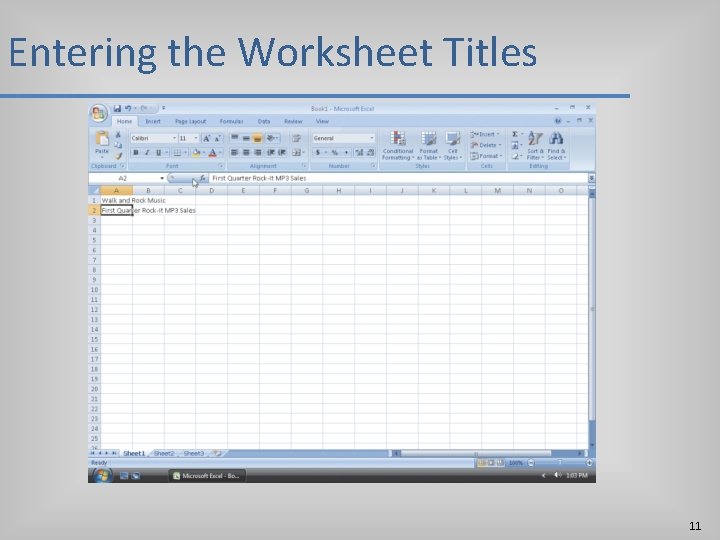
Entering the Worksheet Titles • Click cell A 1 to make cell A 1 the active cell • Type Walk and Rock Music in cell A 1, and then point to the Enter box in the formula bar • Click the Enter box to complete the entry and enter the worksheet title in cell A 1 • Click cell A 2 to select it • Type First Quarter Rock-It MP 3 Sales as the cell entry • Click the Enter box to complete the entry and enter the worksheet subtitle in cell A 2 10
Entering the Worksheet Titles 11
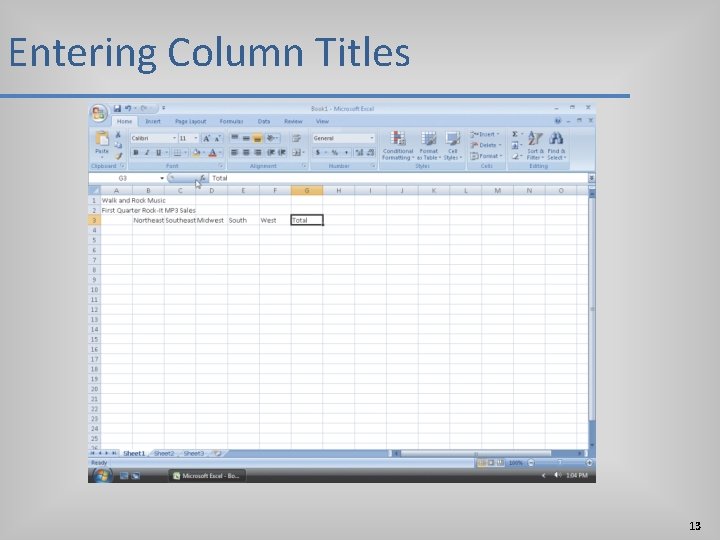
Entering Column Titles • Click cell B 3 to make cell B 3 the active cell • Type Northeast in cell B 3 • Press the RIGHT ARROW key to enter the column title, Northeast, in cell B 3 and make cell C 3 the active cell • Repeat Steps 2 and 3 to enter the remaining column titles in row 3; that is, enter Southeast in cell C 3, Midwest in cell D 3, South in cell E 3, West in cell F 3, and Total in cell G 3 (complete the last entry in cell G 3 by clicking the Enter box in the formula bar) 12
Entering Column Titles 13
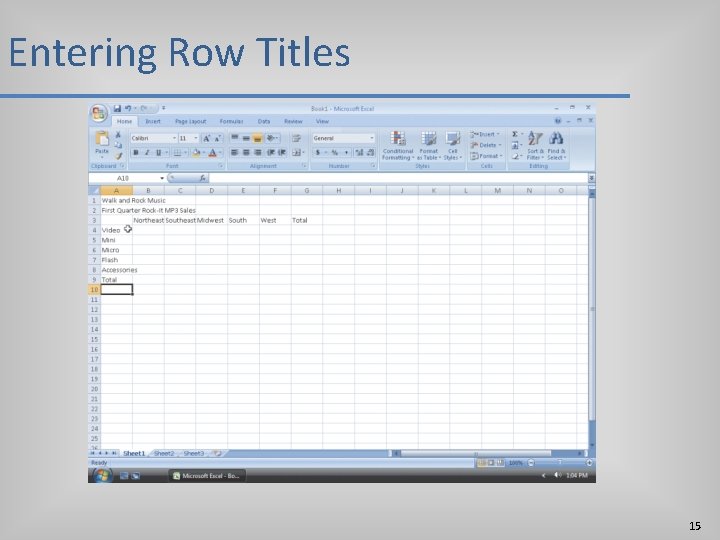
Entering Row Titles • Click cell A 4 to select it • Type Video and then press the DOWN ARROW key to enter the row title and make cell A 5 the active cell • Repeat Step 1 to enter the remaining row titles in column A; that is, enter Mini in cell A 5, Micro in cell A 6, Flash in cell A 7, Accessories in cell A 8, and Total in cell A 9 14
Entering Row Titles 15
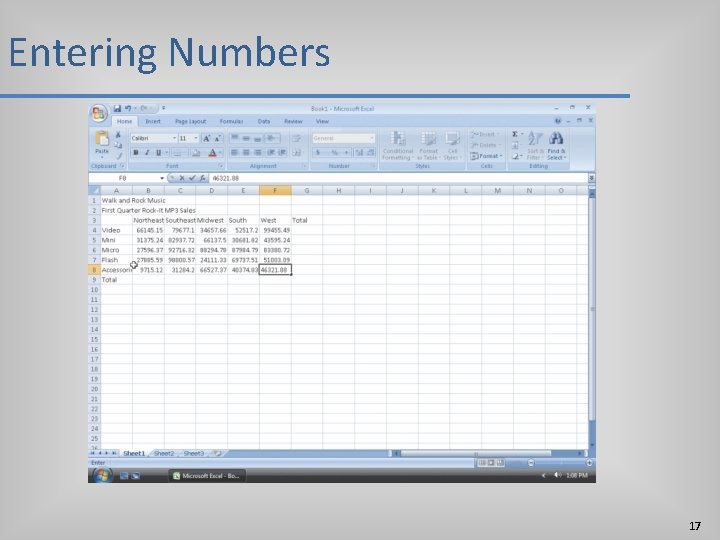
Entering Numbers • Click cell B 4 • Type 66145. 15 and then press the RIGHT ARROW key to enter the data in cell B 4 and make cell C 4 the active cell • Enter 79677. 1 in cell C 4, 34657. 66 in cell D 4, 52517. 2 in cell E 4, and 99455. 49 in cell F 4 • Click cell B 5 • Enter the remaining first quarter sales numbers provided in Table 1– 1 on page EX 23 for each of the four remaining offerings in rows 5, 6, 7, and 8 to display the quarterly sales in the worksheet 16
Entering Numbers 17
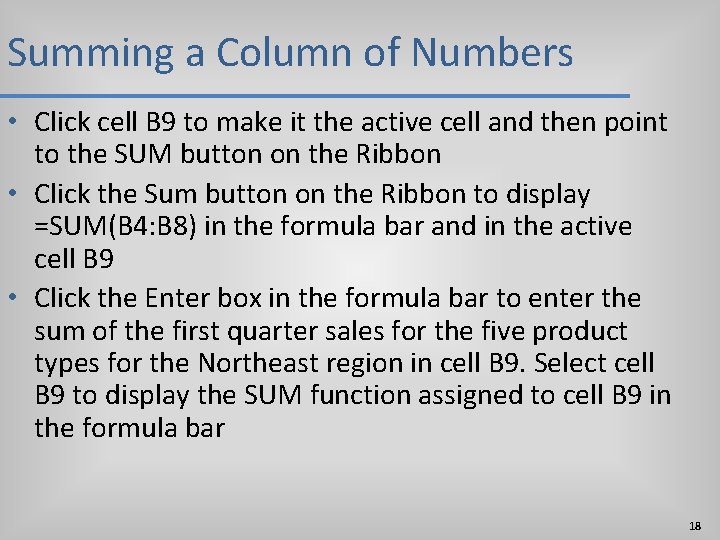
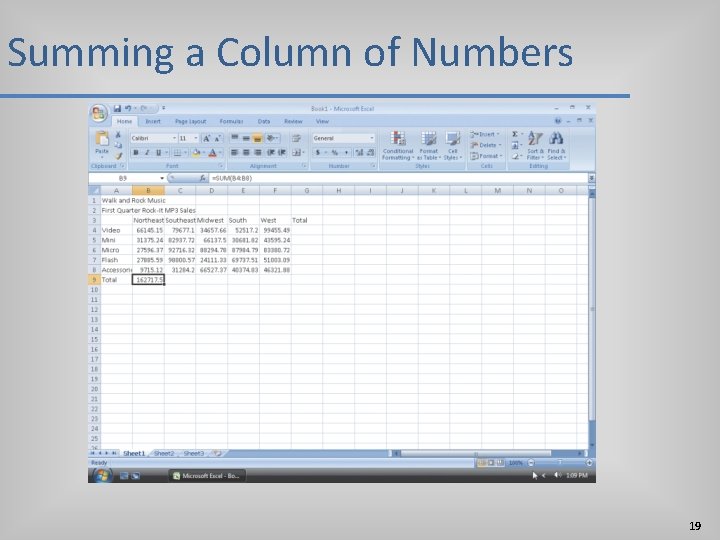
Summing a Column of Numbers • Click cell B 9 to make it the active cell and then point to the SUM button on the Ribbon • Click the Sum button on the Ribbon to display =SUM(B 4: B 8) in the formula bar and in the active cell B 9 • Click the Enter box in the formula bar to enter the sum of the first quarter sales for the five product types for the Northeast region in cell B 9. Select cell B 9 to display the SUM function assigned to cell B 9 in the formula bar 18
Summing a Column of Numbers 19
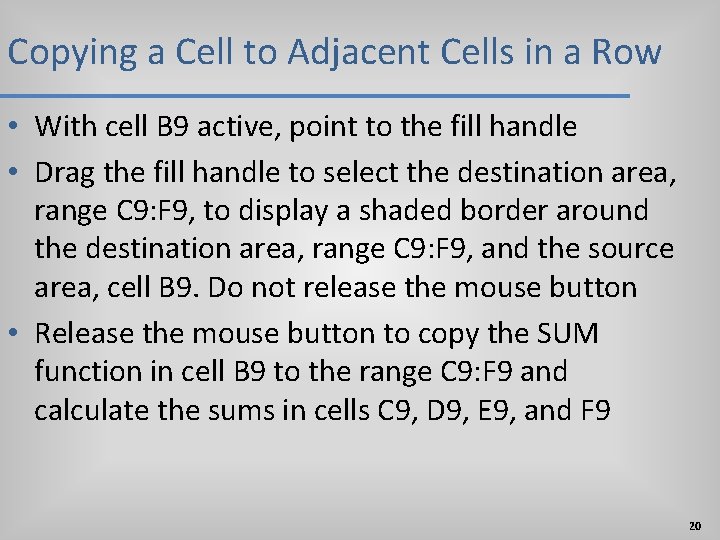
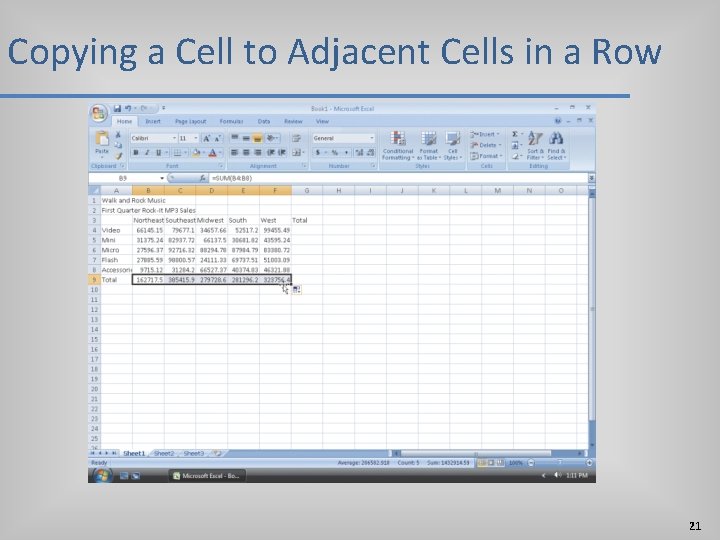
Copying a Cell to Adjacent Cells in a Row • With cell B 9 active, point to the fill handle • Drag the fill handle to select the destination area, range C 9: F 9, to display a shaded border around the destination area, range C 9: F 9, and the source area, cell B 9. Do not release the mouse button • Release the mouse button to copy the SUM function in cell B 9 to the range C 9: F 9 and calculate the sums in cells C 9, D 9, E 9, and F 9 20
Copying a Cell to Adjacent Cells in a Row 21
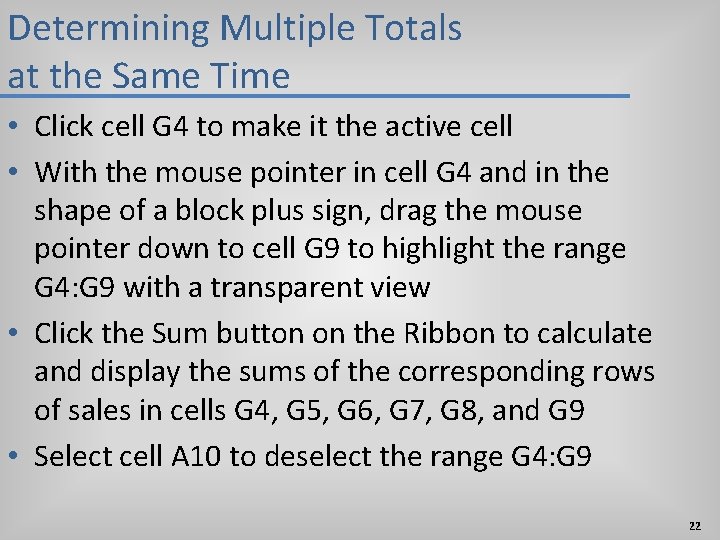
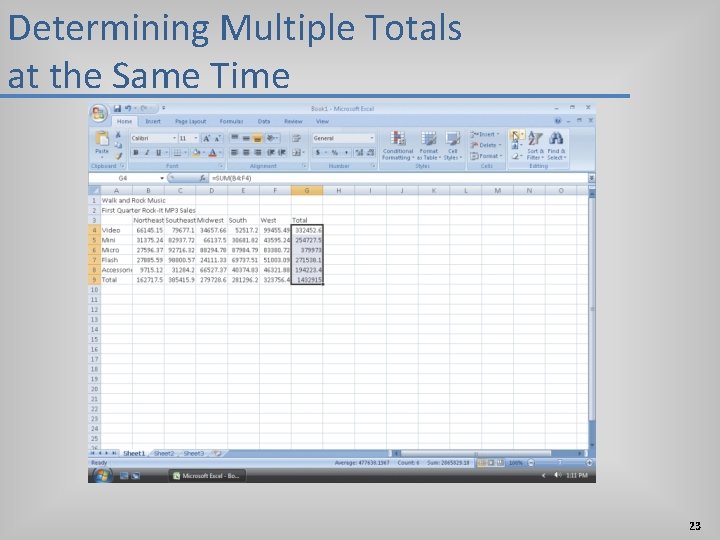
Determining Multiple Totals at the Same Time • Click cell G 4 to make it the active cell • With the mouse pointer in cell G 4 and in the shape of a block plus sign, drag the mouse pointer down to cell G 9 to highlight the range G 4: G 9 with a transparent view • Click the Sum button on the Ribbon to calculate and display the sums of the corresponding rows of sales in cells G 4, G 5, G 6, G 7, G 8, and G 9 • Select cell A 10 to deselect the range G 4: G 9 22
Determining Multiple Totals at the Same Time 23
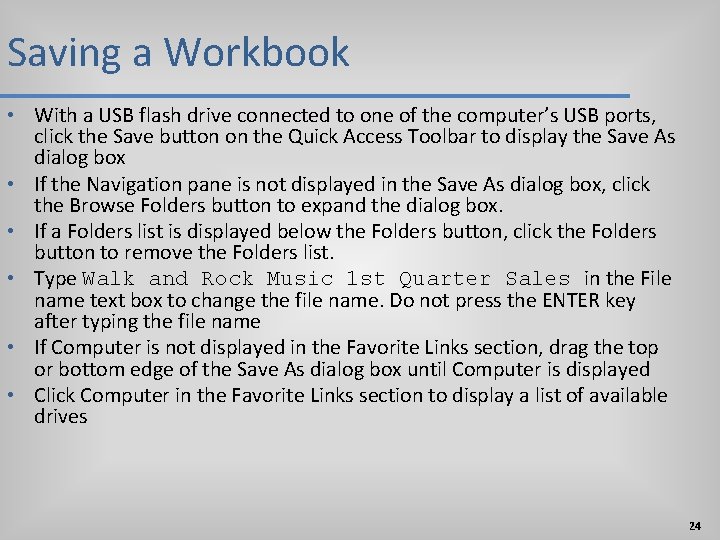
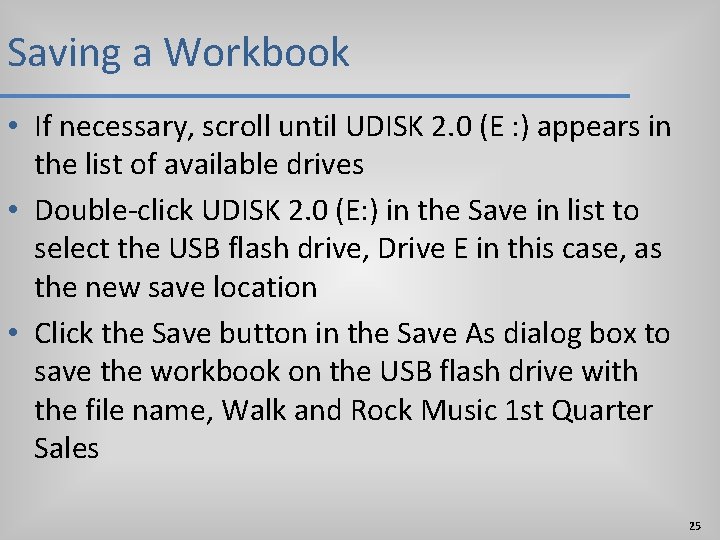
Saving a Workbook • With a USB flash drive connected to one of the computer’s USB ports, click the Save button on the Quick Access Toolbar to display the Save As dialog box • If the Navigation pane is not displayed in the Save As dialog box, click the Browse Folders button to expand the dialog box. • If a Folders list is displayed below the Folders button, click the Folders button to remove the Folders list. • Type Walk and Rock Music 1 st Quarter Sales in the File name text box to change the file name. Do not press the ENTER key after typing the file name • If Computer is not displayed in the Favorite Links section, drag the top or bottom edge of the Save As dialog box until Computer is displayed • Click Computer in the Favorite Links section to display a list of available drives 24
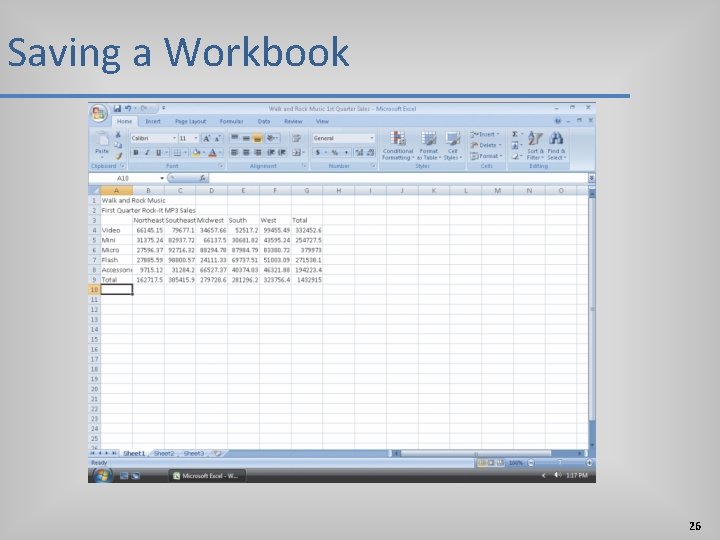
Saving a Workbook • If necessary, scroll until UDISK 2. 0 (E : ) appears in the list of available drives • Double-click UDISK 2. 0 (E: ) in the Save in list to select the USB flash drive, Drive E in this case, as the new save location • Click the Save button in the Save As dialog box to save the workbook on the USB flash drive with the file name, Walk and Rock Music 1 st Quarter Sales 25
Saving a Workbook 26
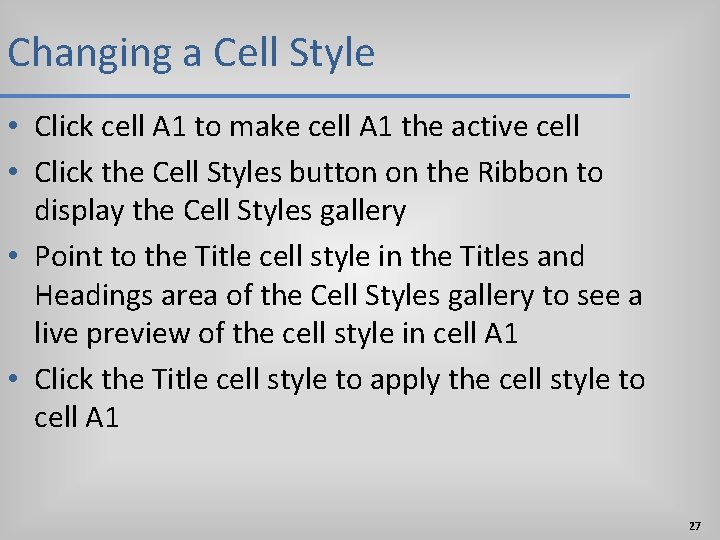
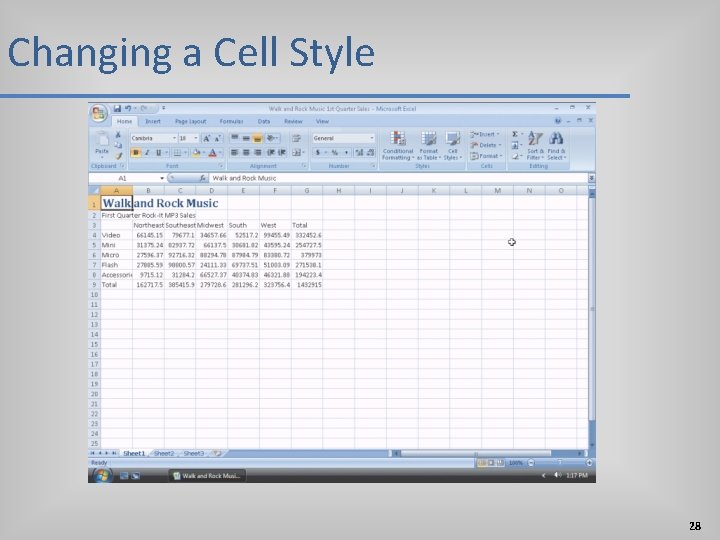
Changing a Cell Style • Click cell A 1 to make cell A 1 the active cell • Click the Cell Styles button on the Ribbon to display the Cell Styles gallery • Point to the Title cell style in the Titles and Headings area of the Cell Styles gallery to see a live preview of the cell style in cell A 1 • Click the Title cell style to apply the cell style to cell A 1 27
Changing a Cell Style 28
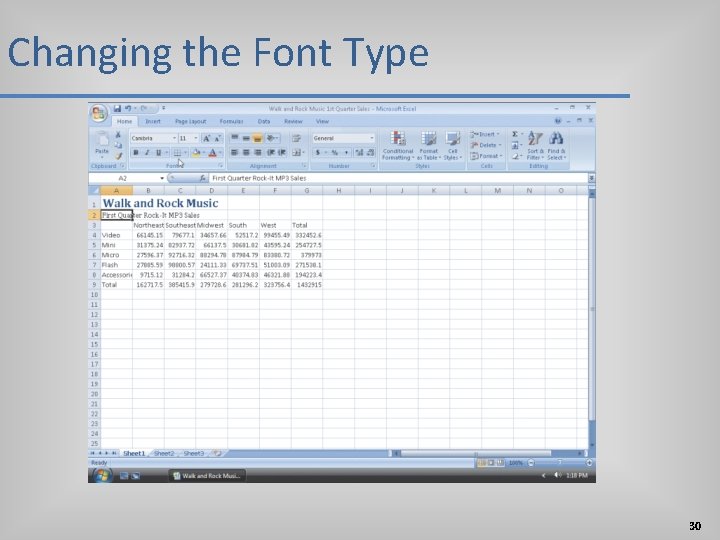
Changing the Font Type • Click cell A 2 to make cell A 2 the active cell • Click the Font box arrow on the Ribbon to display the Font gallery • Point to Cambria in the Theme Fonts area of the Font gallery to see a live preview of the Cambria font in cell A 2 • Click Cambria in the Theme Fonts area to change the font type of the worksheet subtitle in cell A 2 from Calibri to Cambria 29
Changing the Font Type 30
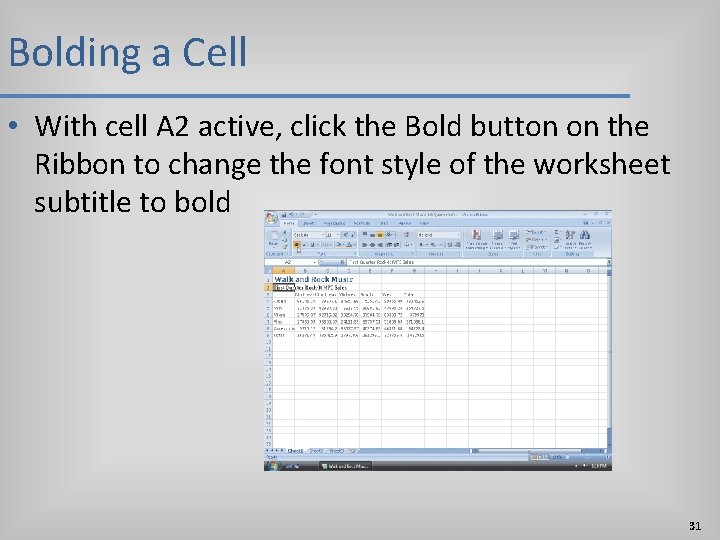
Bolding a Cell • With cell A 2 active, click the Bold button on the Ribbon to change the font style of the worksheet subtitle to bold 31
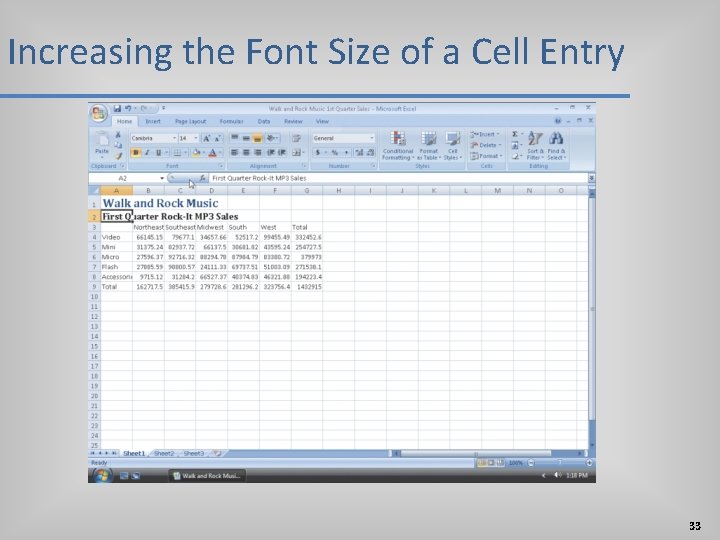
Increasing the Font Size of a Cell Entry • With cell A 2 selected, click the Font Size box arrow on the Ribbon to display the Font Size list • Point to 14 in the Font Size list to see a live preview of cell A 2 with a font size of 14 • Click 14 in the Font Size list to change the font in cell A 2 from 11 point to 14 point 32
Increasing the Font Size of a Cell Entry 33
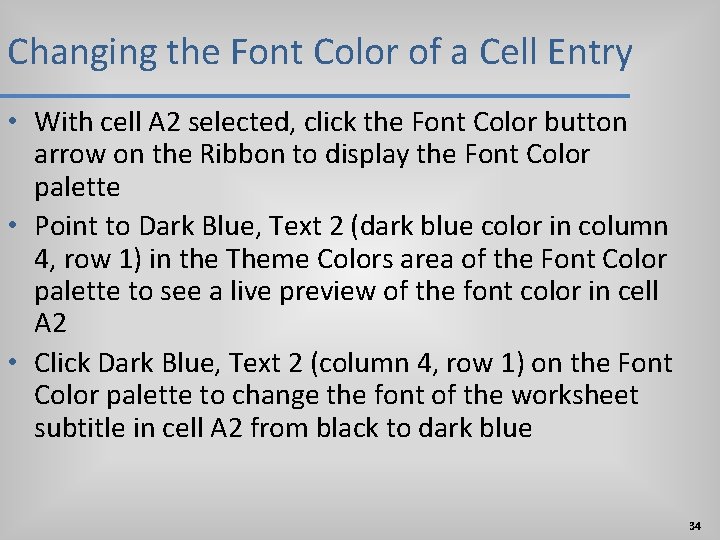
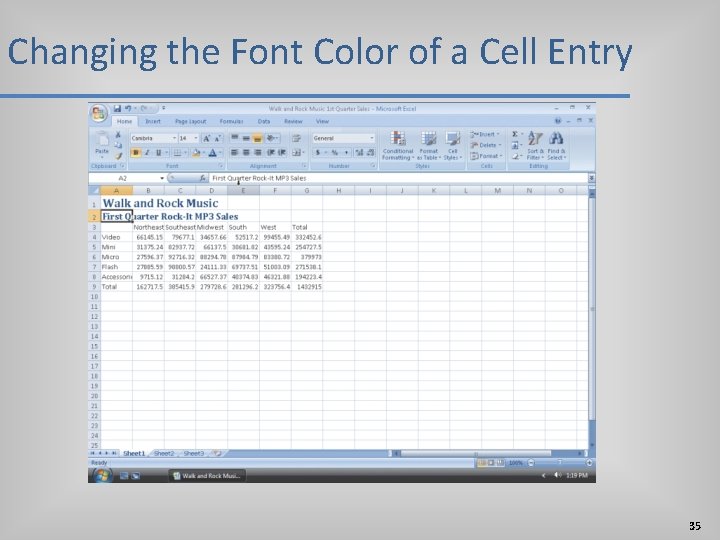
Changing the Font Color of a Cell Entry • With cell A 2 selected, click the Font Color button arrow on the Ribbon to display the Font Color palette • Point to Dark Blue, Text 2 (dark blue color in column 4, row 1) in the Theme Colors area of the Font Color palette to see a live preview of the font color in cell A 2 • Click Dark Blue, Text 2 (column 4, row 1) on the Font Color palette to change the font of the worksheet subtitle in cell A 2 from black to dark blue 34
Changing the Font Color of a Cell Entry 35
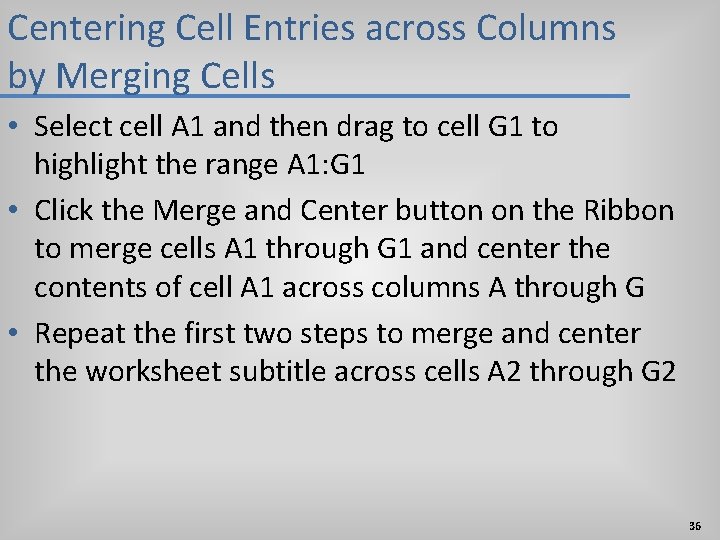
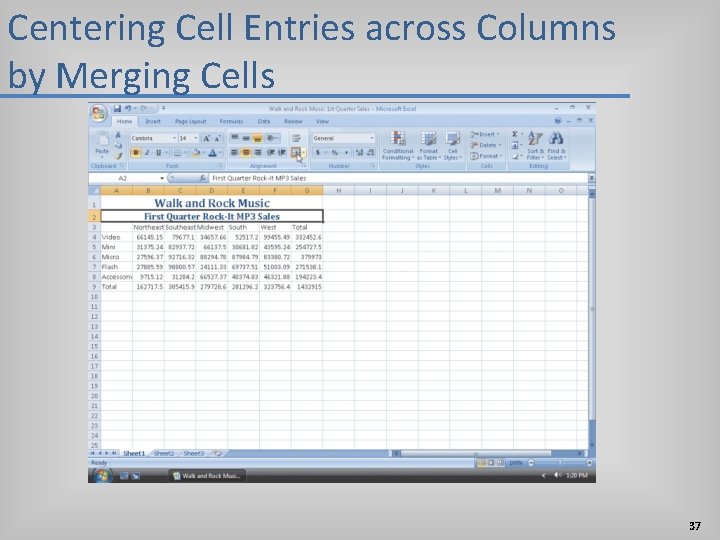
Centering Cell Entries across Columns by Merging Cells • Select cell A 1 and then drag to cell G 1 to highlight the range A 1: G 1 • Click the Merge and Center button on the Ribbon to merge cells A 1 through G 1 and center the contents of cell A 1 across columns A through G • Repeat the first two steps to merge and center the worksheet subtitle across cells A 2 through G 2 36
Centering Cell Entries across Columns by Merging Cells 37
Formatting Column Titles and the Total Row • Click cell A 3 and then drag the mouse pointer to cell G 3 to select the range A 3: G 3 • Point to the Cell Styles button on the Ribbon • Click the Cell Styles button to display the Cell Styles gallery • Point to the Heading 3 cell style in the Titles and Headings area of the Cell Styles gallery to see a live preview of the cell style in the range A 3: G 3 • Click the Heading 3 cell style to apply the cell style to the range A 3: G 3 38
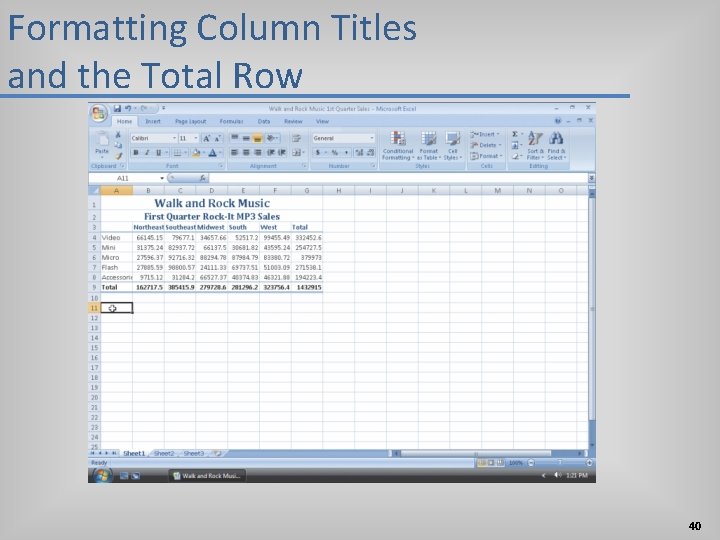
Formatting Column Titles and the Total Row • Click cell A 9 and then drag the mouse pointer to cell G 9 to select the range A 9: G 9 • Point to the Cell Styles button on the Ribbon • Click the Cell Styles button on the Ribbon to display the Cell Styles gallery and then click the Total cell style in the Titles and Headings area to apply the Total cell style to the cells in the range A 9: G 9 • Click cell A 11 to select the cell 39
Formatting Column Titles and the Total Row 40
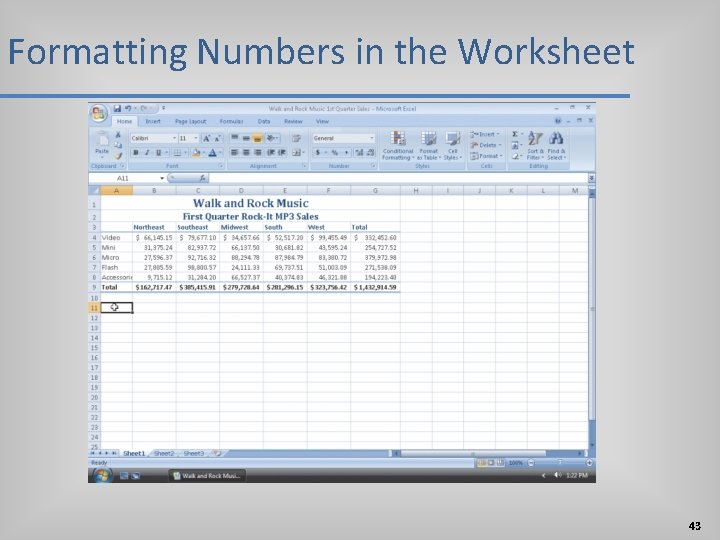
Formatting Numbers in the Worksheet • Select cell B 4 and drag the mouse pointer to cell G 4 to select the range B 4: G 4 • Point to the Accounting Number Format button on the Ribbon to display the Enhanced Screen. Tip • Click the Accounting Number Format button on the Ribbon to apply the Accounting Number Format to the cells in the range B 4: G 4 • Select the range B 5: G 8 41
Formatting Numbers in the Worksheet • Click the Comma Style button on the Ribbon to apply the Comma Style to the range B 5: G 8 • Select the range B 9: G 9 • Click the Accounting Number Format button on the Ribbon to apply the Accounting Number Format to the cells in the range B 9: G 9 • Select cell A 11 42
Formatting Numbers in the Worksheet 43
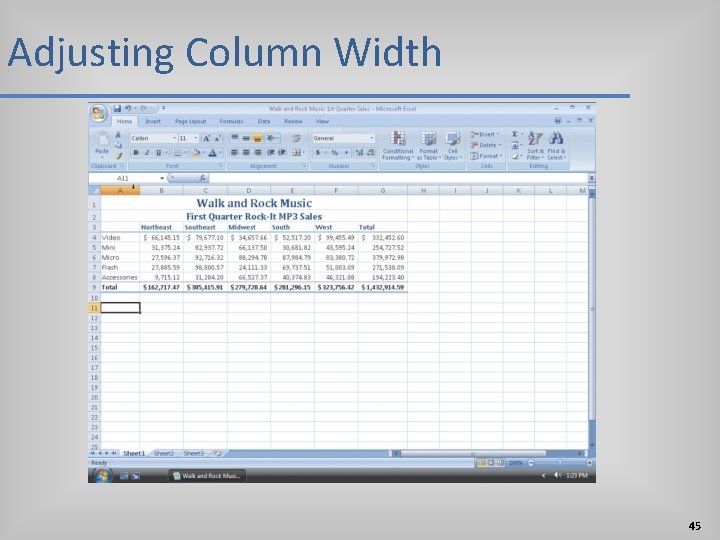
Adjusting Column Width • Point to the boundary on the right side of the column A heading above row 1 to change the mouse pointer to a split double arrow • Double-click on the boundary to adjust the width of column A to the width of the largest item in the column 44
Adjusting Column Width 45
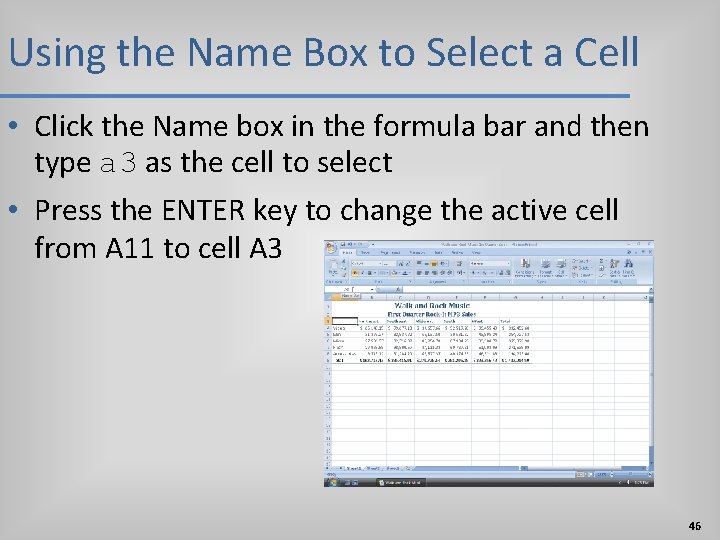
Using the Name Box to Select a Cell • Click the Name box in the formula bar and then type a 3 as the cell to select • Press the ENTER key to change the active cell from A 11 to cell A 3 46
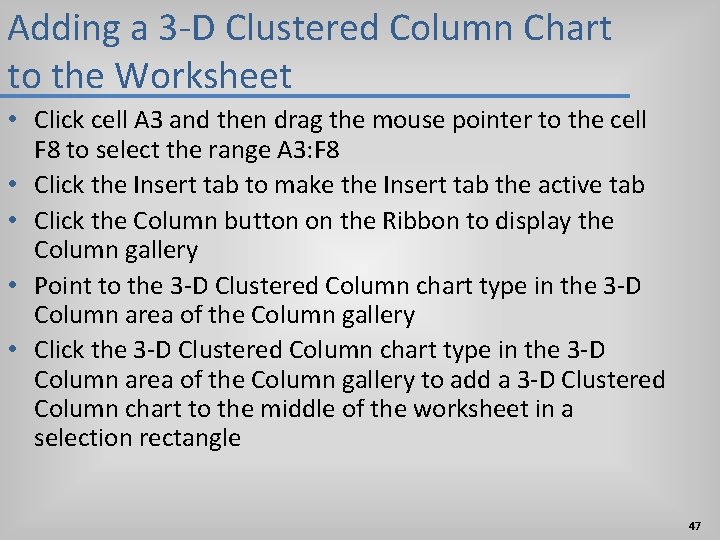
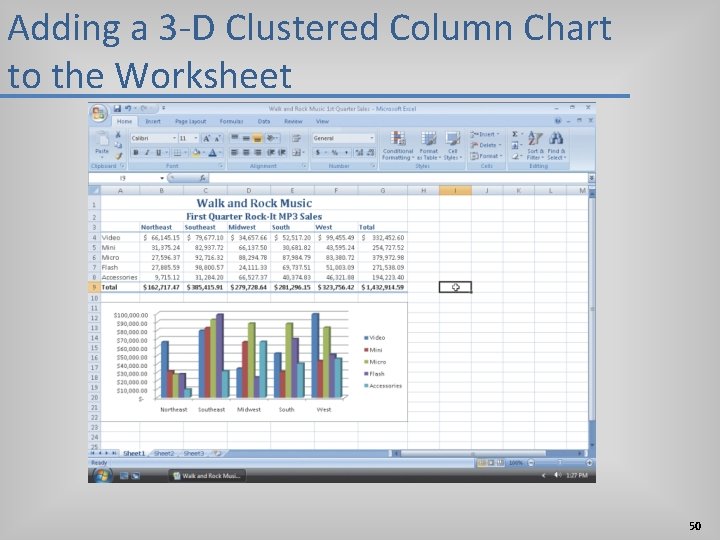
Adding a 3 -D Clustered Column Chart to the Worksheet • Click cell A 3 and then drag the mouse pointer to the cell F 8 to select the range A 3: F 8 • Click the Insert tab to make the Insert tab the active tab • Click the Column button on the Ribbon to display the Column gallery • Point to the 3 -D Clustered Column chart type in the 3 -D Column area of the Column gallery • Click the 3 -D Clustered Column chart type in the 3 -D Column area of the Column gallery to add a 3 -D Clustered Column chart to the middle of the worksheet in a selection rectangle 47
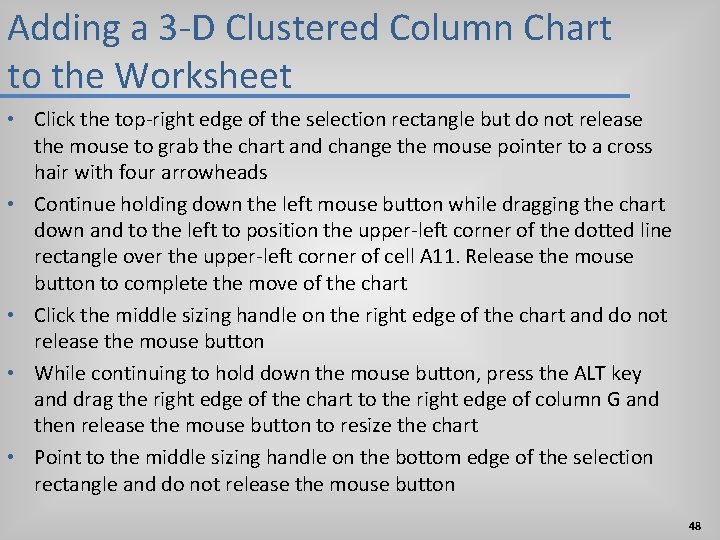
Adding a 3 -D Clustered Column Chart to the Worksheet • Click the top-right edge of the selection rectangle but do not release the mouse to grab the chart and change the mouse pointer to a cross hair with four arrowheads • Continue holding down the left mouse button while dragging the chart down and to the left to position the upper-left corner of the dotted line rectangle over the upper-left corner of cell A 11. Release the mouse button to complete the move of the chart • Click the middle sizing handle on the right edge of the chart and do not release the mouse button • While continuing to hold down the mouse button, press the ALT key and drag the right edge of the chart to the right edge of column G and then release the mouse button to resize the chart • Point to the middle sizing handle on the bottom edge of the selection rectangle and do not release the mouse button 48
Adding a 3 -D Clustered Column Chart to the Worksheet • While continuing to hold down the mouse button, press the ALT key and drag the bottom edge of the chart up to the bottom edge of row 22 and then release the mouse button to resize the chart • Click the More button in the Chart Styles gallery to expand the gallery and point to Style 2 in the gallery (column 2, row 1) • Click Style 2 in the Chart Styles gallery to apply the chart style Style 2 to the chart • Click cell I 9 to deselect the chart and complete the worksheet 49
Adding a 3 -D Clustered Column Chart to the Worksheet 50
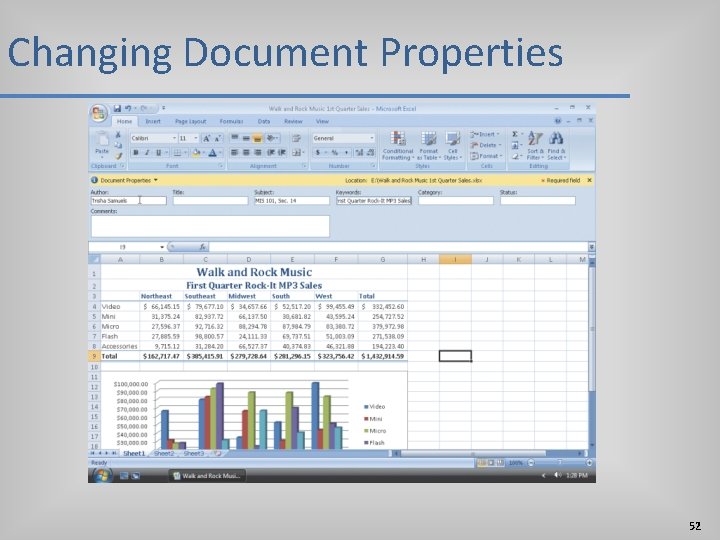
Changing Document Properties • Click the Office Button to display the Office Button menu • Point to Prepare on the Office Button menu to display the Prepare submenu • Click Properties on the Prepare submenu to display the Document Information Panel • Click the Author text box and then type your name as the Author property. If a name already is displayed in the Author text box, delete it before typing your name • Click the Subject text box, if necessary delete any existing text, and then type your course and section as the Subject property • Click the Keywords text box, if necessary delete any existing text, and then type First Quarter Rock-It MP 3 Sales • Click the Close the Document Information Panel button so that the Document Information Panel no longer is displayed 51
Changing Document Properties 52
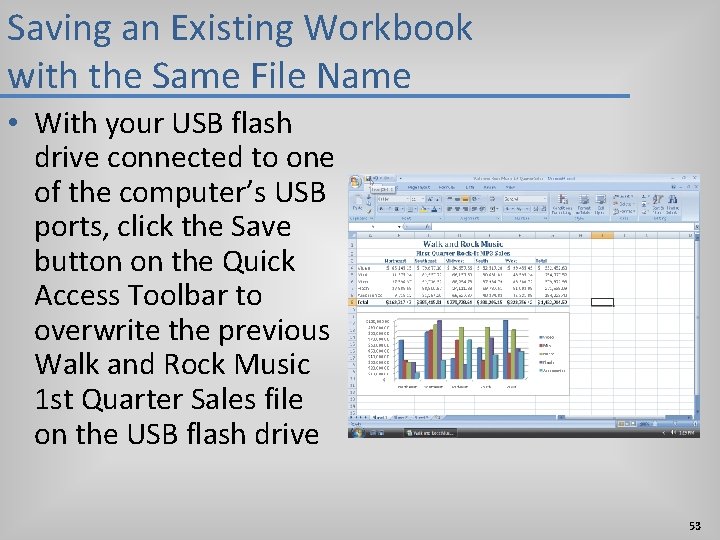
Saving an Existing Workbook with the Same File Name • With your USB flash drive connected to one of the computer’s USB ports, click the Save button on the Quick Access Toolbar to overwrite the previous Walk and Rock Music 1 st Quarter Sales file on the USB flash drive 53
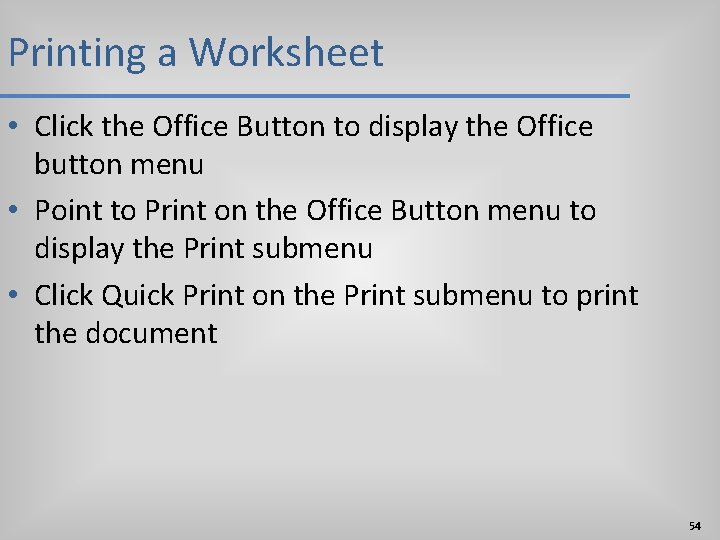
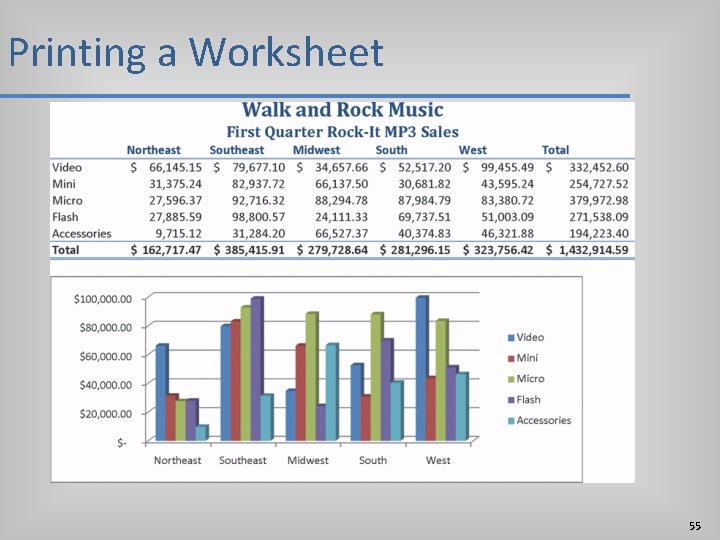
Printing a Worksheet • Click the Office Button to display the Office button menu • Point to Print on the Office Button menu to display the Print submenu • Click Quick Print on the Print submenu to print the document 54
Printing a Worksheet 55
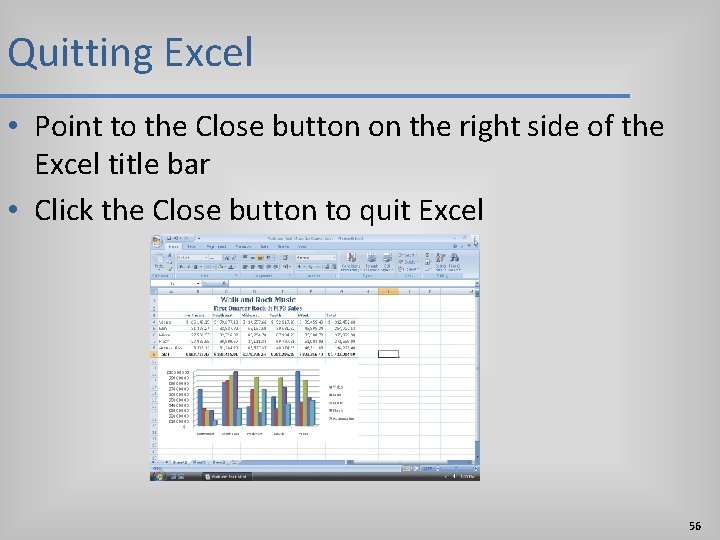
Quitting Excel • Point to the Close button on the right side of the Excel title bar • Click the Close button to quit Excel 56
Starting Excel • Click the Start button on the Windows Vista taskbar to display the Start menu • Click All Programs at the bottom of the left pane on the Start menu to display the All Programs list and then click Microsoft Office in the All Programs list to display the Microsoft Office list. • Click Microsoft Office Excel 2007 on the Microsoft Office submenu to start Excel and display a new blank worksheet in the Excel window • If the Excel window is not maximized, click the Maximize button on its title bar to maximize the window 57
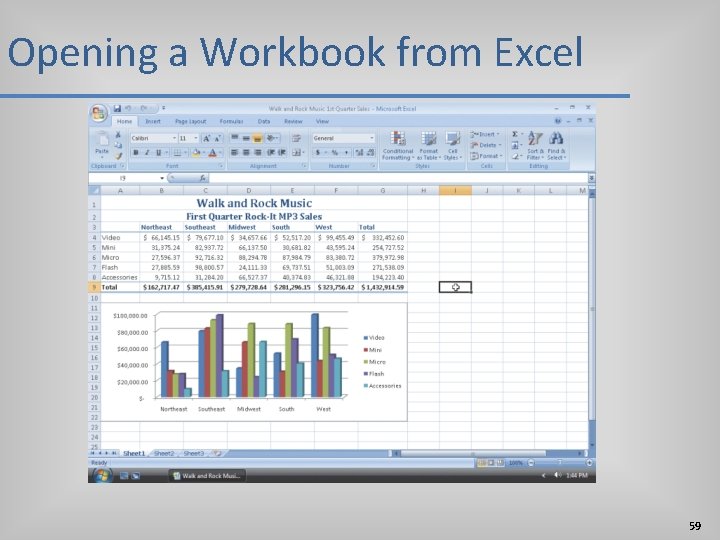
Opening a Workbook from Excel • With your USB flash drive connected to one of the computer’s USB ports, click the Office Button to display the Office Button menu • Click Open on the Office Button menu to display the Open dialog box • If the Folders list is displayed below the Folders button, click the Folders button to remove the Folders list • If necessary, click the Look in box arrow and then click UDISK 2. 0 (E: ) to select the USB flash drive, Drive E in this case, in the Look in list as the new open location • Double-click UDISK 2. 0 (E: ) to select the USB fl ash drive, Drive E in this case, as the new open location • Click Walk and Rock Music 1 st Quarter Sales to select the file name • Click the Open button to open the selected file and display the worksheet in the Excel window 58
Opening a Workbook from Excel 59
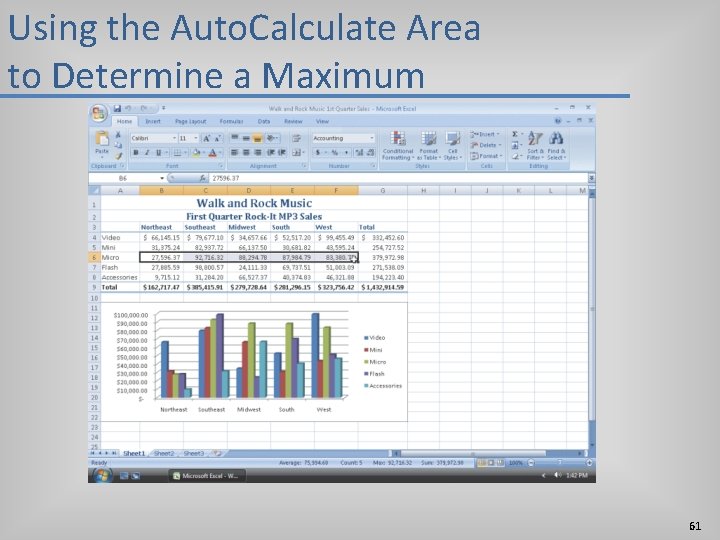
Using the Auto. Calculate Area to Determine a Maximum • Select the range B 6: F 6 and then right-click the Auto. Calculate area on the status bar to display the Status Bar Configuration shortcut menu • Click Maximum on the shortcut menu to display the Maximum value in the range B 6: F 6 in the Auto. Calculate area of the status bar • Click anywhere on the worksheet to cause the shortcut menu to disappear • Right-click the Auto. Calculate area and then click Maximum on the shortcut menu to cause the Maximum value to no longer appear in the Auto. Calculate area 60
Using the Auto. Calculate Area to Determine a Maximum 61
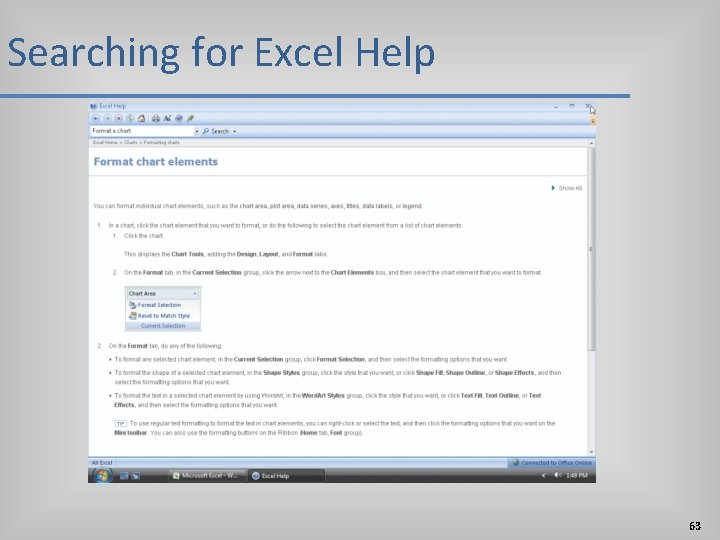
Searching for Excel Help • Click the Microsoft Office Excel Help button near the upper-right corner of the Excel window to open the Excel Help window • Type format a chart in the Type words to search for text box at the top of the Excel Help window • Press the ENTER key to display the search results • Click the Maximize button on the Excel Help window title bar to maximize the Help window • Click the Format chart elements link to display information regarding formatting chart elements • Click the Close button on the Excel Help window title bar to close the Excel Help window and make Excel active 62
Searching for Excel Help 63
Quitting Excel • Click the Close button on the right side of the title bar to quit Excel • If necessary, click the No button in the Microsoft Office Excel dialog box so that any changes you have made are not saved 64
Summary • • • Start and quit Excel Describe the Excel worksheet Enter text and numbers Use the Sum button to sum a range of cells Copy the contents of a cell to a range of cells using the fill handle 65
Summary • • • Save a workbook Format cells in a worksheet Create a 3 -D Clustered Column chart Change document properties Save a workbook a second time using the same file name 66
Summary • Print a worksheet • Open a workbook • Use the Auto. Calculate area to determine statistics • Correct errors on a worksheet • Use Excel Help to answer questions 67
Microsoft Office 2013 Excel Chapter 1 Complete