
Microsoft Computational Finance Server as a platform for
- Slides: 29
Microsoft Computational Finance Server as a platform for computational biology A pilot application Robert Bukowski and Jarek Pillardy Computational Biology Service Unit Cornell University 12/9/2008 Microsoft e. Science Workshop 2008
�Computational Biology Service Unit (CBSU) provides computational support to biologists at Cornell University �Maintains several Windows –based compute clusters, making them available to Cornell community and users world-wide �Convenience of access to HPC is a major issue 12/9/2008 Microsoft e. Science Workshop 2008
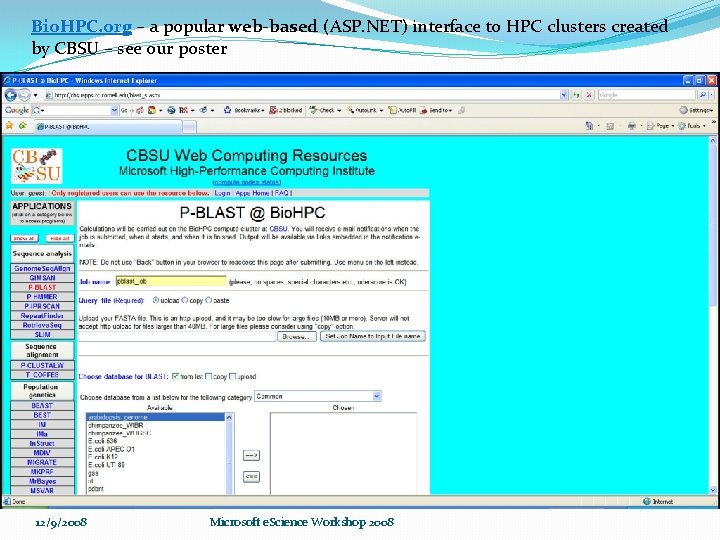
Bio. HPC. org – a popular web-based (ASP. NET) interface to HPC clusters created by CBSU – see our poster 12/9/2008 Microsoft e. Science Workshop 2008
Web service-based interface? Would allow to incorporate HPC applications in analysis pipelines Would allow convenient user interfaces other than web forms, such as Excel 12/9/2008 Microsoft e. Science Workshop 2008
�Microsoft Computational Finance Server (Comp. Fin) � Recently developed by Microsoft HPC++ Labs for computational finance applications (http: //hpc. microsofthpc. net/) � Deployment and execution platform for HPC � Web service - based � Features Excel 2007 user interface �As a “proof of principle” and feasibility test, we decided to adapt a few computational biology applications to Comp. Fin �Our pilot application: STRUCTURE Genetics [J. K. Pritchard et al. , Genetics 155, 945 (2000); D. Falush et al. , Genetics 164, 1567 (2003)]– one of the most popular population genetics programs run on CBSU clusters (via our web interface Bio. HPC. org) 12/9/2008 Microsoft e. Science Workshop 2008
Outline �What is STRUCTURE ? �What is Comp. Fin ? �STRUCTURE @ Comp. Fin �Conclusions 12/9/2008 Microsoft e. Science Workshop 2008
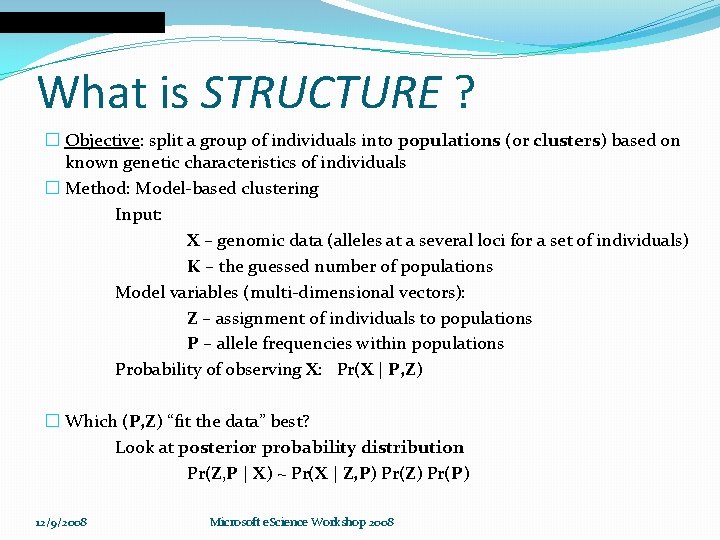
What is STRUCTURE ? � Objective: split a group of individuals into populations (or clusters) based on known genetic characteristics of individuals � Method: Model-based clustering Input: X – genomic data (alleles at a several loci for a set of individuals) K – the guessed number of populations Model variables (multi-dimensional vectors): Z – assignment of individuals to populations P – allele frequencies within populations Probability of observing X: Pr(X | P, Z) � Which (P, Z) “fit the data” best? Look at posterior probability distribution Pr(Z, P | X) ~ Pr(X | Z, P) Pr(Z) Pr(P) 12/9/2008 Microsoft e. Science Workshop 2008
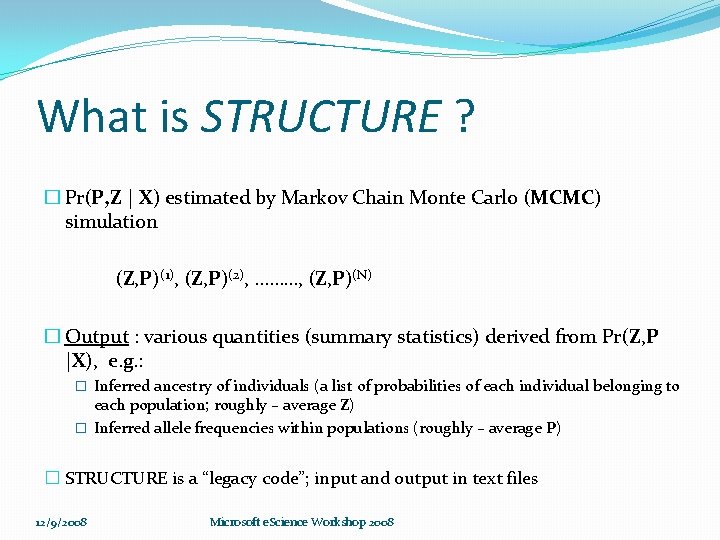
What is STRUCTURE ? � Pr(P, Z | X) estimated by Markov Chain Monte Carlo (MCMC) simulation (Z, P)(1), (Z, P)(2), ………, (Z, P)(N) � Output : various quantities (summary statistics) derived from Pr(Z, P |X), e. g. : � Inferred ancestry of individuals (a list of probabilities of each individual belonging to each population; roughly – average Z) � Inferred allele frequencies within populations (roughly – average P) � STRUCTURE is a “legacy code”; input and output in text files 12/9/2008 Microsoft e. Science Workshop 2008
What is STRUCTURE ? �For a given dataset X, multiple independent simulations are usually needed �For different numbers of populations (K) – to infer the best one �With the same K – to make sure results are consistent �With different MCMC control parameters �Each of the multiple simulations is long (hours to days) �STRUCTURE analysis is an HPC task ! �Would benefit from Excel user interface 12/9/2008 Microsoft e. Science Workshop 2008
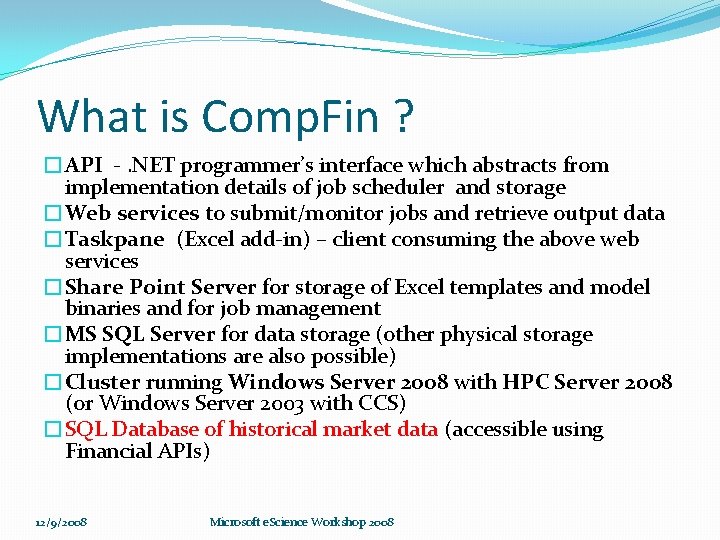
What is Comp. Fin ? �API -. NET programmer’s interface which abstracts from implementation details of job scheduler and storage �Web services to submit/monitor jobs and retrieve output data �Taskpane (Excel add-in) – client consuming the above web services �Share Point Server for storage of Excel templates and model binaries and for job management �MS SQL Server for data storage (other physical storage implementations are also possible) �Cluster running Windows Server 2008 with HPC Server 2008 (or Windows Server 2003 with CCS) �SQL Database of historical market data (accessible using Financial APIs) 12/9/2008 Microsoft e. Science Workshop 2008
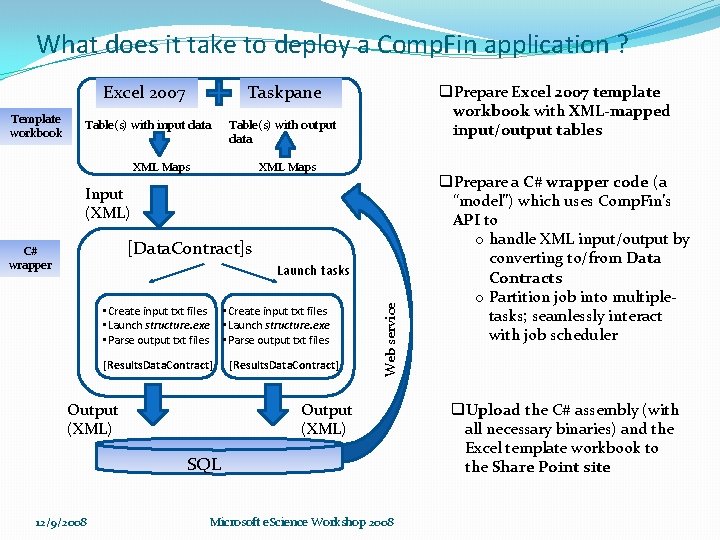
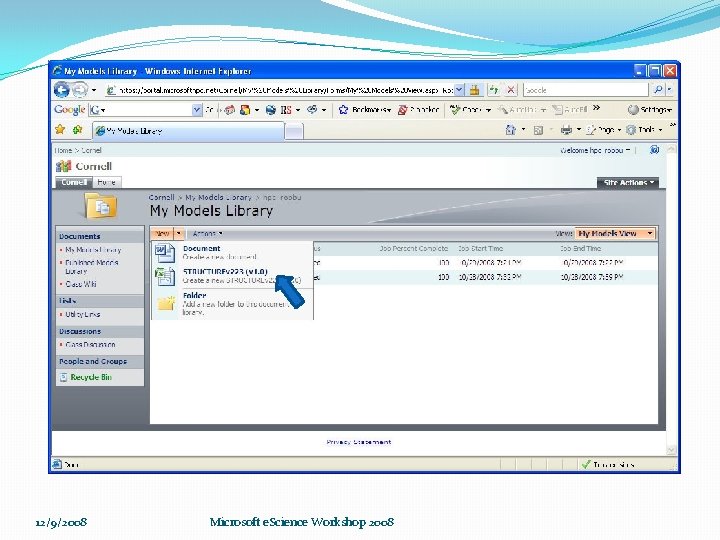
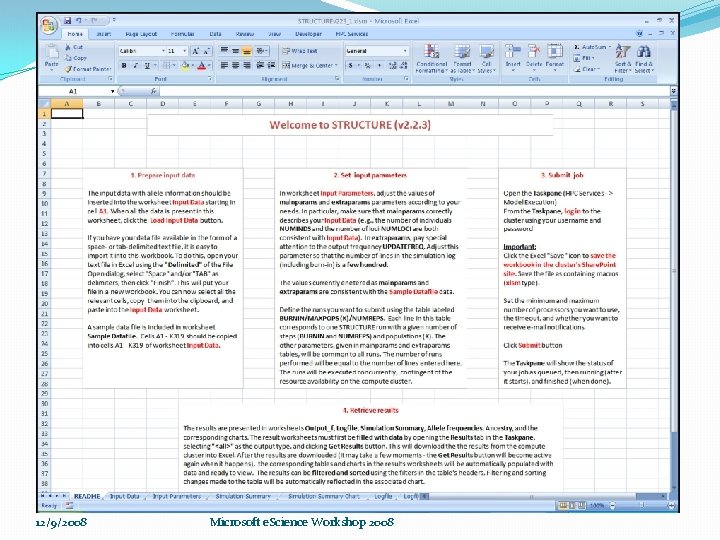
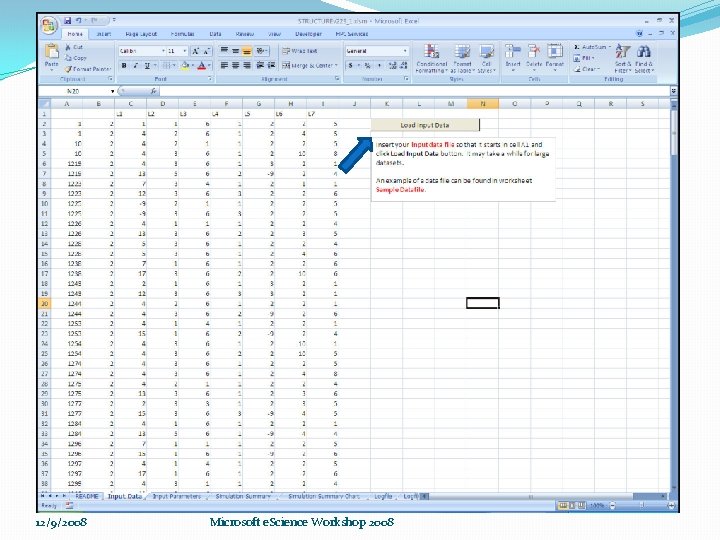
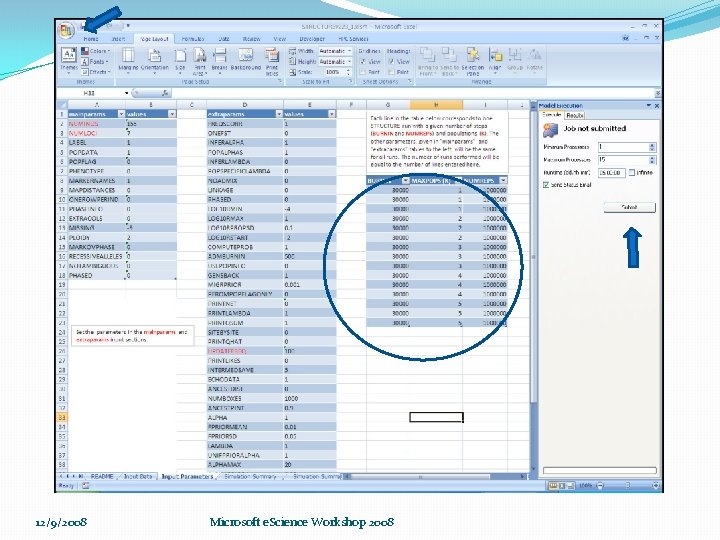
What does it take to deploy a Comp. Fin application ? Excel 2007 Template workbook Taskpane Table(s) with input data q. Prepare Excel 2007 template workbook with XML-mapped input/output tables Table(s) with output data XML Maps Input (XML) [Data. Contract]s C# wrapper • Create input txt files • Launch structure. exe • Parse output txt files [Results. Data. Contract] Output (XML) • Create input txt files • Launch structure. exe • Parse output txt files [Results. Data. Contract] Web service Launch tasks Output (XML) SQL 12/9/2008 Microsoft e. Science Workshop 2008 q. Prepare a C# wrapper code (a “model”) which uses Comp. Fin’s API to o handle XML input/output by converting to/from Data Contracts o Partition job into multipletasks; seamlessly interact with job scheduler q. Upload the C# assembly (with all necessary binaries) and the Excel template workbook to the Share Point site
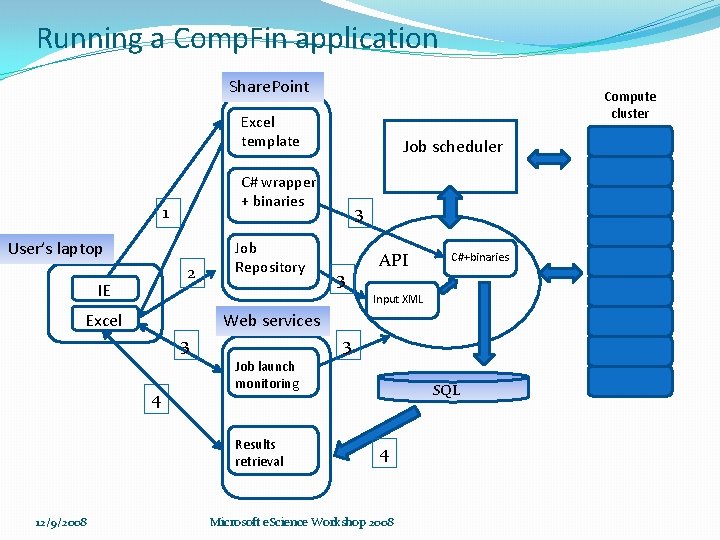
Running a Comp. Fin application Share. Point Compute cluster Excel template C# wrapper + binaries 1 User’s laptop 2 IE Job Repository 3 3 API C#+binaries Input XML Excel Web services 3 4 3 Job launch monitoring Results retrieval 12/9/2008 Job scheduler SQL 4 Microsoft e. Science Workshop 2008
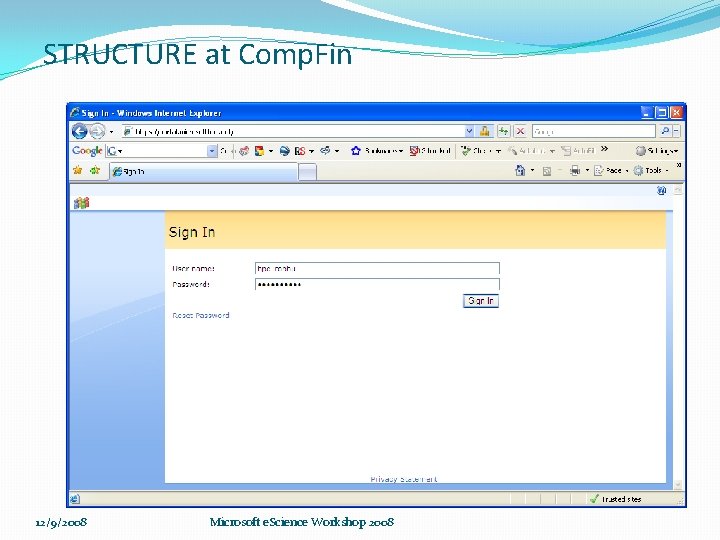
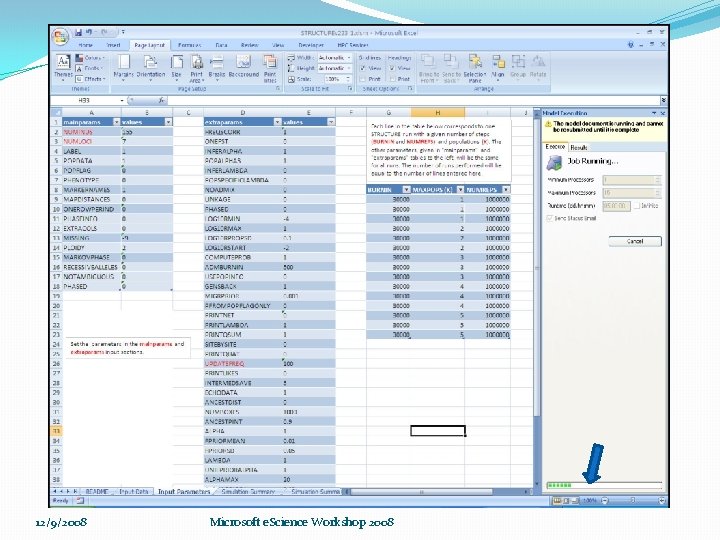
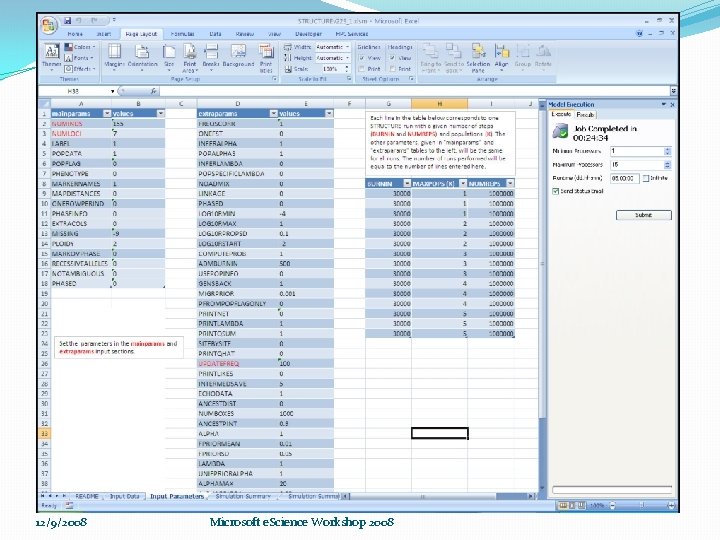
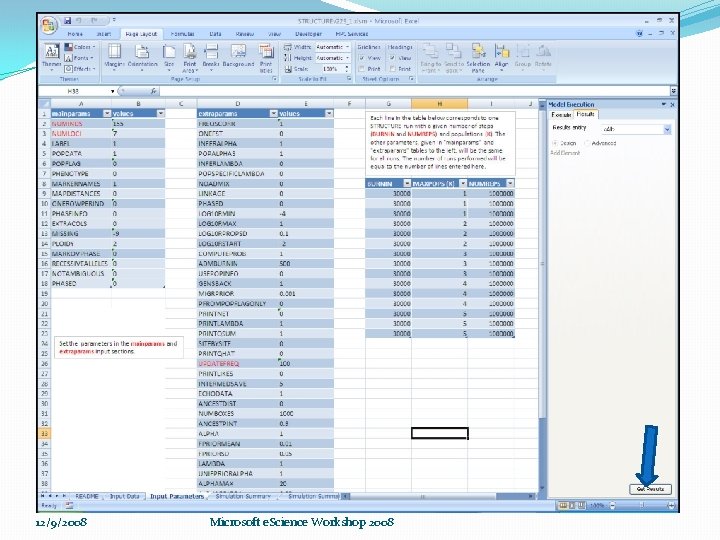
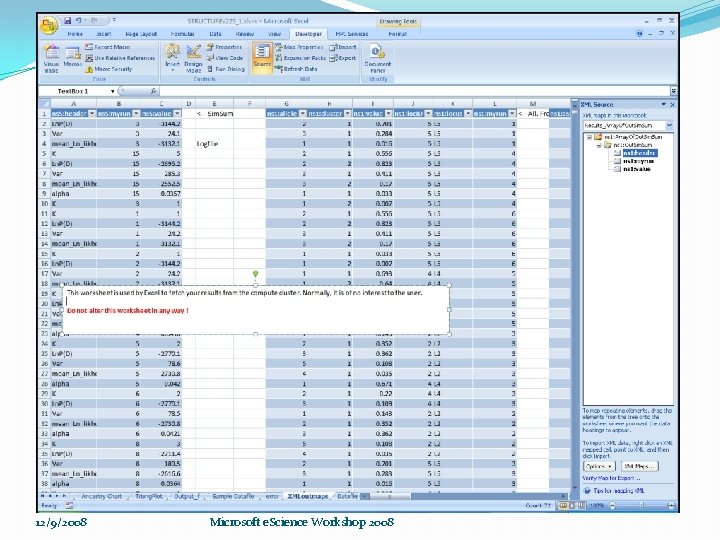
STRUCTURE at Comp. Fin 12/9/2008 Microsoft e. Science Workshop 2008
12/9/2008 Microsoft e. Science Workshop 2008
12/9/2008 Microsoft e. Science Workshop 2008
12/9/2008 Microsoft e. Science Workshop 2008
12/9/2008 Microsoft e. Science Workshop 2008
12/9/2008 Microsoft e. Science Workshop 2008
12/9/2008 Microsoft e. Science Workshop 2008
12/9/2008 Microsoft e. Science Workshop 2008
12/9/2008 Microsoft e. Science Workshop 2008
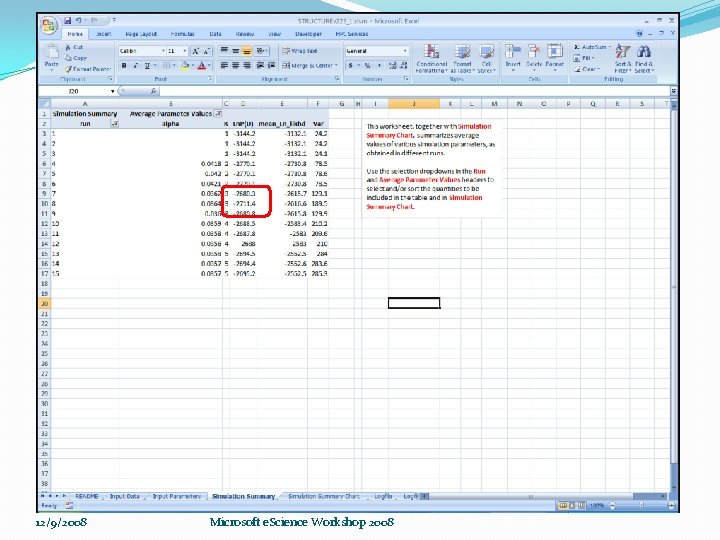
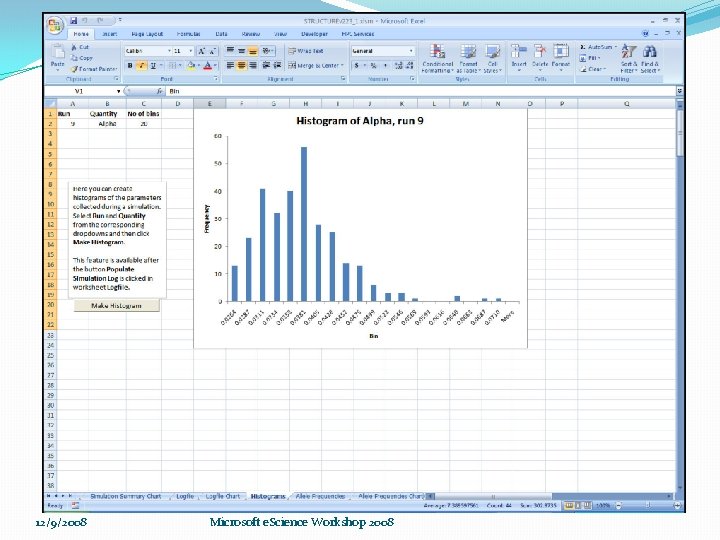
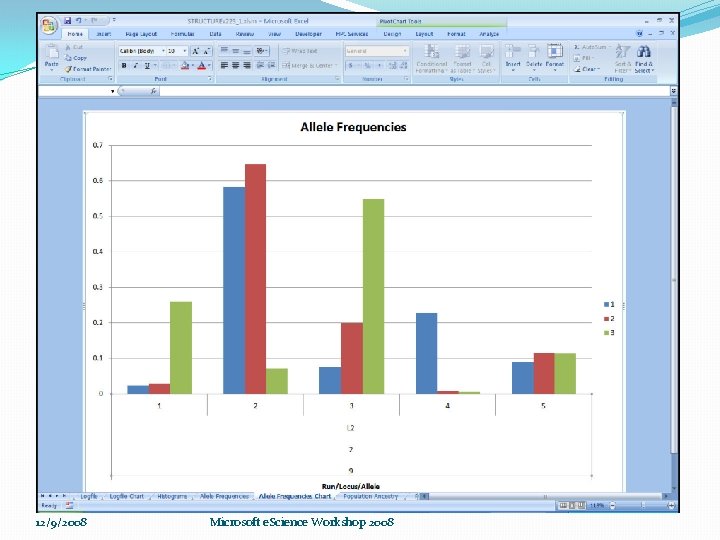
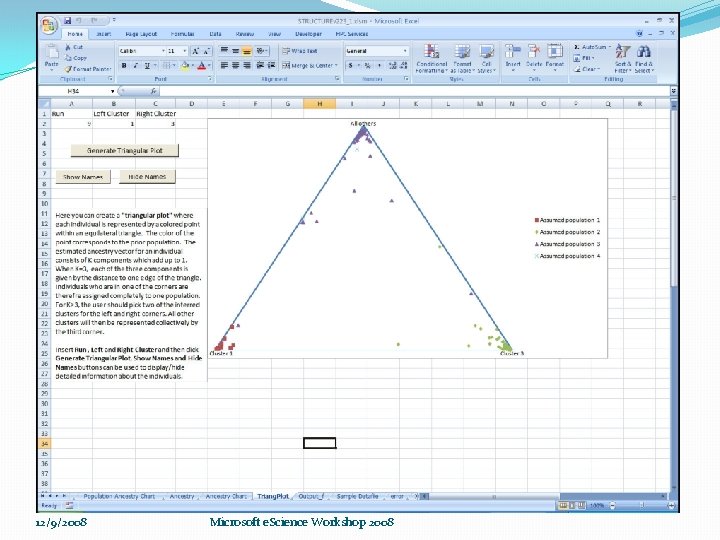
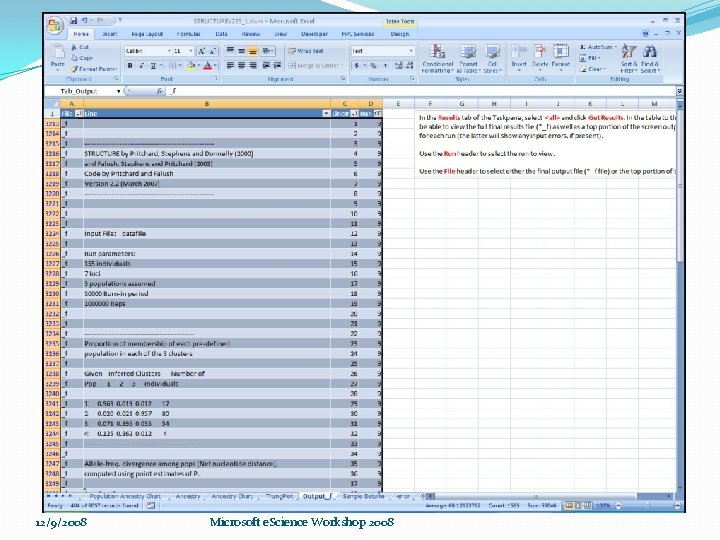
Output information from XML maps is visualized using • pivot tables • pivot charts • VB macros 12/9/2008 Microsoft e. Science Workshop 2008
12/9/2008 Microsoft e. Science Workshop 2008
12/9/2008 Microsoft e. Science Workshop 2008
12/9/2008 Microsoft e. Science Workshop 2008
12/9/2008 Microsoft e. Science Workshop 2008
12/9/2008 Microsoft e. Science Workshop 2008
Comp. Fin as a platform for computational biology �Pros: � Powerful Excel user interface � Easy deployment � On-site (on-cluster) data storage (not used here, but with great potential for data-intensive applications, such as Next Generation Sequencing data analysis) � Comp. Fin developed with the idea of bringing computational power to the data (rather than data to computational power) �Directions of future development � Currently, input/output data transfer is through Excel only. Basic file transfer functionality is needed. � � Raw biological data usually too big or not “pretty” enough to be put into Excel Output transfer from on-cluster SQL storage to Excel XML maps not too efficient for large datasets (although greatly improved as a result of this project) � User needs domain account on cluster – good for small, closed organization, not so much for an open university research environment 12/9/2008 Microsoft e. Science Workshop 2008
We acknowledge support from �Microsoft HPC Institute program �Microsoft Research …. and collaboration with MS HPC Team �Richard Ciapala �Daniel Simon 12/9/2008 Microsoft e. Science Workshop 2008