
Microsoft Azure Government Technical overview Transform the datacenter
- Slides: 14
Microsoft Azure Government Technical overview
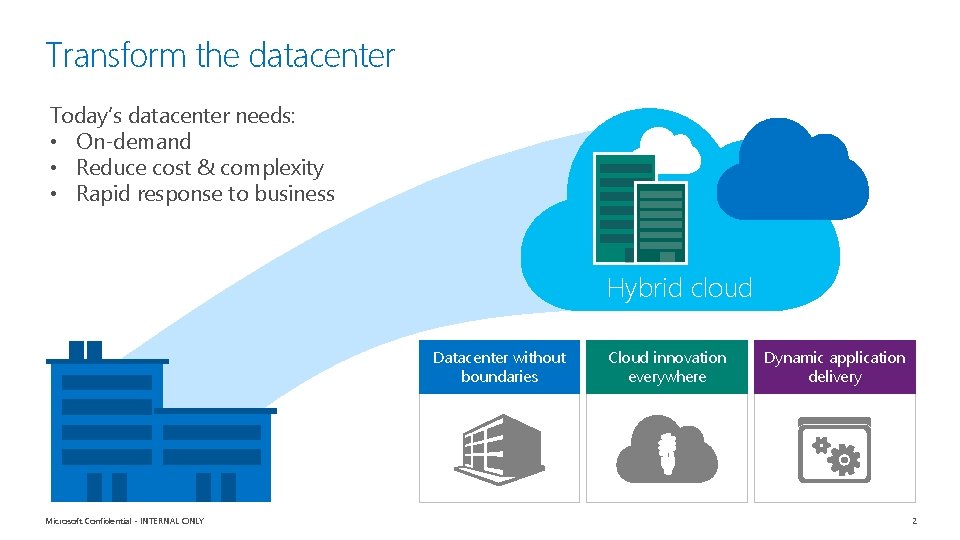
Transform the datacenter Today’s datacenter needs: • On-demand • Reduce cost & complexity • Rapid response to business Hybrid cloud Datacenter Cloud options without on boundaries demand Microsoft Confidential - INTERNAL ONLY Cloud Reduced innovation cost and everywhere complexity Dynamic Rapid response application todelivery business 2
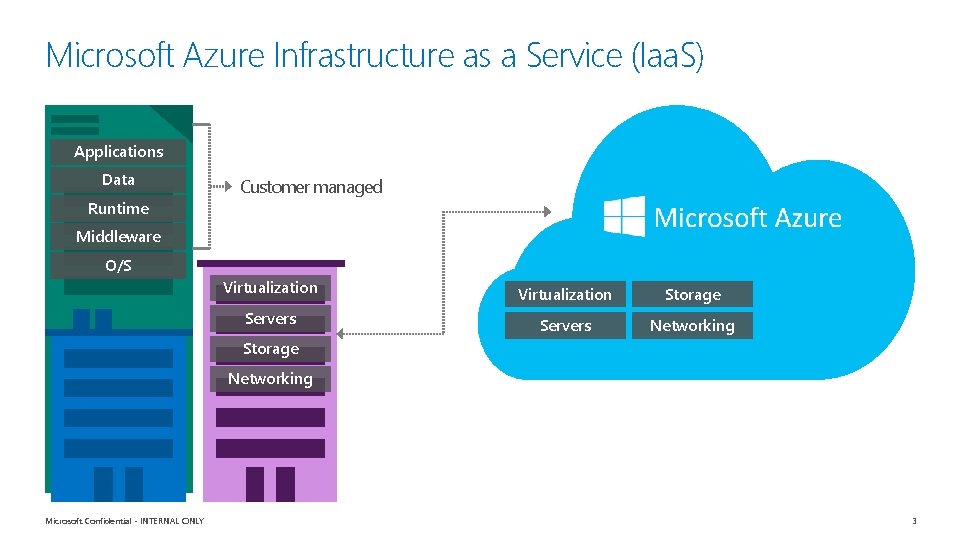
Microsoft Azure Infrastructure as a Service (Iaa. S) Applications Data Runtime Customer managed Middleware O/S Virtualization Storage Servers Networking Storage Networking Microsoft Confidential - INTERNAL ONLY 3
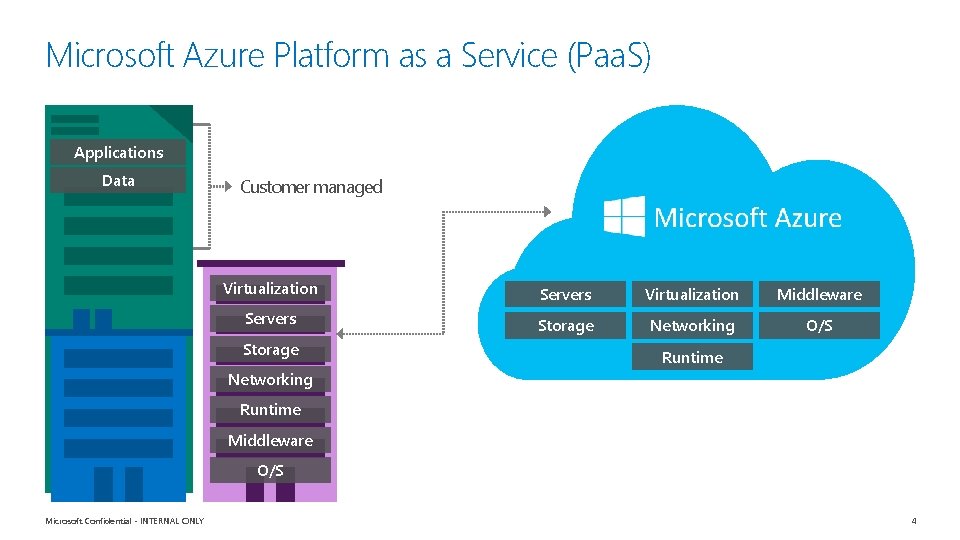
Microsoft Azure Platform as a Service (Paa. S) Applications Data Customer managed Virtualization Servers Virtualization Middleware Servers Storage Networking O/S Storage Runtime Networking Runtime Middleware O/S Microsoft Confidential - INTERNAL ONLY 4
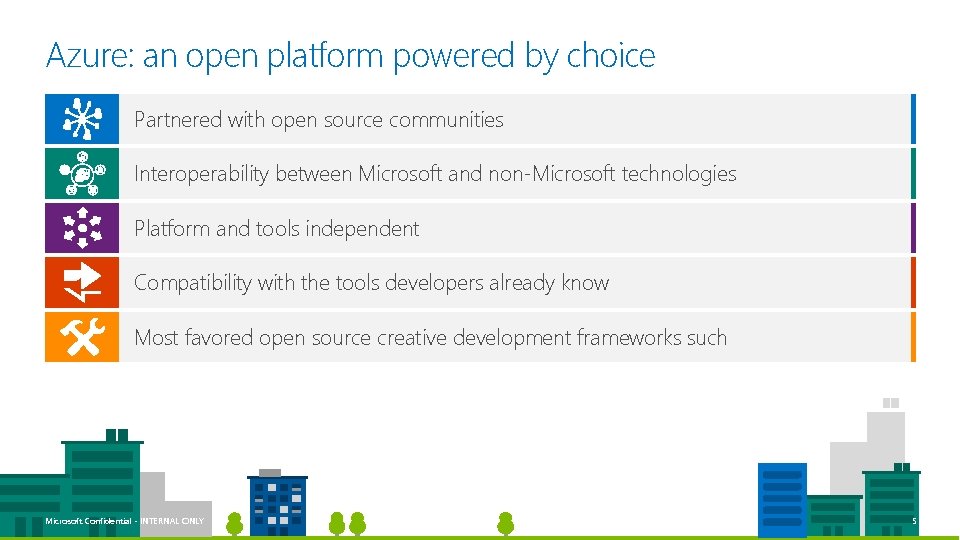
Azure: an open platform powered by choice Partnered with open source communities Interoperability between Microsoft and non-Microsoft technologies Platform and tools independent Compatibility with the tools developers already know Most favored open source creative development frameworks such Microsoft Confidential - INTERNAL ONLY 5
What is Microsoft Azure Government?
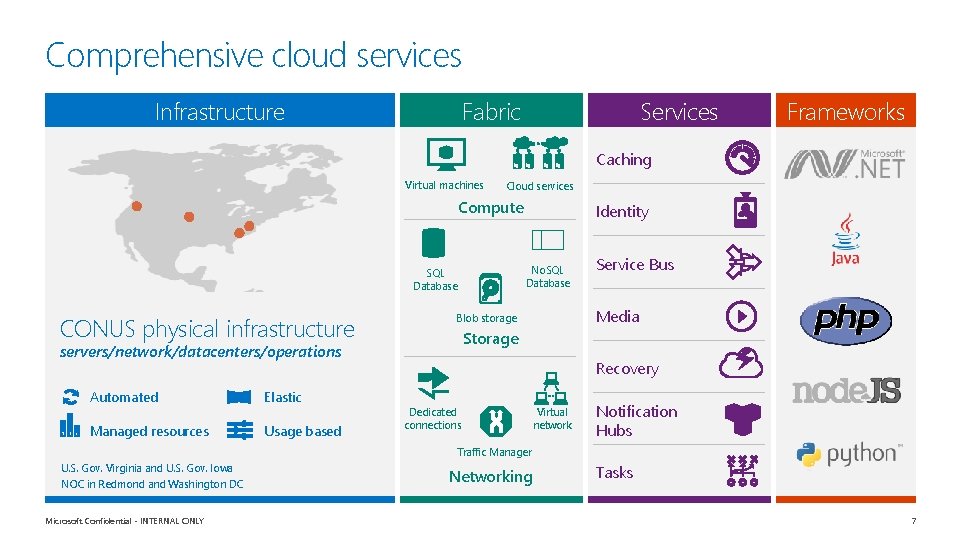
Comprehensive cloud services Infrastructure Fabric Services Frameworks Caching Virtual machines Cloud services Compute No. SQL Database CONUS physical infrastructure 1 2 3 Elastic Managed resources Usage based bob Service Bus Media Blob storage Storage servers/network/datacenters/operations Automated Identity Recovery Dedicated connections Virtual network Notification Hubs Traffic Manager U. S. Gov. Virginia and U. S. Gov. Iowa NOC in Redmond and Washington DC Microsoft Confidential - INTERNAL ONLY Networking Tasks 7
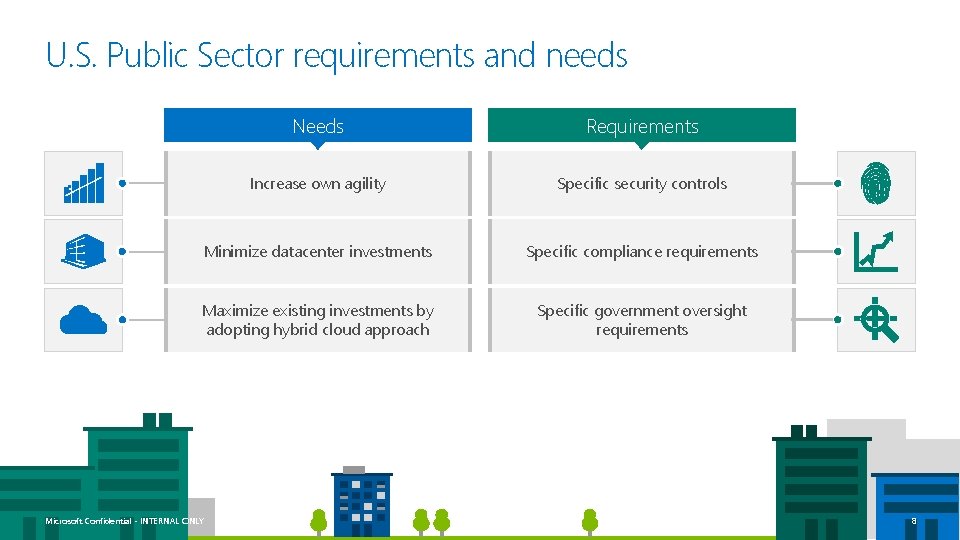
U. S. Public Sector requirements and needs Needs Requirements Increase own agility Specific security controls Minimize datacenter investments Specific compliance requirements Maximize existing investments by adopting hybrid cloud approach Specific government oversight requirements Microsoft Confidential - INTERNAL ONLY 8
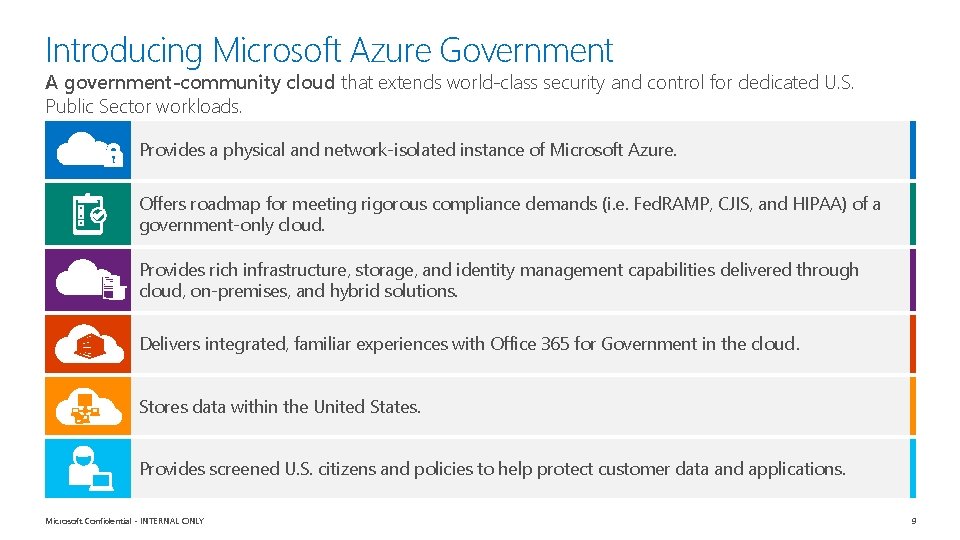
Introducing Microsoft Azure Government A government-community cloud that extends world-class security and control for dedicated U. S. Public Sector workloads. Provides a physical and network-isolated instance of Microsoft Azure. Offers roadmap for meeting rigorous compliance demands (i. e. Fed. RAMP, CJIS, and HIPAA) of a government-only cloud. Provides rich infrastructure, storage, and identity management capabilities delivered through cloud, on-premises, and hybrid solutions. Delivers integrated, familiar experiences with Office 365 for Government in the cloud. Stores data within the United States. Provides screened U. S. citizens and policies to help protect customer data and applications. Microsoft Confidential - INTERNAL ONLY 9
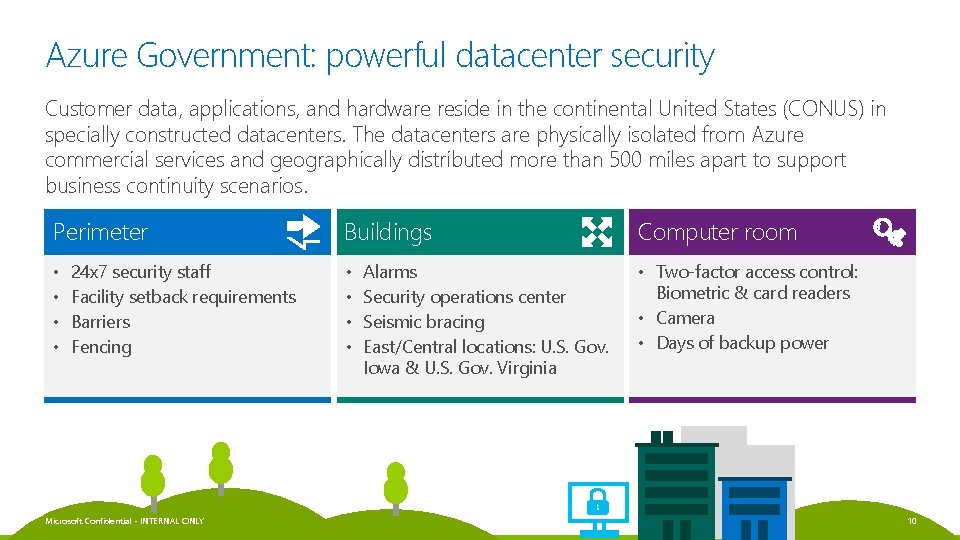
Azure Government: powerful datacenter security Customer data, applications, and hardware reside in the continental United States (CONUS) in specially constructed datacenters. The datacenters are physically isolated from Azure commercial services and geographically distributed more than 500 miles apart to support business continuity scenarios. Perimeter • • 24 x 7 security staff Facility setback requirements Barriers Fencing Microsoft Confidential - INTERNAL ONLY Buildings • • Alarms Security operations center Seismic bracing East/Central locations: U. S. Gov. Iowa & U. S. Gov. Virginia Computer room • Two-factor access control: Biometric & card readers • Camera • Days of backup power 10
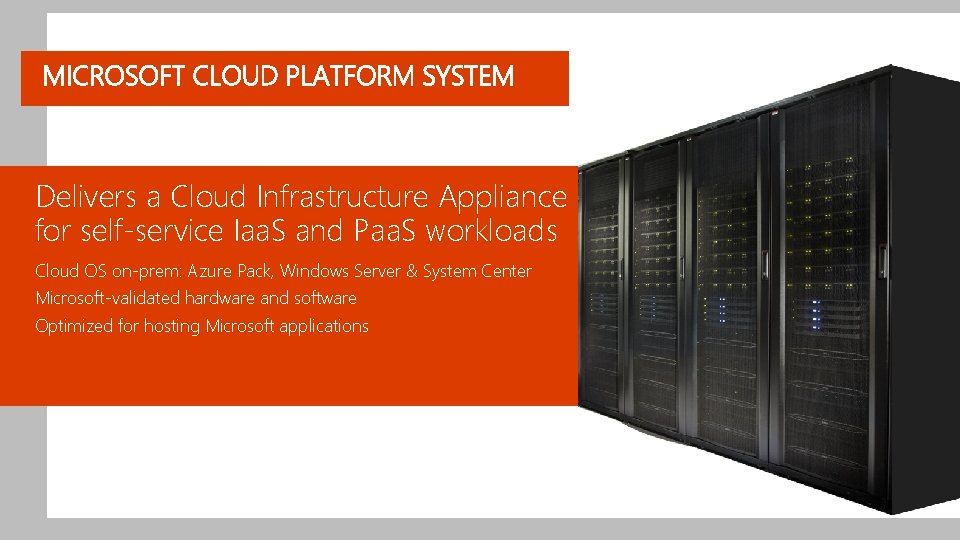
Delivers a Cloud Infrastructure Appliance for self-service Iaa. S and Paa. S workloads Cloud OS on-prem: Azure Pack, Windows Server & System Center Microsoft-validated hardware and software Optimized for hosting Microsoft applications
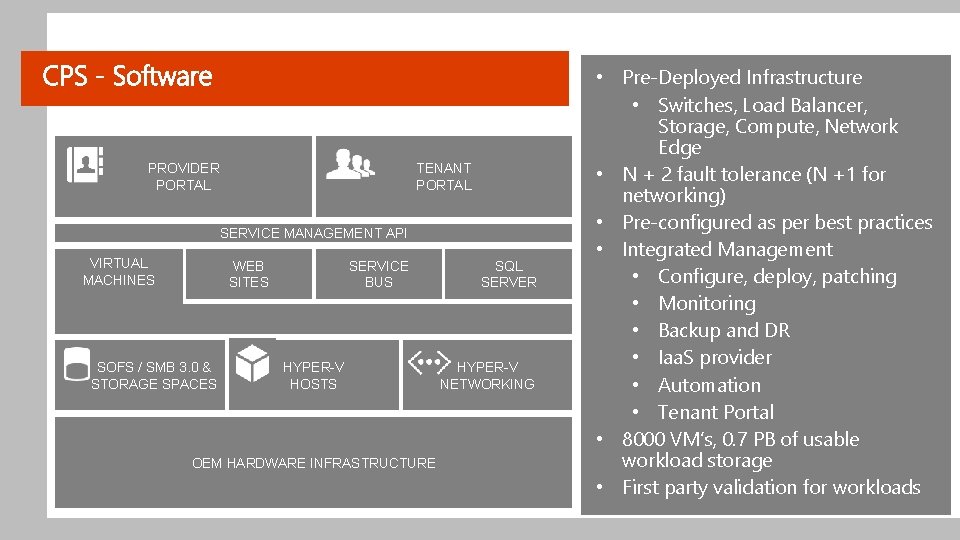
PROVIDER PORTAL TENANT PORTAL SERVICE MANAGEMENT API VIRTUAL MACHINES WEB SITES SOFS / SMB 3. 0 & STORAGE SPACES SERVICE BUS HYPER-V HOSTS OEM HARDWARE INFRASTRUCTURE SQL SERVER HYPER-V NETWORKING • Pre-Deployed Infrastructure • Switches, Load Balancer, Storage, Compute, Network Edge • N + 2 fault tolerance (N +1 for networking) • Pre-configured as per best practices • Integrated Management • Configure, deploy, patching • Monitoring • Backup and DR • Iaa. S provider • Automation • Tenant Portal • 8000 VM’s, 0. 7 PB of usable workload storage • First party validation for workloads
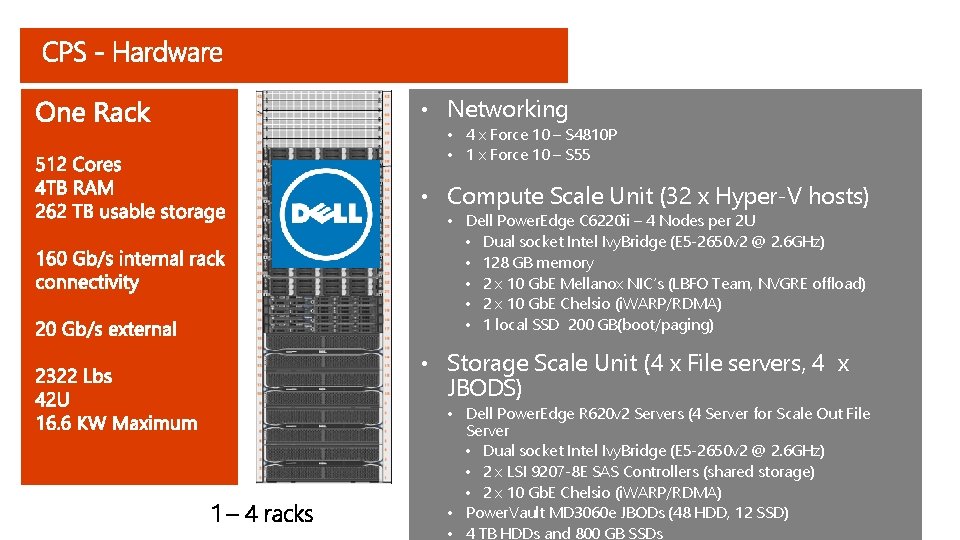
• Networking • 4 x Force 10 – S 4810 P • 1 x Force 10 – S 55 • Compute Scale Unit (32 x Hyper-V hosts) • Dell Power. Edge C 6220 ii – 4 Nodes per 2 U • Dual socket Intel Ivy. Bridge (E 5 -2650 v 2 @ 2. 6 GHz) • 128 GB memory • 2 x 10 Gb. E Mellanox NIC’s (LBFO Team, NVGRE offload) • 2 x 10 Gb. E Chelsio (i. WARP/RDMA) • 1 local SSD 200 GB(boot/paging) • Storage Scale Unit (4 x File servers, 4 x JBODS) • Dell Power. Edge R 620 v 2 Servers (4 Server for Scale Out File Server • Dual socket Intel Ivy. Bridge (E 5 -2650 v 2 @ 2. 6 GHz) • 2 x LSI 9207 -8 E SAS Controllers (shared storage) • 2 x 10 Gb. E Chelsio (i. WARP/RDMA) • Power. Vault MD 3060 e JBODs (48 HDD, 12 SSD) • 4 TB HDDs and 800 GB SSDs
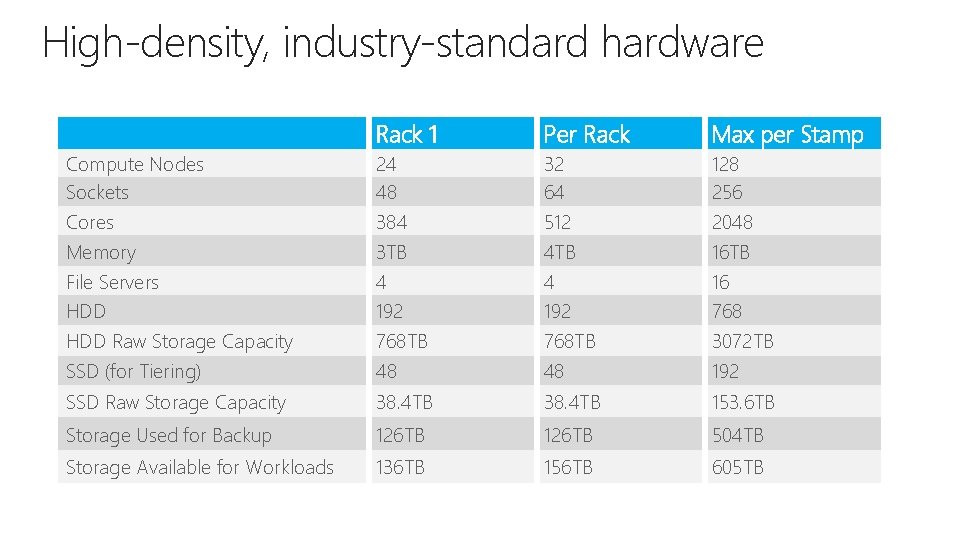
High-density, industry-standard hardware Rack 1 Per Rack Max per Stamp Compute Nodes Sockets Cores 24 48 384 32 64 512 128 256 2048 Memory 3 TB 4 TB 16 TB File Servers HDD 4 192 16 768 HDD Raw Storage Capacity 768 TB 3072 TB SSD (for Tiering) 48 48 192 SSD Raw Storage Capacity 38. 4 TB 153. 6 TB Storage Used for Backup 126 TB 504 TB Storage Available for Workloads 136 TB 156 TB 605 TB