
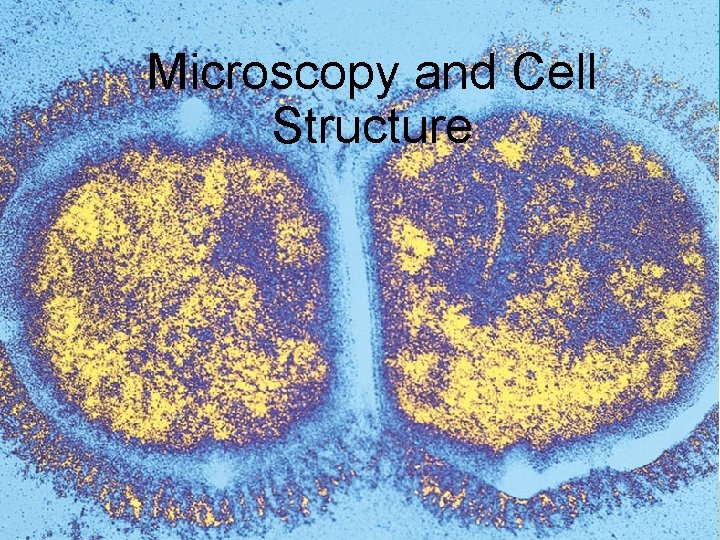
Microscopy and Cell Structure Power Point Lectures for
- Slides: 60
Microscopy and Cell Structure Power. Point Lectures for Biology, Seventh Edition Neil Campbell and Jane Reece Lectures by Chris Romero Copyright © 2005 Pearson Education, Inc. publishing as Benjamin Cummings
Life in Its Diverse Forms – Diversity is the hallmark of life. • The diversity of known life includes 1. 8 million species. • Estimates of the total diversity range from 10 million to over 200 million species. Copyright © 2005 Pearson Education, Inc. publishing as Benjamin Cummings
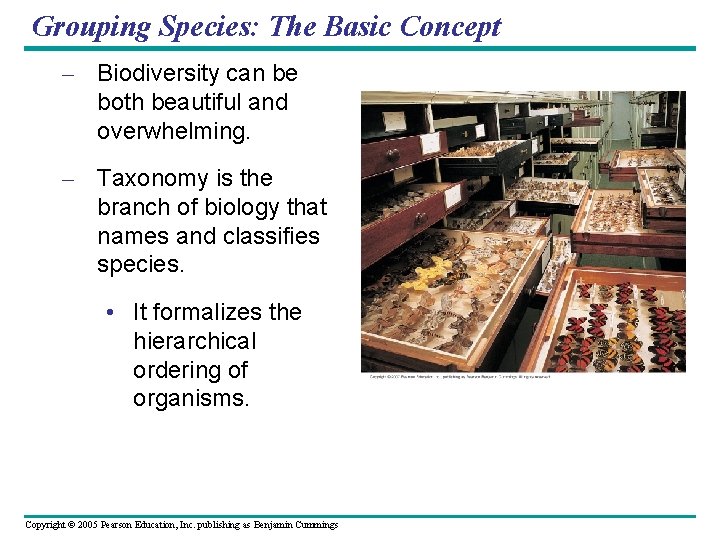
Grouping Species: The Basic Concept – Biodiversity can be both beautiful and overwhelming. – Taxonomy is the branch of biology that names and classifies species. • It formalizes the hierarchical ordering of organisms. Copyright © 2005 Pearson Education, Inc. publishing as Benjamin Cummings
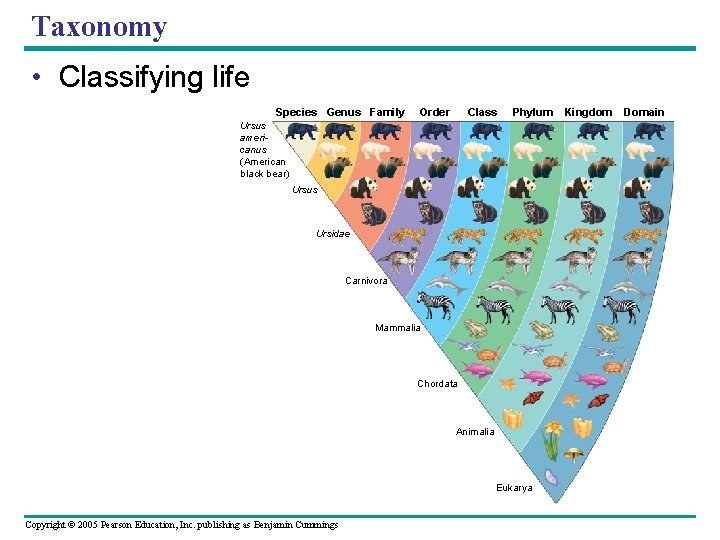
Taxonomy • Classifying life Species Genus Family Order Class Phylum Ursus americanus (American black bear) Ursus Ursidae Carnivora Mammalia Chordata Animalia Eukarya Copyright © 2005 Pearson Education, Inc. publishing as Benjamin Cummings Kingdom Domain
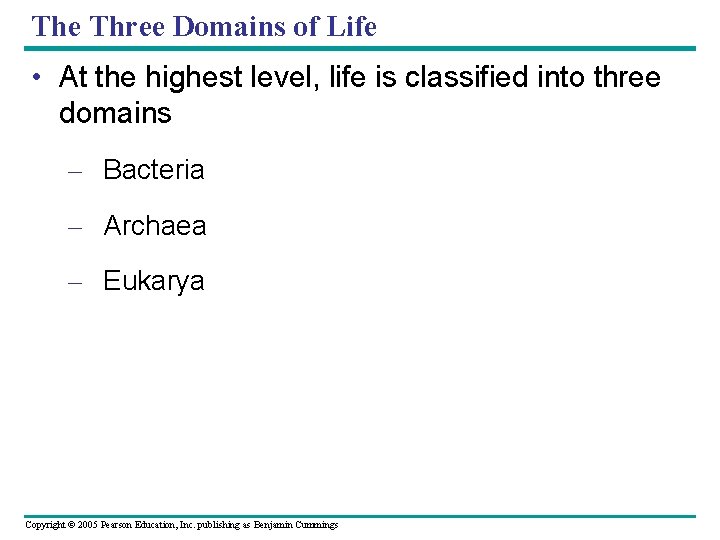
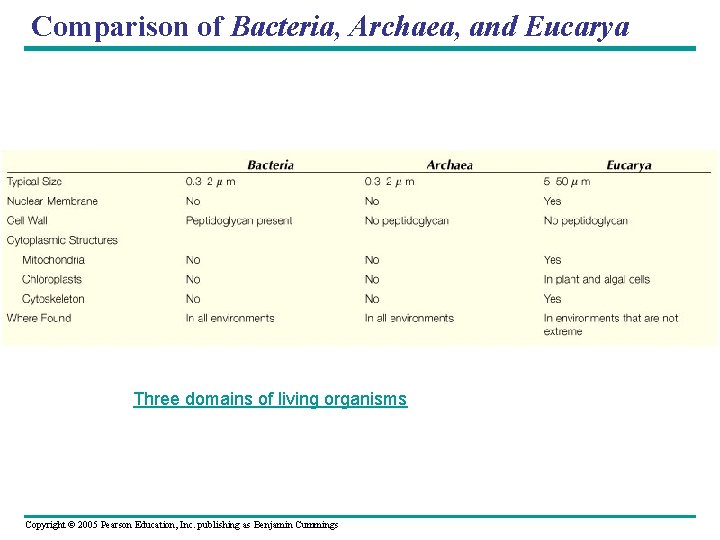
The Three Domains of Life • At the highest level, life is classified into three domains – Bacteria – Archaea – Eukarya Copyright © 2005 Pearson Education, Inc. publishing as Benjamin Cummings
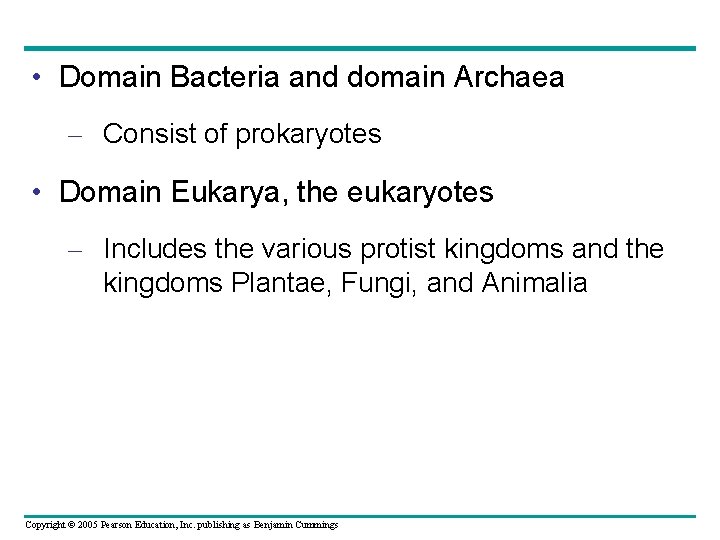
• Domain Bacteria and domain Archaea – Consist of prokaryotes • Domain Eukarya, the eukaryotes – Includes the various protist kingdoms and the kingdoms Plantae, Fungi, and Animalia Copyright © 2005 Pearson Education, Inc. publishing as Benjamin Cummings
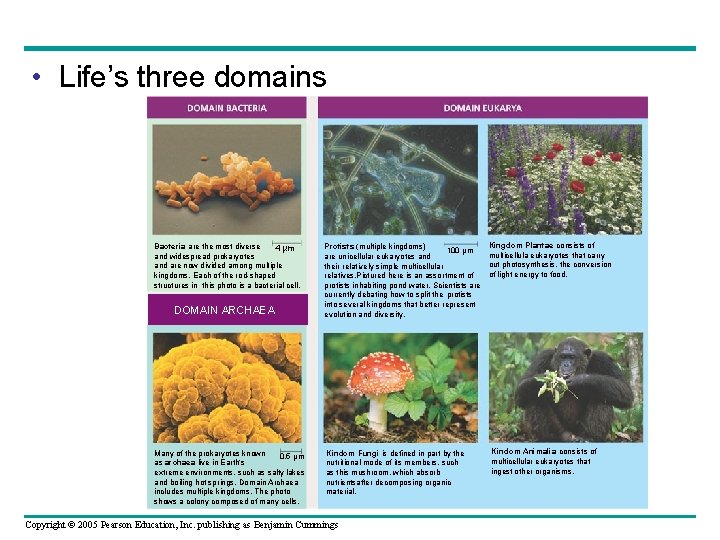
• Life’s three domains Bacteria are the most diverse 4 µm and widespread prokaryotes and are now divided among multiple kingdoms. Each of the rod-shaped structures in this photo is a bacterial cell. DOMAIN ARCHAEA Many of the prokaryotes known 0. 5 µm as archaea live in Earth‘s extreme environments, such as salty lakes and boiling hot springs. Domain Archaea includes multiple kingdoms. The photo shows a colony composed of many cells. Protists (multiple kingdoms) 100 µm are unicellular eukaryotes and their relatively simple multicellular relatives. Pictured here is an assortment of protists inhabiting pond water. Scientists are currently debating how to split the protists into several kingdoms that better represent evolution and diversity. Kingdom Plantae consists of multicellula eukaryotes that carry out photosynthesis, the conversion of light energy to food. Kindom Fungi is defined in part by the nutritional mode of its members, such as this mushroom, which absorb nutrientsafter decomposing organic material. Kindom Animalia consists of multicellular eukaryotes that ingest other organisms. Copyright © 2005 Pearson Education, Inc. publishing as Benjamin Cummings
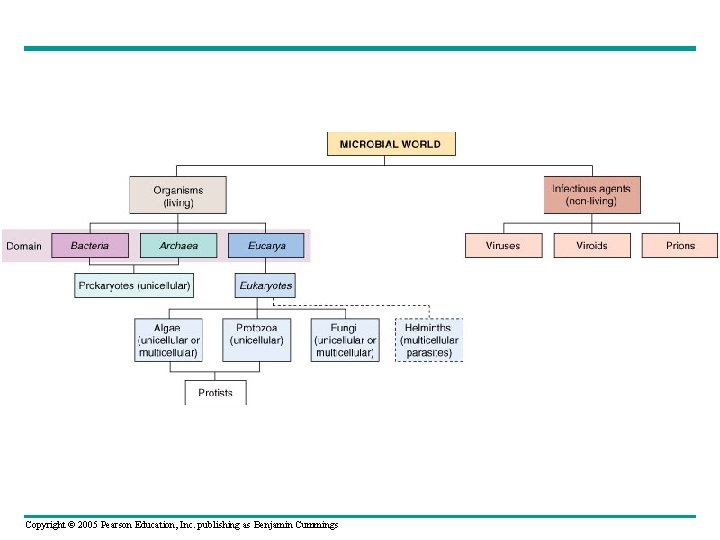
Copyright © 2005 Pearson Education, Inc. publishing as Benjamin Cummings
Comparison of Bacteria, Archaea, and Eucarya Three domains of living organisms Copyright © 2005 Pearson Education, Inc. publishing as Benjamin Cummings
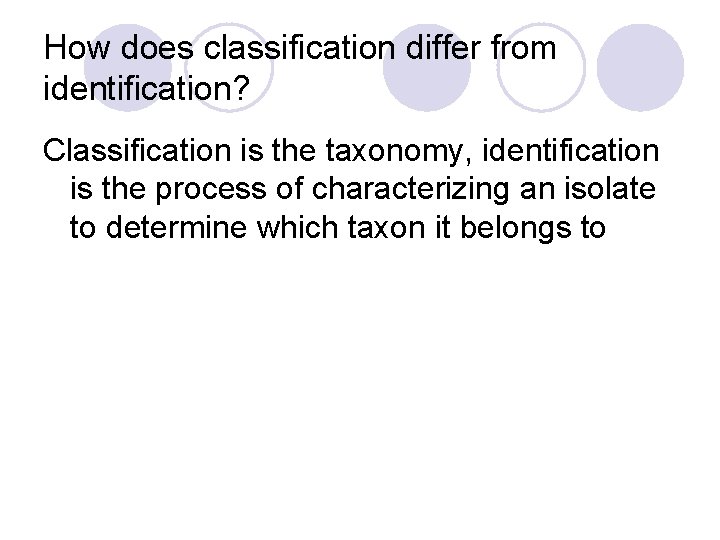
How does classification differ from identification? Classification is the taxonomy, identification is the process of characterizing an isolate to determine which taxon it belongs to
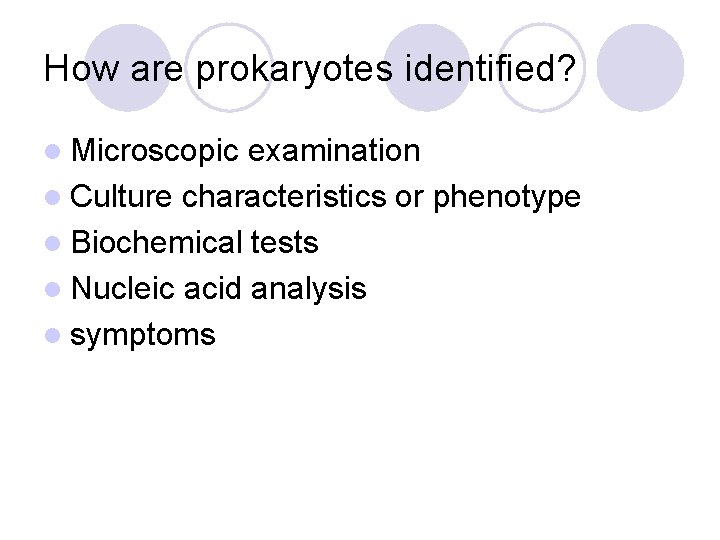
How are prokaryotes identified? l Microscopic examination l Culture characteristics or phenotype l Biochemical tests l Nucleic acid analysis l symptoms
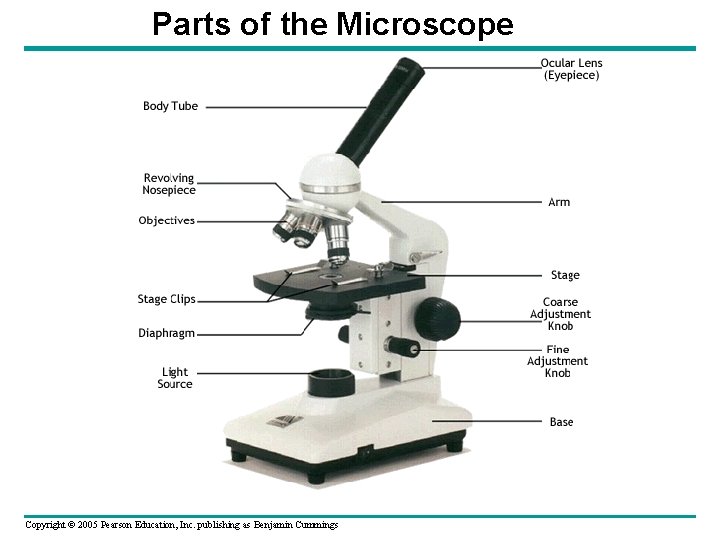
Parts of the Microscope Copyright © 2005 Pearson Education, Inc. publishing as Benjamin Cummings
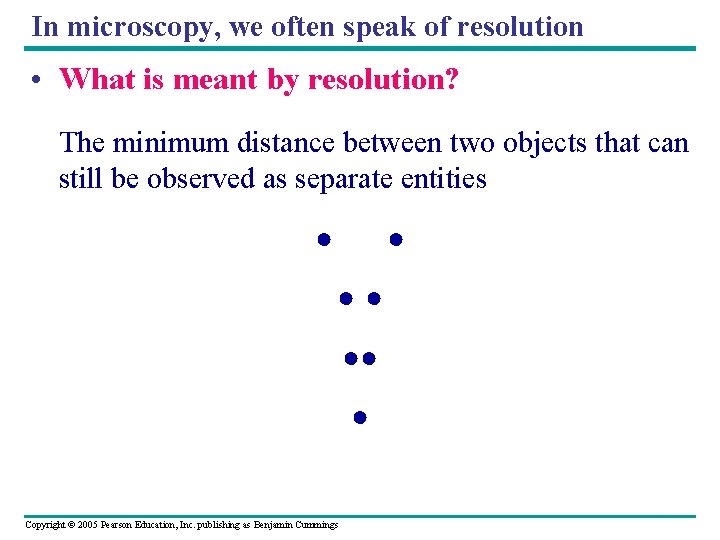
In microscopy, we often speak of resolution • What is meant by resolution? The minimum distance between two objects that can still be observed as separate entities ● ● ●● ●● ● Copyright © 2005 Pearson Education, Inc. publishing as Benjamin Cummings
Lenses and Magnification • The total magnification is the product of all lenses used • The eyepiece magnifies 10 x • The scanning objective is 4 x • What is the total magnification when viewing a specimen with the scanning objective? • The 10 x or 20 x objectives are called low power lenses • The 40 x objective is the high power lens • The 100 x objective is the oil immersion lens Copyright © 2005 Pearson Education, Inc. publishing as Benjamin Cummings
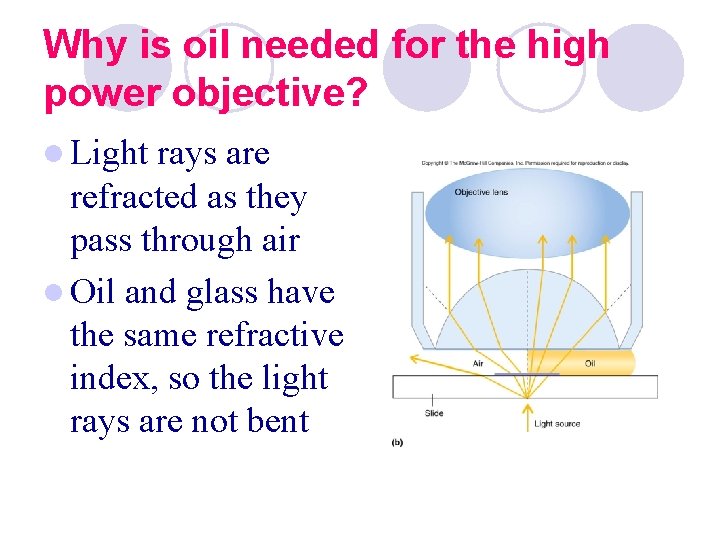
Why is oil needed for the high power objective? l Light rays are refracted as they pass through air l Oil and glass have the same refractive index, so the light rays are not bent
Exercise 1: Use of the Microscope l Review the parts of the compound microscope l Observe a slide of human blood and identify the different cell types l At what magnification are you viewing the cells?
The Microscopic World of Cells ¡ Organisms are either: Single-celled, such as most bacteria and protists l Multicelled, such as plants, animals, and most fungi l
¡ Cells were first discovered in 1665 by Robert Hooke. ¡ The accumulation of scientific evidence led to the cell theory. All living things are composed of cells. l All cells are formed from previously existing cells. l
The Importance of Cells l All organisms are made of cells l The cell is the simplest collection of matter that can live
The Two Major Categories of Cells • The countless cells on earth fall into two categories: – Prokaryotic cells – Eukaryotic cells • Prokaryotic and eukaryotic cells differ in several respects. Copyright © 2007 Pearson Education Inc. , publishing as Pearson Benjamin Cummings
Comparing Prokaryotic and Eukaryotic Cells All cells have several basic features in common • They are bounded by a plasma membrane • They contain a semifluid substance called the cytosol • They contain chromosomes • They all have ribosomes Copyright © 2007 Pearson Education Inc. , publishing as Pearson Benjamin Cummings
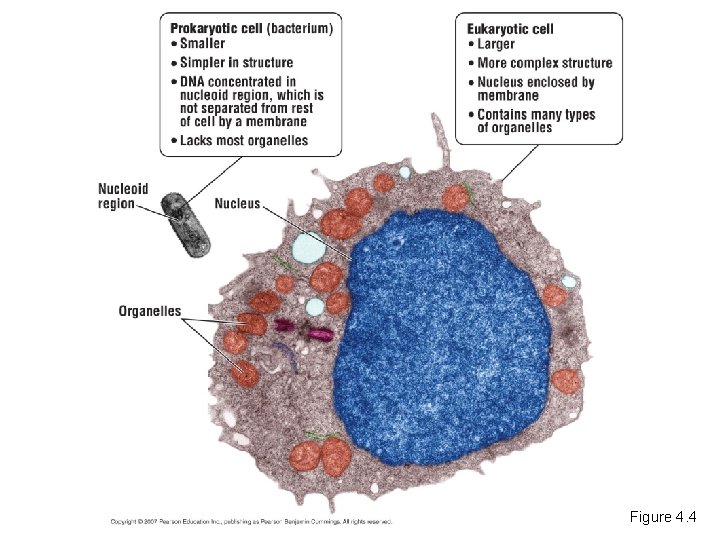
Prokaryotic cells Do not contain a nucleus Have their DNA located in a region called the nucleoid Copyright © 2007 Pearson Education Inc. , publishing as Pearson Benjamin Cummings
Figure 4. 4
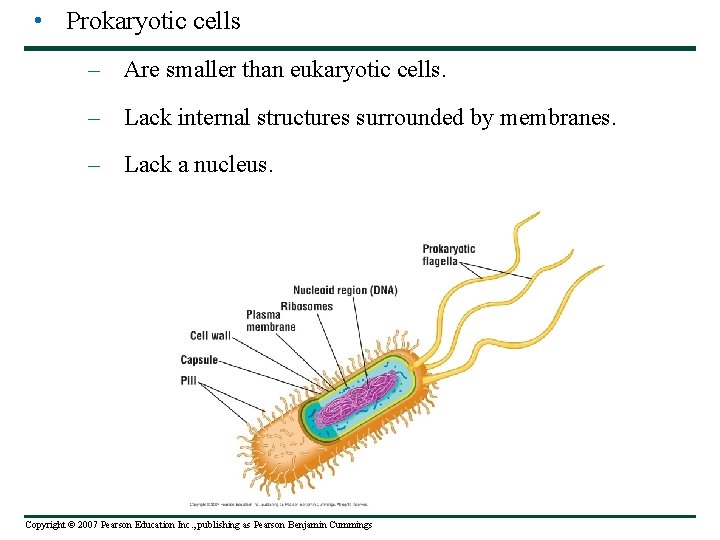
• Prokaryotic cells – Are smaller than eukaryotic cells. – Lack internal structures surrounded by membranes. – Lack a nucleus. Copyright © 2007 Pearson Education Inc. , publishing as Pearson Benjamin Cummings
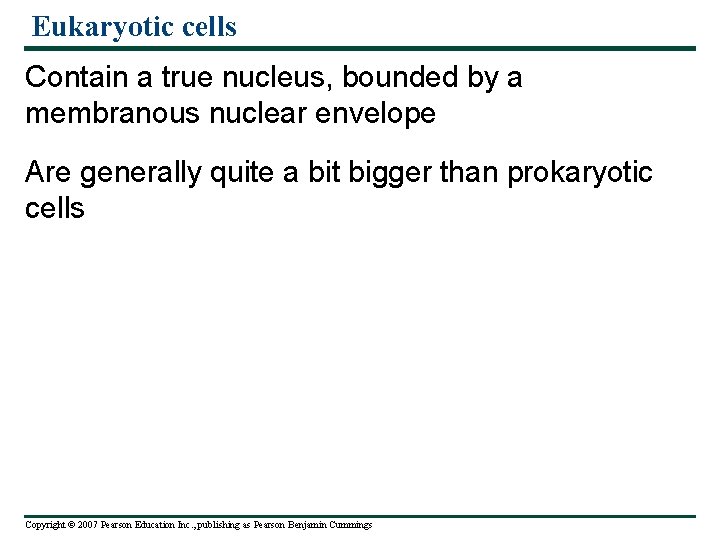
Eukaryotic cells Contain a true nucleus, bounded by a membranous nuclear envelope Are generally quite a bit bigger than prokaryotic cells Copyright © 2007 Pearson Education Inc. , publishing as Pearson Benjamin Cummings
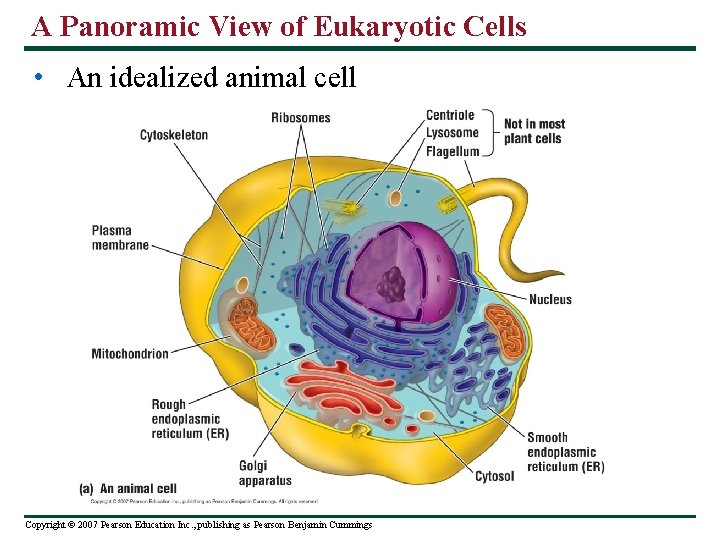
A Panoramic View of Eukaryotic Cells • An idealized animal cell Copyright © 2007 Pearson Education Inc. , publishing as Pearson Benjamin Cummings
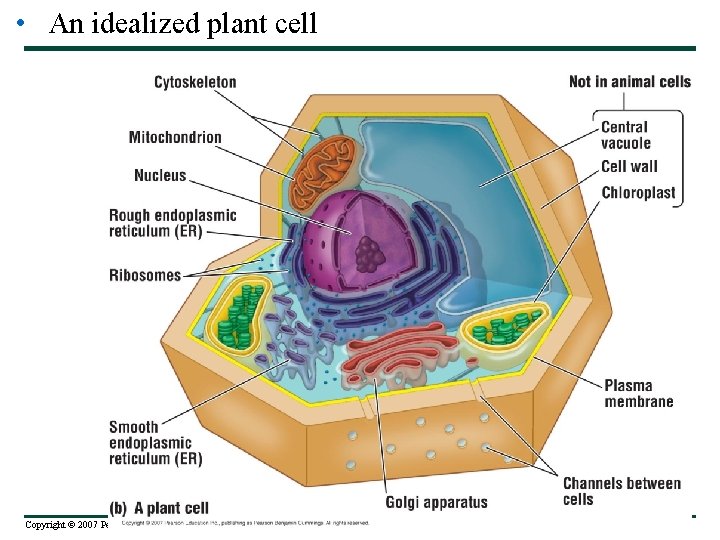
• An idealized plant cell Copyright © 2007 Pearson Education Inc. , publishing as Pearson Benjamin Cummings
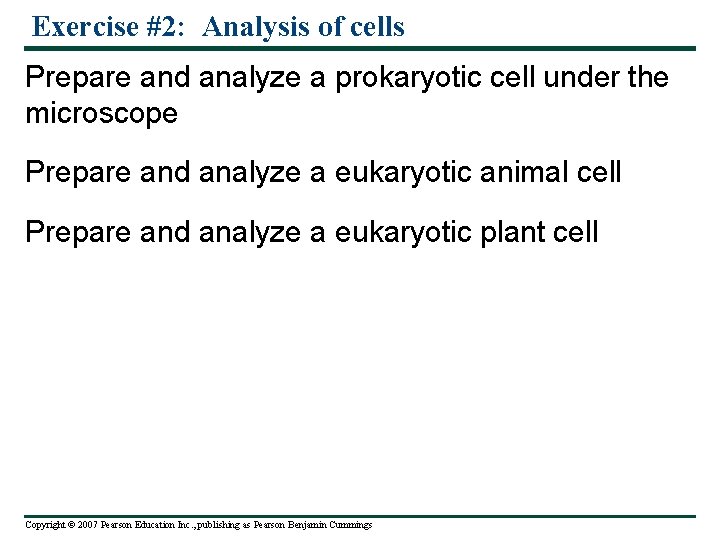
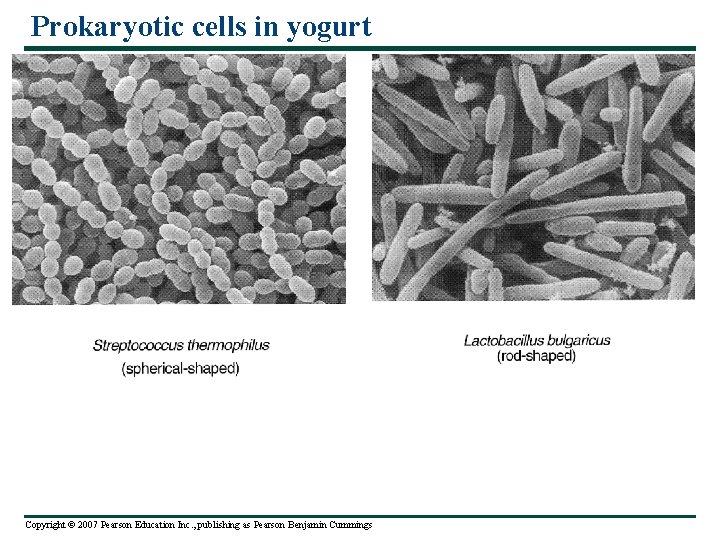
Exercise #2: Analysis of cells Prepare and analyze a prokaryotic cell under the microscope Prepare and analyze a eukaryotic animal cell Prepare and analyze a eukaryotic plant cell Copyright © 2007 Pearson Education Inc. , publishing as Pearson Benjamin Cummings
Prokaryotic cells in yogurt Copyright © 2007 Pearson Education Inc. , publishing as Pearson Benjamin Cummings
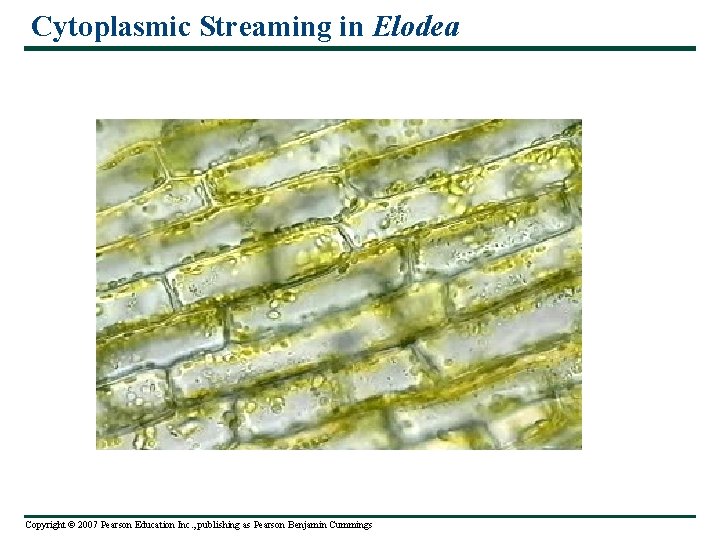
Cytoplasmic Streaming in Elodea Copyright © 2007 Pearson Education Inc. , publishing as Pearson Benjamin Cummings
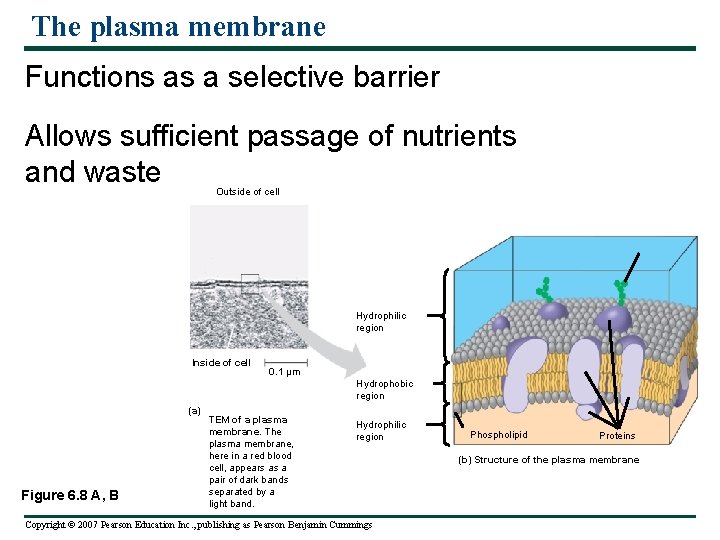
Membrane Structure • The plasma membrane separates the living cell from its nonliving surroundings. Copyright © 2007 Pearson Education Inc. , publishing as Pearson Benjamin Cummings
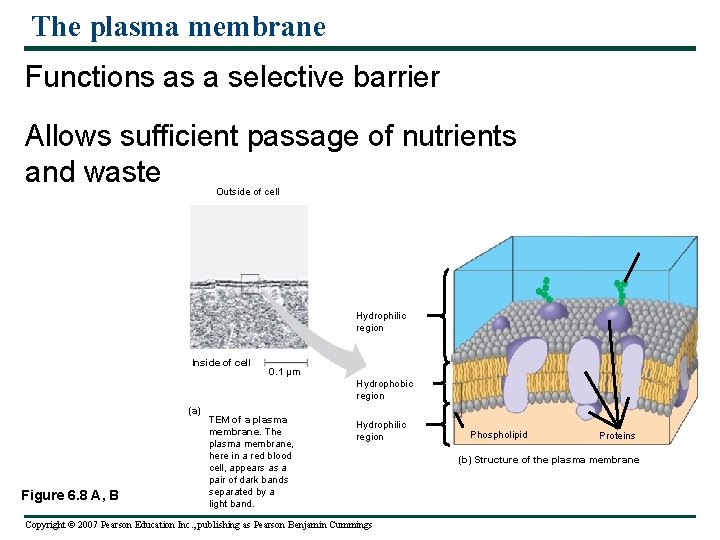
The plasma membrane Functions as a selective barrier Allows sufficient passage of nutrients and waste Outside of cell Carbohydrate side chain Hydrophilic region Inside of cell 0. 1 µm Hydrophobic region (a) Figure 6. 8 A, B TEM of a plasma membrane. The plasma membrane, here in a red blood cell, appears as a pair of dark bands separated by a light band. Hydrophilic region Copyright © 2007 Pearson Education Inc. , publishing as Pearson Benjamin Cummings Phospholipid Proteins (b) Structure of the plasma membrane
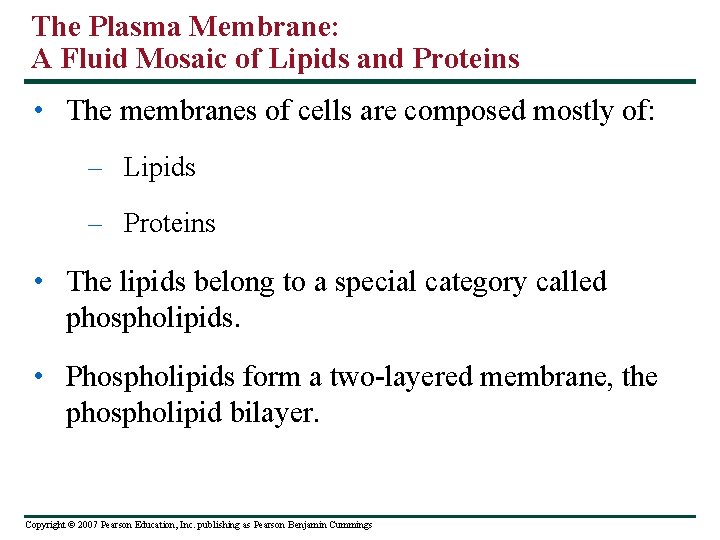
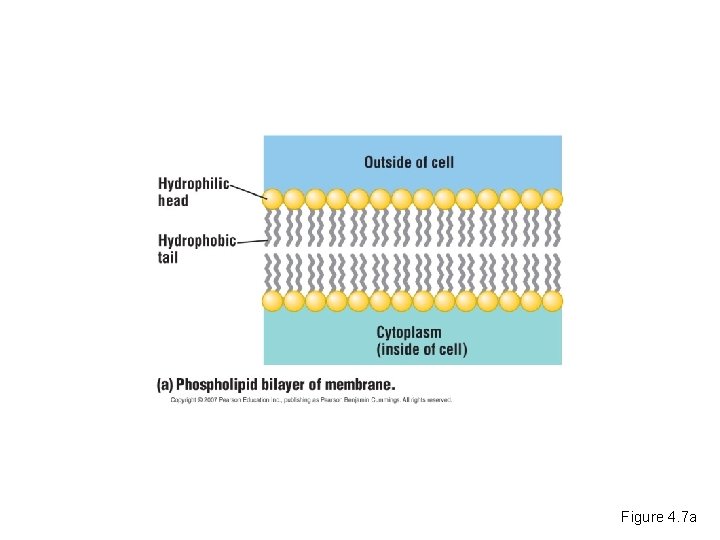
The Plasma Membrane: A Fluid Mosaic of Lipids and Proteins • The membranes of cells are composed mostly of: – Lipids – Proteins • The lipids belong to a special category called phospholipids. • Phospholipids form a two-layered membrane, the phospholipid bilayer. Copyright © 2007 Pearson Education, Inc. publishing as Pearson Benjamin Cummings
The plasma membrane Functions as a selective barrier Allows sufficient passage of nutrients and waste Outside of cell Carbohydrate side chain Hydrophilic region Inside of cell 0. 1 µm Hydrophobic region (a) Figure 6. 8 A, B TEM of a plasma membrane. The plasma membrane, here in a red blood cell, appears as a pair of dark bands separated by a light band. Hydrophilic region Copyright © 2007 Pearson Education Inc. , publishing as Pearson Benjamin Cummings Phospholipid Proteins (b) Structure of the plasma membrane
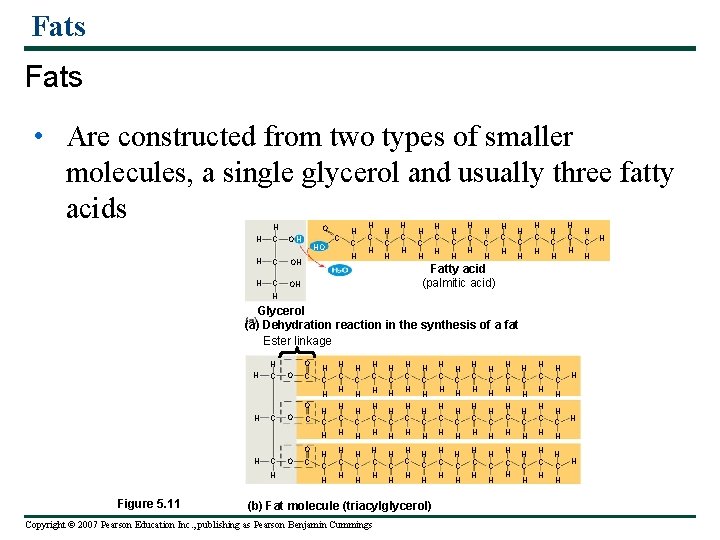
Fats • Are constructed from two types of smaller molecules, a single glycerol and usually three fatty acids H H C O OH H C OH HO C H H C H H C H H C H H C H Fatty acid (palmitic acid) H Glycerol (a) Dehydration reaction in the synthesis of a fat Ester linkage O H H C O C H O H C H Figure 5. 11 O C H C H H H C H H C H H C H H C H (b) Fat molecule (triacylglycerol) Copyright © 2007 Pearson Education Inc. , publishing as Pearson Benjamin Cummings H C H H C H H C H H C H H C H H C H H H C H H
Fatty acids • Vary in the length and number and locations of double bonds they contain Fats Copyright © 2007 Pearson Education Inc. , publishing as Pearson Benjamin Cummings
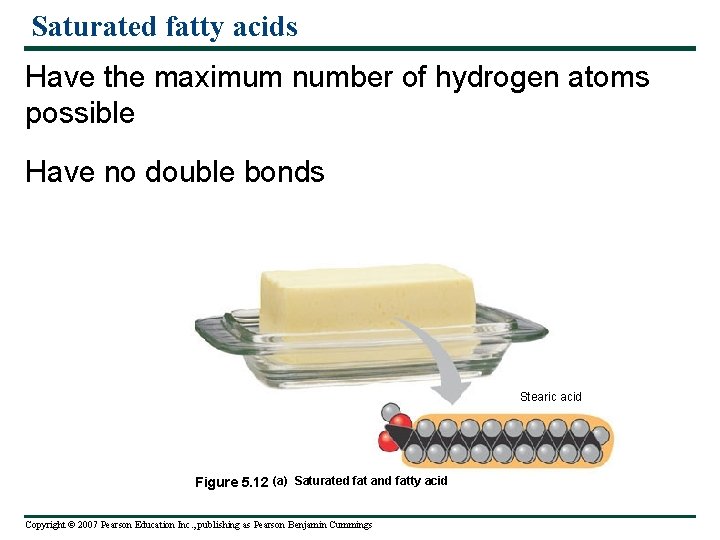
Saturated fatty acids Have the maximum number of hydrogen atoms possible Have no double bonds Stearic acid Figure 5. 12 (a) Saturated fat and fatty acid Copyright © 2007 Pearson Education Inc. , publishing as Pearson Benjamin Cummings
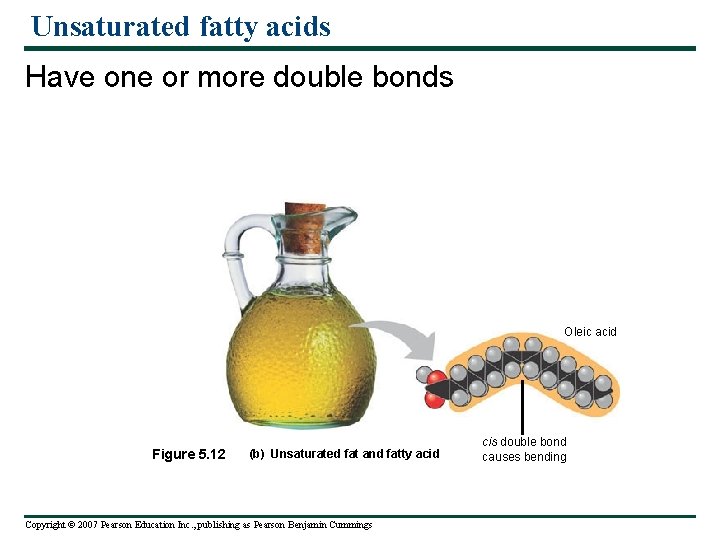
Unsaturated fatty acids Have one or more double bonds Oleic acid Figure 5. 12 (b) Unsaturated fat and fatty acid Copyright © 2007 Pearson Education Inc. , publishing as Pearson Benjamin Cummings cis double bond causes bending
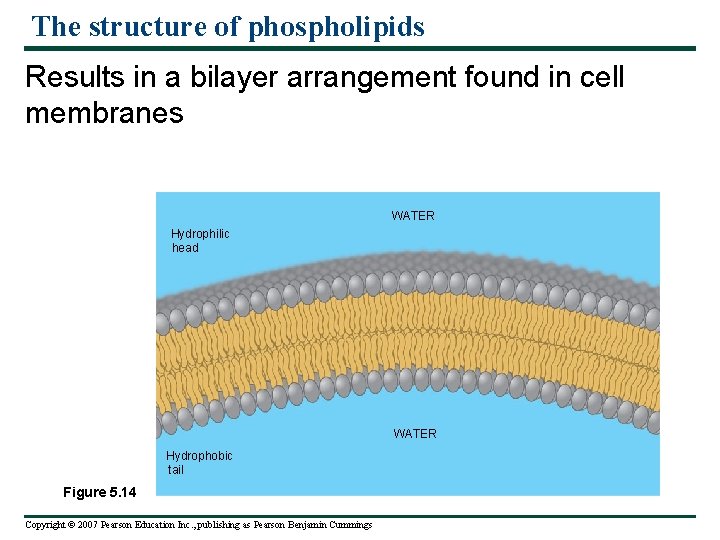
Phospholipids • Have only two fatty acids • Have a phosphate group instead of a third fatty acid Copyright © 2007 Pearson Education Inc. , publishing as Pearson Benjamin Cummings
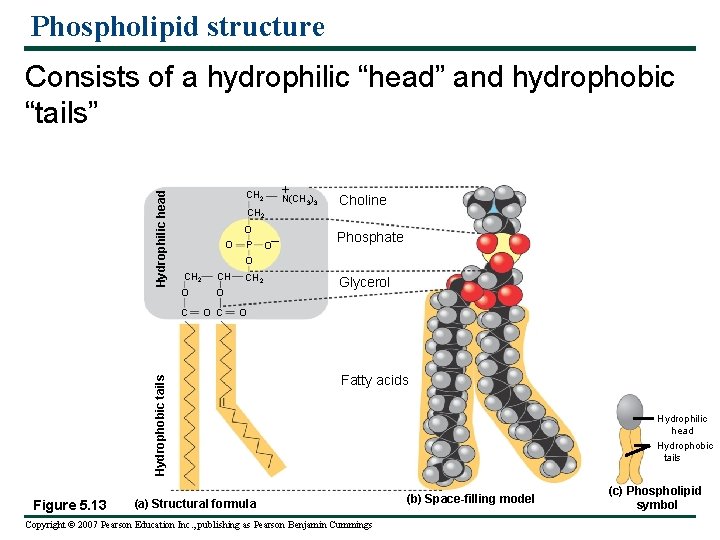
Phospholipid structure CH 2 O O P Figure 5. 13 O– + N(CH ) 3 3 Choline Phosphate O CH 2 CH O O C CH 2 Glycerol O Hydrophobic tails Hydrophilic head Consists of a hydrophilic “head” and hydrophobic “tails” Fatty acids (a) Structural formula Copyright © 2007 Pearson Education Inc. , publishing as Pearson Benjamin Cummings Hydrophilic head Hydrophobic tails (b) Space-filling model (c) Phospholipid symbol
The structure of phospholipids Results in a bilayer arrangement found in cell membranes WATER Hydrophilic head WATER Hydrophobic tail Figure 5. 14 Copyright © 2007 Pearson Education Inc. , publishing as Pearson Benjamin Cummings
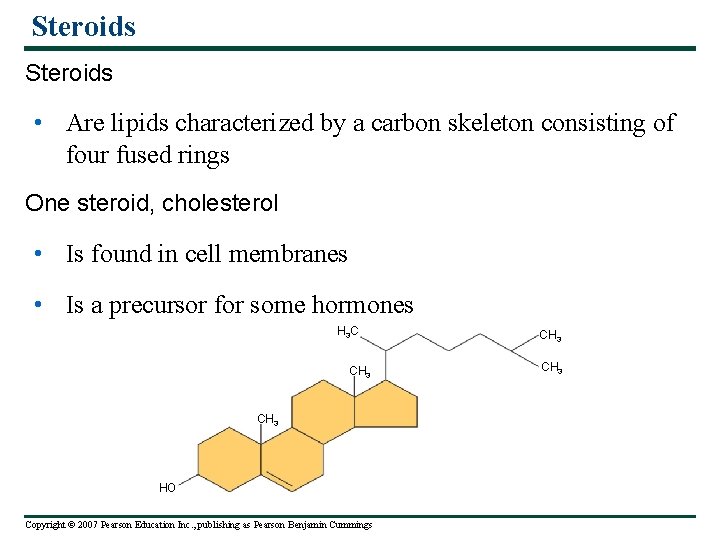
Steroids • Are lipids characterized by a carbon skeleton consisting of four fused rings One steroid, cholesterol • Is found in cell membranes • Is a precursor for some hormones H 3 C CH 3 HO Copyright © 2007 Pearson Education Inc. , publishing as Pearson Benjamin Cummings CH 3
Figure 4. 7 a
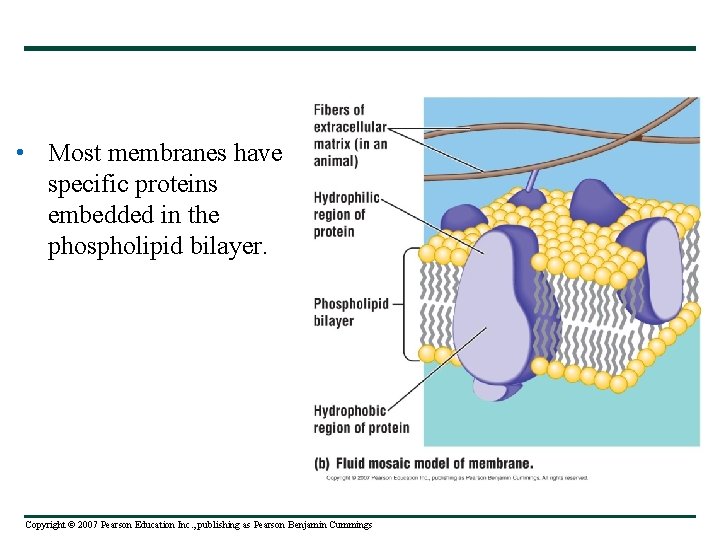
• Most membranes have specific proteins embedded in the phospholipid bilayer. Copyright © 2007 Pearson Education Inc. , publishing as Pearson Benjamin Cummings
• Membrane phospholipids and proteins can drift about in the plane of the membrane. • This behavior leads to the description of a membrane as a fluid mosaic: – Molecules can move freely within the membrane. – A diversity of proteins exists within the membrane. Copyright © 2007 Pearson Education Inc. , publishing as Pearson Benjamin Cummings
Cell Surfaces • Most cells secrete materials for coats of one kind or another – That are external to the plasma membrane. • These extracellular coats help protect and support cells – And facilitate interactions between cellular neighbors in tissues. Copyright © 2007 Pearson Education Inc. , publishing as Pearson Benjamin Cummings
• Plant cells have cell walls, – Which help protect the cells, maintain their shape, and keep the cells from absorbing too much water. • Animal cells have an extracellular matrix, – Which helps hold cells together in tissues and protects and supports them. Copyright © 2007 Pearson Education Inc. , publishing as Pearson Benjamin Cummings
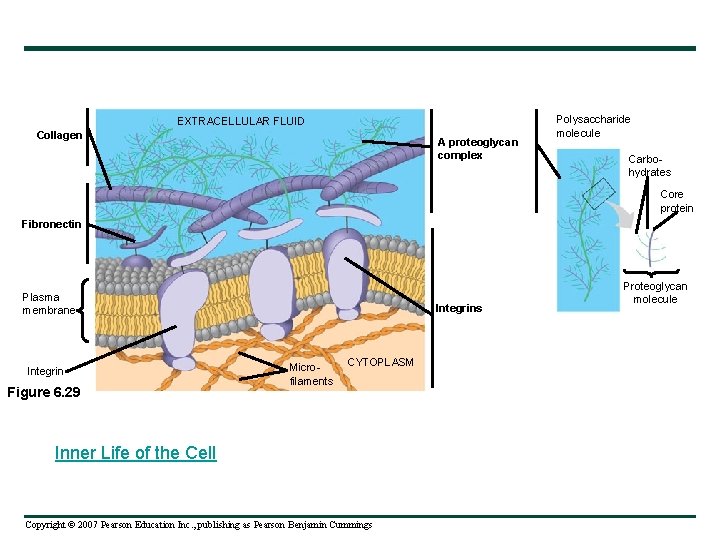
EXTRACELLULAR FLUID Collagen A proteoglycan complex Polysaccharide molecule Carbohydrates Core protein Fibronectin Plasma membrane Integrin Figure 6. 29 Integrins Microfilaments CYTOPLASM Inner Life of the Cell Copyright © 2007 Pearson Education Inc. , publishing as Pearson Benjamin Cummings Proteoglycan molecule
Exercise #3: Constructing a Fluid Mosaic Model Copyright © 2007 Pearson Education Inc. , publishing as Pearson Benjamin Cummings
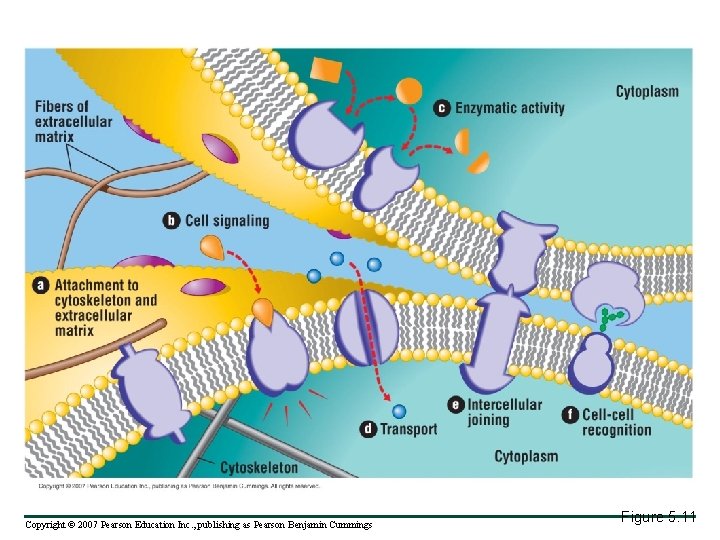
Membrane Function • Working cells must control the flow of materials to and from the environment. – Membrane proteins help with this task. • Membrane proteins perform a variety of functions. Membrane Selectivity Copyright © 2007 Pearson Education Inc. , publishing as Pearson Benjamin Cummings
Copyright © 2007 Pearson Education Inc. , publishing as Pearson Benjamin Cummings Figure 5. 11
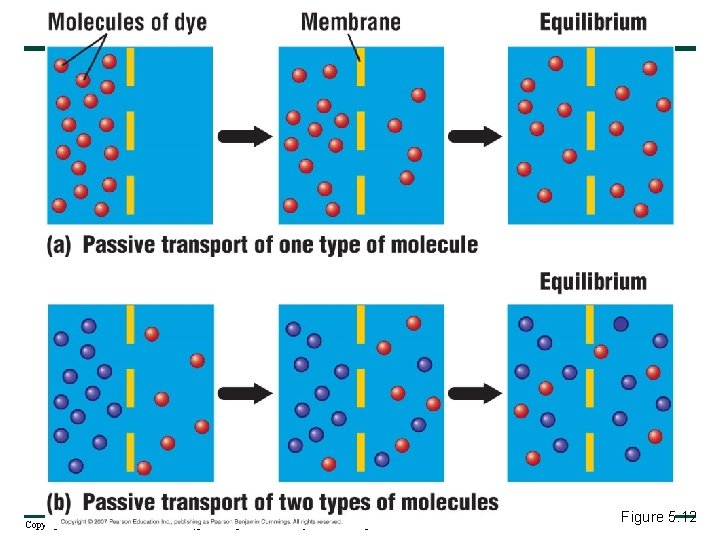
Passive Transport: Diffusion Across Membranes • Molecules contain heat energy. – They vibrate and wander randomly. • Diffusion is one result of the movement of molecules. – Molecules tend to spread into the available space. – Diffusion is passive transport; no energy is needed. Copyright © 2007 Pearson Education Inc. , publishing as Pearson Benjamin Cummings
Copyright © 2007 Pearson Education Inc. , publishing as Pearson Benjamin Cummings Figure 5. 12
• Another type of passive transport is facilitated diffusion, the transport of some substances by specific transport proteins that act as selective corridors. Copyright © 2007 Pearson Education Inc. , publishing as Pearson Benjamin Cummings
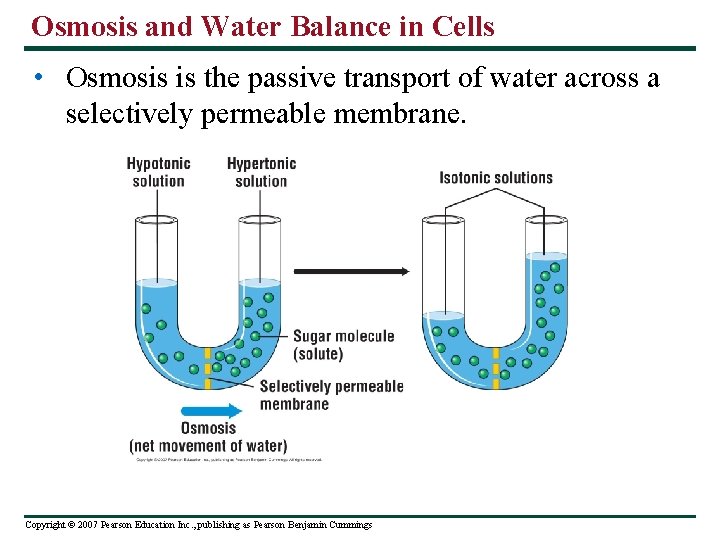
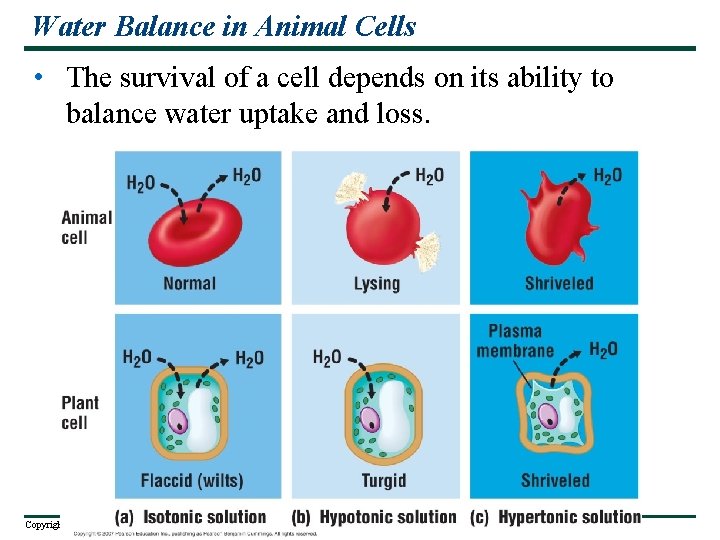
Osmosis and Water Balance in Cells • Osmosis is the passive transport of water across a selectively permeable membrane. Copyright © 2007 Pearson Education Inc. , publishing as Pearson Benjamin Cummings
• A hypertonic solution – Has a higher concentration of solute. • A hypotonic solution – Has a lower concentration of solute. • An isotonic solution – Has an equal concentration of solute. Copyright © 2007 Pearson Education Inc. , publishing as Pearson Benjamin Cummings
Water Balance in Animal Cells • The survival of a cell depends on its ability to balance water uptake and loss. Copyright © 2007 Pearson Education Inc. , publishing as Pearson Benjamin Cummings
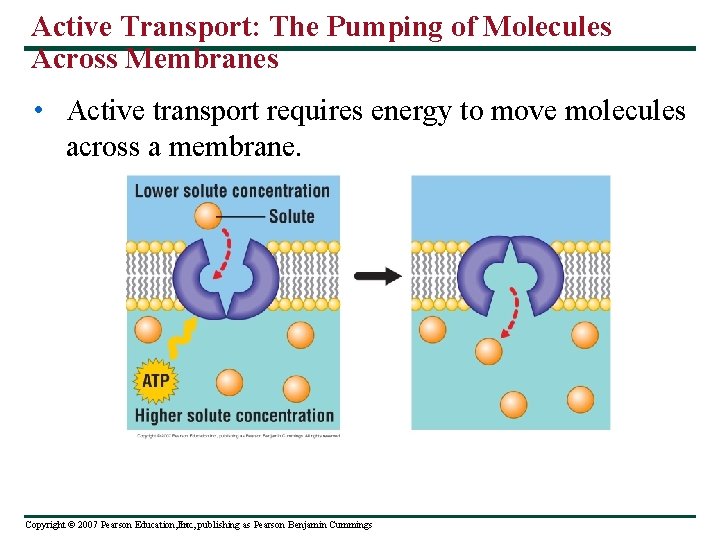
Active Transport: The Pumping of Molecules Across Membranes • Active transport requires energy to move molecules across a membrane. Copyright © 2007 Pearson Education, Education Inc. , Inc. publishing as Pearson Benjamin Cummings
Case Study : Osmosis is Serious Business Case Study Collection Copyright © 2007 Pearson Education Inc. , publishing as Pearson Benjamin Cummings
Exercise #4: Transport Across the Cell Membrane Copyright © 2007 Pearson Education Inc. , publishing as Pearson Benjamin Cummings