
Microscopic Techniques to Troubleshoot Activated Sludge Problems and
Microscopic Techniques to Troubleshoot Activated Sludge, Problems and Control By Jason Calhoun, PE POLYTEC, INC 3 -22 -12
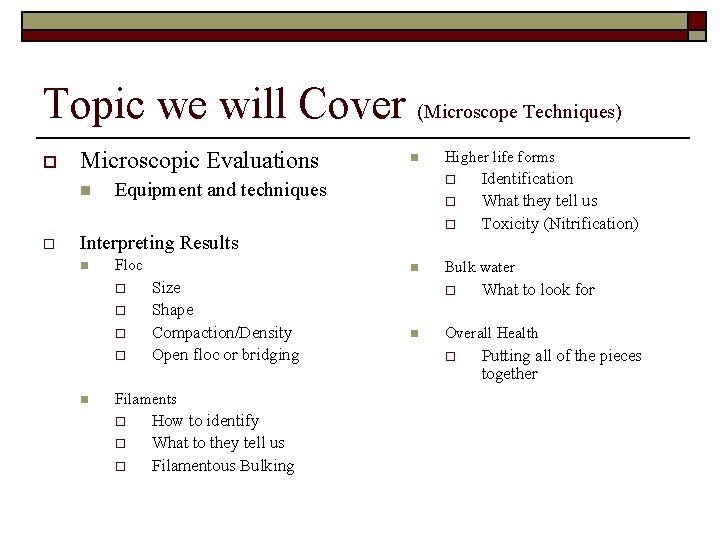
Topic we will Cover (Microscope Techniques) o Microscopic Evaluations n o Equipment and techniques o o Interpreting Results n Floc o o n n Size Shape Compaction/Density Open floc or bridging Filaments o o o How to identify What to they tell us Filamentous Bulking Higher life forms Bulk water o n Identification What they tell us Toxicity (Nitrification) What to look for Overall Health o Putting all of the pieces together

What we will Cover (Microbiology Problems and Causes) o Microbiology Problems and Their Causes n Poor Floc Formation, Pin Floc and Dispersed Growth. n Toxicity n Nitrification and Denitrification Problems n Nutrient Deficiency and Polysaccharide Bulking and Foaming n Zoogloeal Bulking and Foaming n Filamentous Bulking n Filamentous Foaming
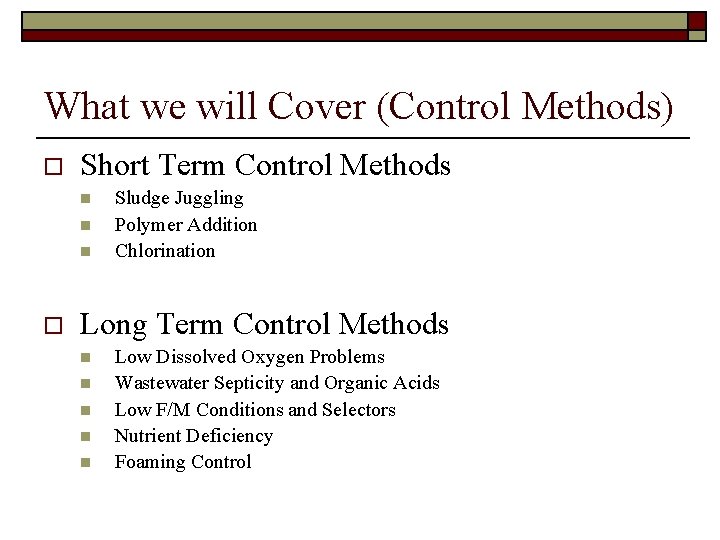
What we will Cover (Control Methods) o Short Term Control Methods n n n o Sludge Juggling Polymer Addition Chlorination Long Term Control Methods n n n Low Dissolved Oxygen Problems Wastewater Septicity and Organic Acids Low F/M Conditions and Selectors Nutrient Deficiency Foaming Control
Why Perform Microscopic Evaluations? o Proactive tool to monitor biological health within your activated sludge system. “The real “heart” of the activated sludge system is the development and maintenance of a mixed microbial culture that treats wastewater and which can be managed… Be a good bug farmer” Eikelboom o Predict toxic upset events. o Detect when operational changes need to be made!

Equipment o o Research grade phase contrast microscope. Both 10 x and 100 x (oil emersion) phase contrast objectives that yield 100 x and 1000 x respectively. o 25 -mm X 75 -mm microscope slide o 22 -mm X 22 -mm (No. 1) glass cover slip o Emersion oil o Gram stain o Neisser stain
Why Phase Contrast? o Phase contrast is needed because biological materials have very low contrast when viewed with direct illumination. o Phase contrast illumination reveals much more detail in low contrast materials.
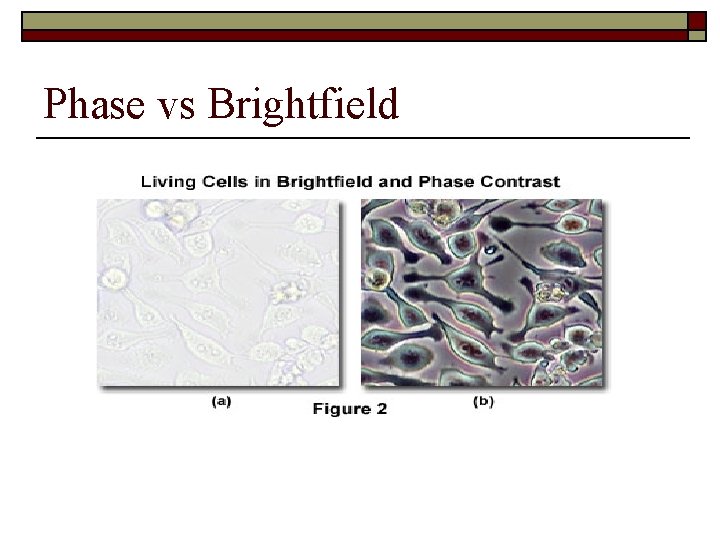
Phase vs Brightfield
Sampling o Take mixed liquor samples at points of good mixing. n n o Take MLSS samples below the surface. n o Effluent end of an aeration basin Mixed liquor channel between the aeration basin and the secondary clarifier. Exclude any foam or other floating material. When excessive foam exist collect a separate sample for examination.
Sampling Frequency o Dictated by circumstances n Daily during critical periods (bulking, RAS chlorination, changes or experimental operation). n Once every MCRT for routine characterization. n Weekly for process control.
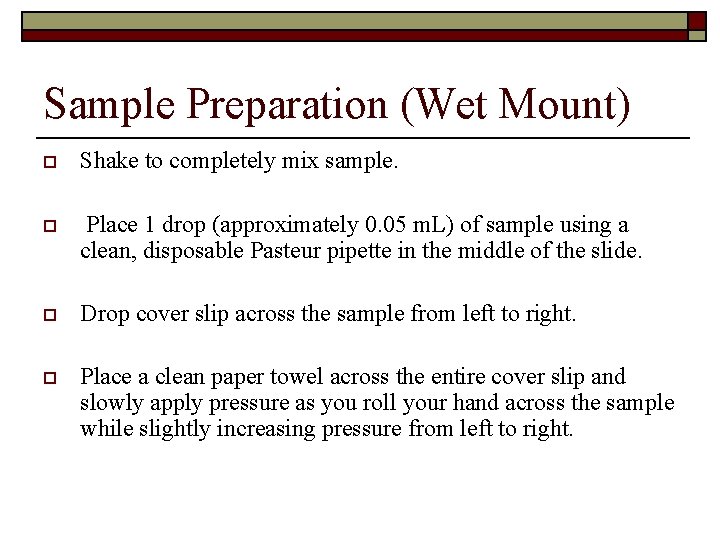
Sample Preparation (Wet Mount) o Shake to completely mix sample. o Place 1 drop (approximately 0. 05 m. L) of sample using a clean, disposable Pasteur pipette in the middle of the slide. o Drop cover slip across the sample from left to right. o Place a clean paper towel across the entire cover slip and slowly apply pressure as you roll your hand across the sample while slightly increasing pressure from left to right.
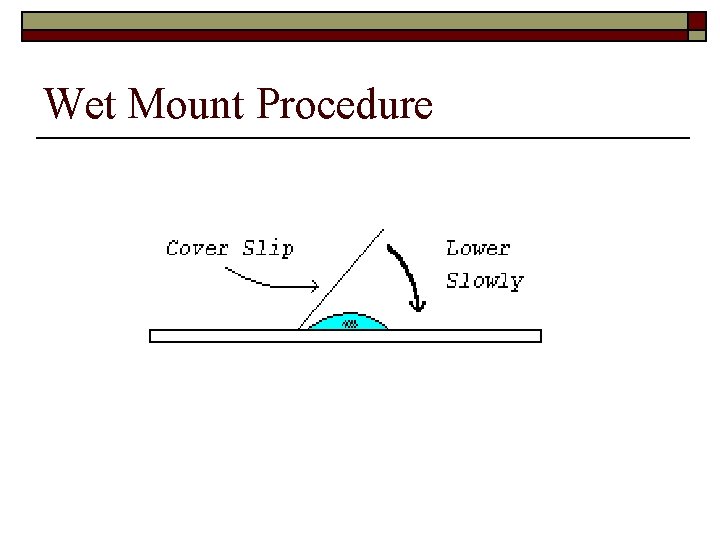
Wet Mount Procedure
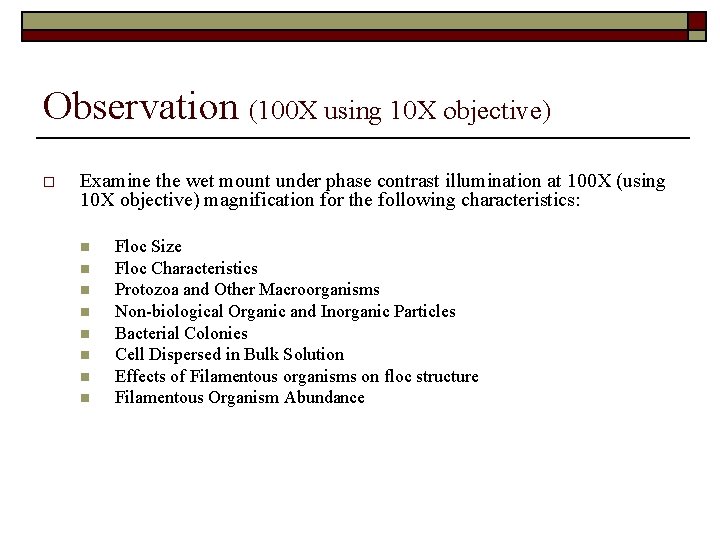
Observation (100 X using 10 X objective) o Examine the wet mount under phase contrast illumination at 100 X (using 10 X objective) magnification for the following characteristics: n n n n Floc Size Floc Characteristics Protozoa and Other Macroorganisms Non-biological Organic and Inorganic Particles Bacterial Colonies Cell Dispersed in Bulk Solution Effects of Filamentous organisms on floc structure Filamentous Organism Abundance

Floc o Basic floc formation is required for activated sludge operation due to the use of gravity clarifiers. o Floc-forming species use the formation of extracellular polysaccharide, protein and cellulose fibrils to cement bacteria together to form floc. o Good floc formation occurs at lower growth rates and at lower nutrient levels, essentially starvation or stationary growth!
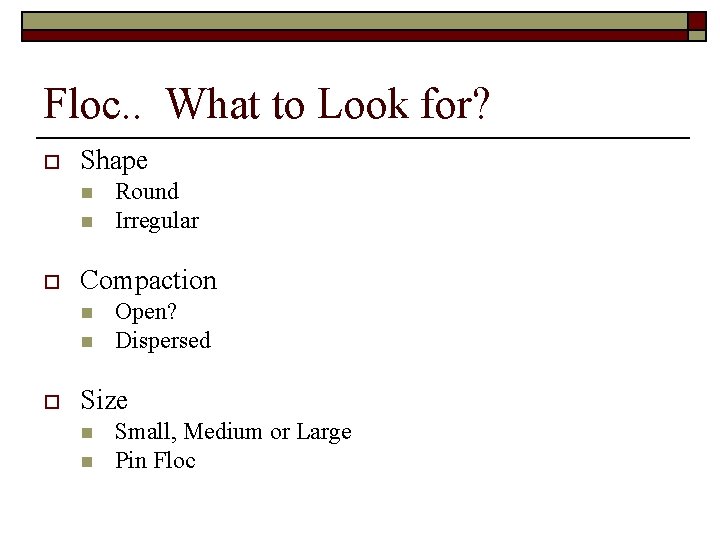
Floc. . What to Look for? o Shape n n o Compaction n n o Round Irregular Open? Dispersed Size n n Small, Medium or Large Pin Floc
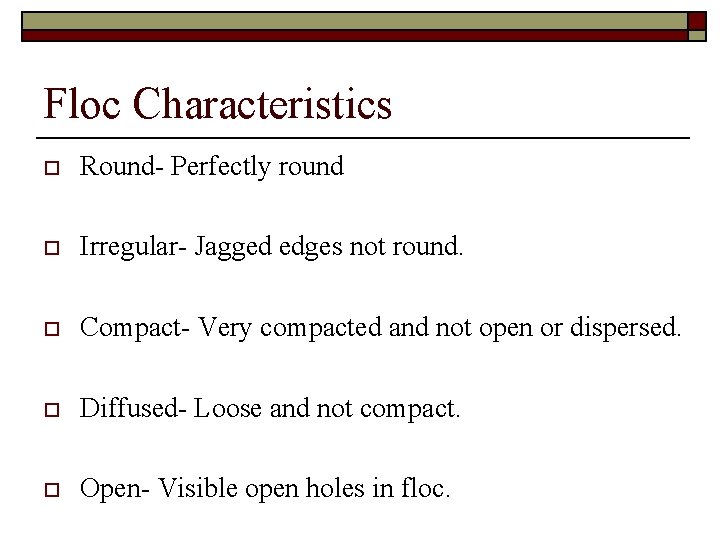
Floc Characteristics o Round- Perfectly round o Irregular- Jagged edges not round. o Compact- Very compacted and not open or dispersed. o Diffused- Loose and not compact. o Open- Visible open holes in floc.
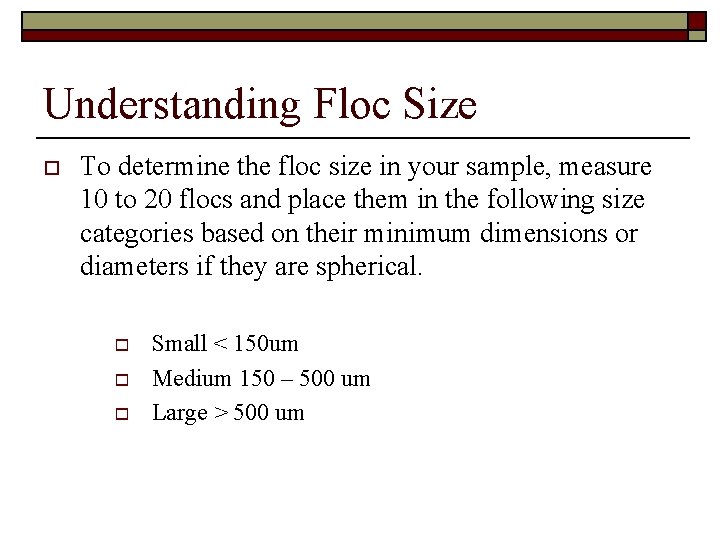
Understanding Floc Size o To determine the floc size in your sample, measure 10 to 20 flocs and place them in the following size categories based on their minimum dimensions or diameters if they are spherical. o o o Small < 150 um Medium 150 – 500 um Large > 500 um
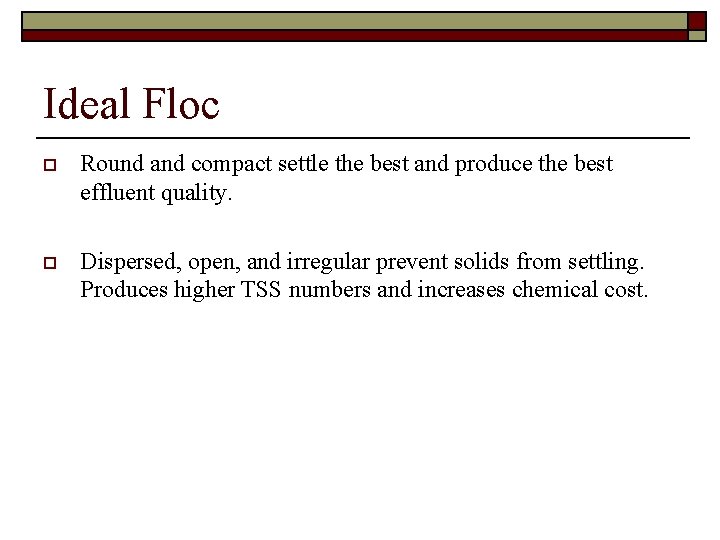
Ideal Floc o Round and compact settle the best and produce the best effluent quality. o Dispersed, open, and irregular prevent solids from settling. Produces higher TSS numbers and increases chemical cost.

Good Floc
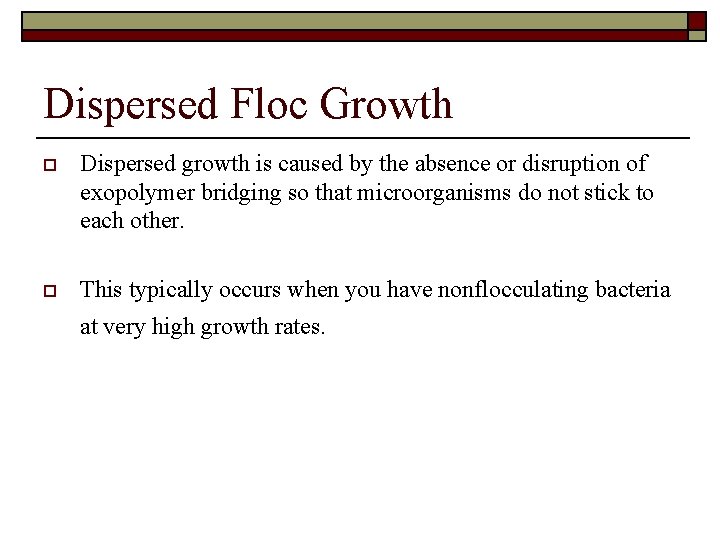
Dispersed Floc Growth o Dispersed growth is caused by the absence or disruption of exopolymer bridging so that microorganisms do not stick to each other. o This typically occurs when you have nonflocculating bacteria at very high growth rates.
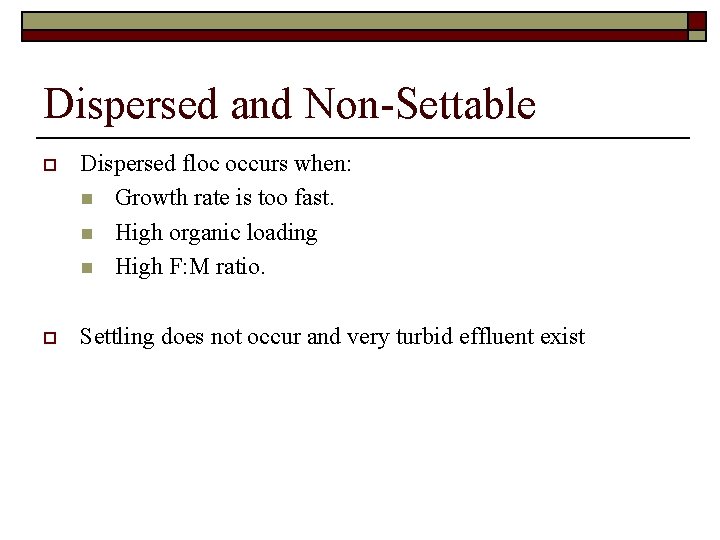
Dispersed and Non-Settable o Dispersed floc occurs when: n Growth rate is too fast. n High organic loading n High F: M ratio. o Settling does not occur and very turbid effluent exist
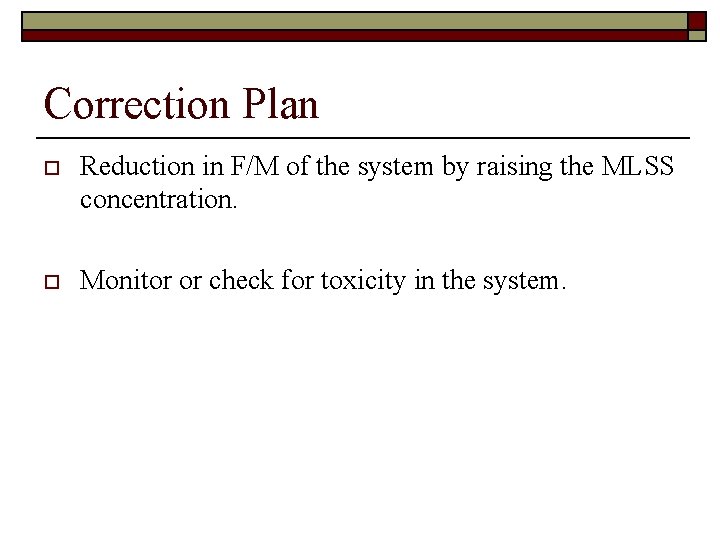
Correction Plan o Reduction in F/M of the system by raising the MLSS concentration. o Monitor or check for toxicity in the system.

Dispersed Floc
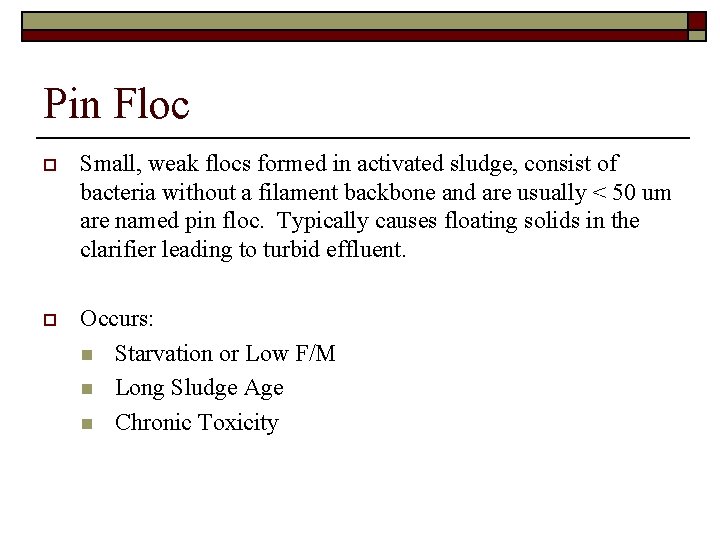
Pin Floc o Small, weak flocs formed in activated sludge, consist of bacteria without a filament backbone and are usually < 50 um are named pin floc. Typically causes floating solids in the clarifier leading to turbid effluent. o Occurs: n Starvation or Low F/M n Long Sludge Age n Chronic Toxicity
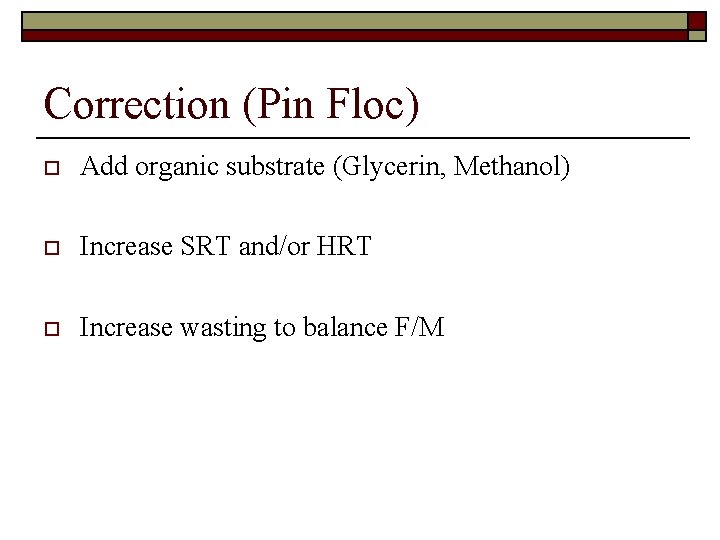
Correction (Pin Floc) o Add organic substrate (Glycerin, Methanol) o Increase SRT and/or HRT o Increase wasting to balance F/M

Pin Floc
Effects of Filamentous on Floc Structure o None o Bridging: Filaments extend from the floc surface into the bulk solution and bridge between the flocs. o Open Floc Structure: Floc population attaches and grows around the filamentous organisms leading to large, irregularly shaped flocs with substantial internal voids.
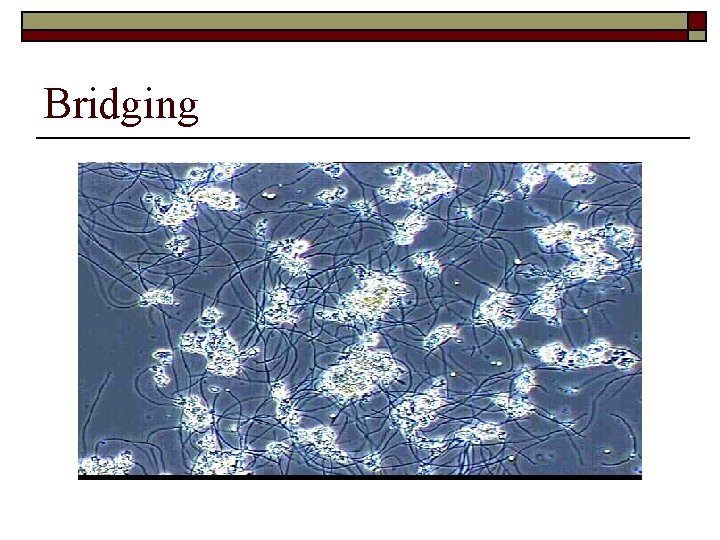
Bridging

Open Floc Structure
Protozoa and Other Macroorganisms o After looking at floc health, the next observation to be made is to scan the entire slide for Protozoa. o Look under 10 x or 100 x objective. n n n Identify types of protozoa. Activity. numbers
Higher Life-forms o In a wastewater treatment system, the next higher life form above bacteria are protozoans. These single-celled animals perform three significant roles in the activated sludge process. o o o floc formation cropping of bacteria removal of suspended material (BOD). o Protozoans are also indicators of biomass health and effluent quality. o The presence of protozoans and metazoans and the relative abundance of certain species can be a predictor of operational changes within a treatment plant. In this way, an operator is able to make adjustments and minimize negative operational effects simply by observing changes in the protozoan and metazoan population.
Higher Life forms as indicator Organisms o Various protozoan and invertebrate groups develop in activated sludge according to growth conditions. Thus, the activated sludge growth at (MCRT) rarely limits the development of these organisms. o Principally, food availability is the primary determination of which group predominates!

Types of Higher Life Forms o The six basic groups observed in activated sludge are: o o o Flagellates Amoebae Free Swimming Ciliates Attached/Stalked Ciliates Rotifers Invertebrates

Flagellates o Small oval or elongated 1 forms actively motile with whip like flagellae. o Feed on soluble organic matter seen in high BOD systems.
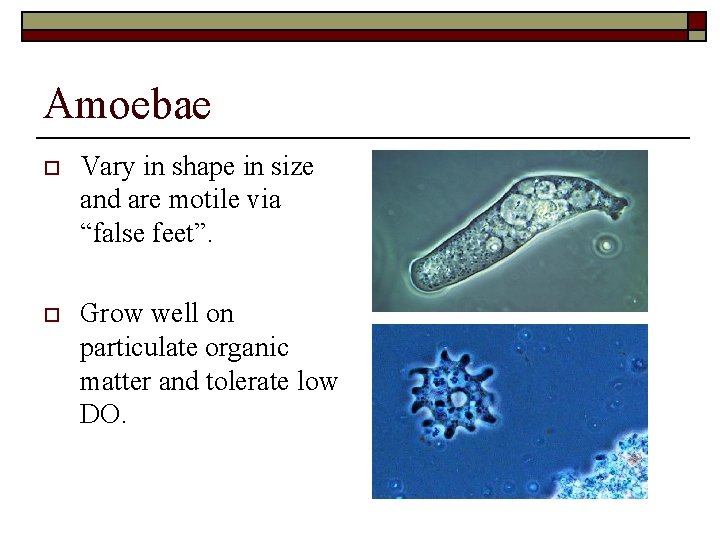
Amoebae o Vary in shape in size and are motile via “false feet”. o Grow well on particulate organic matter and tolerate low DO. 1
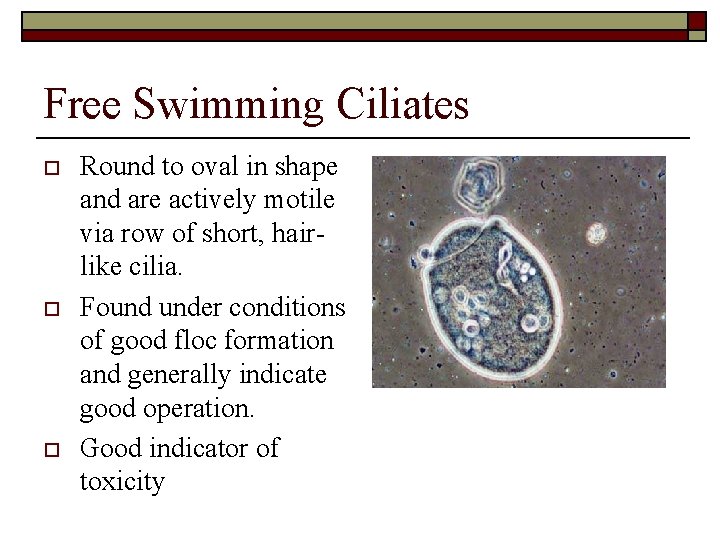
Free Swimming Ciliates o o o Round to oval in shape 1 and are actively motile via row of short, hairlike cilia. Found under conditions of good floc formation and generally indicate good operation. Good indicator of toxicity
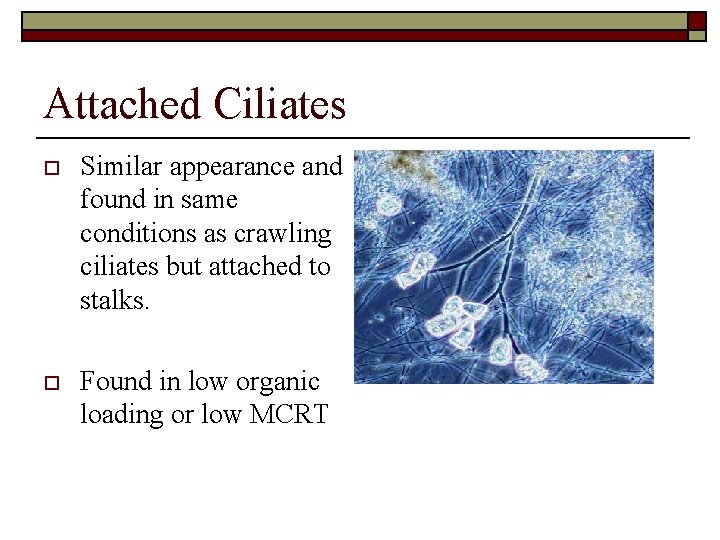
Attached Ciliates o Similar appearance and found in same conditions as crawling ciliates but attached to stalks. o Found in low organic loading or low MCRT
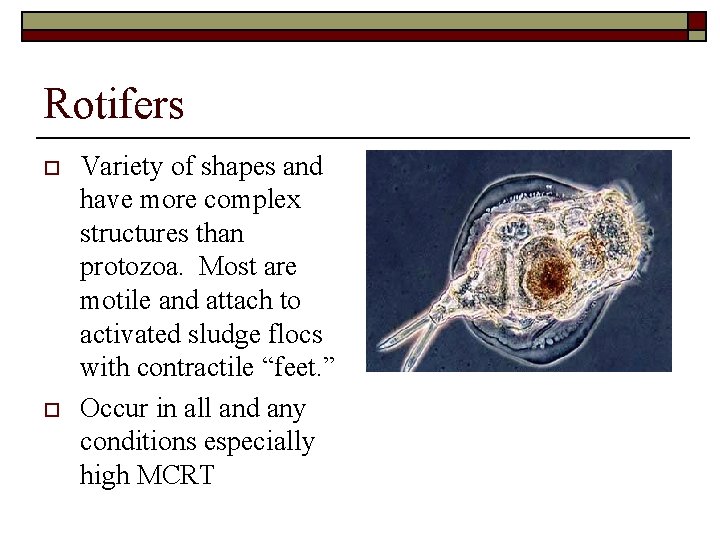
Rotifers o o Variety of shapes and have more complex structures than protozoa. Most are motile and attach to activated sludge flocs with contractile “feet. ” Occur in all and any conditions especially high MCRT 1
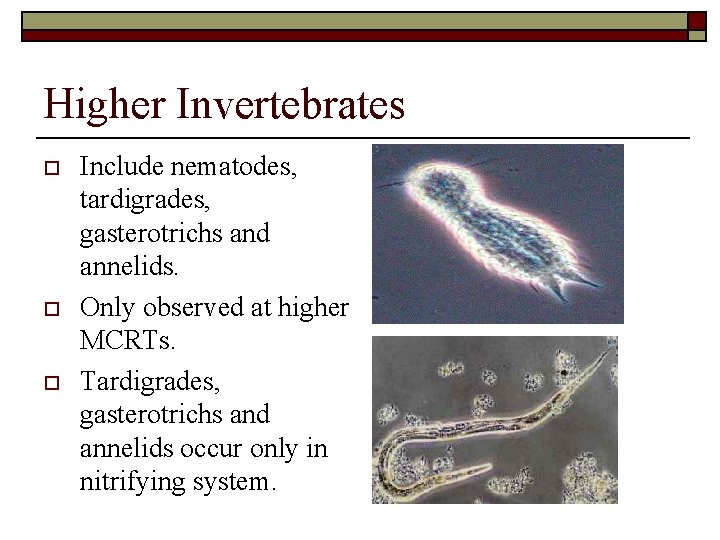
Higher Invertebrates o o o Include nematodes, 1 tardigrades, gasterotrichs and annelids. Only observed at higher MCRTs. Tardigrades, gasterotrichs and annelids occur only in nitrifying system.
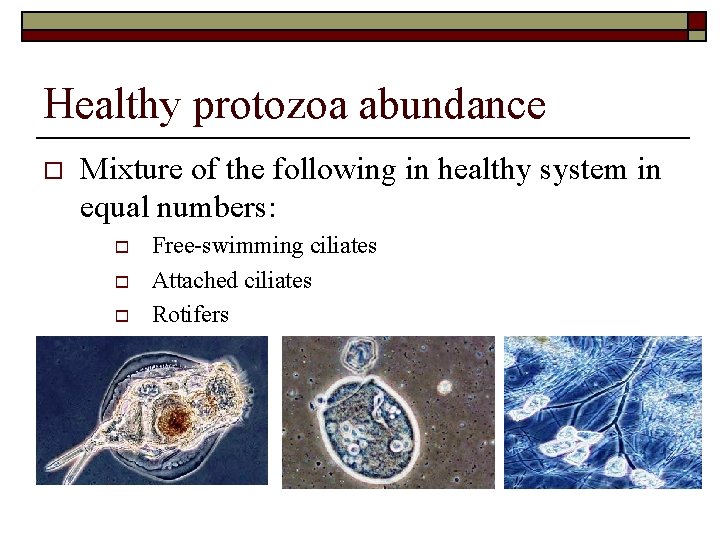
Healthy protozoa abundance o Mixture of the following in healthy system in equal numbers: o o o Free-swimming ciliates Attached ciliates Rotifers

Plant Start-up, low MCRT, or high organic loading o Flagellates o Amoebae o Small swimming ciliates
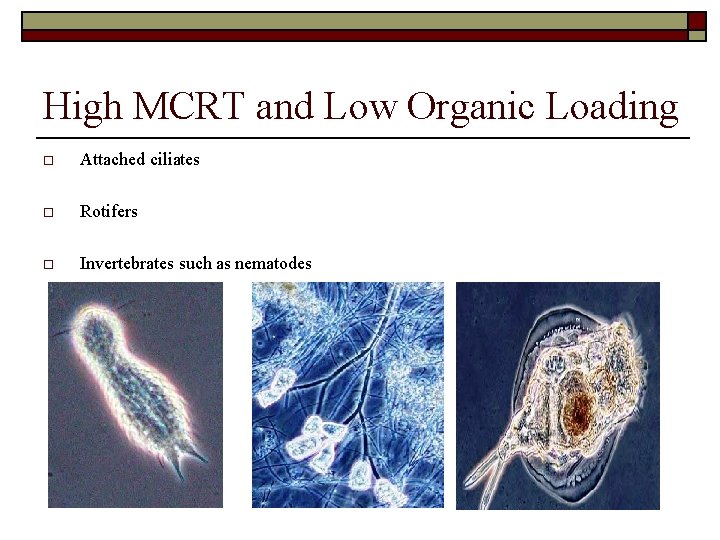
High MCRT and Low Organic Loading o Attached ciliates o Rotifers o Invertebrates such as nematodes
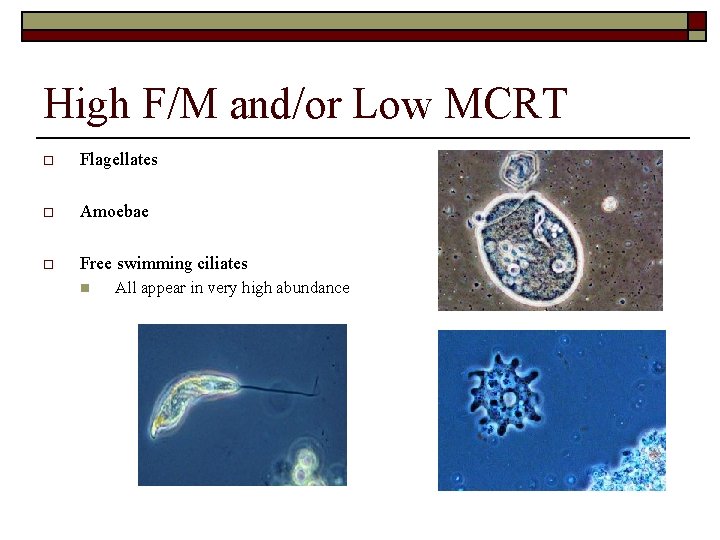
High F/M and/or Low MCRT o Flagellates o Amoebae o Free swimming ciliates n All appear in very high abundance

Low F/M High MCRT o Attached ciliates o Rotifers o High concentration of other higher life forms, especially nematodes
Toxicity Assessment and Higher Lifeforms o Typically ciliates and rotifers are the first to be impacted. o First noticeable sign is slowing or cessation of cilia movement. o Second, flagellates become abundant organism along with small swimming ciliates. o Third (severe case) all protozoa die, lyses and release their cell contents, sometimes producing white foam.
Toxicity o Toxic shocks can cause severe problem in activated sludge operation. o Myths say this is more common in industrial wastewater than municipal, but are false!
Diagnosing Toxicity Microscopically o Look for initial flagellate bloom o Subsequent complete die-off of protozoa and other higher life forms o Biomass deflocculation, often accompanied by foaming o Loss of BOD removal o Filamentous bulking upon process recovery.
Observations (10 x) o o o Floc health Protozoa activity and abundance Bulk water observation n Helps us understand flocculation Identify broken or damaged filaments Observe encapsulation or zoogloea.
Bulk Water Observation o Very subjective based on plant effluent. Some plants have a lot of organic particulate. Monitor the following: o o o Broken floating filaments Zooglea Dispersed Cells Dead higher life forms Pin floc Encapsulated cells
Ideal Bulk Water o Clean and clear of debris which results in a quality supernatant. o Some industries pulp and paper or other industrial will always have pulp fiber and other debris in bulk water due to operation. o Always subjective and look for changes from exam to exam.
Clean vs. Dirty Bulk Water
Bulk Water Observations (Zoogloea) o While observing the bulk water and floc, we must also look for both zoogloea and encapsulated floc.
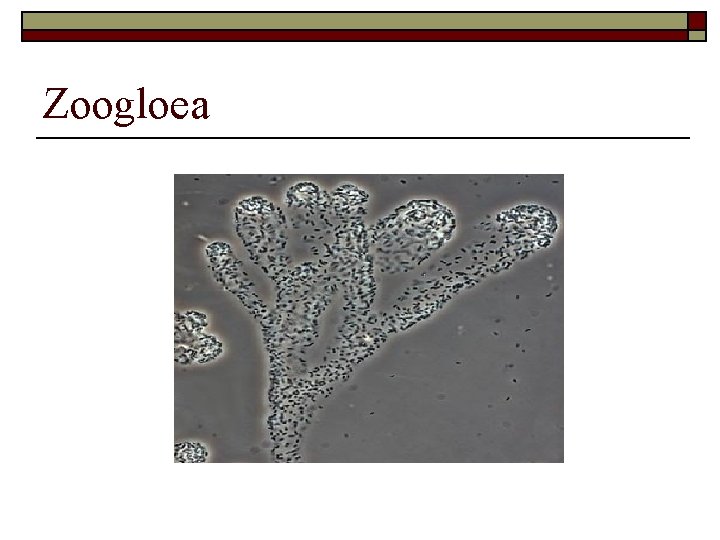
Zoogloea Bulking and Foaming o Zoogloea is another form of polysaccharide that forms in the system and forms biopolymers or amino-sugars. These produce high amounts of filamentous bulking making solids hard to settle and dewater. o Zoogloea occur at high F/M conditions and when specific organic acids and alcohols are high in amount due to septicity or low oxygen conditions.

Anthrone Test to Separate Zoogloea from Nutrient Deficiency o Anthrone test measures glucose or expresses results as ug/m. L glucose. This can be converted to carbohydrate per gram of activated sludge. o This is an extensive time consuming test but will give great results to determine nutrient deficiency.
Zoogloea
Nitrification and Denitrification Problems Under the Microscope o Dispersed growth and filamentous bulking during spring. o Low p. H filaments. n o Fungi Slime bulking due to high nitrogen levels.
Nutrient Deficiency and Polysaccharide Bulking and Foaming o Nitrogen and Phosphorus can be growth limiting if not present in sufficient amounts in the influent wastewater. o BOD 5: N: P weight ratio in the wastewater of 100: 5: 1 is needed for complete BOD removal and biological growth and health.
Signs of Nutrient Deficiency o Filamentous Bulking which is a viscous activated sludge that exhibits significant exopolysaccharide. o Foam on the aeration basin that contains polysaccharide.
Extracellular polysaccharide o Is produced by all activated sludge bacteria and is in part, responsible for floc formation. o Overproduction of polysaccharide can occur at nutrient deficiency which build up in the sludge. o This condition is termed slime bulking which leads to settling and dewatering issues.
How to treat o The recommended effluent total inorganic nitrogen (ammonia plus nitrate) and ortho-phosphorus concentrations are 1 -2 mg/L. o Some total Kjeldahl nitrogen and total phosphorus are not used as they may contain organically bound nutrients, not rapidly biologically available (“bug bodies”)
Encapsulated Cells o Extracellular polysaccharides produced by nutrient deficiencies results in encapsulated cells. o Encapsulated cells prevent floc from forming and greatly limit settling.

Encapsulation
Encapsulation or Zoogloea o You can perform an India ink stain test to determine if you have either zoogloea or encapsulated cells. o This is where you smear India ink over your slide sample and then look at it under open phase.
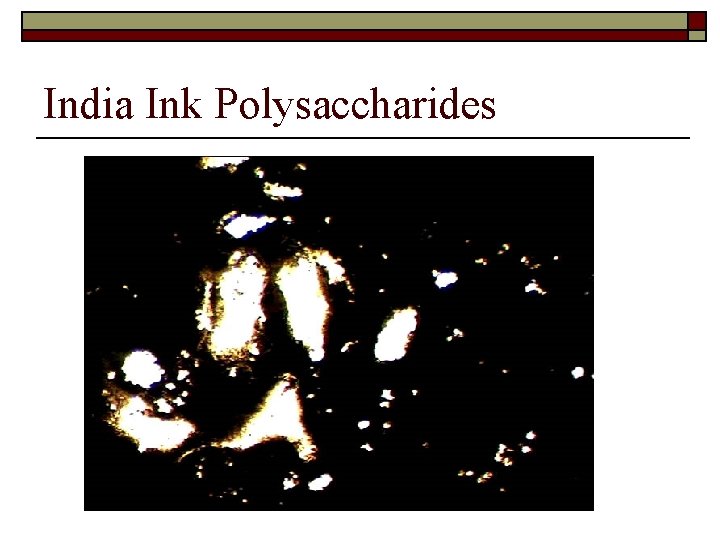
India Ink Polysaccharides
Observation 1000 x using 100 x objective (Filament Identification) o Branching o Filament Width o Mobility o Filament Length o Filament Shape o Cell Shape o Location o Cell Size o Sulfur Deposits o Attached Bacteria o Sheath o Cross-Walls (Cell Septa)
Stains to Identify Filaments o We must use both gram and neisser stains in order to accurately identify filaments. o This is the easiest way to narrow down options and make the proper identification.
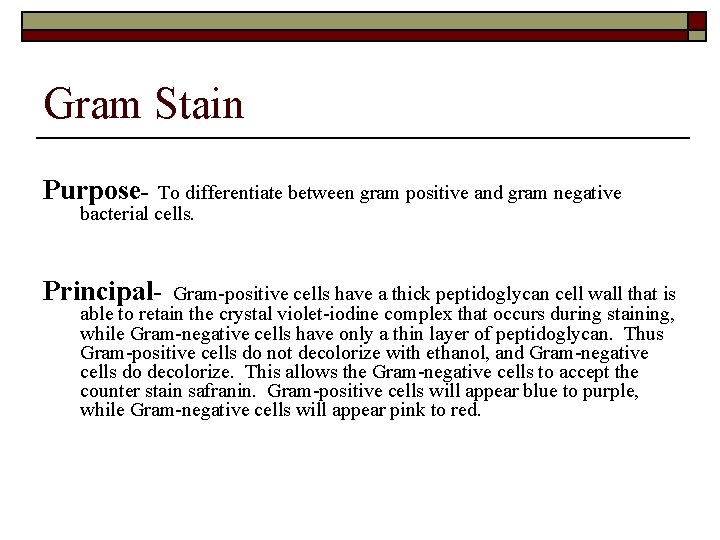
Gram Stain Purpose- To differentiate between gram positive and gram negative bacterial cells. Principal- Gram-positive cells have a thick peptidoglycan cell wall that is able to retain the crystal violet-iodine complex that occurs during staining, while Gram-negative cells have only a thin layer of peptidoglycan. Thus Gram-positive cells do not decolorize with ethanol, and Gram-negative cells do decolorize. This allows the Gram-negative cells to accept the counter stain safranin. Gram-positive cells will appear blue to purple, while Gram-negative cells will appear pink to red.
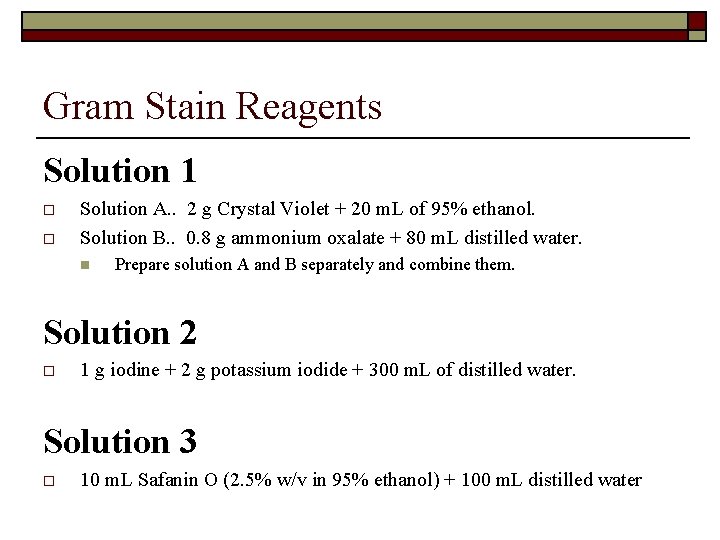
Gram Stain Reagents Solution 1 o o Solution A. . 2 g Crystal Violet + 20 m. L of 95% ethanol. Solution B. . 0. 8 g ammonium oxalate + 80 m. L distilled water. n Prepare solution A and B separately and combine them. Solution 2 o 1 g iodine + 2 g potassium iodide + 300 m. L of distilled water. Solution 3 o 10 m. L Safanin O (2. 5% w/v in 95% ethanol) + 100 m. L distilled water
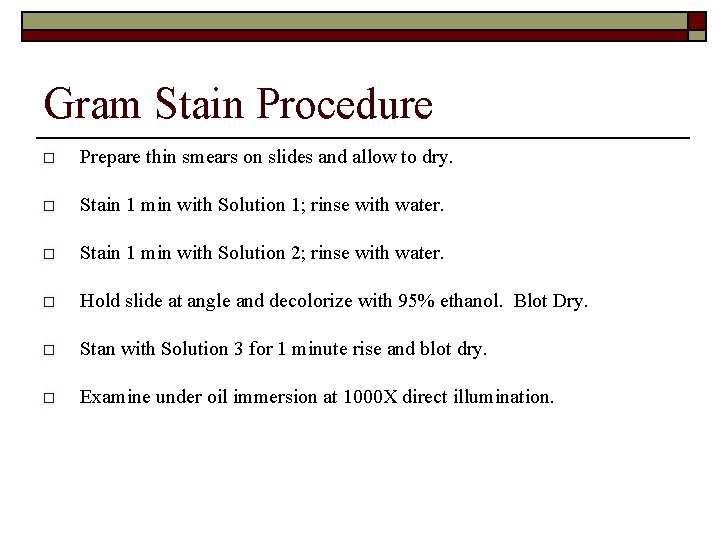
Gram Stain Procedure o Prepare thin smears on slides and allow to dry. o Stain 1 min with Solution 1; rinse with water. o Stain 1 min with Solution 2; rinse with water. o Hold slide at angle and decolorize with 95% ethanol. Blot Dry. o Stan with Solution 3 for 1 minute rise and blot dry. o Examine under oil immersion at 1000 X direct illumination.
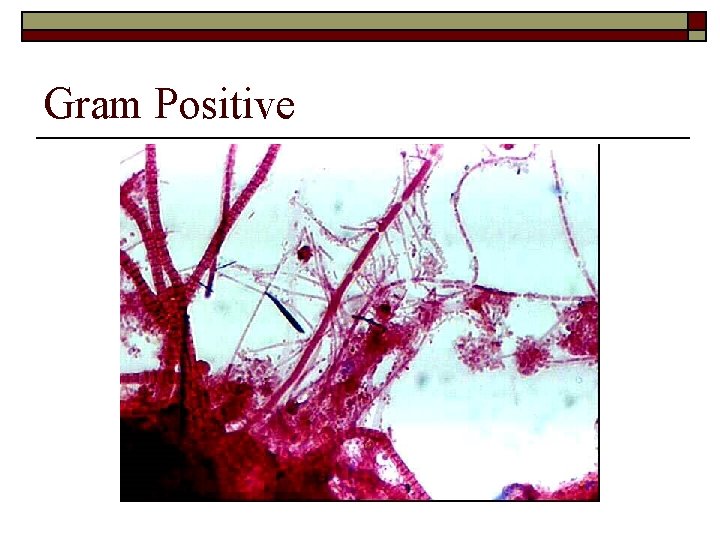
Gram Positive

Neisser Stain Purpose: To differentiate types of bacterial cells and filaments. Neisser positive turns purple, while neisser negative turns yellow.
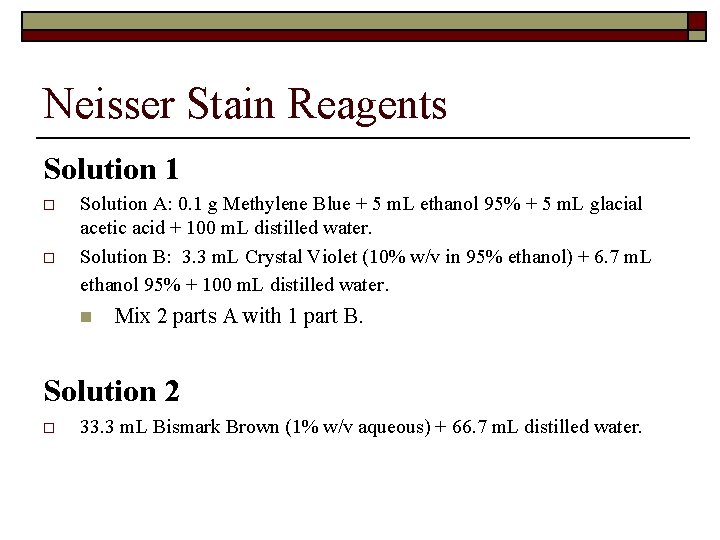
Neisser Stain Reagents Solution 1 o o Solution A: 0. 1 g Methylene Blue + 5 m. L ethanol 95% + 5 m. L glacial acetic acid + 100 m. L distilled water. Solution B: 3. 3 m. L Crystal Violet (10% w/v in 95% ethanol) + 6. 7 m. L ethanol 95% + 100 m. L distilled water. n Mix 2 parts A with 1 part B. Solution 2 o 33. 3 m. L Bismark Brown (1% w/v aqueous) + 66. 7 m. L distilled water.
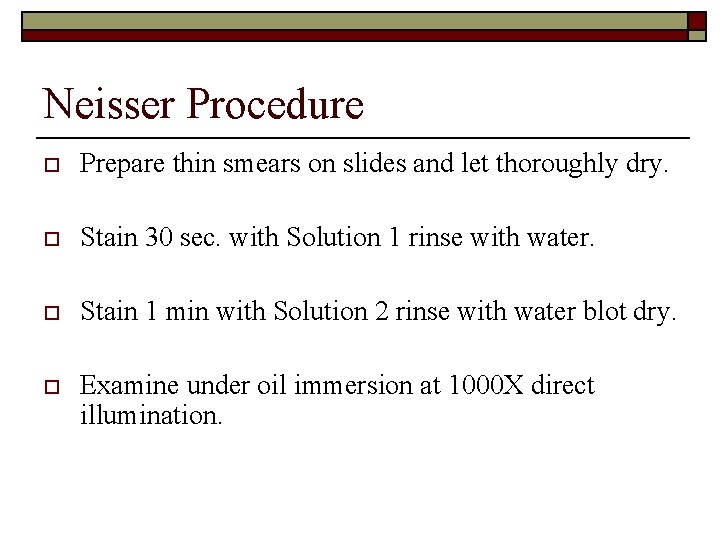
Neisser Procedure o Prepare thin smears on slides and let thoroughly dry. o Stain 30 sec. with Solution 1 rinse with water. o Stain 1 min with Solution 2 rinse with water blot dry. o Examine under oil immersion at 1000 X direct illumination.
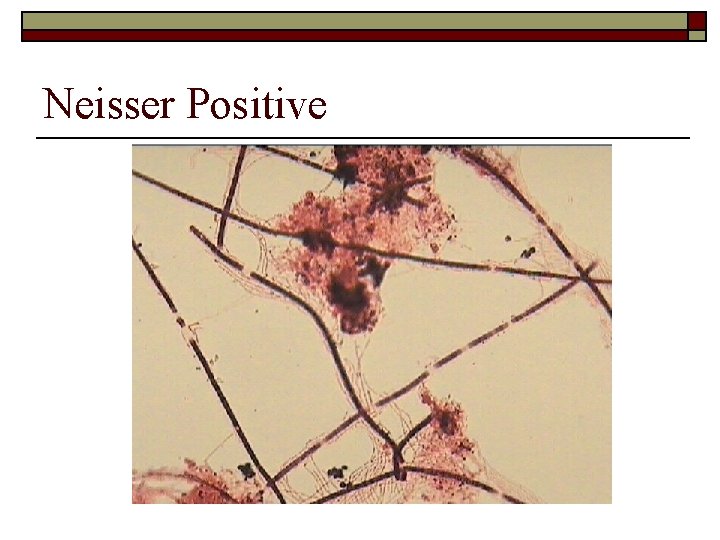
Neisser Positive
Filamentous Organisms o Microscopic examination of the types, abundance, condition and growth forms of filamentous organisms provides a wealth of knowledge. n Can Determine: o o o o o Solids separation issues Nutrient imbalances High organic loadings Sulfides Lipids Toxicity RAS Cycle DO concentration p. H Temperature
Which filaments do I have? o The proper identification of filaments is very important to completing an accurate micro-exam. The inability to correctly identify organisms can leave you with wrong answers to your problems. o Use your stains o Utilized the key
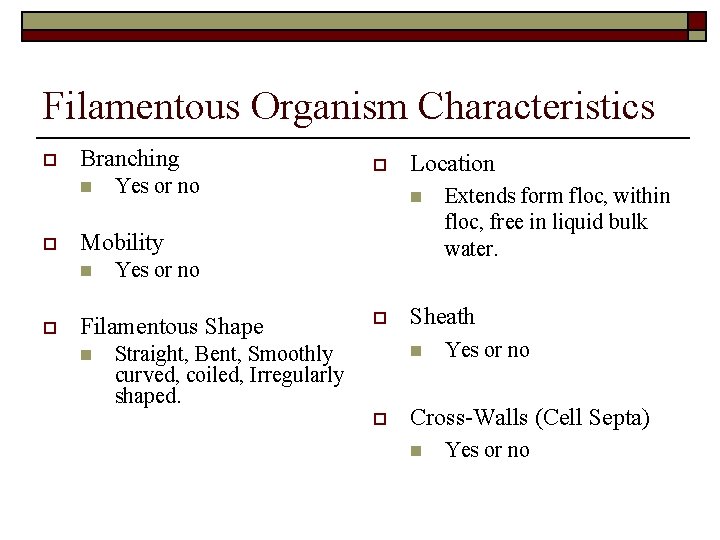
Filamentous Organism Characteristics o Branching n o Location n Mobility n o Yes or no Filamentous Shape n o Sheath n Straight, Bent, Smoothly curved, coiled, Irregularly shaped. o Extends form floc, within floc, free in liquid bulk water. Yes or no Cross-Walls (Cell Septa) n Yes or no
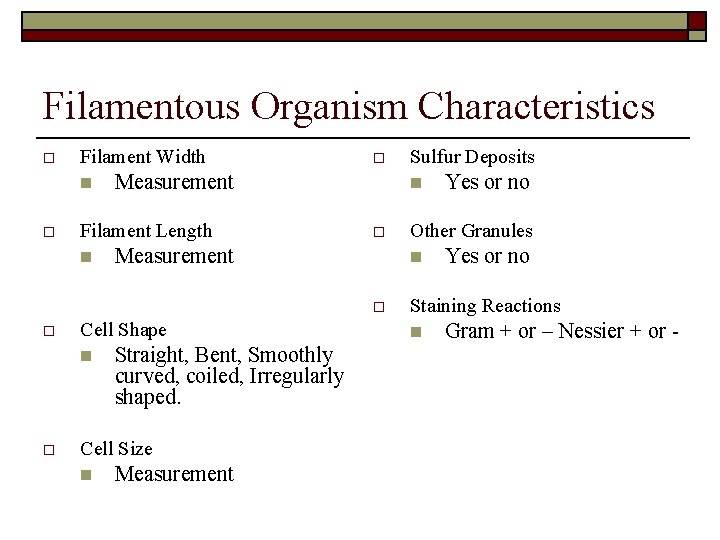
Filamentous Organism Characteristics o Filament Width n o Measurement Filament Length n o Measurement Cell Shape n o Straight, Bent, Smoothly curved, coiled, Irregularly shaped. Cell Size n Measurement Yes or no Other Granules n o o Sulfur Deposits Yes or no Staining Reactions n Gram + or – Nessier + or -
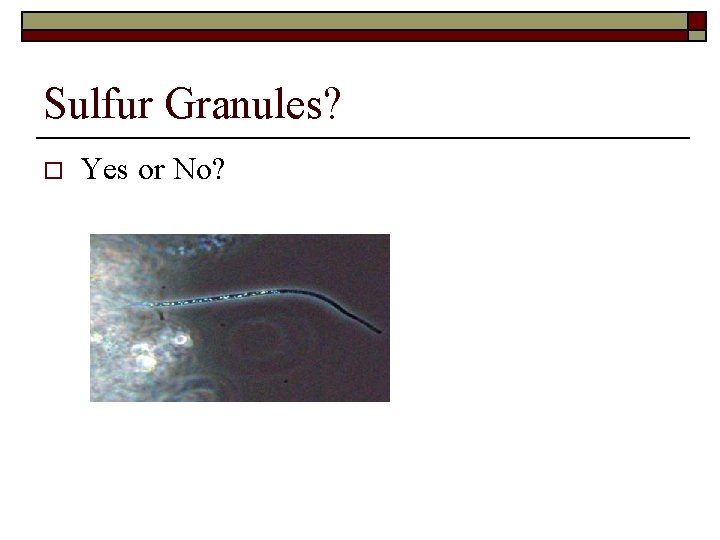
Sulfur Granules? o Yes or No?
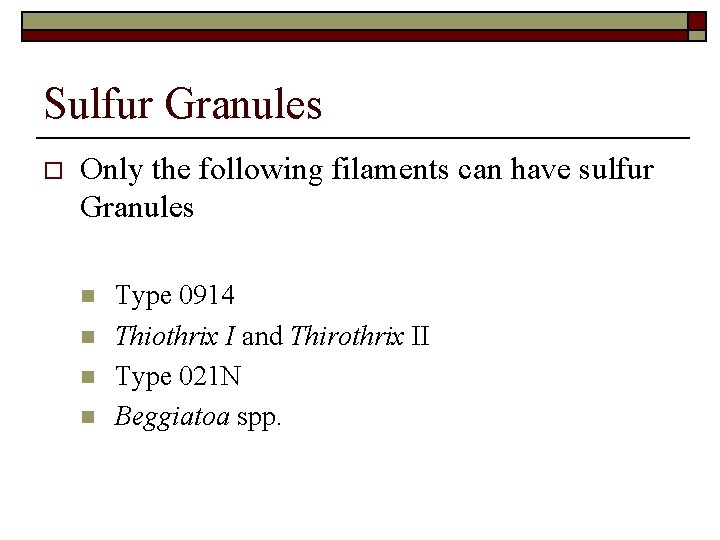
Sulfur Granules o Only the following filaments can have sulfur Granules n n Type 0914 Thiothrix I and Thirothrix II Type 021 N Beggiatoa spp.
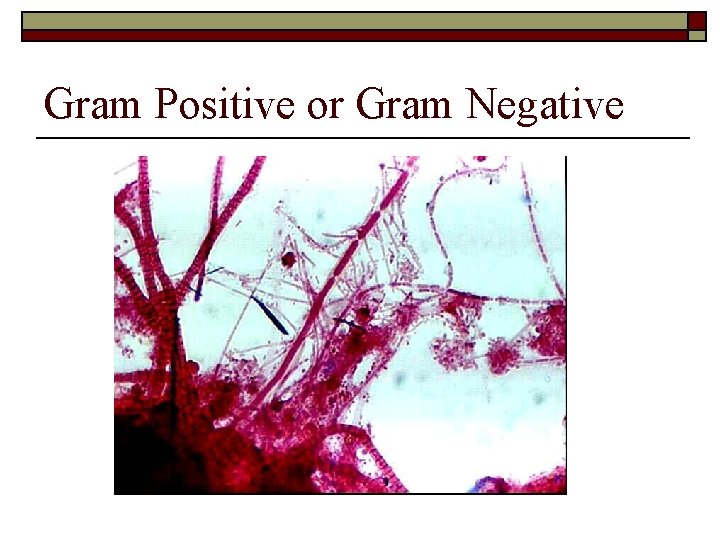
Gram Positive or Gram Negative
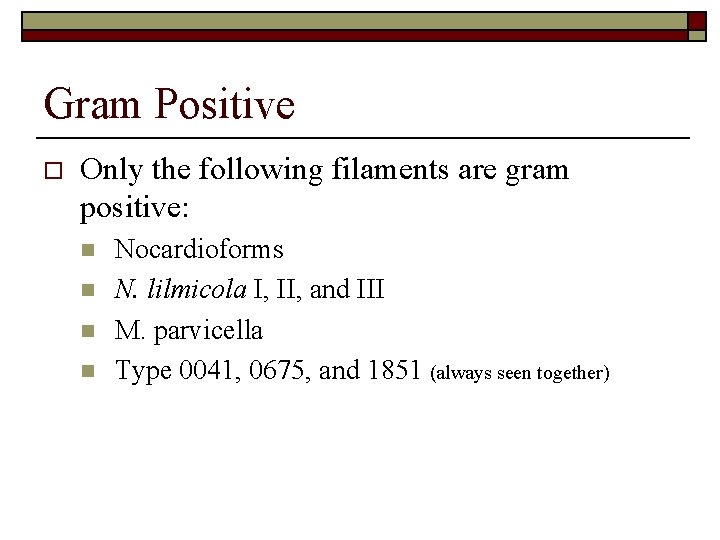
Gram Positive o Only the following filaments are gram positive: n n Nocardioforms N. lilmicola I, II, and III M. parvicella Type 0041, 0675, and 1851 (always seen together)
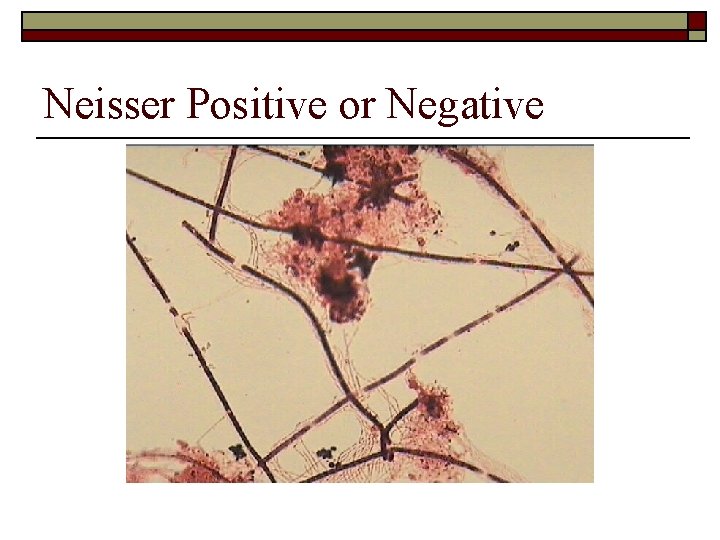
Neisser Positive or Negative
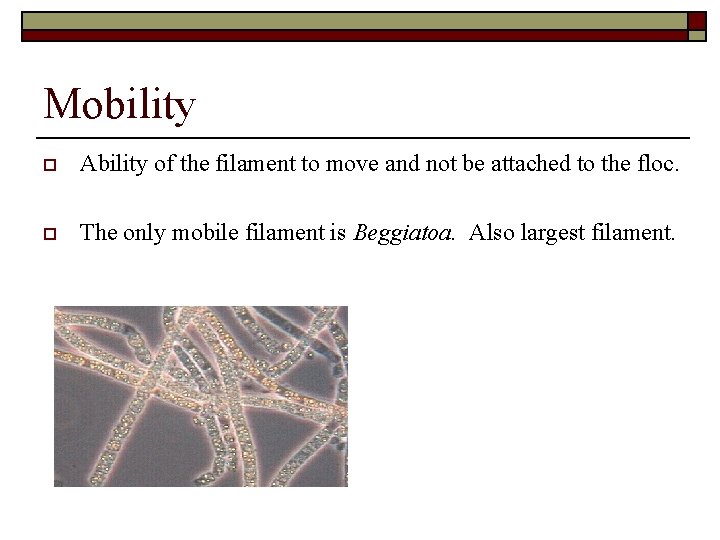
Mobility o Ability of the filament to move and not be attached to the floc. o The only mobile filament is Beggiatoa. Also largest filament.
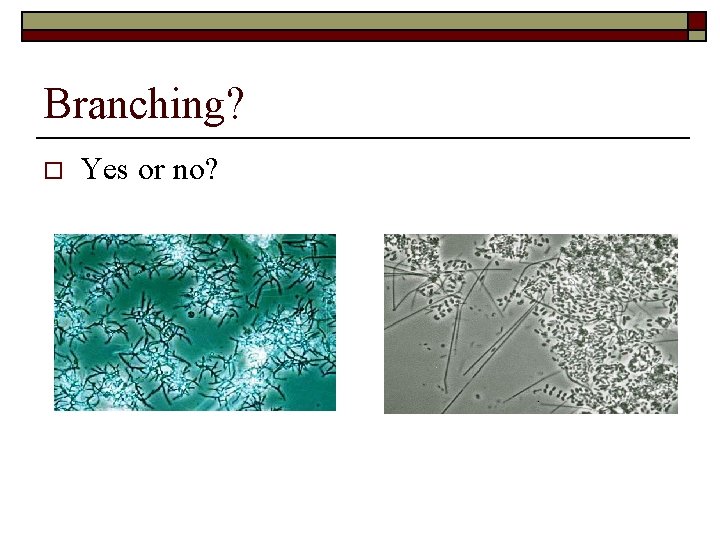
Branching? o Yes or no?
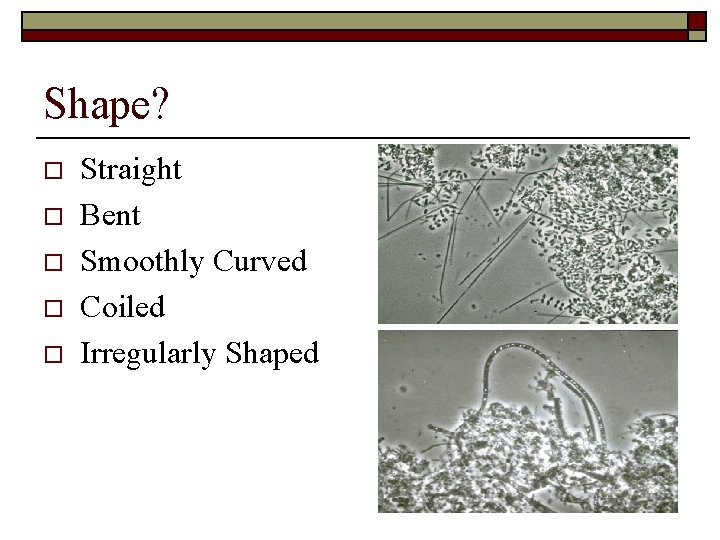
Shape? o o o Straight Bent Smoothly Curved Coiled Irregularly Shaped

Location o o o Extends from floc surface. Mostly within floc Free in liquid between the flocs

Sheath? o A sheath is an enveloping tubular structure, that surrounds the stem or the tissue that encloses a muscle or fiber. Yes or no
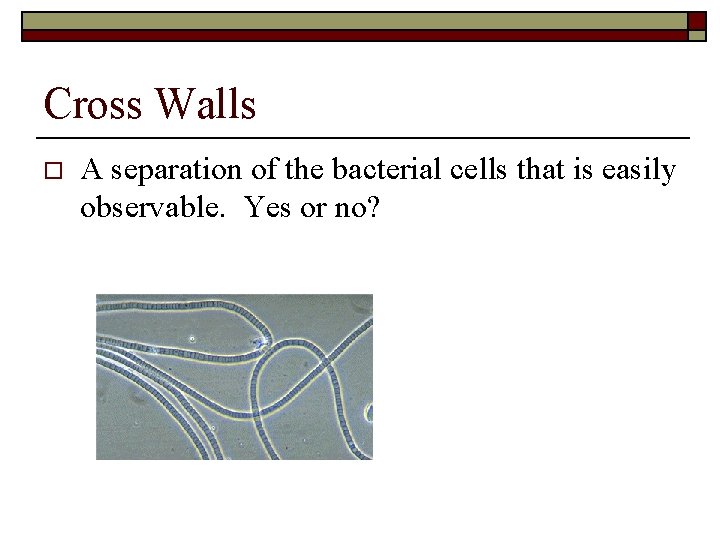
Cross Walls o A separation of the bacterial cells that is easily observable. Yes or no?
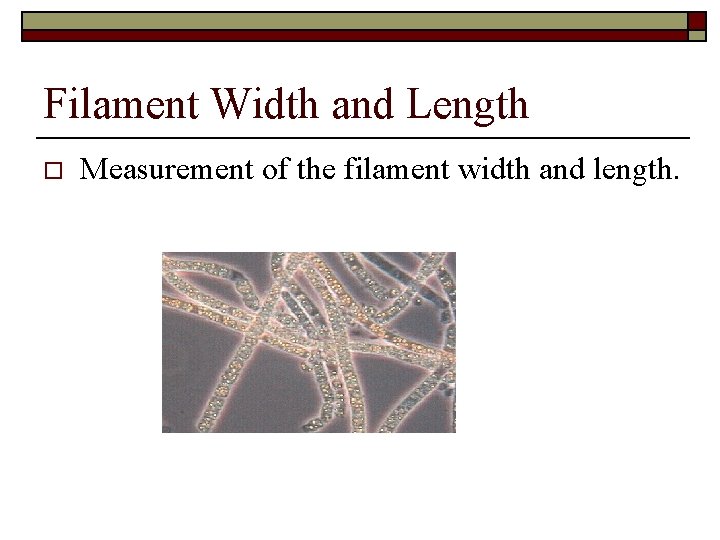
Filament Width and Length o Measurement of the filament width and length.
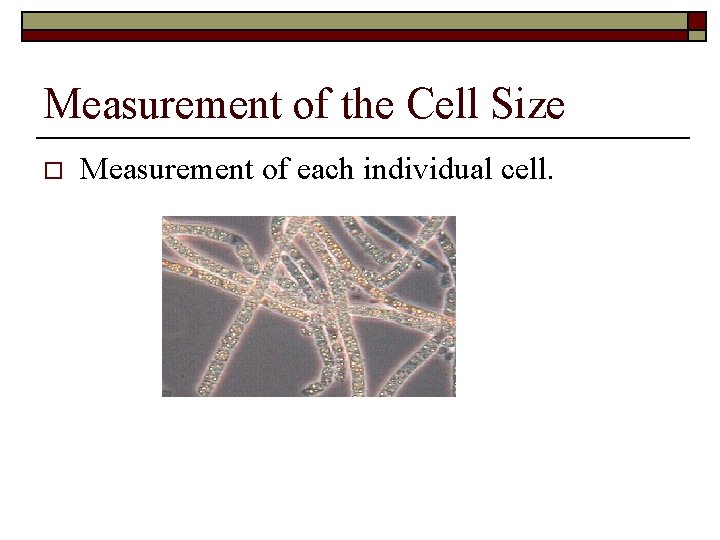
Measurement of the Cell Size o Measurement of each individual cell.
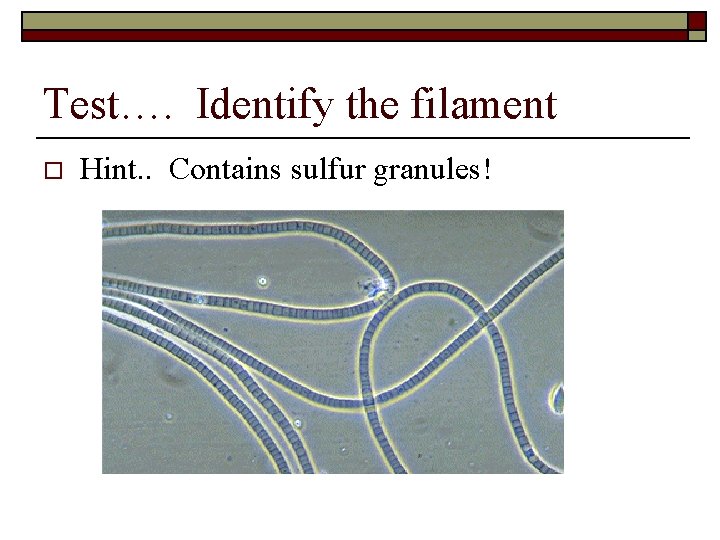
Test…. Identify the filament o Hint. . Contains sulfur granules!
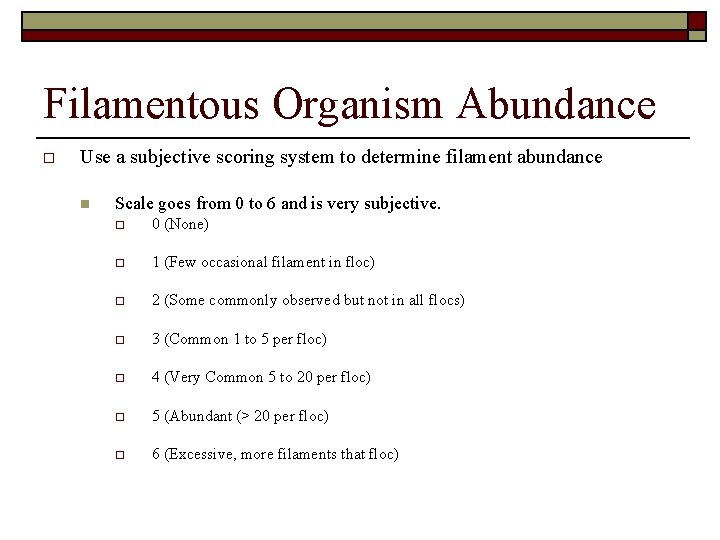
Filamentous Organism Abundance o Use a subjective scoring system to determine filament abundance n Scale goes from 0 to 6 and is very subjective. o 0 (None) o 1 (Few occasional filament in floc) o 2 (Some commonly observed but not in all flocs) o 3 (Common 1 to 5 per floc) o 4 (Very Common 5 to 20 per floc) o 5 (Abundant (> 20 per floc) o 6 (Excessive, more filaments that floc)

Filament Abundance (0 or 6)?
Filament Abundance o A rating of 3 is an ideal number for filament abundance. o This is a healthy amount that serves as the backbone for floc production, but does not inhibit settling.
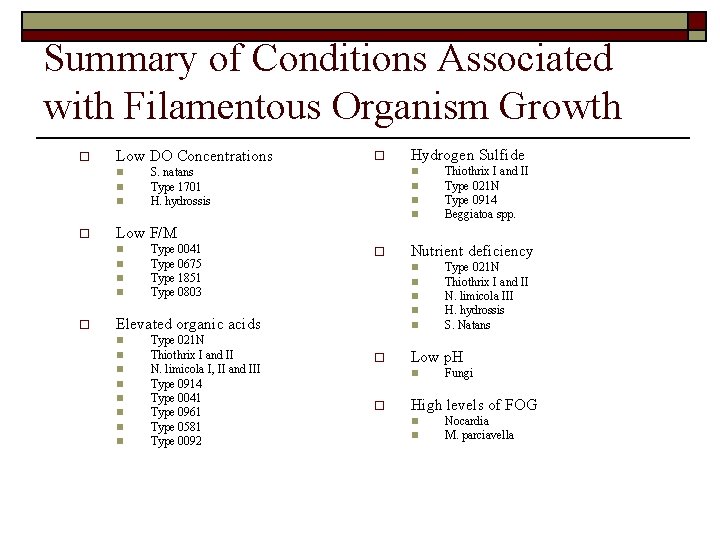
Summary of Conditions Associated with Filamentous Organism Growth o Low DO Concentrations n n n o S. natans Type 1701 H. hydrossis Hydrogen Sulfide n n o Low F/M n n o Thiothrix I and II Type 021 N Type 0914 Beggiatoa spp. Type 0041 Type 0675 Type 1851 Type 0803 o n n Elevated organic acids n n n n Type 021 N Thiothrix I and II N. limicola I, II and III Type 0914 Type 0041 Type 0961 Type 0581 Type 0092 Nutrient deficiency n o Low p. H n o Type 021 N Thiothrix I and II N. limicola III H. hydrossis S. Natans Fungi High levels of FOG n n Nocardia M. parciavella

Low DO filaments (s. natans, Type 1701, H. hydrosis)
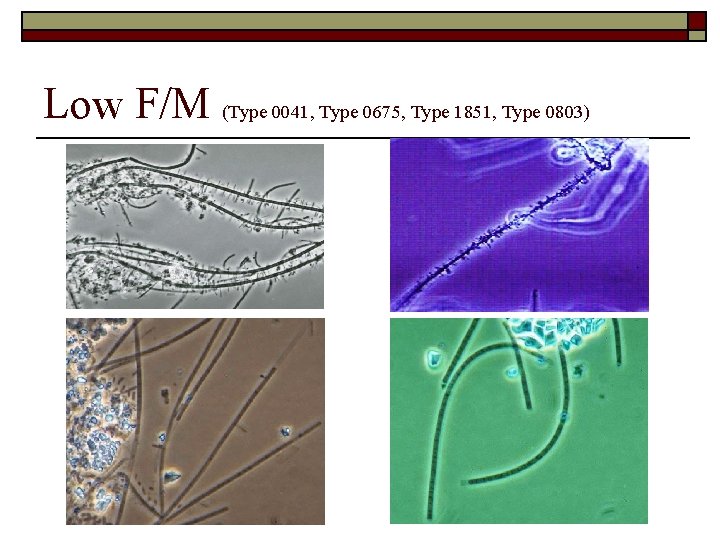
Low F/M (Type 0041, Type 0675, Type 1851, Type 0803)

Elevated Organic Acids (Type 021 N, Thiothrix, N. limicola, and Type 0914)
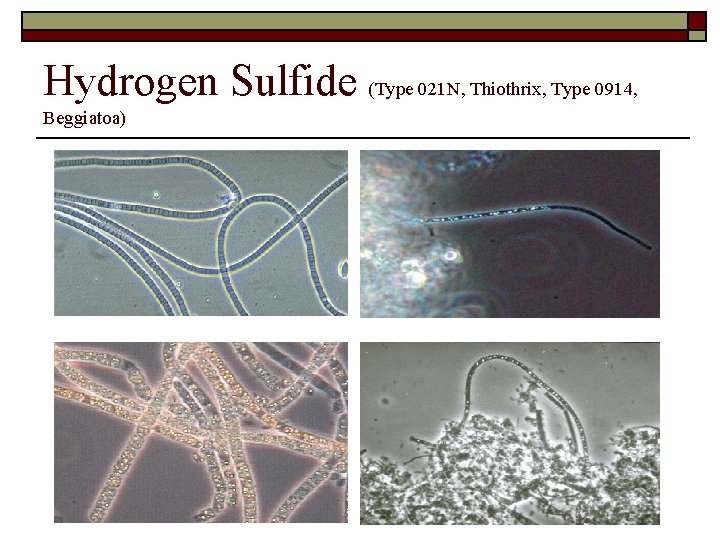
Hydrogen Sulfide (Type 021 N, Thiothrix, Type 0914, Beggiatoa)
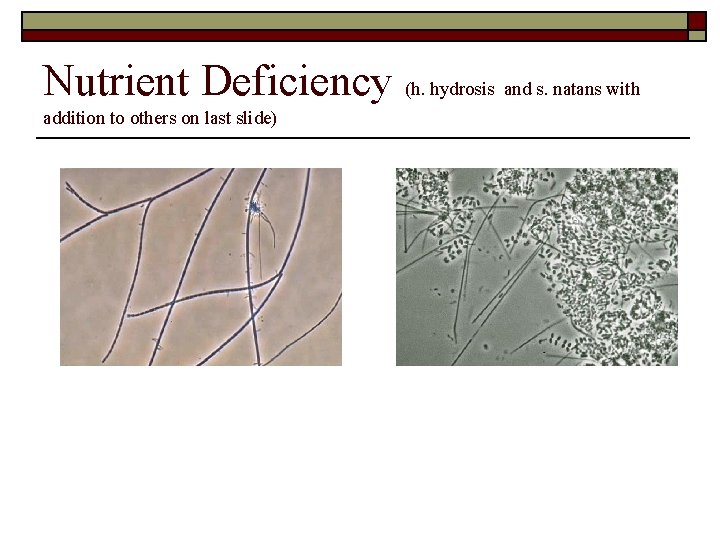
Nutrient Deficiency (h. hydrosis and s. natans with addition to others on last slide)
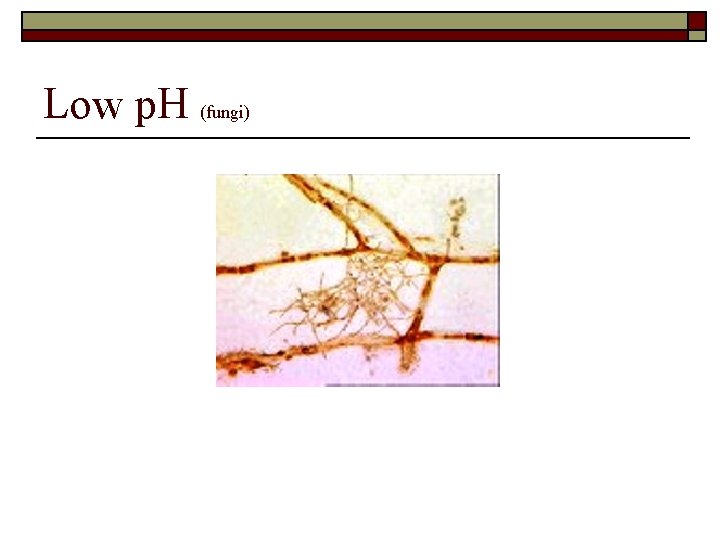
Low p. H (fungi)
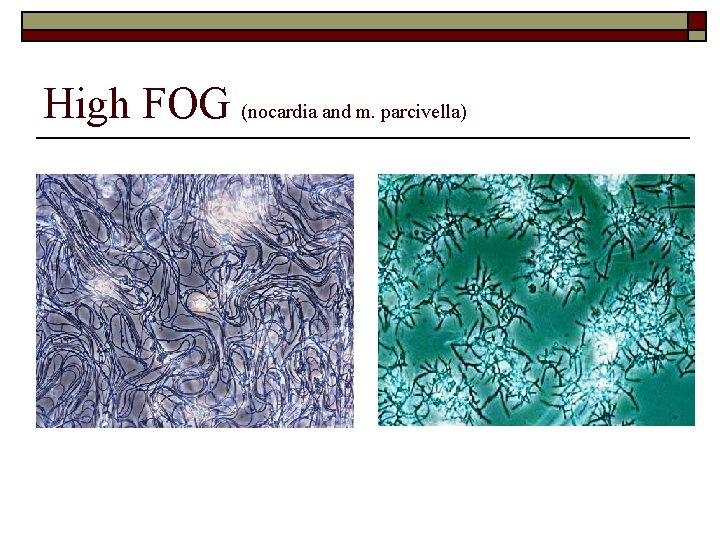
High FOG (nocardia and m. parcivella)
Filamentous Bulking o Filamentous bulking and foaming are common and serious problems in activated sludge operation, affecting most plants at one time or another. o Filamentous bulking is the number one cause of effluent noncompliance in U. S o Bulking sludge is defined as one that settles and compacts slowly. An operational definition often used is a sludge with a (SVI) of >150 ml/g
Filaments and Bulking sludge o A certain amount of filamentous bacteria can be beneficial to the activated sludge process. o Lack of filamentous bacteria leads to pin floc. o Filaments act as backbone to floc structure allowing formation of larger, stronger flocs. o Filaments also catch and hold small particles during sludge settling, yielding lower turbidity effluent. o It is only when large amounts (approximately 10^7 um filaments per gram of activated sludge) that hindrance in sludge settling and compaction occurs.
Filamentous Bulking o Bulking sludge is most often seen as open floc structure and interfloc bridging. o This typically results in loss of sludge inventory to the effluent, causing environmental damage and effluent violations. o A lot of time the loss of sludge inventory results in plant’s treatment capacity to diminish and failure to treat their influent water. o The excess solids also make it impossible to disinfect effluent water. o Severe cases leads to excessive RAS which lease to high amounts of disposed sludge.

Filamentous Bulking
Correction of Filamentous Bulking o Perform microscopic examination to determine the amounts and identities of filamentous organisms. o Use cause of filamentous growth to determine plan of action (chemical or operational).
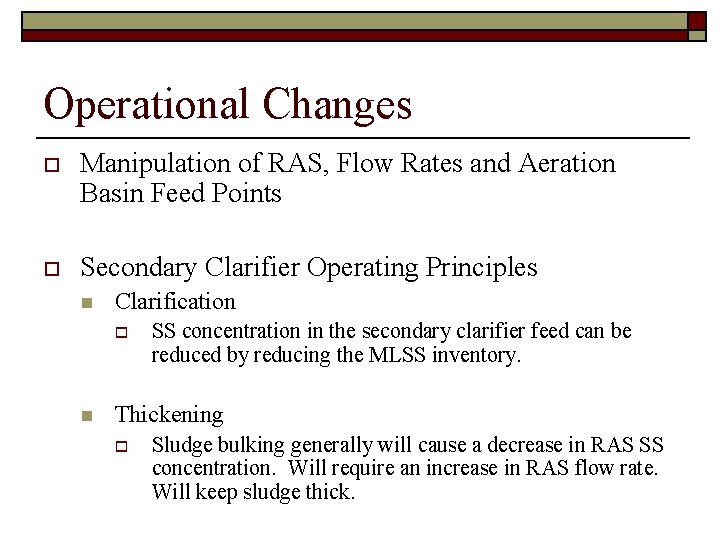
Operational Changes o Manipulation of RAS, Flow Rates and Aeration Basin Feed Points o Secondary Clarifier Operating Principles n Clarification o n SS concentration in the secondary clarifier feed can be reduced by reducing the MLSS inventory. Thickening o Sludge bulking generally will cause a decrease in RAS SS concentration. Will require an increase in RAS flow rate. Will keep sludge thick.
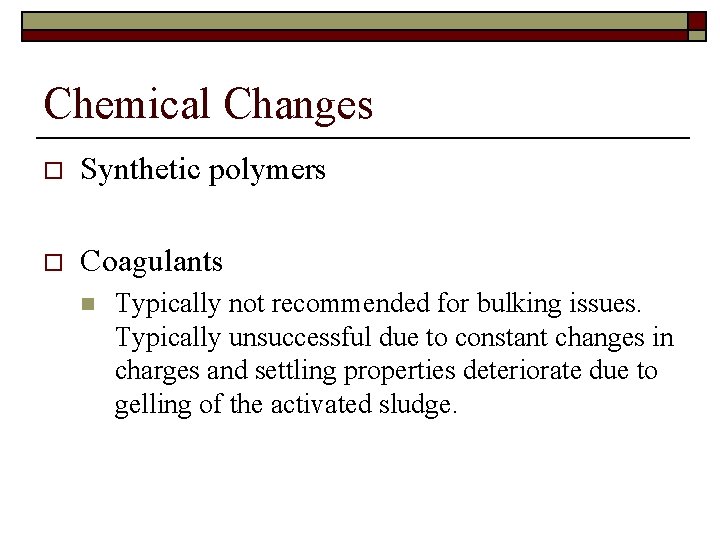
Chemical Changes o Synthetic polymers o Coagulants n Typically not recommended for bulking issues. Typically unsuccessful due to constant changes in charges and settling properties deteriorate due to gelling of the activated sludge.
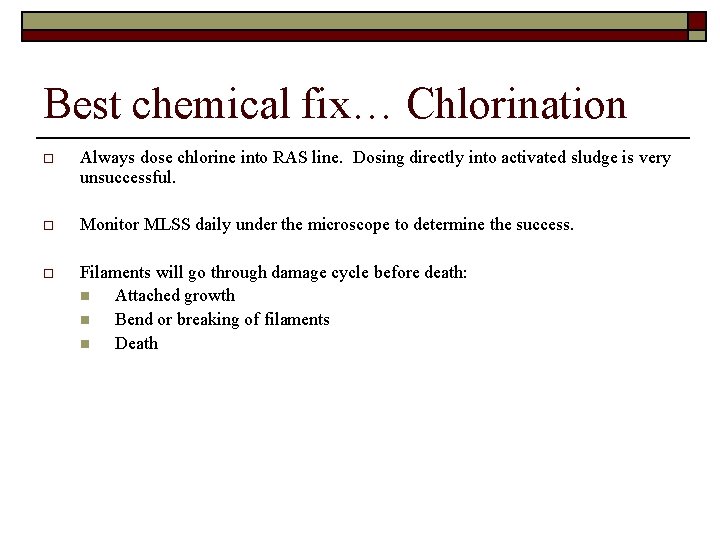
Best chemical fix… Chlorination o Always dose chlorine into RAS line. Dosing directly into activated sludge is very unsuccessful. o Monitor MLSS daily under the microscope to determine the success. o Filaments will go through damage cycle before death: n Attached growth n Bend or breaking of filaments n Death
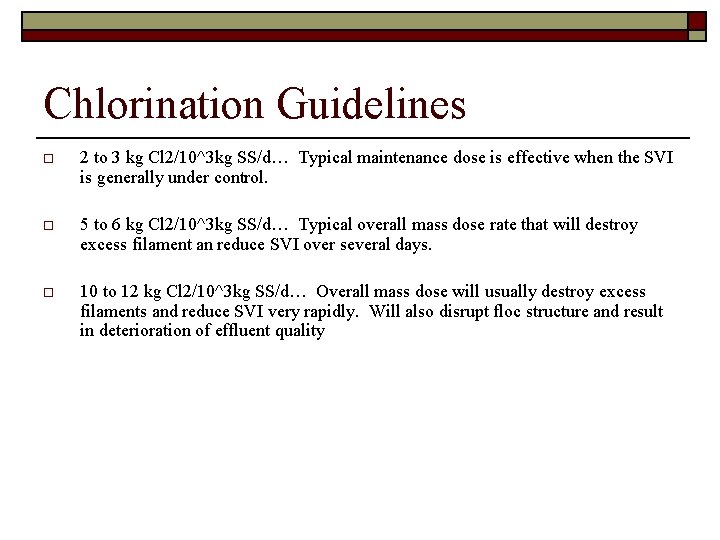
Chlorination Guidelines o 2 to 3 kg Cl 2/10^3 kg SS/d… Typical maintenance dose is effective when the SVI is generally under control. o 5 to 6 kg Cl 2/10^3 kg SS/d… Typical overall mass dose rate that will destroy excess filament an reduce SVI over several days. o 10 to 12 kg Cl 2/10^3 kg SS/d… Overall mass dose will usually destroy excess filaments and reduce SVI very rapidly. Will also disrupt floc structure and result in deterioration of effluent quality
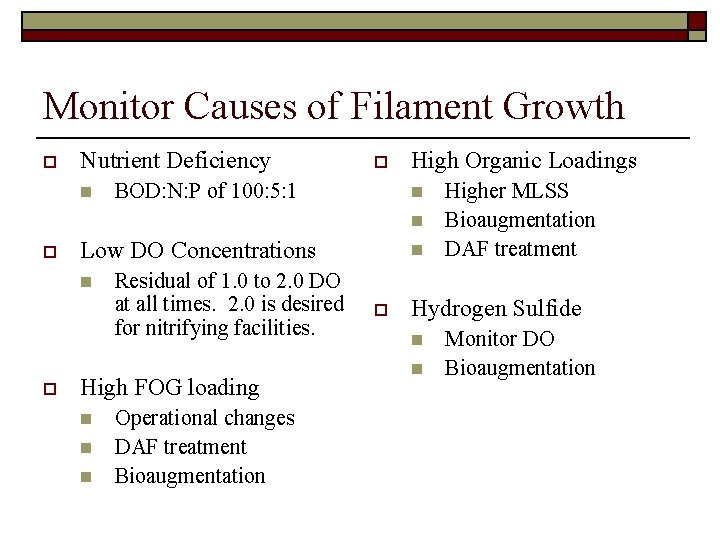
Monitor Causes of Filament Growth o Nutrient Deficiency n o BOD: N: P of 100: 5: 1 High Organic Loadings n n o Low DO Concentrations n o Residual of 1. 0 to 2. 0 DO at all times. 2. 0 is desired for nitrifying facilities. High FOG loading n n n Operational changes DAF treatment Bioaugmentation n o Higher MLSS Bioaugmentation DAF treatment Hydrogen Sulfide n n Monitor DO Bioaugmentation
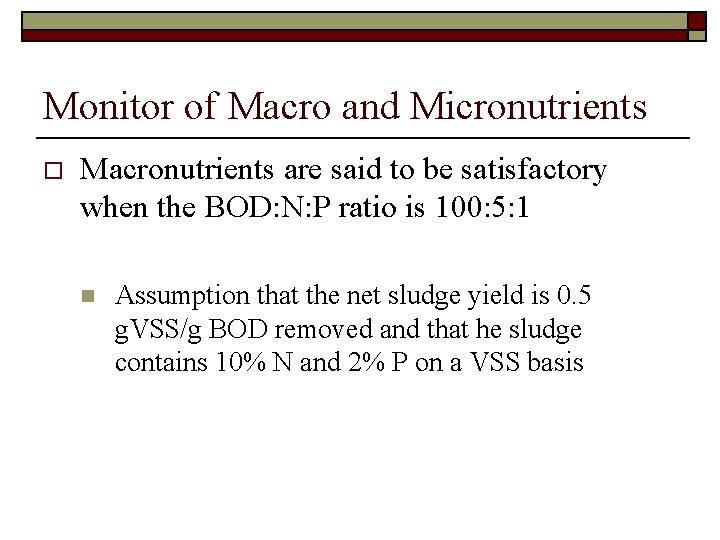
Monitor of Macro and Micronutrients o Macronutrients are said to be satisfactory when the BOD: N: P ratio is 100: 5: 1 n Assumption that the net sludge yield is 0. 5 g. VSS/g BOD removed and that he sludge contains 10% N and 2% P on a VSS basis
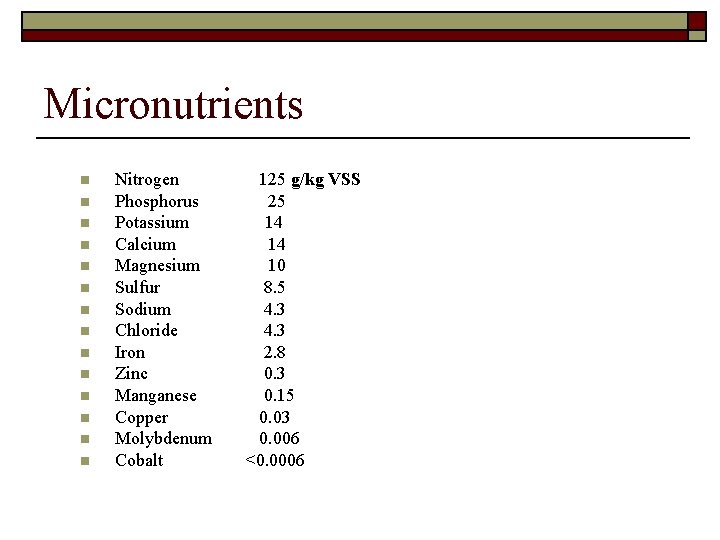
Micronutrients n n n n Nitrogen 125 g/kg VSS Phosphorus 25 Potassium 14 Calcium 14 Magnesium 10 Sulfur 8. 5 Sodium 4. 3 Chloride 4. 3 Iron 2. 8 Zinc 0. 3 Manganese 0. 15 Copper 0. 03 Molybdenum 0. 006 Cobalt <0. 0006

Activated Sludge Foaming and Control o Along with filamentous growth and changes in activated sludge operation, the formation of foam and/or scum on the surfaces of activated sludge aeration basins and clarifiers is possible. o Major filaments contributing to foam are n Nocardia n Microthrix Parvicella
Foaming Issues
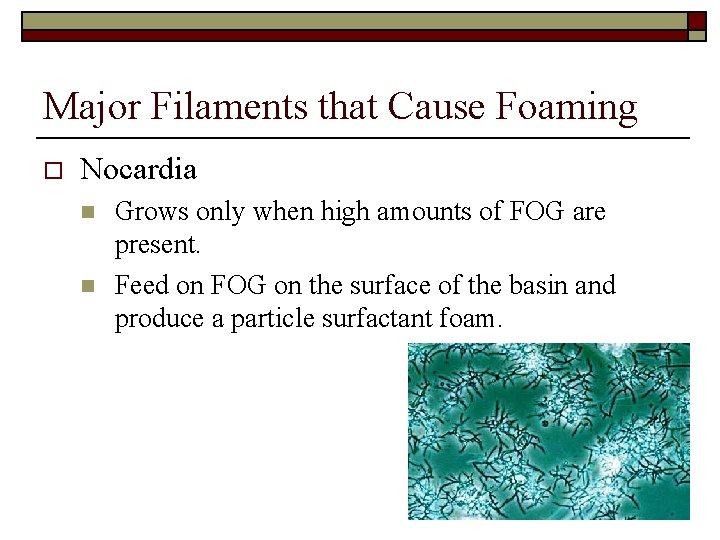
Major Filaments that Cause Foaming o Nocardia n n Grows only when high amounts of FOG are present. Feed on FOG on the surface of the basin and produce a particle surfactant foam.
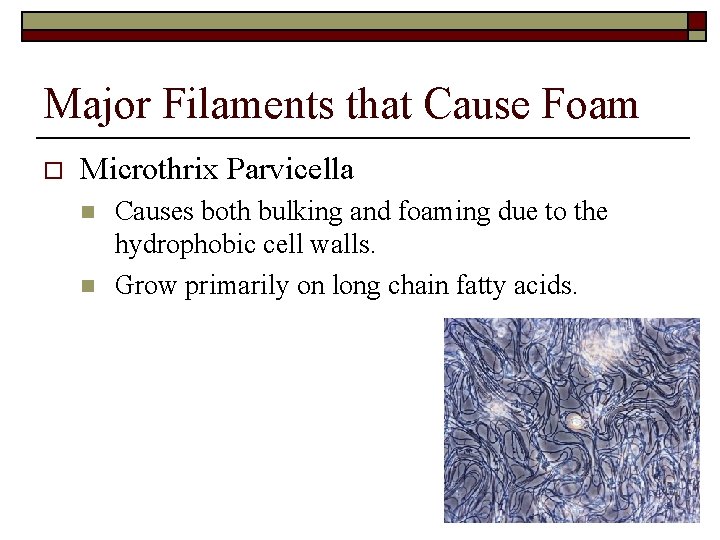
Major Filaments that Cause Foam o Microthrix Parvicella n n Causes both bulking and foaming due to the hydrophobic cell walls. Grow primarily on long chain fatty acids.
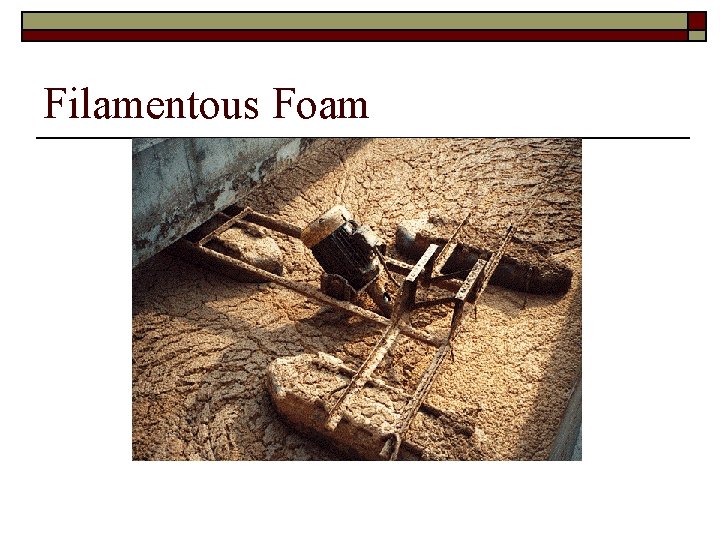
Filamentous Foam
How to fix it? o Chlorination in the RAS line! o Defoamers are not effective! o Wasting not effective!
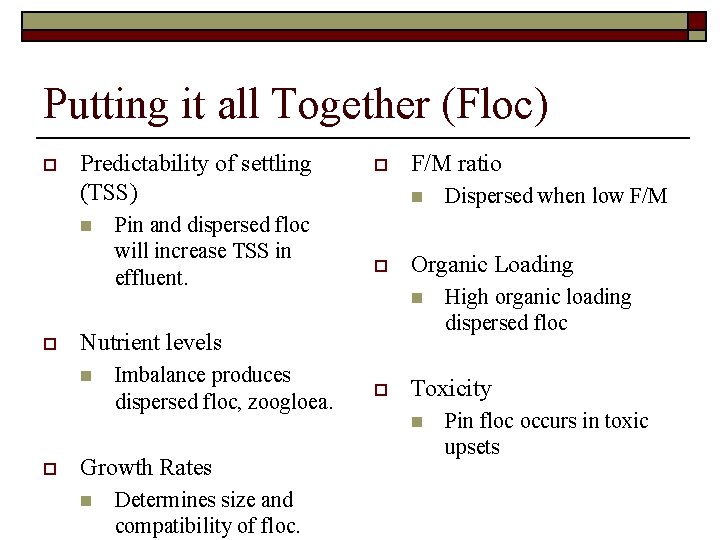
Putting it all Together (Floc) o Predictability of settling (TSS) n o F/M ratio n o Imbalance produces dispersed floc, zoogloea. n Growth Rates n Determines size and compatibility of floc. o Dispersed when low F/M Organic Loading Nutrient levels n o Pin and dispersed floc will increase TSS in effluent. o High organic loading dispersed floc Toxicity n Pin floc occurs in toxic upsets
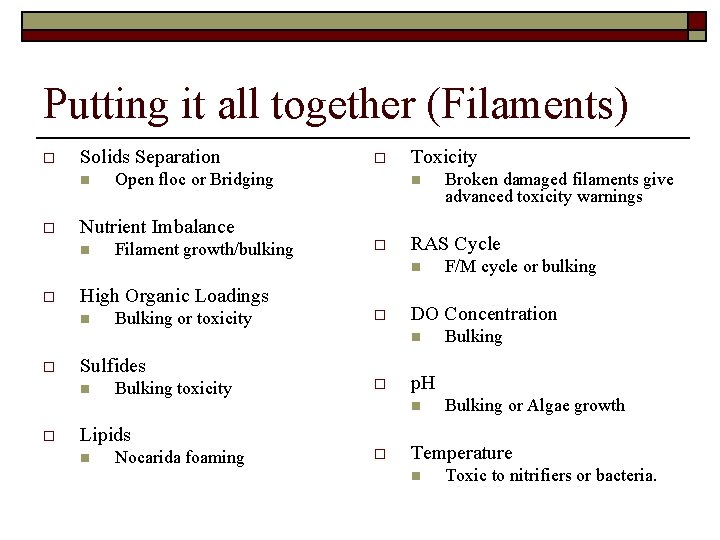
Putting it all together (Filaments) o Solids Separation n o o Open floc or Bridging Nutrient Imbalance n Filament growth/bulking High Organic Loadings n o Bulking or toxicity Toxicity n o RAS Cycle n o Sulfides n Bulking toxicity o Lipids n Nocarida foaming o Bulking p. H n o F/M cycle or bulking DO Concentration n o Broken damaged filaments give advanced toxicity warnings Bulking or Algae growth Temperature n Toxic to nitrifiers or bacteria.
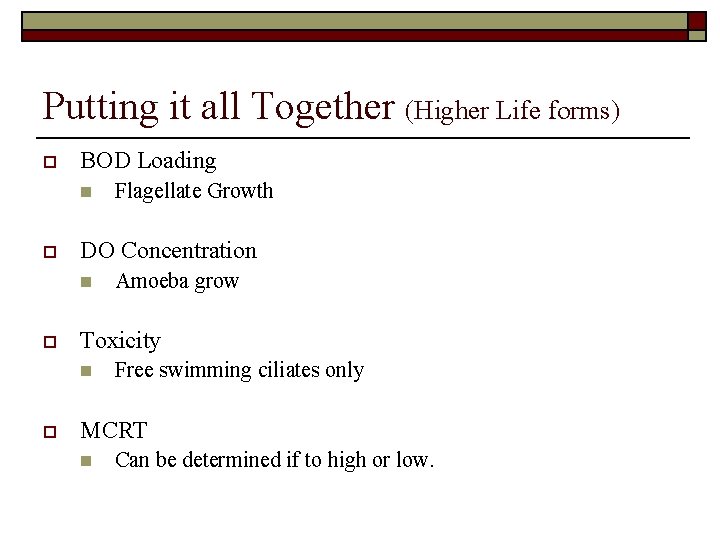
Putting it all Together (Higher Life forms) o BOD Loading n o DO Concentration n o Amoeba grow Toxicity n o Flagellate Growth Free swimming ciliates only MCRT n Can be determined if to high or low.
Questions?
- Slides: 125