
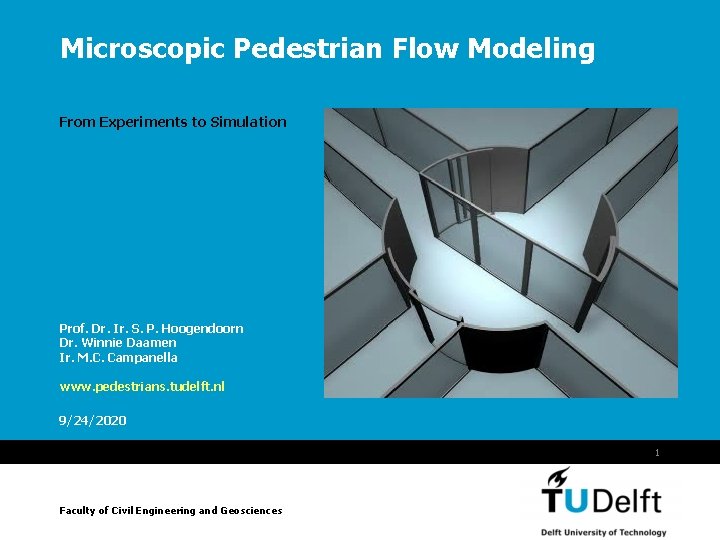
Microscopic Pedestrian Flow Modeling From Experiments to Simulation
- Slides: 34
Microscopic Pedestrian Flow Modeling From Experiments to Simulation Prof. Dr. Ir. S. P. Hoogendoorn Dr. Winnie Daamen Ir. M. C. Campanella www. pedestrians. tudelft. nl 9/24/2020 1 Faculty of Civil Engineering and Geosciences
Problem background • Research goals: develop tools / microscopic simulation models to • describe and predict pedestrian flow operations … • in different types of infrastructure (urban areas, airports, railway stations, buildings) … • in case of different situations (peak-hours, off-peak period, emergencies and evacuation; emphasis on crowds) • With the final aim to assess a new infrastructure design / changes in design / evacuation plan in terms of: • Comfort, efficiency, safety 9/24/2020 2
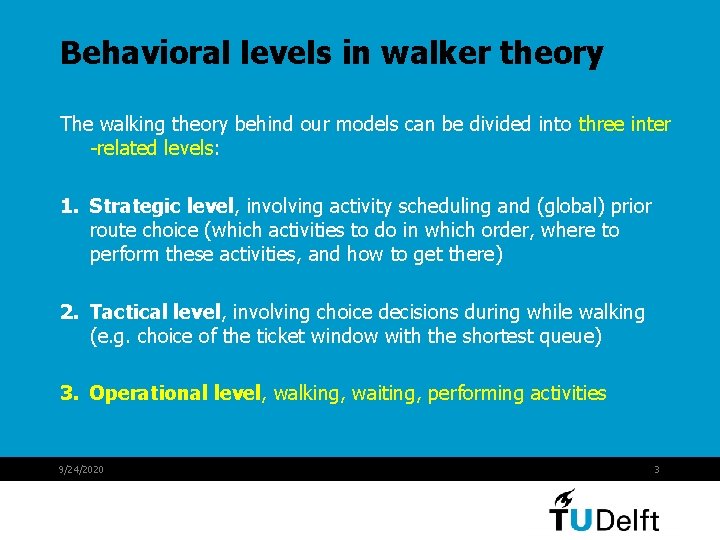
Behavioral levels in walker theory The walking theory behind our models can be divided into three inter -related levels: 1. Strategic level, involving activity scheduling and (global) prior route choice (which activities to do in which order, where to perform these activities, and how to get there) 2. Tactical level, involving choice decisions during while walking (e. g. choice of the ticket window with the shortest queue) 3. Operational level, walking, waiting, performing activities 9/24/2020 3
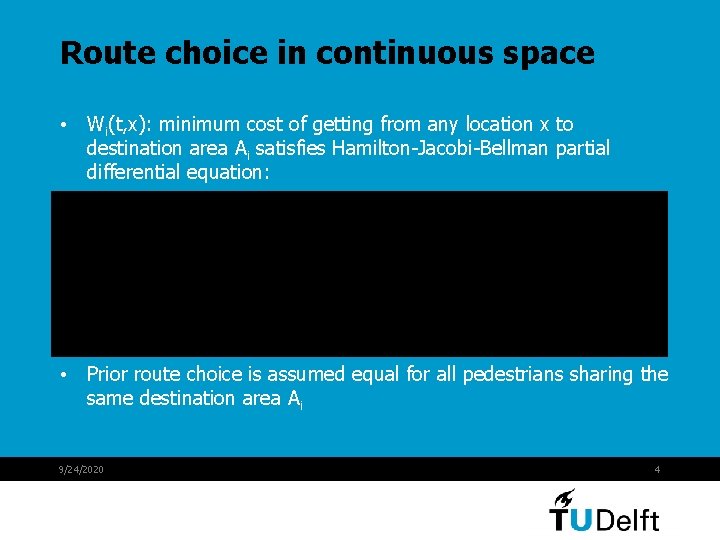
Route choice in continuous space • Wi(t, x): minimum cost of getting from any location x to destination area Ai satisfies Hamilton-Jacobi-Bellman partial differential equation: • Prior route choice is assumed equal for all pedestrians sharing the same destination area Ai 9/24/2020 4
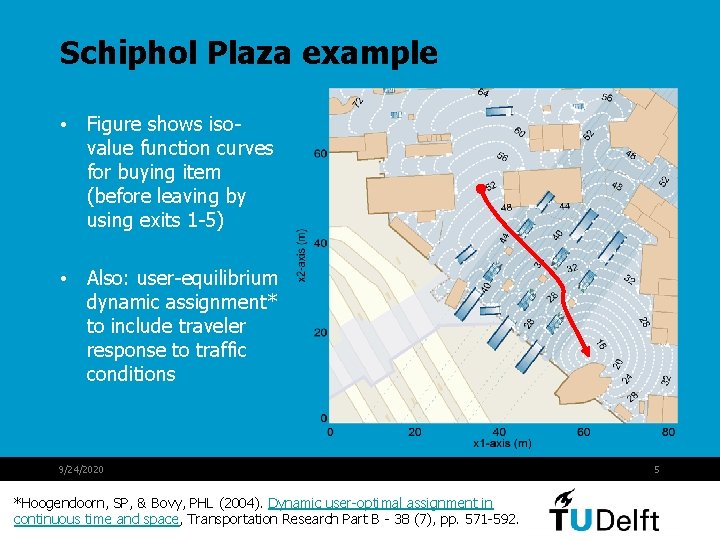
Schiphol Plaza example • Figure shows isovalue function curves for buying item (before leaving by using exits 1 -5) • Also: user-equilibrium dynamic assignment* to include traveler response to traffic conditions 9/24/2020 *Hoogendoorn, SP, & Bovy, PHL (2004). Dynamic user-optimal assignment in continuous time and space, Transportation Research Part B - 38 (7), pp. 571 -592. 5
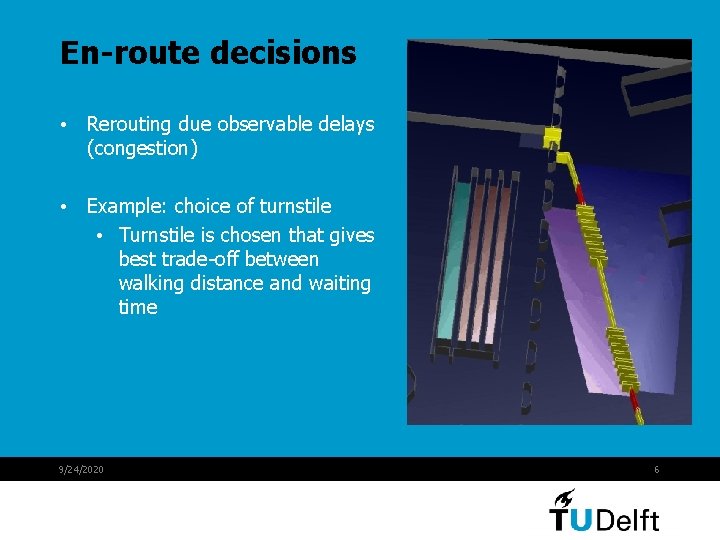
En-route decisions • Rerouting due observable delays (congestion) • Example: choice of turnstile • Turnstile is chosen that gives best trade-off between walking distance and waiting time 9/24/2020 6
Empirical / experimental facts of walking • Substantial body of research on pedestrian flow operations both from viewpoint of individual pedestrians and collective flow • Examples microscopic facts: • Free walking speed of pedestrians and dependence on internal and external factors (age, gender, purpose of walking, inclination, temperature) • Relation required spacing and walking speed • Example macroscopic facts: • Fundamental relation between flow, density and speed • Capacity estimations for hallways, doors, revolving doors, etc. • Self-organization phenomena 9/24/2020 7
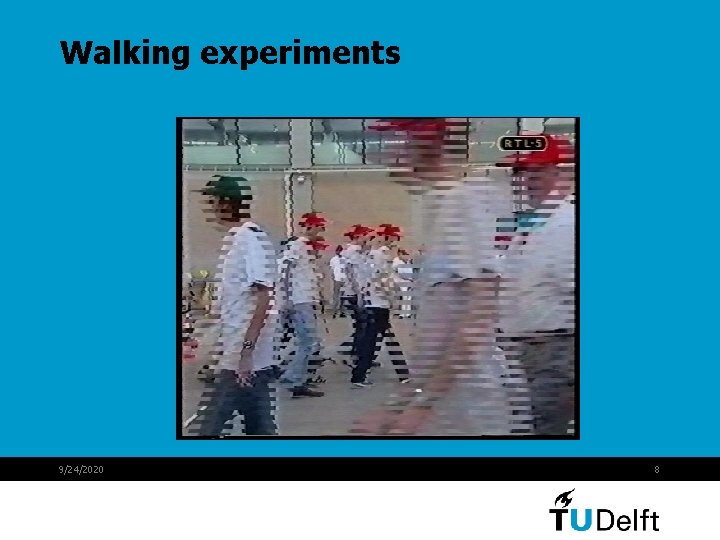
Walking experiments 9/24/2020 8
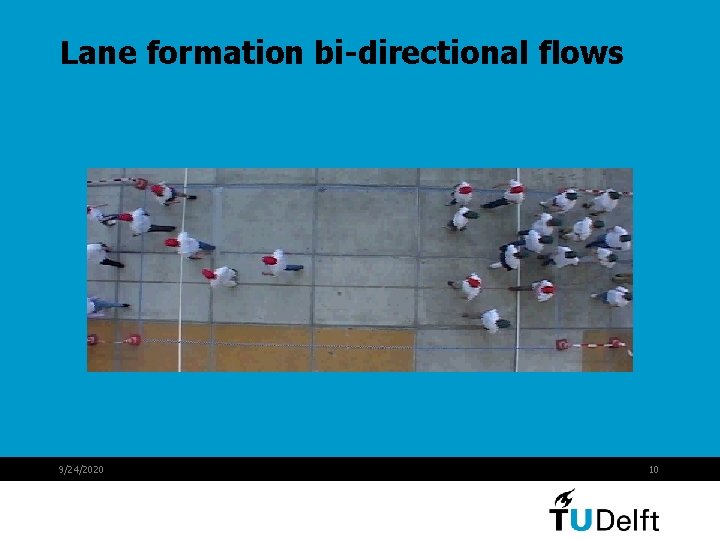
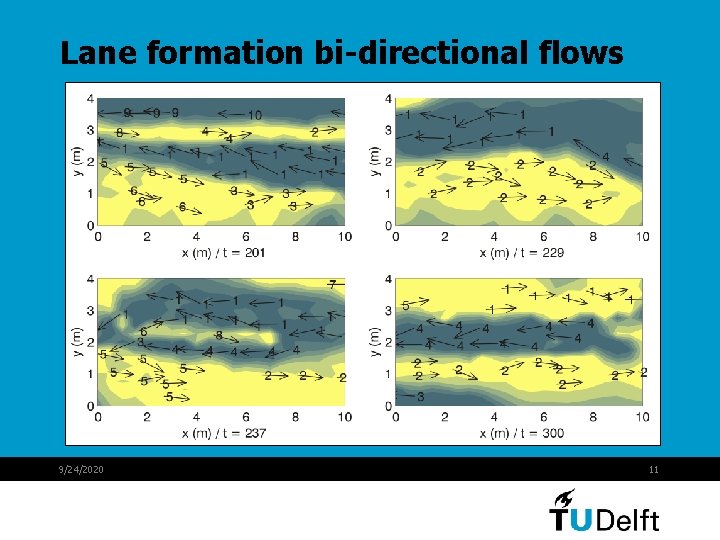
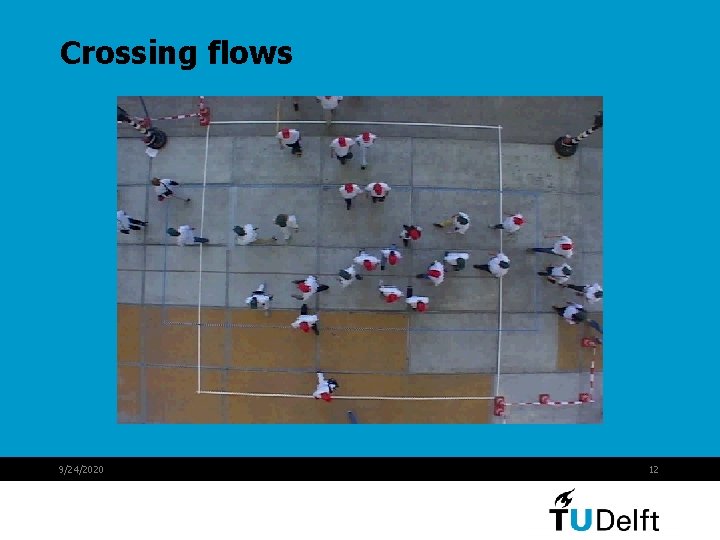
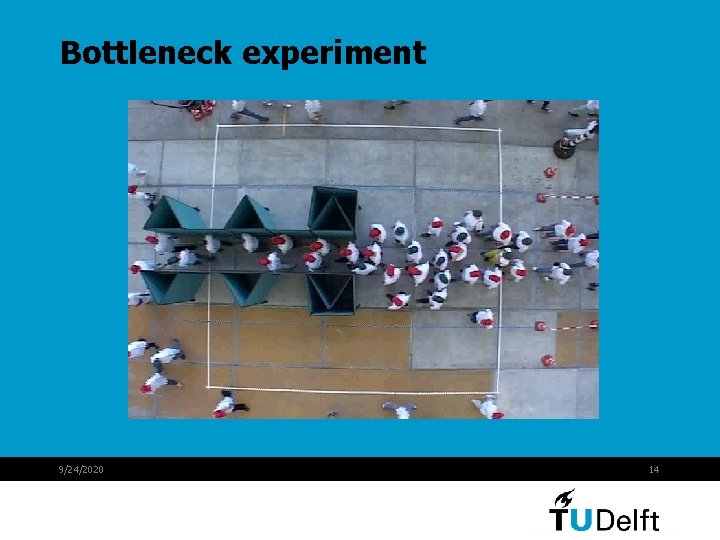
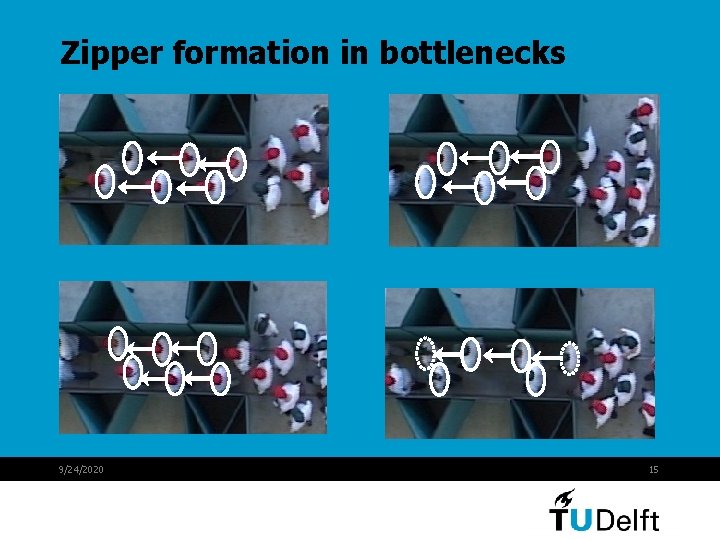
Self-organization • In pedestrian flow, several self-organized patterns can be observed which are fundamental for modeling pedestrian flow: • Formation of dynamic lanes in bi-directional flows (or in case of faster / slower pedestrians) • Formation of diagonal stripes in crossing flows • Zipper effect in long oversaturated bottlenecks • Arc formation and the ‘faster is slower effect’ • Self-organization has been studied empirically and experimentally • Some examples… 9/24/2020 9
Lane formation bi-directional flows 9/24/2020 10
Lane formation bi-directional flows 9/24/2020 11
Crossing flows 9/24/2020 12
Crossing flows 9/24/2020 13
Bottleneck experiment 9/24/2020 14
Zipper formation in bottlenecks 9/24/2020 15
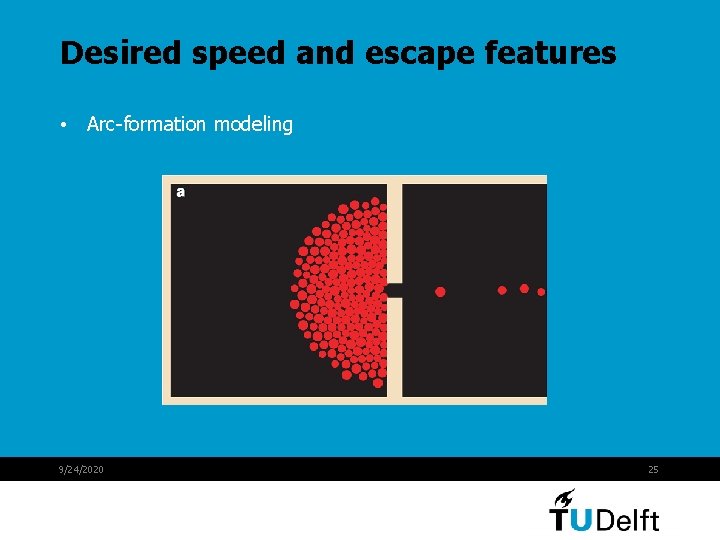
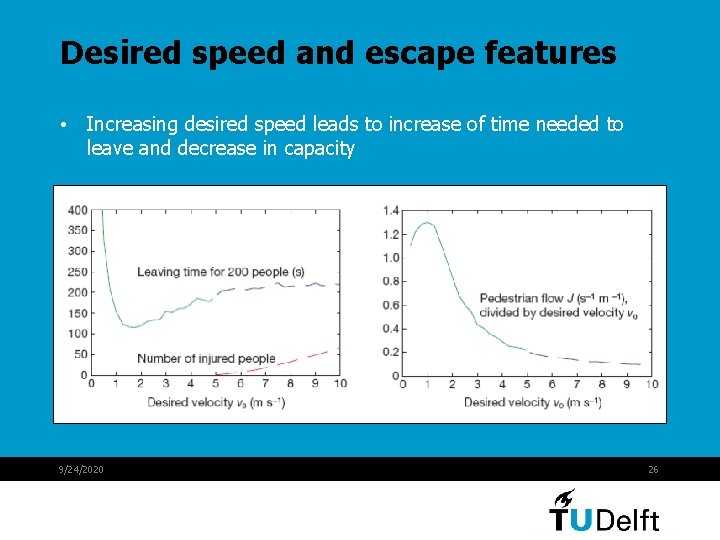
Walker operations during emergency • Although panic does generally not occur (less than 10% of all cases), the wish to leave a building as quickly as changes the nature of the walking operations (adaptive behavior) • Excellent experimental and simulation research on emergent traffic conditions has been done by Peschl (1971), Stapelfeldt (1976) and Helbing (2004) • An important effect is the so-called ‘faster-is-slower’ effect / arc formation: pedestrians with a stronger wish to leave the building (or leaving it more quickly) cause increased ‘forces’ on other pedestrians possibly leading to arc formation or tripping pedestrians 9/24/2020 16
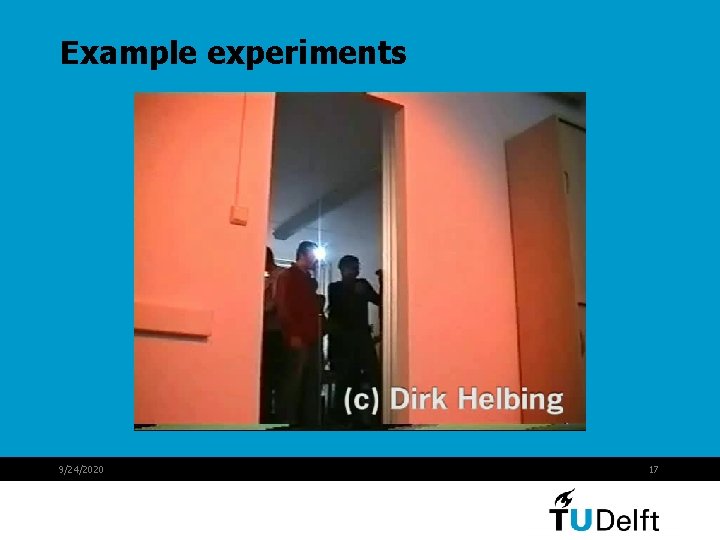
Example experiments 9/24/2020 17
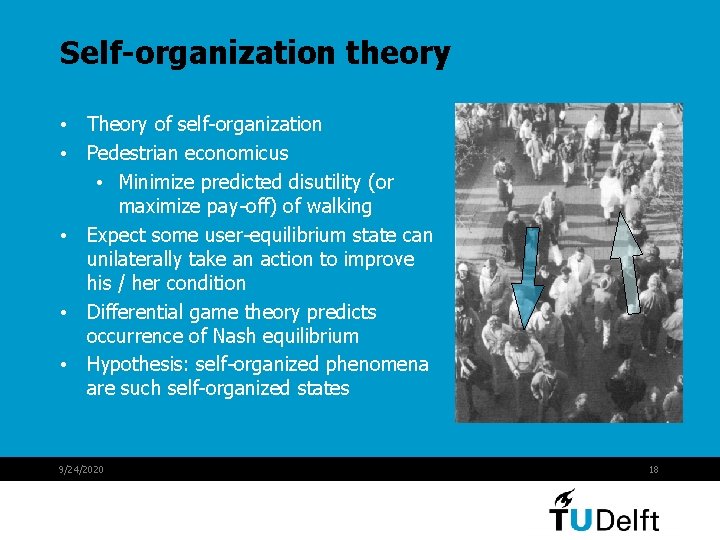
Self-organization theory • Theory of self-organization • Pedestrian economicus • Minimize predicted disutility (or maximize pay-off) of walking • Expect some user-equilibrium state can unilaterally take an action to improve his / her condition • Differential game theory predicts occurrence of Nash equilibrium • Hypothesis: self-organized phenomena are such self-organized states 9/24/2020 18
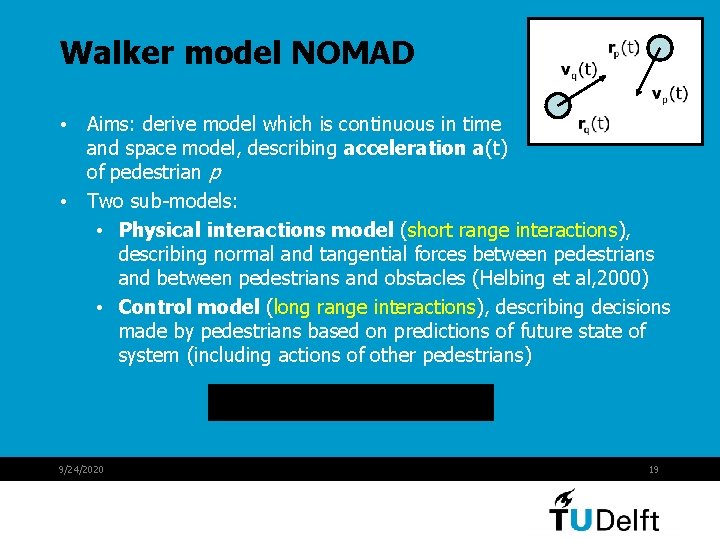
Walker model NOMAD • Aims: derive model which is continuous in time and space model, describing acceleration a(t) of pedestrian p • Two sub-models: • Physical interactions model (short range interactions), describing normal and tangential forces between pedestrians and obstacles (Helbing et al, 2000) • Control model (long range interactions), describing decisions made by pedestrians based on predictions of future state of system (including actions of other pedestrians) 9/24/2020 19
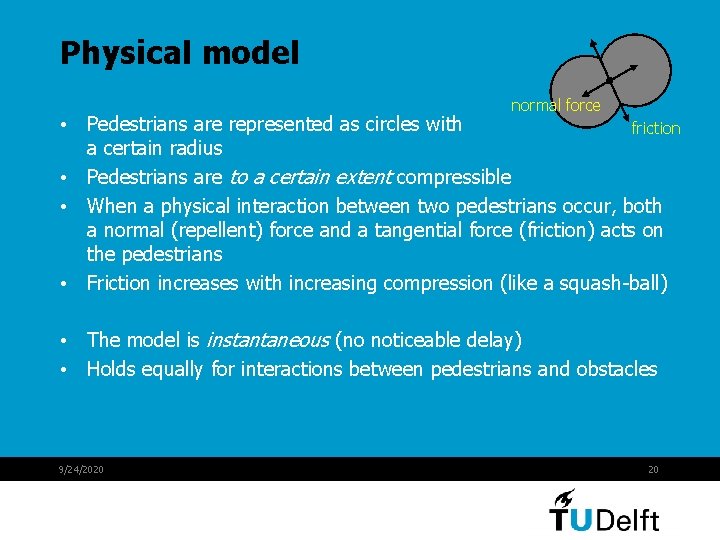
Physical model normal force • Pedestrians are represented as circles with friction a certain radius • Pedestrians are to a certain extent compressible • When a physical interaction between two pedestrians occur, both a normal (repellent) force and a tangential force (friction) acts on the pedestrians • Friction increases with increasing compression (like a squash-ball) • The model is instantaneous (no noticeable delay) • Holds equally for interactions between pedestrians and obstacles 9/24/2020 20
Control model derivation • Control model describes long-range / non-physical interactions between pedestrians (differential game) • Dynamics are determined by the control decisions of pedestrians, where pedestrians are assumed to be optimal controllers that minimize predicted walking cost (or pay-off) given expected reactions of other pedestrians (opponents) • Commercial models (i. e. Legion) make similar assumptions 9/24/2020 21
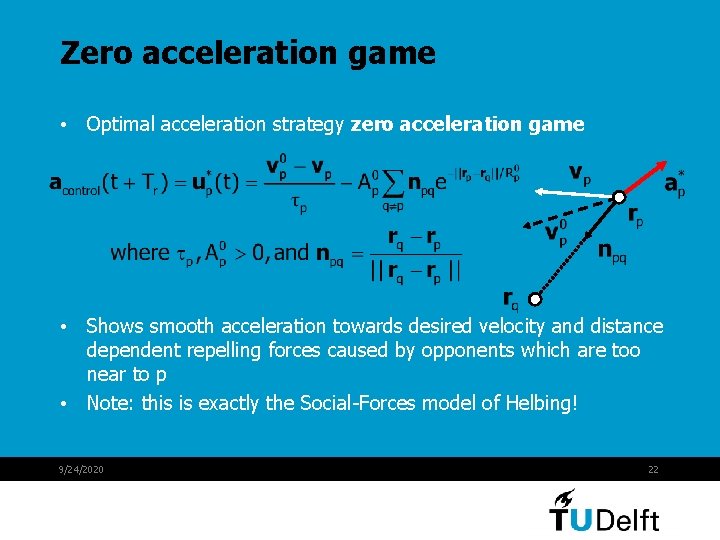
Zero acceleration game • Optimal acceleration strategy zero acceleration game • Shows smooth acceleration towards desired velocity and distance dependent repelling forces caused by opponents which are too near to p • Note: this is exactly the Social-Forces model of Helbing! 9/24/2020 22
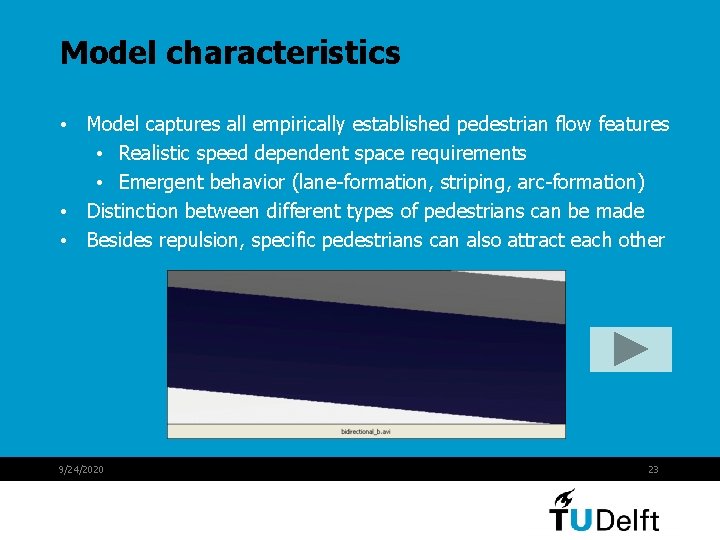
Model characteristics • Model captures all empirically established pedestrian flow features • Realistic speed dependent space requirements • Emergent behavior (lane-formation, striping, arc-formation) • Distinction between different types of pedestrians can be made • Besides repulsion, specific pedestrians can also attract each other 9/24/2020 23
Example application: evacuation • Reproducing ‘faster-is-slower’ effect? • NOMAD / Social-Forces: pedestrians are compressible ‘particles’ exerting friction on each other when touching • Friction increases with level of compression • In case of emergency / evacuation pressure / friction between pedestrians / pedestrians and infrastructure increases due to • Increased desire to get out / walk at the desired speed / increase of the desired speed • Higher demand of pedestrians aiming to get out of the facility • See research of Helbing and Molnar, Hoogendoorn and Daamen 9/24/2020 24
Desired speed and escape features • Arc-formation modeling 9/24/2020 25
Desired speed and escape features • Increasing desired speed leads to increase of time needed to leave and decrease in capacity 9/24/2020 26
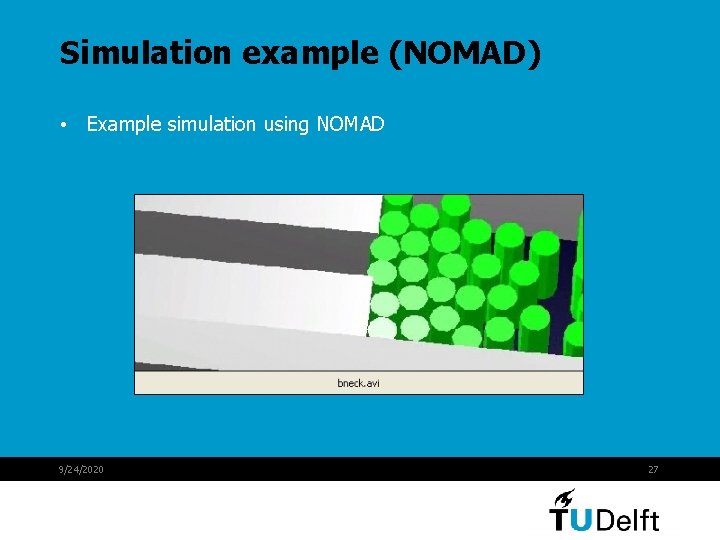
Simulation example (NOMAD) • Example simulation using NOMAD 9/24/2020 27
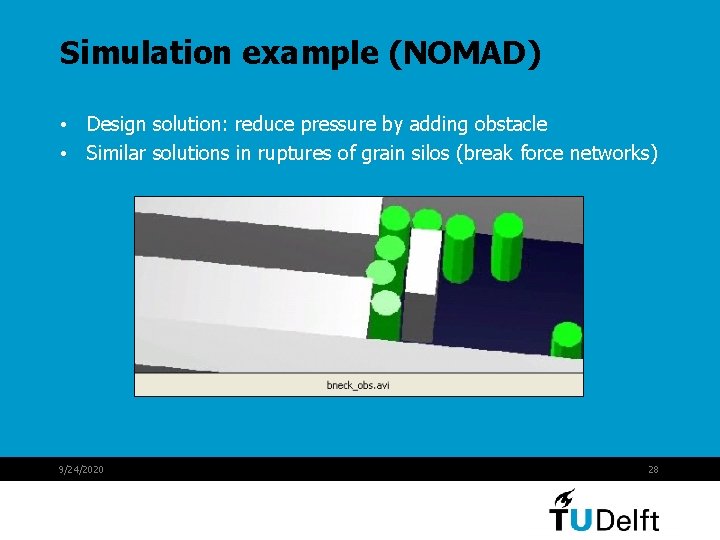
Simulation example (NOMAD) • Design solution: reduce pressure by adding obstacle • Similar solutions in ruptures of grain silos (break force networks) 9/24/2020 28
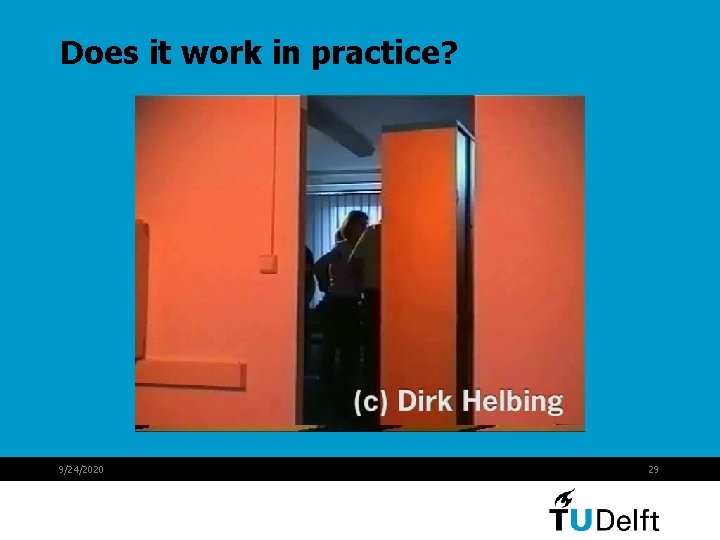
Does it work in practice? 9/24/2020 29
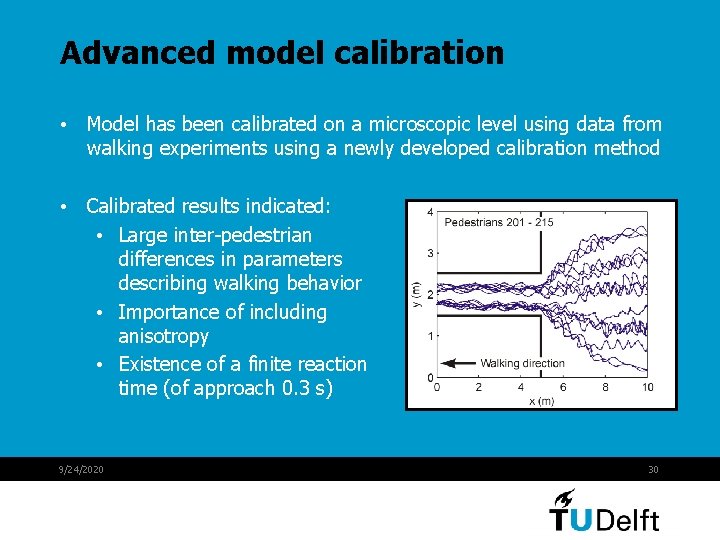
Advanced model calibration • Model has been calibrated on a microscopic level using data from walking experiments using a newly developed calibration method • Calibrated results indicated: • Large inter-pedestrian differences in parameters describing walking behavior • Importance of including anisotropy • Existence of a finite reaction time (of approach 0. 3 s) 9/24/2020 30
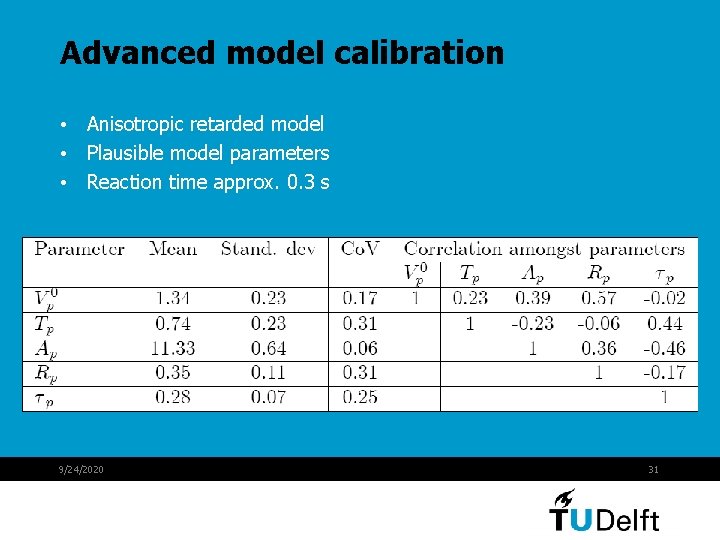
Advanced model calibration • Anisotropic retarded model • Plausible model parameters • Reaction time approx. 0. 3 s 9/24/2020 31
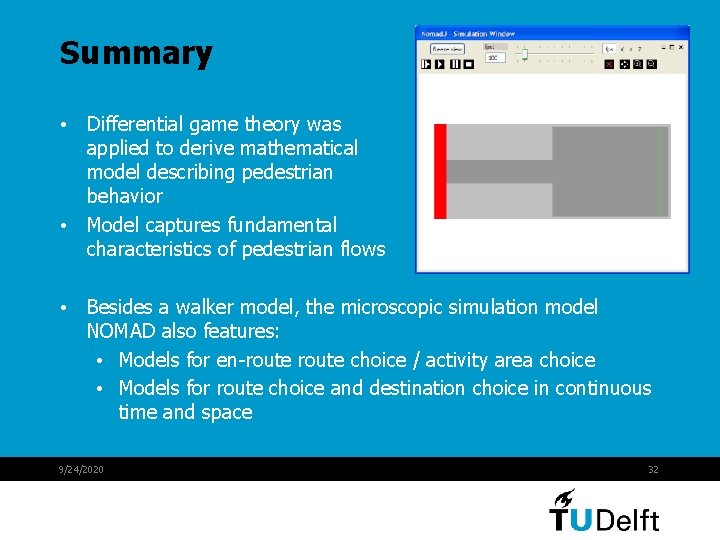
Summary • Differential game theory was applied to derive mathematical model describing pedestrian behavior • Model captures fundamental characteristics of pedestrian flows • Besides a walker model, the microscopic simulation model NOMAD also features: • Models for en-route choice / activity area choice • Models for route choice and destination choice in continuous time and space 9/24/2020 32
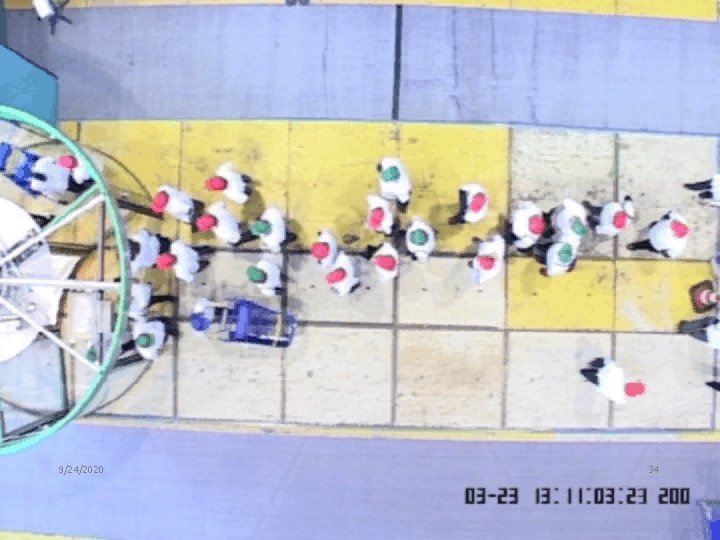
Future work • Improved models for pedestrian behavior near entrances (doors, revolving doors, turnstiles, etc. ); dedicated walking experiments have been performed to this end! • Improving efficiency of route choice modeling • Improving numerical efficiency of walker modeling • Including other kinds of traffic (bicycles, cars, etc. ) in the model • Freeware version of NOMADj will be available soon at the TU Delft pedestrian website (www. pedestrians. tudelft. nl) • Please visit website for all publications 9/24/2020 33
9/24/2020 34