
MICROSCOPIC EXAMINATION OF BACTERIA UNSTAINED STAINED SMEARS By
MICROSCOPIC EXAMINATION OF BACTERIA (UNSTAINED & STAINED SMEARS) By Dr. Emad Abd. Elhameed Morad Lecturer of Medical Microbiology and Immunology
• There are two principal ways of preparing a microbial specimen for observation with light microscope: 1. Unstained smears (wet preparation): to examine the motility of the bacteria. 2. Stained smears: to study the size, shape, arrangement and staining affinity of the bacteria. 9/5/2021 Dr. Emad Abd. Elhameed Morad Microscopic examination 2
Stained smears • Study size, shape, arrangement and staining affinity of the bacteria. size • Bacteria are measured in microns. 9/5/2021 Dr. Emad Abd. Elhameed Morad Microscopic examination 3
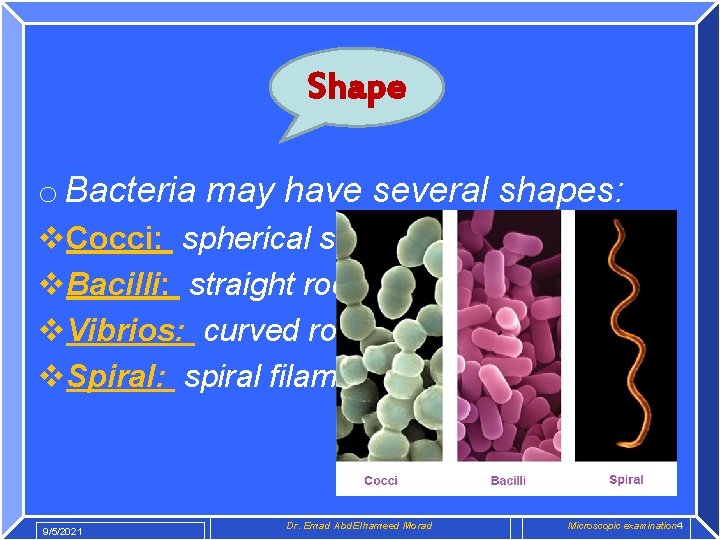
Shape o Bacteria may have several shapes: v. Cocci: spherical shape v. Bacilli: straight rods v. Vibrios: curved rods v. Spiral: spiral filaments 9/5/2021 Dr. Emad Abd. Elhameed Morad Microscopic examination 4
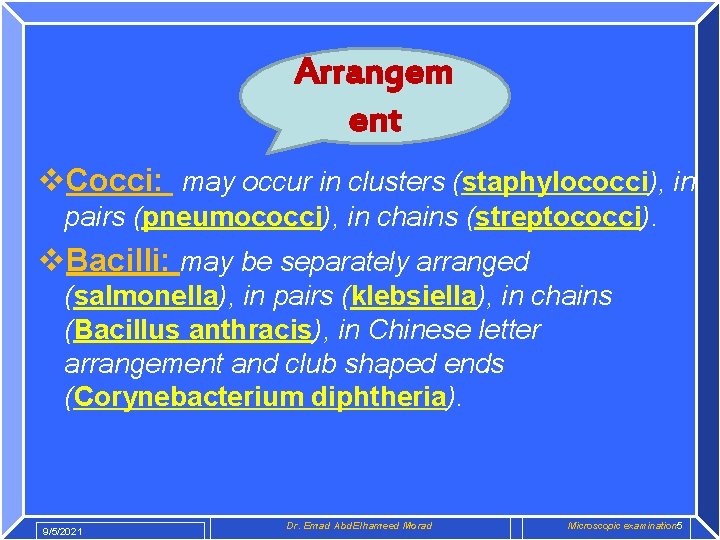
Arrangem ent v. Cocci: may occur in clusters (staphylococci), in pairs (pneumococci), in chains (streptococci). v. Bacilli: may be separately arranged (salmonella), in pairs (klebsiella), in chains (Bacillus anthracis), in Chinese letter arrangement and club shaped ends (Corynebacterium diphtheria). 9/5/2021 Dr. Emad Abd. Elhameed Morad Microscopic examination 5

Cocci arranged in clusters 9/5/2021 Cocci arranged in chains 6
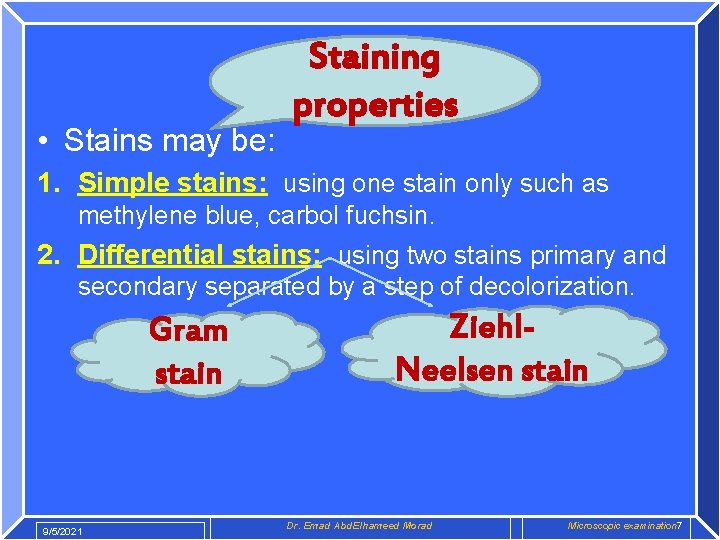
• Stains may be: Staining properties 1. Simple stains: using one stain only such as methylene blue, carbol fuchsin. 2. Differential stains: using two stains primary and secondary separated by a step of decolorization. Gram stain 9/5/2021 Ziehl. Neelsen stain Dr. Emad Abd. Elhameed Morad Microscopic examination 7
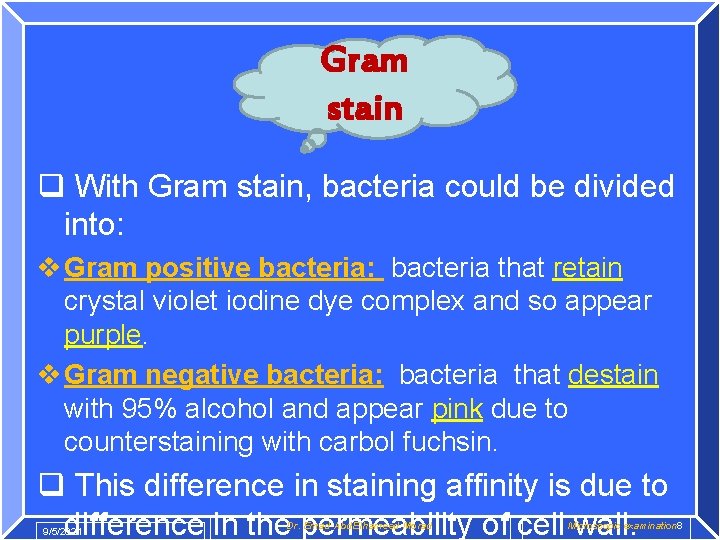
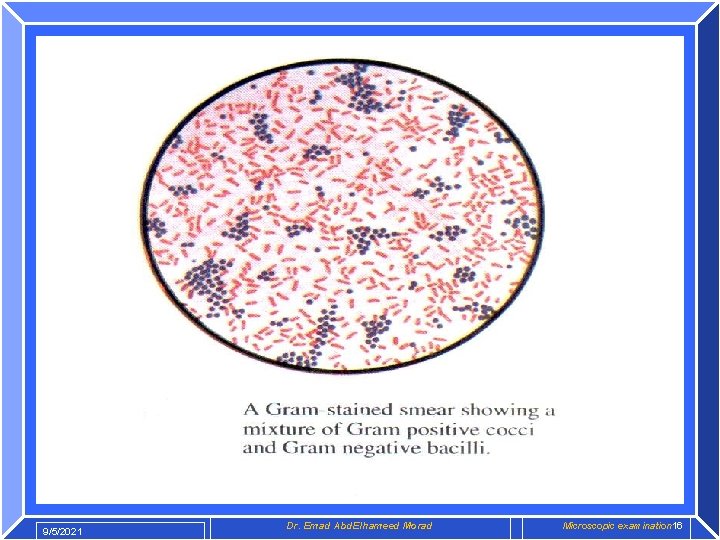
Gram stain q With Gram stain, bacteria could be divided into: v Gram positive bacteria: bacteria that retain crystal violet iodine dye complex and so appear purple. v Gram negative bacteria: bacteria that destain with 95% alcohol and appear pink due to counterstaining with carbol fuchsin. q This difference in staining affinity is due to difference in the permeability of cell wall. 9/5/2021 Dr. Emad Abd. Elhameed Morad Microscopic examination 8

Gram staining Preparation and fixation of smears Staining Examination Interpretation 9/5/2021 Dr. Emad Abd. Elhameed Morad Microscopic examination 9

Preparation of smears • Put a drop of water on the middle of the slide using the inoculating needle. • With the sterile needle, collect bacteria from agar surface by touching the bacterial growth. • Rub the tip of the needle on the glass slide in the drop of water in a circular motion till you get homogenous smear. • Allow the smear to dry. 9/5/2021 Dr. Emad Abd. Elhameed Morad Microscopic examination 10

Fixation of smears o Pass the slide with the smear side uppermost over the flame for 2 -3 times. o Do not overheat the smear. The slide should only be warm when you touch it with hands. o Passage of the smear through heat has two benefits: 1. Fixation of the smear to the slide. 2. Killing of the bacteria in the smear so it becomes non infectious. 9/5/2021 Dr. Emad Abd. Elhameed Morad Microscopic examination 11
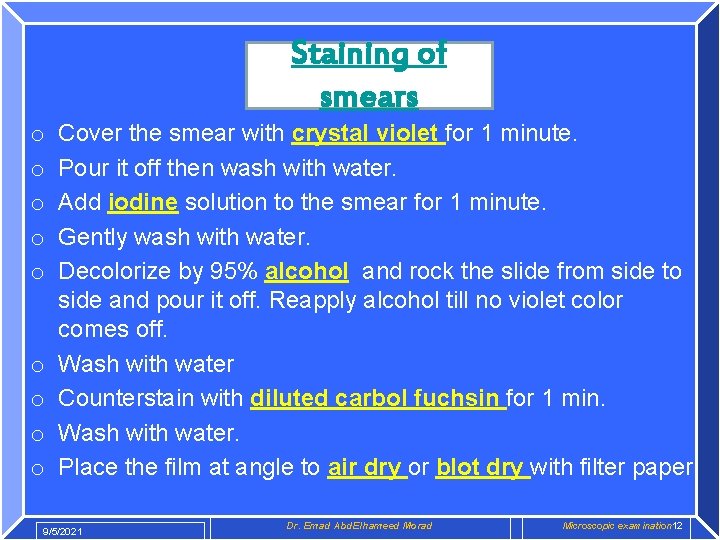
Staining of smears o o o o o Cover the smear with crystal violet for 1 minute. Pour it off then wash with water. Add iodine solution to the smear for 1 minute. Gently wash with water. Decolorize by 95% alcohol and rock the slide from side to side and pour it off. Reapply alcohol till no violet color comes off. Wash with water Counterstain with diluted carbol fuchsin for 1 min. Wash with water. Place the film at angle to air dry or blot dry with filter paper. 9/5/2021 Dr. Emad Abd. Elhameed Morad Microscopic examination 12

Gram staining 9/5/2021 Dr. Emad Abd. Elhameed Morad Microscopic examination 13

Examination of smears o Rack the condenser high and open the iris diaphragm. o Place a drop of immersion oil on the smear. o Put the slide with the smear side up on the stage. o Use the oil immersion lens. o Lower the oil lens till the lens contacts the oil and almost touches the smear. o Look through the eye piece of the microscope. o Focus on the object using the coarse adjustment screw then the fine one. 9/5/2021 Dr. Emad Abd. Elhameed Morad Microscopic examination 14
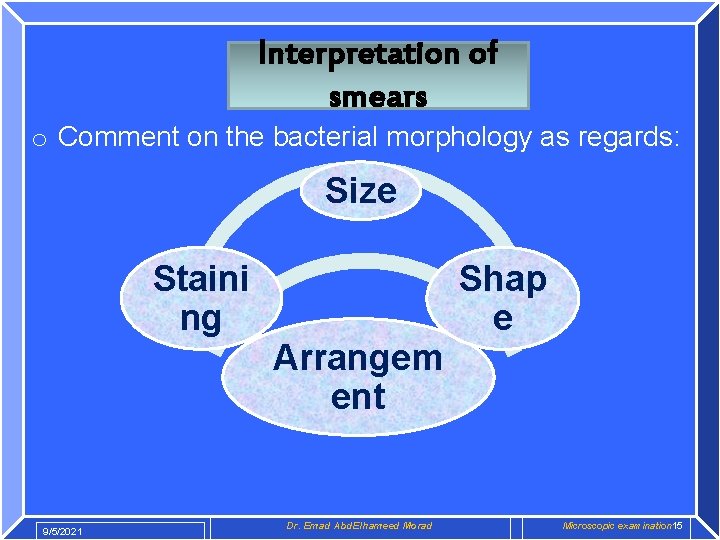
Interpretation of smears o Comment on the bacterial morphology as regards: Size Staini ng 9/5/2021 Arrangem ent Dr. Emad Abd. Elhameed Morad Shap e Microscopic examination 15
9/5/2021 Dr. Emad Abd. Elhameed Morad Microscopic examination 16
Ziehl Neelsen stain • This stain is used for detection of bacteria which are described as acid fast. • These bacteria are not stained with ordinary stains but they need exposure to strong stains with application of heat. • Once stained, they will resist decolorization with mineral acids such as H 2 SO 4 or HCL. • This property is due to large amount of lipids and fatty acids especially mycolic acid wax in cell wall of these bacteria. 9/5/2021 Dr. Emad Abd. Elhameed Morad Microscopic examination 17
q. Examples of acid fast bacteria or bacterial structures: A. Tubercle bacilli: retain red carbol fuchsin when decolorized with 20% H 2 SO 4 or 3% HCL in alcohol. B. Lepra bacilli and saprophytic acid fast bacilli: retain red dye when decolorized with 5% H 2 SO 4 or 1% HCL in alcohol. C. Actinomyces clubs and nocardia: retain red dye when decolorized with 0. 5% to 1% H 2 SO 4. D. Spores: tolerates only 0. 25% to 0. 5% H 2 SO 4. 9/5/2021 Dr. Emad Abd. Elhameed Morad Microscopic examination 18
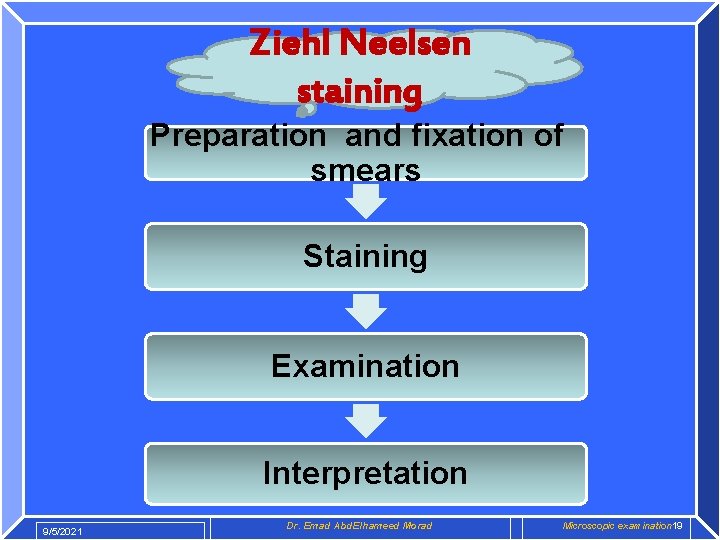
Ziehl Neelsen staining Preparation and fixation of smears Staining Examination Interpretation 9/5/2021 Dr. Emad Abd. Elhameed Morad Microscopic examination 19
Preparation and fixation of smears Ø Tubercle bacilli cause tuberculosis. Pulmonary tuberculosis is the commonest form of tuberculous infection in which tubercle bacilli are found in the sputum of the patients. Ø Smears could be prepared from sputum samples as follows: o Three morning sputum samples are preferable since they represent overnight accumulation. o Choose a purulent portion of sputum and spread it evenly in the middle of a new clean glass slide. o Leave the smear to dry. o Then fix the smear by. Dr. passing through the flame. Emad Abd. Elhameed Morad Microscopic examination 20 9/5/2021
Staining of smears o Flood the smear with strong carbol fuchsin. Allow the stain to act for 5 -10 minutes. o Heat intermittently until the vapor begins to rise. Do not allow the stain to boil or dry. o Pour it off then wash with water. o Flood the smear with 20% H 2 SO 4 or 3% HCL in 95% alcohol. Allow to act for 1 min. then wash with water and reapply fresh acid. Repeat this process several times till the smear becomes colorless or pale pink. o Wash thoroughly with water. o Add methylene blue or malachite green for 2 min. o Wash with water. Dry then examine. 9/5/2021 Dr. Emad Abd. Elhameed Morad Microscopic examination 21
Kinyoun technique o It is called cold Z. N. because no heating is applied. o Penetration of the dye is achieved by increasing concentration of carbol fuchsin and incorporation of a wetting chemical agent. o However, acid fast bacilli stain less well by this method than hot Z. N. 9/5/2021 Dr. Emad Abd. Elhameed Morad Microscopic examination 22
Examination of smears o Put immersion oil on a dry slide. o Examine under oil immersion lens. o Tubercle bacilli appear pink rods that may be single or bundles. o The background appears blue in color. 9/5/2021 Dr. Emad Abd. Elhameed Morad Microscopic examination 23
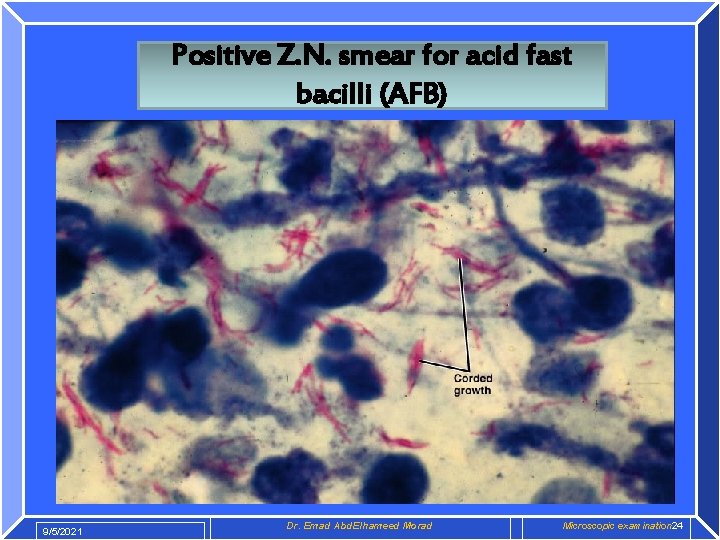
Positive Z. N. smear for acid fast bacilli (AFB) 9/5/2021 Dr. Emad Abd. Elhameed Morad Microscopic examination 24
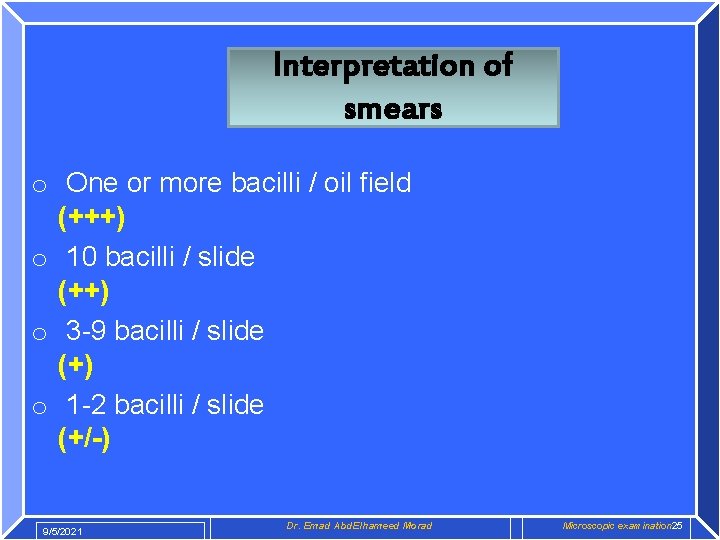
Interpretation of smears o One or more bacilli / oil field (+++) o 10 bacilli / slide (++) o 3 -9 bacilli / slide (+) o 1 -2 bacilli / slide (+/-) 9/5/2021 Dr. Emad Abd. Elhameed Morad Microscopic examination 25

Thank you 9/5/2021 Dr. Emad Abd. Elhameed Morad Microscopic examination 26
- Slides: 26