
Microscopic Ethics By Matthew Sparks History In 1959
Microscopic Ethics By: Matthew Sparks
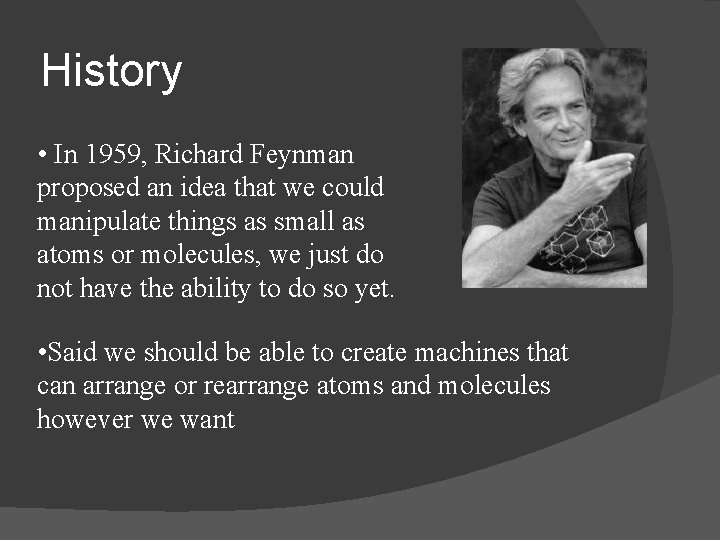
History • In 1959, Richard Feynman proposed an idea that we could manipulate things as small as atoms or molecules, we just do not have the ability to do so yet. • Said we should be able to create machines that can arrange or rearrange atoms and molecules however we want
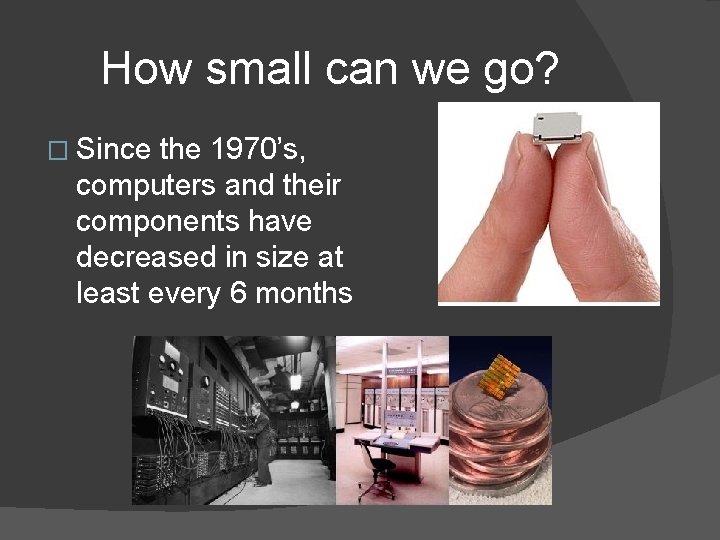
How small can we go? � Since the 1970’s, computers and their components have decreased in size at least every 6 months
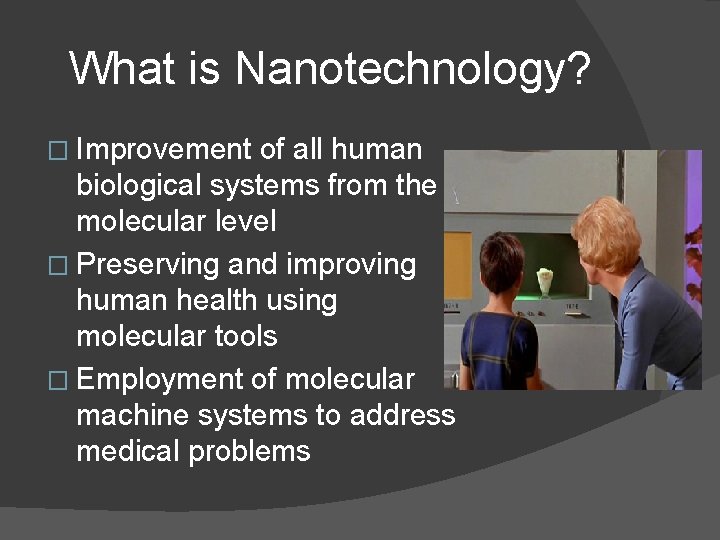
What is Nanotechnology? � Improvement of all human biological systems from the molecular level � Preserving and improving human health using molecular tools � Employment of molecular machine systems to address medical problems
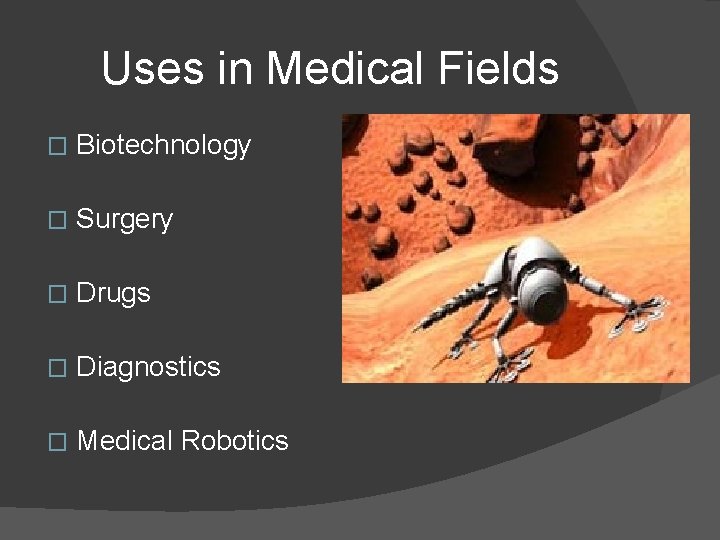
Uses in Medical Fields � Biotechnology � Surgery � Drugs � Diagnostics � Medical Robotics
Biotechnology � The application of the principles and practices of engineering and technology to the life sciences � Limiting � Gene and delivering stem cells Therapy
Surgery � Absolute � No noninvasive surgery risk of scars or outside influence � Doctor never even has to actually touch the patient � Construct inside new, or repair organs from the
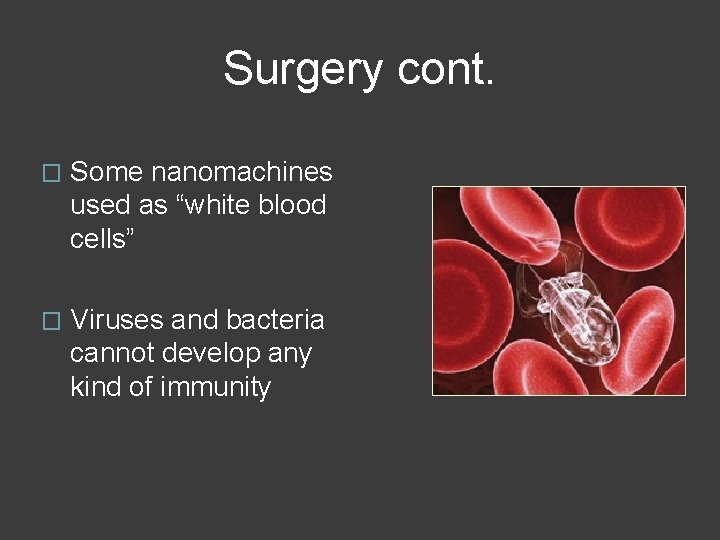
Surgery cont. � Some nanomachines used as “white blood cells” � Viruses and bacteria cannot develop any kind of immunity
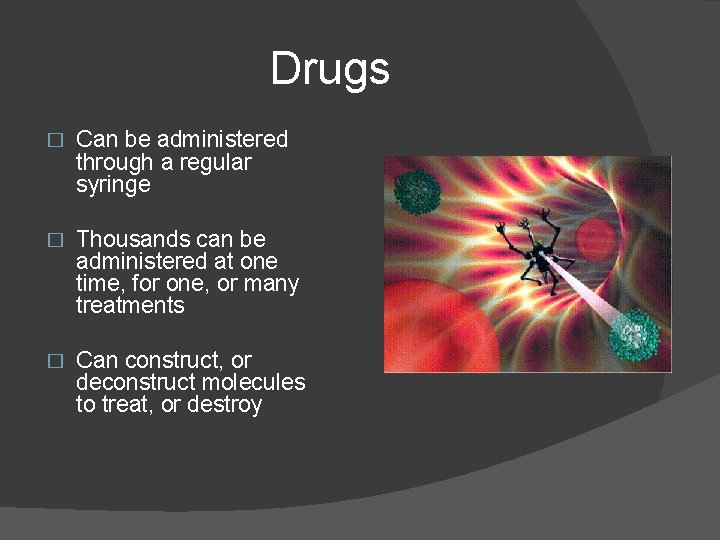
Drugs � Can be administered through a regular syringe � Thousands can be administered at one time, for one, or many treatments � Can construct, or deconstruct molecules to treat, or destroy
Diagnostics � Diagnostic nanobots can take measurements, track certain cells, bacteria, etc. � Transmit data back to doctors � Nanocameras take images of healthy and/or damaged cells � Can determine if other nanobots present should act
Medical Robots � Can be effective in almost any part of human body � Mouthwash � Skin Cream � Immune System � Directed targeting of infected or diseased areas
Ethical Issues � Not enough extensive work yet � Nanobots may be so small they can pass through membranes within the body � Blood-brain � Not barrier known if nanobots toxic to humans
Issues cont. � Long term risks � Self-Replication � Gray-goo scenario � Invisible tracking and recording devices � Bioterrorism
Issues cont. � How much will it cost? � Separation of those who can afford nanomedicine and who cannot? � Gene therapy � Altering DNA in unborn children
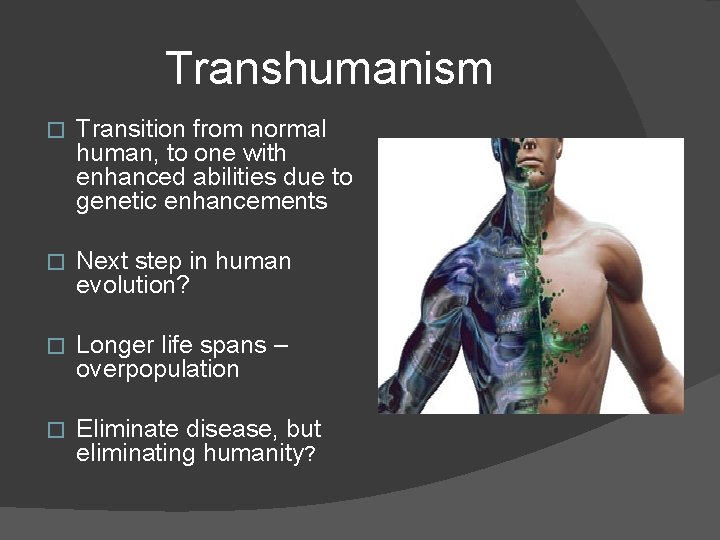
Transhumanism � Transition from normal human, to one with enhanced abilities due to genetic enhancements � Next step in human evolution? � Longer life spans – overpopulation � Eliminate disease, but eliminating humanity?
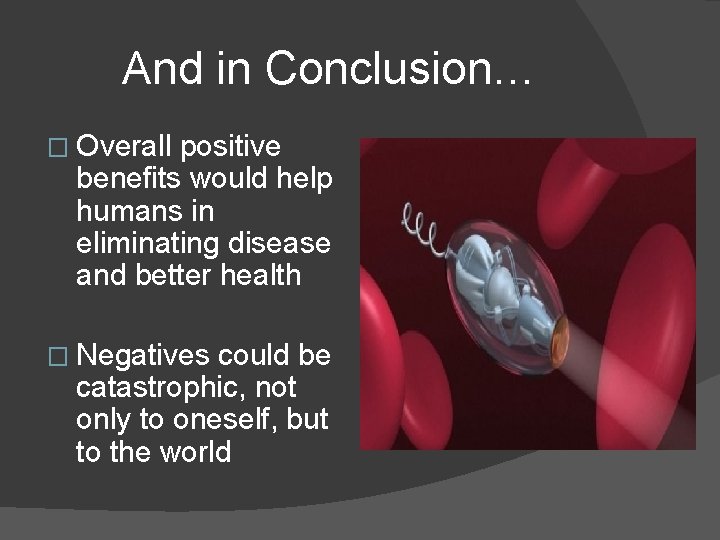
And in Conclusion… � Overall positive benefits would help humans in eliminating disease and better health � Negatives could be catastrophic, not only to oneself, but to the world
What do you think? � Better for humanity, or a downfall? � Would there still be a distinction between man and machine? Or another category? � Could nanotechnology be controlled to only pertain to the good aspects? � Who should be the ones that receive the nanomedicinal treatments?
References � � � Berger, M. (2008, January 9). Ethical aspects of nanotechnology in medicine. Retrieved from http: //www. nanowerk. com/spotlight/spotid=3938. php Bonsor, K. , & Strickland, J. (2007). Nanotechnology challenges, risks and ethics. How Nanotechnology Works, Retrieved from http: //science. howstuffworks. com/nanotechnology 5. htm Davidson, Keay. (2005). Big troubles may lurk in super-tiny tech / nanotechnology experts say legal, ethical issues loom. Chronicle Science Writer, Retrieved from http: //articles. sfgate. com/2005 -1031/news/17396870_1_foresight-nanotech-institute-nanotechnologyindustry-nanomaterials Freitas Jr. , R. A. (1999). Nanomedicine, volume i: basic capabilities. Retrieved from http: //www. nanomedicine. com/NMI. htm Keating, E. L. (1999). A brief history of nanotechnology. Unpublished raw data, College of Liberal Arts, University of Texas at Austin, TX. Retrieved from http: //www. utexas. edu/cola/progs/sts/the-nanofuture/science/a-brief-history-of-nanotechnology. php Lenhert, S. (2002). A brief history of nanotechnology. Retrieved from http: //www. nanoword. net/pages/history. htm
- Slides: 18