
Microscopic Dynamics Simulations of Heavyion fusion multinucleon transfer
- Slides: 31
Microscopic Dynamics Simulations of Heavy-ion fusion & multi-nucleon transfer Reactions Ning Wang Guangxi Normal University, Guilin, China o Introduction/motivations o Im. QMD model o Heavy-ion fusion reactions o Multi-nucleon transfer in Kr+Ni & Sm+Gd o Summary CUSTIPEN-IMP-PKU Workshop on Physics of Exotic Nuclei Huizhou, Dec. 12 - 15, 2016
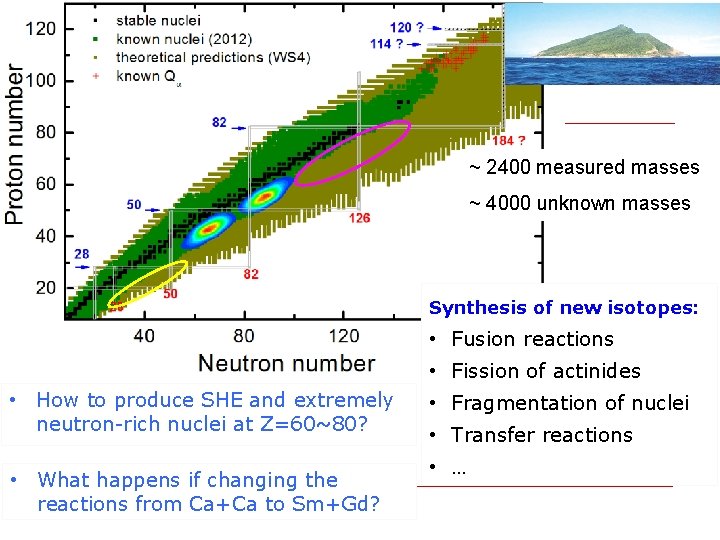
~ 2400 measured masses ~ 4000 unknown masses Synthesis of new isotopes: • Fusion reactions • Fission of actinides • How to produce SHE and extremely neutron-rich nuclei at Z=60~80? • What happens if changing the reactions from Ca+Ca to Sm+Gd? • Fragmentation of nuclei • Transfer reactions • …
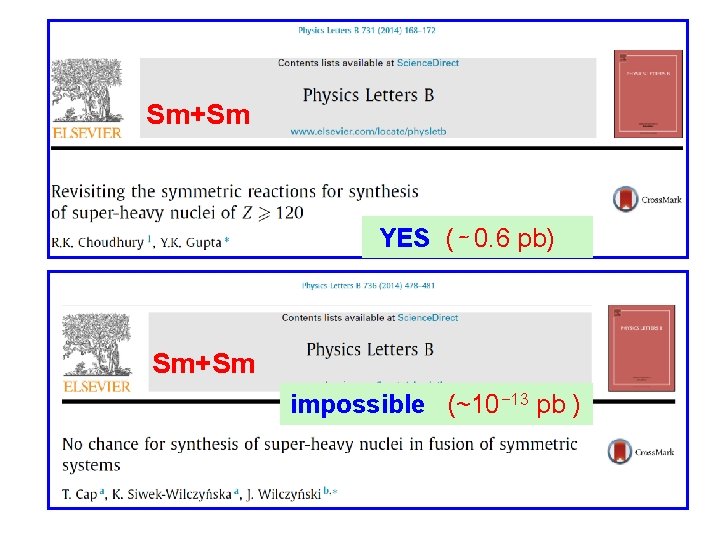
Sm+Sm YES (∼ 0. 6 pb) Sm+Sm impossible (~10− 13 pb )
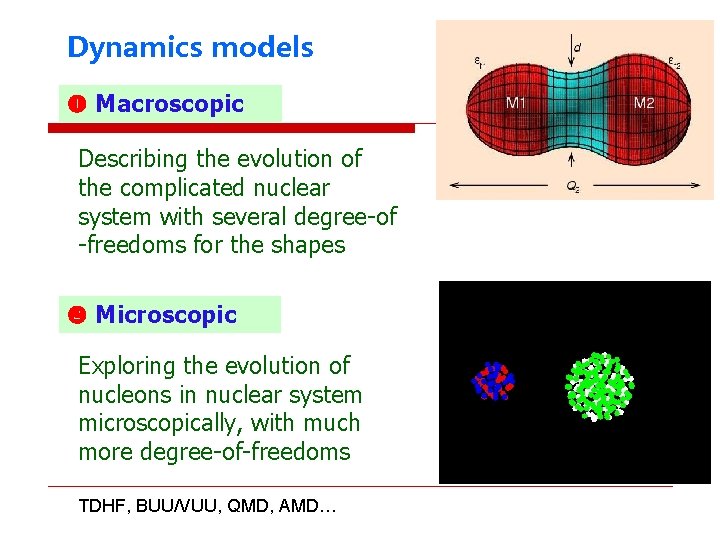
Dynamics models Macroscopic Describing the evolution of the complicated nuclear system with several degree-of -freedoms for the shapes Microscopic Exploring the evolution of nucleons in nuclear system microscopically, with much more degree-of-freedoms TDHF, BUU/VUU, QMD, AMD…
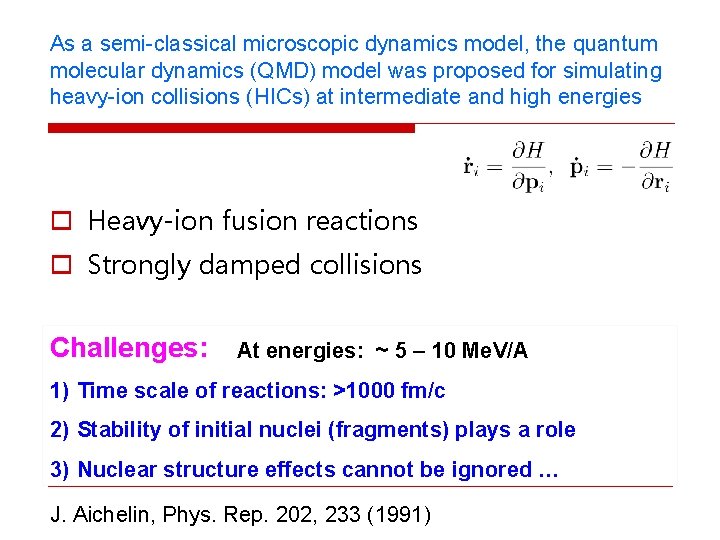
As a semi-classical microscopic dynamics model, the quantum molecular dynamics (QMD) model was proposed for simulating heavy-ion collisions (HICs) at intermediate and high energies o Heavy-ion fusion reactions o Strongly damped collisions Challenges: At energies: ~ 5 – 10 Me. V/A 1) Time scale of reactions: >1000 fm/c 2) Stability of initial nuclei (fragments) plays a role 3) Nuclear structure effects cannot be ignored … J. Aichelin, Phys. Rep. 202, 233 (1991)
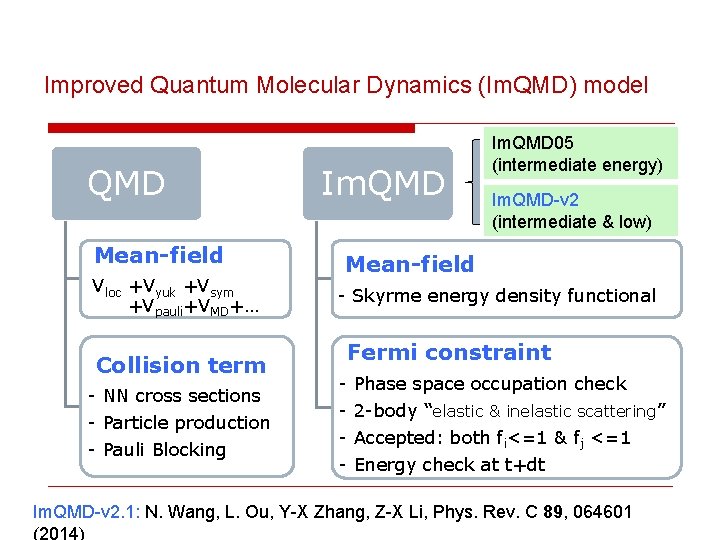
Improved Quantum Molecular Dynamics (Im. QMD) model QMD Mean-field Vloc +Vyuk +Vsym +Vpauli+VMD+… Collision term - NN cross sections - Particle production - Pauli Blocking Im. QMD 05 (intermediate energy) Im. QMD-v 2 (intermediate & low) Mean-field - Skyrme energy density functional Fermi constraint - Phase space occupation check 2 -body “elastic & inelastic scattering” Accepted: both fi<=1 & fj <=1 Energy check at t+dt Im. QMD-v 2. 1: N. Wang, L. Ou, Y-X Zhang, Z-X Li, Phys. Rev. C 89, 064601 (2014)
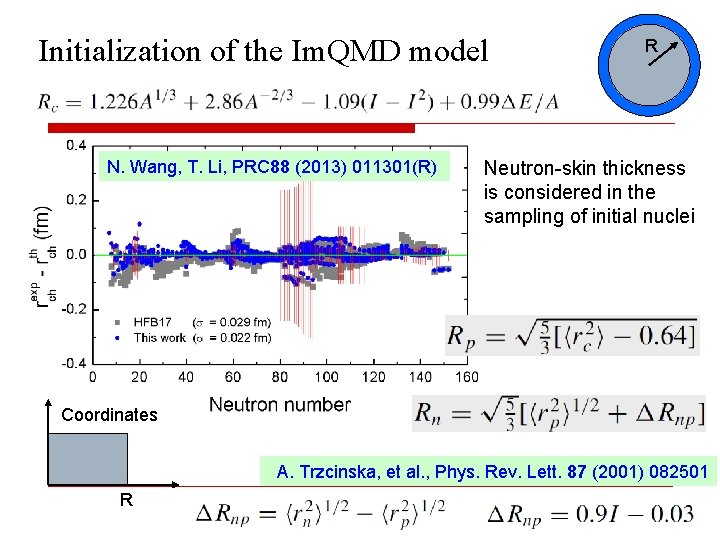
Initialization of the Im. QMD model N. Wang, T. Li, PRC 88 (2013) 011301(R) R Neutron-skin thickness is considered in the sampling of initial nuclei Coordinates A. Trzcinska, et al. , Phys. Rev. Lett. 87 (2001) 082501 R
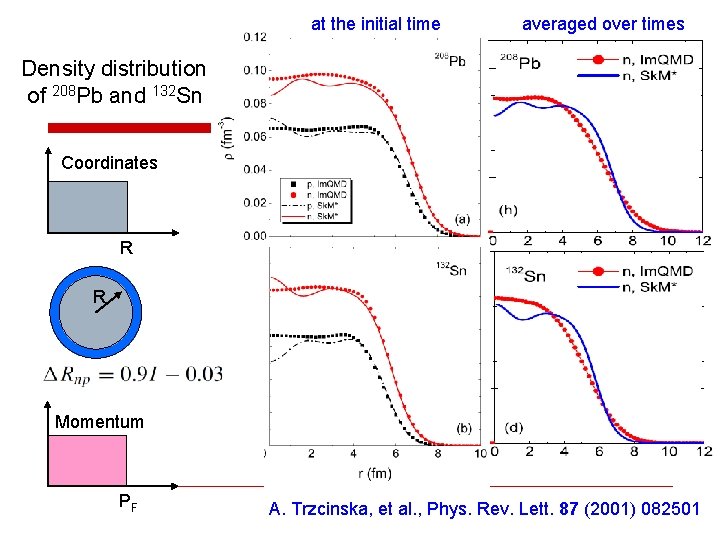
at the initial time averaged over times Density distribution of 208 Pb and 132 Sn Coordinates R R Momentum PF A. Trzcinska, et al. , Phys. Rev. Lett. 87 (2001) 082501
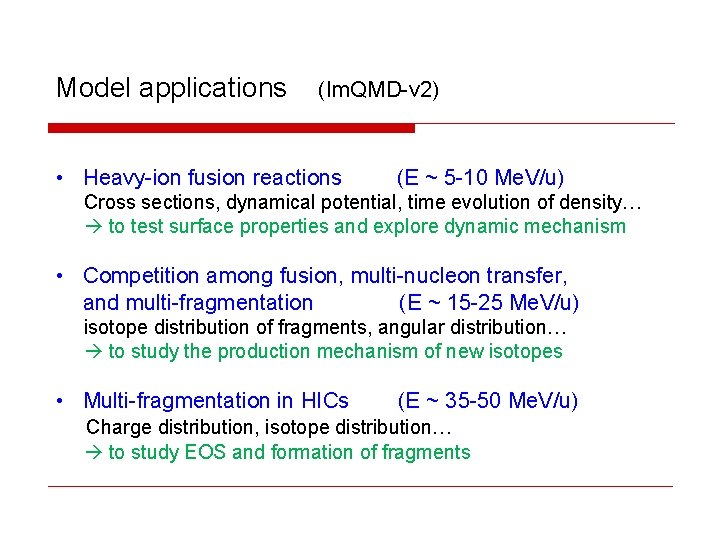
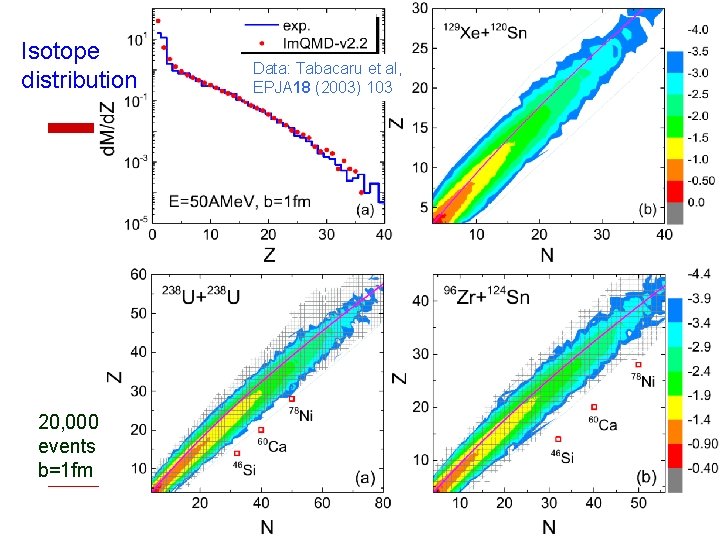
Model applications (Im. QMD-v 2) • Heavy-ion fusion reactions (E ~ 5 -10 Me. V/u) Cross sections, dynamical potential, time evolution of density… to test surface properties and explore dynamic mechanism • Competition among fusion, multi-nucleon transfer, and multi-fragmentation (E ~ 15 -25 Me. V/u) isotope distribution of fragments, angular distribution… to study the production mechanism of new isotopes • Multi-fragmentation in HICs (E ~ 35 -50 Me. V/u) Charge distribution, isotope distribution… to study EOS and formation of fragments
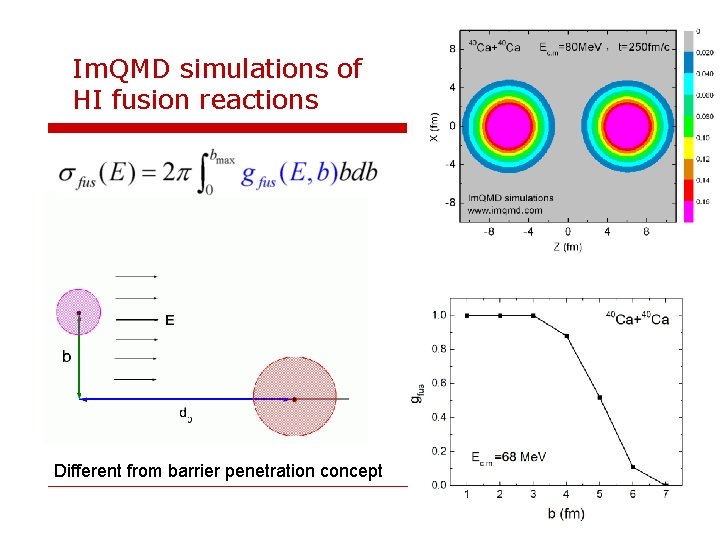
Im. QMD simulations of HI fusion reactions Different from barrier penetration concept
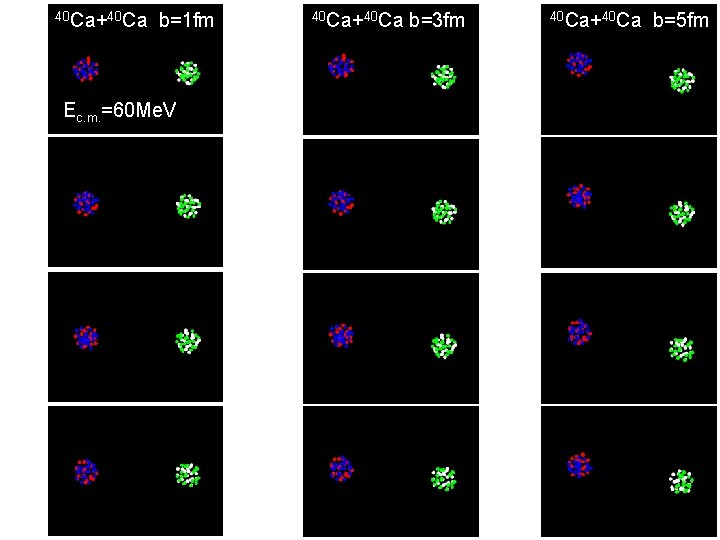
40 Ca+40 Ca b=1 fm Ec. m. =60 Me. V 40 Ca+40 Ca b=3 fm 40 Ca+40 Ca b=5 fm
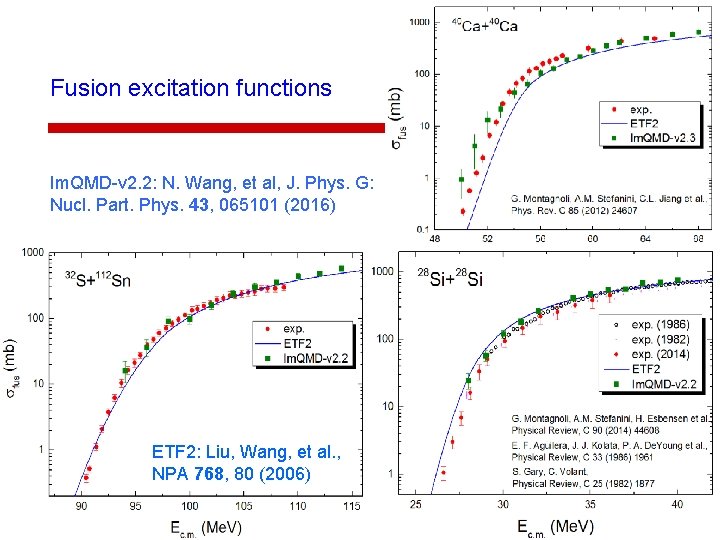
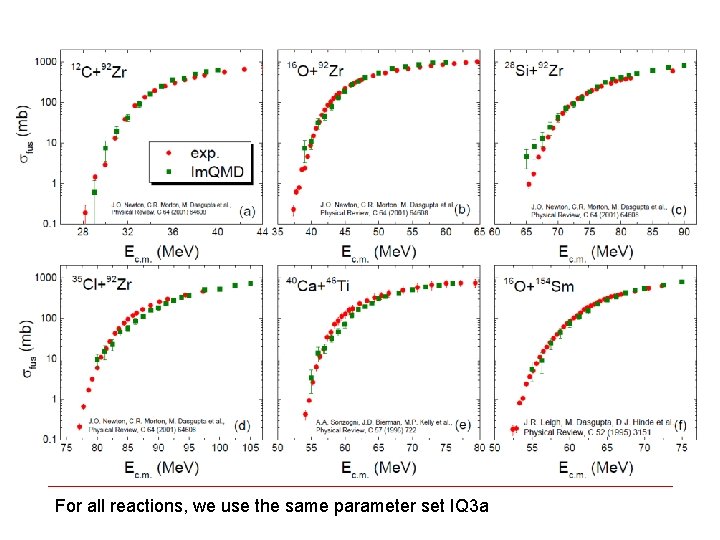
Fusion excitation functions Im. QMD-v 2. 2: N. Wang, et al, J. Phys. G: Nucl. Part. Phys. 43, 065101 (2016) ETF 2: Liu, Wang, et al. , NPA 768, 80 (2006)
For all reactions, we use the same parameter set IQ 3 a
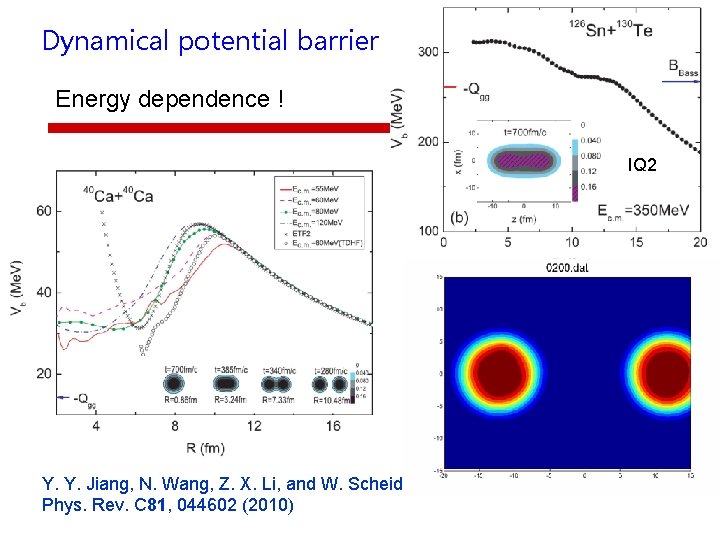
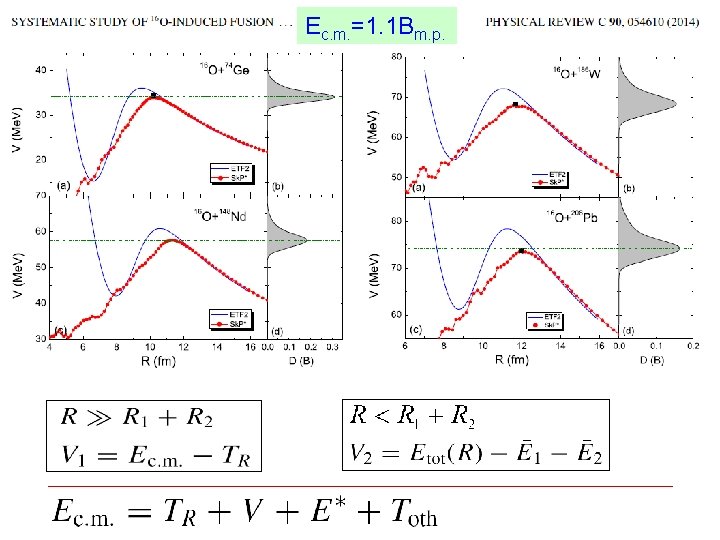
Dynamical potential barrier Energy dependence ! IQ 2 Y. Y. Jiang, N. Wang, Z. X. Li, and W. Scheid, Phys. Rev. C 81, 044602 (2010)
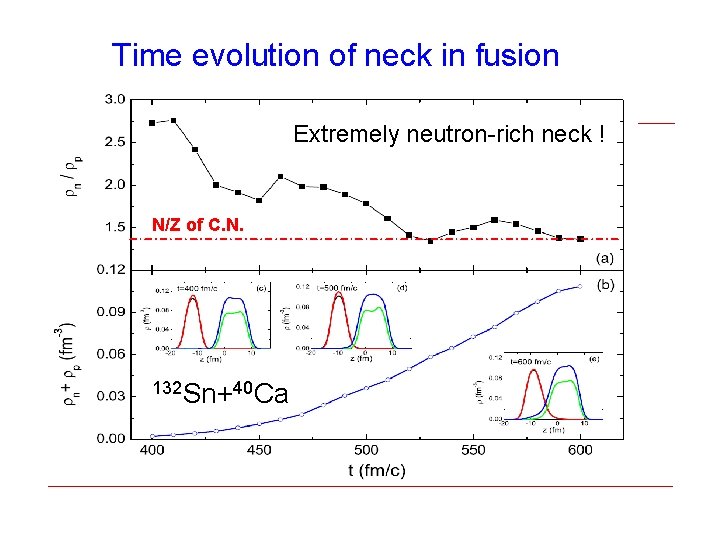
Time evolution of neck in fusion Extremely neutron-rich neck ! N/Z of C. N. 132 Sn+40 Ca
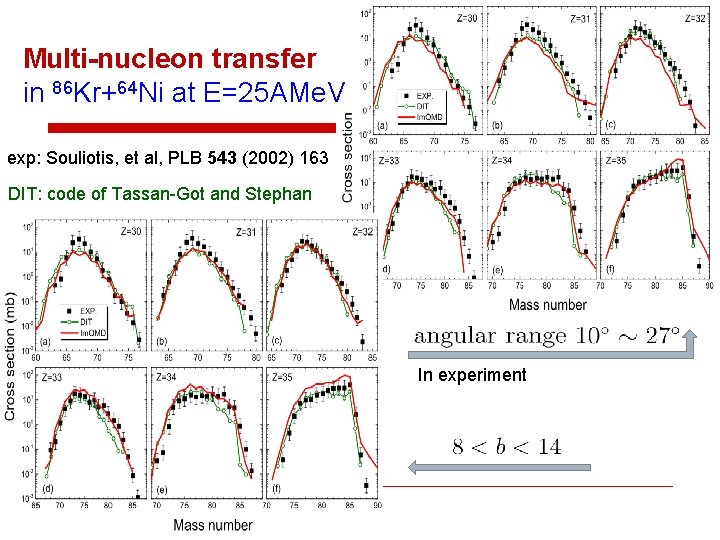
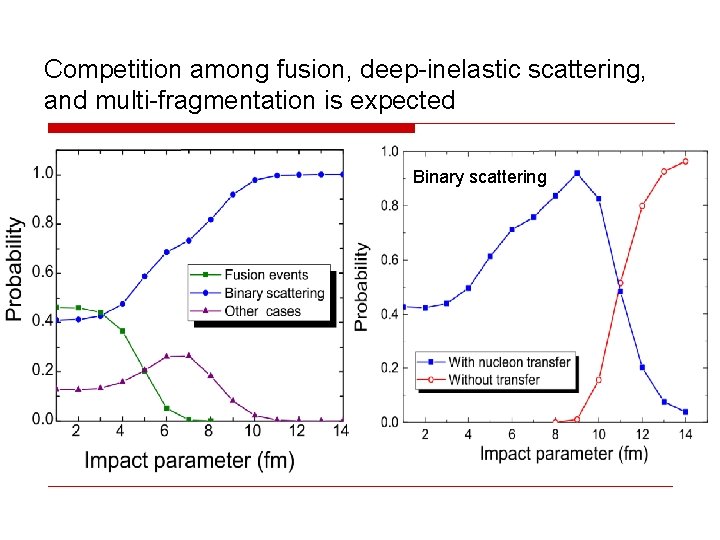
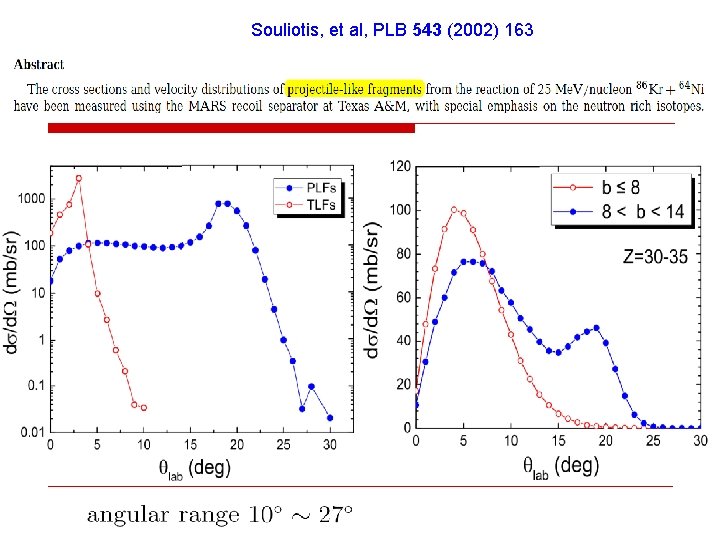
Multi-nucleon transfer in 86 Kr+64 Ni at E=25 AMe. V exp: Souliotis, et al, PLB 543 (2002) 163 DIT: code of Tassan-Got and Stephan In experiment
Competition among fusion, deep-inelastic scattering, and multi-fragmentation is expected Binary scattering
Souliotis, et al, PLB 543 (2002) 163
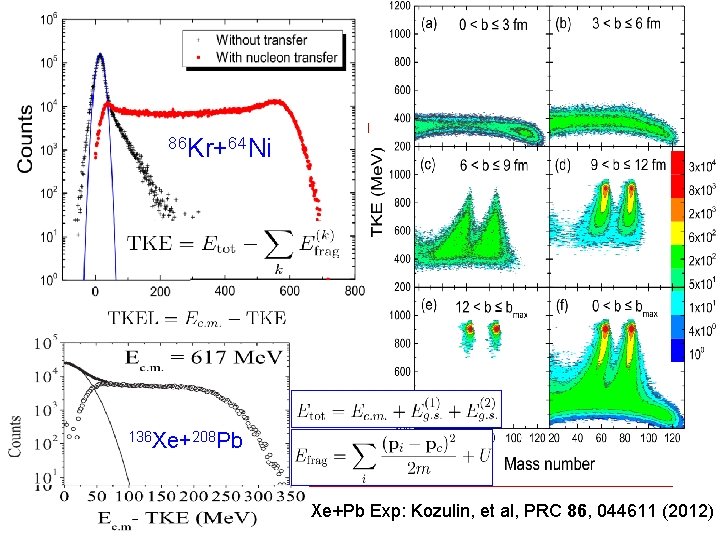
86 Kr+64 Ni 136 Xe+208 Pb Xe+Pb Exp: Kozulin, et al, PRC 86, 044611 (2012)
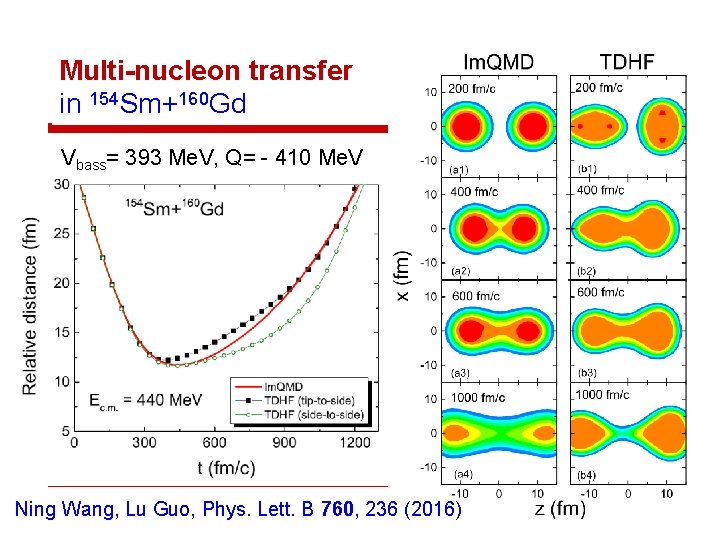
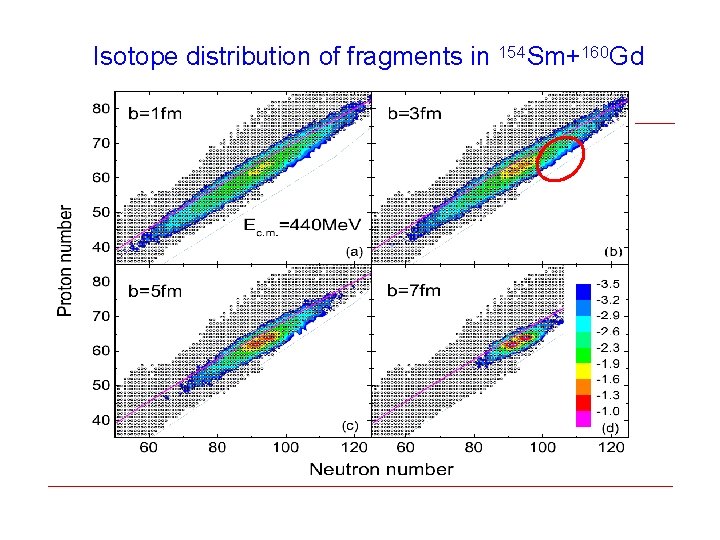
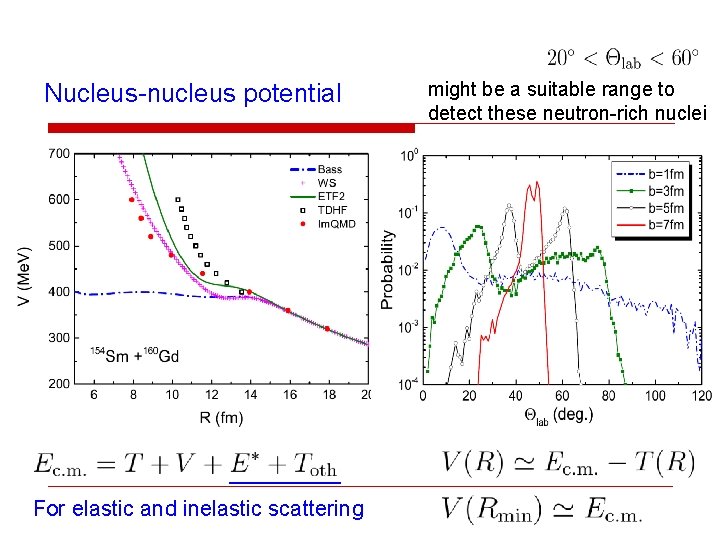
Multi-nucleon transfer in 154 Sm+160 Gd Vbass= 393 Me. V, Q= - 410 Me. V Ning Wang, Lu Guo, Phys. Lett. B 760, 236 (2016)
Isotope distribution of fragments in 154 Sm+160 Gd
p Summary l Heavy-ion fusion reactions at energies above the Coulomb barrier can be reasonably well described with the Im. QMD-v 2. 2 model. l Energy dependence of fusion barrier and neutron-rich neck can be evidently observed in the Im. QMD simulations. l Isotope distributions in multi-nucleon transfer of 86 Kr+64 Ni at 25 AMe. V are well reproduced, and the competition among fusion, multi-nucleon transfer, and multi-fragmentation is observed.
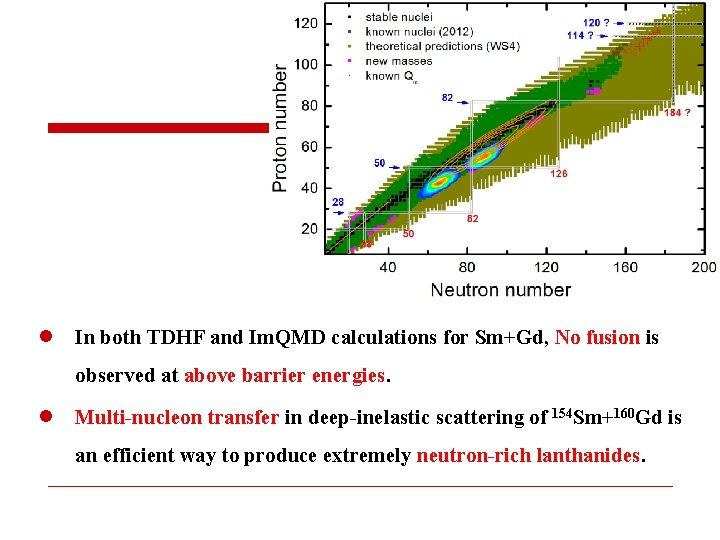
l In both TDHF and Im. QMD calculations for Sm+Gd, No fusion is observed at above barrier energies. l Multi-nucleon transfer in deep-inelastic scattering of 154 Sm+160 Gd is an efficient way to produce extremely neutron-rich lanthanides.
Thank you for your attention Im. QMD Collaborators: • Zhu-Xia Li (CIAE, Beijing) Im. QMD-v 2. 2: www. Im. QMD. com/code • Xi-Zhen Wu (CIAE, Beijing) • Li Ou (GXNU, Guilin) • Ying-Xun Zhang (CIAE, Beijing) TDHF Collaborator: • Kai Zhao (CIAE, Beijing) • Lu Guo (UCAS, Beijing) • Jun-Long Tian (AYNU, Anyang) • Shan-Gui Zhou (ITP-CAS, Beijing) • Zhi-Gang Xiao (Tsinghua U. , Beijing)
backup
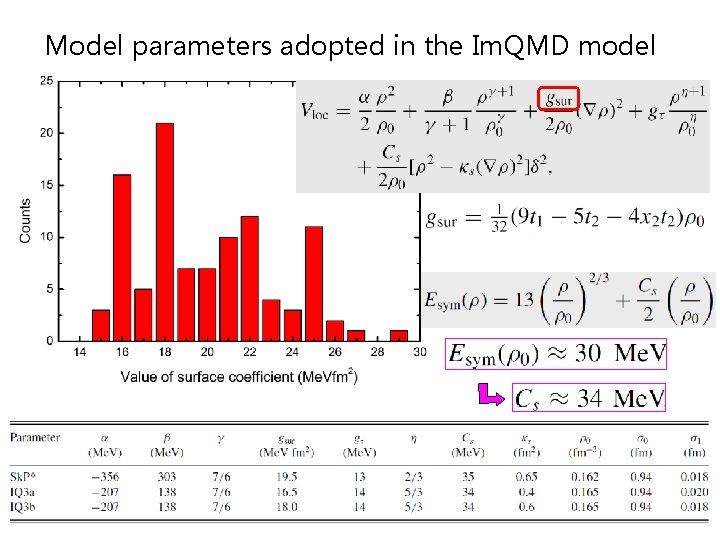
Model parameters adopted in the Im. QMD model
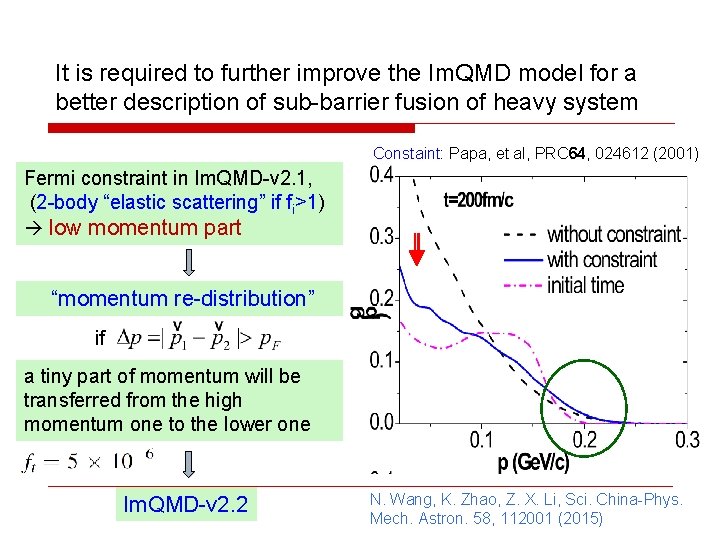
It is required to further improve the Im. QMD model for a better description of sub-barrier fusion of heavy system Constaint: Papa, et al, PRC 64, 024612 (2001) Fermi constraint in Im. QMD-v 2. 1, (2 -body “elastic scattering” if fi>1) low momentum part “momentum re-distribution” if a tiny part of momentum will be transferred from the high momentum one to the lower one Im. QMD-v 2. 2 N. Wang, K. Zhao, Z. X. Li, Sci. China-Phys. Mech. Astron. 58, 112001 (2015)
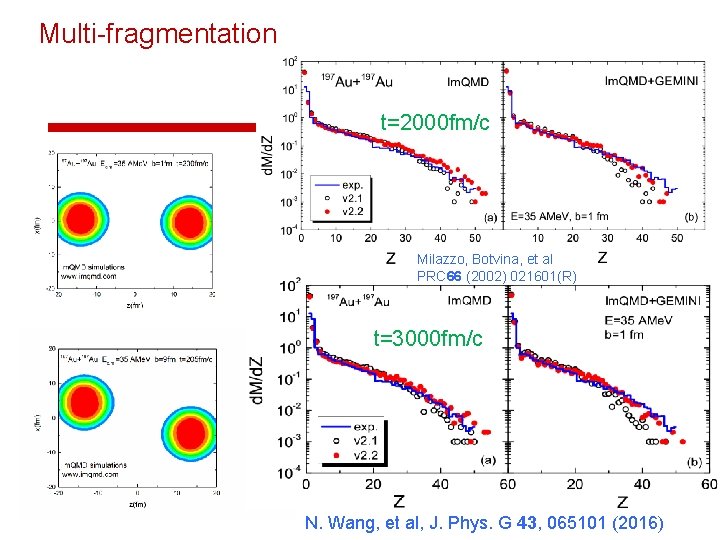
Multi-fragmentation t=2000 fm/c Milazzo, Botvina, et al PRC 66 (2002) 021601(R) t=3000 fm/c N. Wang, et al, J. Phys. G 43, 065101 (2016)
Isotope distribution 20, 000 events b=1 fm Data: Tabacaru et al, EPJA 18 (2003) 103
Ec. m. =1. 1 Bm. p.
Nucleus-nucleus potential For elastic and inelastic scattering might be a suitable range to detect these neutron-rich nuclei