
MICROSCOPIC ANATOMY OF THE BRAIN AND SPINAL CORD
MICROSCOPIC ANATOMY OF THE BRAIN AND SPINAL CORD. • The brain and spinal cord constitute the CNS • The 3 components that make up healthy CNS are • Neurons of different types • Glial cells of various forms, and • Blood vessels bringing nutrients with oxygen and carrying away wastes from the tissue. • there are 3 major functions of CNS • somatosensory system • motor system • homeostasis and higher brain functions • microanatomy of the spinal cord will first be considered, then the brain. 1

Spinal cord (Medulla Spinalis) • this commences below the foremen magnum as a continuation of medulla oblongata, at the upper border of C 1 vertebra • it occupies the 2/3 rd of vertebral canal. • It terminates at L 2 in adults, as conus medullaris • it weighs about 30 g in adults • the length varies between 42 cm in female and 45 cm in male • it has 31 spinal nerves associated with it. Its about 2% of CNS. • its shape is cylindrical in the upper cervical and thoracic segments and oval in shape in the lower cervical and lumbar segments • it has two natural cervical and lumbosacral curvatures for limb innervation 2
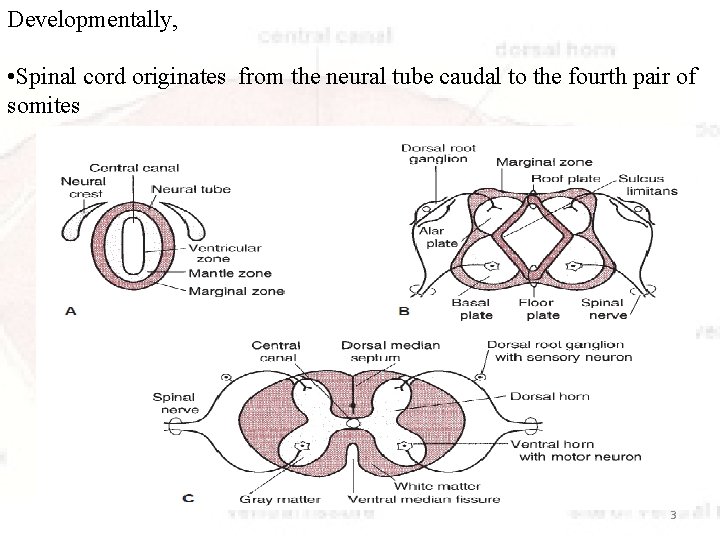
Developmentally, • Spinal cord originates from the neural tube caudal to the fourth pair of somites 3
Layers of the neural tube wall • are formed within the wall of the primitive neural tube. Ventricular zone or Neuroepithelial layer • is the innermost layer of ependymal cells lines the central canal and future brain ventricles. Mantle (intermediate) zone • is the middle layer. • contains neurons and glial cells, the central gray matter of the spinal cord. • forms alar and basal plates separated by sulcus limitans 4
Marginal zone • is the outermost layer. • contains nerve fibers of neuroblasts of the mantle layer and glial cells. • produces the white matter of the spinal cord. Derivatives of Alar and Basal Plates Alar plate • is a dorsolateral thickening of the mantle layer. • gives rise to second order sensory neuroblasts of the dorsal horn of spinal cord to form; • General somatic afferent (GSA); and • General visceral afferent (GVA) cell regions 5
• it also receives axons, which become the dorsal roots, from the dorsal root ganglion. • it enventually becomes the dorsal horn of the spinal cord. Basal plate • is a ventrolateral thickening of the mantle zone • gives rise to the motor neuroblasts of the ventral and lateral horns to form • General somatic efferent (GSE) and • General visceral efferent (GVE) cell regions. • Axons from motor neuroblasts exit the spinal cord and form the ventral roots. • this eventually becomes the ventral horn of the spinal cord. 6
Structurally, • The microanatomy of the spinal cord varies based on the segments of the cord being considered. • More descending and ascending fibres are seen, for example, in cervical region compared to lower sacral region. • some fibres are absent in certain regions. The dorsal spinocerebellar tract appears first at L 2 segment and is not present below this. • The cuneate tract (fasciculus) appears above the T 6 segment and is not present below this segment • Hence, the dorsal intermediate sulcus, which separates the gracile and cuneate tracts only present above T 6 level • 7
Internal Structural Arrangements of the Spinal Cord • Internally, spinal cord has grey matter surrounded by white matter. • In transverse section the grey matter of the spinal cord is a H-shaped or a butterfly shaped mass of neurons. • the grey matter is divisible into a larger ventral mass, the anterior (or ventral) grey column, and a narrow elongated posterior (or dorsal) grey column. • In the thoracic and the sacral parts of the spinal cord, a small lateral projection is seen: lateral grey column. • The grey matter of the right and left halves of the spinal cord is connected across the midline by the grey commissure which is traversed by the central canal 8
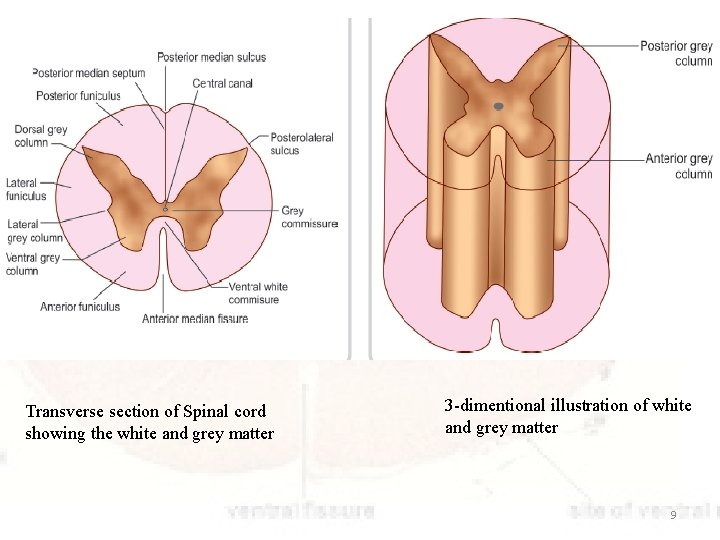
Transverse section of Spinal cord showing the white and grey matter 3 -dimentional illustration of white and grey matter 9
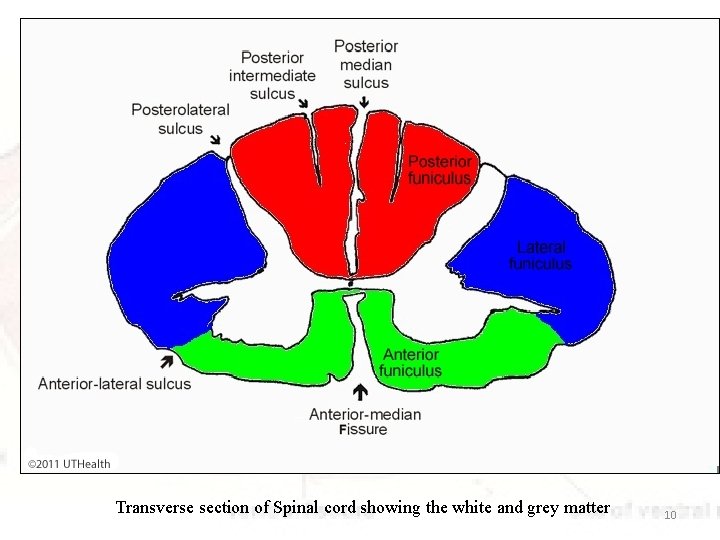
Transverse section of Spinal cord showing the white and grey matter 10

Regional Differences in Spinal Cord 11
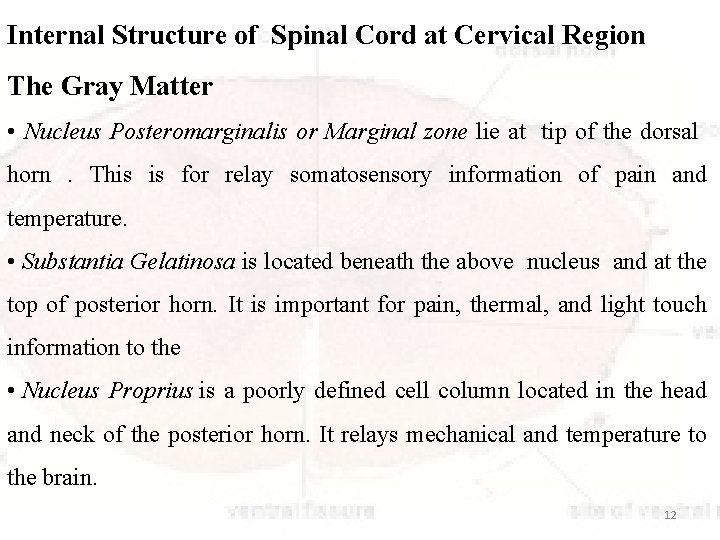
Internal Structure of Spinal Cord at Cervical Region The Gray Matter • Nucleus Posteromarginalis or Marginal zone lie at tip of the dorsal horn. This is for relay somatosensory information of pain and temperature. • Substantia Gelatinosa is located beneath the above nucleus and at the top of posterior horn. It is important for pain, thermal, and light touch information to the • Nucleus Proprius is a poorly defined cell column located in the head and neck of the posterior horn. It relays mechanical and temperature to the brain. 12
• At this level of the spinal cord which above T 1, the lateral horn is absent and no contain autonomic neurons. • However, the anterior horn is highly developed here. The anterior horn contains large α motor neurons and small γ motor neurons whose axons form brachial plexus innervate the upper limb musculature. The White Matter • Posterior Funiculus lies between the posterior median sulcus and the posterior root entry zone at the posterolateral sulcus. • Above T 6 the posterior funiculus is subdivided by the posterior intermediate sulcus into the fasciculus gracilis medially and the fasciculus cuneatus laterally. 13
• the sensory information from segments below T 6 travels in the fasciculus gracilis and that above T 6 moves in fasciculus cuneatus • The funiculus of posterior root ganglion cells contains fibres that innervate sensory receptors in the skin and deep tissues of the body. • Lateral Funiculus lies between the anterolateral and posterolateral sulci. • The lateral funiculus contains both ascending and descending nerve fiber tracts. • Anterior Funiculus lies between the anterior grey column and the anterior median fissure. • Anterior funiculus also contains both ascending and descending nerve fiber tracts. 14
At the Thoracic Region The Gray Matter • The Nucleus Posteromarginalis, Substantia Gelatinosa, Nucleus Proprius are present throughout the length of the cord • In addition to above nuclei, there is Dorsal Nucleus Of Clarke which is only present at spinal cord levels C 8 through L 3. • It lies in the neck and base of the posterior horn. It relays unconscious proprioceptive sensations up the neuroaxis. • The Lateral Grey Horn of the intermediate gray is well developed at thoracic and upper lumbar levels (T 1 - L 3) • it contains autonomic neurons of the spinal sympathetic system. 15
• The anterior horn is much reduced in size in comparison to the cervical segment. • the anterior horns of upper thoracic (T 2 - T 8) segments are smaller than the lower ones as they supply only axial musculature. • However, Lower thoracic (T 9 - T 12) segments have larger anterior horns as they supply back masculature, intercostals and abdominal musculature. The White Matter The posterior funiculus is divided by the posterior intermediate sulcus at levels above T 6 into the fasciculus gracilis and the fasciculus cuneatus. Below T 6, the posterior funiculus consists only of the fasciculus gracilis. 16
• Collaterals of posterior root ganglion axons ascend and descend the spinal cord in the tract of Lissauer. • Intersegmental association cord cells send their axons in the fasciculus proprius to cord neurons in lower or higher segments. The fasciculus proprius (propriospinal tract) forms a thin shell of fibers around the gray matter. At Lumbar Region • there is curvature on this region • the grey matter here is similar to cervical region especially the anterior grey horn which are large for innervation of lower limbs • the white matter here is smaller in size as fewer fibres are seen 17
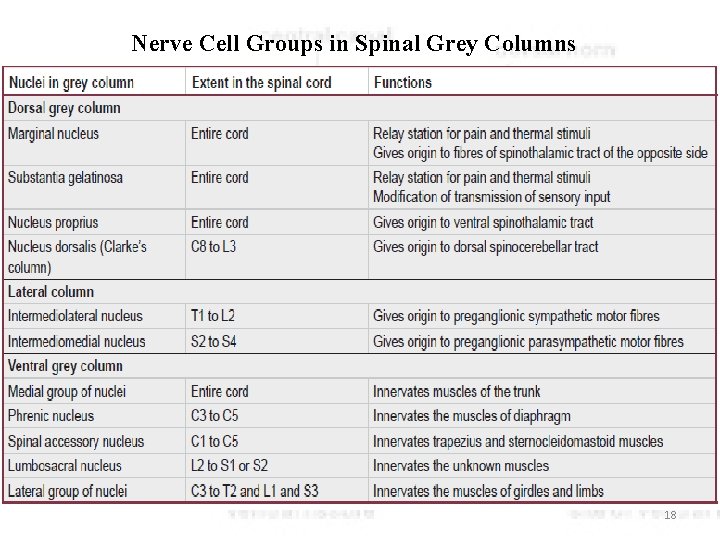
Nerve Cell Groups in Spinal Grey Columns 18
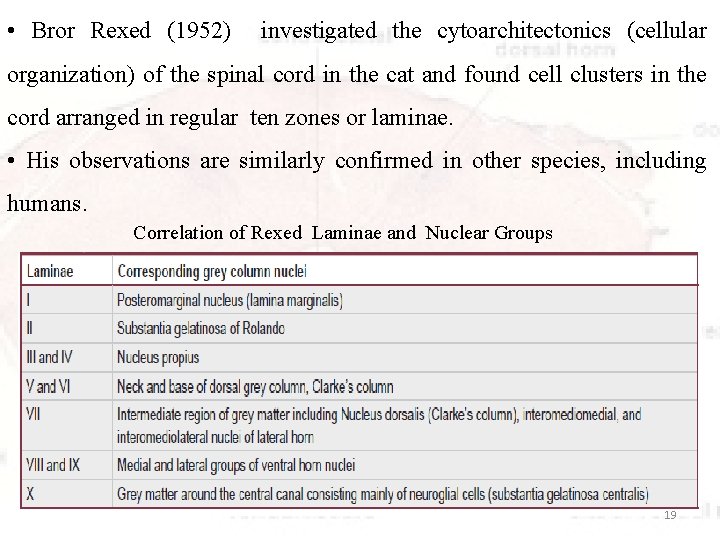
• Bror Rexed (1952) investigated the cytoarchitectonics (cellular organization) of the spinal cord in the cat and found cell clusters in the cord arranged in regular ten zones or laminae. • His observations are similarly confirmed in other species, including humans. Correlation of Rexed Laminae and Nuclear Groups 19
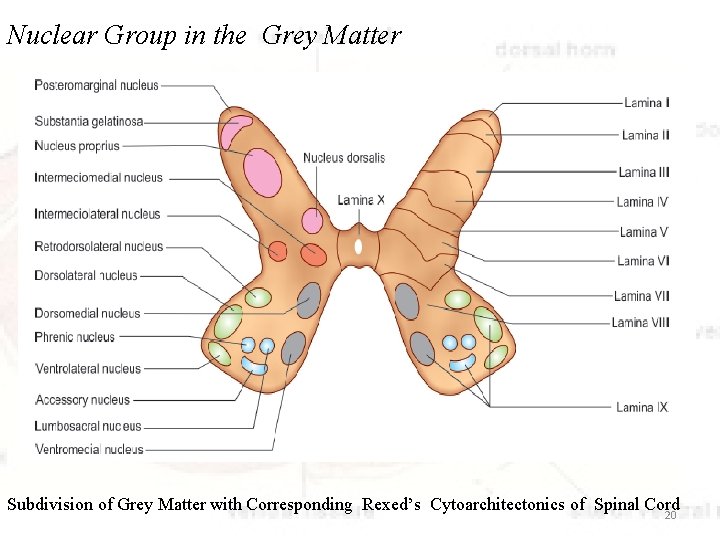
Nuclear Group in the Grey Matter Subdivision of Grey Matter with Corresponding Rexed’s Cytoarchitectonics of Spinal Cord 20
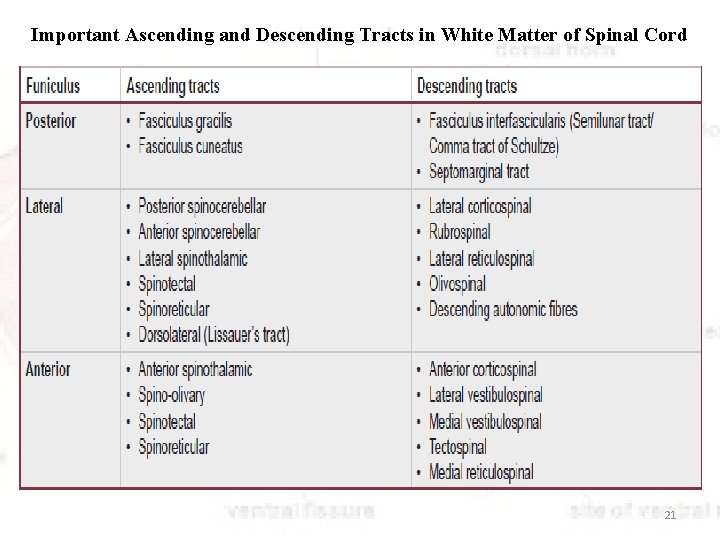
Important Ascending and Descending Tracts in White Matter of Spinal Cord 21
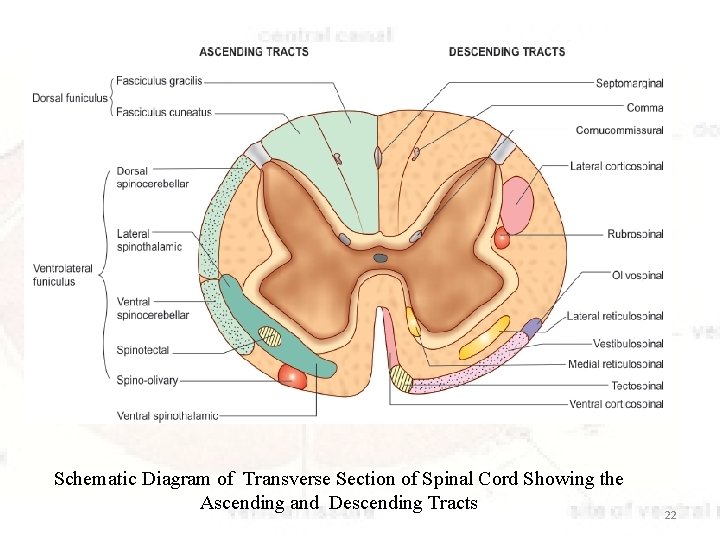
Schematic Diagram of Transverse Section of Spinal Cord Showing the Ascending and Descending Tracts 22
Clinical Importance of Spinal Cord Motor Lesions • Upper motor neuron lesion • caused by lesion to pyramidal tract • Xtised by • hypertonia, spasticity, hyperreflexia, slight muscle wasting • Lower motor neuron lesion • xterised by • flaccid paresis or paralysis, hyporeflexia, muscle atrophy, hypotonia or atonia 23
Sensory Lesions • Disruption of ascending pathways results; • Total loss of sensory perception is anesthesia • Reduced perception of touch is hypoesthesia; • Reduced perception of pain is hypoalgesia. • Increased perception of touch is hyperesthesia. • Abnormal sensations are referred to as paresthesias other lesions Referred pain • pain from a diseased viscus may be felt on the skin or part of the body wall supplied by the same spinal segments innervating the viscus 24
• Pain from diaphragm or diaphragmatic pleura is referred to the shoulder (C 4). • Referred pain from heart is felt at the lower cervical and upper thoracic segments. It is felt in the chest wall and along the medial side of the left arm (T 1 to T 2). It may also be referred to the neck or jaw. • Referred pain from the stomach is felt in the epigastrium (T 7 to T 9) • Referred pain from the small intestines is felt in the epigastrium and around the umbilicus (T 7 to T 10). • Pain from the appendix is felt in the umbilical region (T 10). • Large intestinal pain is referred to umbilical and hypogastric region (T 10 to L 1). 25
• Pain from the gall bladder is referred to the epigastrium. It may also be referred to the back just below the inferior angle of the right scapula (T 7). • Pain from uterus is felt at hypogastrium and inner border of thigh (L 1, L 2). • Pain from cervix and pelvic viscera are felt in low back (S 2 to S 4). • Pain arising in the area of distribution of one division of the trigeminal nerve may be referred along other branches of the same division, or even along branches of other divisions 26
Herpes zoster • Herpes virus can affect dorsal root ganglia. Vesicles appear on the skin over the area of distribution of the nerve (dermatone). The condition is called as herpes zoster (shingles) and can be very painful. • Trauma, e. g. vertebral fracture, prolapsed intervertebral disc which may lead to complete transection of the cord or hemisection of the cord (Brown-Sequard syndrome) 27
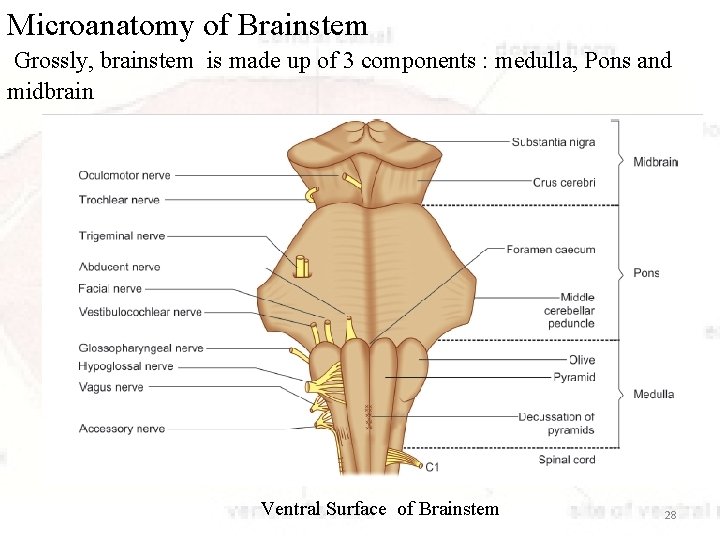
Microanatomy of Brainstem Grossly, brainstem is made up of 3 components : medulla, Pons and midbrain Ventral Surface of Brainstem 28
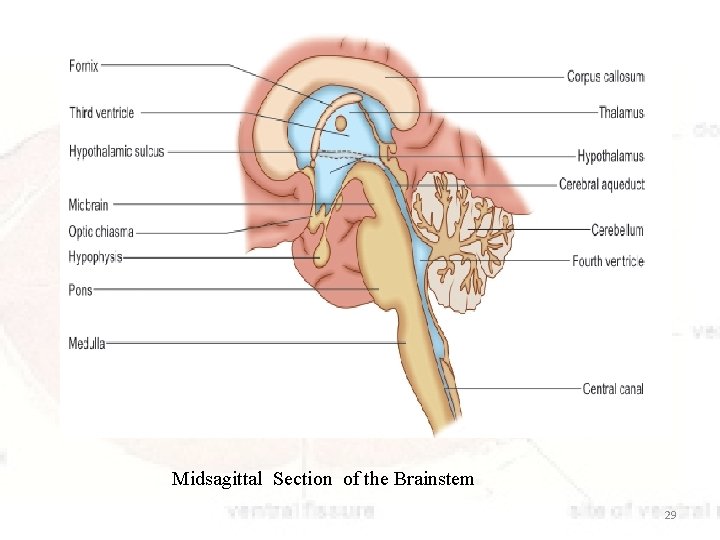
Midsagittal Section of the Brainstem 29
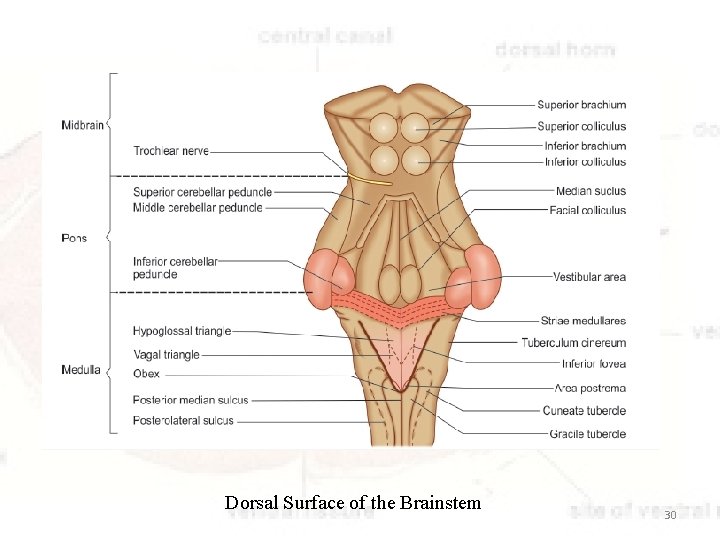
Dorsal Surface of the Brainstem 30
- Slides: 30