
Microscopes Light microscope Depth of field small Magnification

- Slides: 10
Microscopes Light microscope Depth of field: small
Magnification • Uses lenses arranged in series, made of optical material that bends light. All magnification takes place via lenses. Uses diascopic illumination (that is, light is transmitted through the specimen). Magnification up to about 1000 x.
Light Microscope • Uses: Pathology, microbiology, forensics, education • Advantages: Color viewing. Require no electricity except for the light source. Can be used on living samples. Simple models are relatively common and inexpensive. • Disadvantages: Usually requires prepared slides and cannot examine objects well in 3 dimensions.
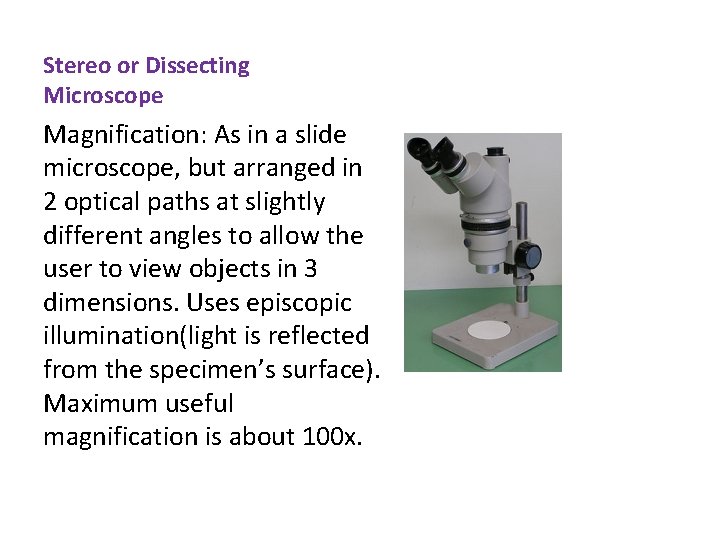
Stereo or Dissecting Microscope Magnification: As in a slide microscope, but arranged in 2 optical paths at slightly different angles to allow the user to view objects in 3 dimensions. Uses episcopic illumination(light is reflected from the specimen’s surface). Maximum useful magnification is about 100 x.
Stereo or Dissecting Microscope • Depth of field: Large • Uses: Microsurgery, fine repair, dissection, paleontology, quality control, sorting, forensics. • Advantages: Color viewing. Can be used on living samples. Requires little or no preparation of the sample. • Disadvantages: Low magnification
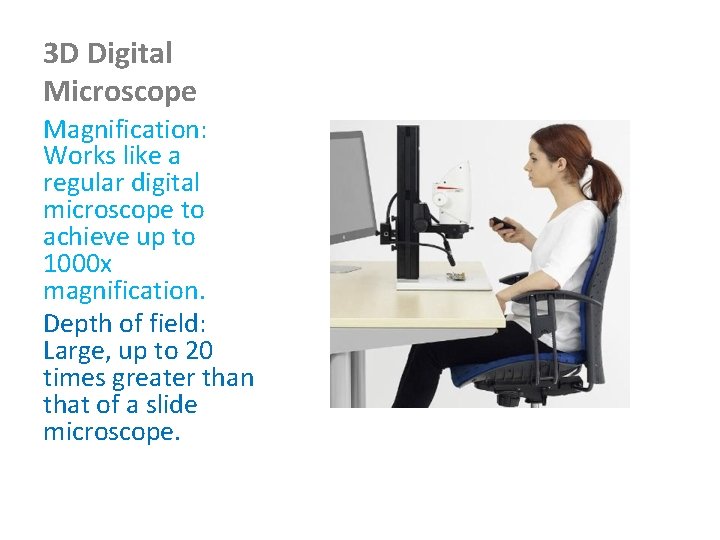
3 D Digital Microscope Magnification: Works like a regular digital microscope to achieve up to 1000 x magnification. Depth of field: Large, up to 20 times greater than that of a slide microscope.
3 D Digital Microscope Advantages: Object can be viewed from almost any angle and its 3 dimensional features can be examined. Disadvantages: As with regular digital microscopes, can be expensive.
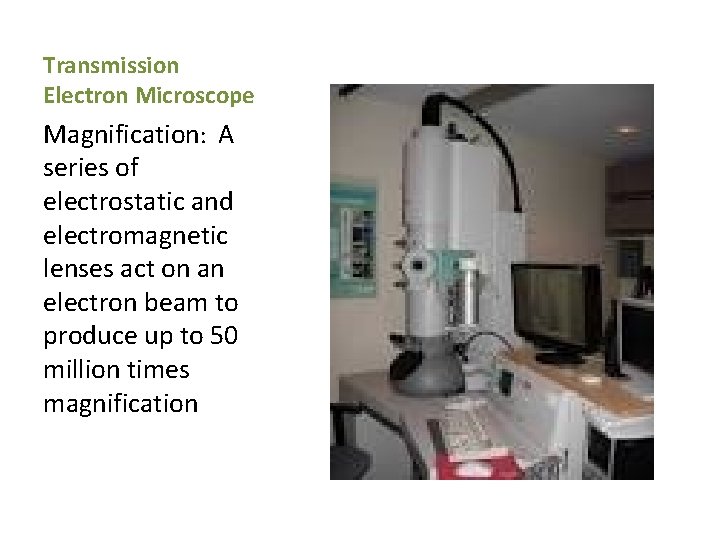
Transmission Electron Microscope Magnification: A series of electrostatic and electromagnetic lenses act on an electron beam to produce up to 50 million times magnification
Transmission Electron Microscope Depth of field: Very small Uses: Microbiology, pathology, crystallography Advantages: Very high resolution Disadvantages: Requires extensive specimen preparation, including staining & sectioning with an ultramicrotome. Cannot observe the surface of objects. Very specialized equipment that requires a partial vacuum.
Scanning Electron Microscope Magnification: Electrostatic & electromagnetic lenses, as with TEM. Magnification ranges from 25 x to 250, 000 x. Depth of field: Large compared to that of TEM Uses: Biology, microbiology, geology, nanotechnology, crystallography Advantages: Can view objects’ 3 dimensional surface. Disadvantages: As with TEM, requires specialized equipment and a partial vacuum. Cannot be used on living specimens.