
MICROQUASARS JETS FROM BINARY SYSTEMS TO THE INTERSTELLAR
MICROQUASARS JETS: FROM BINARY SYSTEMS TO THE INTERSTELLAR MEDIUM (Multi- observations of MICROQUASARS and high energy neutrinos prospects) Yaël Fuchs Service d’Astrophysique, CEA/Saclay (France)
PLAN I. Introduction to microquasars II. The X-ray binary systems 1. 2. III. Different binary systems Variability: light curves, changes in states The different types of jets 1. Compacts jets 2. Isolated and superluminal ejections 3. Large scale jets: interaction with the surrounding medium ex: SS 433/W 50 and XTE J 1550 -564 4. Comparison to extragalactic jets 5. Microblazars: candidates IV. Microquasars: sources of Te. V Neutrinos ? V. Conclusion
I. Introduction to Microquasars
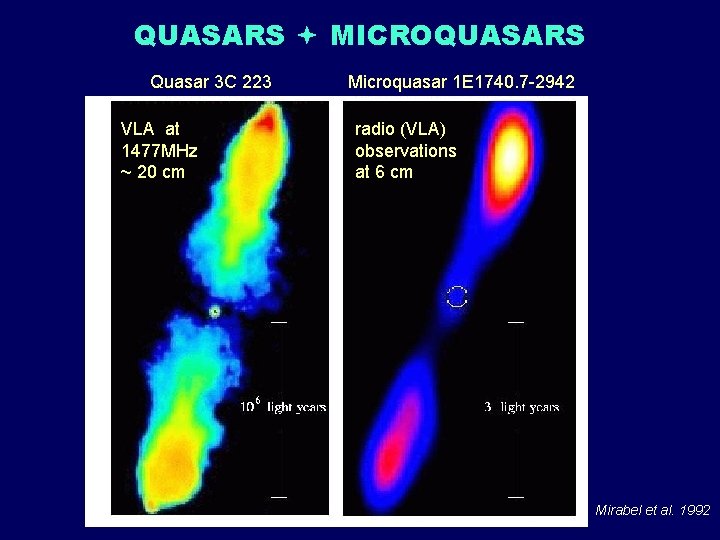
QUASARS MICROQUASARS Quasar 3 C 223 VLA at 1477 MHz ~ 20 cm Microquasar 1 E 1740. 7 -2942 radio (VLA) observations at 6 cm Mirabel et al. 1992
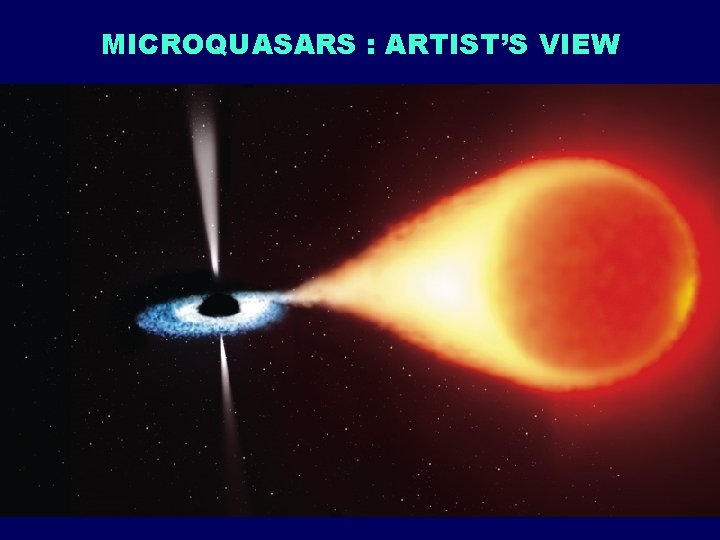
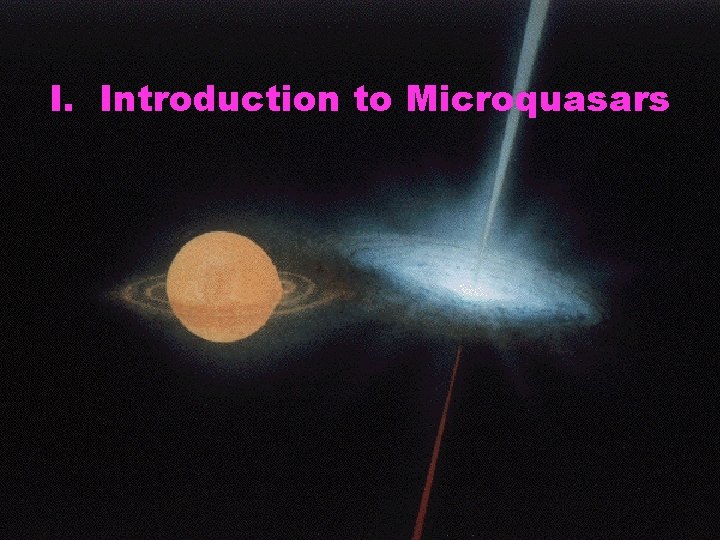
MICROQUASARS : ARTIST’S VIEW
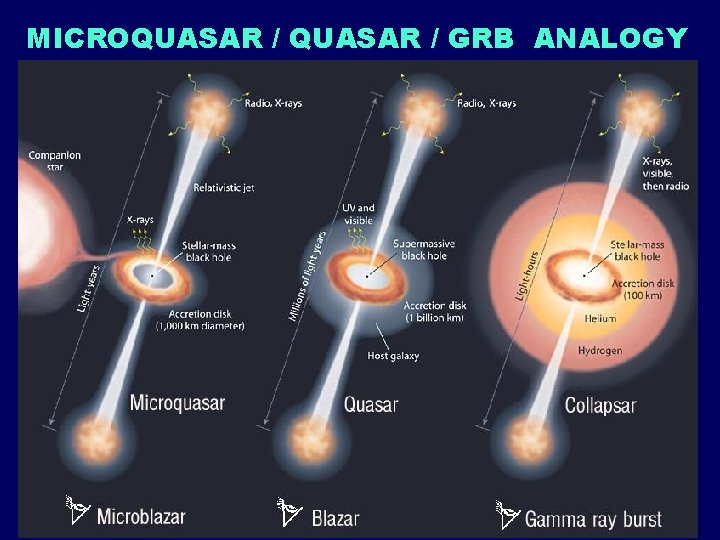
MICROQUASAR / GRB ANALOGY
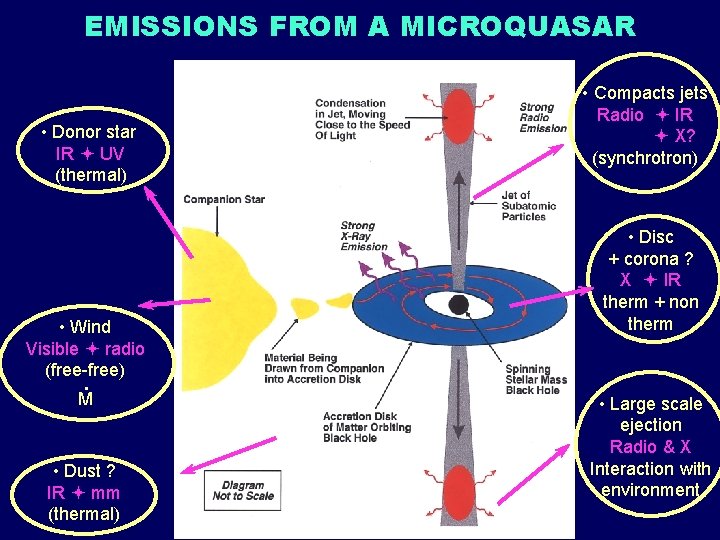
EMISSIONS FROM A MICROQUASAR • Donor star IR UV (thermal) • Wind Visible radio (free-free) • M • Dust ? IR mm (thermal) • Compacts jets Radio IR X? (synchrotron) • Disc + corona ? X IR therm + non therm • Large scale ejection Radio & X Interaction with environment
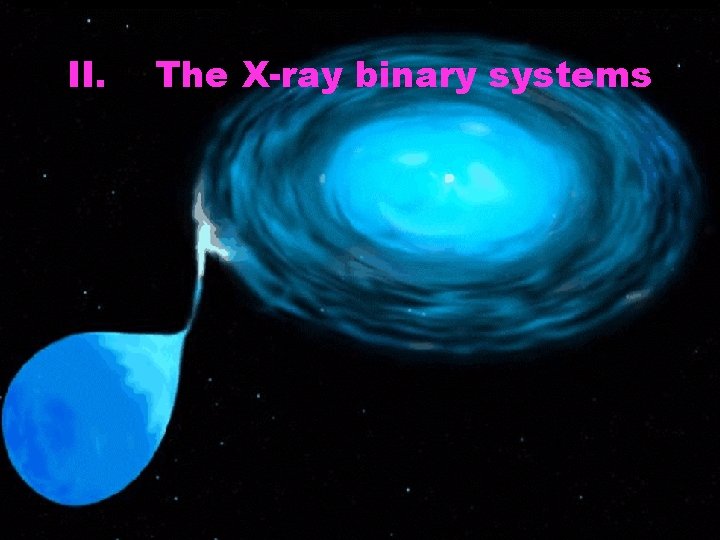
II. The X-ray binary systems
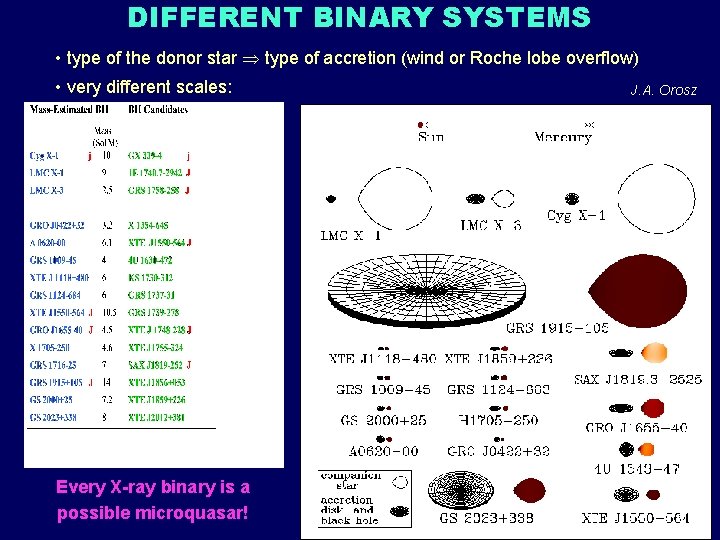
DIFFERENT BINARY SYSTEMS • type of the donor star type of accretion (wind or Roche lobe overflow) • very different scales: Every X-ray binary is a possible microquasar! J. A. Orosz
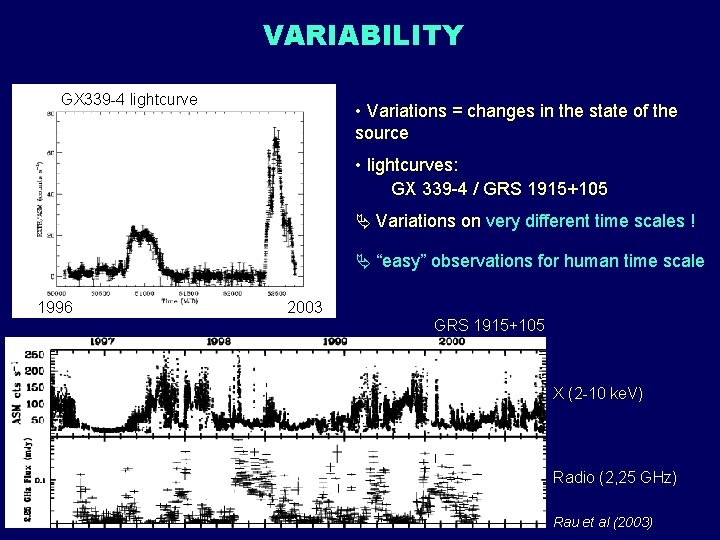
VARIABILITY GX 339 -4 lightcurve • Variations = changes in the state of the source • lightcurves: GX 339 -4 / GRS 1915+105 Variations on very different time scales ! “easy” observations for human time scale 1996 2003 GRS 1915+105 X (2 -10 ke. V) Radio (2, 25 GHz) Rau et al (2003)
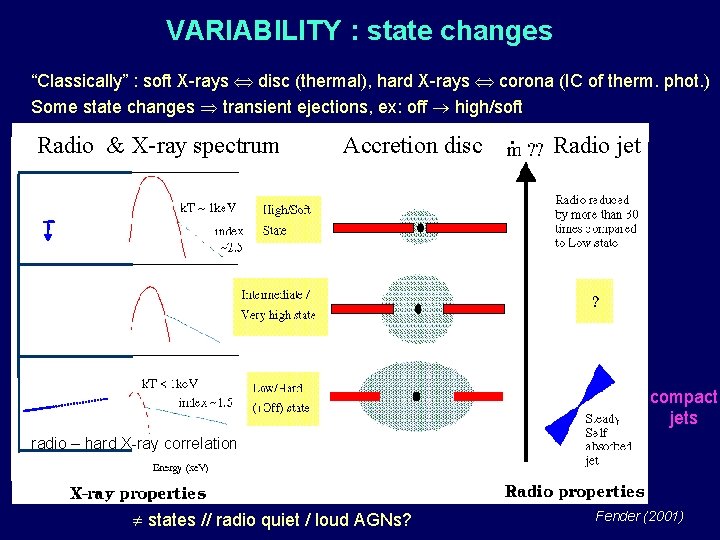
VARIABILITY : state changes “Classically” : soft X-rays disc (thermal), hard X-rays corona (IC of therm. phot. ) Some state changes transient ejections, ex: off high/soft Radio & X-ray spectrum Accretion disc • Radio jet compact jets radio – hard X-ray correlation states // radio quiet / loud AGNs? Fender (2001)
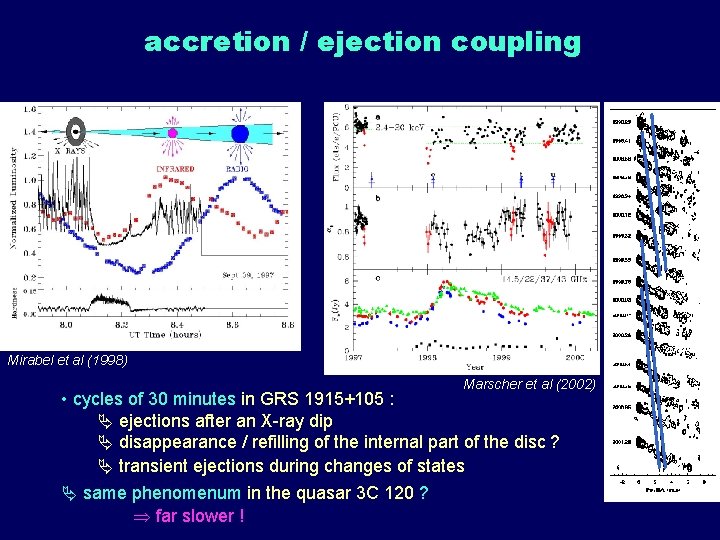
accretion / ejection coupling Mirabel et al (1998) Marscher et al (2002) • cycles of 30 minutes in GRS 1915+105 : ejections after an X-ray dip disappearance / refilling of the internal part of the disc ? transient ejections during changes of states same phenomenum in the quasar 3 C 120 ? far slower !
III. The different types of jets
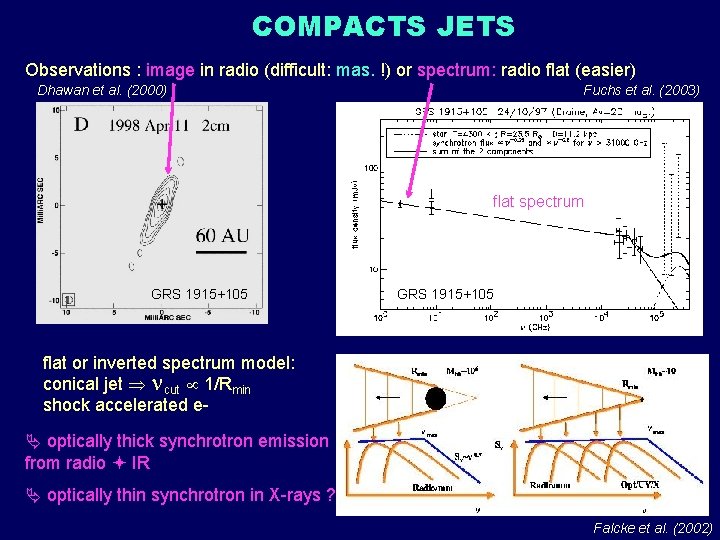
COMPACTS JETS Observations : image in radio (difficult: mas. !) or spectrum: radio flat (easier) Dhawan et al. (2000) Fuchs et al. (2003) flat spectrum GRS 1915+105 flat or inverted spectrum model: conical jet cut 1/Rmin shock accelerated e- optically thick synchrotron emission from radio IR optically thin synchrotron in X-rays ? Falcke et al. (2002)
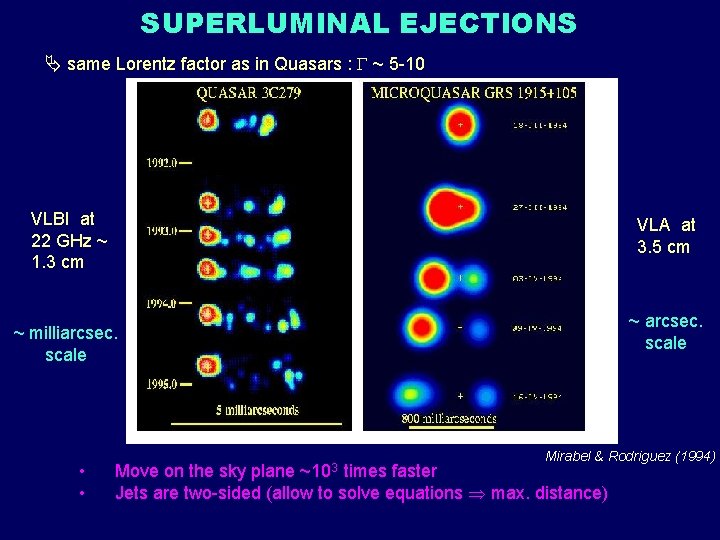
SUPERLUMINAL EJECTIONS same Lorentz factor as in Quasars : ~ 5 -10 VLBI at 22 GHz ~ 1. 3 cm VLA at 3. 5 cm ~ arcsec. scale ~ milliarcsec. scale • • ~103 Mirabel & Rodriguez (1994) Move on the sky plane times faster Jets are two-sided (allow to solve equations max. distance)
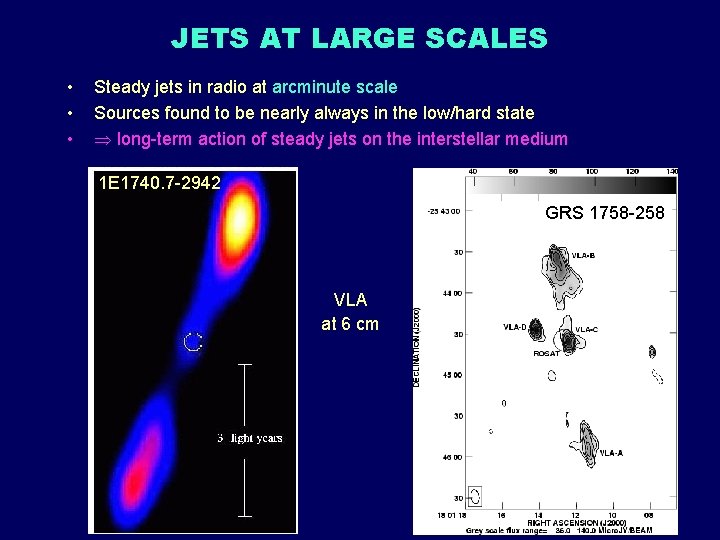
JETS AT LARGE SCALES • • • Steady jets in radio at arcminute scale Sources found to be nearly always in the low/hard state long-term action of steady jets on the interstellar medium 1 E 1740. 7 -2942 GRS 1758 -258 VLA at 6 cm
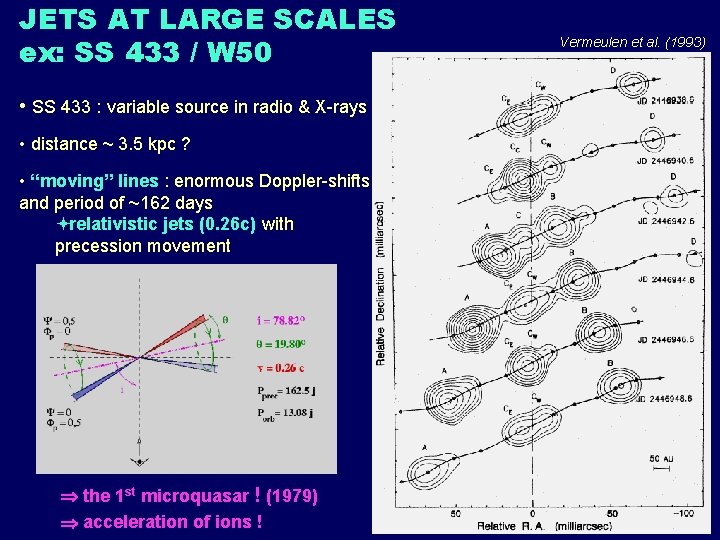
JETS AT LARGE SCALES ex: SS 433 / W 50 • SS 433 : variable source in radio & X-rays • distance ~ 3. 5 kpc ? • “moving” lines : enormous Doppler-shifts and period of ~162 days relativistic jets (0. 26 c) with precession movement the 1 st microquasar ! (1979) acceleration of ions ! Vermeulen et al. (1993)
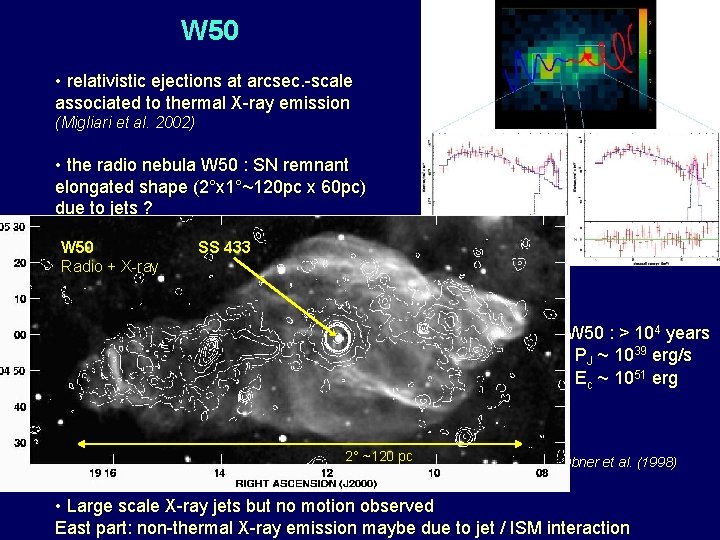
W 50 • relativistic ejections at arcsec. -scale associated to thermal X-ray emission (Migliari et al. 2002) • the radio nebula W 50 : SN remnant elongated shape (2°x 1°~120 pc x 60 pc) due to jets ? W 50 Radio + X-ray SS 433 • W 50 : > 104 years PJ ~ 1039 erg/s Ec ~ 1051 erg 2° ~120 pc Dubner et al. (1998) • Large scale X-ray jets but no motion observed East part: non-thermal X-ray emission maybe due to jet / ISM interaction
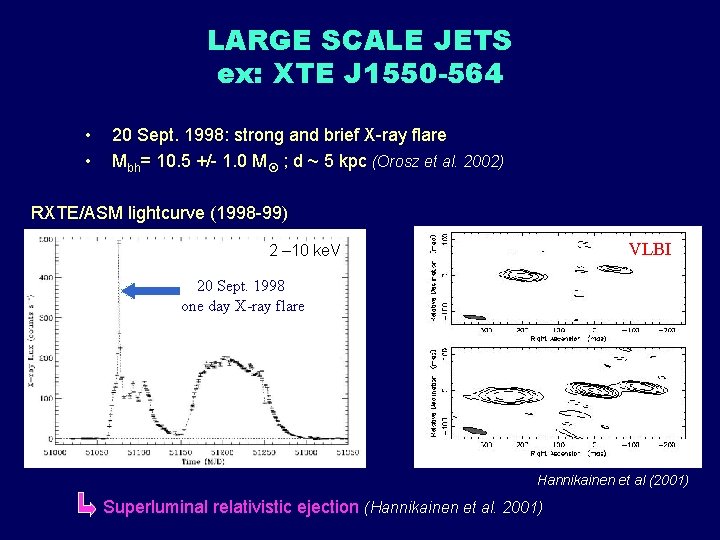
LARGE SCALE JETS ex: XTE J 1550 -564 • • 20 Sept. 1998: strong and brief X-ray flare Mbh= 10. 5 +/- 1. 0 M ; d ~ 5 kpc (Orosz et al. 2002) RXTE/ASM lightcurve (1998 -99) VLBI 2 – 10 ke. V 20 Sept. 1998 one day X-ray flare Hannikainen et al (2001) Superluminal relativistic ejection (Hannikainen et al. 2001)
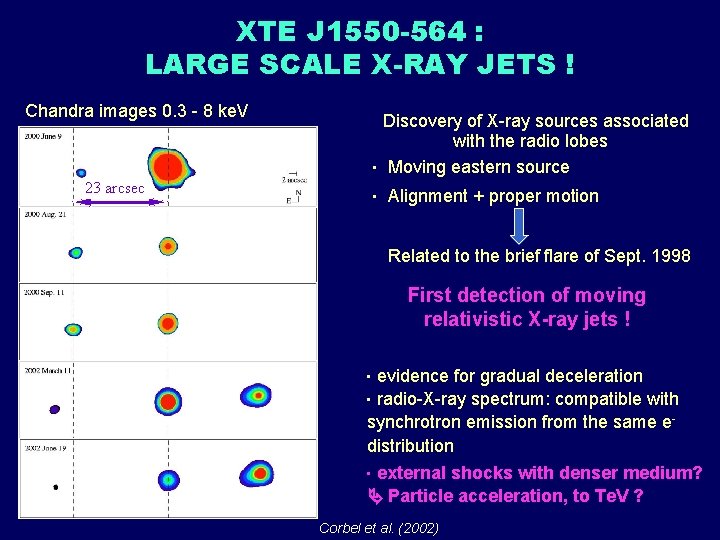
XTE J 1550 -564 : LARGE SCALE X-RAY JETS ! Chandra images 0. 3 - 8 ke. V Discovery of X-ray sources associated with the radio lobes • Moving eastern source 23 arcsec • Alignment + proper motion Related to the brief flare of Sept. 1998 First detection of moving relativistic X-ray jets ! evidence for gradual deceleration • radio-X-ray spectrum: compatible with synchrotron emission from the same edistribution • external shocks with denser medium? Particle acceleration, to Te. V ? • Corbel et al. (2002)
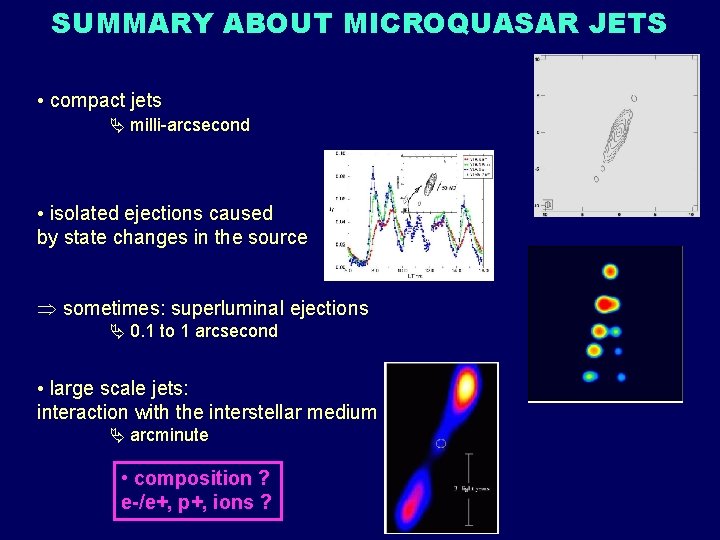
SUMMARY ABOUT MICROQUASAR JETS • compact jets milli-arcsecond • isolated ejections caused by state changes in the source sometimes: superluminal ejections 0. 1 to 1 arcsecond • large scale jets: interaction with the interstellar medium arcminute • composition ? e-/e+, p+, ions ?
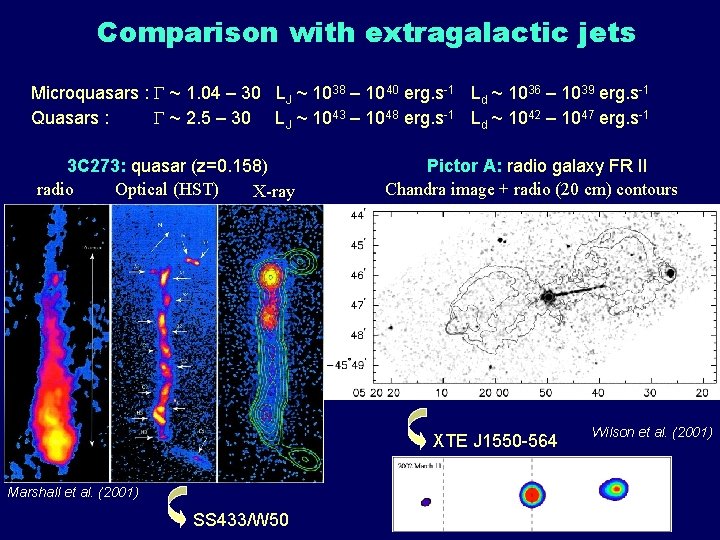
Comparison with extragalactic jets Microquasars : ~ 1. 04 – 30 LJ ~ 1038 – 1040 erg. s-1 Ld ~ 1036 – 1039 erg. s-1 Quasars : ~ 2. 5 – 30 LJ ~ 1043 – 1048 erg. s-1 Ld ~ 1042 – 1047 erg. s-1 3 C 273: quasar (z=0. 158) radio Optical (HST) X-ray Pictor A: radio galaxy FR II Chandra image + radio (20 cm) contours XTE J 1550 -564 Marshall et al. (2001) SS 433/W 50 Wilson et al. (2001)
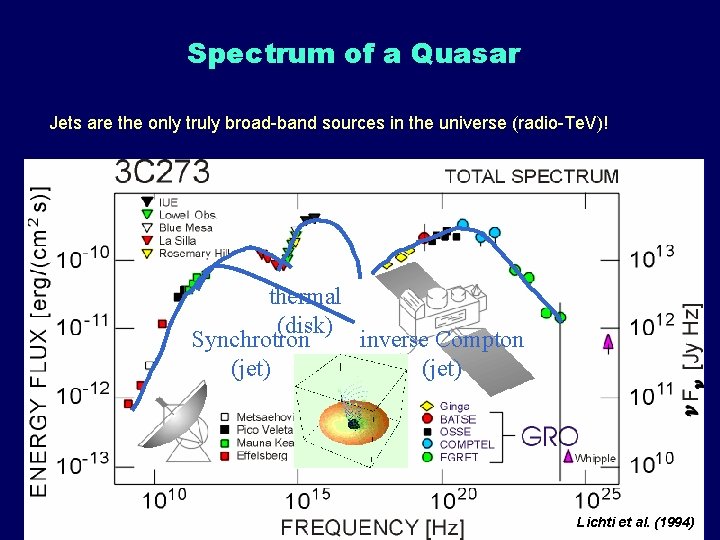
Spectrum of a Quasar Jets are the only truly broad-band sources in the universe (radio-Te. V)! thermal (disk) Synchrotron inverse Compton (jet) Lichti et al. (1994)
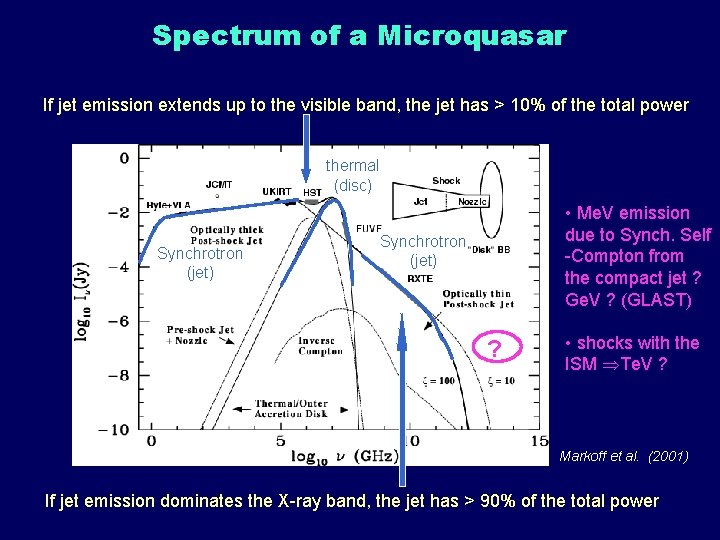
Spectrum of a Microquasar If jet emission extends up to the visible band, the jet has > 10% of the total power thermal (disc) Synchrotron (jet) • Me. V emission due to Synch. Self -Compton from the compact jet ? Ge. V ? (GLAST) Synchrotron (jet) ? • shocks with the ISM Te. V ? Markoff et al. (2001) If jet emission dominates the X-ray band, the jet has > 90% of the total power
MICROBLAZARS • Microblazars = sources with viewing angle < 10°: - time scales lowered by 2 2 - flux density increased by 8 3 intense et rapid variations CANDIDATES: • ULXs ? ex: first radio counterpart of an ULX in the NGC 5408 galaxy • galactic sources? Cyg X-1: gamma-ray flares observed in this region in 2002 V 4641 Sgr: rapid optical flares high mass X-ray binaries + jet sources interaction of jet with UV photon field from the donor star inverse Compton • EGRET unidentified sources ? (LS 5039)

IV. Microquasars: sources of Te. V Neutrinos ?
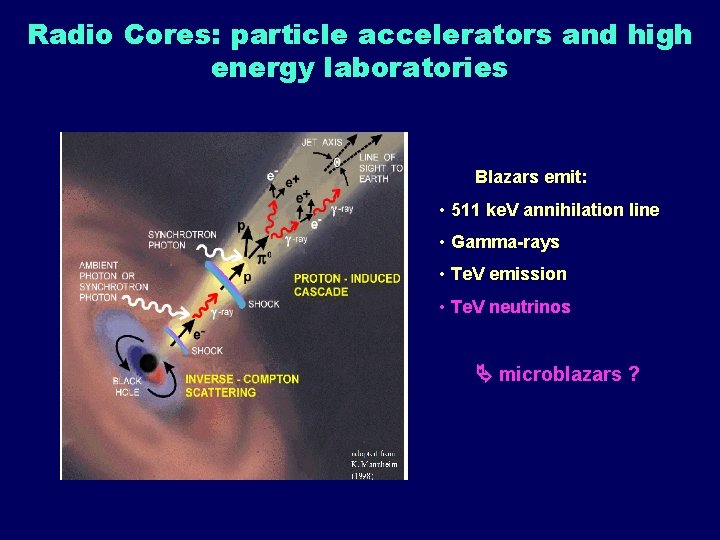
Radio Cores: particle accelerators and high energy laboratories Blazars emit: • 511 ke. V annihilation line • Gamma-rays • Te. V emission • Te. V neutrinos microblazars ?
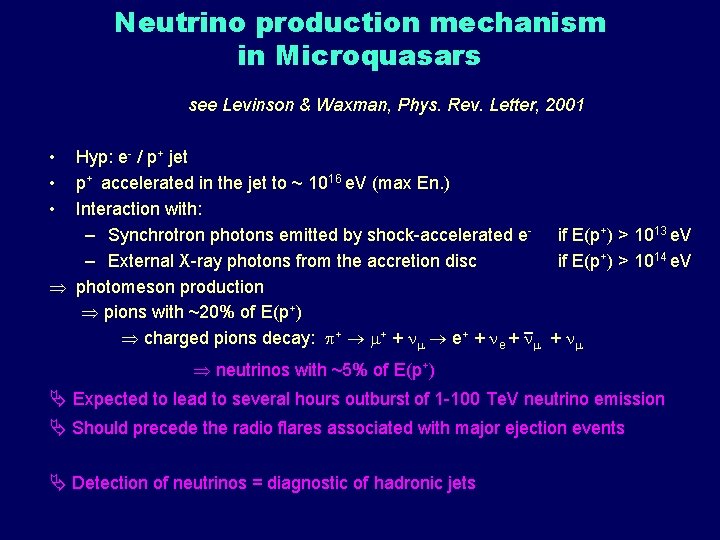
Neutrino production mechanism in Microquasars see Levinson & Waxman, Phys. Rev. Letter, 2001 • • • Hyp: e- / p+ jet p+ accelerated in the jet to ~ 1016 e. V (max En. ) Interaction with: – Synchrotron photons emitted by shock-accelerated e- if E(p+) > 1013 e. V – External X-ray photons from the accretion disc if E(p+) > 1014 e. V photomeson production pions with ~20% of E(p+) _ + + + charged pions decay: + e + + neutrinos with ~5% of E(p+) Expected to lead to several hours outburst of 1 -100 Te. V neutrino emission Should precede the radio flares associated with major ejection events Detection of neutrinos = diagnostic of hadronic jets
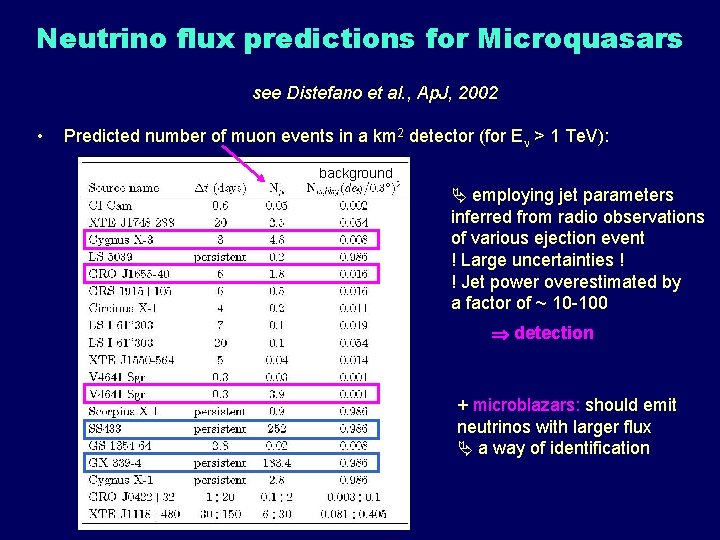
Neutrino flux predictions for Microquasars see Distefano et al. , Ap. J, 2002 • Predicted number of muon events in a km 2 detector (for E > 1 Te. V): background employing jet parameters inferred from radio observations of various ejection event ! Large uncertainties ! ! Jet power overestimated by a factor of ~ 10 -100 detection + microblazars: should emit neutrinos with larger flux a way of identification
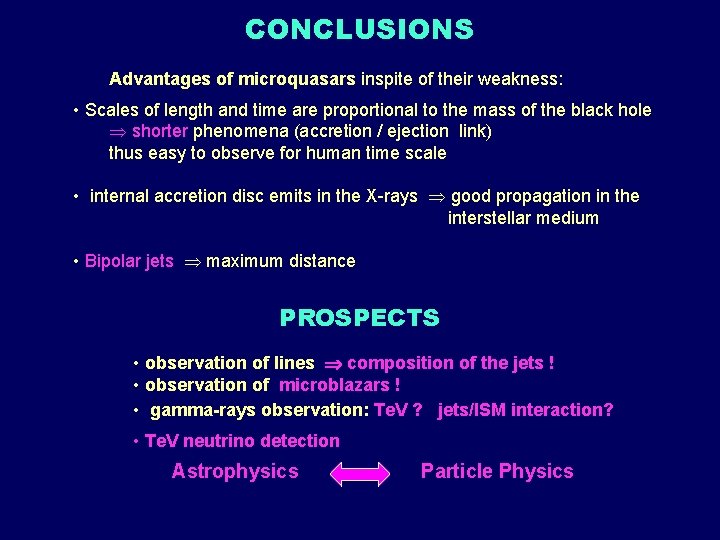
CONCLUSIONS Advantages of microquasars inspite of their weakness: • Scales of length and time are proportional to the mass of the black hole shorter phenomena (accretion / ejection link) thus easy to observe for human time scale • internal accretion disc emits in the X-rays good propagation in the interstellar medium • Bipolar jets maximum distance PROSPECTS • observation of lines composition of the jets ! • observation of microblazars ! • gamma-rays observation: Te. V ? jets/ISM interaction? • Te. V neutrino detection Astrophysics Particle Physics
- Slides: 30