
Micropulse Lidar Measurements in South China Sea Expedition
- Slides: 1
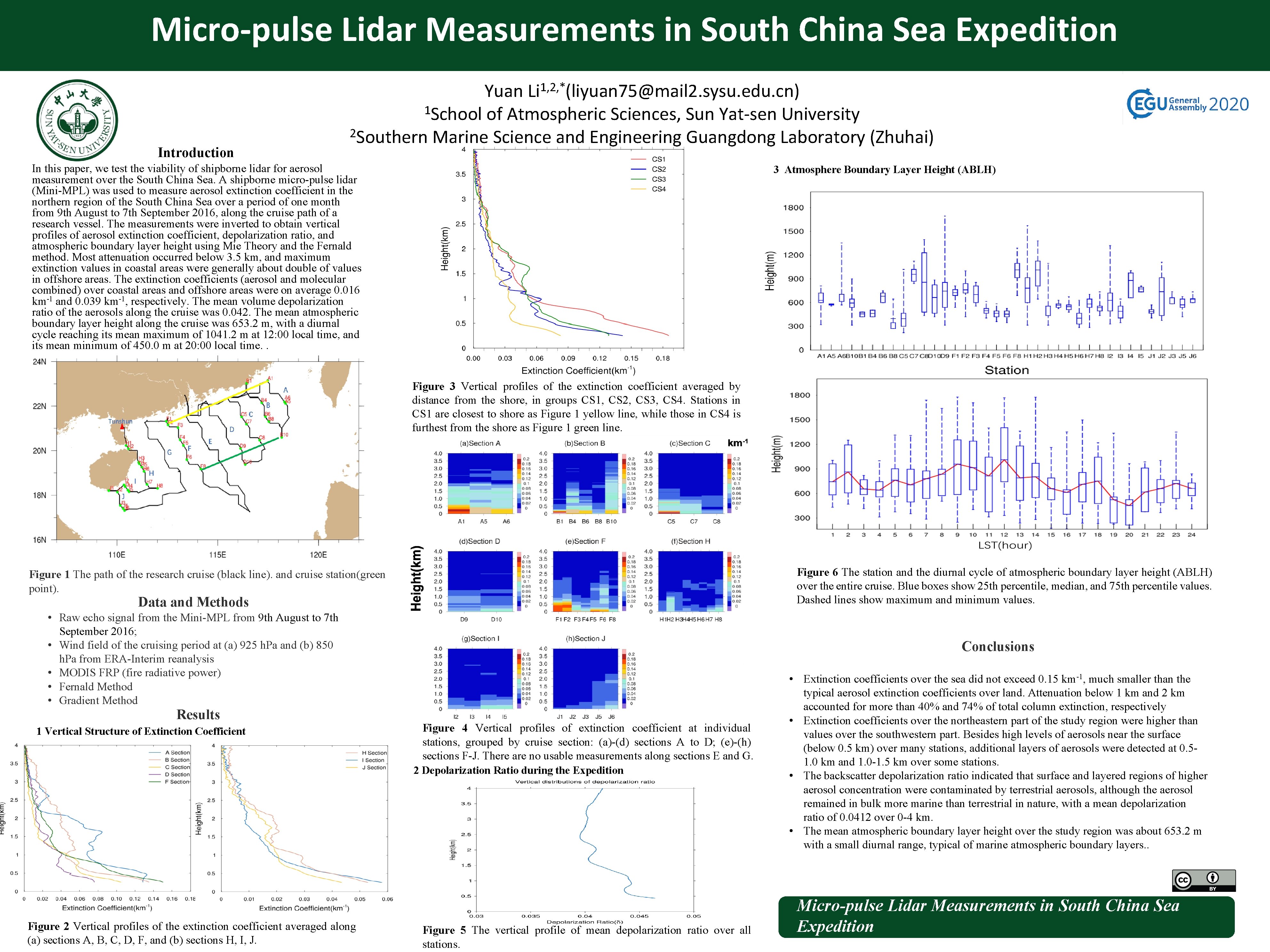
Micro-pulse Lidar Measurements in South China Sea Expedition 1, 2, * Li (liyuan 75@mail 2. sysu. edu. cn) Introduction Yuan 1 School of Atmospheric Sciences, Sun Yat-sen University 2 Southern Marine Science and Engineering Guangdong Laboratory (Zhuhai) In this paper, we test the viability of shipborne lidar for aerosol measurement over the South China Sea. A shipborne micro-pulse lidar (Mini-MPL) was used to measure aerosol extinction coefficient in the northern region of the South China Sea over a period of one month from 9 th August to 7 th September 2016, along the cruise path of a research vessel. The measurements were inverted to obtain vertical profiles of aerosol extinction coefficient, depolarization ratio, and atmospheric boundary layer height using Mie Theory and the Fernald method. Most attenuation occurred below 3. 5 km, and maximum extinction values in coastal areas were generally about double of values in offshore areas. The extinction coefficients (aerosol and molecular combined) over coastal areas and offshore areas were on average 0. 016 km-1 and 0. 039 km-1, respectively. The mean volume depolarization ratio of the aerosols along the cruise was 0. 042. The mean atmospheric boundary layer height along the cruise was 653. 2 m, with a diurnal cycle reaching its mean maximum of 1041. 2 m at 12: 00 local time, and its mean minimum of 450. 0 m at 20: 00 local time. . 3 Atmosphere Boundary Layer Height (ABLH) Figure 3 Vertical profiles of the extinction coefficient averaged by distance from the shore, in groups CS 1, CS 2, CS 3, CS 4. Stations in CS 1 are closest to shore as Figure 1 yellow line, while those in CS 4 is furthest from the shore as Figure 1 green line. Figure 6 The station and the diurnal cycle of atmospheric boundary layer height (ABLH) over the entire cruise. Blue boxes show 25 th percentile, median, and 75 th percentile values. Dashed lines show maximum and minimum values. Figure 1 The path of the research cruise (black line). and cruise station(green point). Data and Methods • Raw echo signal from the Mini-MPL from 9 th August to 7 th September 2016; • Wind field of the cruising period at (a) 925 h. Pa and (b) 850 h. Pa from ERA-Interim reanalysis • MODIS FRP (fire radiative power) • Fernald Method • Gradient Method Results 1 Vertical Structure of Extinction Coefficient Conclusions Figure 4 Vertical profiles of extinction coefficient at individual stations, grouped by cruise section: (a)-(d) sections A to D; (e)-(h) sections F-J. There are no usable measurements along sections E and G. 2 Depolarization Ratio during the Expedition Figure 2 Vertical profiles of the extinction coefficient averaged along (a) sections A, B, C, D, F, and (b) sections H, I, J. Figure 5 The vertical profile of mean depolarization ratio over all stations. • Extinction coefficients over the sea did not exceed 0. 15 km-1, much smaller than the typical aerosol extinction coefficients over land. Attenuation below 1 km and 2 km accounted for more than 40% and 74% of total column extinction, respectively • Extinction coefficients over the northeastern part of the study region were higher than values over the southwestern part. Besides high levels of aerosols near the surface (below 0. 5 km) over many stations, additional layers of aerosols were detected at 0. 51. 0 km and 1. 0 -1. 5 km over some stations. • The backscatter depolarization ratio indicated that surface and layered regions of higher aerosol concentration were contaminated by terrestrial aerosols, although the aerosol remained in bulk more marine than terrestrial in nature, with a mean depolarization ratio of 0. 0412 over 0 -4 km. • The mean atmospheric boundary layer height over the study region was about 653. 2 m with a small diurnal range, typical of marine atmospheric boundary layers. . Micro-pulse Lidar Measurements in South China Sea Expedition