
Microprocessor Microarchitecture Multithreading Lynn Choi School of Electrical



- Slides: 15
Microprocessor Microarchitecture Multithreading Lynn Choi School of Electrical Engineering
Limitations of Superscalar Processors q Limited instruction fetch bandwidth Taken branches Branch prediction accuracy Branch prediction throughput q Limited instruction window size Limited by instruction fetch bandwidth Limited by quadratic increase in wakeup and selection logic q Hardware complexity of wide-issue processors q Renaming bandwidth Wakeup and selection logic Bypass logic complexity Register file access time On-chip wire delays prevent centralized shared resources End-to-end on-chip wire delay grows rapidly from 2 -3 clock cycles in 0. 25 to 20 clock cycles in sub 0. 1 technology - This prevents centralized shared resources
Today’s Microprocessor q CPU 2010 – looking back to year 2002 according to Moore’s law - 64 X increase in terms of transistors - 64 X performance improvement, however, 6 Wider issue rate increases the clock cycle time 6 Limited amount of ILP in applications q Diminishing return in terms of Performance and resource utilization q Goals Scalable performance and more efficient resource utilization q Intel i 7 Processor Technology - 32 nm process, 130 W, 239 mm² die, 1. 17 B transistors - 3. 46 GHz, 64 -bit 6 -core 12 -thread processor - 159 Ispec, 103 Fspec on SPEC CPU 2006 (296 MHz Ultra. Sparc II processor as a reference machine) - 14 -stage 4 -issue out-of-order (OOO) pipeline optimized for multicore and low power consumption - 64 bit Intel architecture (x 86 -64) - 256 KB L 2 cache/core, 12 MB L 3 Caches
Approaches q MP (Multiprocessor) approach Decentralize all resources Multiprocessing on a single chip - Communicate through shared-memory: Stanford Hydra - Communicate through messages: MIT RAW q MT (Multithreaded) approach More tightly coupled than MP Dependent threads vs. independent threads - Dependent threads require HW for inter-thread synchronization and communication 6 Examples: Multiscalar (U of Wisconsin), Superthreading (U of Minnesota), DMT, Trace Processor - Independent threads: Fine-grain multithreading, SMT Centralized vs. decentralized architectures - Decentralized multithreaded architectures 6 Each thread has a separate pipeline 6 Multiscalar, Superthreading - Centralized multithreaded architectures 6 Share pipelines among multiple threads 6 TERA, SMT (throughput-oriented), Trace Processor, DMT (performance-oriented)
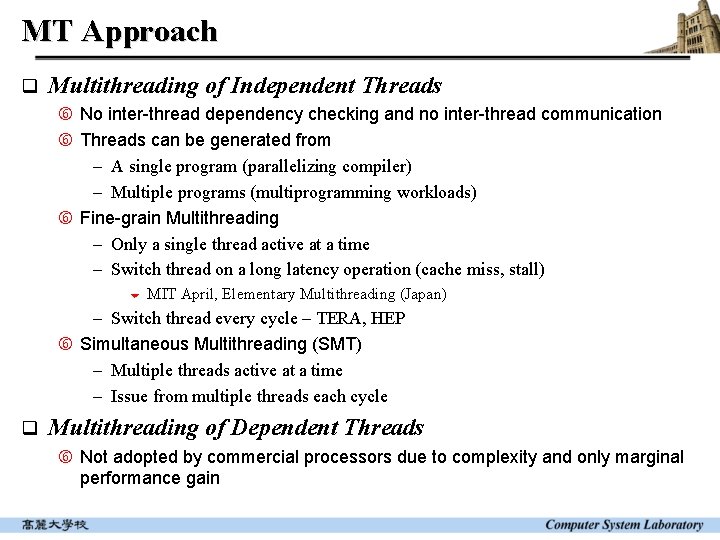
MT Approach q Multithreading of Independent Threads No inter-thread dependency checking and no inter-thread communication Threads can be generated from - A single program (parallelizing compiler) - Multiple programs (multiprogramming workloads) Fine-grain Multithreading - Only a single thread active at a time - Switch thread on a long latency operation (cache miss, stall) 6 MIT April, Elementary Multithreading (Japan) - Switch thread every cycle – TERA, HEP Simultaneous Multithreading (SMT) - Multiple threads active at a time - Issue from multiple threads each cycle q Multithreading of Dependent Threads Not adopted by commercial processors due to complexity and only marginal performance gain
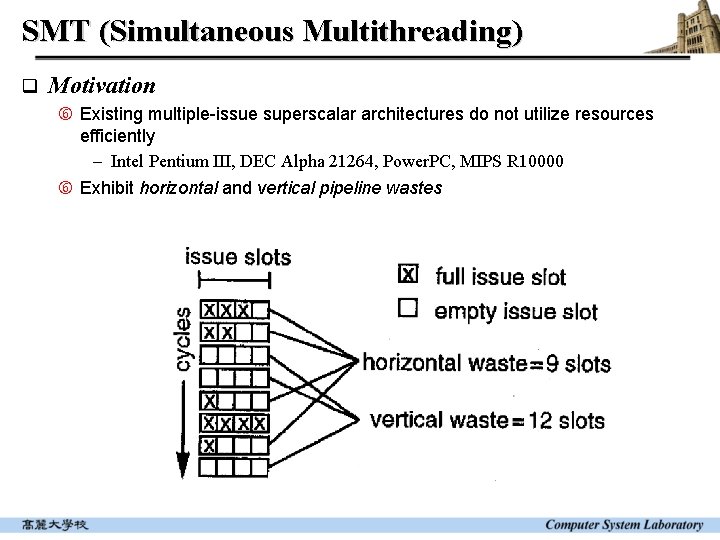
SMT (Simultaneous Multithreading) q Motivation Existing multiple-issue superscalar architectures do not utilize resources efficiently - Intel Pentium III, DEC Alpha 21264, Power. PC, MIPS R 10000 Exhibit horizontal and vertical pipeline wastes
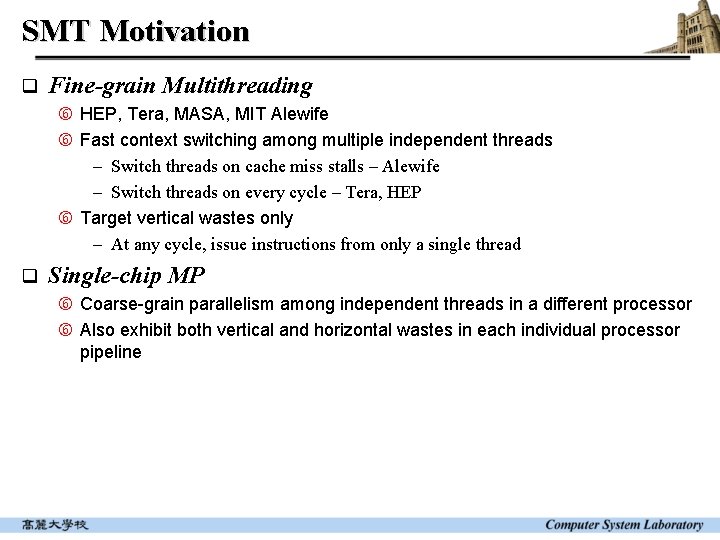
SMT Motivation q Fine-grain Multithreading HEP, Tera, MASA, MIT Alewife Fast context switching among multiple independent threads - Switch threads on cache miss stalls – Alewife - Switch threads on every cycle – Tera, HEP Target vertical wastes only - At any cycle, issue instructions from only a single thread q Single-chip MP Coarse-grain parallelism among independent threads in a different processor Also exhibit both vertical and horizontal wastes in each individual processor pipeline
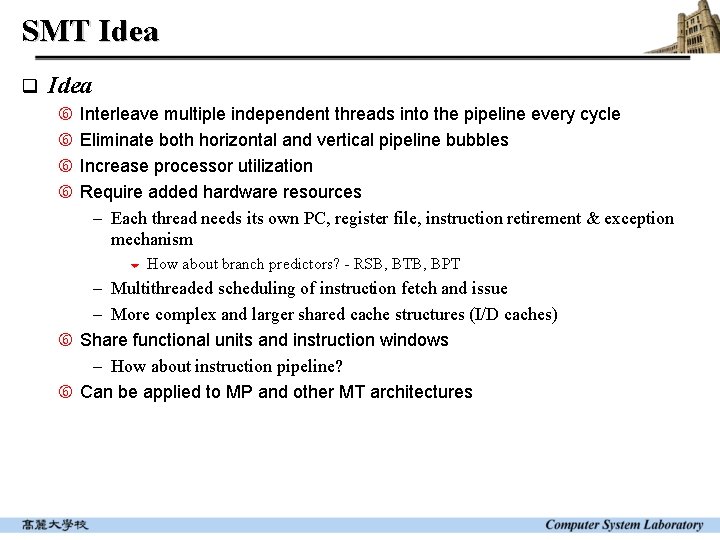
SMT Idea q Idea Interleave multiple independent threads into the pipeline every cycle Eliminate both horizontal and vertical pipeline bubbles Increase processor utilization Require added hardware resources - Each thread needs its own PC, register file, instruction retirement & exception mechanism 6 How about branch predictors? - RSB, BTB, BPT - Multithreaded scheduling of instruction fetch and issue - More complex and larger shared cache structures (I/D caches) Share functional units and instruction windows - How about instruction pipeline? Can be applied to MP and other MT architectures
Multithreading of Independent Threads Comparison of pipeline issue slots in three different architectures Superscalar Fine-grained Multithreading Simultaneous Multithreading Eggers, Susan, Joel Emer, Henry Levy, Rebecca Stamm, and Dean Tullsen (1997), Simultaneous Multithreading: A Platform for Next. Generation Processors, IEEE , September/October 1997, pp 13 -19.
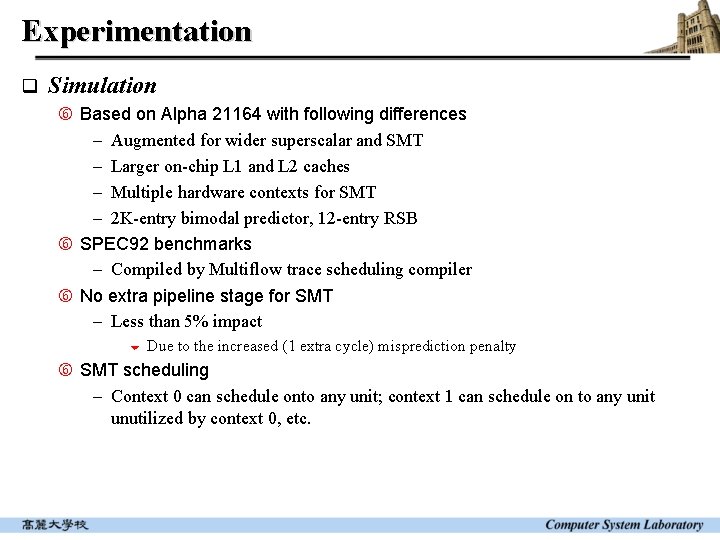
Experimentation q Simulation Based on Alpha 21164 with following differences - Augmented for wider superscalar and SMT - Larger on-chip L 1 and L 2 caches - Multiple hardware contexts for SMT - 2 K-entry bimodal predictor, 12 -entry RSB SPEC 92 benchmarks - Compiled by Multiflow trace scheduling compiler No extra pipeline stage for SMT - Less than 5% impact 6 Due to the increased (1 extra cycle) misprediction penalty SMT scheduling - Context 0 can schedule onto any unit; context 1 can schedule on to any unit unutilized by context 0, etc.
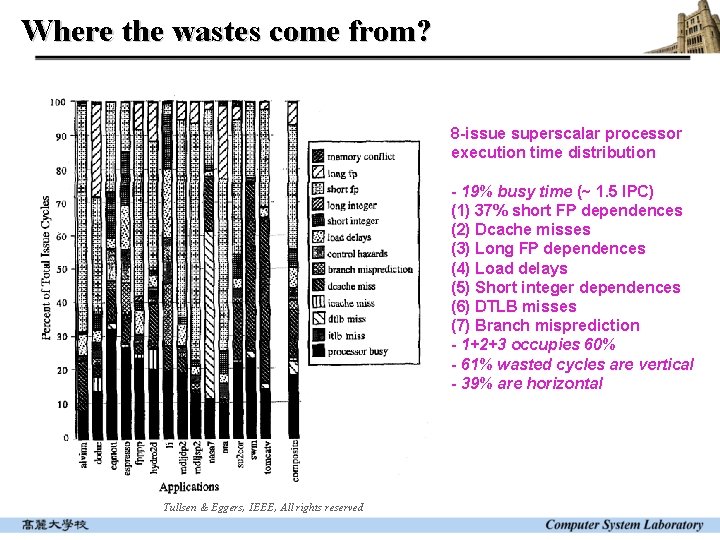
Where the wastes come from? 8 -issue superscalar processor execution time distribution - 19% busy time (~ 1. 5 IPC) (1) 37% short FP dependences (2) Dcache misses (3) Long FP dependences (4) Load delays (5) Short integer dependences (6) DTLB misses (7) Branch misprediction - 1+2+3 occupies 60% - 61% wasted cycles are vertical - 39% are horizontal Tullsen & Eggers, IEEE, All rights reserved
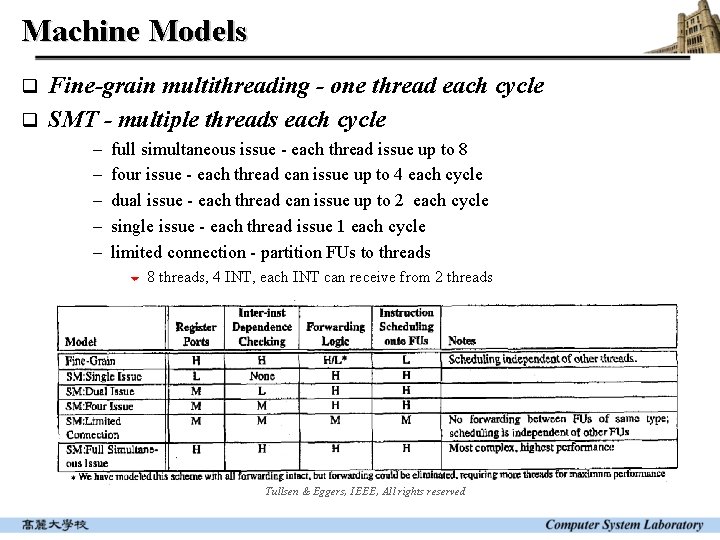
Machine Models Fine-grain multithreading - one thread each cycle q SMT - multiple threads each cycle q - full simultaneous issue - each thread issue up to 8 four issue - each thread can issue up to 4 each cycle dual issue - each thread can issue up to 2 each cycle single issue - each thread issue 1 each cycle limited connection - partition FUs to threads 6 8 threads, 4 INT, each INT can receive from 2 threads Tullsen & Eggers, IEEE, All rights reserved
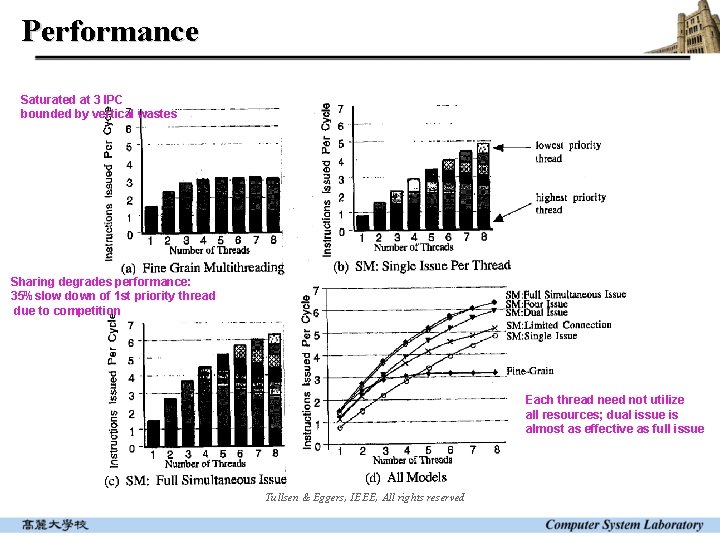
Performance Saturated at 3 IPC bounded by vertical wastes Sharing degrades performance: 35%slow down of 1 st priority thread due to competition Each thread need not utilize all resources; dual issue is almost as effective as full issue Tullsen & Eggers, IEEE, All rights reserved
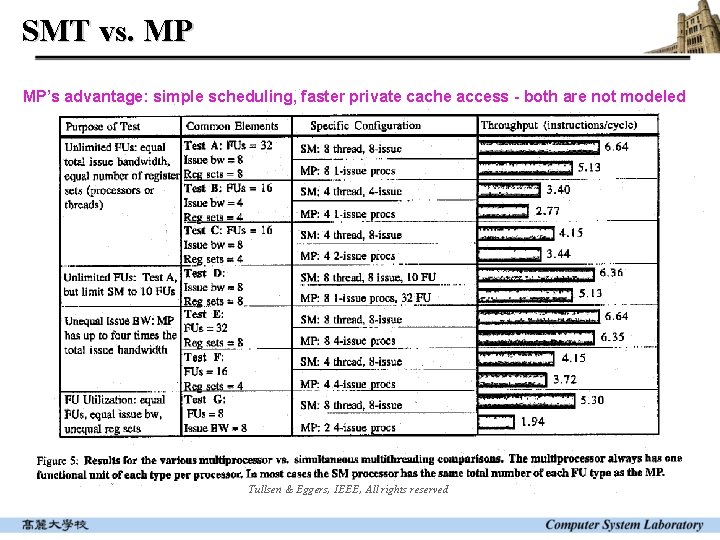
SMT vs. MP MP’s advantage: simple scheduling, faster private cache access - both are not modeled Tullsen & Eggers, IEEE, All rights reserved
Exercises and Discussion q Compare SMT versus MP on a single chip in terms of cost/performance and machine scalability. q Discuss the bottleneck in each stage of a OOO superscalar pipeline. q What is the additional hardware/complexity required for SMT implementation?