
Microprocessor Architecture meets Maryann the Steam Shovel Bob
Microprocessor Architecture meets Maryann, the Steam Shovel Bob Colwell Intel Corporation ® ISCA, June 2000 1 1
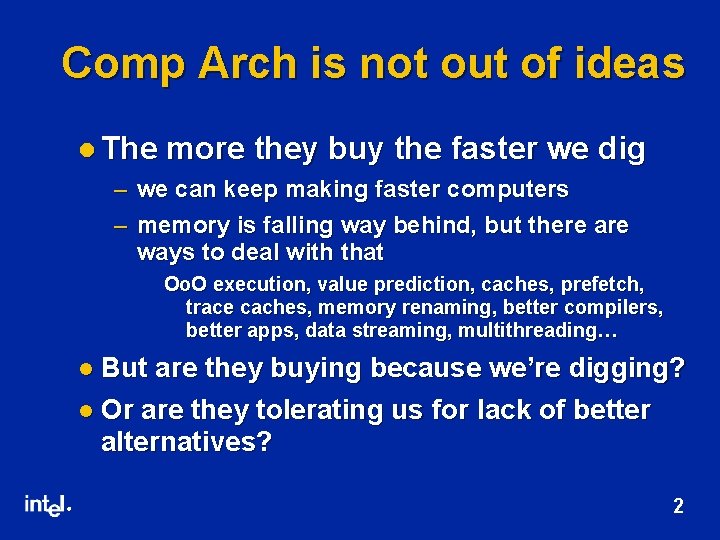
Comp Arch is not out of ideas l The more they buy the faster we dig – we can keep making faster computers – memory is falling way behind, but there are ways to deal with that Oo. O execution, value prediction, caches, prefetch, trace caches, memory renaming, better compilers, better apps, data streaming, multithreading… l But are they buying because we’re digging? l Or are they tolerating us for lack of better alternatives? ® 2 2
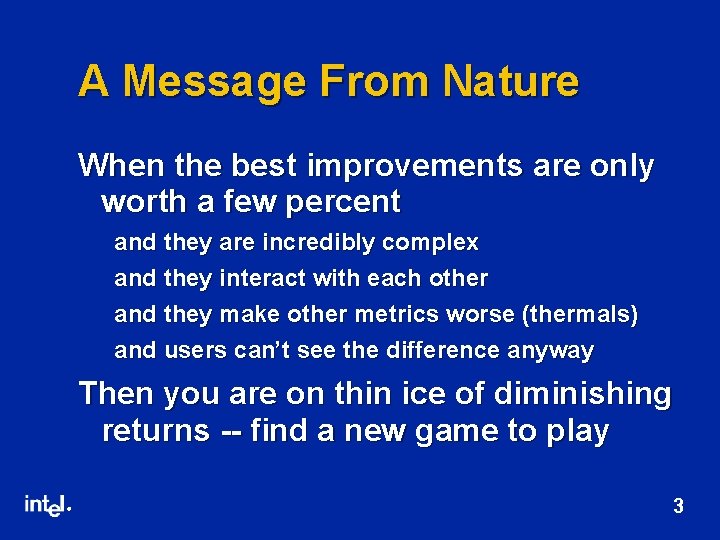
A Message From Nature When the best improvements are only worth a few percent and they are incredibly complex and they interact with each other and they make other metrics worse (thermals) and users can’t see the difference anyway Then you are on thin ice of diminishing returns -- find a new game to play ® 3 3
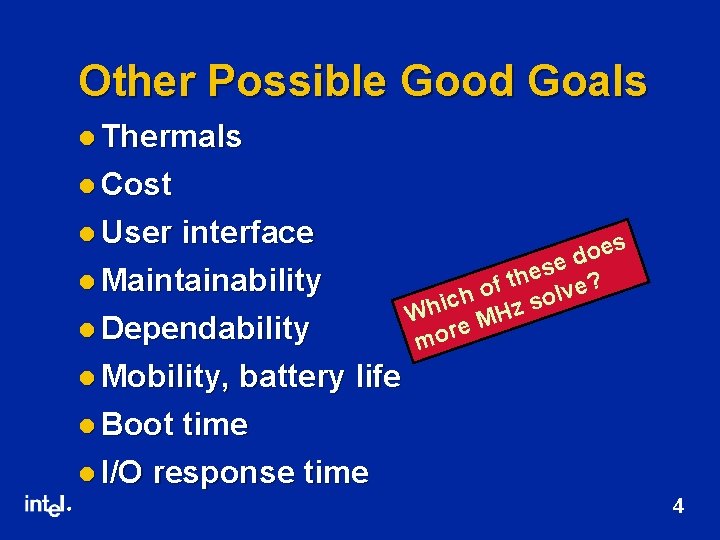
Other Possible Good Goals l Thermals l Cost l User interface s e o d e s he e? t l Maintainability f o lv h o c s i Wh MHz e r l Dependability o m l Mobility, battery life l Boot time l I/O response time ® 4 4
The Problem of Scale l Big Systems do not scale from small l Must design differently – – – Root causes: system complexity, physics Human body, telephone system, internet No single points of failure End-to-end checking, judicious redundancy Overall system “understands” user’s intent l Where ® is this point? l Will u. P’s hit it? Have they already? 5 5
What’s needed l Need – – to develop new u. Arch technology Robust computing in face of SER Robust in face of design flaws Robust in face of determined hackers Use all those transistors to really improve machines, not just make them trivially faster – Extra credit: robust in face of SW bugs – Let performance increases come from process Match what people want from computing ® 6 6
A little light reading Normal Accidents, Charles Perrow, Princeton University Press, 1984, 1999 An Investigation of the Therac-25 Accidents, Nancy Leveson & Clark Turner, IEEE Computer V 25, N 7, p 18 The Invisible Computer, Donald Norman, MIT Press, 1998 The Limits of Safety, Scott D. Sagan, Princeton University Press, 1993 To Engineer Is Human, Henry Petroski, St. Martin’s Press, 1982 The Challenger Launch Decision, Diane Vaughan, The University of Chicago Press, 1996 Searching For Safety, Aaron Wildavsky, Transaction Publishers, 1991 Why Buildings Fall Down , Matthys Levy and Mario Salvadori, Norton & Co. , 1992 Why Things Bite Back: Technology and the Revenge of Unintended Consequences , Edward Tenner, Knopf, 1996 Beyond Engineering: How Society Shapes Technology , Robert Pool, Oxford University Press, 1997 Flying Buttresses, Entropy, and O-Rings: The World of an Engineer , James L. Adams, Harvard Press, 1991 Societal Risk Assessment: How Safe Is Safe Enough? , Richard Schwing and Walter Albers, Plenum Press, 1980 Controlling Technology, Stephen H. Unger, Wiley Interscience, 1994 Inside the Sky, William Langewiesche, Vintage Books, 1998 On The Right Lines? The Limits of Technological Innovation , Stephen Potter, St. Martin’s Press, 1987 The Hubble Wars, Eric J. Chaisson, Harper. Collins Publishers, 1994 The Blunder Book, M. Hirsh Goldberg, Quill, 1984 The Control of Nature, John Mc. Phee, The Noonday Press, 1989 The Civilized Engineer, Samuel C. Florman, St. Martin’s Press, 1987 The Mythical Man-Month, Frederick P. Brooks Jr. , Addison-Wesley, 1979 What Engineers Know and How They Know It , Walter G. Vincenti, Johns Hopkins University Press, 1990 Fluid Concepts and Creative Analogies, Douglas Hofstadter, Basic Books, 1995 Computing Calamities: Lessons Learned from products, projects, and companies that failed , Robert L. Glass, Prentice-Hall, 1999 ® 7 7
- Slides: 7