
Micropolitan Statistical Areas and the Business Cycle The
Micropolitan Statistical Areas and the Business Cycle: The Case of the Plains Region Bienvenido Cortes Pittsburg State University
Motivation Focus on a smaller geographical delineation called “micropolitan statistical area” Is the economic health and prosperity of a micropolitan area coupled or tied to changes in the national economy? How important is industry mix in explaining the micropolitan area-national business cycle relationship?
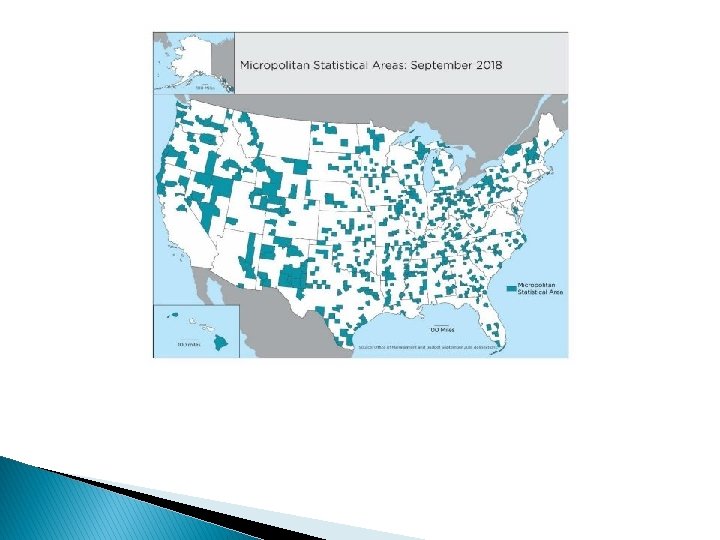
U. S. Micropolitan Statistical Area Definition: A geographical area with one or more counties and an urbanized core with a population of 10, 000 to 49, 999. There are 543 micropolitan areas in the U. S. Source of map: https: //www. census. gov/library/stories/2019/07/micropolita n-statistical-areas-small-town-america. html
Plains Region Seven states (Kansas, Iowa, Missouri, Minnesota, Nebraska, North Dakota, and South Dakota) 87 micropolitan statistical areas; Missouri has the largest number of micros (19) and North Dakota has the least (4) Wide variation in population, income, and employment
Objectives of the study To analyze the sensitivity of correlation of micropolitan economic activity in the Plains region relative to the national business cycle; To identify and measure the effects of industry mix and other factors on variations in the business cycle sensitivity of micropolitan areas.
Relevant Past Studies State studies: Carlino & De. Fina (2003); Owyang, Rapach, & Wall (2009); Gascon & Hass (2019) Metropolitan studies: Carlino, De. Fina & Sill (2001); Arias, Gascon, & Rapach (2016) County studies: Han & Goetz (2015); Gascon & Reinbold (2019) Micropolitan studies: Davidsson & Rickman (2011); Cortes, Davidsson, & Mc. Kinnis (2015)
States’ Comovement with the Business Cycle � Carlino & De. Fina (2003) find that the “cohesion” of cycles for a particular industry across states is greater than that across industries within a particular state. � Owyang et al (2009) and Gascon & Hass (2019) find that the comovement of states with the national business cycle is determined by industrial composition, establishment size, agglomeration economies, and attributes of neighboring states.
Metropolitan Area and Countylevel Studies Arias et al (2016) find that national recessions in 1990 s and 2000 s have different impacts on metropolitan areas; explanatory factors include housing supply, education levels, and spillover effects across large cities. Gascon & Reinbold (2019) find that growth in rural areas tends to be slower than that in urban areas due to an unfavorable mix of industries: “greater exposure to government sector and lower exposure to private service-producing sector. ”
Analysis of Plains Micropolitan Areas relative to Business Cycle Historical correlations of annual percentage changes in various micro area variables with changes in US real GDP in 1969 -2017; Responsiveness of each micro area industry (23 sectors) to changes in US GDP; Five most responsive micro area industries vs. five industries least responsive to the business cycle.
Sensitivity of Micro Areas to Business Cycle (Table 1) Four variables (total employment, onfarm employment, Gross Regional Product, per capita personal income) for 87 micropolitan areas are regressed on changes in US GDP; 61 micro areas (70%) have significant correlations, 8 micros have insignificant correlations, and 18 have mixed results; North Dakota’s micros are the least sensitive, followed by Kansas; with few exceptions, the other states’ micros follow closely the business cycle.
Sensitivity of Micro Area Industries to the Business Cycle (Table 2) A total of 2, 001 micro area industry-business cycle regressions are calculated; correlation coefficients are tested for significance at 10% level; Industries of Missouri and Minnesota are the most responsive to the business cycle; the least sensitive are those in North Dakota;
Table 2 findings continued Manufacturing has the greatest number of significant correlations, followed by information services, retail trade, other services, construction, and accommodation & food services sector; The least responsive micro area industries are farming, management of companies, educational services, utilities, and mining.
Five Micropolitan Industries Most Sensitive to the Business Cycle Table 3 shows the percentage of micro area employment accounted for by the five most sensitive sectors: manufacturing, information, retail trade, other services, and construction; Manufacturing accounts for 10 -16% of all Plains micros’ employment except for North Dakota where manufacturing share is 4%; Retail trade is more important in Missouri and the Dakotas.

Five Micropolitan Industries Least Sensitive to the Business Cycle As with the previous tables, Table 4 shows that there is a great deal of heterogeneity across and within the Plains states; For industries that tend to not be dependent on the business cycle, mining is dominant in North Dakota while agriculture and educational services have higher employment shares in the other states.
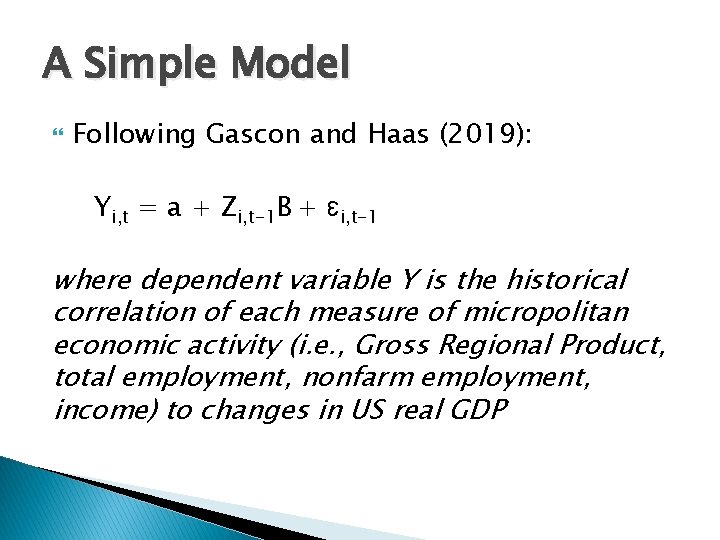
A Simple Model Following Gascon and Haas (2019): Yi, t = a + Zi, t-1 B + ԑi, t-1 where dependent variable Y is the historical correlation of each measure of micropolitan economic activity (i. e. , Gross Regional Product, total employment, nonfarm employment, income) to changes in US real GDP
Determinants of Micropolitan Area Sensitivity Variables of interest (Z): Total employment share of five most sensitive industries and total employment share of five least sensitive industries Control variable Micropolitan area initial ranking
Findings A micropolitan area’s industry mix has a positive and significant influence on how closely the local area’s economy follows changes in the national economy; However, the combined impact of the employment shares of the high- and low-sensitive industries only explains 10 -33%; Adding a control variable -- the Micropolitan Economic Strength Index (initial ranking and change in ranking) has the same qualitative results.
Conclusions and Further Study � Approximately 70% of the 87 Plains states’ micropolitan areas have significant correlations with the national business cycle. � There is much heterogeneity across and within the Plains states, with Missouri and Minnesota more coupled with the business cycle and North Dakota the least responsive. � Industrial composition explains these linkages; however, this co-movement tends to be weaker as the geographical unit of study becomes smaller. � Further study will look into other micropolitan area attributes that make it more “resilient” to shocks and swings in national activity.
- Slides: 19