
Micromegas Based Muon Telescopes for The Scan Pyramids
Micromegas Based Muon Telescopes for The Scan. Pyramids Mission - Performance & First Results D. Attié, S. Bouteille, D. Calvet, P. Magnier, I. Mandjavidze, S. Procureur, M. Riallot
Outline • Muon tomography • Genetic Multiplexed Resistive Bulk Micromegas • Demonstrator for a Water Tower (Wat. To) imagery • Wat. To to Scan. Pyramids • Installation at the Khufu Pyramid • Results • Conclusions david. attie@cea. fr Scan. Pyramids – 8 th Symposium on large TPCs for low-energy rare event detection 05/12/16 | 2

Muon Tomography • Muons from cosmic rays interacts with matter and can be either deviated by Coulomb scattering or absorbed • Deviation and absorption depend on - material length - density • can be used to probe an object - Many applications in the world: homeland security, volcanology, archeology, mining, … - In France: Diaphane, Tomu. Vol, Geo-Azur - Why another one? david. attie@cea. fr Micromegas offer spatial resolution 10 -20 times better Scan. Pyramids – 8 th Symposium on large TPCs for low-energy rare event detection 05/12/16 | 3
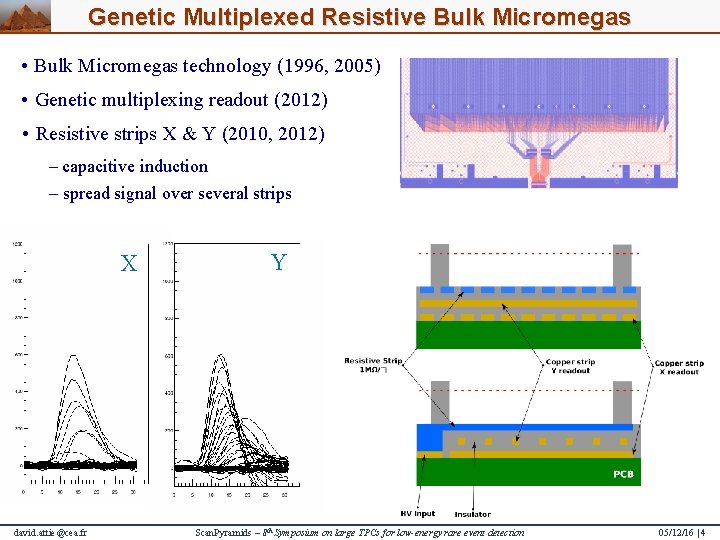
Genetic Multiplexed Resistive Bulk Micromegas • Bulk Micromegas technology (1996, 2005) • Genetic multiplexing readout (2012) • Resistive strips X & Y (2010, 2012) – capacitive induction – spread signal over several strips X david. attie@cea. fr Y Scan. Pyramids – 8 th Symposium on large TPCs for low-energy rare event detection 05/12/16 | 4

Wat. To (Water Tower): Micromegas Muon Telescope • 1 st muon telescope with multiplexed Micromegas Tmin ~ 12°C; Tmax ~ 42°C – 1 st use of Micromegas outside: gain stability f(T, P) – Self trigger mode of Particle Physics electronics – Compact electronic system (nano-PC, specific HV card) – 30 W power consumption μ Y 50 cm (X 1, Y 1) 1, 8 m X david. attie@cea. fr (X 2, Y 2) (X 3, Y 3) Scan. Pyramids – 8 th Symposium on large TPCs for low-energy rare event detection 05/12/16 | 5
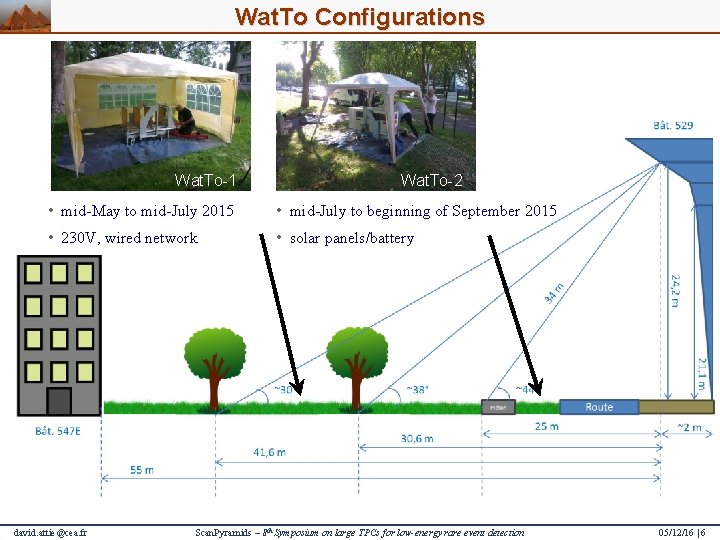
Wat. To Configurations Wat. To-1 Wat. To-2 • mid-May to mid-July 2015 • mid-July to beginning of September 2015 • 230 V, wired network • solar panels/battery david. attie@cea. fr Scan. Pyramids – 8 th Symposium on large TPCs for low-energy rare event detection 05/12/16 | 6
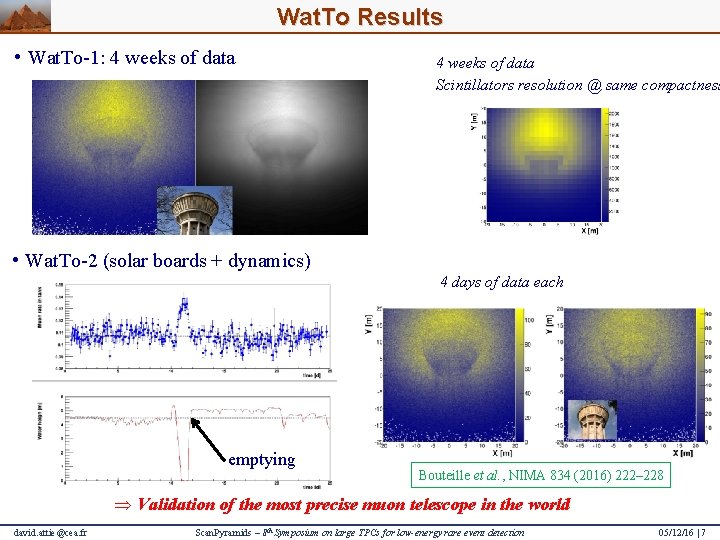
Wat. To Results • Wat. To-1: 4 weeks of data Scintillators resolution @ same compactness • Wat. To-2 (solar boards + dynamics) 4 days of data each emptying Bouteille et al. , NIMA 834 (2016) 222– 228 Þ Validation of the most precise muon telescope in the world david. attie@cea. fr Scan. Pyramids – 8 th Symposium on large TPCs for low-energy rare event detection 05/12/16 | 7
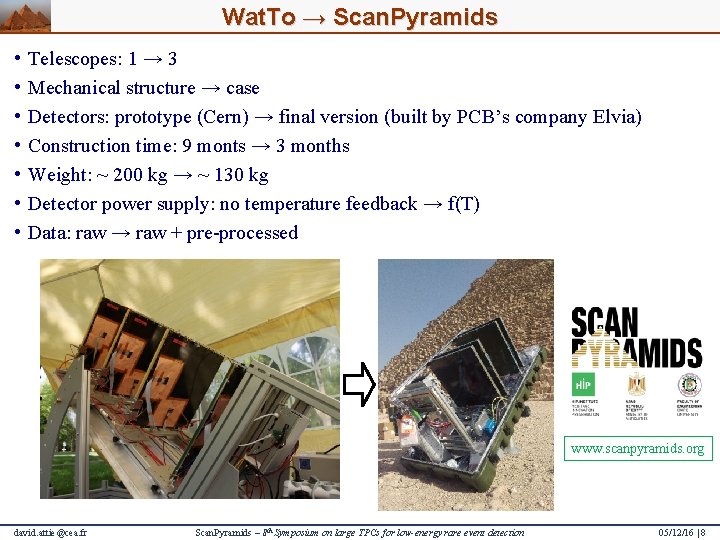
Wat. To → Scan. Pyramids • • Telescopes: 1 → 3 Mechanical structure → case Detectors: prototype (Cern) → final version (built by PCB’s company Elvia) Construction time: 9 monts → 3 months Weight: ~ 200 kg → ~ 130 kg Detector power supply: no temperature feedback → f(T) Data: raw → raw + pre-processed www. scanpyramids. org david. attie@cea. fr Scan. Pyramids – 8 th Symposium on large TPCs for low-energy rare event detection 05/12/16 | 8
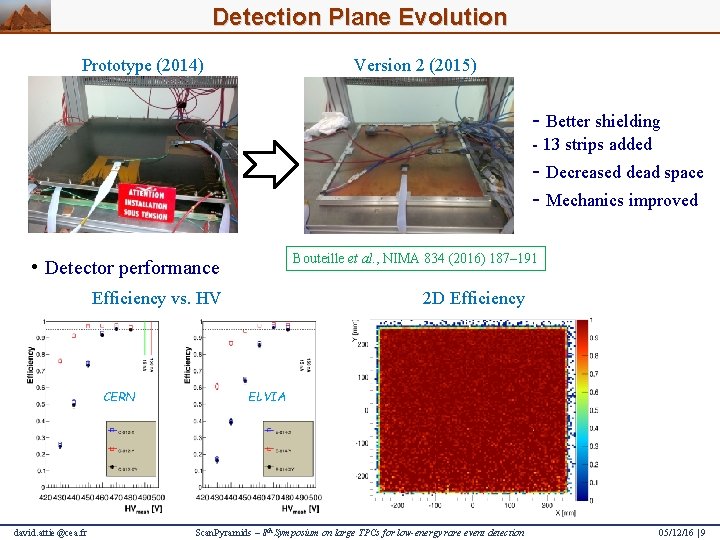
Detection Plane Evolution Prototype (2014) Version 2 (2015) - Better shielding - 13 strips added - Decreased dead space - Mechanics improved Bouteille et al. , NIMA 834 (2016) 187– 191 • Detector performance Efficiency vs. HV CERN david. attie@cea. fr 2 D Efficiency ELVIA Scan. Pyramids – 8 th Symposium on large TPCs for low-energy rare event detection 05/12/16 | 9
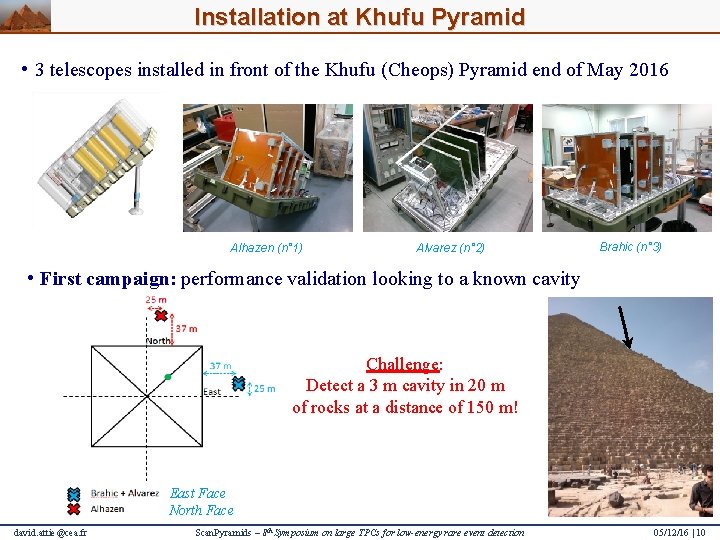
Installation at Khufu Pyramid • 3 telescopes installed in front of the Khufu (Cheops) Pyramid end of May 2016 Alhazen (n° 1) Alvarez (n° 2) Brahic (n° 3) • First campaign: performance validation looking to a known cavity Challenge: Detect a 3 m cavity in 20 m of rocks at a distance of 150 m! East Face North Face david. attie@cea. fr Scan. Pyramids – 8 th Symposium on large TPCs for low-energy rare event detection 05/12/16 | 10
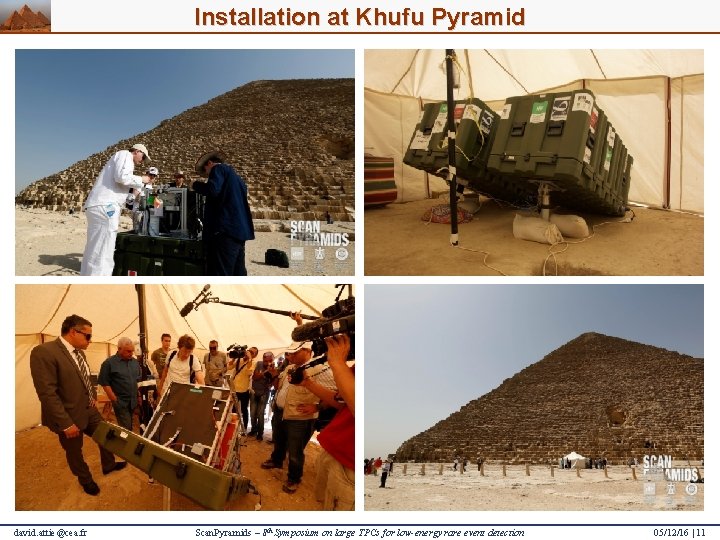
Installation at Khufu Pyramid david. attie@cea. fr Scan. Pyramids – 8 th Symposium on large TPCs for low-energy rare event detection 05/12/16 | 11
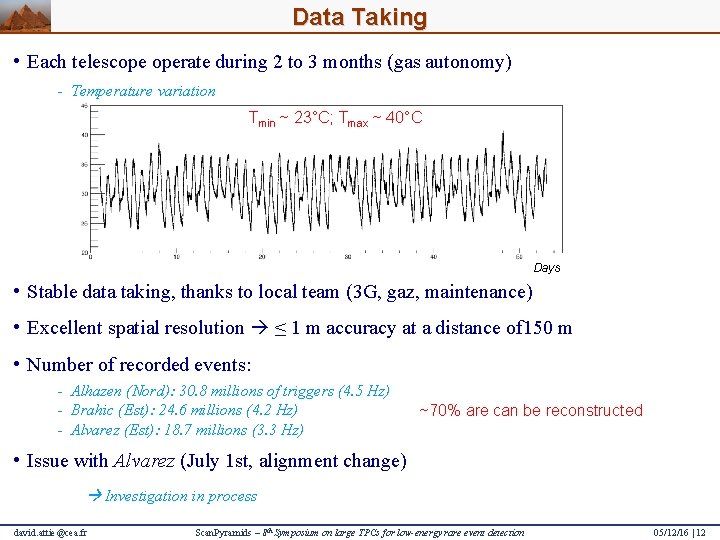
Data Taking • Each telescope operate during 2 to 3 months (gas autonomy) - Temperature variation Tmin ~ 23°C; Tmax ~ 40°C Days • Stable data taking, thanks to local team (3 G, gaz, maintenance) • Excellent spatial resolution ≤ 1 m accuracy at a distance of 150 m • Number of recorded events: - Alhazen (Nord): 30. 8 millions of triggers (4. 5 Hz) - Brahic (Est): 24. 6 millions (4. 2 Hz) - Alvarez (Est): 18. 7 millions (3. 3 Hz) ~70% are can be reconstructed • Issue with Alvarez (July 1 st, alignment change) Investigation in process david. attie@cea. fr Scan. Pyramids – 8 th Symposium on large TPCs for low-energy rare event detection 05/12/16 | 12
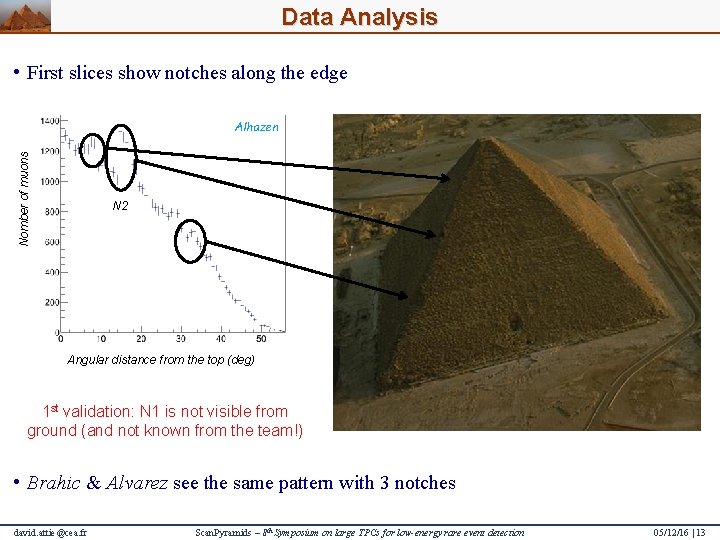
Data Analysis • First slices show notches along the edge Nomber of muons Alhazen N 2 Angular distance from the top (deg) 1 st validation: N 1 is not visible from ground (and not known from the team!) • Brahic & Alvarez see the same pattern with 3 notches david. attie@cea. fr Scan. Pyramids – 8 th Symposium on large TPCs for low-energy rare event detection 05/12/16 | 13
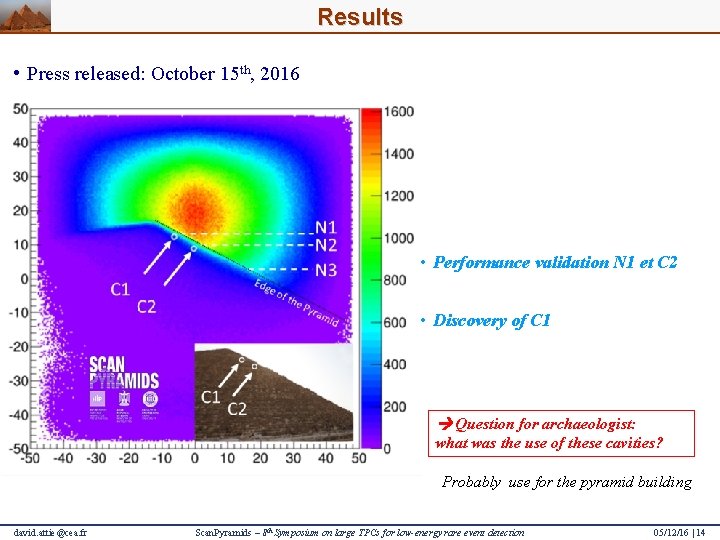
Results • Press released: October 15 th, 2016 • Performance validation N 1 et C 2 • Discovery of C 1 Question for archaeologist: what was the use of these cavities? Probably use for the pyramid building david. attie@cea. fr Scan. Pyramids – 8 th Symposium on large TPCs for low-energy rare event detection 05/12/16 | 14
Conclusions and Perspectives • The first Scan. Pyramids campaign was a success • Discovery of a new cavity (C 1) • The 3 telescopes are still in Cairo waiting for redeployment • Next steps: – look at other edges – scan other Pyramid edges (Khafre, etc. ) – data analysis is in continuing (add reconstructed events) • Contact in progress with several private companies (RATP, etc. ) for societal applications, but first need simulations or in situ demonstration david. attie@cea. fr Scan. Pyramids – 8 th Symposium on large TPCs for low-energy rare event detection 05/12/16 | 15

Thank You! david. attie@cea. fr Scan. Pyramids – 8 th Symposium on large TPCs for low-energy rare event detection 05/12/16 | 16
- Slides: 16