
Microkernels From Mach to se L 4 Lecture













- Slides: 45
Microkernels: From Mach to se. L 4 (Lecture 8, cs 262 a) Ion Stoica, UC Berkeley September 21, 2016
Project Proposals We’ll give you feedback on the projects by next Monday, 9/28 Please make sure you are enabling comments
Papers “Microkernel Operating System Architecure and Mach”, D. Black, D. Golub, D. Julin, R. Rashid, R. Draves, R. Dean, A. Forin, J. Barrera, H. Tokuda, G. Malan, and D. Bohman (https: //amplab. github. io/cs 262 a-fall 2016/notes/Mach. pdf) From L 3 to se. L 4 What Have We Learnt in 20 Years of L 4 Microkernels? ”, K. Elphinstone and G. Heiser, Proceedings of SOSP’ 13, Farmington, Pennsylvania, USA (http: //sigops. org/sosp 13/papers/p 133 -elphinstone. pdf)
Key Observation (~1985) Modern OSes systems (e. g. , Unix, OS/2) primarily distinguished by the programming environment they provide and not by the way they manage resources Opportunity: • Factor out the common part • Make it easier to build new OSes
Microkernels separates OS in two parts Part of OS that control basic hardware resources (i. e. . microkernel) Part of OS that determine unique characteristics of application environment (e. g. , file system)
What problem do they try to solve? Portability: • Environment mostly independent on the instruction set architecture Extensibility & customization: • Can easily add new versions of environments • Enable environments to evolve faster (decouples them from microkernel) • Can simultaneously provide environments emulating interfaces Sounds familiar? • Microkernel as a narrow waist (anchor point) of OSes • Provide hardware independence, similar to data independence in
What problem do they try to solve? Easier to provide better functionality and performance for kernel: • Real-time: no need to maintain lock for extended periods of time; environments are preemptable • Multiprocessor support: simpler functionality easier to parallelize • Multicomputer support: simpler functionality easier to distribute • Security: simpler functionality easier to secure Flexibility (network accessibility): • System environment can run remotely
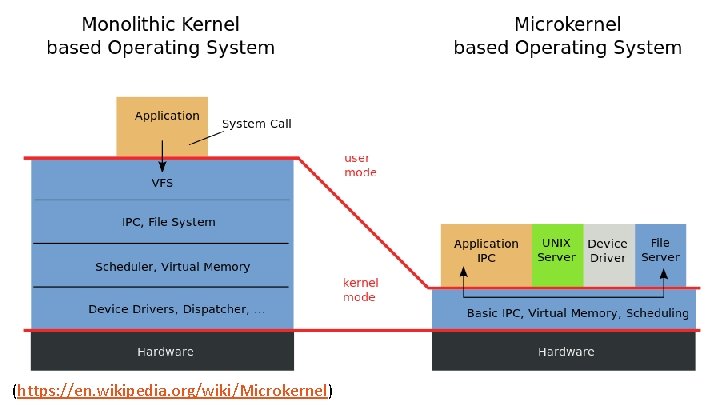
(https: //en. wikipedia. org/wiki/Microkernel)
Mach Goal: show that microkernels can be as efficient as monolithic operating systems: • “… achieving the levels of functionality and performance expected and required of commercial products” Sounds familiar? • Similar goals as System R and Ingress: Show that a conceptually superior solution (i. e. , relational model) admit efficient implementations that can match the performance of existing solutions (i. e. , network and hierarchical models)
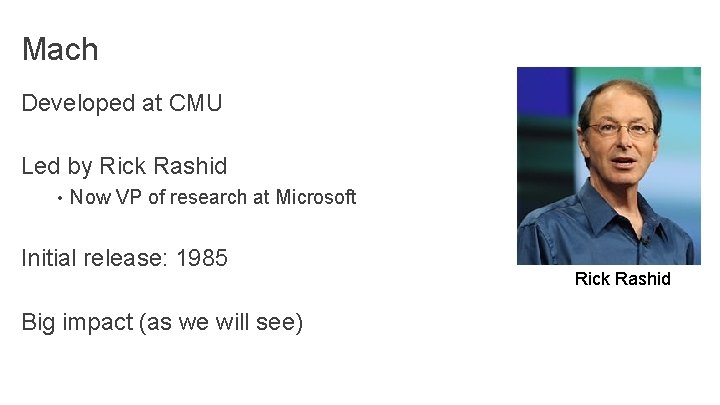
Mach Developed at CMU Led by Rick Rashid • Now VP of research at Microsoft Initial release: 1985 Big impact (as we will see) Rick Rashid
What does a microkernel (Mach) do? Task and thread management: • Task (process) unit of allocation • Thread, unit of execution • Implements CPU scheduling: exposed to apps – Applications/environments can implement their own scheduling policies Interprocess communication (IPC) • Between threads via ports • Secured by capabilities
What does a microkernel (Mach) do? Memory object management: • Essentially virtual memory • Persistent store accessed via IPC System call redirection: • Enable to trap system calls and transfer control to user mode • Essentially enable applications to modify/extend the behavior and functionality of system calls, e. g. , – Enable binary emulation of environments, tracing, debugging
What else does a microkernel (Mach) do? Device support: • Implemented using IPC (devices are contacted via ports) • Support both synchronous and asynchronous devices User multiprocessing: • Essentially a user level thread package, with wait()/signal() primitives • One or more user threads can map to same kernel thread Multicomputer support: • Can map transparently tasks/resources on different nodes in a cluster
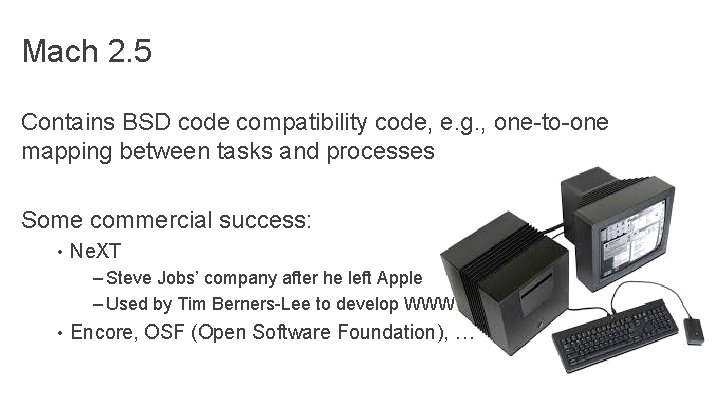
Mach 2. 5 Contains BSD code compatibility code, e. g. , one-to-one mapping between tasks and processes Some commercial success: • Ne. XT – Steve Jobs’ company after he left Apple – Used by Tim Berners-Lee to develop WWW • Encore, OSF (Open Software Foundation), …
Mach 3 Eliminate BSD code Rewrite IPC to improve performance • RPC on (then) contemporary workstations: 95 usec Expose device interface Provide more control to user applications via continuation: • Address of an user function to be called when thread is rescheduled plus some data: essentially a callback • Enable application to save restore state, so that the microkernel doesn’t need to do it, e. g. , saving and restoring register state
OSes and Application Programs Mach allows application to implement: • Paging • Control data cached by virtual memory • … Redirection allows call traps to link directly to executable binaries without modifying he kernel! • Just need an emulation library
Emulation Libraries Translator for system services and a cache for their results • Converts app calls to Mach calls • Invoke functionality of the environment (e. g. , OS) and reply to app • Typically linked to app to avoid another context switching
OSes Environment Architectures Fully implemented in the emulation library • Simple, single user systems (e. g. , MS-Do. S) As a server (see previous slide) Native OSes: use the code of the original systems • Used to implement both Mac. OS, and DOS • Emulation library also virtualizes the physical resources
Performance: Mach 2. 5 vs 3. 0 Virtually the same as Mach 2. 5, and commercial Unix systems of that time • Sun. OS 4. 1 and Ultrix 4. 1 Why? • I/O dominated tasks (read, write, compile) Microbenchmarks would have been nice, e. g. : • IPC • Cost of a page fault
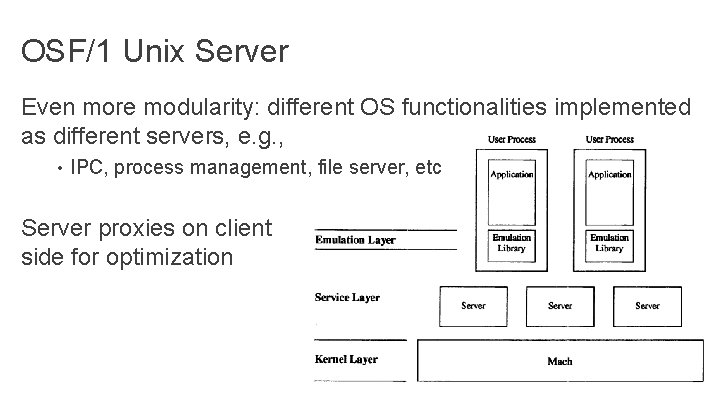
OSF/1 Unix Server Even more modularity: different OS functionalities implemented as different servers, e. g. , • IPC, process management, file server, etc Server proxies on client side for optimization
L 3 se. L 4
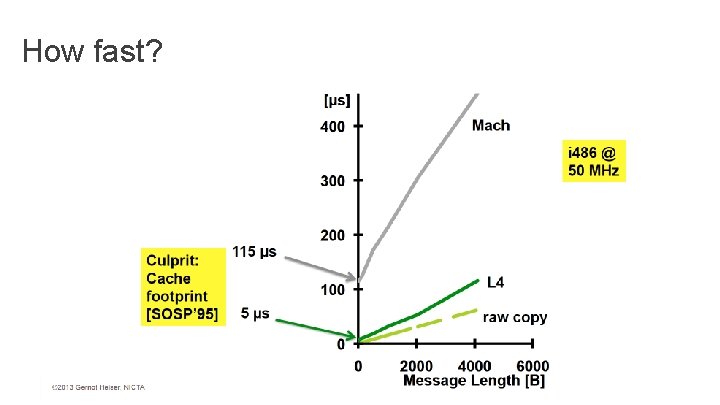
How it started? (1993) Microkernels (e. g. , Mach) still too slow • Mostly because IPCs Tide was turning towards monolithic kernels Jochen Liedtke (GMD – Society for Mathematics and Information technology) aimed to show that IPC can be supper-fast Jochen Liedtke
How fast?
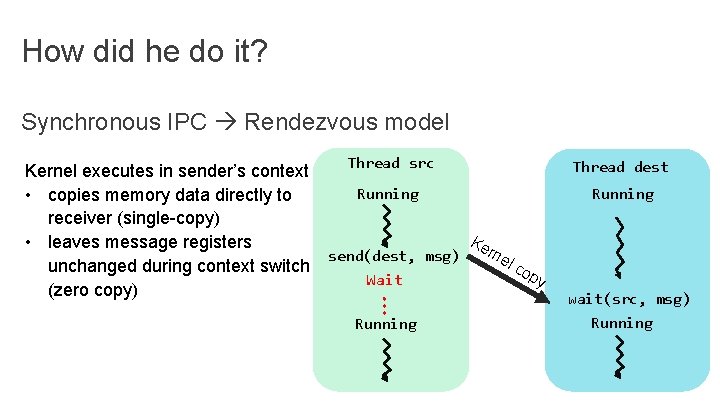
How did he do it? Synchronous IPC Rendezvous model Thread src Thread dest Running send(dest, msg) Wait … Kernel executes in sender’s context • copies memory data directly to receiver (single-copy) • leaves message registers unchanged during context switch (zero copy) Running Ke rne lc op y wait(src, msg) Running
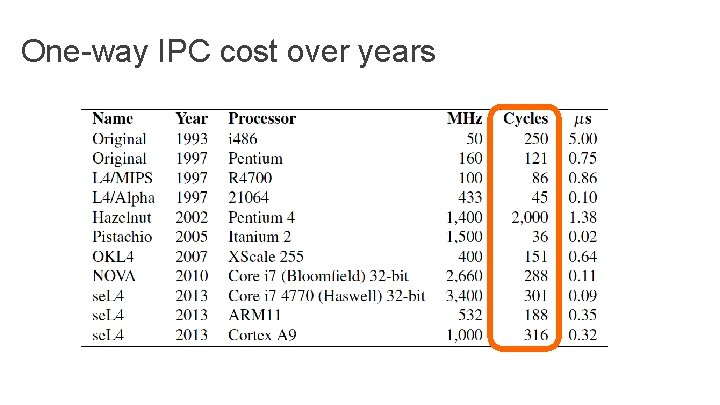
One-way IPC cost over years
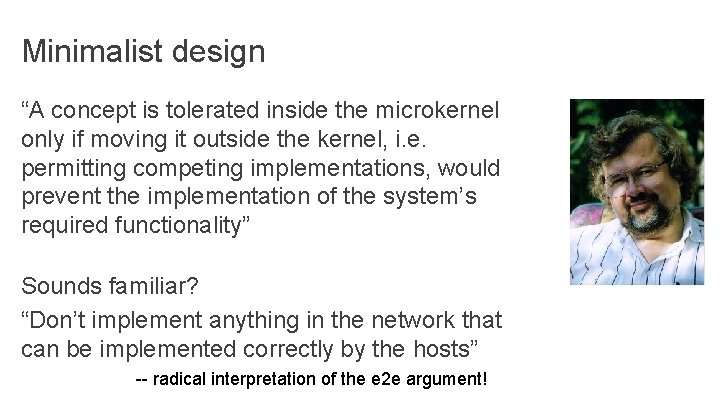
Minimalist design “A concept is tolerated inside the microkernel only if moving it outside the kernel, i. e. permitting competing implementations, would prevent the implementation of the system’s required functionality” Sounds familiar? “Don’t implement anything in the network that can be implemented correctly by the hosts” -- radical interpretation of the e 2 e argument!
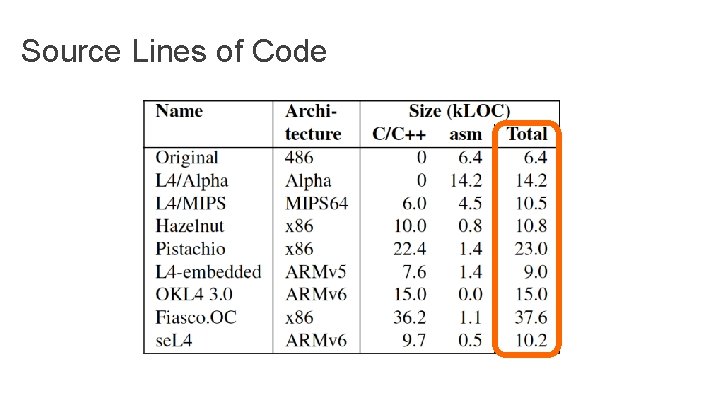
Source Lines of Code
L 4 family tree
L 4 family tree “The Secure Enclave runs an Apple-customized version of the L 4 microkernel family” - i. OS Security, Apple Inc, 2015 (www. apple. com/business/docs/i. OS_Security_Guide. pdf )
Long IPCs: Transferring large messages What happens during page faults? IPC page faults are nested exceptions • L 4 executes with interrupts disabled for performance, no concurrency • Must invoke untrusted user mode page-fault handlers – Potential for DOSing other thread (i. e. , page fault handler hangs) • Can use timeouts to avoid DOS attacks – Complex, goes against minimalist design
Why long IPCs? POSIX-style APIs • Use message passing between apps and OS, e. g. , write(fd, buf, nbytes) Linux became de-facto standard • Communicate via shared memory Long IPC abandoned Supporting POSIX not as critical • Message passing can be emulated anyway via shared memory
IPC destinations Initially use thread identifier (why? ) • Wanted to avoid cache an TLB pollution But • Poor information hiding (e. g. , multi-threaded server has to expose the structure to the clients) • Large caches and TLBs reduced pollution Thread IDs replaced by port-like endpoints
Timeouts Synchronous IPC may lead to thread being blocked indefinitely • E. g. , a thread which waits for another thread that hangs Solution: timeouts Timeouts abandoned • No reliable way to pick a timeout; application specific Ended up just using two values: 0 and infinity • Client sends and receives with infinite timeouts • Servers requests with an infinite timeout but replies with a zero timeout
Asynchronous IPCs Thread Insufficient (Why? ) Disadvantages of synchronous IPCs • Forces apps to use multithreading • Poor choice for multicores (no need to block if IO executes on another core!) Want async IPCs • Want something like select()/poll()/epoll() in Unix initiate_IO(…) wait_IO(…) receive … • Have to block on IO operations Running msg
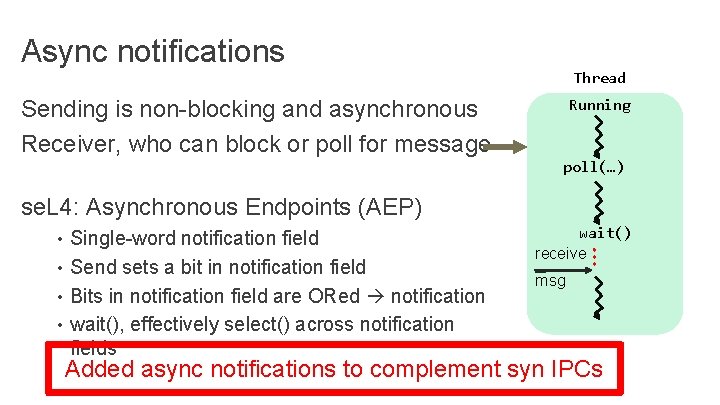
Async notifications Thread Running Sending is non-blocking and asynchronous Receiver, who can block or poll for message poll(…) se. L 4: Asynchronous Endpoints (AEP) • Send sets a bit in notification field • Bits in notification field are ORed notification wait() receive … • Single-word notification field msg • wait(), effectively select() across notification fields Added async notifications to complement syn IPCs
Lazy scheduling What is the problem? • Lot’s of queue manipulations: threads frequently switch between ready and wait queues due to the rendezvous IPC model Lazy scheduling: • When a thread blocks on an IPC operation, leave it in ready queue • Dequeue all blocked threads at next scheduling event Why does it work? • Move work from a high-frequency IPC operation to the less frequently scheduler calls
Benno scheduling Lazy scheduling drawback • Bad when many threads worst-case proportional with # of threads Benno scheduling • Ready queue contains all runnable threads, except current running one • When a thread is unblocked by an IPC operation, run it without placing in ready queue (as it may block again very soon) • If running thread is preempted, place it in ready queue • Still need to maintain wait queues but typically they are in hit cache Replace lazy scheduling by Benno scheduling
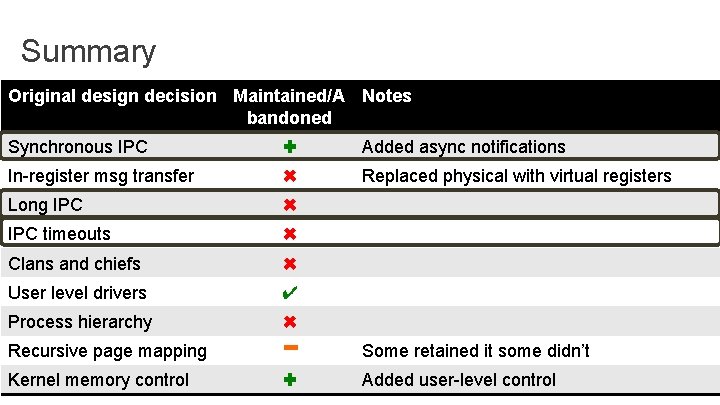
Summary Original design decision Maintained/A Notes bandoned Synchronous IPC ✚ Added async notifications In-register msg transfer ✖ Replaced physical with virtual registers Long IPC ✖ IPC timeouts ✖ Clans and chiefs ✖ User level drivers ✔ Process hierarchy ✖ Recursive page mapping Kernel memory control Some retained it some didn’t ✚ Added user-level control
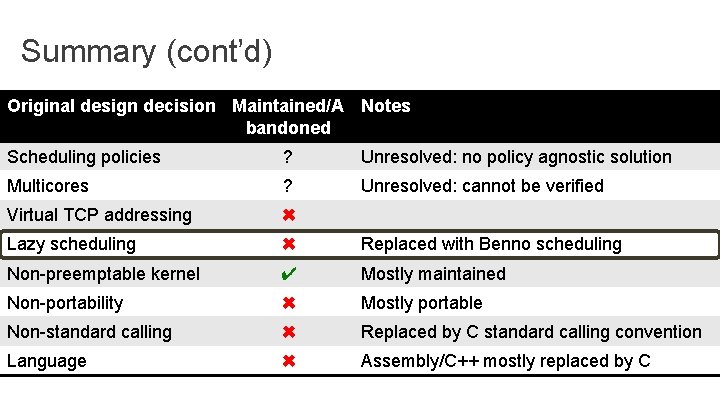
Summary (cont’d) Original design decision Maintained/A Notes bandoned Scheduling policies ? Unresolved: no policy agnostic solution Multicores ? Unresolved: cannot be verified Virtual TCP addressing ✖ Lazy scheduling ✖ Replaced with Benno scheduling Non-preemptable kernel ✔ Mostly maintained Non-portability ✖ Mostly portable Non-standard calling ✖ Replaced by C standard calling convention Language ✖ Assembly/C++ mostly replaced by C
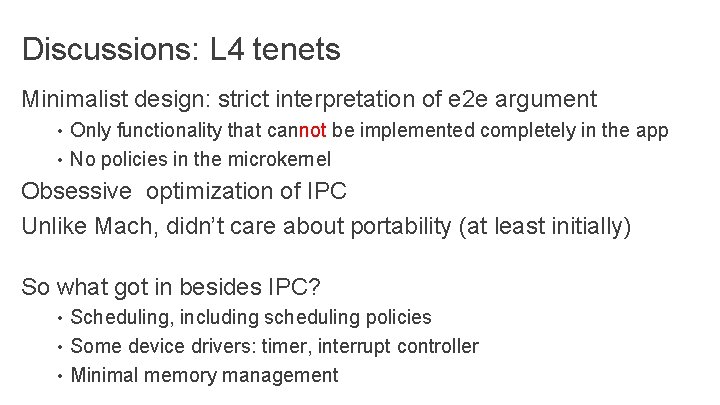
Discussions: L 4 tenets Minimalist design: strict interpretation of e 2 e argument • Only functionality that cannot be implemented completely in the app • No policies in the microkernel Obsessive optimization of IPC Unlike Mach, didn’t care about portability (at least initially) So what got in besides IPC? • Scheduling, including scheduling policies • Some device drivers: timer, interrupt controller • Minimal memory management
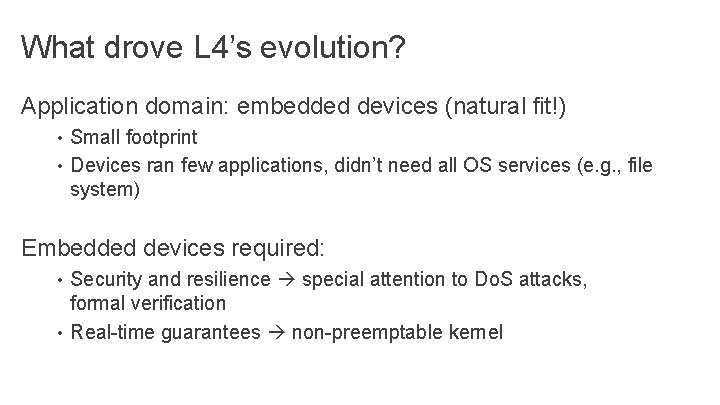
What drove L 4’s evolution? Application domain: embedded devices (natural fit!) • Small footprint • Devices ran few applications, didn’t need all OS services (e. g. , file system) Embedded devices required: • Security and resilience special attention to Do. S attacks, formal verification • Real-time guarantees non-preemptable kernel
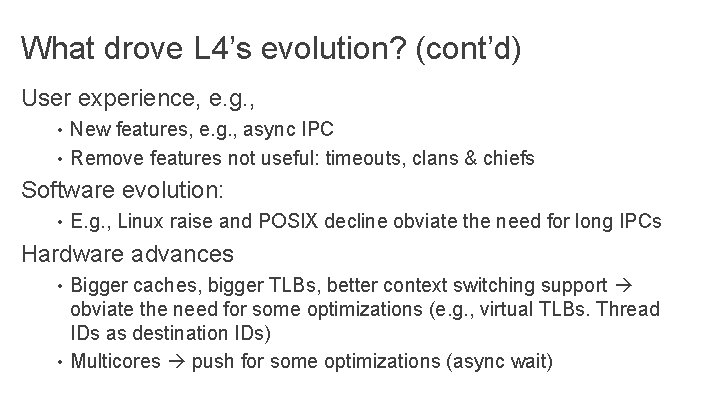
What drove L 4’s evolution? (cont’d) User experience, e. g. , • New features, e. g. , async IPC • Remove features not useful: timeouts, clans & chiefs Software evolution: • E. g. , Linux raise and POSIX decline obviate the need for long IPCs Hardware advances • Bigger caches, bigger TLBs, better context switching support obviate the need for some optimizations (e. g. , virtual TLBs. Thread IDs as destination IDs) • Multicores push for some optimizations (async wait)
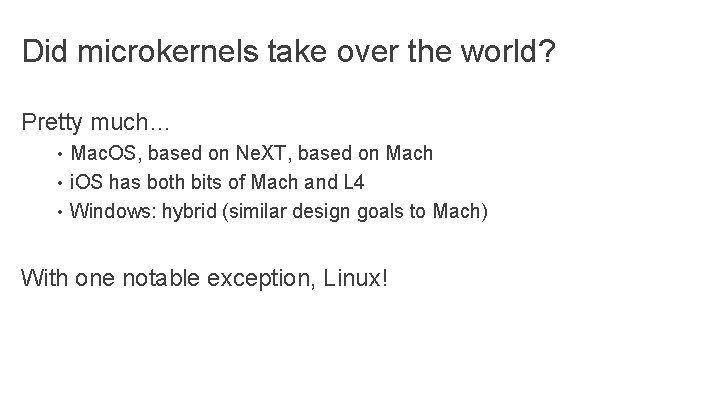
Did microkernels take over the world? Pretty much… • Mac. OS, based on Ne. XT, based on Mach • i. OS has both bits of Mach and L 4 • Windows: hybrid (similar design goals to Mach) With one notable exception, Linux!
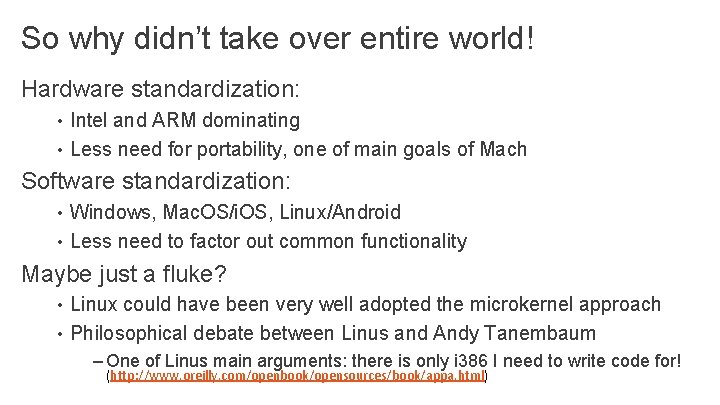
So why didn’t take over entire world! Hardware standardization: • Intel and ARM dominating • Less need for portability, one of main goals of Mach Software standardization: • Windows, Mac. OS/i. OS, Linux/Android • Less need to factor out common functionality Maybe just a fluke? • Linux could have been very well adopted the microkernel approach • Philosophical debate between Linus and Andy Tanembaum – One of Linus main arguments: there is only i 386 I need to write code for! (http: //www. oreilly. com/openbook/opensources/book/appa. html)