
Microirrigation design Oregon NRCS Engineering Meeting January 11





- Slides: 63
Microirrigation design Oregon NRCS Engineering Meeting January 11 -14, 2005 United States Department of Agriculture NRC Natural Resources Conservation Service
n n Over view Water requirement –System Flow rate Pressure requirement Component design
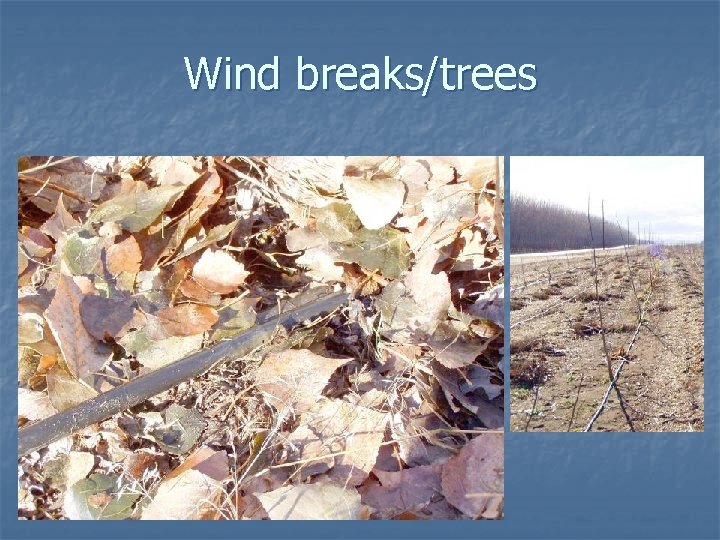
Wind breaks/trees
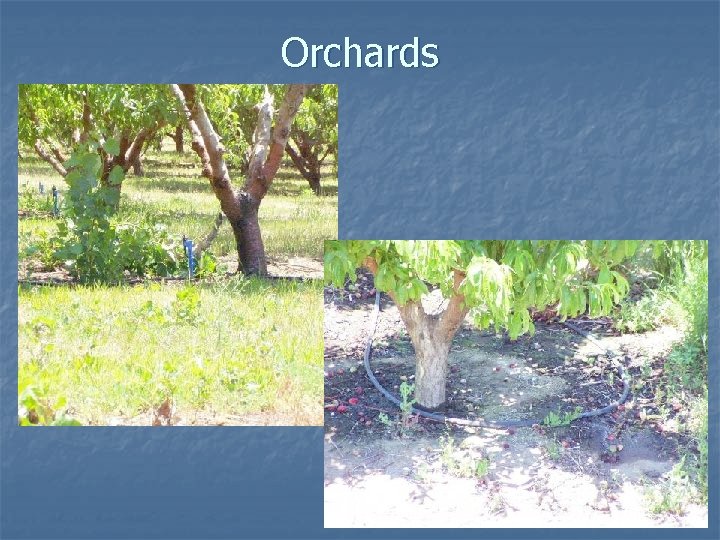
Orchards
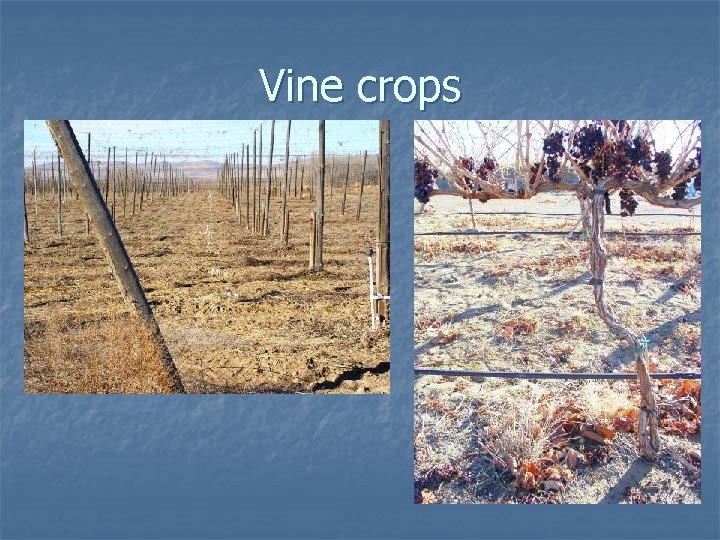
Vine crops
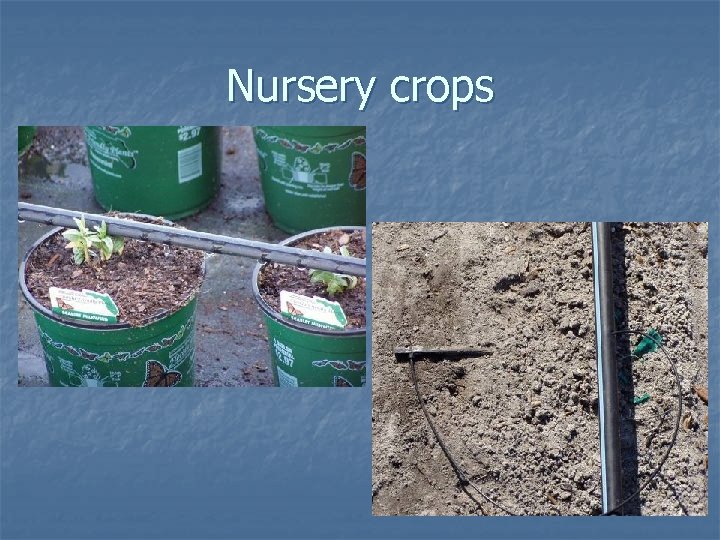
Nursery crops
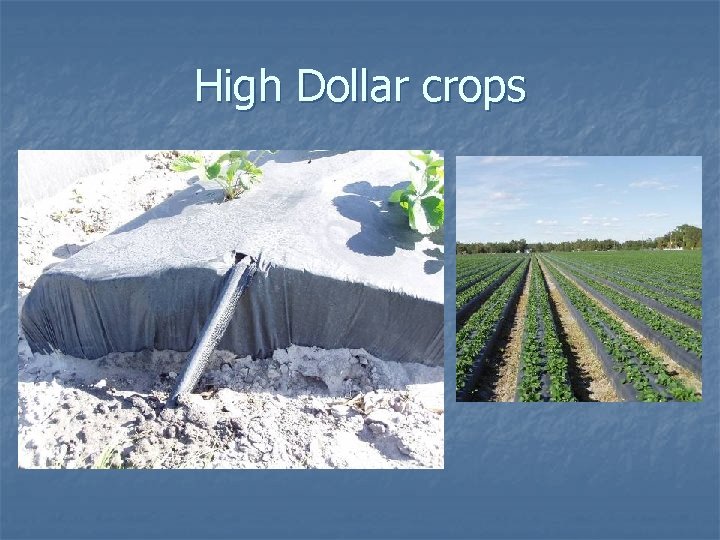
High Dollar crops
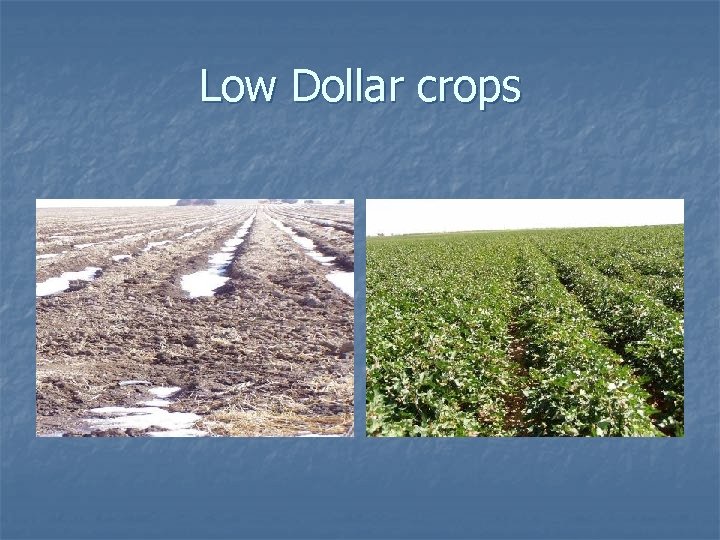
Low Dollar crops
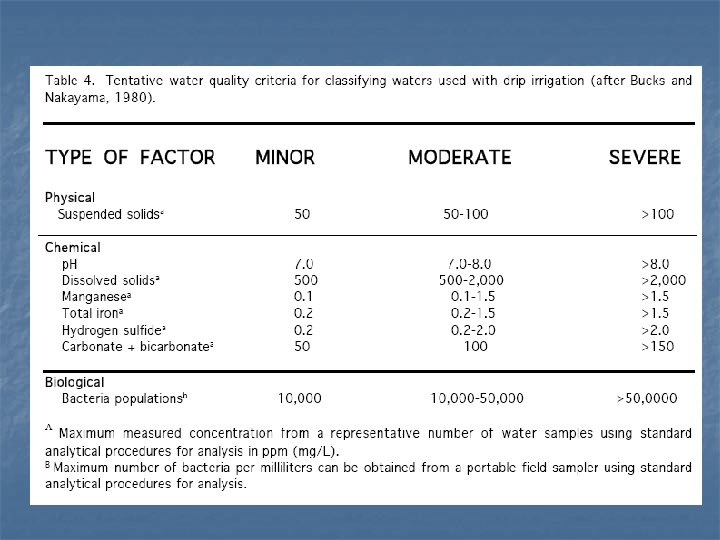
Water Quality n Water quality factors can be divided into three major categories: n n n physical clogging caused mostly by suspended solids, chemical clogging resulting from p. H of the water, dissolved solids, sodium, calcium, magnesium and total iron and biological clogging resulting from algae and bacterial populations.
System Flow rate
NRCS Standards Depth of application. n Net depth of application shall be sufficient to replace the water used by the plant during the plant peak use period. n Applications shall include adequate water for leaching to maintain a steady state salt balance.
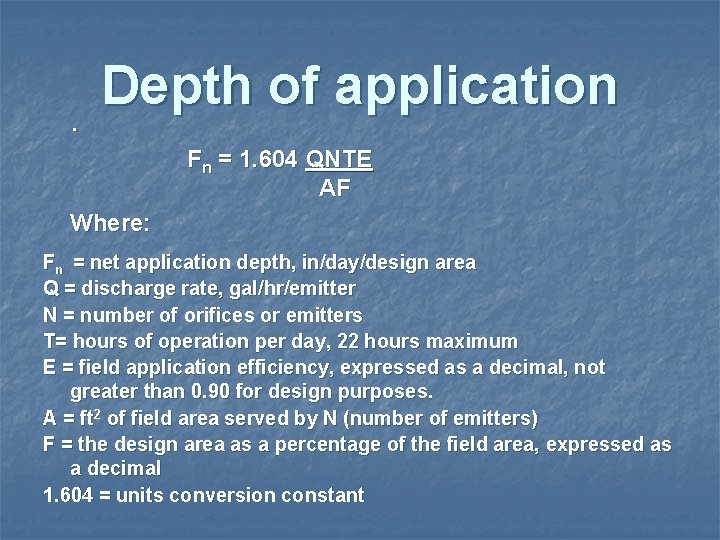
. Depth of application Fn = 1. 604 QNTE AF Where: Fn = net application depth, in/day/design area Q = discharge rate, gal/hr/emitter N = number of orifices or emitters T= hours of operation per day, 22 hours maximum E = field application efficiency, expressed as a decimal, not greater than 0. 90 for design purposes. A = ft 2 of field area served by N (number of emitters) F = the design area as a percentage of the field area, expressed as a decimal 1. 604 = units conversion constant
System capacity. n shall be adequate to meet the intended water demands during the peak use period n shall include an allowance for reasonable water losses (evaporation, runoff, and deep percolation) during application periods. n shall have the capacity to apply a specified amount of water to the design area within the net operation period.
System capacity Continued n should have a minimum design capacity sufficient to deliver the peak daily irrigation water requirements in 90% of the time available, but not to exceed 22 hours of operation per day. n Field application efficiency (E) for design purposes shall not exceed 90 percent.
Number and spacing of emitters. n shall be adequate to provide water distribution to the plant root zone and percent plant wetted area (Pw).
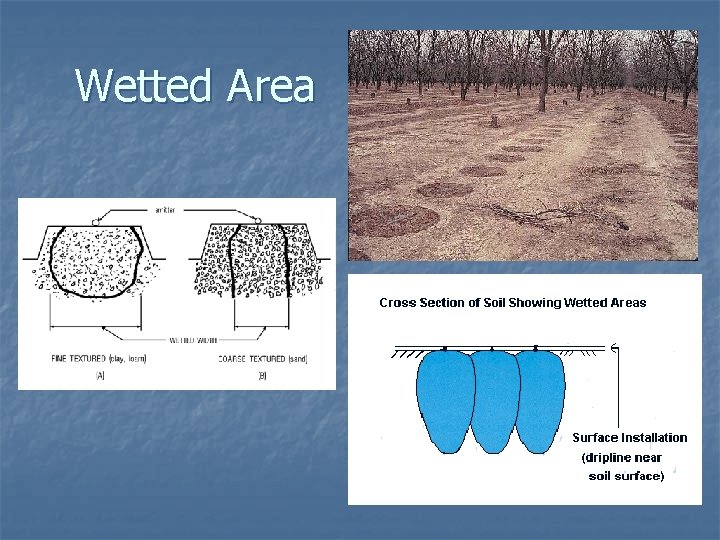
Wetted Area
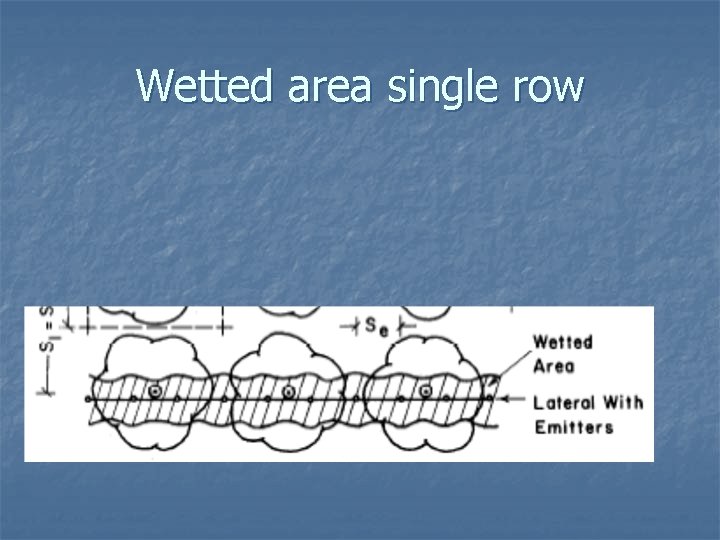
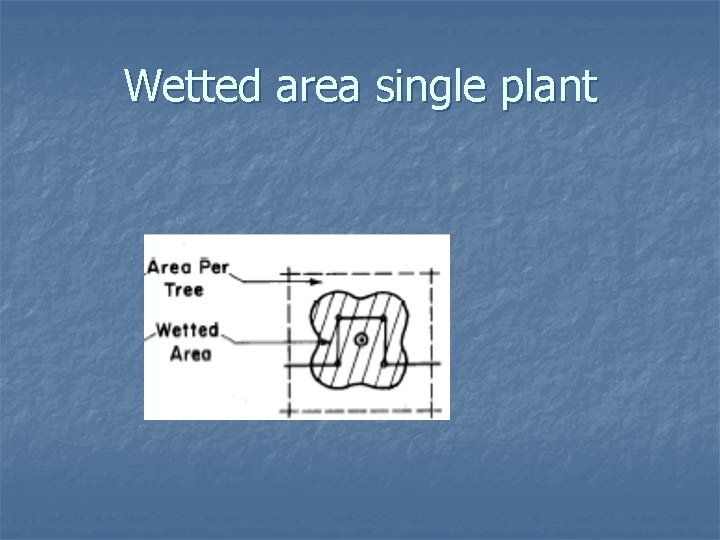
Percent Wetted Area n n n For widely spaced crops such as vines, bushes, and trees, a reasonable design objective is to wet at least one-third and up to one-half of the horizontal cross-sectional area of the root system. smaller Pw is favored for economic reasons. rows spaced less than 6 ft. (1. 83 m) apart, the Pw may approach 100 %.
Wetted area single row
Wetted area single plant
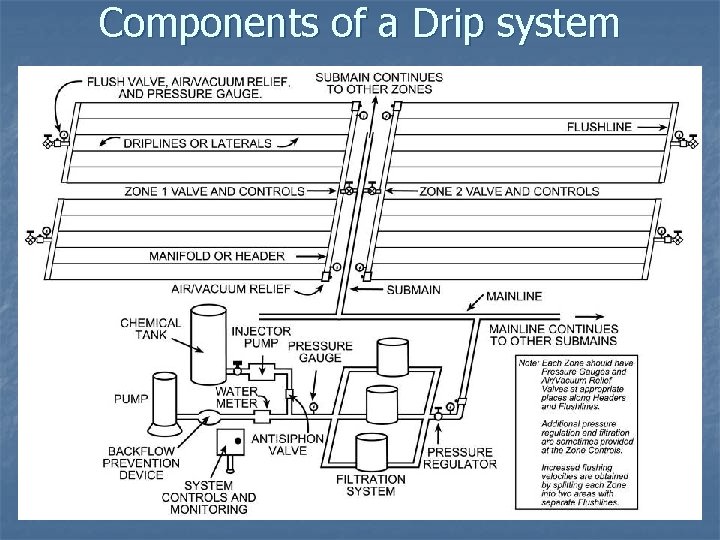
Components of a Drip system
Subunit Design n n n Plant and emitter spacing Average emitter flow rate and allowable pressure head variations Desired number of operating stations Overall length of plant rows in field or subset Number of plant rows in field or subset Field topography
Emitter types n n n Long path emitters, Short orifice emitters, Vortex emitters, Pressure compensating emitters, Porous pipe or tube emitters.
Emitter manufacturing variability The manufacturer’s coefficient of variation (CV) shall be less than 0. 07 for point source emitters and less than 0. 20 for line source emitters.
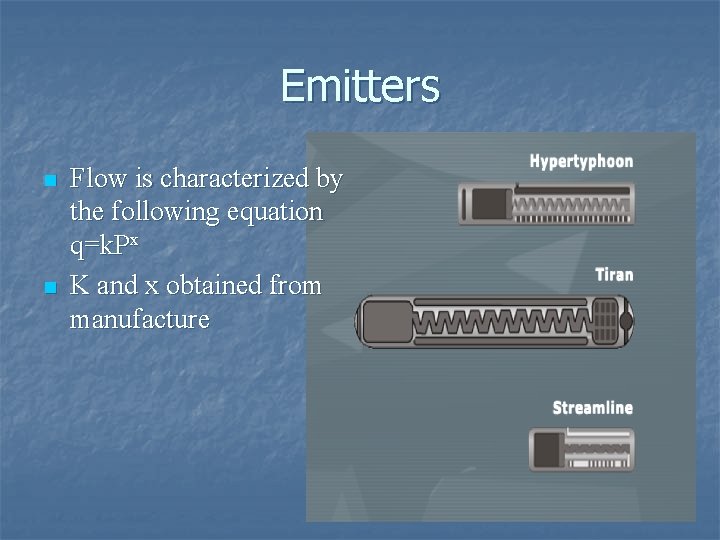
Emitters n n Flow is characterized by the following equation q=k. Px K and x obtained from manufacture
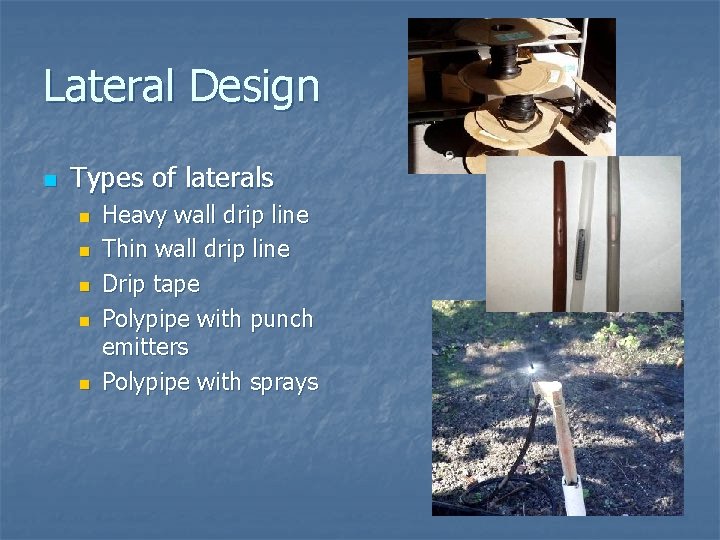
Lateral Design n Types of laterals n n n Heavy wall drip line Thin wall drip line Drip tape Polypipe with punch emitters Polypipe with sprays
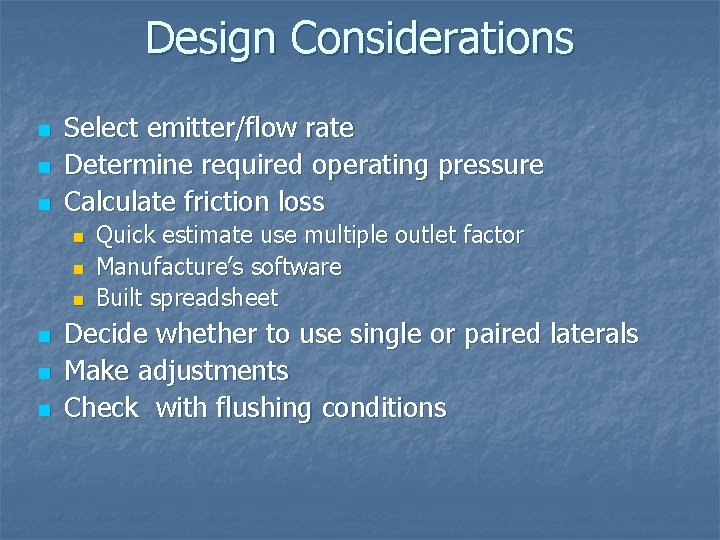
Design Considerations n n n Select emitter/flow rate Determine required operating pressure Calculate friction loss n n n Quick estimate use multiple outlet factor Manufacture’s software Built spreadsheet Decide whether to use single or paired laterals Make adjustments Check with flushing conditions
Slope and topography
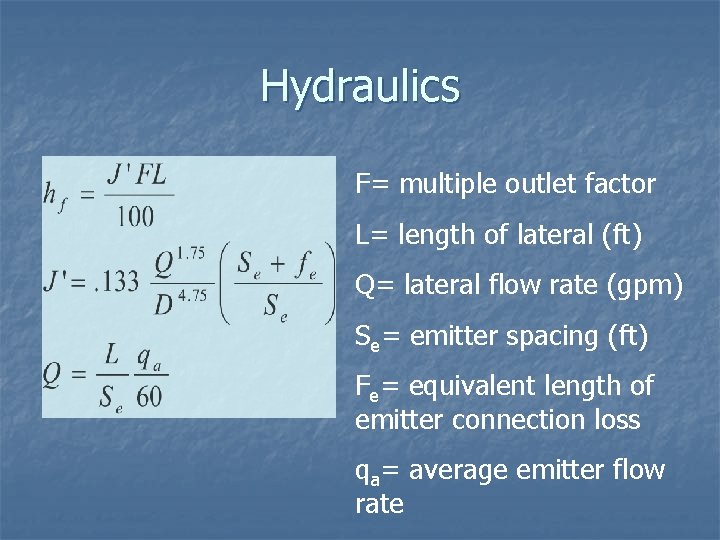
Hydraulics F= multiple outlet factor L= length of lateral (ft) Q= lateral flow rate (gpm) Se= emitter spacing (ft) Fe= equivalent length of emitter connection loss qa= average emitter flow rate
Emission Uniformity n Emission Uniformity Rating 90 - 100% Excellent 80 - 90% Good 70 - 80% Fair Less than 70% Poor
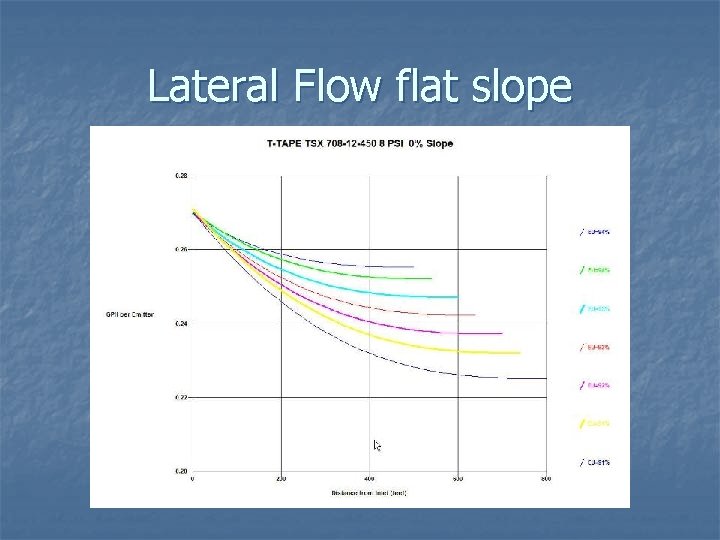
Lateral Flow flat slope
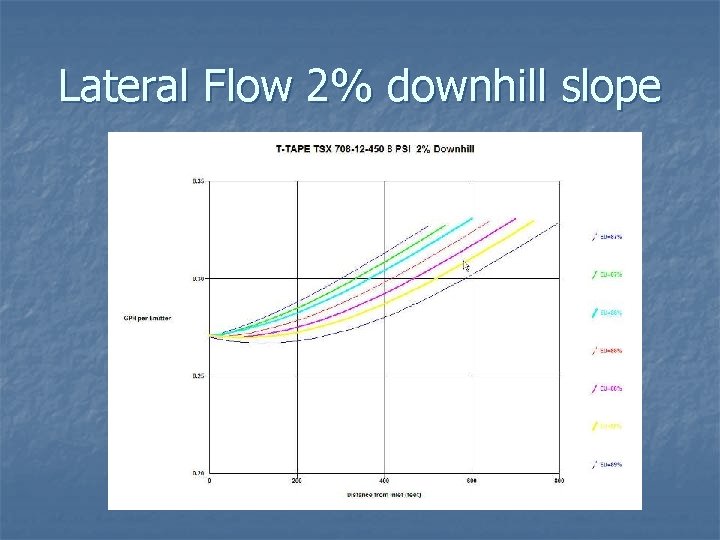
Lateral Flow 2% downhill slope
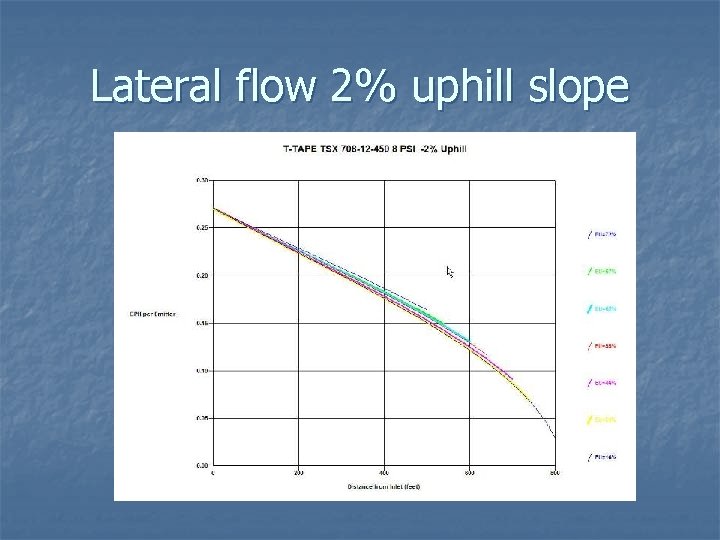
Lateral flow 2% uphill slope
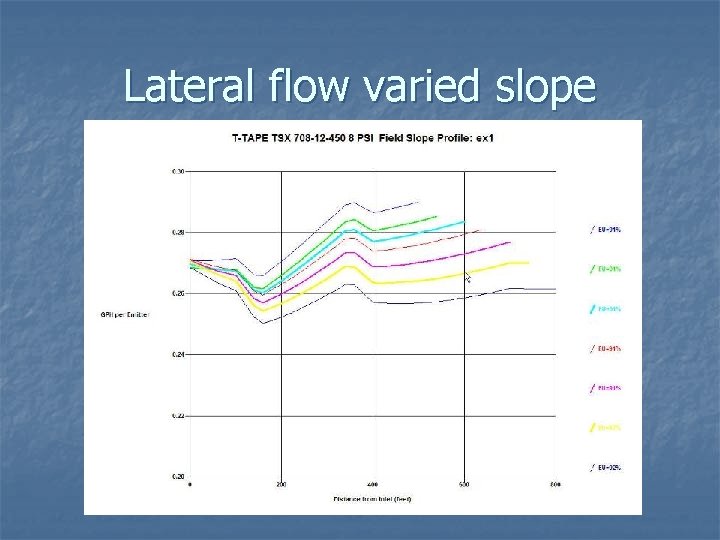
Lateral flow varied slope
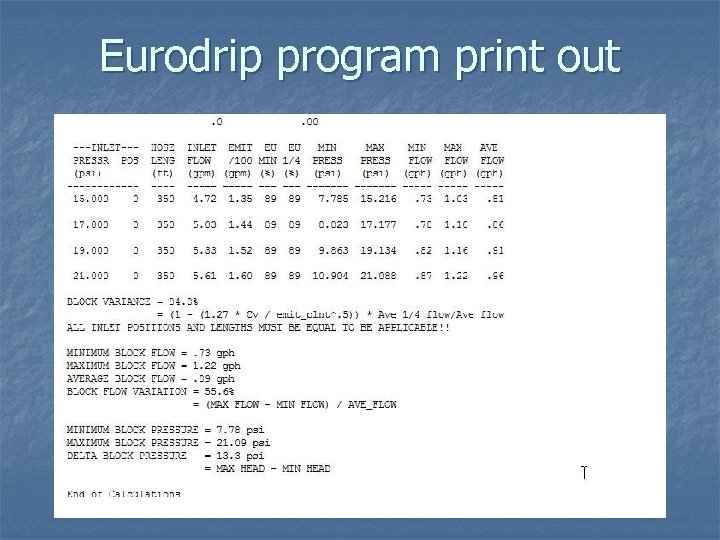
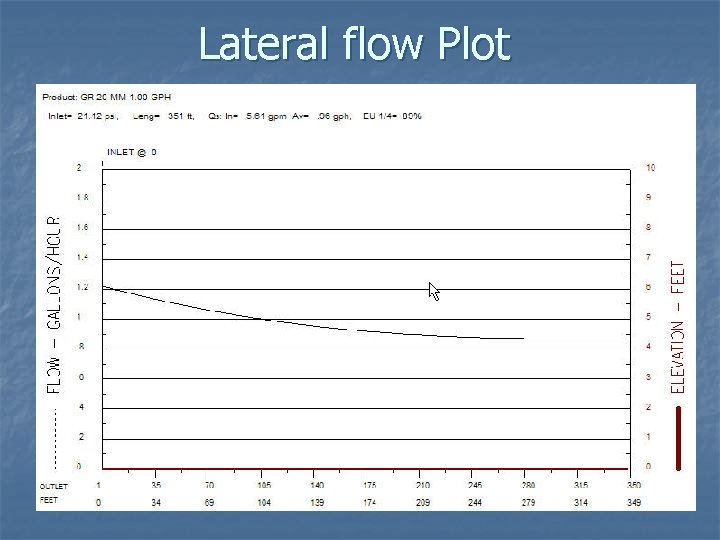
Eurodrip program print out
Lateral flow Plot
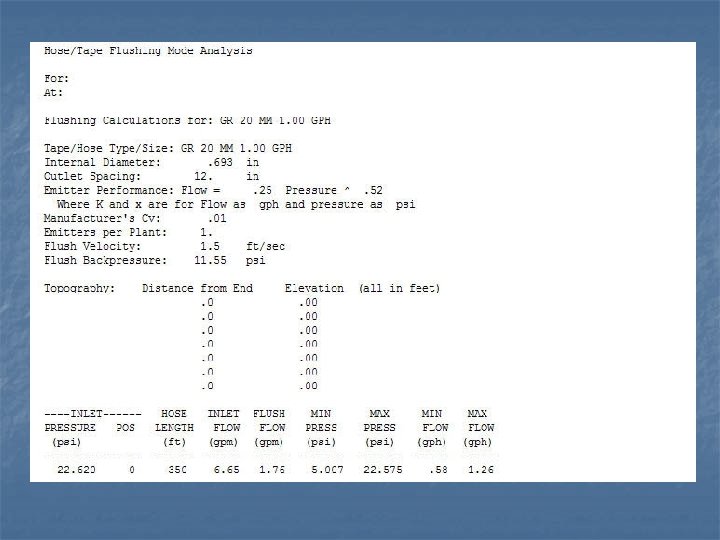
System flushing. n Appropriate fittings shall be installed above ground at the ends of all mains, submains, and laterals to facilitate flushing. A minimum flow velocity of 1 ft/sec is considered adequate for flushing.
Manifold Design Needed information Flow rate n Inlet location n Pipe sizes n Inlet pressure n Flow variation n Emissions uniformity n
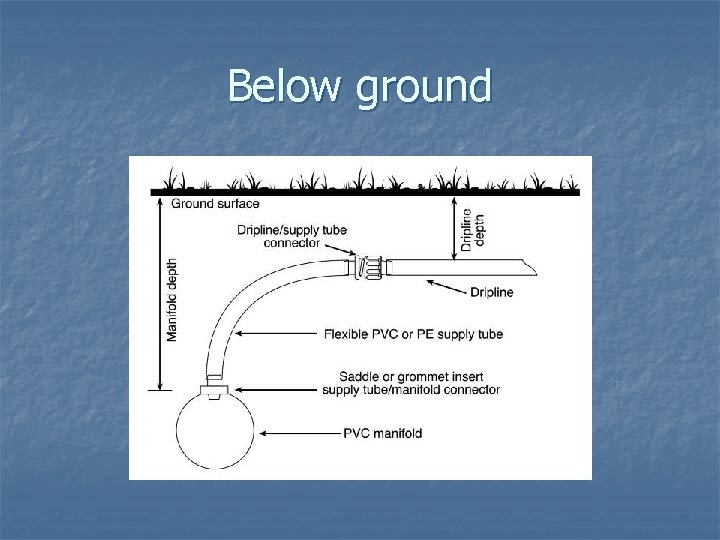
Below ground
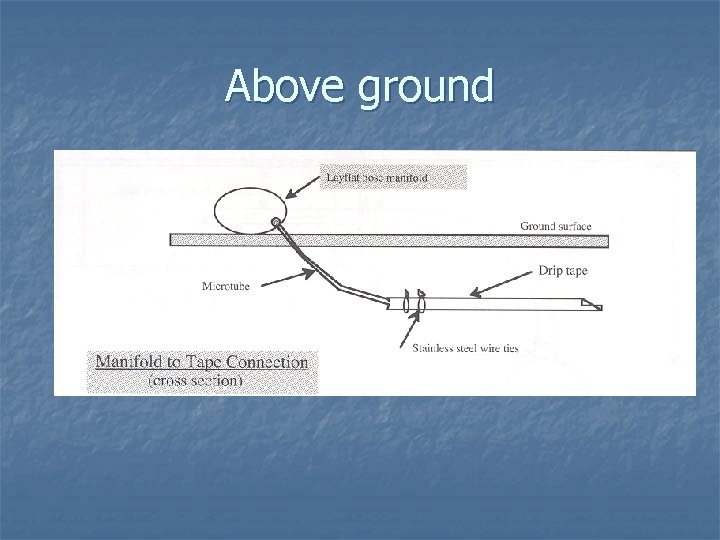
Above ground
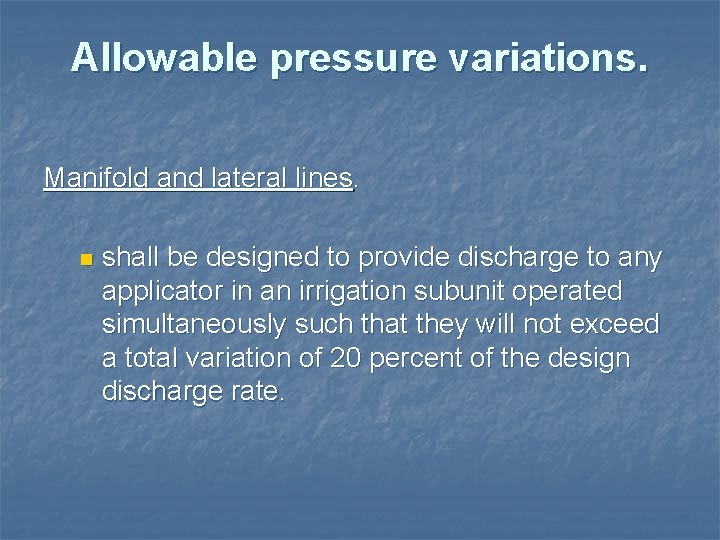
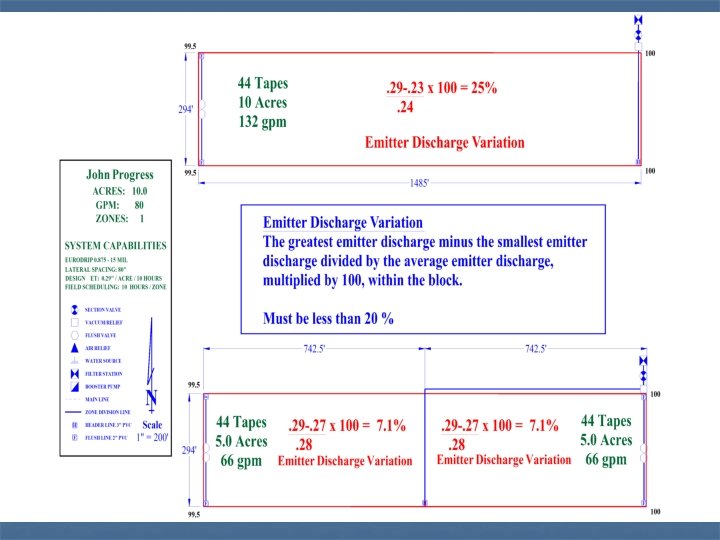
Allowable pressure variations. Manifold and lateral lines. n shall be designed to provide discharge to any applicator in an irrigation subunit operated simultaneously such that they will not exceed a total variation of 20 percent of the design discharge rate.
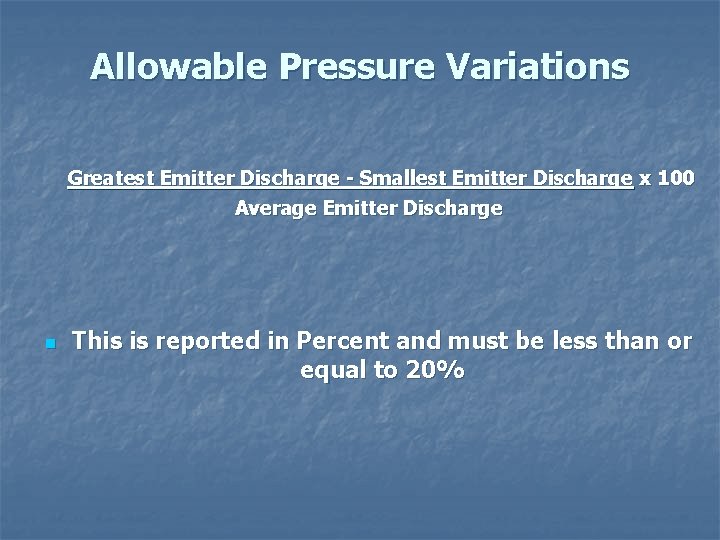
Allowable Pressure Variations Greatest Emitter Discharge - Smallest Emitter Discharge x 100 Average Emitter Discharge n This is reported in Percent and must be less than or equal to 20%
Flushing n Method Manual n Manifold n Size n friction loss through manifold and valves n n Frequency
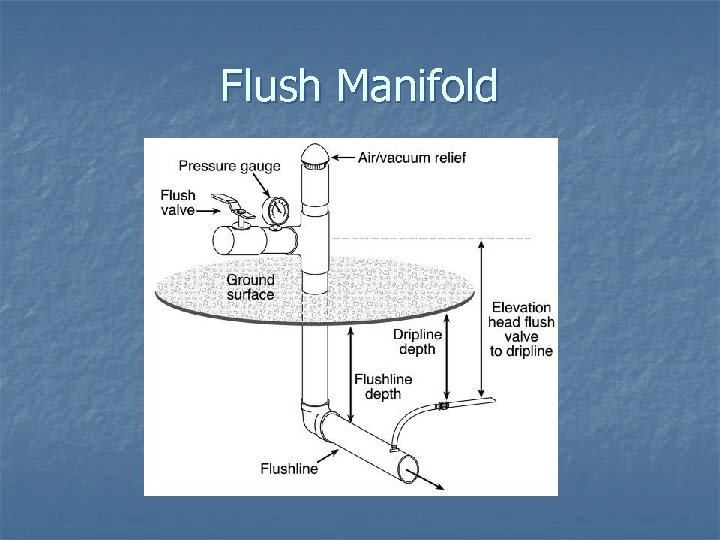
Flush Manifold
Main line design n Size system flow rate pressure loss
Filters n shall be provided at the system inlet. Under clean conditions, filters shall be designed for a head loss of 5 psi or less. n shall be sized to prevent the passage of solids in sizes or quantities that might obstruct the emitter openings. n shall be designed to remove solids equal to or larger than one-fourth the emitter opening diameter, or the emitter manufacturer's recommendations, whichever is more stringent
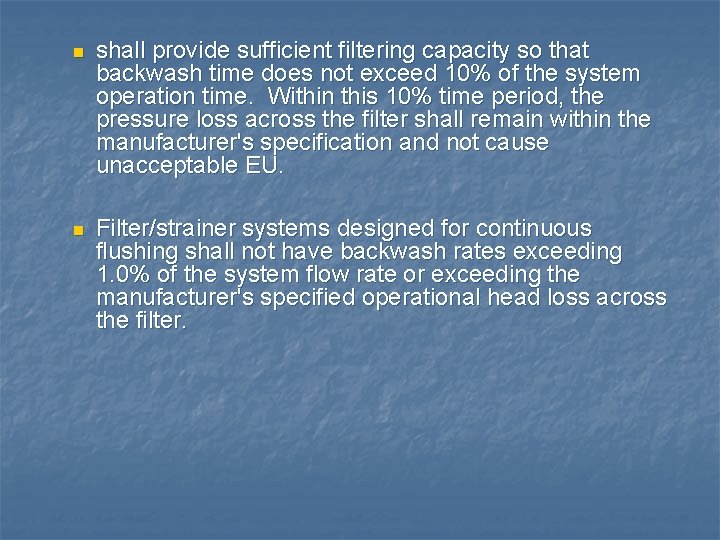
n shall provide sufficient filtering capacity so that backwash time does not exceed 10% of the system operation time. Within this 10% time period, the pressure loss across the filter shall remain within the manufacturer's specification and not cause unacceptable EU. n Filter/strainer systems designed for continuous flushing shall not have backwash rates exceeding 1. 0% of the system flow rate or exceeding the manufacturer's specified operational head loss across the filter.
Filter Design n Select Type n May need two n n Pre-filter and primary filter Size Flow rate n Must account for pressure through filter n Must account for pressure required to back flush n
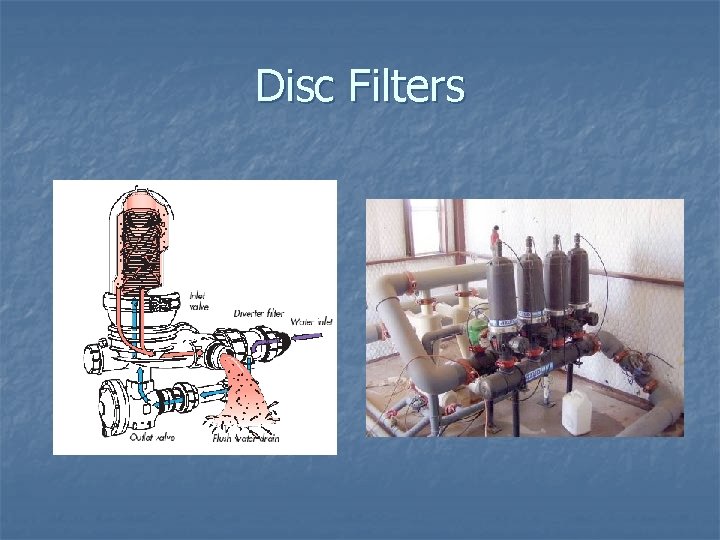
Disc Filters
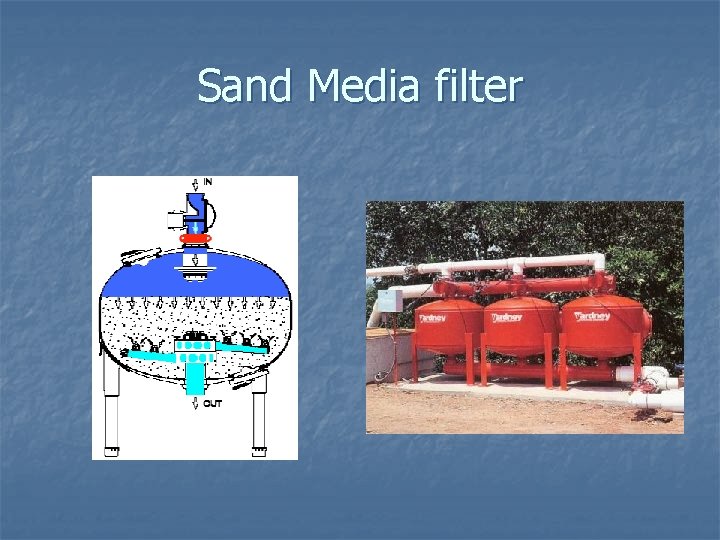
Sand Media filter
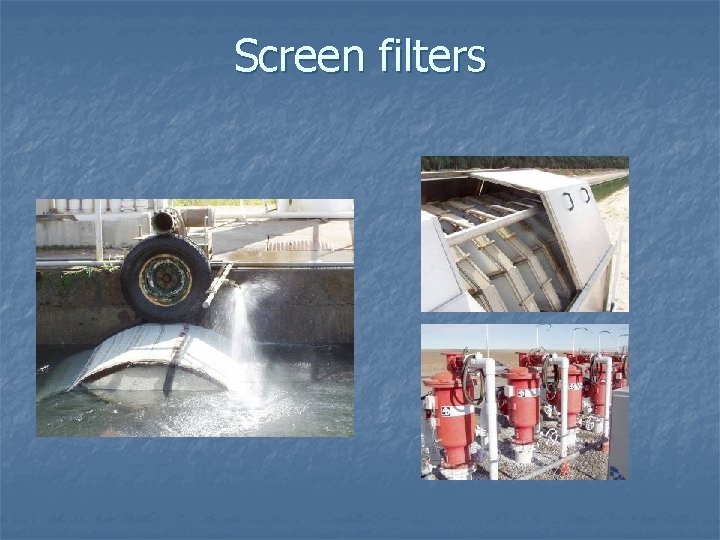
Screen filters
Filter summary
Chemigation. n System EU shall not be less than 85 percent. n Injectors and other automatic operating equipment shall be located adjacent to the pump and power unit, and include integrated back flow prevention protection. n Shall be accomplished in the minimum length of time needed to deliver the chemicals and flush the pipelines.
Select an Injection System n n n Fertilizer Acid ( change ph, help against root intrusion and clogging) Chlorine ( prevent biological clogging) Other water amendments Pesticides Need safety devices ( State regulations)
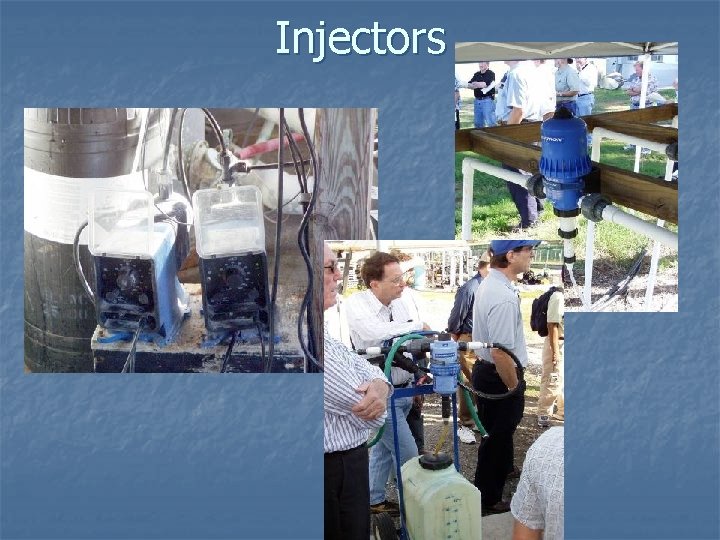
Injectors
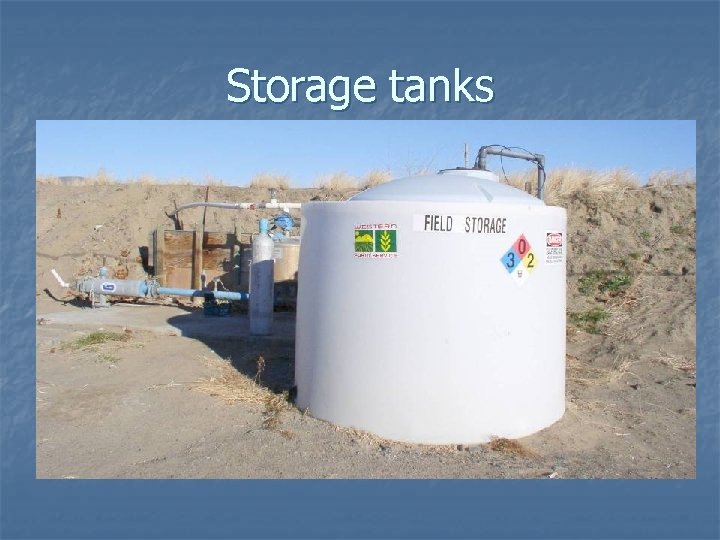
Storage tanks
Pump Design n n Calculate TDH Size Pump
Miscellaneous n n n Automatic controls Pressure regulators Air vents/valves
Summary n Determine Plant information n n Test water quality Select emitter/sprayer n n n Spacing row/plant Water requirement Irrigation frequency Type Spacing Discharge Emitter factors Cv, K, x Design Lateral – normal/flushing n n n size Flow rate Pressure requirement
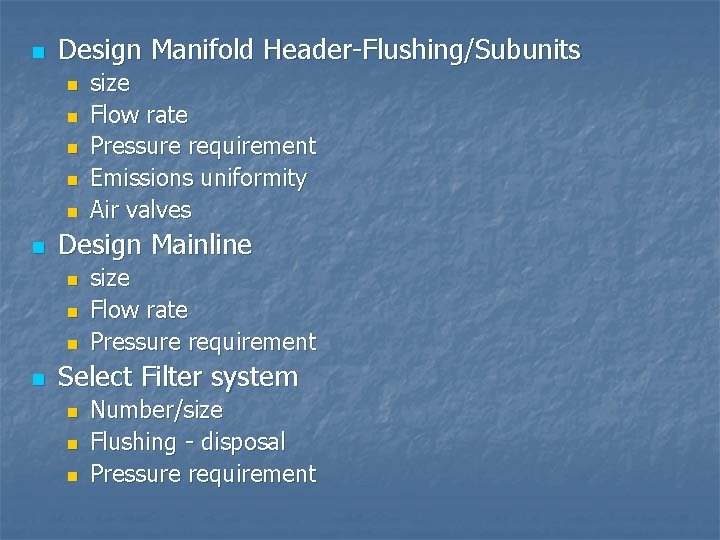
n Design Manifold Header-Flushing/Subunits n n n Design Mainline n n size Flow rate Pressure requirement Emissions uniformity Air valves size Flow rate Pressure requirement Select Filter system n n n Number/size Flushing - disposal Pressure requirement
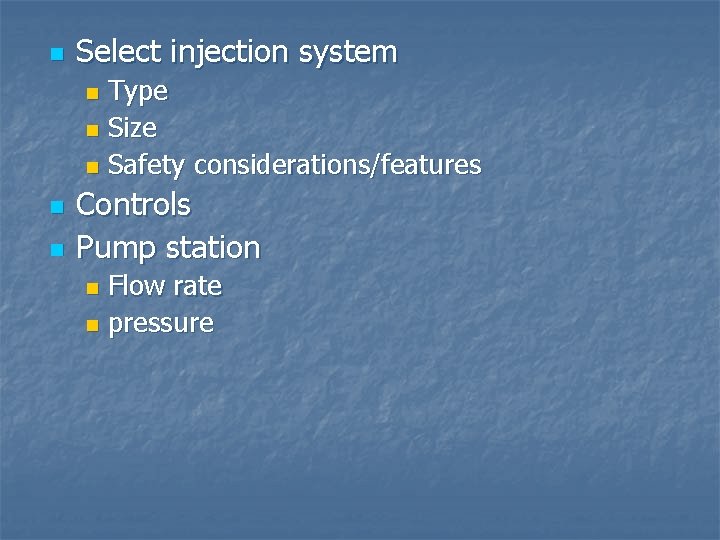
n Select injection system Type n Size n Safety considerations/features n n n Controls Pump station Flow rate n pressure n