
MICROHYDRO SYSTEM TECHNOLOGY Wind and Hydro Power Technologies





- Slides: 40
MICROHYDRO SYSTEM TECHNOLOGY Wind and Hydro Power Technologies Fall 2011 Appalachian State University
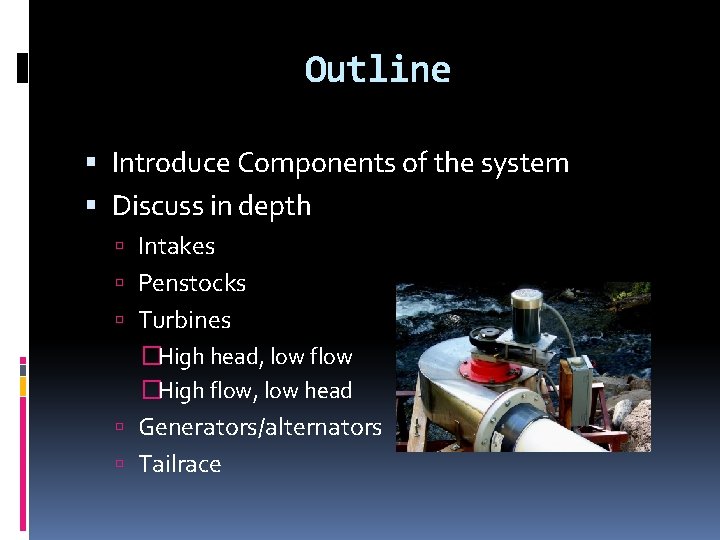
Outline Introduce Components of the system Discuss in depth Intakes Penstocks Turbines �High head, low flow �High flow, low head Generators/alternators Tailrace
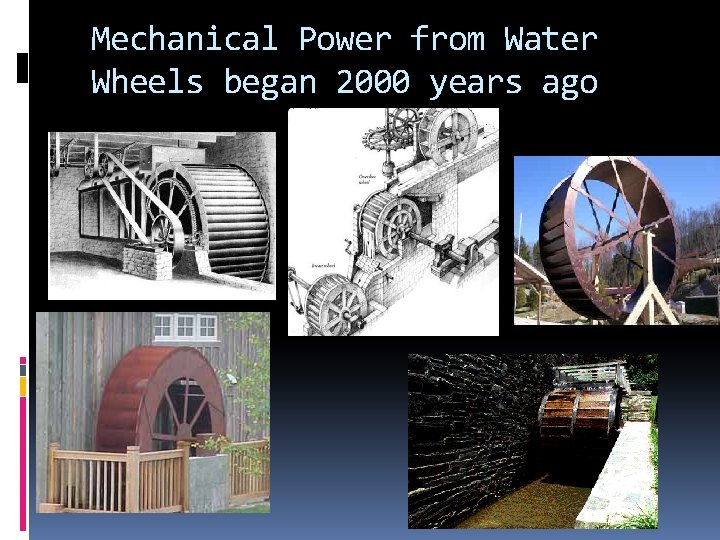
Mechanical Power from Water Wheels began 2000 years ago
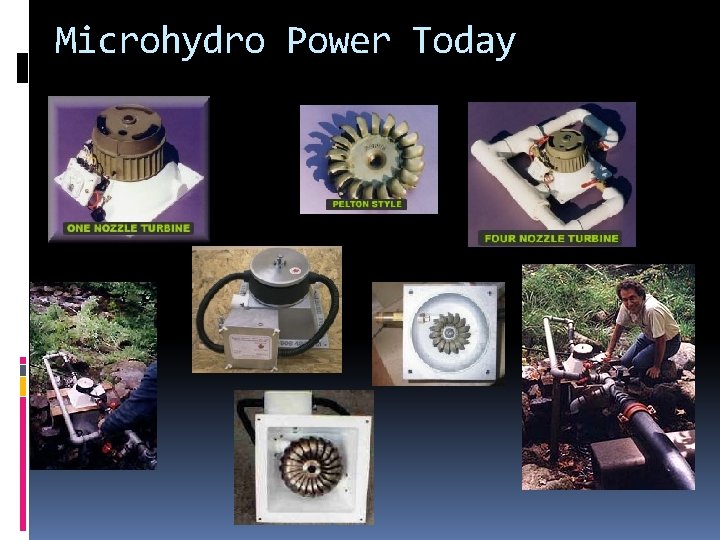
Microhydro Power Today
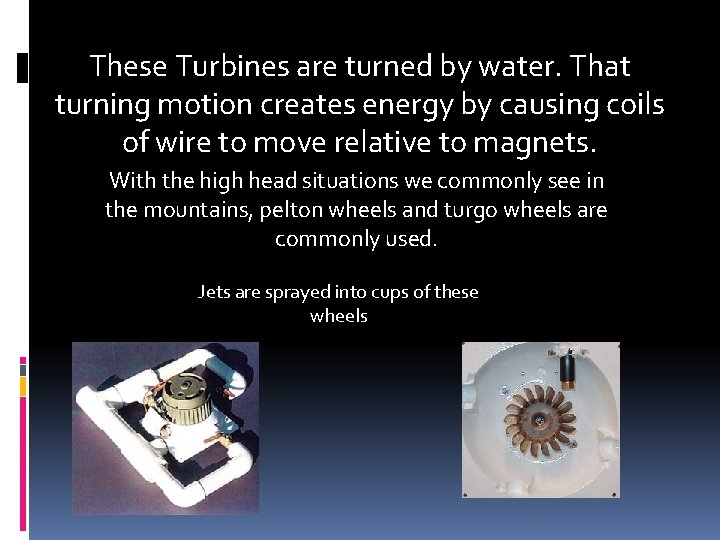
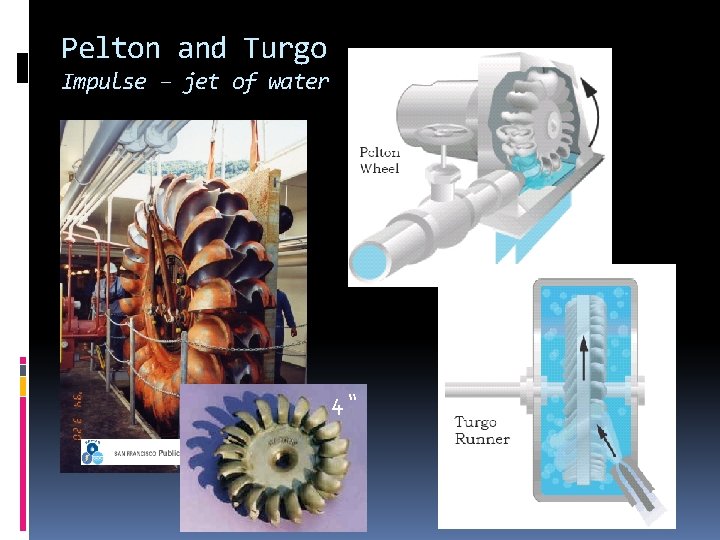
These Turbines are turned by water. That turning motion creates energy by causing coils of wire to move relative to magnets. With the high head situations we commonly see in the mountains, pelton wheels and turgo wheels are commonly used. Jets are sprayed into cups of these wheels
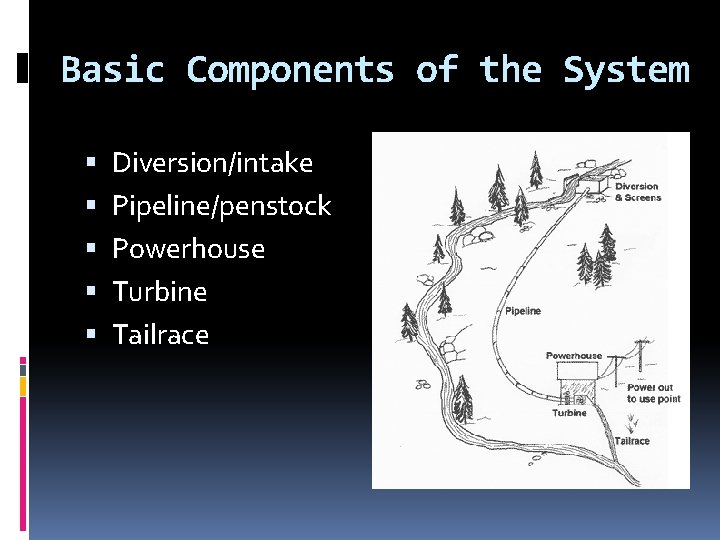
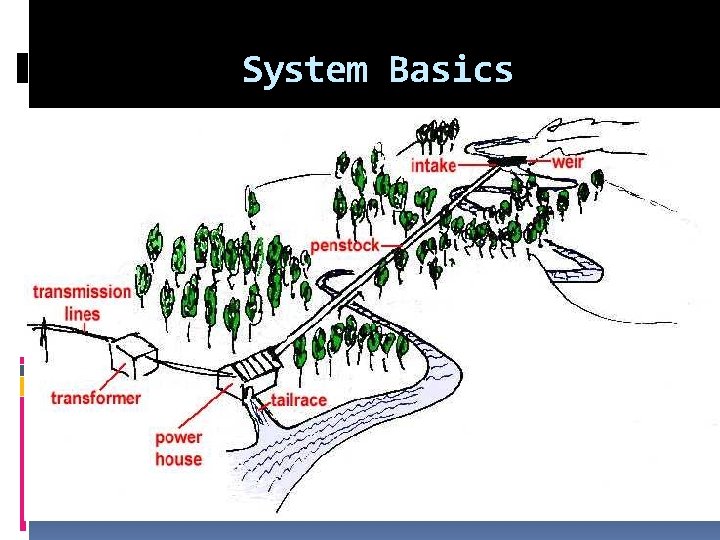
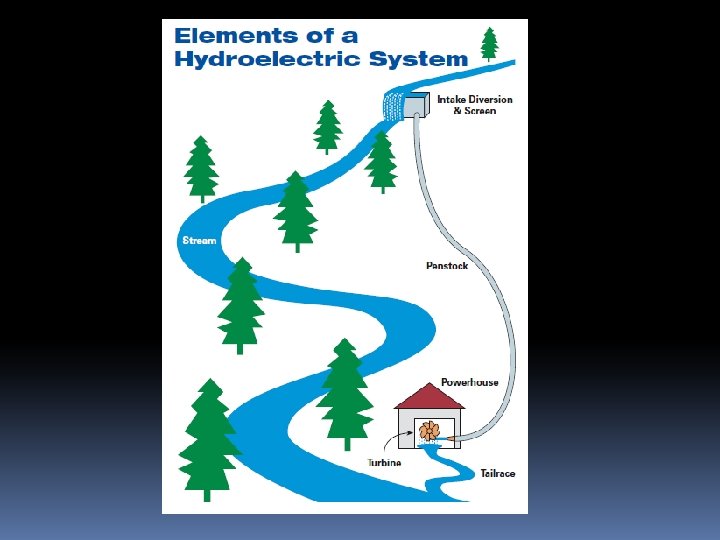
Basic Components of the System Diversion/intake Pipeline/penstock Powerhouse Turbine Tailrace
System Basics
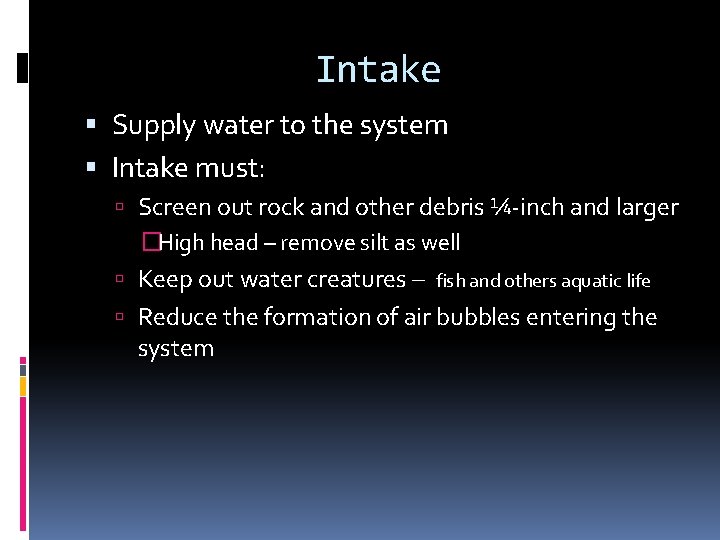
Intake Supply water to the system Intake must: Screen out rock and other debris ¼-inch and larger �High head – remove silt as well Keep out water creatures – fish and others aquatic life Reduce the formation of air bubbles entering the system
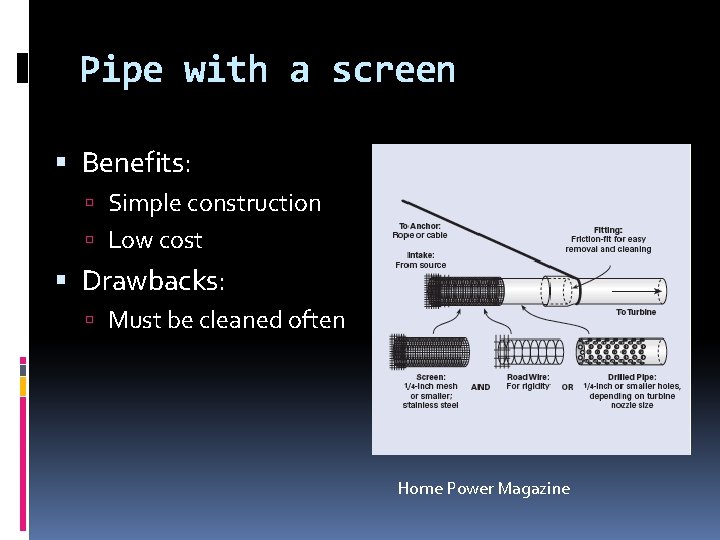
Pipe with a screen Benefits: Simple construction Low cost Drawbacks: Must be cleaned often Home Power Magazine
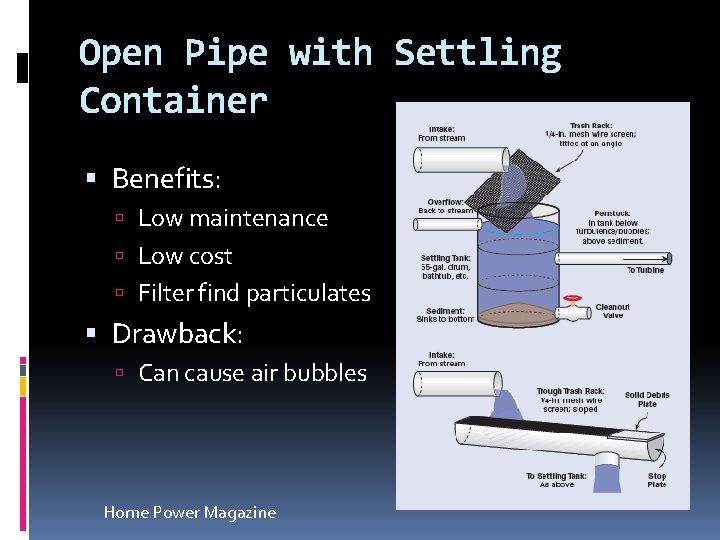
Open Pipe with Settling Container Benefits: Low maintenance Low cost Filter find particulates Drawback: Can cause air bubbles Home Power Magazine
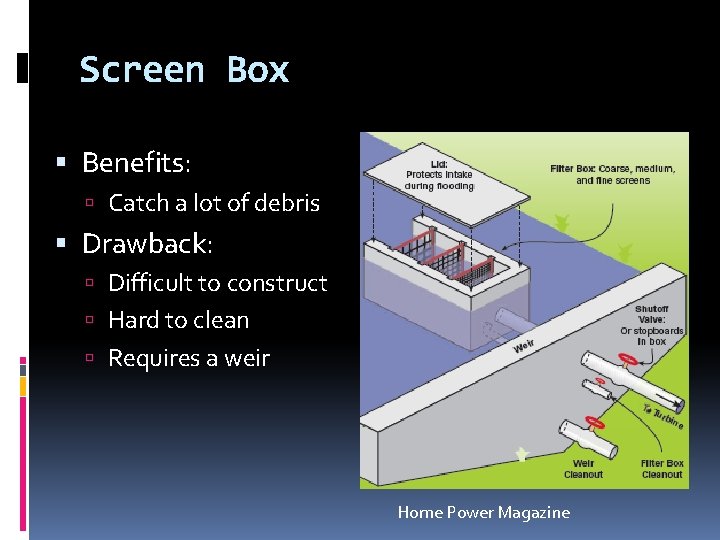
Screen Box Benefits: Catch a lot of debris Drawback: Difficult to construct Hard to clean Requires a weir Home Power Magazine
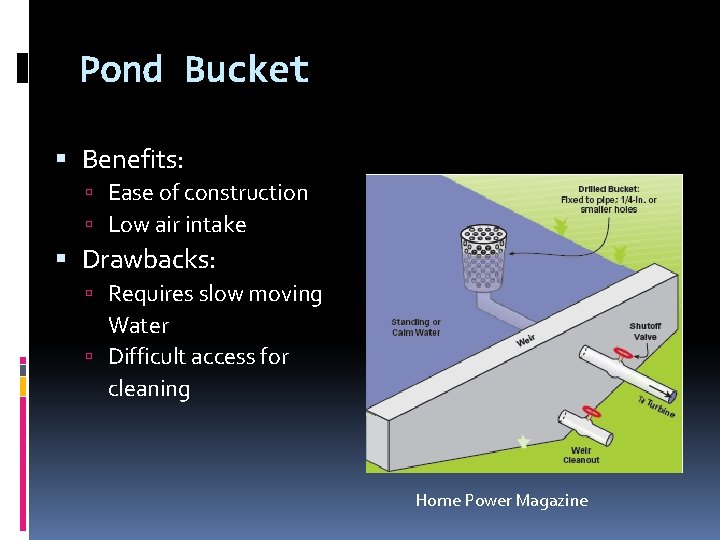
Pond Bucket Benefits: Ease of construction Low air intake Drawbacks: Requires slow moving Water Difficult access for cleaning Home Power Magazine
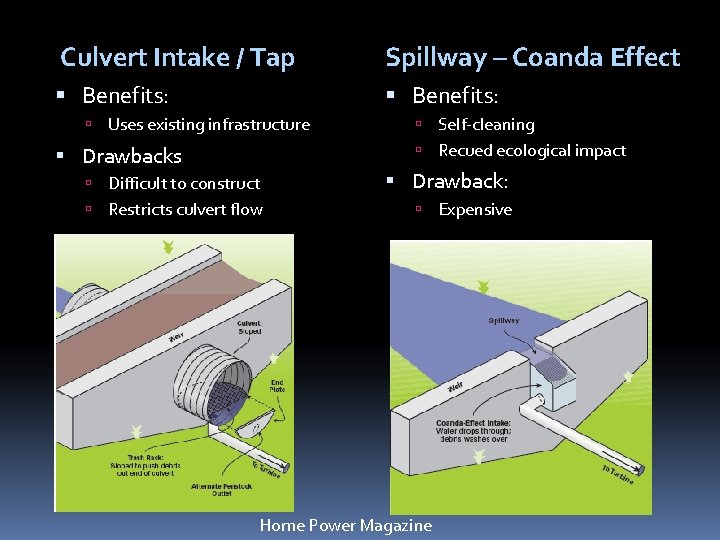
Culvert Intake / Tap Spillway – Coanda Effect Benefits: Uses existing infrastructure Self-cleaning Recued ecological impact Drawbacks Difficult to construct Drawback: Restricts culvert flow Expensive Home Power Magazine
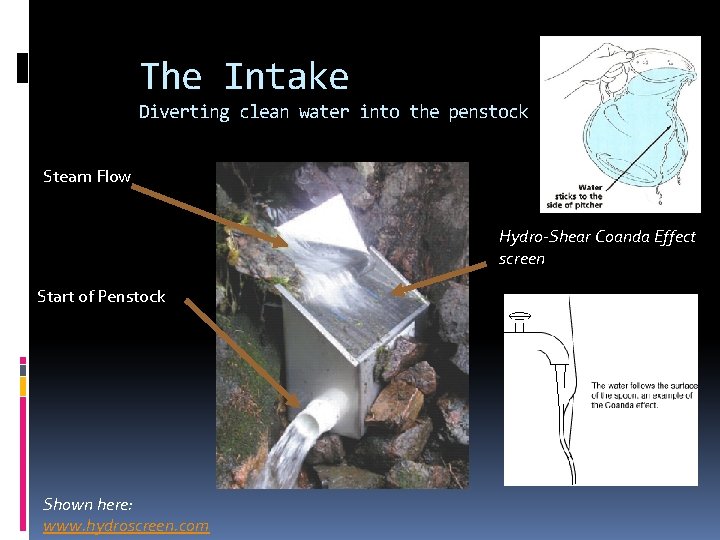
The Intake Diverting clean water into the penstock Steam Flow Hydro-Shear Coanda Effect screen Start of Penstock Shown here: www. hydroscreen. com
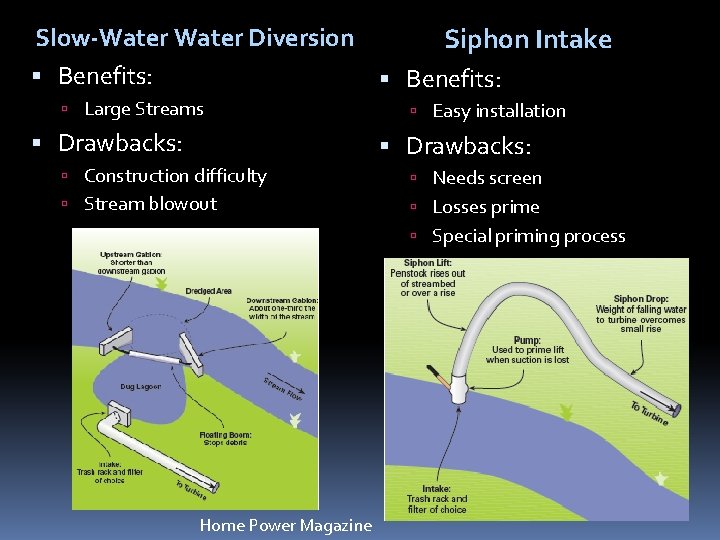
Slow-Water Diversion Siphon Intake Benefits: Large Streams Drawbacks: Easy installation Drawbacks: Construction difficulty Needs screen Stream blowout Losses prime Special priming process Home Power Magazine
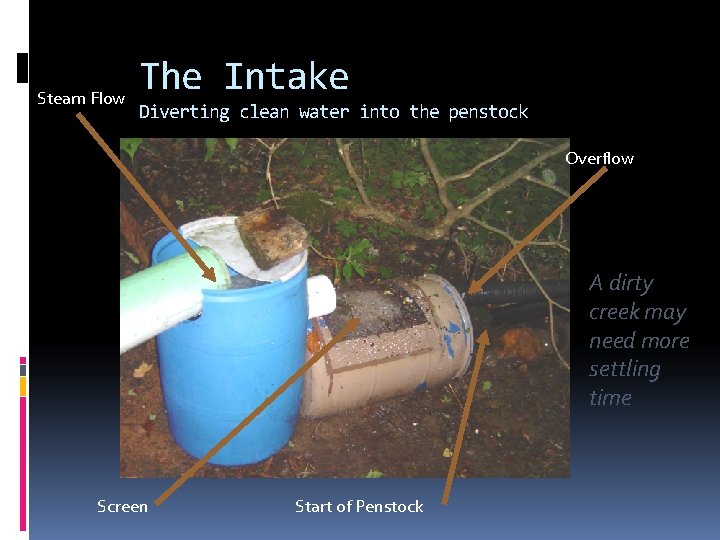
Steam Flow The Intake Diverting clean water into the penstock Overflow A dirty creek may need more settling time Screen Start of Penstock
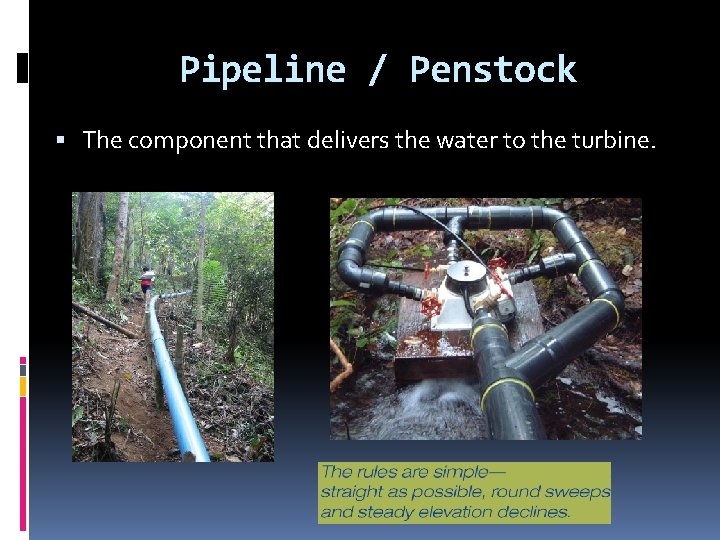
Pipeline / Penstock The component that delivers the water to the turbine.
Factors to Consider surface roughness design pressure method of jointing weight and ease of installation accessibility of the site terrain soil type design life and maintenance weather conditions availability relative cost likelihood of structural damage.
Burying Pipe Burying the penstock improve aesthetics. It is vital to ensure a buried penstock is properly and meticulously installed subsequent problems such as leaks are much harder to detect and rectify. A good idea if using PVC
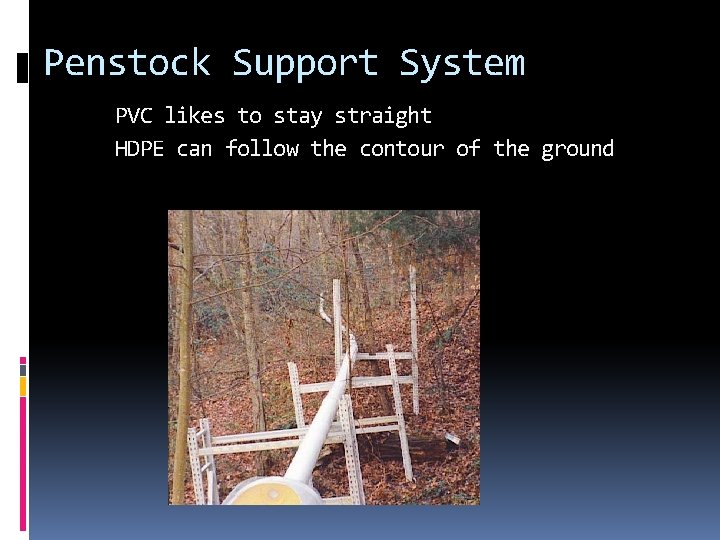
Penstock Support System PVC likes to stay straight HDPE can follow the contour of the ground
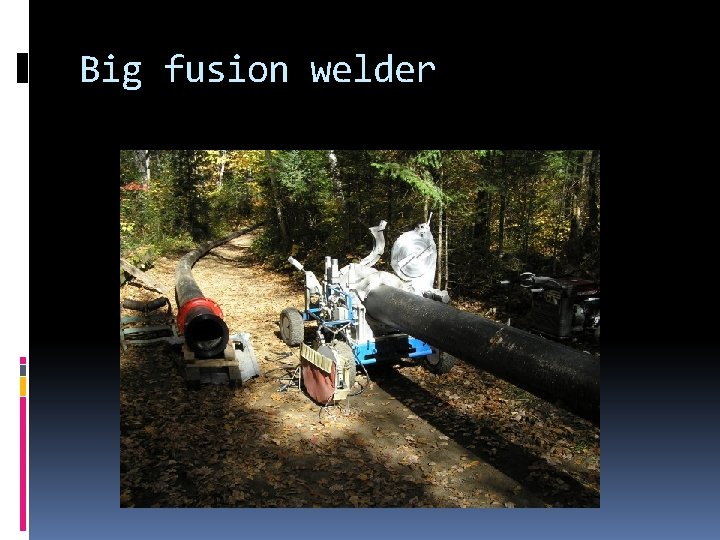
Penstock Materials Steel Rust, rough (high losses) High wear and high pressure (road crossing, bottom of penstock) AL irrigation pipe Low pressure rating Can’t be buried else it will corrode Pressure Rated PVC Readily available and easily joined UV degradation and physical damage Buried, covered or painted PVC sewer pipe Low-budget, not pressure-rated! HPDE (Polyethylene) Toughest, you can drag it into place, can be exposed Joined by a fusion welder
Big fusion welder
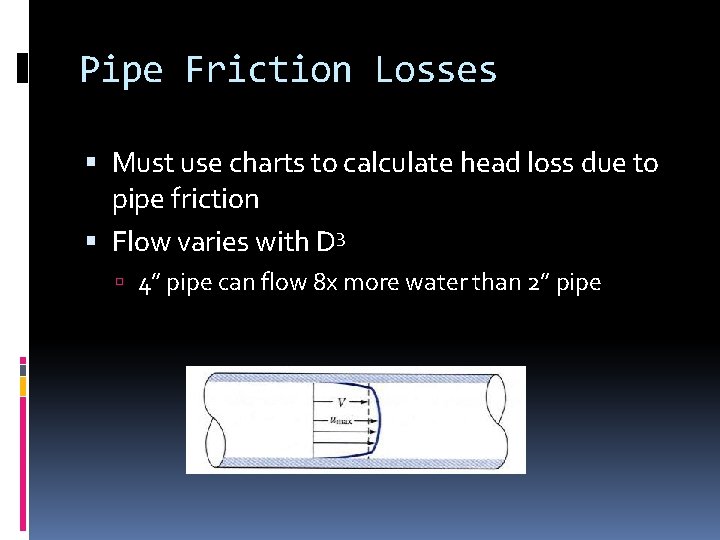
Pipe Friction Losses Must use charts to calculate head loss due to pipe friction Flow varies with D 3 4” pipe can flow 8 x more water than 2” pipe
Types of Turbines
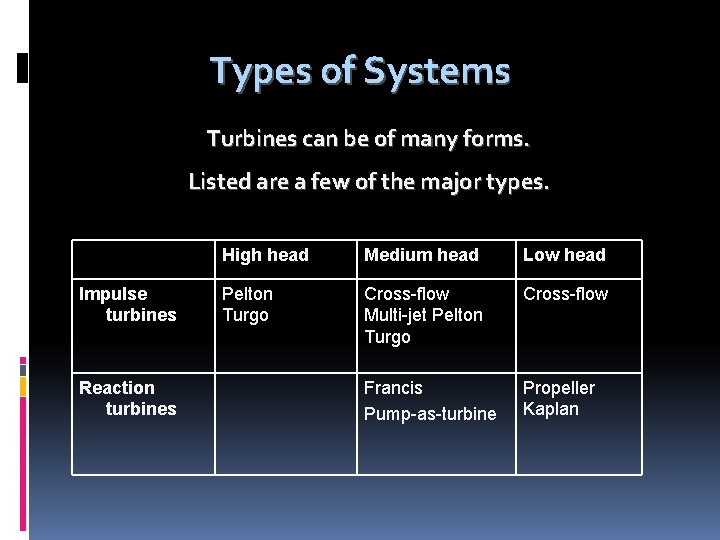
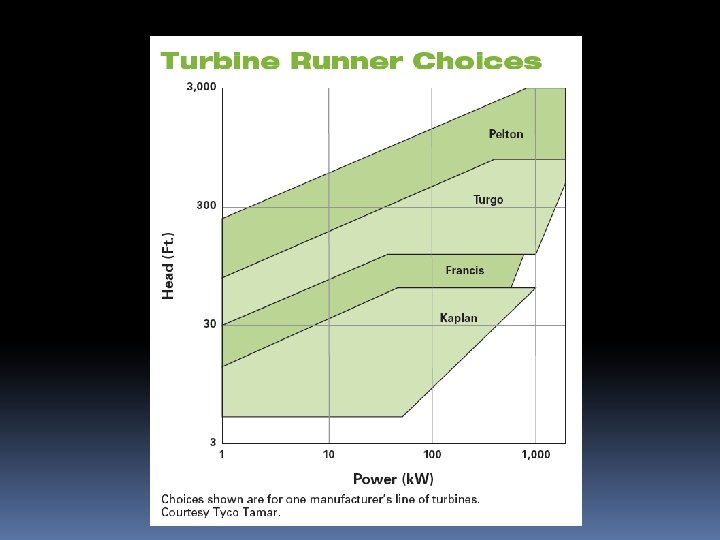
Types of Systems Turbines can be of many forms. Listed are a few of the major types. High head Medium head Low head Impulse turbines Pelton Turgo Cross-flow Multi-jet Pelton Turgo Cross-flow Reaction turbines Francis Pump-as-turbine Propeller Kaplan
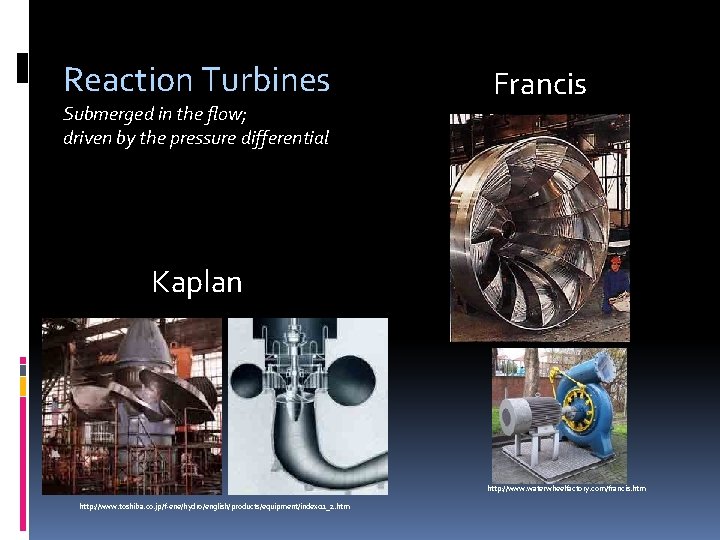
Reaction Turbines Submerged in the flow; driven by the pressure differential Francis Kaplan http: //www. waterwheelfactory. com/francis. htm http: //www. toshiba. co. jp/f-ene/hydro/english/products/equipment/index 01_2. htm
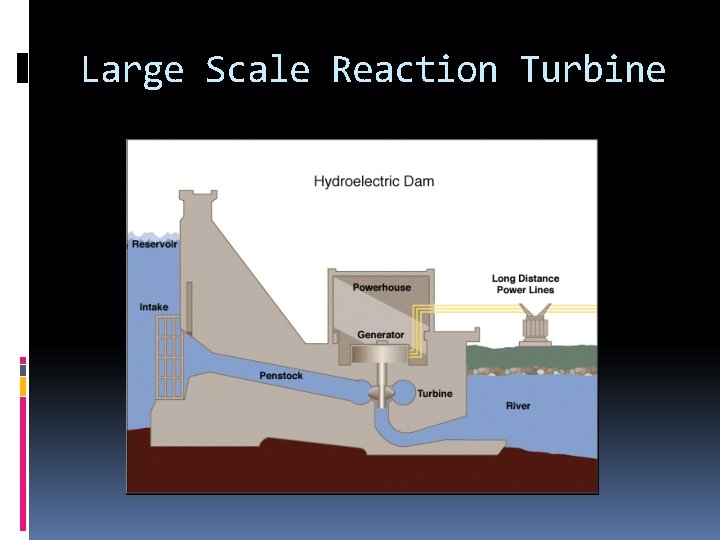
Large Scale Reaction Turbine
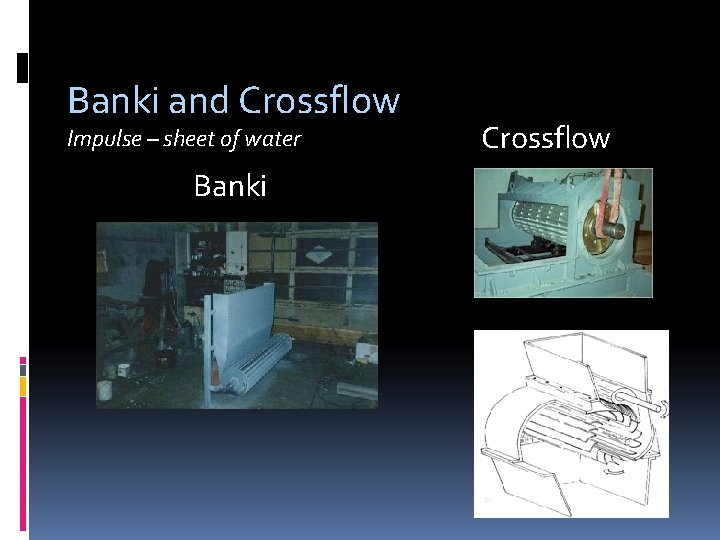
Banki and Crossflow Impulse – sheet of water Banki Crossflow
Pelton and Turgo Impulse – jet of water 4“
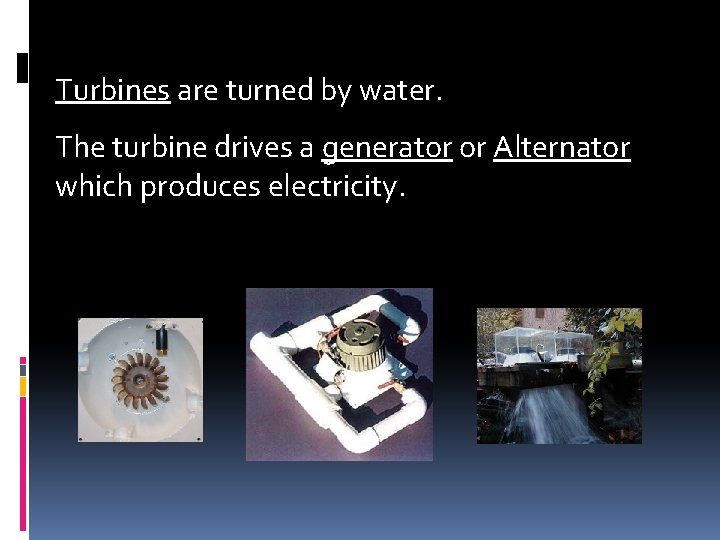
Turbines are turned by water. The turbine drives a generator or Alternator which produces electricity.
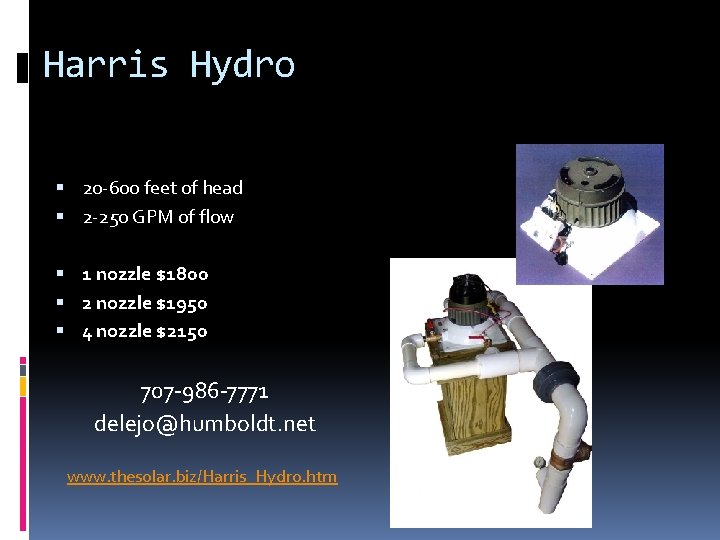
Harris Hydro 20 -600 feet of head 2 -250 GPM of flow 1 nozzle $1800 2 nozzle $1950 4 nozzle $2150 707 -986 -7771 delejo@humboldt. net www. thesolar. biz/Harris_Hydro. htm
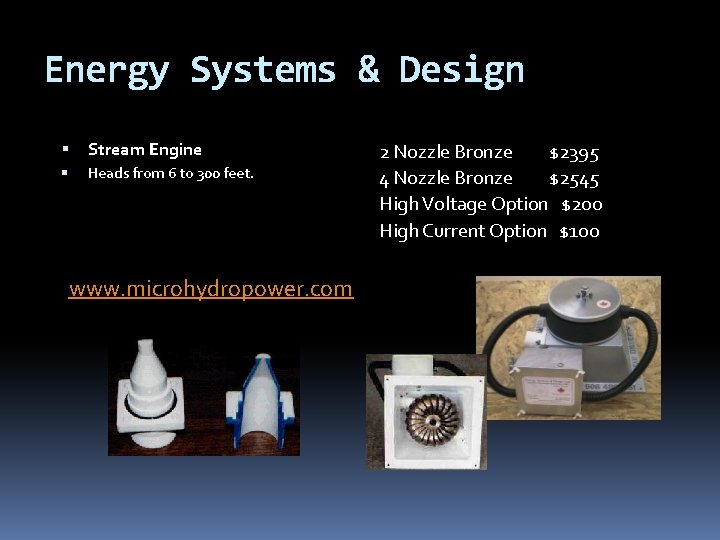
Energy Systems & Design Stream Engine Heads from 6 to 300 feet. www. microhydropower. com 2 Nozzle Bronze $2395 4 Nozzle Bronze $2545 High Voltage Option $200 High Current Option $100
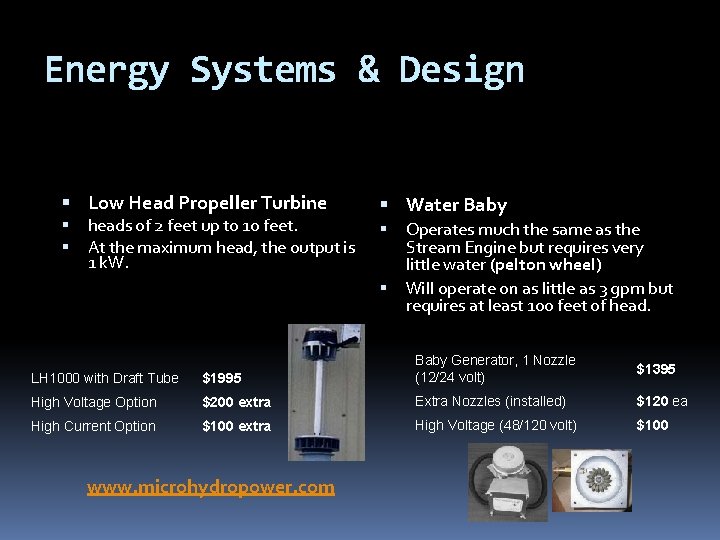
Energy Systems & Design Low Head Propeller Turbine heads of 2 feet up to 10 feet. At the maximum head, the output is 1 k. W. Water Baby Operates much the same as the Stream Engine but requires very little water (pelton wheel) Will operate on as little as 3 gpm but requires at least 100 feet of head. LH 1000 with Draft Tube $1995 Baby Generator, 1 Nozzle (12/24 volt) High Voltage Option $200 extra Extra Nozzles (installed) $120 ea High Current Option $100 extra High Voltage (48/120 volt) $100 www. microhydropower. com $1395
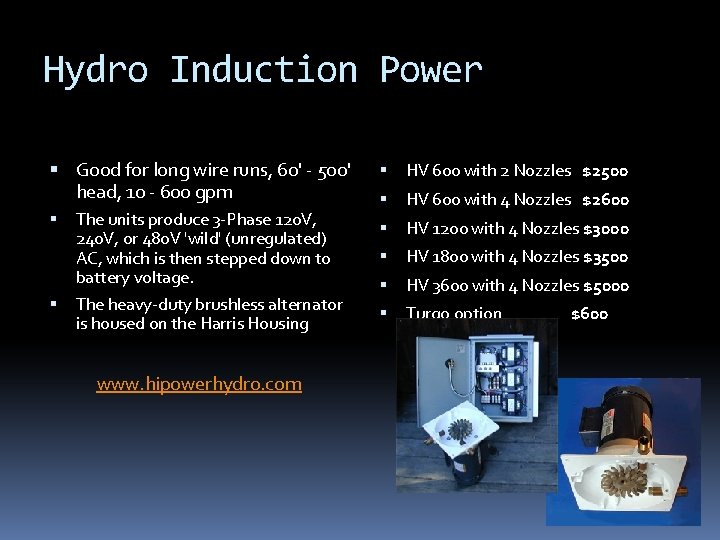
Hydro Induction Power Good for long wire runs, 60' - 500' head, 10 - 600 gpm The units produce 3 -Phase 120 V, 240 V, or 480 V 'wild' (unregulated) AC, which is then stepped down to battery voltage. The heavy-duty brushless alternator is housed on the Harris Housing www. hipowerhydro. com HV 600 with 2 Nozzles $2500 HV 600 with 4 Nozzles $2600 HV 1200 with 4 Nozzles $3000 HV 1800 with 4 Nozzles $3500 HV 3600 with 4 Nozzles $5000 Turgo option $600
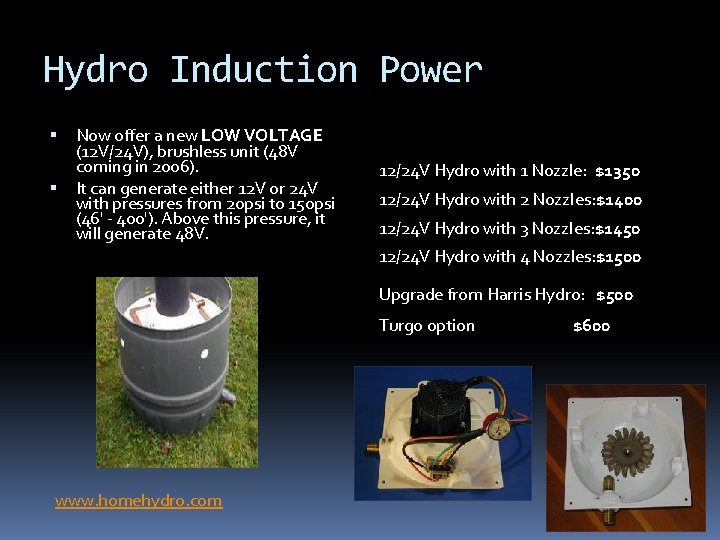
Hydro Induction Power Now offer a new LOW VOLTAGE (12 V/24 V), brushless unit (48 V coming in 2006). It can generate either 12 V or 24 V with pressures from 20 psi to 150 psi (46' - 400'). Above this pressure, it will generate 48 V. 12/24 V Hydro with 1 Nozzle: $1350 12/24 V Hydro with 2 Nozzles: $1400 12/24 V Hydro with 3 Nozzles: $1450 12/24 V Hydro with 4 Nozzles: $1500 Upgrade from Harris Hydro: $500 Turgo option www. homehydro. com $600
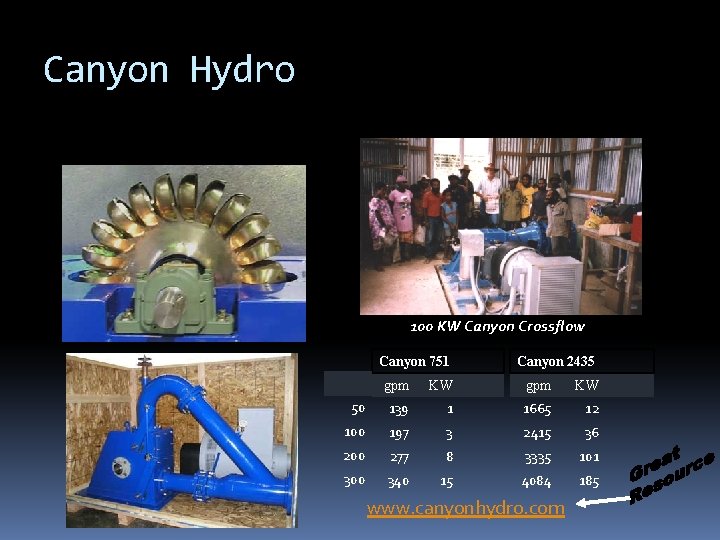
Canyon Hydro Serious engineering 100 KW Canyon Crossflow Canyon 751 gpm KW 50 139 100 Canyon 2435 gpm KW 1 1665 12 197 3 2415 36 200 277 8 3335 101 300 340 15 4084 185 www. canyonhydro. com
Alternative Power & Machine Economy models Permanent magnet units Accessories Exercise Bicycle Type Battery Chargers, etc. Niche: Ease of maintenance and adjustment www. apmhydro. com
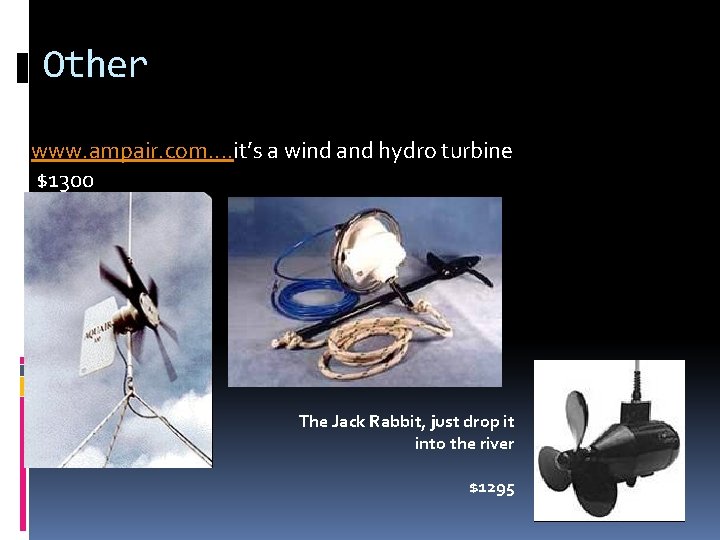
Other www. ampair. com. . it’s a wind and hydro turbine $1300 The Jack Rabbit, just drop it into the river $1295