
MicroGasification for Clean Combustion in Cookstoves Paul S
Micro-Gasification for Clean Combustion in Cookstoves Paul S. Anderson, Ph. D psanders@ilstu. edu Thomas B. Reed, Ph. D tombreed@comcast. net Biomass Energy Foundation, Golden, Colorado (A presentation at the PCIA 2007 Conference, 20 – 24 March 2007, Bangalore, India)
Defining Micro-Gasification • Gasifiers use dry biomass to produce combustible gases separate in both time and space from where those gases are combusted. – Result: Cleaner emissions • True gasifiers, quasi-gasifiers, & others • Micro-gasifier devices are size-appropriate and intended for residential and institutional cooking and/or heating.
Two Different Technologies for Micro-Gasification 1. “Top-Lit Up. Draft” (TLUD) 2. “Another Variation Up. Draft” (AVUD) Others might be possible, but they are not yet seen in functional cookstoves. Both TLUD and AVUD Micro-Gasifiers can use a wide variety of biomass fuels in chips, pellets, briquettes, chunks, and some small particle sizes.
Fuels for Micro-Gasifiers • Woody Biomass – – Wood Pellets Wood Chips Wood Stems Mesquite • Seeds and Shells – – – • Pellets and Briquettes – – – Switch Grass Leaves Agro Wastes Miscanthus Paper Shreds Sawdust Coconut Shells • Special Conditions Cherry Pits Peanut Shells – Rice Husks Pine Cones – Coconut Husks Corn – Raw Sawdust Bean Pods **Some fuels require special features. Additional fuels are being researched. **
What is Top-Lit Up. Draft (TLUD) gasification? • A distinctly new form of controlled combustion conceptualized in 1985 by Dr. Thomas B. Reed and marketed since 2003. • Highly efficient burning of dry biomass such as woodchips, corn cobs, and small briquettes in cookstoves appropriate for Third-World situations. • Flaming pyrolysis at the top of a column of chunky dry biomass is starved of oxygen, resulting in pyrolytic gases (“smoke”) moving upward to where fresh secondary air enters, resulting in clean combustion of the gases.
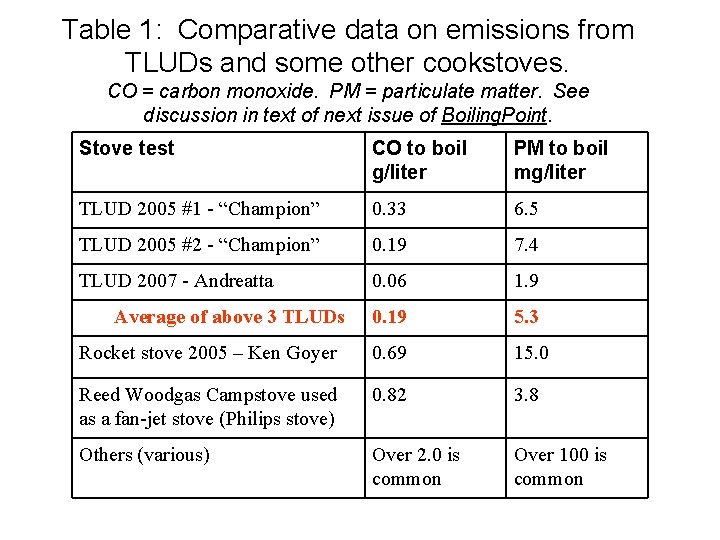
Table 1: Comparative data on emissions from TLUDs and some other cookstoves. CO = carbon monoxide. PM = particulate matter. See discussion in text of next issue of Boiling. Point. Stove test CO to boil g/liter PM to boil mg/liter TLUD 2005 #1 - “Champion” 0. 33 6. 5 TLUD 2005 #2 - “Champion” 0. 19 7. 4 TLUD 2007 - Andreatta 0. 06 1. 9 0. 19 5. 3 Rocket stove 2005 – Ken Goyer 0. 69 15. 0 Reed Woodgas Campstove used as a fan-jet stove (Philips stove) 0. 82 3. 8 Others (various) Over 2. 0 is common Over 100 is common Average of above 3 TLUDs
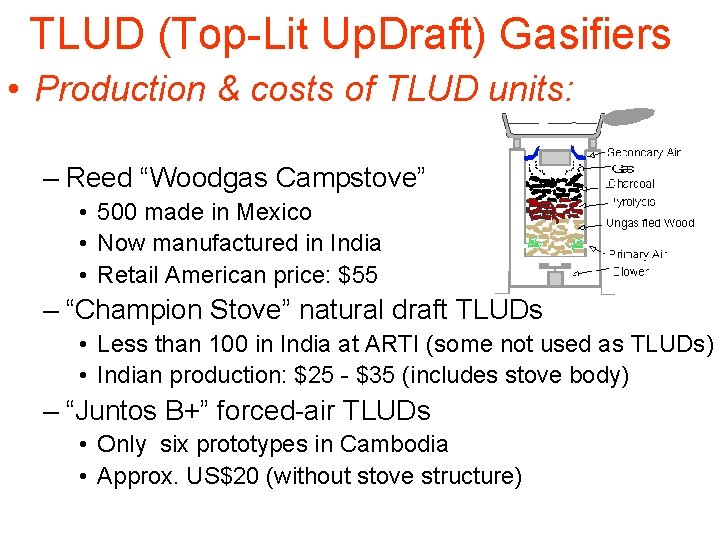
TLUD (Top-Lit Up. Draft) Gasifiers • Production & costs of TLUD units: – Reed “Woodgas Campstove” • 500 made in Mexico • Now manufactured in India • Retail American price: $55 – “Champion Stove” natural draft TLUDs • Less than 100 in India at ARTI (some not used as TLUDs) • Indian production: $25 - $35 (includes stove body) – “Juntos B+” forced-air TLUDs • Only six prototypes in Cambodia • Approx. US$20 (without stove structure)
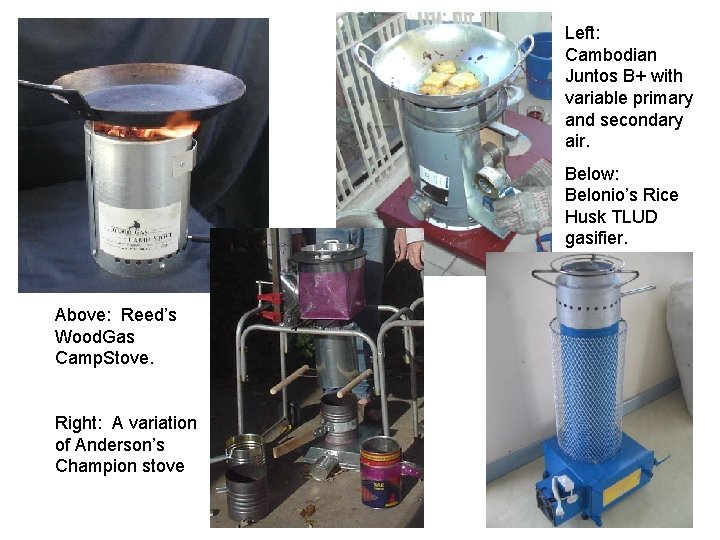
Left: Cambodian Juntos B+ with variable primary and secondary air. Below: Belonio’s Rice Husk TLUD gasifier. Above: Reed’s Wood. Gas Camp. Stove. Right: A variation of Anderson’s Champion stove
AVUD (Another Variation Up. Draft) Gasifiers • Accomplished in 2004 by Paul S. Anderson. Products developed in 2006 by Chip Energy of Goodfield, Illinois • Advantages include: – Continuous operation – Easy fuel handling – Control of heat levels – Options for numerous convenience features • Size Variations for different applications
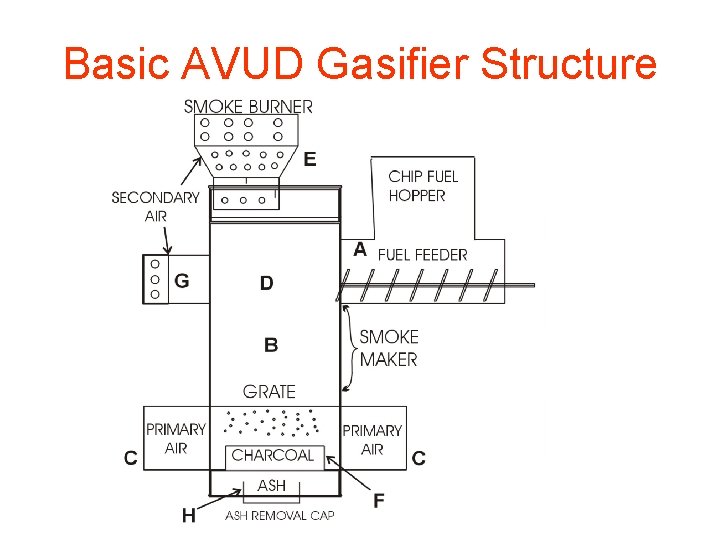
Basic AVUD Gasifier Structure
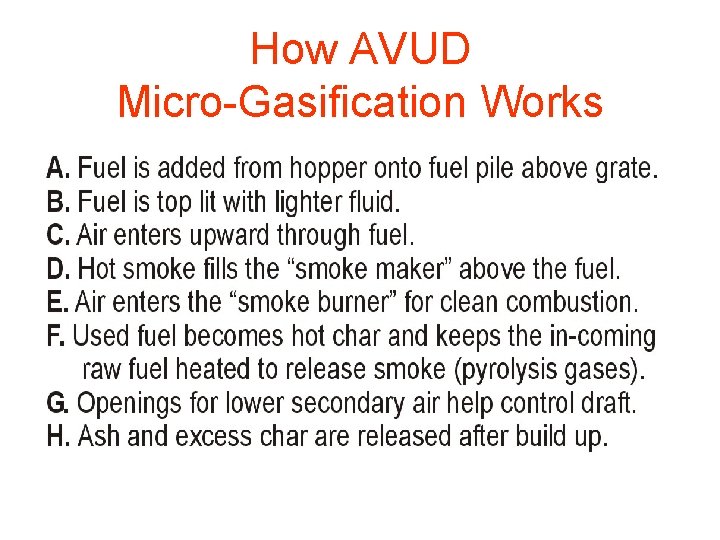
How AVUD Micro-Gasification Works
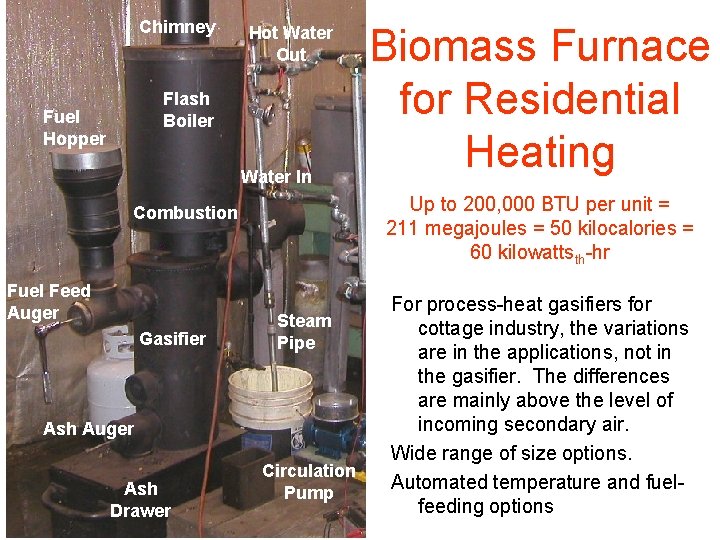
Chimney Hot Water Out Flash Boiler Fuel Hopper Water In Up to 200, 000 BTU per unit = 211 megajoules = 50 kilocalories = 60 kilowattsth-hr Combustion Fuel Feed Auger Gasifier Steam Pipe Ash Auger Ash Drawer Biomass Furnace for Residential Heating Circulation Pump For process-heat gasifiers for cottage industry, the variations are in the applications, not in the gasifier. The differences are mainly above the level of incoming secondary air. Wide range of size options. Automated temperature and fuelfeeding options
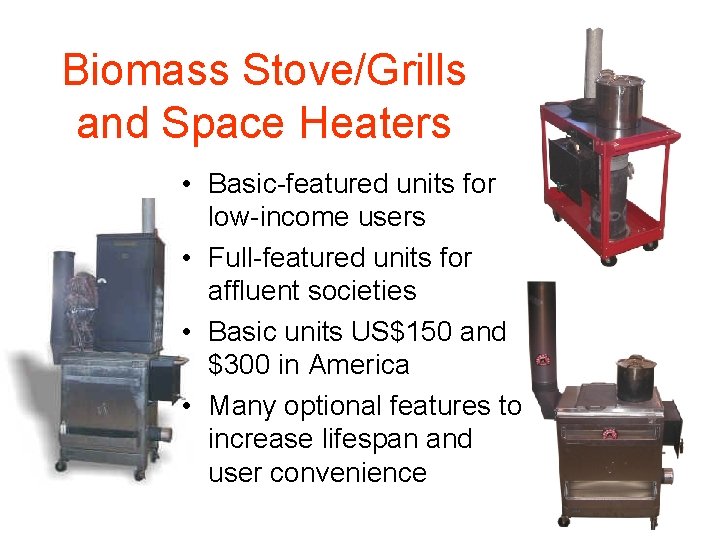
Biomass Stove/Grills and Space Heaters • Basic-featured units for low-income users • Full-featured units for affluent societies • Basic units US$150 and $300 in America • Many optional features to increase lifespan and user convenience
Chip Energy is freely sharing the updraft gasification technology to accomplish the international goals for clean indoor air. For projects involving commercialization and/or grants, we would appreciate the opportunity to work with you.
Bibliography/References: • Anderson, Paul S. and Thomas B. Reed (2004). “Biomass Gasification: Clean Residential Stoves, Commercial Power Generation, and Global Impacts” Presented to the LAMNET Project International Workshop on “Bioenergy for a Sustainable Development, ” 8 -10 Nov 2004, Viña del Mar, Chile. On the Internet at: http: //bioenergylists. org/stovesdoc/Anderson/Gasifier. LAMN ET. pdf • Andreatta, Dale (2007). “A Report on Some Experiments with the Top-Lit Up Draft (TLUD) Stove. ” Presented at the ETHOS 2007 Conference, Kirkland, Washington, January 27, 2007. On the Internet at: http: //bioenergylists. org/stovesdoc/Andreatta/TLUD_Report. pdf
- Slides: 15