
Microfluidic Biochips Design Programming and Optimization Bill Thies
Microfluidic Biochips: Design, Programming, and Optimization Bill Thies Joint work with Vaishnavi Ananthanarayanan, J. P. Urbanski, Nada Amin, David Craig, Jeremy Gunawardena, Todd Thorsen, and Saman Amarasinghe Indian Statistical Institute March 2, 2011
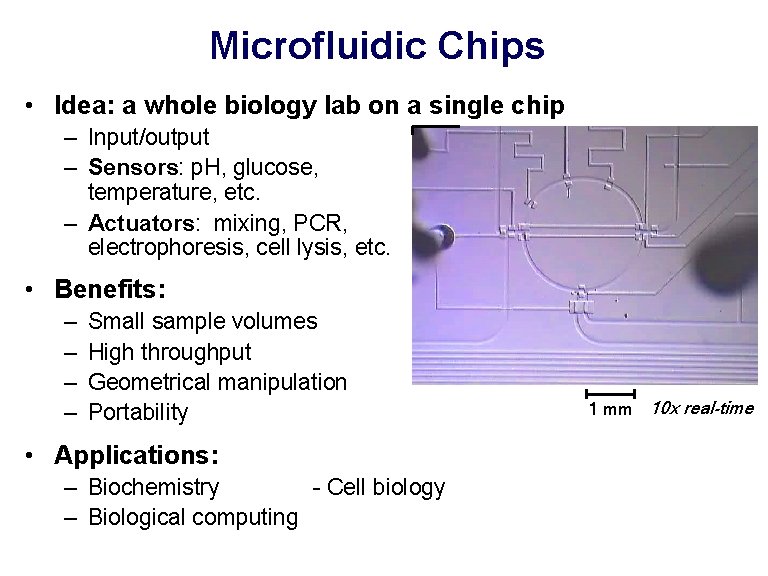
Microfluidic Chips • Idea: a whole biology lab on a single chip – Input/output – Sensors: p. H, glucose, temperature, etc. – Actuators: mixing, PCR, electrophoresis, cell lysis, etc. • Benefits: – – Small sample volumes High throughput Geometrical manipulation Portability • Applications: – Biochemistry - Cell biology – Biological computing 1 mm 10 x real-time
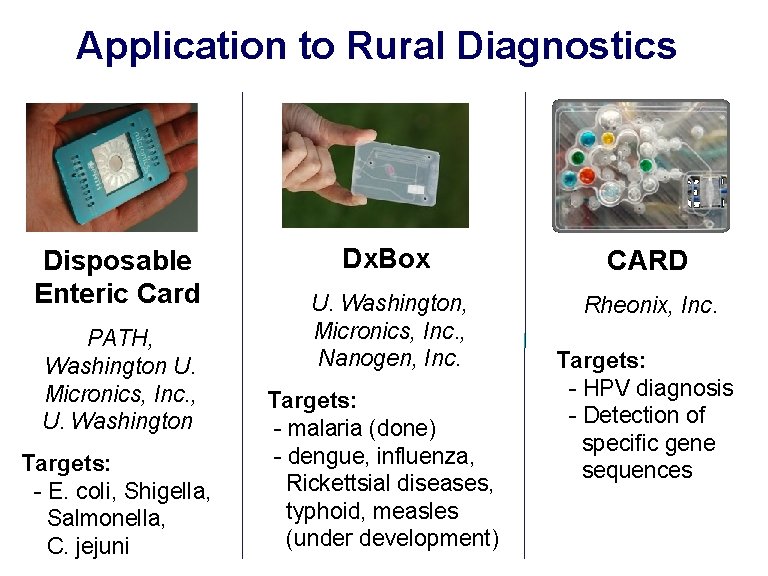
Application to Rural Diagnostics Disposable Enteric Card PATH, Washington U. Micronics, Inc. , U. Washington Targets: - E. coli, Shigella, Salmonella, C. jejuni Dx. Box CARD U. Washington, Micronics, Inc. , Nanogen, Inc. Rheonix, Inc. Targets: - malaria (done) - dengue, influenza, Rickettsial diseases, typhoid, measles (under development) Targets: - HPV diagnosis - Detection of specific gene sequences
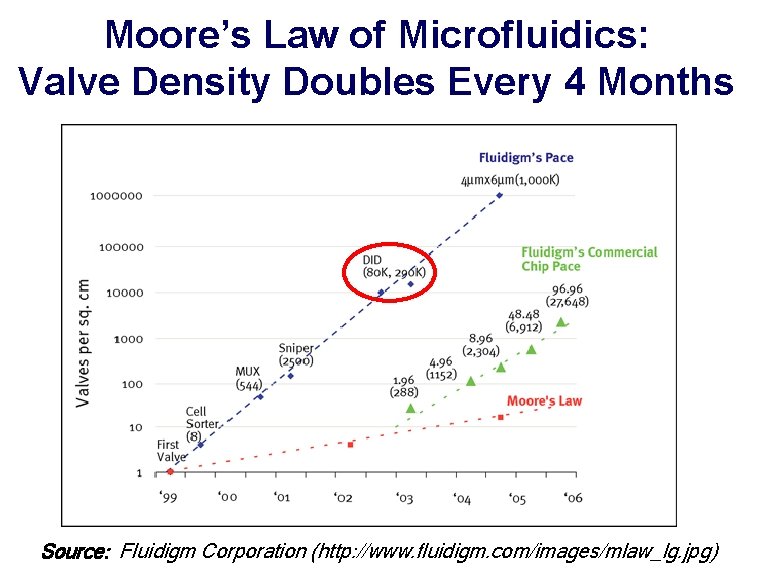
Moore’s Law of Microfluidics: Valve Density Doubles Every 4 Months Source: Fluidigm Corporation (http: //www. fluidigm. com/images/mlaw_lg. jpg)
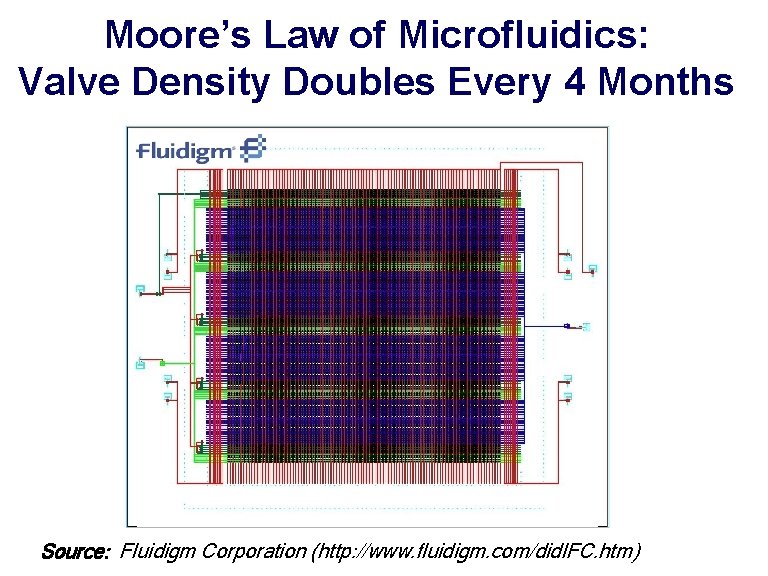
Moore’s Law of Microfluidics: Valve Density Doubles Every 4 Months Source: Fluidigm Corporation (http: //www. fluidigm. com/did. IFC. htm)
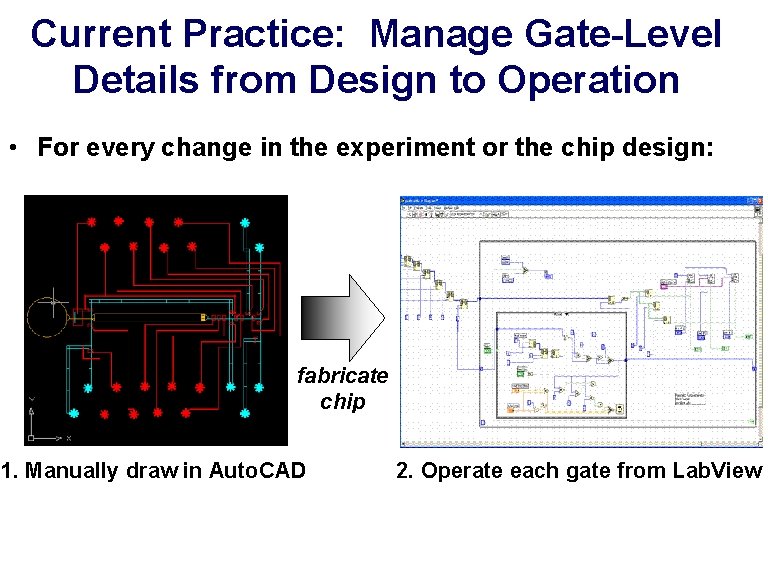
Current Practice: Manage Gate-Level Details from Design to Operation • For every change in the experiment or the chip design: fabricate chip 1. Manually draw in Auto. CAD 2. Operate each gate from Lab. View
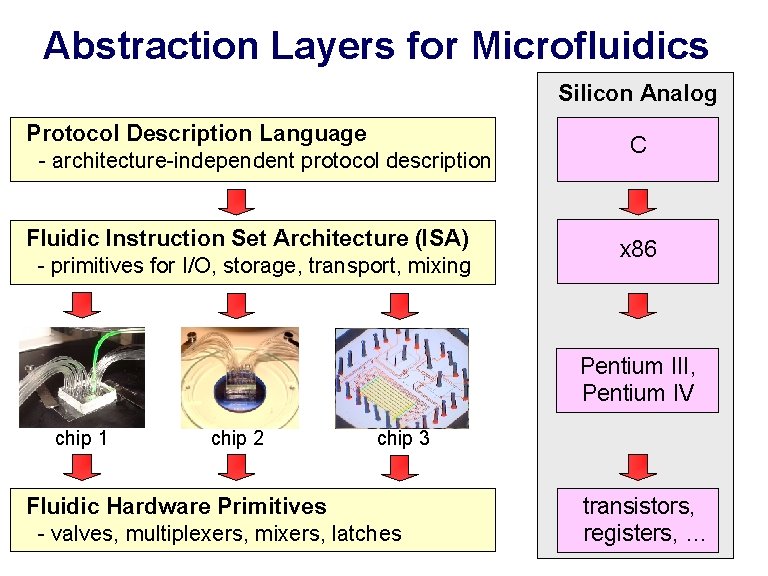
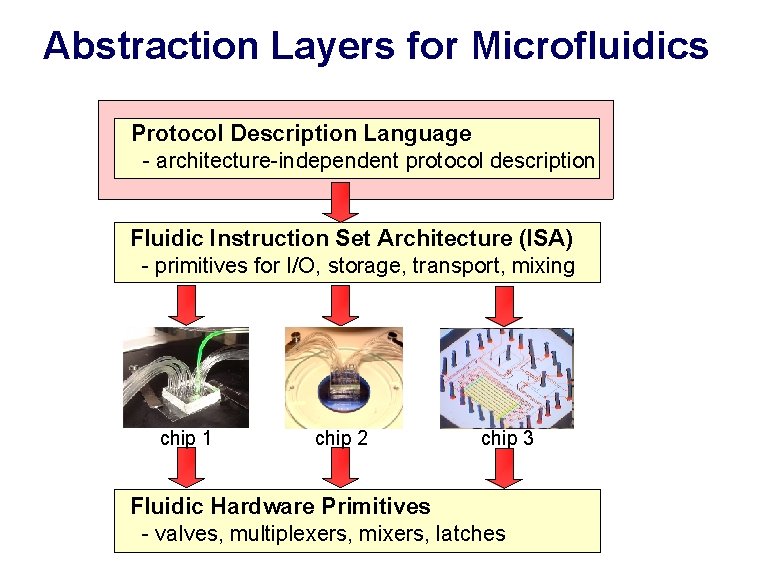
Abstraction Layers for Microfluidics Silicon Analog Protocol Description Language - architecture-independent protocol description Fluidic Instruction Set Architecture (ISA) - primitives for I/O, storage, transport, mixing C x 86 Pentium III, Pentium IV chip 1 chip 2 chip 3 Fluidic Hardware Primitives - valves, multiplexers, mixers, latches transistors, registers, …
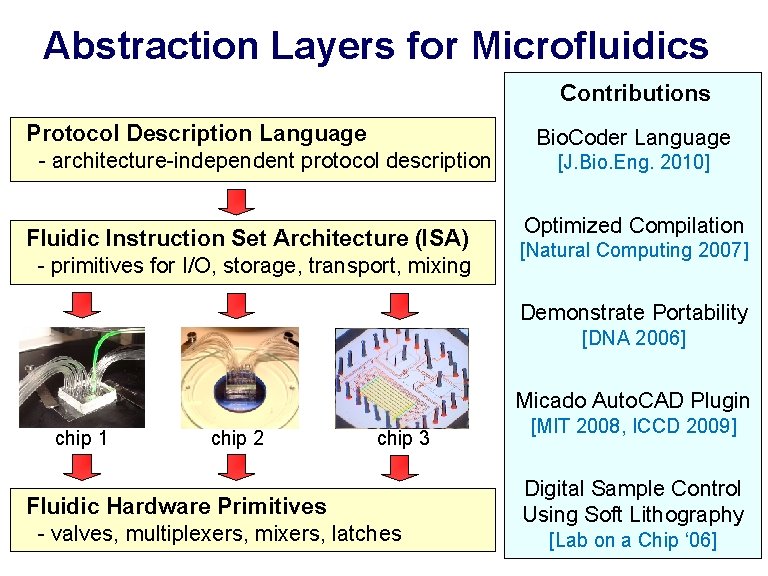
Abstraction Layers for Microfluidics Contributions Protocol Description Language - architecture-independent protocol description Fluidic Instruction Set Architecture (ISA) - primitives for I/O, storage, transport, mixing Bio. Coder Language [J. Bio. Eng. 2010] Optimized Compilation [Natural Computing 2007] Demonstrate Portability [DNA 2006] Micado Auto. CAD Plugin chip 1 chip 2 chip 3 Fluidic Hardware Primitives - valves, multiplexers, mixers, latches [MIT 2008, ICCD 2009] Digital Sample Control Using Soft Lithography [Lab on a Chip ‘ 06]
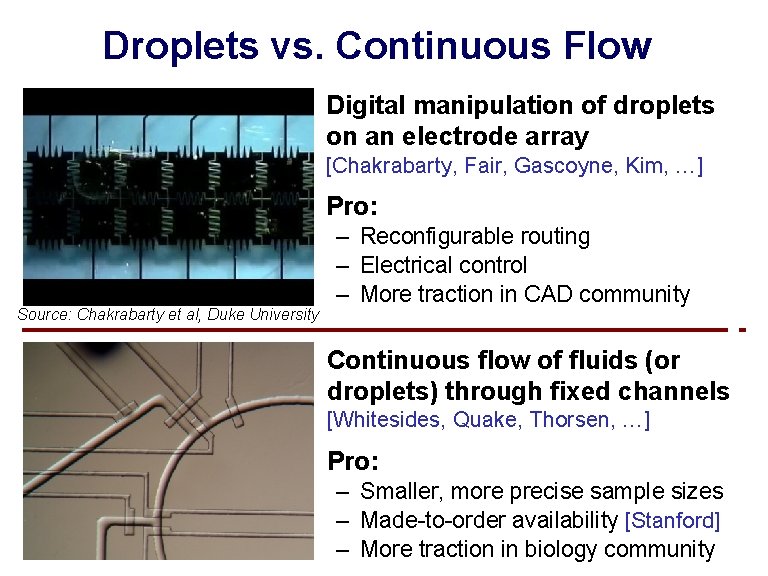
Droplets vs. Continuous Flow • Digital manipulation of droplets on an electrode array [Chakrabarty, Fair, Gascoyne, Kim, …] • Pro: Source: Chakrabarty et al, Duke University – Reconfigurable routing – Electrical control – More traction in CAD community • Continuous flow of fluids (or droplets) through fixed channels [Whitesides, Quake, Thorsen, …] • Pro: – Smaller, more precise sample sizes – Made-to-order availability [Stanford] – More traction in biology community
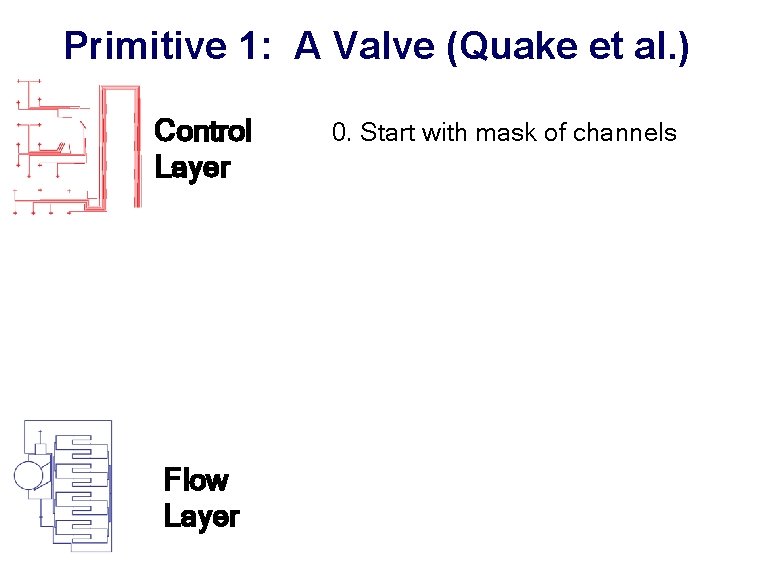
Primitive 1: A Valve (Quake et al. ) Control Layer Flow Layer 0. Start with mask of channels
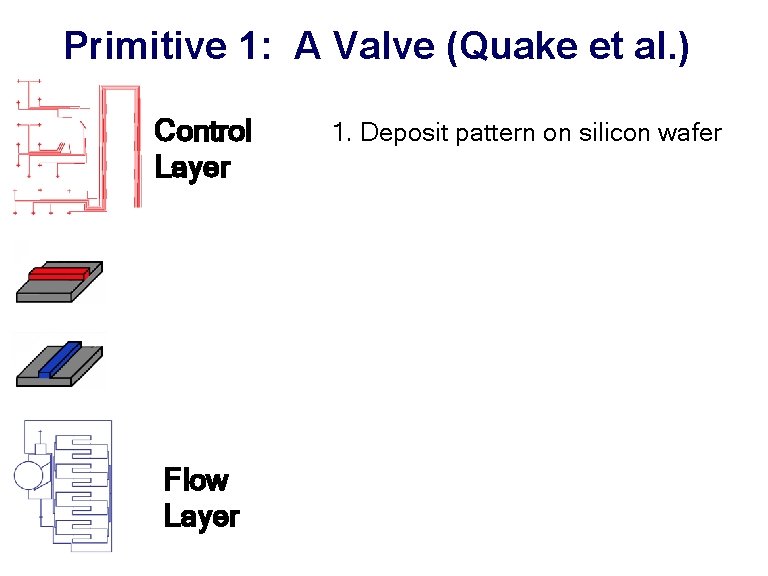
Primitive 1: A Valve (Quake et al. ) Control Layer Flow Layer 1. Deposit pattern on silicon wafer
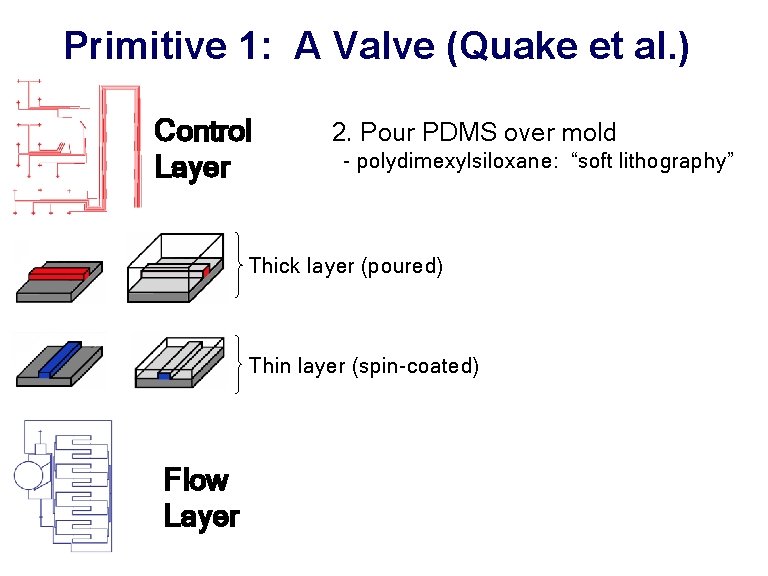
Primitive 1: A Valve (Quake et al. ) Control Layer 2. Pour PDMS over mold - polydimexylsiloxane: “soft lithography” Thick layer (poured) Thin layer (spin-coated) Flow Layer
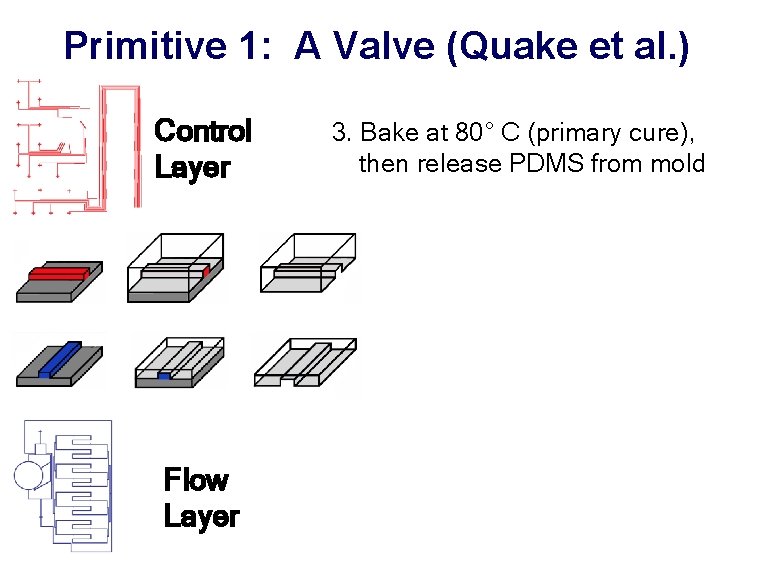
Primitive 1: A Valve (Quake et al. ) Control Layer Flow Layer 3. Bake at 80° C (primary cure), then release PDMS from mold
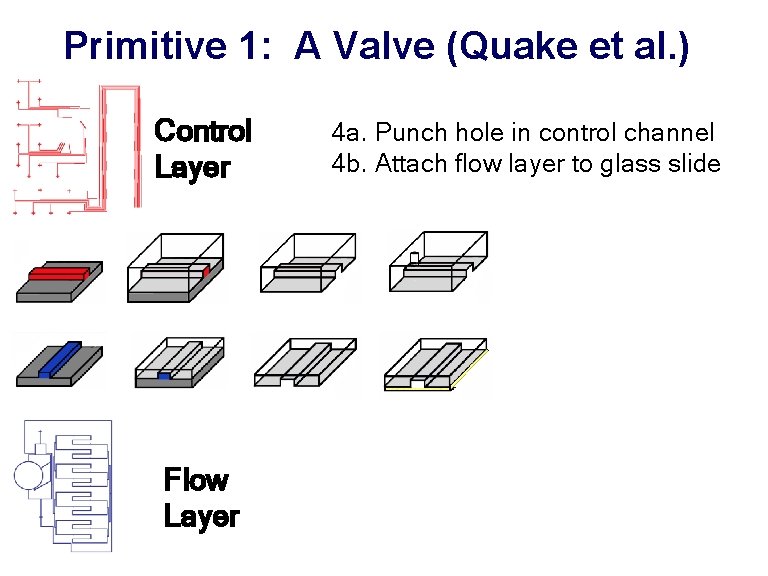
Primitive 1: A Valve (Quake et al. ) Control Layer Flow Layer 4 a. Punch hole in control channel 4 b. Attach flow layer to glass slide
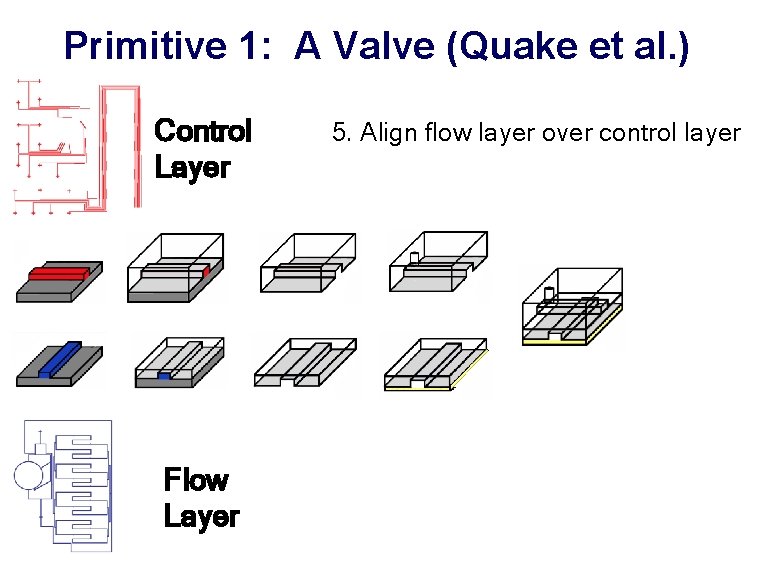
Primitive 1: A Valve (Quake et al. ) Control Layer Flow Layer 5. Align flow layer over control layer
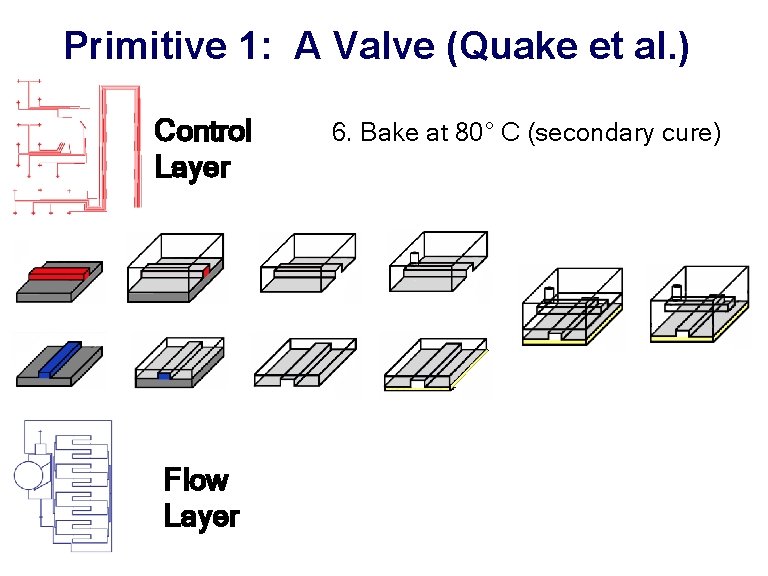
Primitive 1: A Valve (Quake et al. ) Control Layer Flow Layer 6. Bake at 80° C (secondary cure)
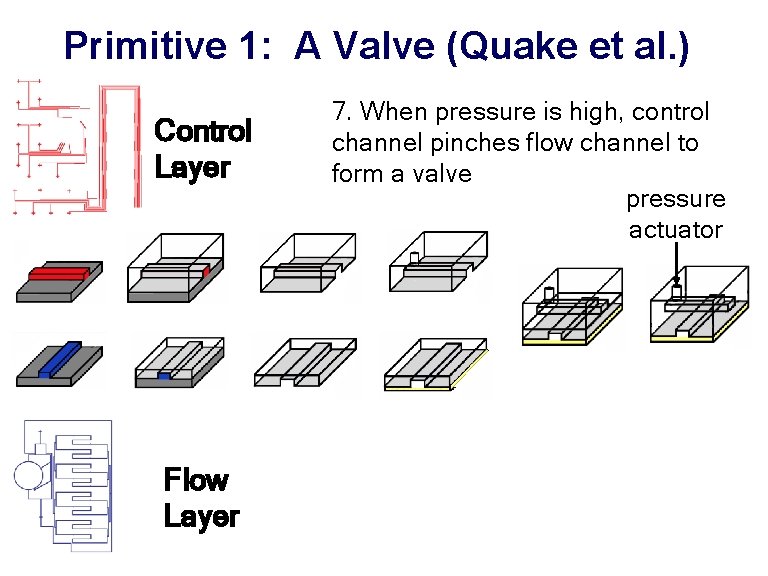
Primitive 1: A Valve (Quake et al. ) Control Layer Flow Layer 7. When pressure is high, control channel pinches flow channel to form a valve pressure actuator
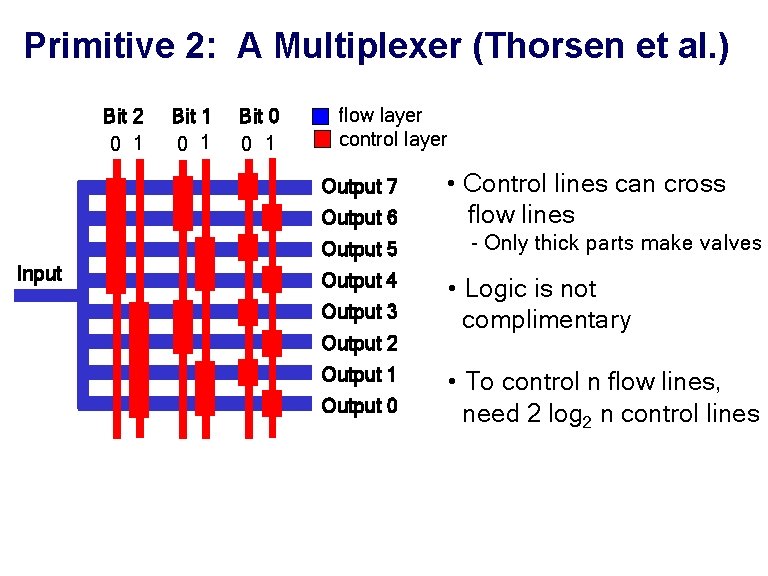
Primitive 2: A Multiplexer (Thorsen et al. ) Bit 2 0 1 Bit 1 0 1 Bit 0 0 1 flow layer control layer Output 7 Output 6 Output 5 Input Output 4 Output 3 Output 2 Output 1 Output 0 • Control lines can cross flow lines - Only thick parts make valves • Logic is not complimentary • To control n flow lines, need 2 log 2 n control lines
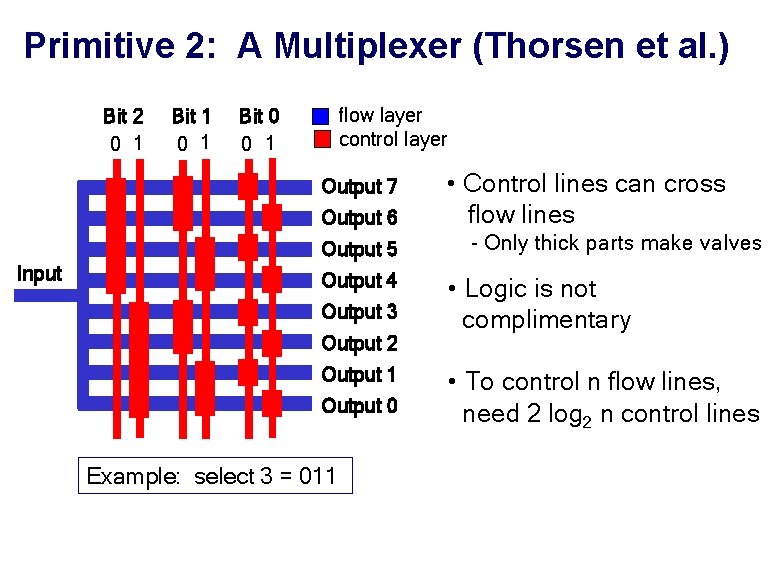
Primitive 2: A Multiplexer (Thorsen et al. ) Bit 2 0 1 Bit 1 0 1 flow layer control layer Bit 0 0 1 Output 7 Output 6 Output 5 Input Output 4 Output 3 Output 2 Output 1 Output 0 Example: select 3 = 011 • Control lines can cross flow lines - Only thick parts make valves • Logic is not complimentary • To control n flow lines, need 2 log 2 n control lines
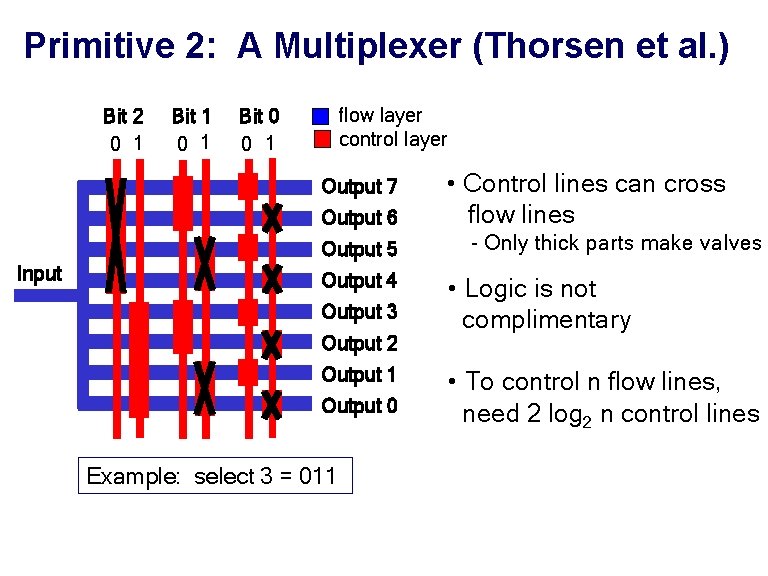
Primitive 2: A Multiplexer (Thorsen et al. ) Bit 2 0 1 Bit 1 0 1 flow layer control layer Bit 0 0 1 Output 7 Output 6 Output 5 Input Output 4 Output 3 Output 2 Output 1 Output 0 Example: select 3 = 011 • Control lines can cross flow lines - Only thick parts make valves • Logic is not complimentary • To control n flow lines, need 2 log 2 n control lines
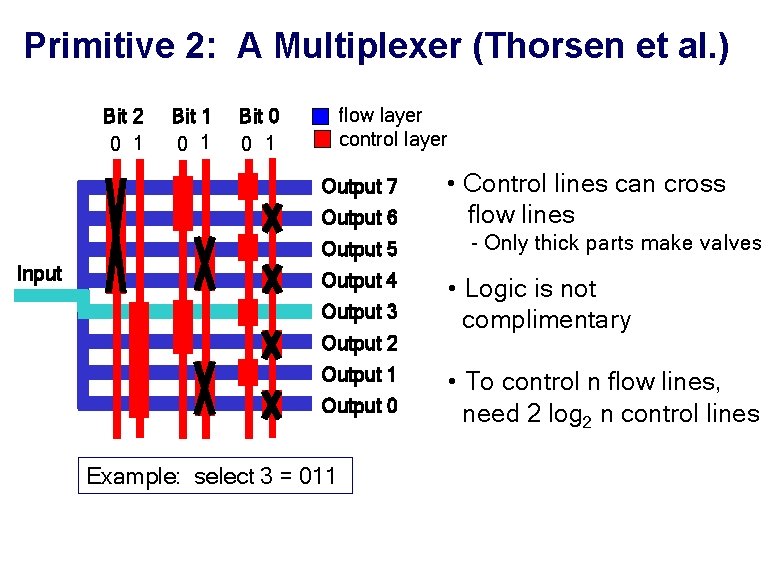
Primitive 2: A Multiplexer (Thorsen et al. ) Bit 2 0 1 Bit 1 0 1 flow layer control layer Bit 0 0 1 Output 7 Output 6 Output 5 Input Output 4 Output 3 Output 2 Output 1 Output 0 Example: select 3 = 011 • Control lines can cross flow lines - Only thick parts make valves • Logic is not complimentary • To control n flow lines, need 2 log 2 n control lines
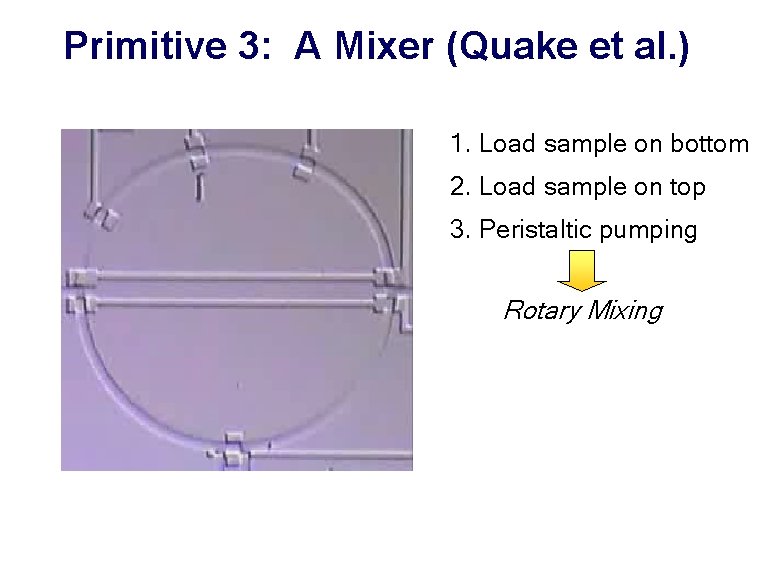
Primitive 3: A Mixer (Quake et al. ) 1. Load sample on bottom 2. Load sample on top 3. Peristaltic pumping Rotary Mixing
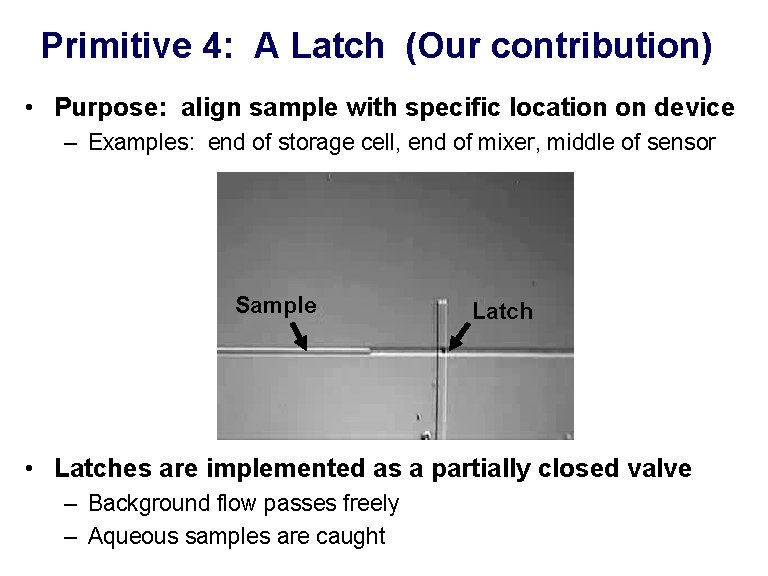
Primitive 4: A Latch (Our contribution) • Purpose: align sample with specific location on device – Examples: end of storage cell, end of mixer, middle of sensor Sample Latch • Latches are implemented as a partially closed valve – Background flow passes freely – Aqueous samples are caught
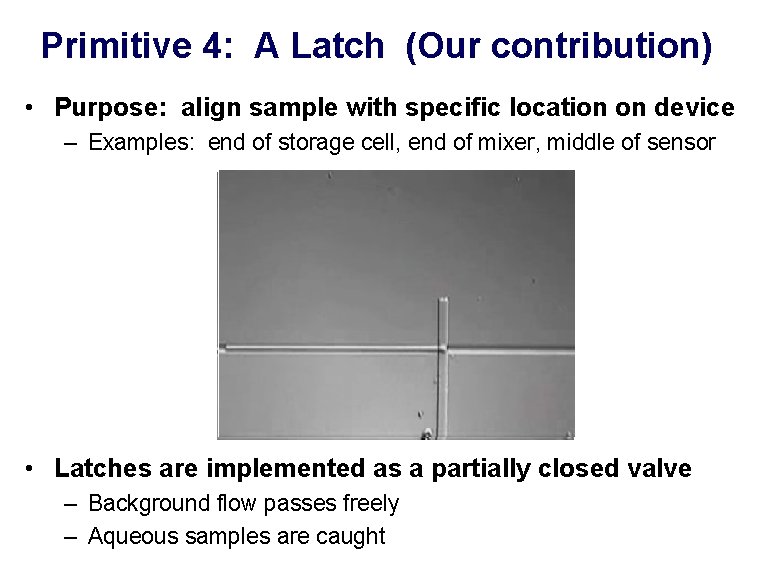
Primitive 4: A Latch (Our contribution) • Purpose: align sample with specific location on device – Examples: end of storage cell, end of mixer, middle of sensor Sample Latch • Latches are implemented as a partially closed valve – Background flow passes freely – Aqueous samples are caught
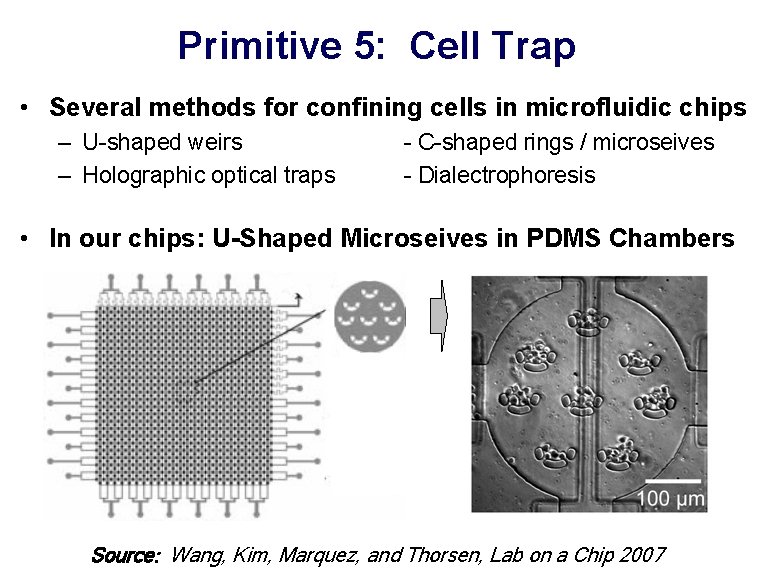
Primitive 5: Cell Trap • Several methods for confining cells in microfluidic chips – U-shaped weirs – Holographic optical traps - C-shaped rings / microseives - Dialectrophoresis • In our chips: U-Shaped Microseives in PDMS Chambers Source: Wang, Kim, Marquez, and Thorsen, Lab on a Chip 2007
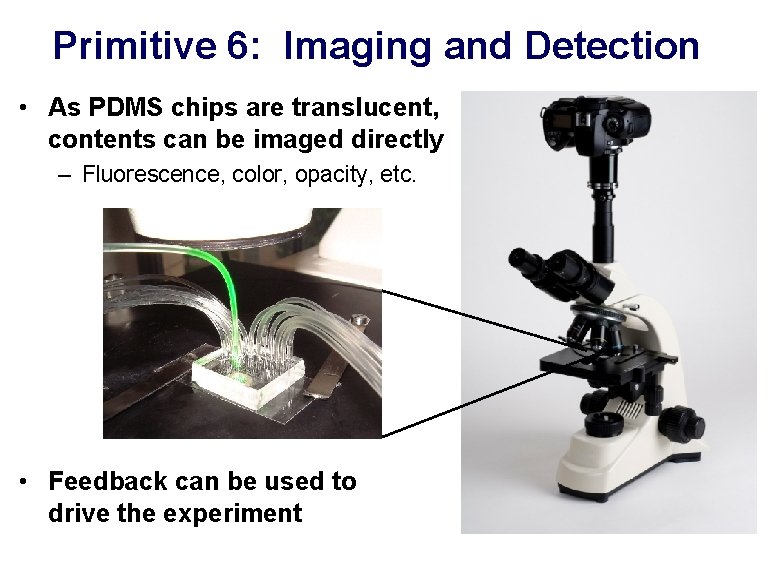
Primitive 6: Imaging and Detection • As PDMS chips are translucent, contents can be imaged directly – Fluorescence, color, opacity, etc. • Feedback can be used to drive the experiment
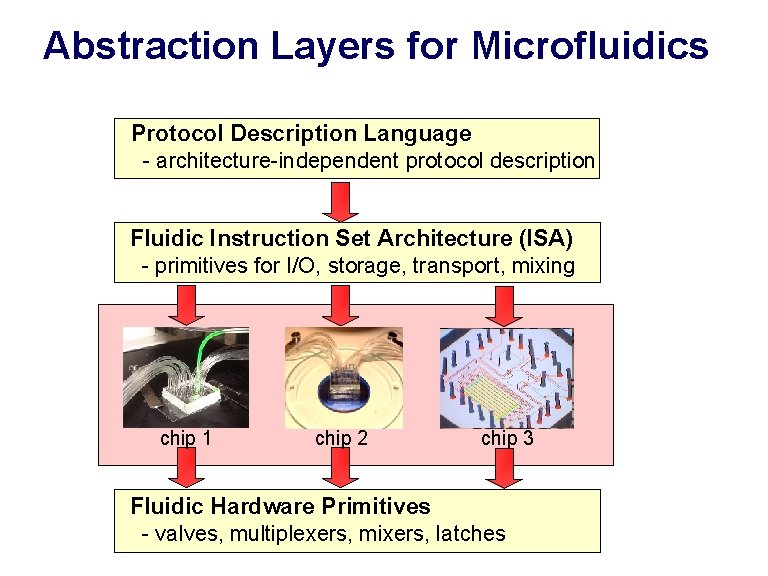
Abstraction Layers for Microfluidics Protocol Description Language - architecture-independent protocol description Fluidic Instruction Set Architecture (ISA) - primitives for I/O, storage, transport, mixing chip 1 chip 2 chip 3 Fluidic Hardware Primitives - valves, multiplexers, mixers, latches
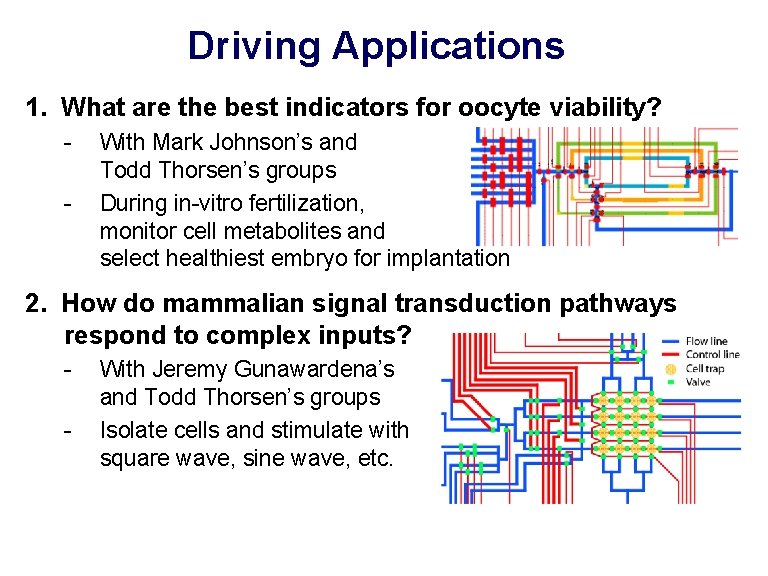
Driving Applications 1. What are the best indicators for oocyte viability? - With Mark Johnson’s and Todd Thorsen’s groups During in-vitro fertilization, monitor cell metabolites and select healthiest embryo for implantation 2. How do mammalian signal transduction pathways respond to complex inputs? - With Jeremy Gunawardena’s and Todd Thorsen’s groups Isolate cells and stimulate with square wave, sine wave, etc.
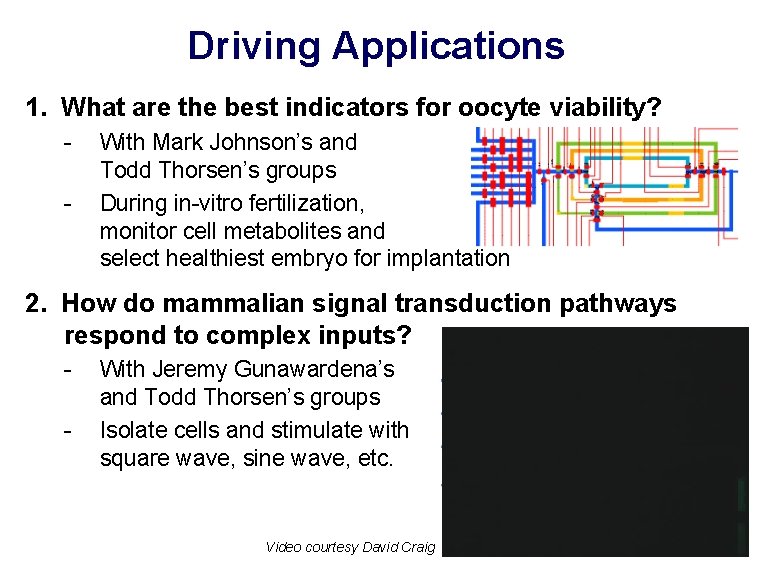
Driving Applications 1. What are the best indicators for oocyte viability? - With Mark Johnson’s and Todd Thorsen’s groups During in-vitro fertilization, monitor cell metabolites and select healthiest embryo for implantation 2. How do mammalian signal transduction pathways respond to complex inputs? - With Jeremy Gunawardena’s and Todd Thorsen’s groups Isolate cells and stimulate with square wave, sine wave, etc. Video courtesy David Craig
CAD Tools for Microfluidic Chips • Goal: automate placement, routing, control of microfluidic features • Why is this different than electronic CAD?
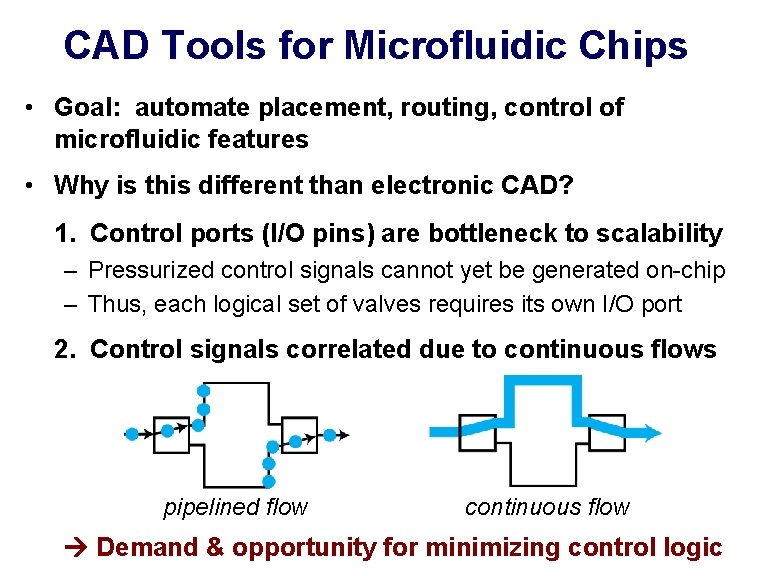
CAD Tools for Microfluidic Chips • Goal: automate placement, routing, control of microfluidic features • Why is this different than electronic CAD? 1. Control ports (I/O pins) are bottleneck to scalability – Pressurized control signals cannot yet be generated on-chip – Thus, each logical set of valves requires its own I/O port 2. Control signals correlated due to continuous flows pipelined flow continuous flow Demand & opportunity for minimizing control logic
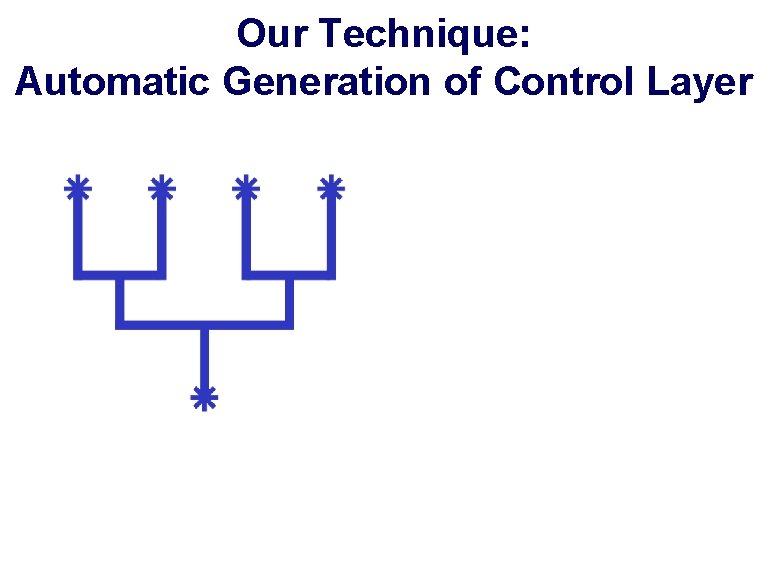
Our Technique: Automatic Generation of Control Layer
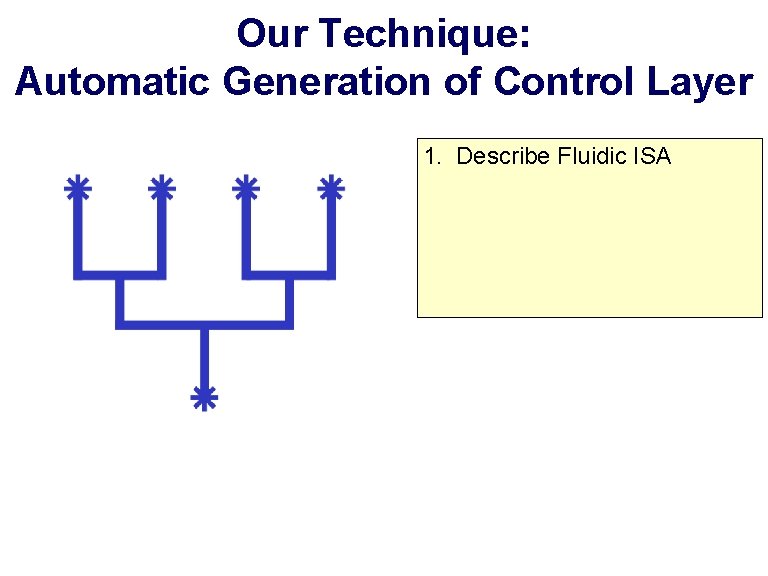
Our Technique: Automatic Generation of Control Layer 1. Describe Fluidic ISA
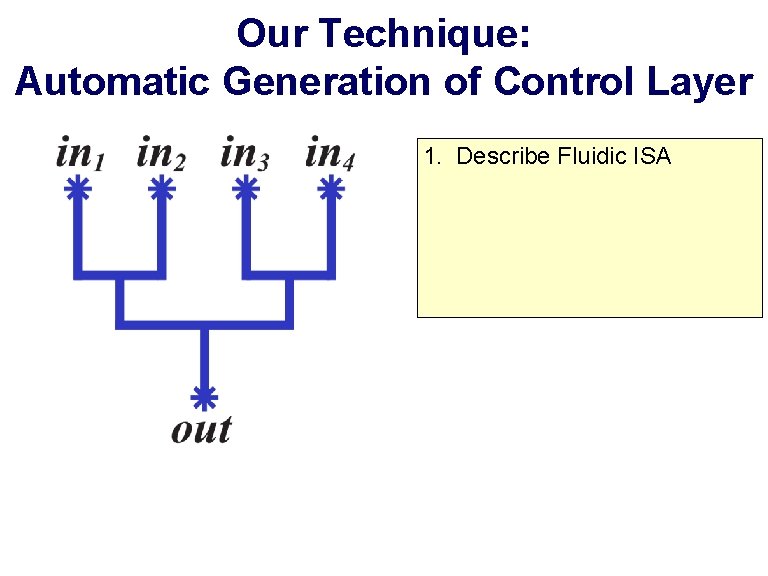
Our Technique: Automatic Generation of Control Layer 1. Describe Fluidic ISA
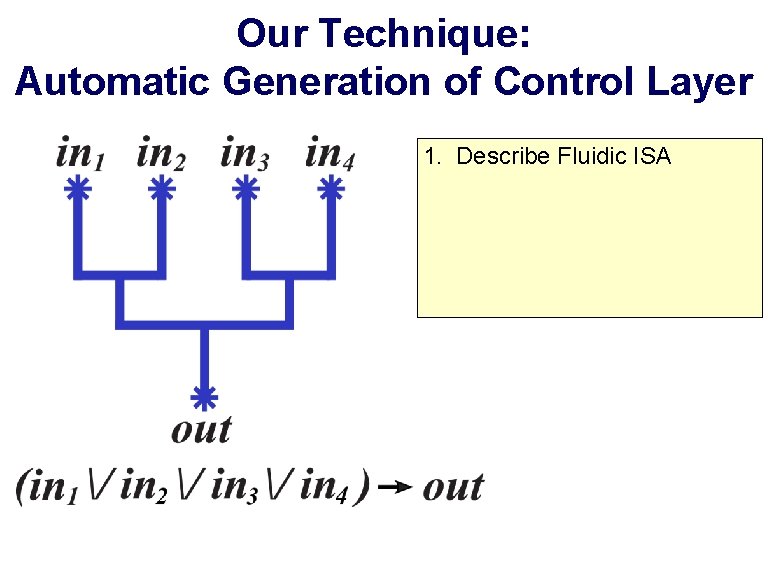
Our Technique: Automatic Generation of Control Layer 1. Describe Fluidic ISA
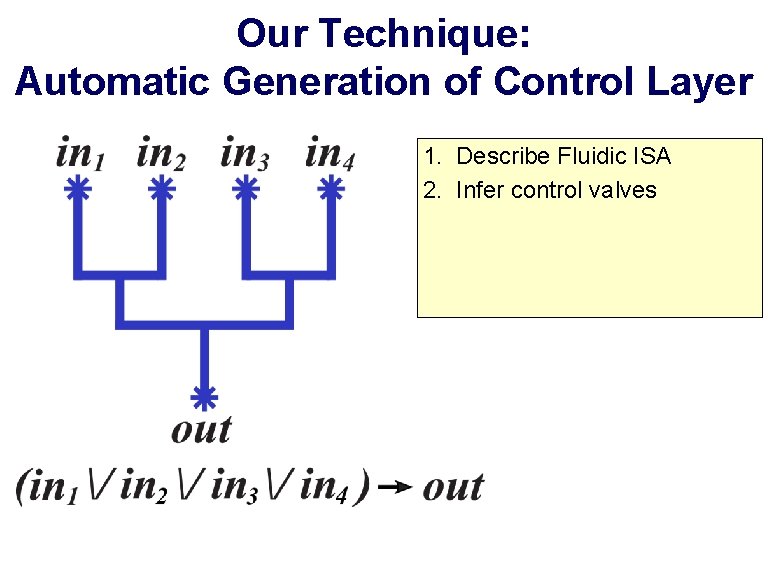
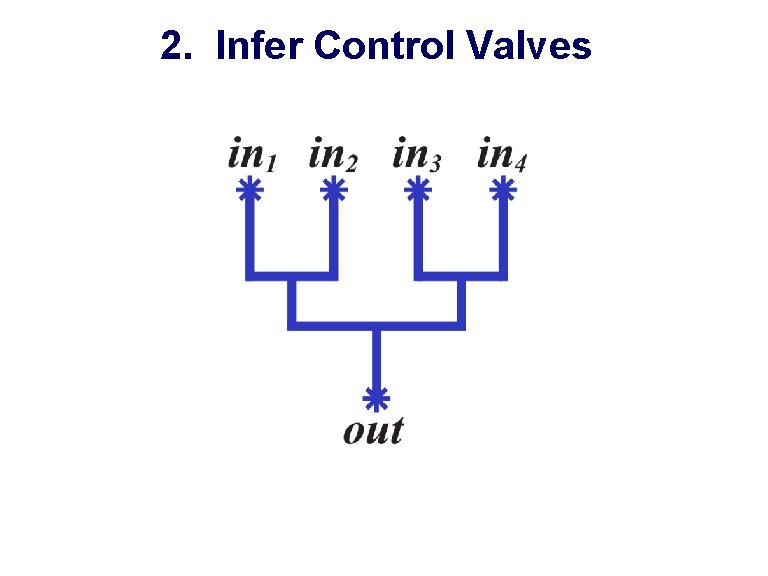
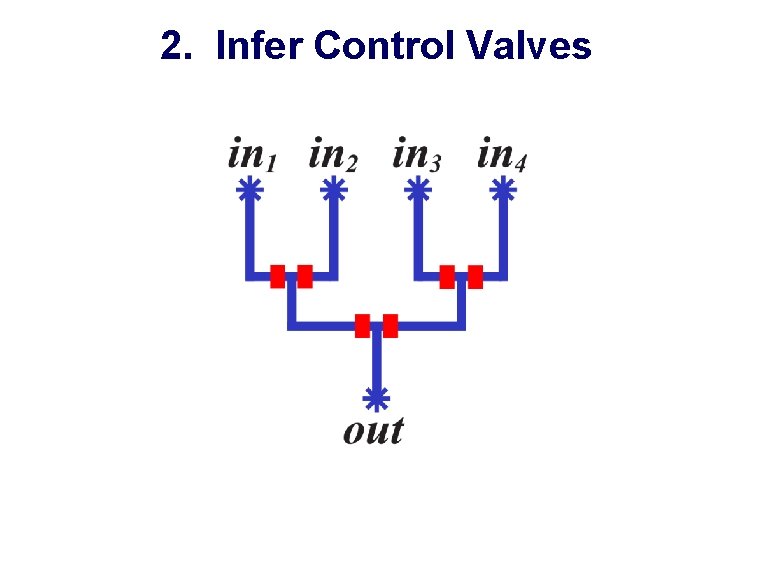
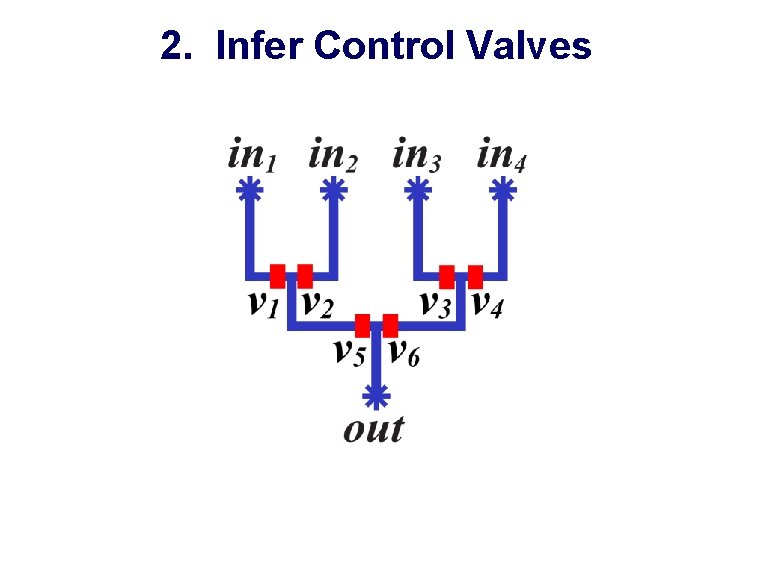
Our Technique: Automatic Generation of Control Layer 1. Describe Fluidic ISA 2. Infer control valves
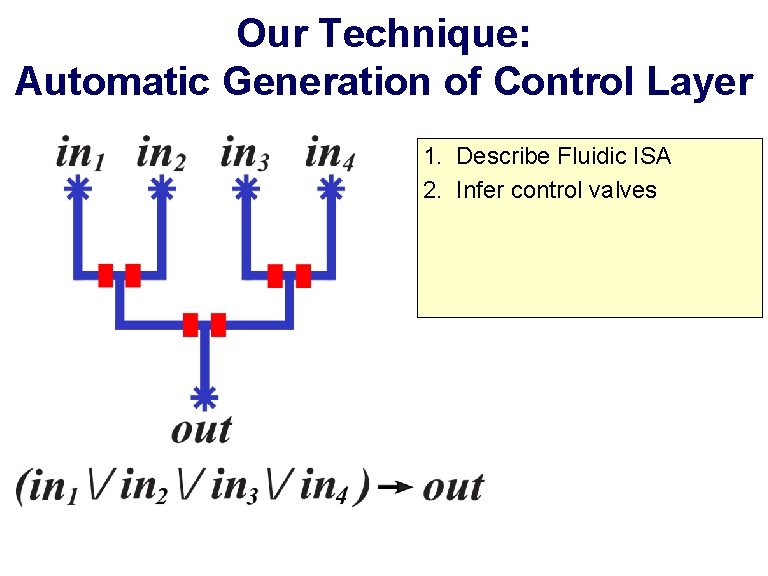
Our Technique: Automatic Generation of Control Layer 1. Describe Fluidic ISA 2. Infer control valves
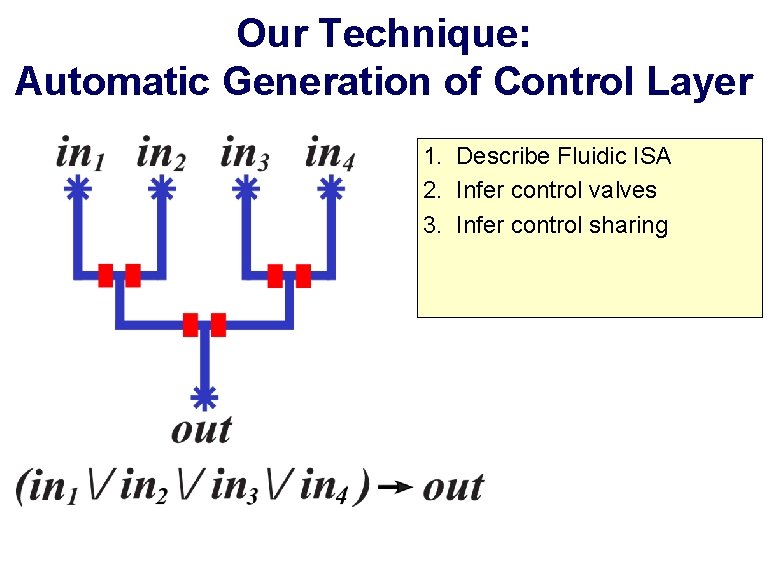
Our Technique: Automatic Generation of Control Layer 1. Describe Fluidic ISA 2. Infer control valves 3. Infer control sharing
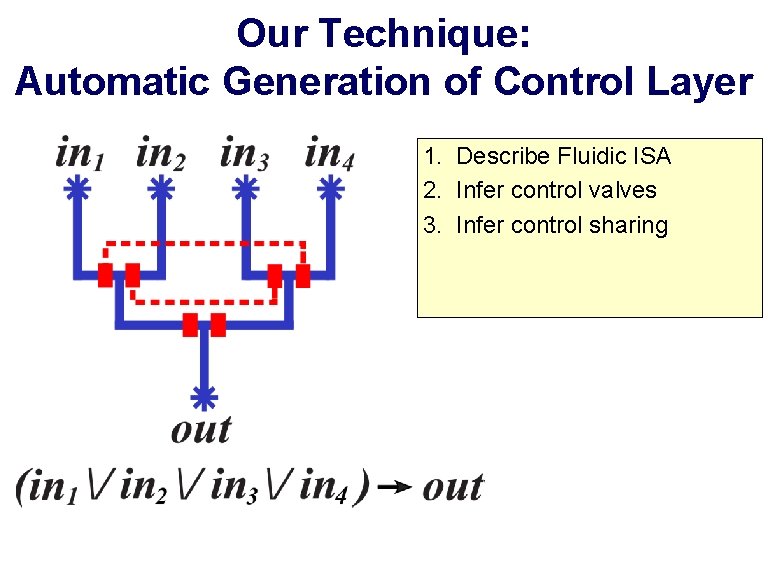
Our Technique: Automatic Generation of Control Layer 1. Describe Fluidic ISA 2. Infer control valves 3. Infer control sharing
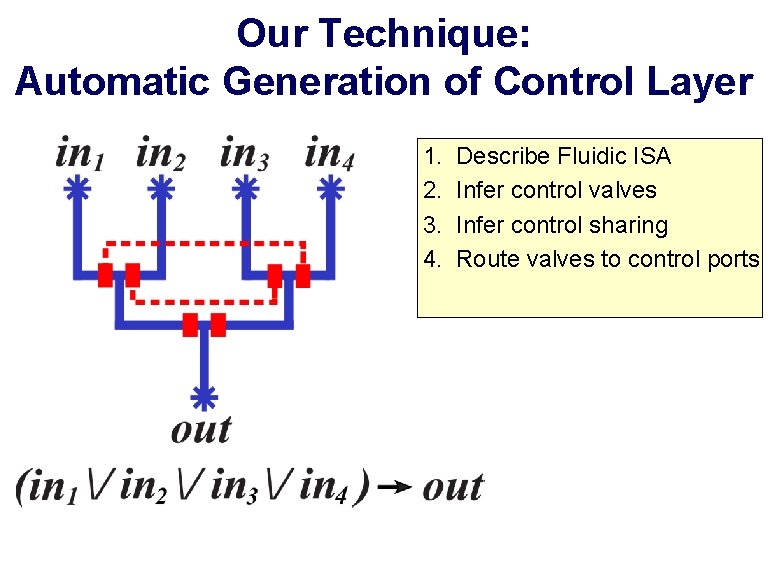
Our Technique: Automatic Generation of Control Layer 1. 2. 3. 4. Describe Fluidic ISA Infer control valves Infer control sharing Route valves to control ports
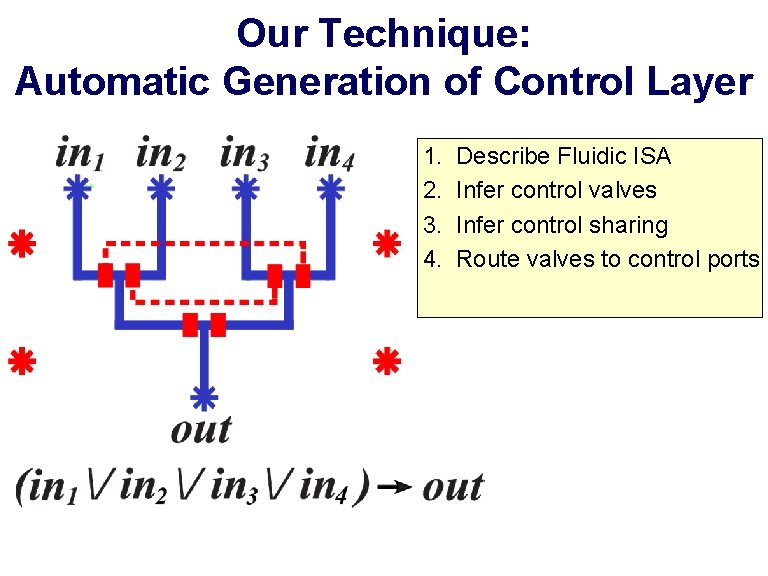
Our Technique: Automatic Generation of Control Layer 1. 2. 3. 4. Describe Fluidic ISA Infer control valves Infer control sharing Route valves to control ports
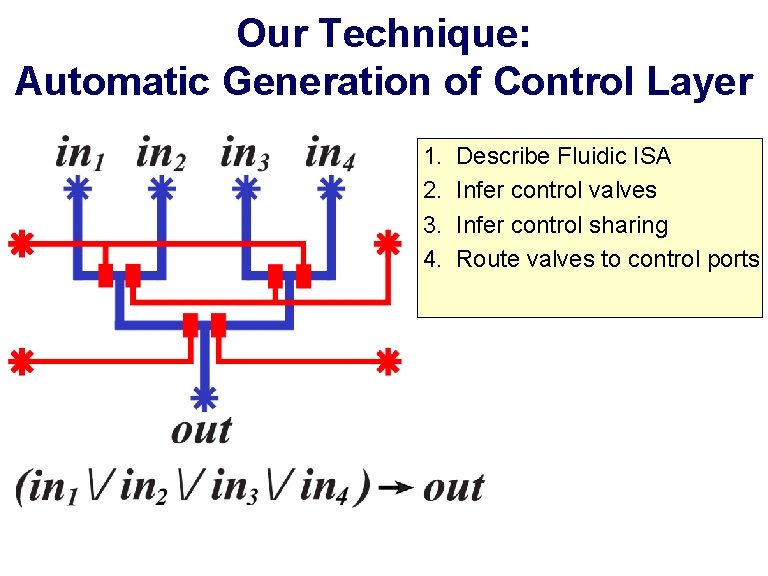
Our Technique: Automatic Generation of Control Layer 1. 2. 3. 4. Describe Fluidic ISA Infer control valves Infer control sharing Route valves to control ports
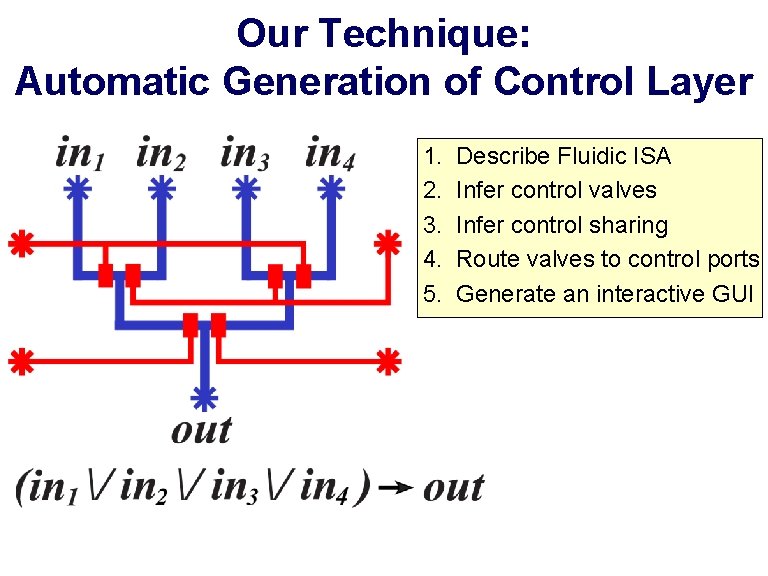
Our Technique: Automatic Generation of Control Layer 1. 2. 3. 4. 5. Describe Fluidic ISA Infer control valves Infer control sharing Route valves to control ports Generate an interactive GUI
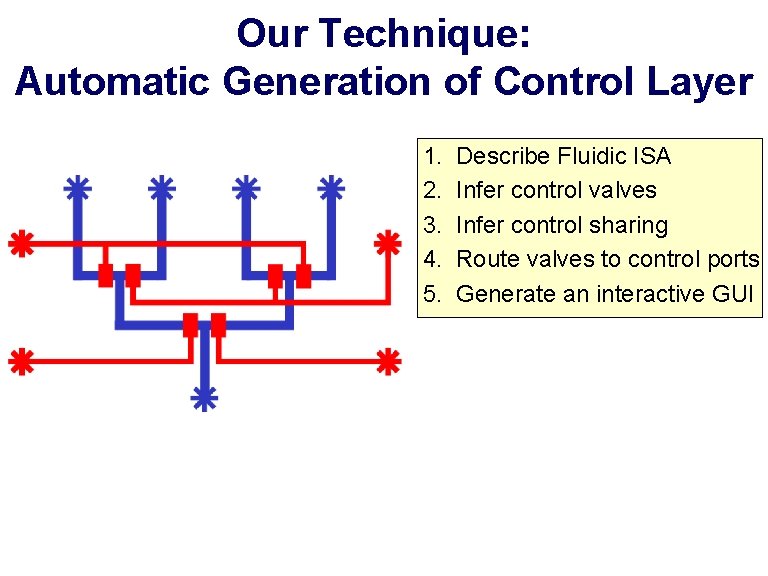
Our Technique: Automatic Generation of Control Layer 1. 2. 3. 4. 5. Describe Fluidic ISA Infer control valves Infer control sharing Route valves to control ports Generate an interactive GUI
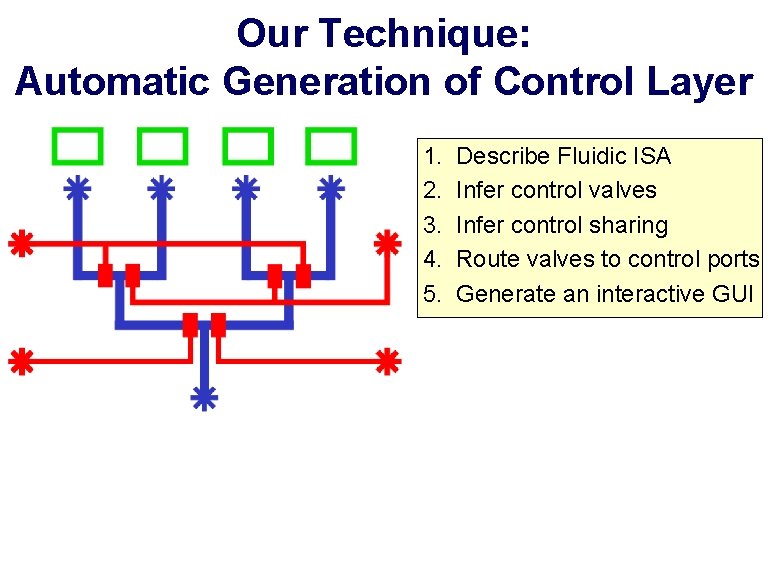
Our Technique: Automatic Generation of Control Layer 1. 2. 3. 4. 5. Describe Fluidic ISA Infer control valves Infer control sharing Route valves to control ports Generate an interactive GUI
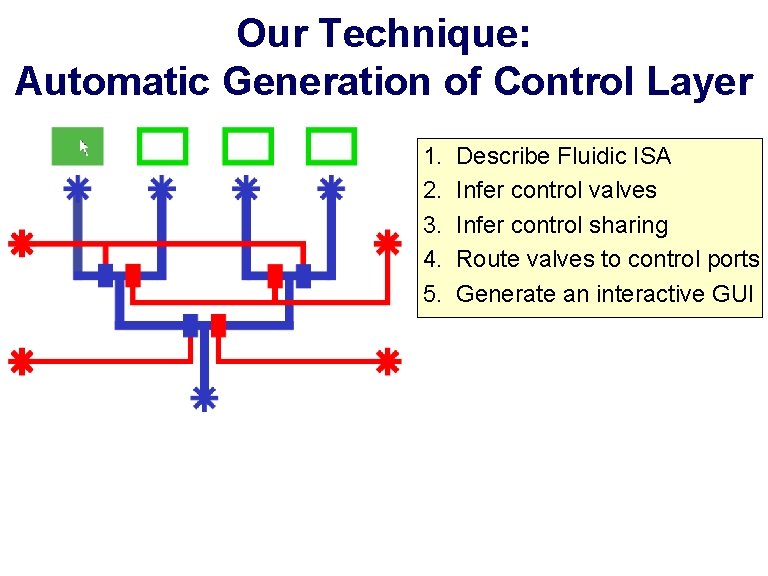
Our Technique: Automatic Generation of Control Layer 1. 2. 3. 4. 5. Describe Fluidic ISA Infer control valves Infer control sharing Route valves to control ports Generate an interactive GUI
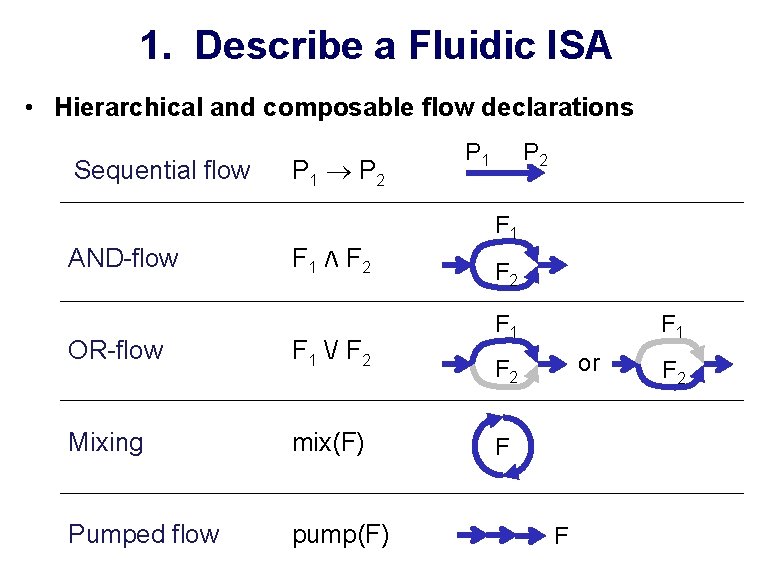
1. Describe a Fluidic ISA • Hierarchical and composable flow declarations Sequential flow AND-flow P 1 P 2 F 1 Λ F 2 OR-flow F 1 / F 2 Mixing mix(F) Pumped flow pump(F) P 1 P 2 F 1 F 1 or F 2 F F F 2
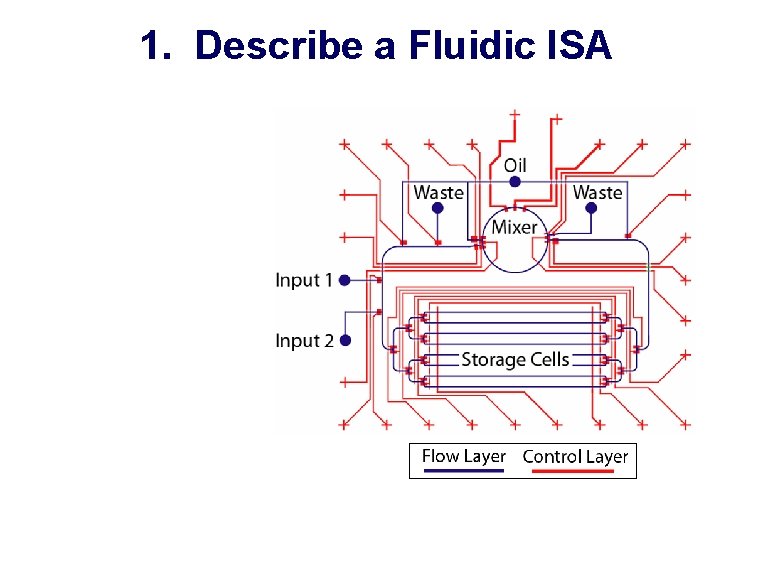
1. Describe a Fluidic ISA
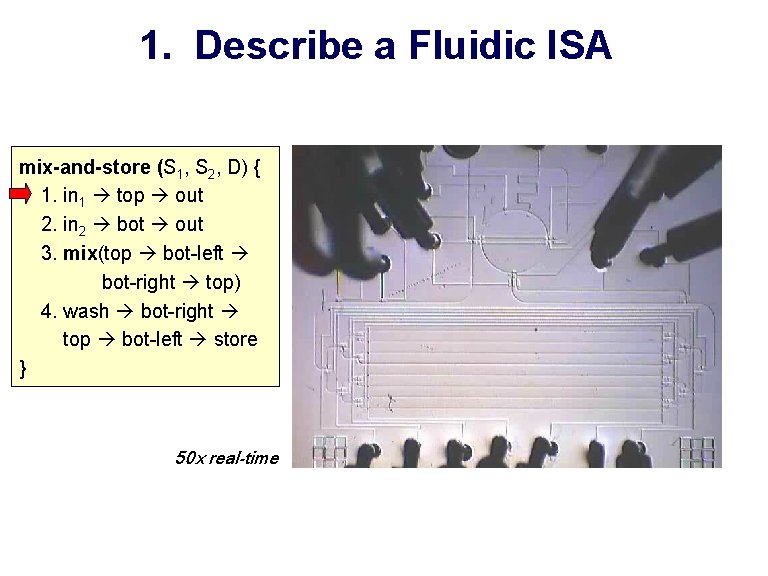
1. Describe a Fluidic ISA mix-and-store (S 1, S 2, D) { 1. in 1 top out 2. in 2 bot out 3. mix(top bot-left bot-right top) 4. wash bot-right top bot-left store } 50 x real-time
2. Infer Control Valves
2. Infer Control Valves
2. Infer Control Valves
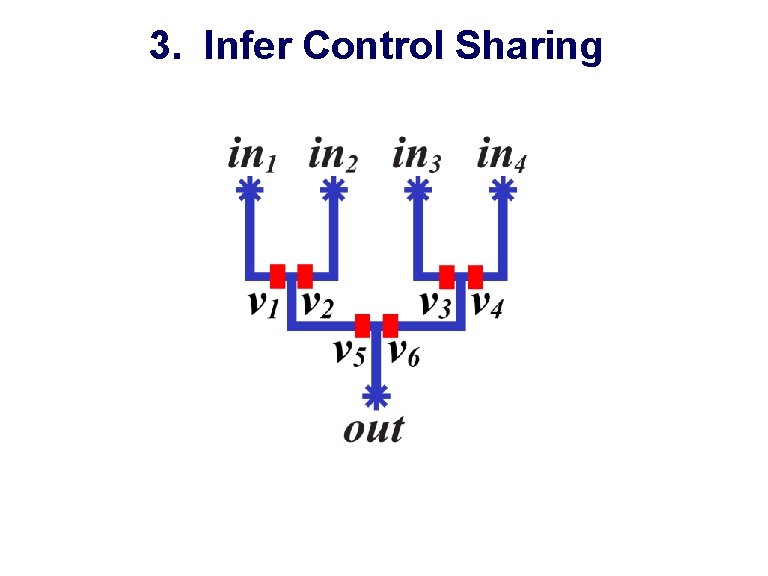
3. Infer Control Sharing
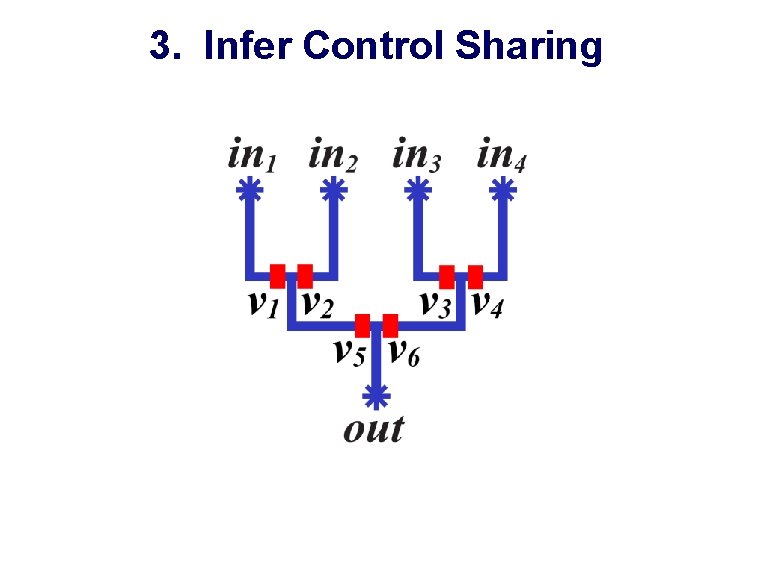
3. Infer Control Sharing
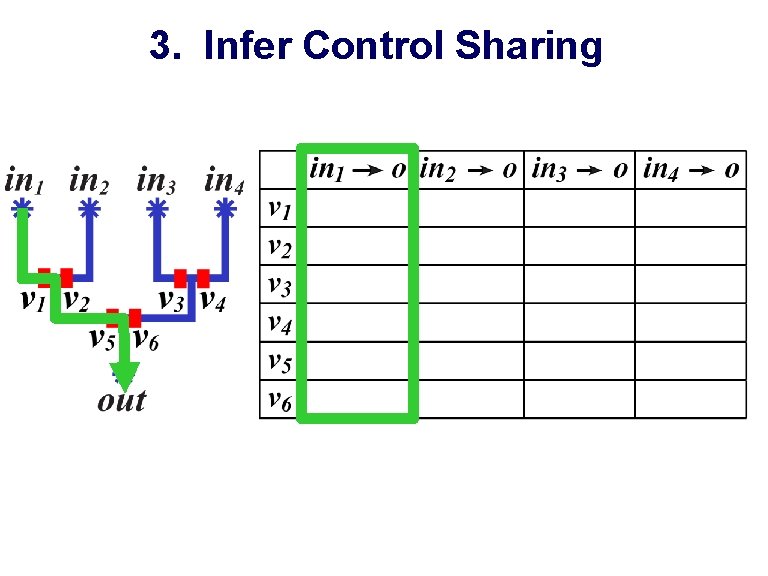
3. Infer Control Sharing
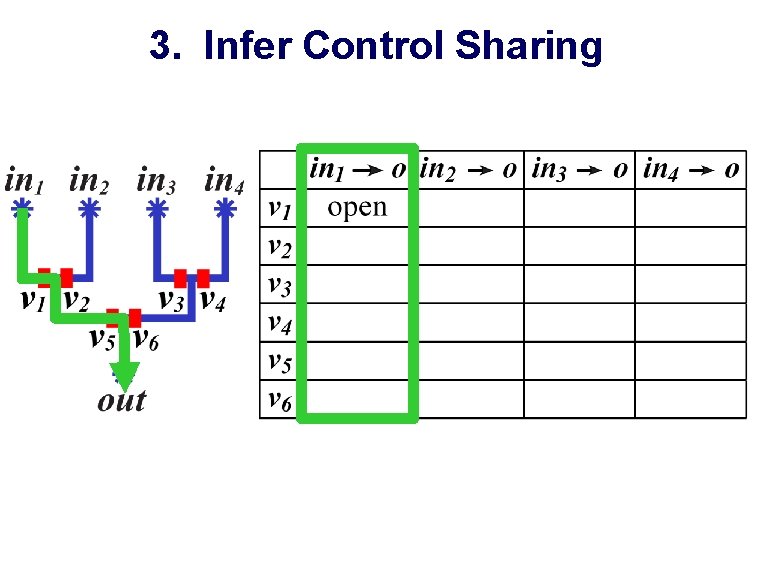
3. Infer Control Sharing
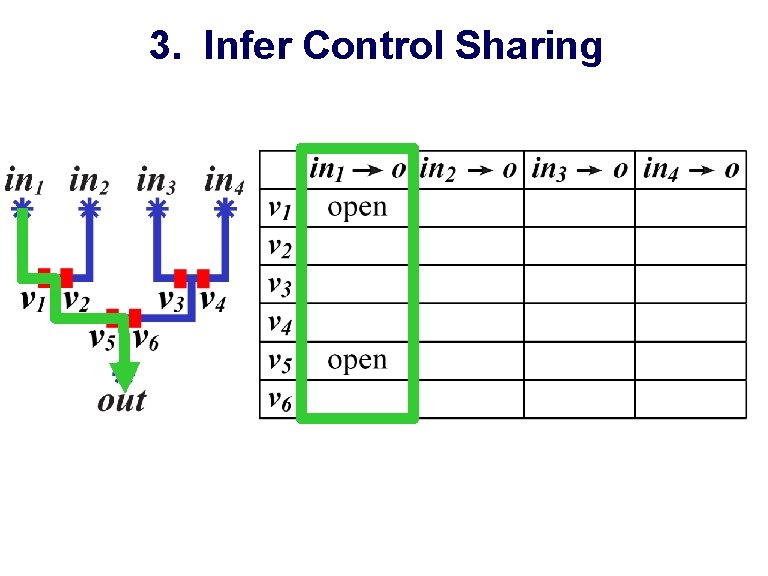
3. Infer Control Sharing
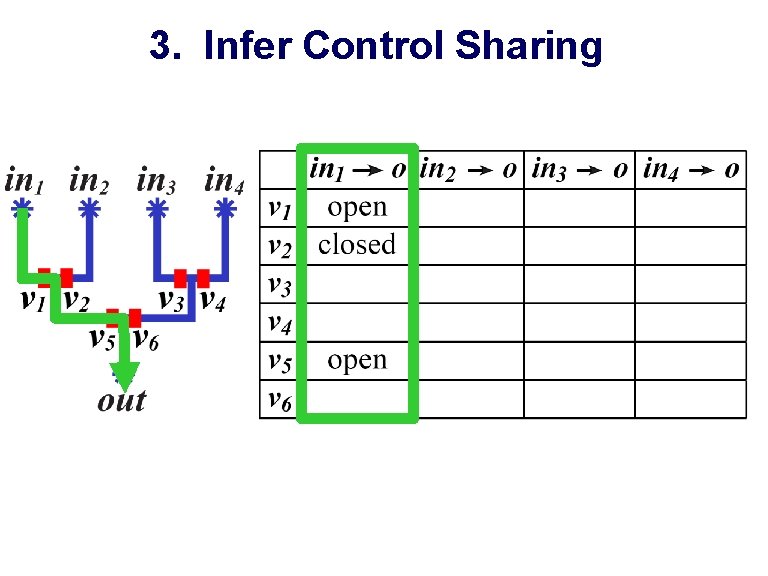
3. Infer Control Sharing
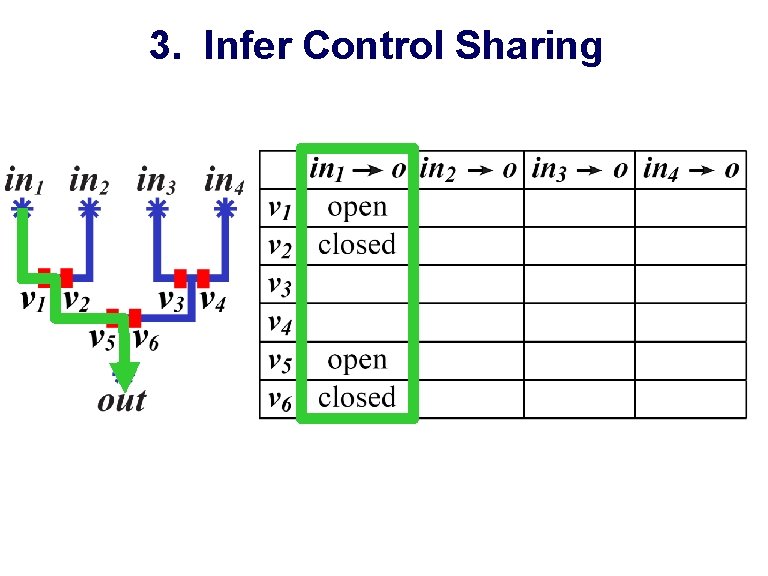
3. Infer Control Sharing
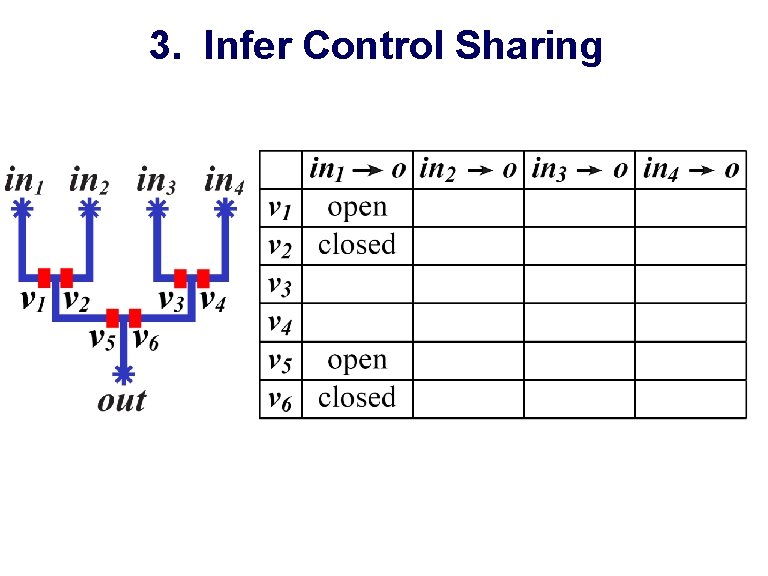
3. Infer Control Sharing
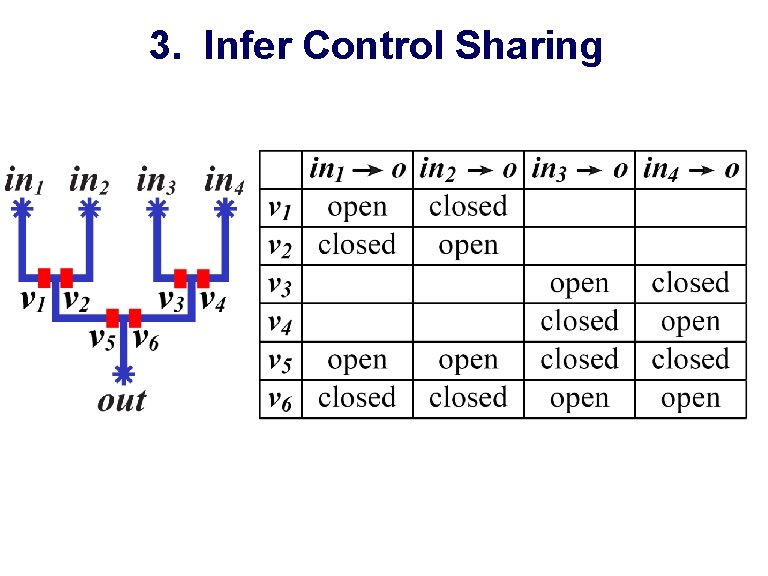
3. Infer Control Sharing
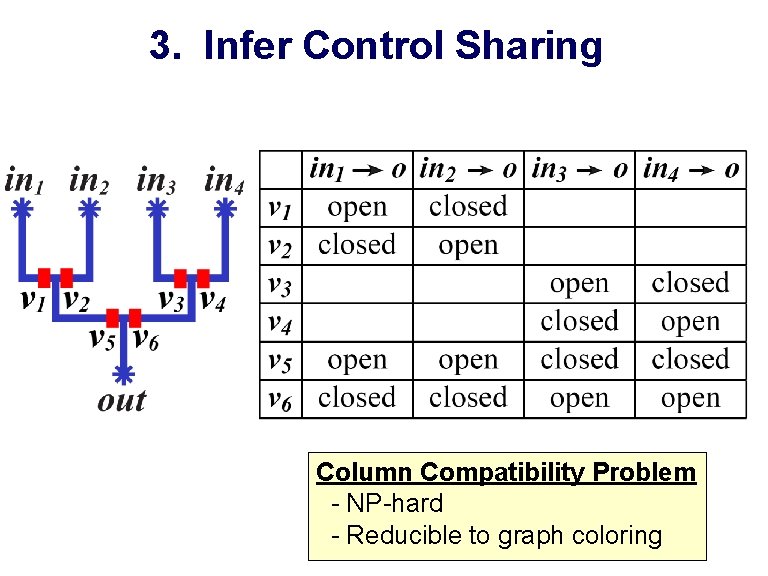
3. Infer Control Sharing Column Compatibility Problem - NP-hard - Reducible to graph coloring
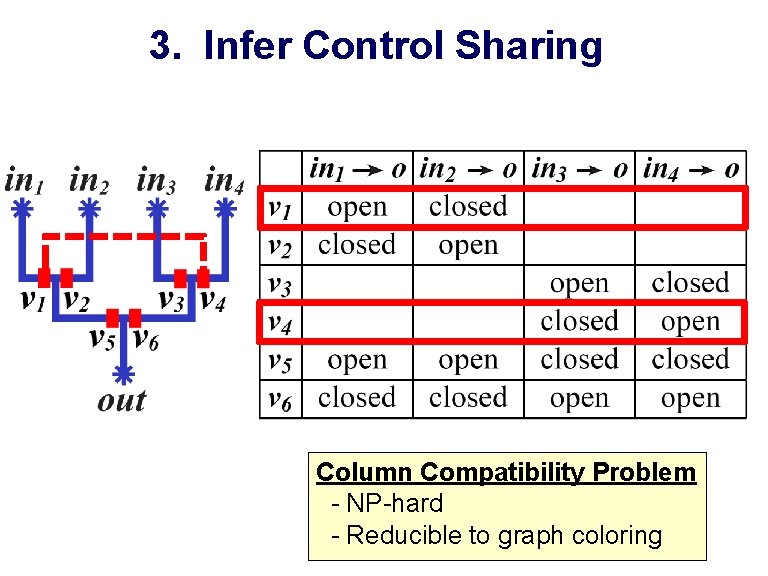
3. Infer Control Sharing Column Compatibility Problem - NP-hard - Reducible to graph coloring
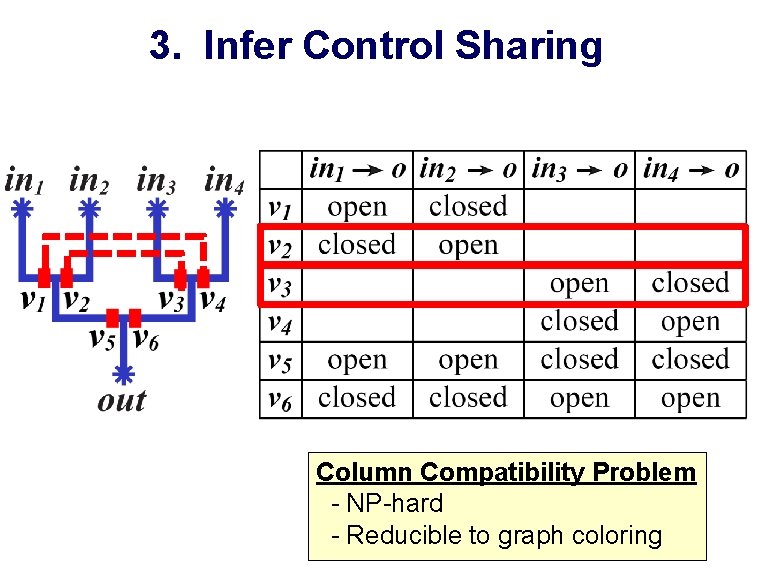
3. Infer Control Sharing Column Compatibility Problem - NP-hard - Reducible to graph coloring
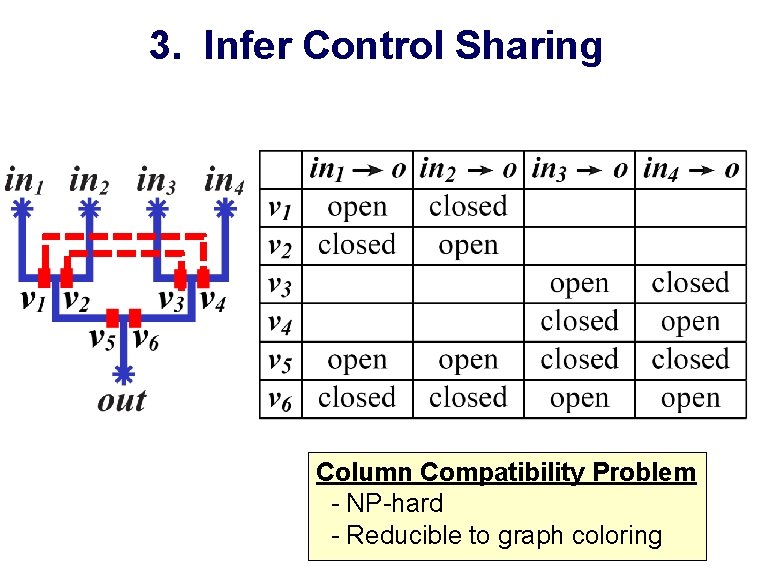
3. Infer Control Sharing Column Compatibility Problem - NP-hard - Reducible to graph coloring
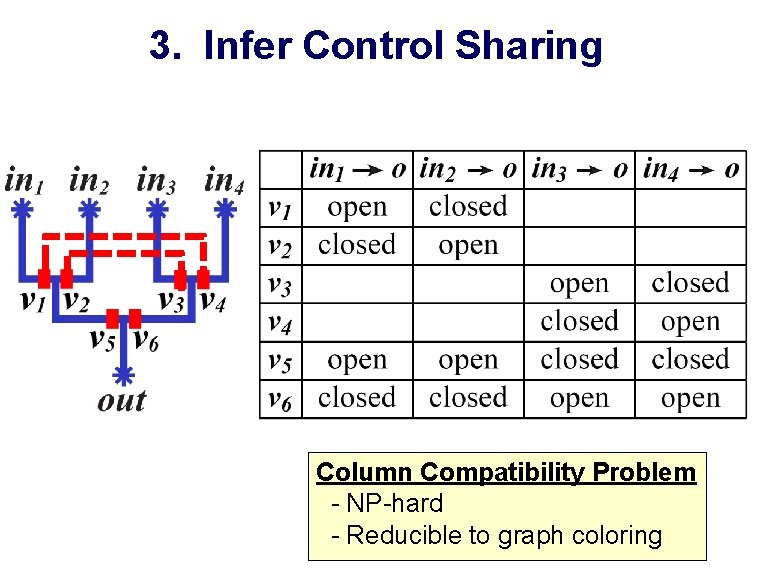
3. Infer Control Sharing Column Compatibility Problem - NP-hard - Reducible to graph coloring
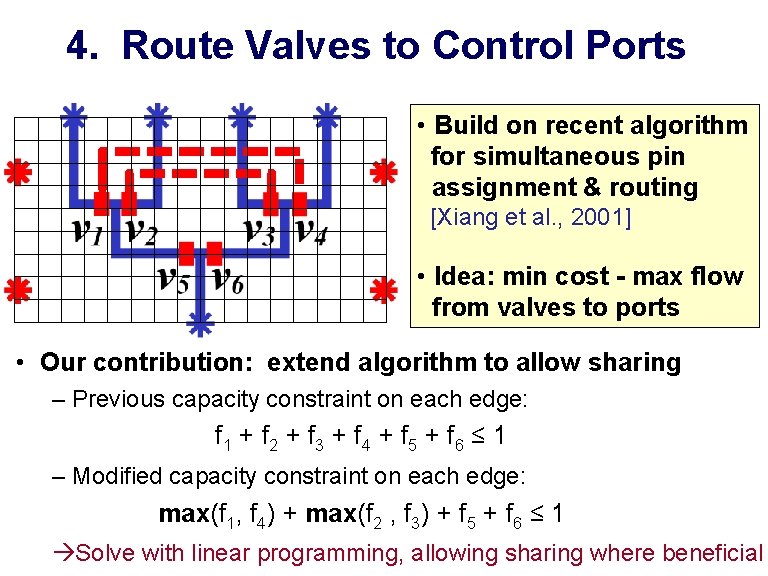
4. Route Valves to Control Ports • Build on recent algorithm for simultaneous pin assignment & routing [Xiang et al. , 2001] • Idea: min cost - max flow from valves to ports • Our contribution: extend algorithm to allow sharing – Previous capacity constraint on each edge: f 1 + f 2 + f 3 + f 4 + f 5 + f 6 ≤ 1 – Modified capacity constraint on each edge: max(f 1, f 4) + max(f 2 , f 3) + f 5 + f 6 ≤ 1 Solve with linear programming, allowing sharing where beneficial
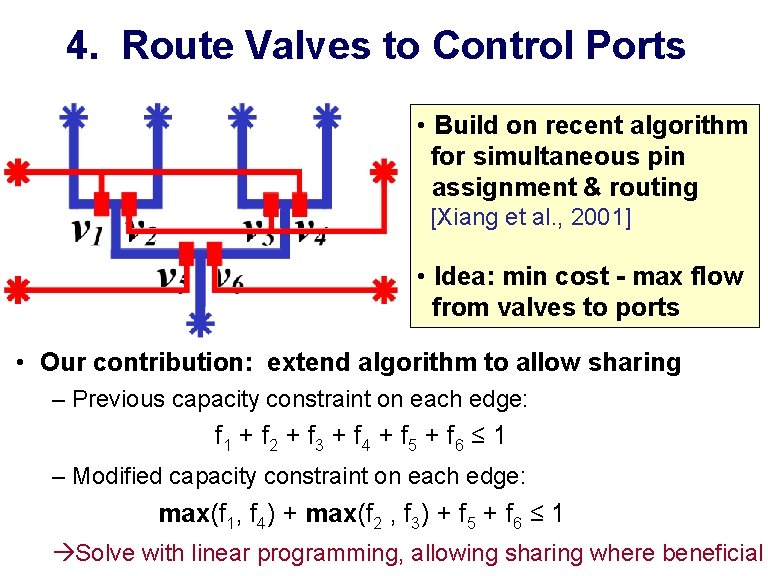
4. Route Valves to Control Ports • Build on recent algorithm for simultaneous pin assignment & routing [Xiang et al. , 2001] • Idea: min cost - max flow from valves to ports • Our contribution: extend algorithm to allow sharing – Previous capacity constraint on each edge: f 1 + f 2 + f 3 + f 4 + f 5 + f 6 ≤ 1 – Modified capacity constraint on each edge: max(f 1, f 4) + max(f 2 , f 3) + f 5 + f 6 ≤ 1 Solve with linear programming, allowing sharing where beneficial
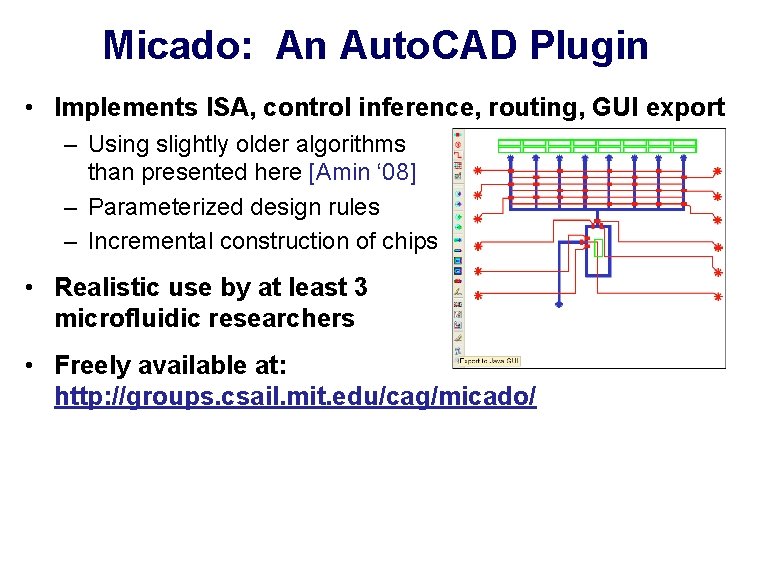
Micado: An Auto. CAD Plugin • Implements ISA, control inference, routing, GUI export – Using slightly older algorithms than presented here [Amin ‘ 08] – Parameterized design rules – Incremental construction of chips • Realistic use by at least 3 microfluidic researchers • Freely available at: http: //groups. csail. mit. edu/cag/micado/
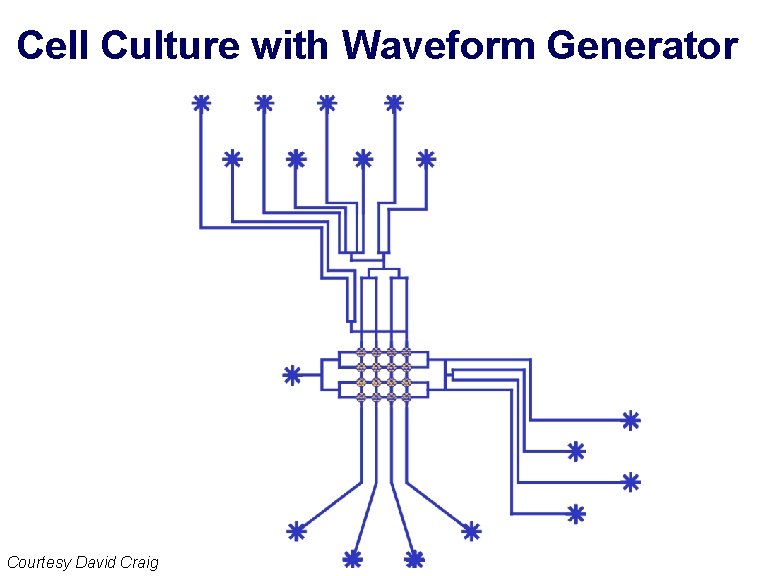
Cell Culture with Waveform Generator Courtesy David Craig
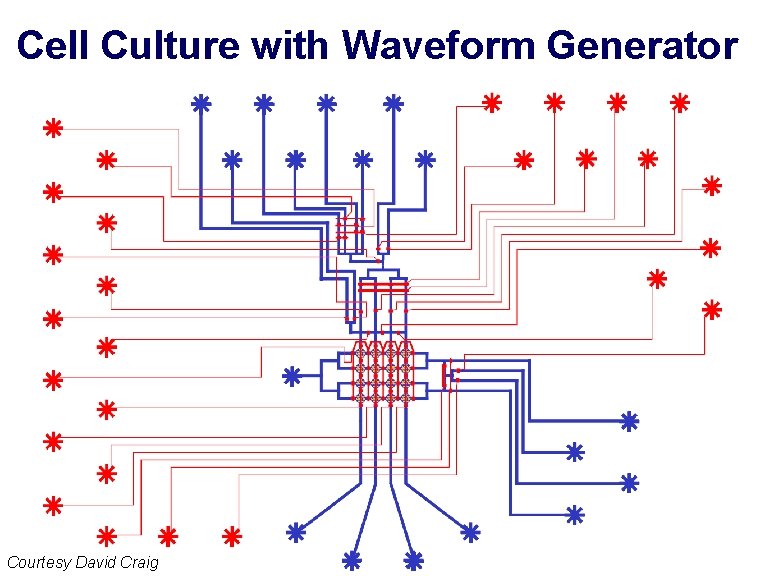
Cell Culture with Waveform Generator Courtesy David Craig
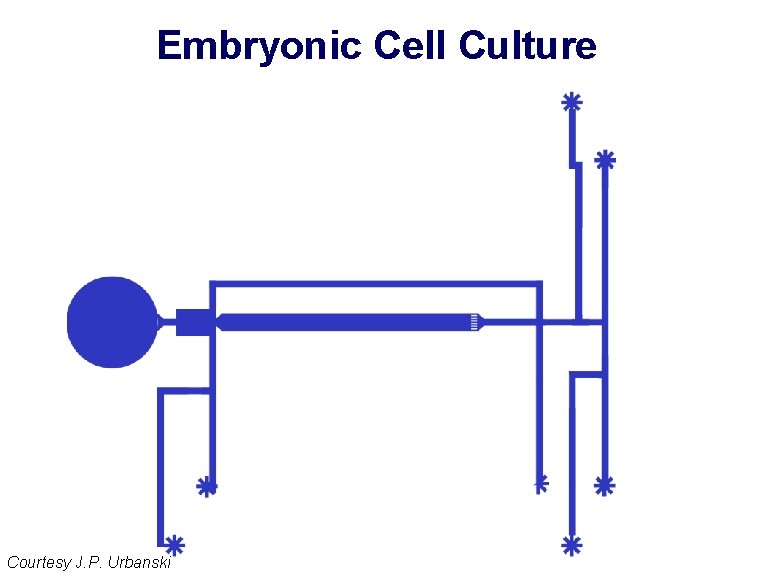
Embryonic Cell Culture Courtesy J. P. Urbanski
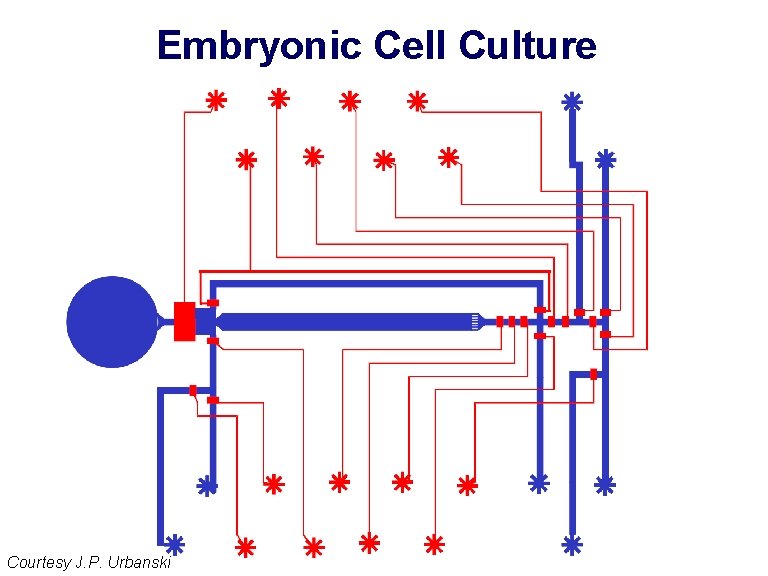
Embryonic Cell Culture Courtesy J. P. Urbanski
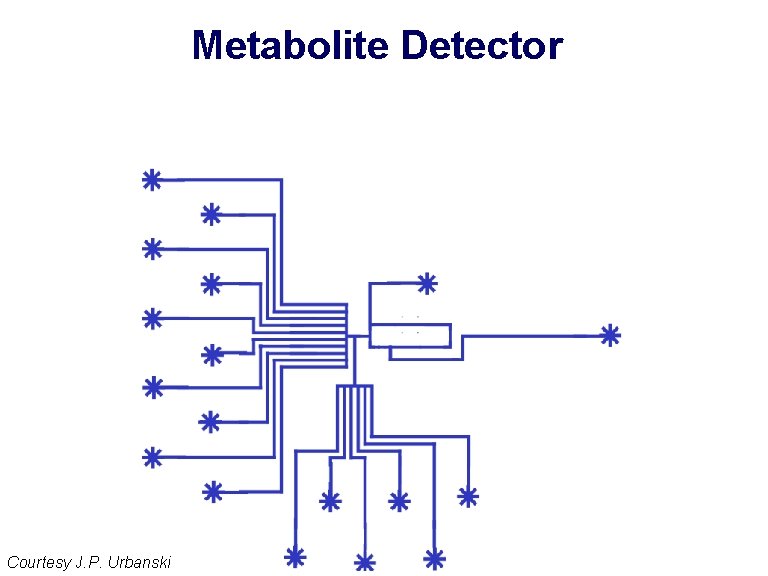
Metabolite Detector Courtesy J. P. Urbanski
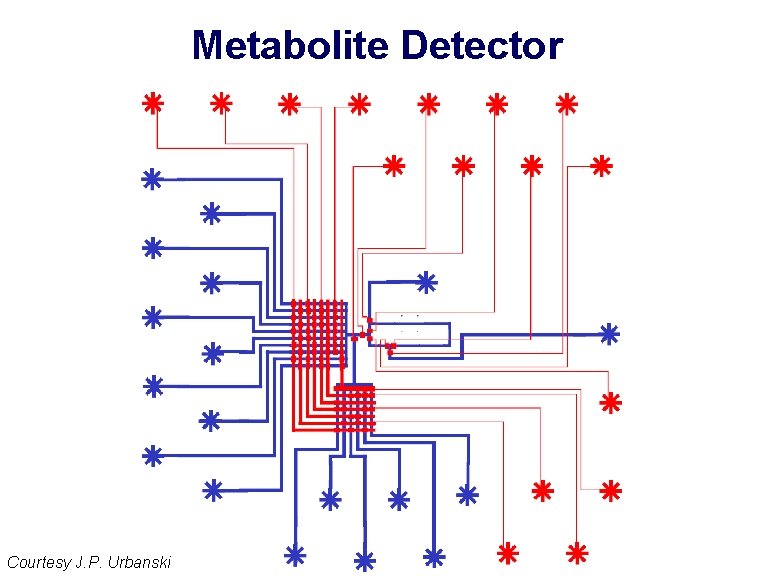
Metabolite Detector Courtesy J. P. Urbanski
Open Problems • Automate the design of the flow layer – Hardware description language for microfluidics – Define parameterized and reusable modules • Replicate and pack a primitive as densely as possible – How many cell cultures can you fit on a chip? • Support additional primitives and functionality – – – Metering volumes Sieve valves Alternate mixers Separation primitives …
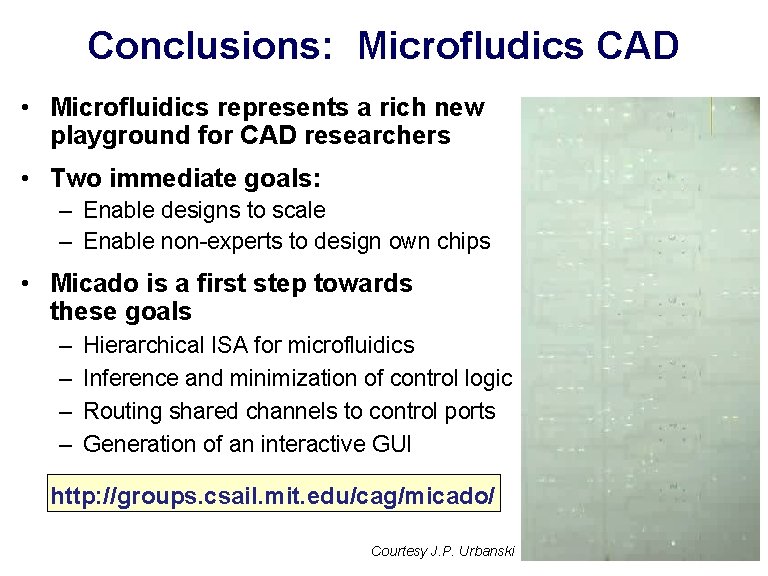
Conclusions: Microfludics CAD • Microfluidics represents a rich new playground for CAD researchers • Two immediate goals: – Enable designs to scale – Enable non-experts to design own chips • Micado is a first step towards these goals – – Hierarchical ISA for microfluidics Inference and minimization of control logic Routing shared channels to control ports Generation of an interactive GUI http: //groups. csail. mit. edu/cag/micado/ Courtesy J. P. Urbanski
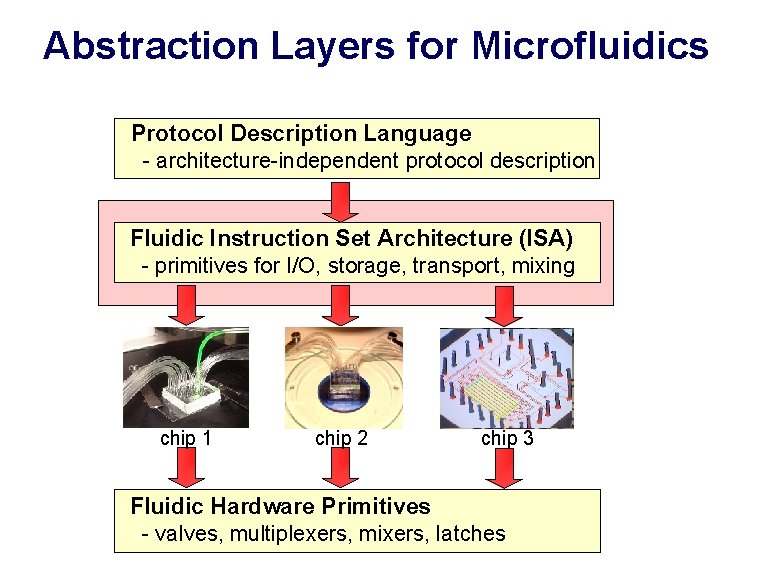
Abstraction Layers for Microfluidics Protocol Description Language - architecture-independent protocol description Fluidic Instruction Set Architecture (ISA) - primitives for I/O, storage, transport, mixing chip 1 chip 2 chip 3 Fluidic Hardware Primitives - valves, multiplexers, mixers, latches
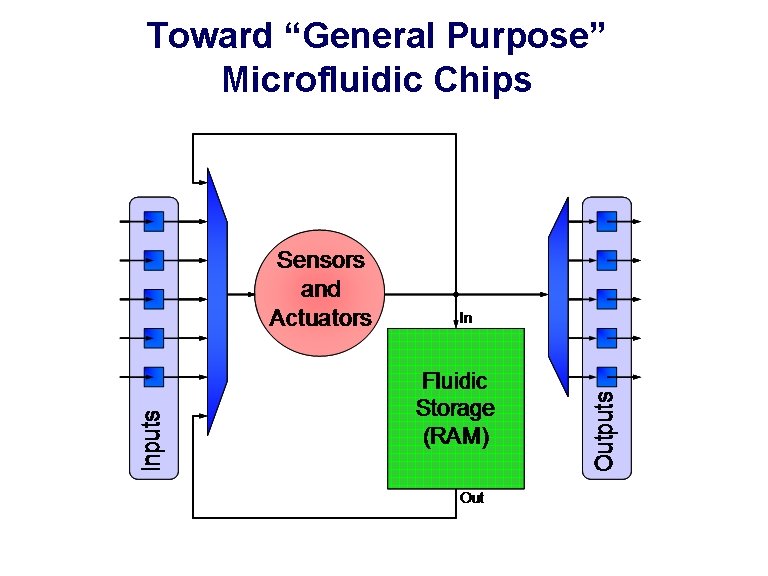
Toward “General Purpose” Microfluidic Chips
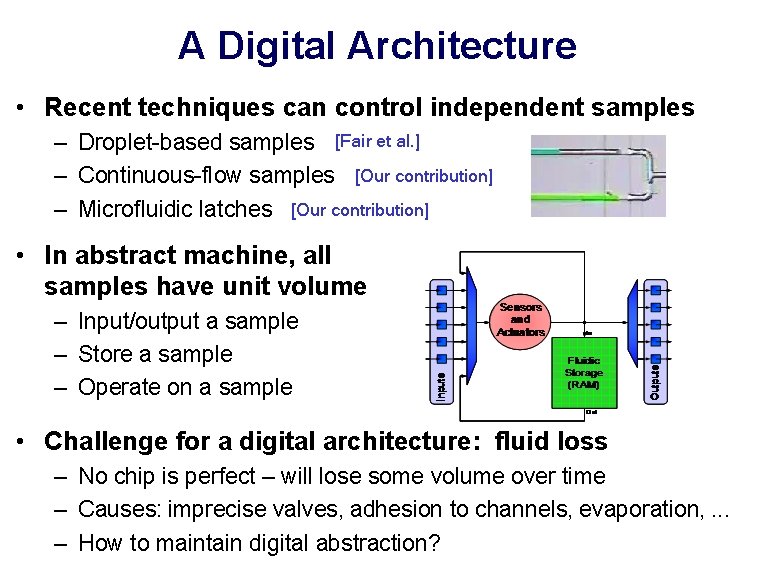
A Digital Architecture • Recent techniques can control independent samples – Droplet-based samples [Fair et al. ] – Continuous-flow samples [Our contribution] – Microfluidic latches [Our contribution] • In abstract machine, all samples have unit volume – Input/output a sample – Store a sample – Operate on a sample • Challenge for a digital architecture: fluid loss – No chip is perfect – will lose some volume over time – Causes: imprecise valves, adhesion to channels, evaporation, . . . – How to maintain digital abstraction?

Maintaining a Digital Abstraction
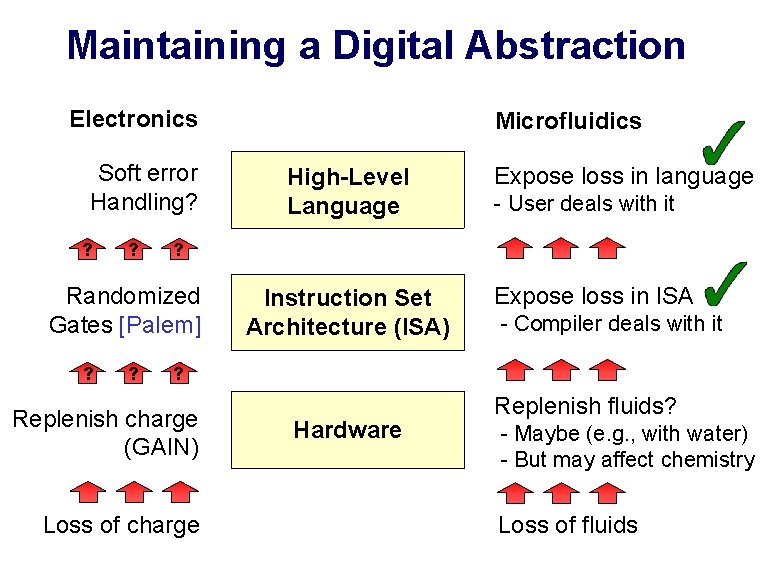
Maintaining a Digital Abstraction Electronics Soft error Handling? ? ? ? High-Level Language Expose loss in language - User deals with it ? Randomized Gates [Palem] ? Microfluidics Instruction Set Architecture (ISA) Expose loss in ISA - Compiler deals with it ? Replenish charge (GAIN) Loss of charge Hardware Replenish fluids? - Maybe (e. g. , with water) - But may affect chemistry Loss of fluids
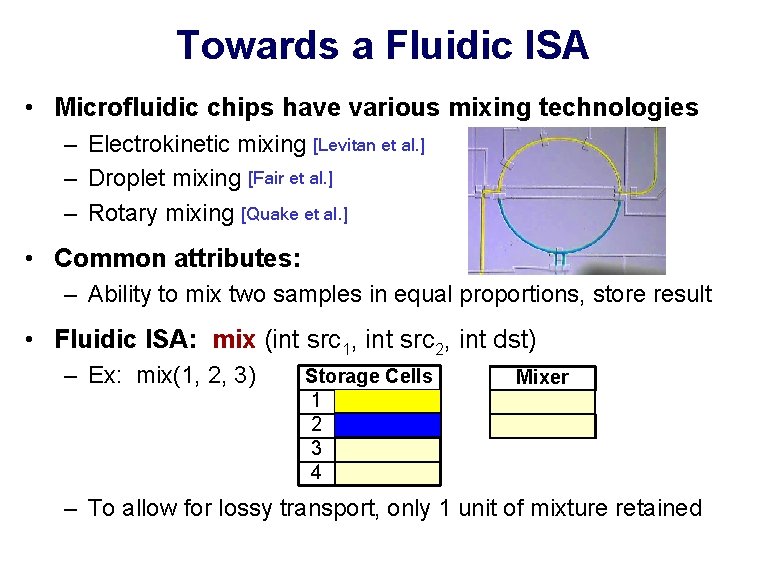
Towards a Fluidic ISA • Microfluidic chips have various mixing technologies – Electrokinetic mixing [Levitan et al. ] – Droplet mixing [Fair et al. ] – Rotary mixing [Quake et al. ] • Common attributes: – Ability to mix two samples in equal proportions, store result • Fluidic ISA: mix (int src 1, int src 2, int dst) – Ex: mix(1, 2, 3) Storage Cells 1 2 3 4 Mixer – To allow for lossy transport, only 1 unit of mixture retained
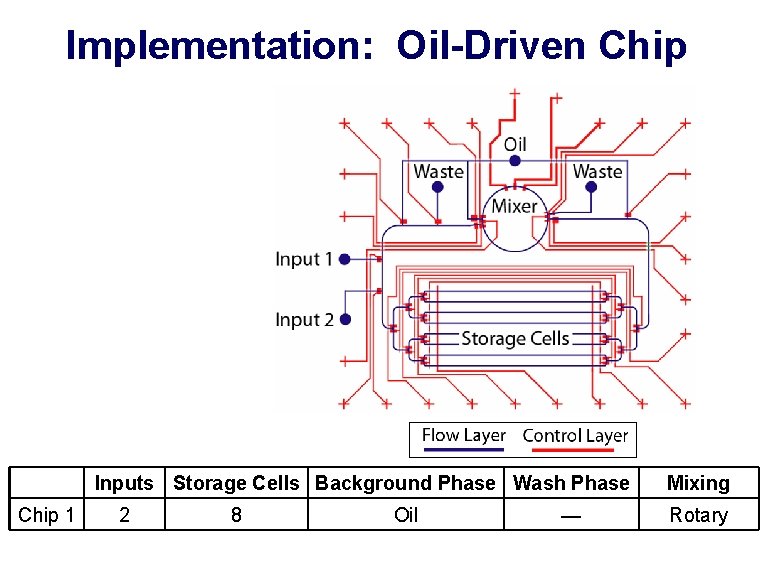
Implementation: Oil-Driven Chip Inputs Storage Cells Background Phase Wash Phase Chip 1 2 8 Oil — Mixing Rotary
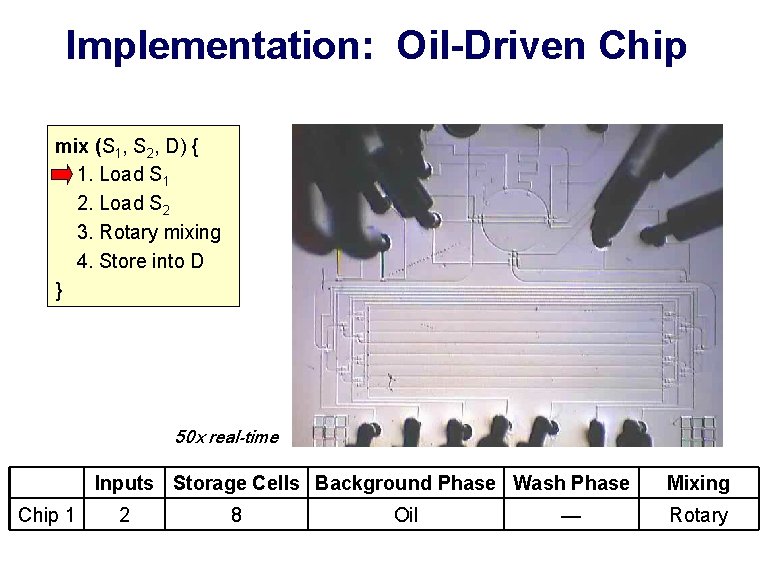
Implementation: Oil-Driven Chip mix (S 1, S 2, D) { 1. Load S 1 2. Load S 2 3. Rotary mixing 4. Store into D } 50 x real-time Inputs Storage Cells Background Phase Wash Phase Chip 1 2 8 Oil — Mixing Rotary
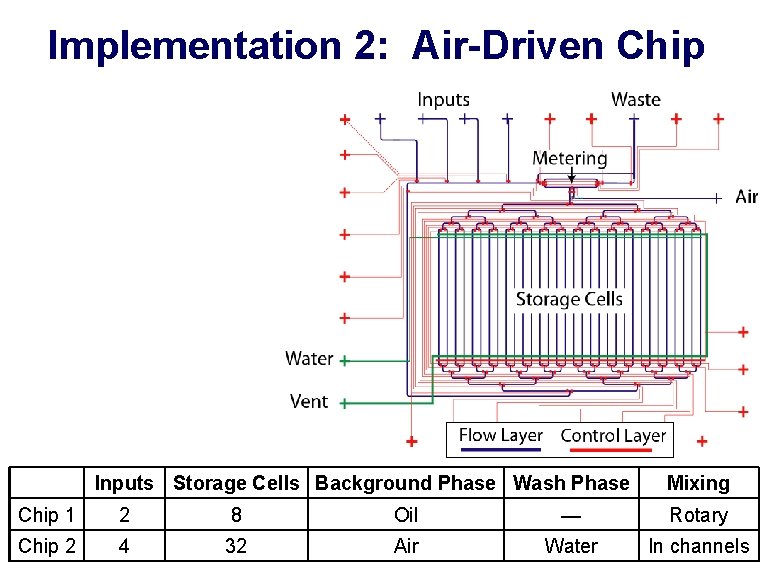
Implementation 2: Air-Driven Chip Inputs Storage Cells Background Phase Wash Phase Mixing Chip 1 2 8 Oil — Rotary Chip 2 4 32 Air Water In channels
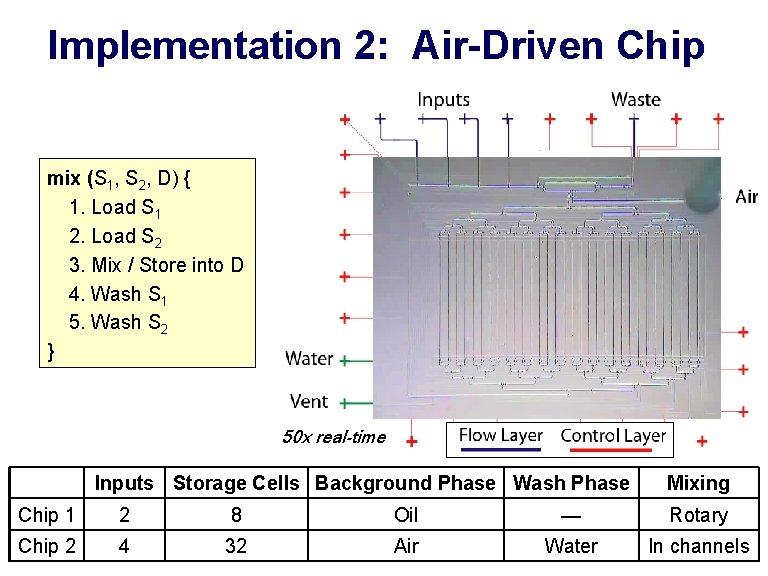
Implementation 2: Air-Driven Chip mix (S 1, S 2, D) { 1. Load S 1 2. Load S 2 3. Mix / Store into D 4. Wash S 1 5. Wash S 2 } 50 x real-time Inputs Storage Cells Background Phase Wash Phase Mixing Chip 1 2 8 Oil — Rotary Chip 2 4 32 Air Water In channels
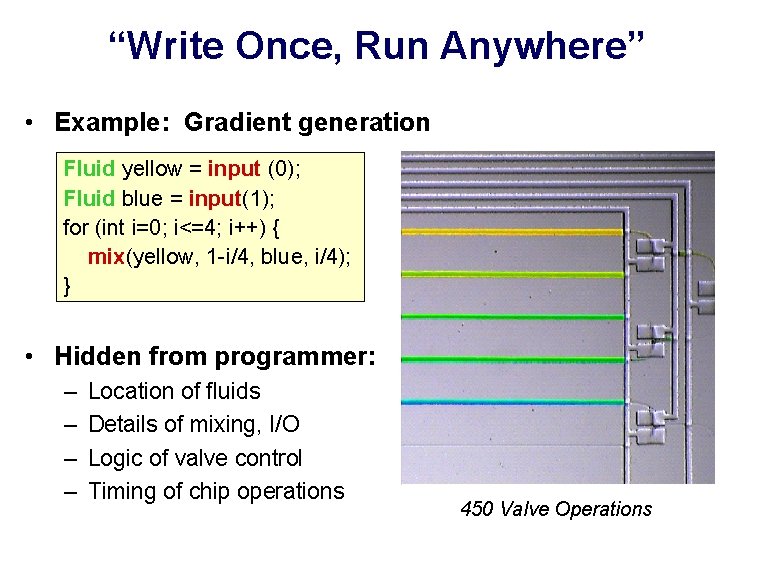
“Write Once, Run Anywhere” • Example: Gradient generation Fluid yellow = input (0); Fluid blue = input(1); for (int i=0; i<=4; i++) { mix(yellow, 1 -i/4, blue, i/4); } • Hidden from programmer: – – Location of fluids Details of mixing, I/O Logic of valve control Timing of chip operations 450 Valve Operations
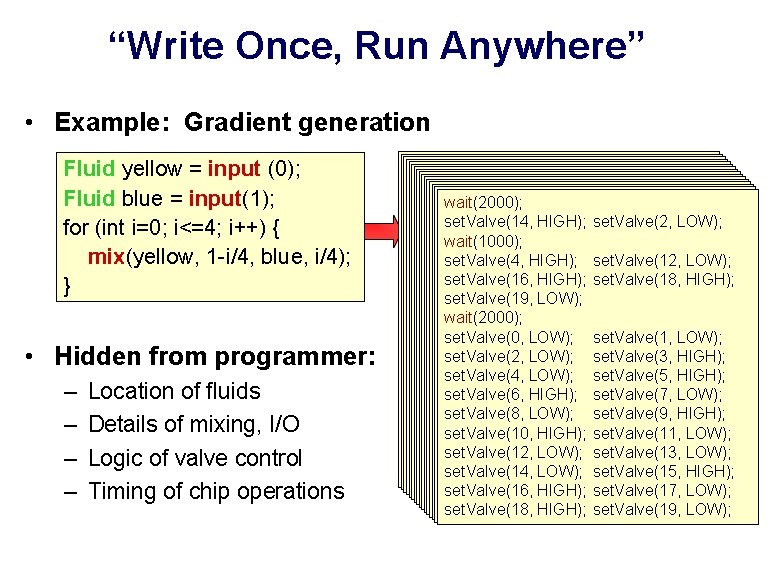
“Write Once, Run Anywhere” • Example: Gradient generation Fluid yellow = input (0); Fluid blue = input(1); for (int i=0; i<=4; i++) { mix(yellow, 1 -i/4, blue, i/4); } • Hidden from programmer: – – Location of fluids Details of mixing, I/O Logic of valve control Timing of chip operations set. Valve(0, HIGH); set. Valve(1, HIGH); wait(2000); set. Valve(2, LOW); set. Valve(3, HIGH); set. Valve(0, HIGH); set. Valve(1, HIGH); set. Valve(14, HIGH); set. Valve(2, LOW); wait(2000); set. Valve(4, LOW); set. Valve(5, LOW); set. Valve(2, LOW); set. Valve(3, HIGH); wait(1000); set. Valve(14, HIGH); set. Valve(2, LOW); set. Valve(6, HIGH); set. Valve(7, LOW); set. Valve(4, LOW); set. Valve(5, LOW); set. Valve(4, HIGH); set. Valve(12, LOW); wait(1000); set. Valve(8, LOW); set. Valve(9, HIGH); set. Valve(6, HIGH); set. Valve(7, LOW); set. Valve(16, HIGH); set. Valve(18, HIGH); set. Valve(4, HIGH); set. Valve(12, LOW); set. Valve(10, LOW); set. Valve(11, HIGH); set. Valve(8, LOW); set. Valve(9, HIGH); set. Valve(19, LOW); set. Valve(16, HIGH); set. Valve(18, HIGH); set. Valve(12, LOW); set. Valve(13, HIGH); set. Valve(10, LOW); set. Valve(11, HIGH); wait(2000); set. Valve(19, LOW); set. Valve(14, LOW); set. Valve(15, HIGH); set. Valve(12, LOW); set. Valve(13, HIGH); set. Valve(0, LOW); set. Valve(1, LOW); wait(2000); set. Valve(16, LOW); set. Valve(17, LOW); set. Valve(14, LOW); set. Valve(15, HIGH); set. Valve(2, LOW); set. Valve(3, HIGH); set. Valve(0, LOW); set. Valve(1, LOW); set. Valve(18, LOW); set. Valve(19, LOW); set. Valve(16, LOW); set. Valve(17, LOW); set. Valve(4, LOW); set. Valve(5, HIGH); set. Valve(2, LOW); set. Valve(3, HIGH); wait(2000); set. Valve(18, LOW); set. Valve(19, LOW); set. Valve(6, HIGH); set. Valve(7, LOW); set. Valve(4, LOW); set. Valve(5, HIGH); set. Valve(14, HIGH); set. Valve(2, LOW); wait(2000); set. Valve(8, LOW); set. Valve(9, HIGH); set. Valve(6, HIGH); set. Valve(7, LOW); wait(1000); set. Valve(14, HIGH); set. Valve(2, LOW); set. Valve(10, HIGH); set. Valve(11, LOW); set. Valve(8, LOW); set. Valve(9, HIGH); set. Valve(4, HIGH); set. Valve(12, LOW); wait(1000); set. Valve(12, LOW); set. Valve(13, LOW); set. Valve(10, HIGH); set. Valve(11, LOW); set. Valve(16, HIGH); set. Valve(18, HIGH); set. Valve(4, HIGH); set. Valve(12, LOW); set. Valve(14, LOW); set. Valve(15, HIGH); set. Valve(12, LOW); set. Valve(13, LOW); set. Valve(19, LOW); set. Valve(16, HIGH); set. Valve(18, HIGH); set. Valve(16, HIGH); set. Valve(17, LOW); set. Valve(14, LOW); set. Valve(15, HIGH); wait(2000); set. Valve(19, LOW); set. Valve(18, HIGH); set. Valve(19, LOW); set. Valve(16, HIGH); set. Valve(17, LOW); wait(2000); set. Valve(18, HIGH); set. Valve(19, LOW); 450 Valve Operations
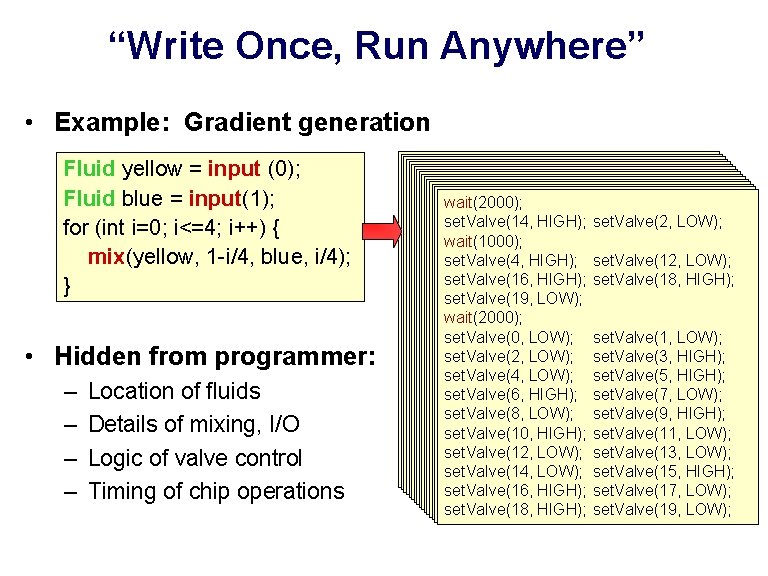
“Write Once, Run Anywhere” • Example: Gradient generation Fluid yellow = input (0); Fluid blue = input(1); for (int i=0; i<=4; i++) { mix(yellow, 1 -i/4, blue, i/4); } • Hidden from programmer: – – Location of fluids Details of mixing, I/O Logic of valve control Timing of chip operations set. Valve(0, HIGH); set. Valve(1, HIGH); wait(2000); set. Valve(2, LOW); set. Valve(3, HIGH); set. Valve(0, HIGH); set. Valve(1, HIGH); set. Valve(14, HIGH); set. Valve(2, LOW); wait(2000); set. Valve(4, LOW); set. Valve(5, LOW); set. Valve(2, LOW); set. Valve(3, HIGH); wait(1000); set. Valve(14, HIGH); set. Valve(2, LOW); set. Valve(6, HIGH); set. Valve(7, LOW); set. Valve(4, LOW); set. Valve(5, LOW); set. Valve(4, HIGH); set. Valve(12, LOW); wait(1000); set. Valve(8, LOW); set. Valve(9, HIGH); set. Valve(6, HIGH); set. Valve(7, LOW); set. Valve(16, HIGH); set. Valve(18, HIGH); set. Valve(4, HIGH); set. Valve(12, LOW); set. Valve(10, LOW); set. Valve(11, HIGH); set. Valve(8, LOW); set. Valve(9, HIGH); set. Valve(19, LOW); set. Valve(16, HIGH); set. Valve(18, HIGH); set. Valve(12, LOW); set. Valve(13, HIGH); set. Valve(10, LOW); set. Valve(11, HIGH); wait(2000); set. Valve(19, LOW); set. Valve(14, LOW); set. Valve(15, HIGH); set. Valve(12, LOW); set. Valve(13, HIGH); set. Valve(0, LOW); set. Valve(1, LOW); wait(2000); set. Valve(16, LOW); set. Valve(17, LOW); set. Valve(14, LOW); set. Valve(15, HIGH); set. Valve(2, LOW); set. Valve(3, HIGH); set. Valve(0, LOW); set. Valve(1, LOW); set. Valve(18, LOW); set. Valve(19, LOW); set. Valve(16, LOW); set. Valve(17, LOW); set. Valve(4, LOW); set. Valve(5, HIGH); set. Valve(2, LOW); set. Valve(3, HIGH); wait(2000); set. Valve(18, LOW); set. Valve(19, LOW); set. Valve(6, HIGH); set. Valve(7, LOW); set. Valve(4, LOW); set. Valve(5, HIGH); set. Valve(14, HIGH); set. Valve(2, LOW); wait(2000); set. Valve(8, LOW); set. Valve(9, HIGH); set. Valve(6, HIGH); set. Valve(7, LOW); wait(1000); set. Valve(14, HIGH); set. Valve(2, LOW); set. Valve(10, HIGH); set. Valve(11, LOW); set. Valve(8, LOW); set. Valve(9, HIGH); set. Valve(4, HIGH); set. Valve(12, LOW); wait(1000); set. Valve(12, LOW); set. Valve(13, LOW); set. Valve(10, HIGH); set. Valve(11, LOW); set. Valve(16, HIGH); set. Valve(18, HIGH); set. Valve(4, HIGH); set. Valve(12, LOW); set. Valve(14, LOW); set. Valve(15, HIGH); set. Valve(12, LOW); set. Valve(13, LOW); set. Valve(19, LOW); set. Valve(16, HIGH); set. Valve(18, HIGH); set. Valve(16, HIGH); set. Valve(17, LOW); set. Valve(14, LOW); set. Valve(15, HIGH); wait(2000); set. Valve(19, LOW); set. Valve(18, HIGH); set. Valve(19, LOW); set. Valve(16, HIGH); set. Valve(17, LOW); wait(2000); set. Valve(18, HIGH); set. Valve(19, LOW); 450 Valve Operations
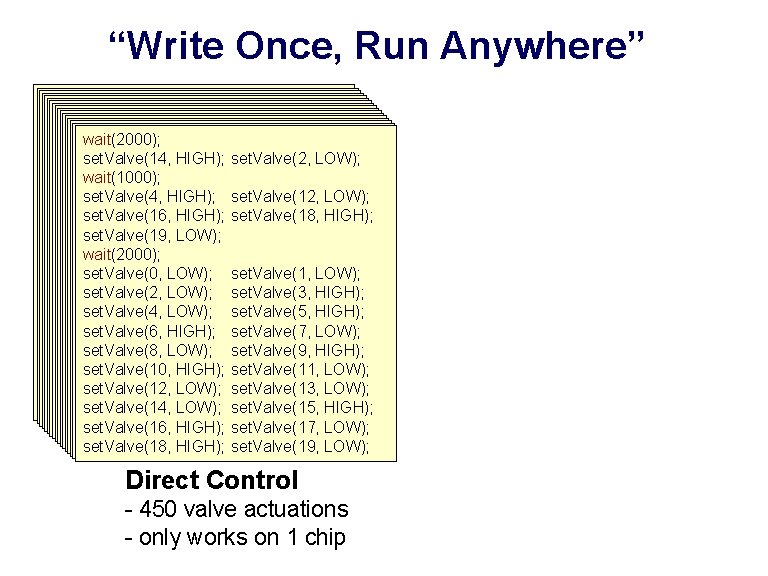
“Write Once, Run Anywhere” set. Valve(0, HIGH); set. Valve(1, HIGH); wait(2000); set. Valve(0, HIGH); set. Valve(1, HIGH); set. Valve(2, LOW); set. Valve(3, HIGH); wait(2000); set. Valve(2, LOW); set. Valve(3, HIGH); set. Valve(0, HIGH); set. Valve(1, HIGH); set. Valve(14, HIGH); set. Valve(2, LOW); wait(2000); set. Valve(2, LOW); set. Valve(3, HIGH); set. Valve(0, HIGH); set. Valve(1, HIGH); set. Valve(4, LOW); set. Valve(5, LOW); set. Valve(14, HIGH); set. Valve(2, LOW); wait(2000); set. Valve(4, LOW); set. Valve(5, LOW); set. Valve(2, LOW); set. Valve(3, HIGH); wait(1000); set. Valve(14, HIGH); set. Valve(2, LOW); set. Valve(4, LOW); set. Valve(5, LOW); set. Valve(2, LOW); set. Valve(3, HIGH); set. Valve(6, HIGH); set. Valve(7, LOW); wait(1000); set. Valve(14, HIGH); set. Valve(2, LOW); set. Valve(6, HIGH); set. Valve(7, LOW); set. Valve(4, LOW); set. Valve(5, LOW); set. Valve(4, HIGH); set. Valve(12, LOW); wait(1000); set. Valve(6, HIGH); set. Valve(7, LOW); set. Valve(4, LOW); set. Valve(5, LOW); set. Valve(8, LOW); set. Valve(9, HIGH); set. Valve(4, HIGH); set. Valve(12, LOW); wait(1000); set. Valve(8, LOW); set. Valve(9, HIGH); set. Valve(6, HIGH); set. Valve(7, LOW); set. Valve(16, HIGH); set. Valve(18, HIGH); set. Valve(4, HIGH); set. Valve(12, LOW); set. Valve(8, LOW); set. Valve(9, HIGH); set. Valve(6, HIGH); set. Valve(7, LOW); set. Valve(10, LOW); set. Valve(11, HIGH); set. Valve(16, HIGH); set. Valve(18, HIGH); set. Valve(4, HIGH); set. Valve(12, LOW); set. Valve(10, LOW); set. Valve(11, HIGH); set. Valve(8, LOW); set. Valve(9, HIGH); set. Valve(19, LOW); set. Valve(16, HIGH); set. Valve(18, HIGH); set. Valve(10, LOW); set. Valve(11, HIGH); set. Valve(8, LOW); set. Valve(9, HIGH); set. Valve(12, LOW); set. Valve(13, HIGH); set. Valve(19, LOW); set. Valve(16, HIGH); set. Valve(18, HIGH); set. Valve(12, LOW); set. Valve(13, HIGH); set. Valve(10, LOW); set. Valve(11, HIGH); wait(2000); set. Valve(19, LOW); set. Valve(12, LOW); set. Valve(13, HIGH); set. Valve(10, LOW); set. Valve(11, HIGH); set. Valve(14, LOW); set. Valve(15, HIGH); wait(2000); set. Valve(19, LOW); set. Valve(14, LOW); set. Valve(15, HIGH); set. Valve(12, LOW); set. Valve(13, HIGH); set. Valve(0, LOW); set. Valve(1, LOW); wait(2000); set. Valve(14, LOW); set. Valve(15, HIGH); set. Valve(12, LOW); set. Valve(13, HIGH); set. Valve(16, LOW); set. Valve(17, LOW); set. Valve(0, LOW); set. Valve(1, LOW); wait(2000); set. Valve(16, LOW); set. Valve(17, LOW); set. Valve(14, LOW); set. Valve(15, HIGH); set. Valve(2, LOW); set. Valve(3, HIGH); set. Valve(0, LOW); set. Valve(1, LOW); set. Valve(16, LOW); set. Valve(17, LOW); set. Valve(14, LOW); set. Valve(15, HIGH); set. Valve(2, LOW); set. Valve(3, HIGH); set. Valve(0, LOW); set. Valve(16, LOW); set. Valve(17, LOW); set. Valve(14, LOW); set. Valve(15, HIGH); set. Valve(18, LOW); set. Valve(19, LOW); set. Valve(2, LOW); set. Valve(3, HIGH); set. Valve(0, LOW); set. Valve(18, LOW); set. Valve(19, LOW); set. Valve(16, LOW); set. Valve(17, LOW); set. Valve(4, LOW); set. Valve(5, HIGH); set. Valve(2, LOW); set. Valve(3, HIGH); set. Valve(18, LOW); set. Valve(19, LOW); set. Valve(16, LOW); set. Valve(17, LOW); wait(2000); set. Valve(4, LOW); set. Valve(5, HIGH); set. Valve(2, LOW); set. Valve(3, HIGH); wait(2000); set. Valve(18, LOW); set. Valve(19, LOW); set. Valve(6, HIGH); set. Valve(7, LOW); set. Valve(4, LOW); set. Valve(5, HIGH); wait(2000); set. Valve(18, LOW); set. Valve(19, LOW); set. Valve(14, HIGH); set. Valve(2, LOW); set. Valve(6, HIGH); set. Valve(7, LOW); set. Valve(4, LOW); set. Valve(5, HIGH); set. Valve(14, HIGH); set. Valve(2, LOW); wait(2000); set. Valve(8, LOW); set. Valve(9, HIGH); set. Valve(6, HIGH); set. Valve(7, LOW); set. Valve(14, HIGH); set. Valve(2, LOW); wait(2000); wait(1000); set. Valve(8, LOW); set. Valve(9, HIGH); set. Valve(6, HIGH); set. Valve(7, LOW); wait(1000); set. Valve(14, HIGH); set. Valve(2, LOW); set. Valve(10, HIGH); set. Valve(11, LOW); set. Valve(8, LOW); set. Valve(9, HIGH); wait(1000); set. Valve(14, HIGH); set. Valve(2, LOW); set. Valve(4, HIGH); set. Valve(12, LOW); set. Valve(10, HIGH); set. Valve(11, LOW); set. Valve(8, LOW); set. Valve(9, HIGH); set. Valve(4, HIGH); set. Valve(12, LOW); wait(1000); set. Valve(12, LOW); set. Valve(13, LOW); set. Valve(10, HIGH); set. Valve(11, LOW); set. Valve(4, HIGH); set. Valve(12, LOW); wait(1000); set. Valve(16, HIGH); set. Valve(18, HIGH); set. Valve(12, LOW); set. Valve(13, LOW); set. Valve(10, HIGH); set. Valve(11, LOW); set. Valve(16, HIGH); set. Valve(18, HIGH); set. Valve(4, HIGH); set. Valve(12, LOW); set. Valve(14, LOW); set. Valve(15, HIGH); set. Valve(12, LOW); set. Valve(13, LOW); set. Valve(16, HIGH); set. Valve(18, HIGH); set. Valve(4, HIGH); set. Valve(12, LOW); set. Valve(19, LOW); set. Valve(14, LOW); set. Valve(15, HIGH); set. Valve(12, LOW); set. Valve(13, LOW); set. Valve(19, LOW); set. Valve(16, HIGH); set. Valve(18, HIGH); set. Valve(16, HIGH); set. Valve(17, LOW); set. Valve(14, LOW); set. Valve(15, HIGH); set. Valve(19, LOW); set. Valve(16, HIGH); set. Valve(18, HIGH); wait(2000); set. Valve(16, HIGH); set. Valve(17, LOW); set. Valve(14, LOW); set. Valve(15, HIGH); wait(2000); set. Valve(19, LOW); set. Valve(18, HIGH); set. Valve(19, LOW); set. Valve(16, HIGH); set. Valve(17, LOW); wait(2000); set. Valve(18, HIGH); set. Valve(19, LOW); Direct Control - 450 valve actuations - only works on 1 chip
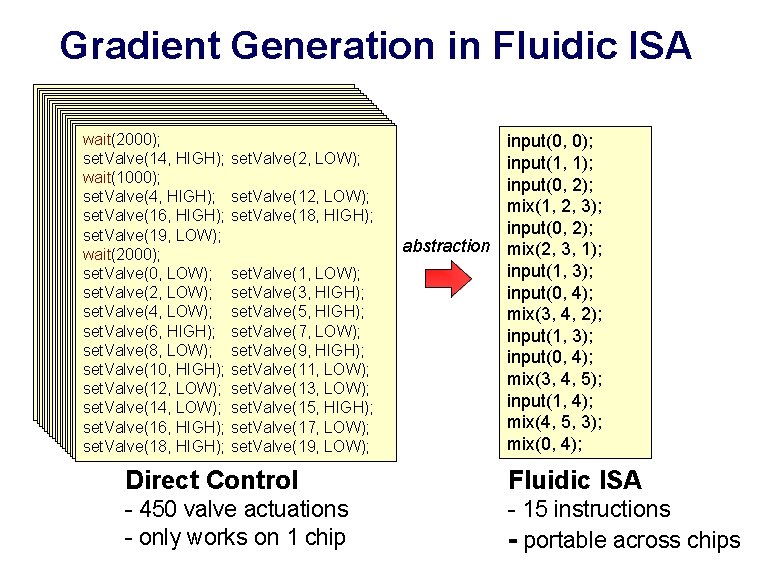
Gradient Generation in Fluidic ISA set. Valve(0, HIGH); set. Valve(1, HIGH); wait(2000); set. Valve(0, HIGH); set. Valve(1, HIGH); set. Valve(2, LOW); set. Valve(3, HIGH); wait(2000); set. Valve(2, LOW); set. Valve(3, HIGH); set. Valve(0, HIGH); set. Valve(1, HIGH); set. Valve(14, HIGH); set. Valve(2, LOW); wait(2000); set. Valve(2, LOW); set. Valve(3, HIGH); set. Valve(0, HIGH); set. Valve(1, HIGH); set. Valve(4, LOW); set. Valve(5, LOW); set. Valve(14, HIGH); set. Valve(2, LOW); wait(2000); set. Valve(4, LOW); set. Valve(5, LOW); set. Valve(2, LOW); set. Valve(3, HIGH); wait(1000); set. Valve(14, HIGH); set. Valve(2, LOW); set. Valve(4, LOW); set. Valve(5, LOW); set. Valve(2, LOW); set. Valve(3, HIGH); set. Valve(6, HIGH); set. Valve(7, LOW); wait(1000); set. Valve(14, HIGH); set. Valve(2, LOW); set. Valve(6, HIGH); set. Valve(7, LOW); set. Valve(4, LOW); set. Valve(5, LOW); set. Valve(4, HIGH); set. Valve(12, LOW); wait(1000); set. Valve(6, HIGH); set. Valve(7, LOW); set. Valve(4, LOW); set. Valve(5, LOW); set. Valve(8, LOW); set. Valve(9, HIGH); set. Valve(4, HIGH); set. Valve(12, LOW); wait(1000); set. Valve(8, LOW); set. Valve(9, HIGH); set. Valve(6, HIGH); set. Valve(7, LOW); set. Valve(16, HIGH); set. Valve(18, HIGH); set. Valve(4, HIGH); set. Valve(12, LOW); set. Valve(8, LOW); set. Valve(9, HIGH); set. Valve(6, HIGH); set. Valve(7, LOW); set. Valve(10, LOW); set. Valve(11, HIGH); set. Valve(16, HIGH); set. Valve(18, HIGH); set. Valve(4, HIGH); set. Valve(12, LOW); set. Valve(10, LOW); set. Valve(11, HIGH); set. Valve(8, LOW); set. Valve(9, HIGH); set. Valve(19, LOW); set. Valve(16, HIGH); set. Valve(18, HIGH); set. Valve(10, LOW); set. Valve(11, HIGH); set. Valve(8, LOW); set. Valve(9, HIGH); set. Valve(12, LOW); set. Valve(13, HIGH); set. Valve(19, LOW); set. Valve(16, HIGH); set. Valve(18, HIGH); set. Valve(12, LOW); set. Valve(13, HIGH); set. Valve(10, LOW); set. Valve(11, HIGH); wait(2000); set. Valve(19, LOW); set. Valve(12, LOW); set. Valve(13, HIGH); set. Valve(10, LOW); set. Valve(11, HIGH); set. Valve(14, LOW); set. Valve(15, HIGH); wait(2000); set. Valve(19, LOW); set. Valve(14, LOW); set. Valve(15, HIGH); set. Valve(12, LOW); set. Valve(13, HIGH); set. Valve(0, LOW); set. Valve(1, LOW); wait(2000); set. Valve(14, LOW); set. Valve(15, HIGH); set. Valve(12, LOW); set. Valve(13, HIGH); set. Valve(16, LOW); set. Valve(17, LOW); set. Valve(0, LOW); set. Valve(1, LOW); wait(2000); set. Valve(16, LOW); set. Valve(17, LOW); set. Valve(14, LOW); set. Valve(15, HIGH); set. Valve(2, LOW); set. Valve(3, HIGH); set. Valve(0, LOW); set. Valve(1, LOW); set. Valve(16, LOW); set. Valve(17, LOW); set. Valve(14, LOW); set. Valve(15, HIGH); set. Valve(2, LOW); set. Valve(3, HIGH); set. Valve(0, LOW); set. Valve(16, LOW); set. Valve(17, LOW); set. Valve(14, LOW); set. Valve(15, HIGH); set. Valve(18, LOW); set. Valve(19, LOW); set. Valve(2, LOW); set. Valve(3, HIGH); set. Valve(0, LOW); set. Valve(18, LOW); set. Valve(19, LOW); set. Valve(16, LOW); set. Valve(17, LOW); set. Valve(4, LOW); set. Valve(5, HIGH); set. Valve(2, LOW); set. Valve(3, HIGH); set. Valve(18, LOW); set. Valve(19, LOW); set. Valve(16, LOW); set. Valve(17, LOW); wait(2000); set. Valve(4, LOW); set. Valve(5, HIGH); set. Valve(2, LOW); set. Valve(3, HIGH); wait(2000); set. Valve(18, LOW); set. Valve(19, LOW); set. Valve(6, HIGH); set. Valve(7, LOW); set. Valve(4, LOW); set. Valve(5, HIGH); wait(2000); set. Valve(18, LOW); set. Valve(19, LOW); set. Valve(14, HIGH); set. Valve(2, LOW); set. Valve(6, HIGH); set. Valve(7, LOW); set. Valve(4, LOW); set. Valve(5, HIGH); set. Valve(14, HIGH); set. Valve(2, LOW); wait(2000); set. Valve(8, LOW); set. Valve(9, HIGH); set. Valve(6, HIGH); set. Valve(7, LOW); set. Valve(14, HIGH); set. Valve(2, LOW); wait(2000); wait(1000); set. Valve(8, LOW); set. Valve(9, HIGH); set. Valve(6, HIGH); set. Valve(7, LOW); wait(1000); set. Valve(14, HIGH); set. Valve(2, LOW); set. Valve(10, HIGH); set. Valve(11, LOW); set. Valve(8, LOW); set. Valve(9, HIGH); wait(1000); set. Valve(14, HIGH); set. Valve(2, LOW); set. Valve(4, HIGH); set. Valve(12, LOW); set. Valve(10, HIGH); set. Valve(11, LOW); set. Valve(8, LOW); set. Valve(9, HIGH); set. Valve(4, HIGH); set. Valve(12, LOW); wait(1000); set. Valve(12, LOW); set. Valve(13, LOW); set. Valve(10, HIGH); set. Valve(11, LOW); set. Valve(4, HIGH); set. Valve(12, LOW); wait(1000); set. Valve(16, HIGH); set. Valve(18, HIGH); set. Valve(12, LOW); set. Valve(13, LOW); set. Valve(10, HIGH); set. Valve(11, LOW); set. Valve(16, HIGH); set. Valve(18, HIGH); set. Valve(4, HIGH); set. Valve(12, LOW); set. Valve(14, LOW); set. Valve(15, HIGH); set. Valve(12, LOW); set. Valve(13, LOW); set. Valve(16, HIGH); set. Valve(18, HIGH); set. Valve(4, HIGH); set. Valve(12, LOW); set. Valve(19, LOW); set. Valve(14, LOW); set. Valve(15, HIGH); set. Valve(12, LOW); set. Valve(13, LOW); set. Valve(19, LOW); set. Valve(16, HIGH); set. Valve(18, HIGH); set. Valve(16, HIGH); set. Valve(17, LOW); set. Valve(14, LOW); set. Valve(15, HIGH); set. Valve(19, LOW); set. Valve(16, HIGH); set. Valve(18, HIGH); wait(2000); set. Valve(16, HIGH); set. Valve(17, LOW); set. Valve(14, LOW); set. Valve(15, HIGH); wait(2000); set. Valve(19, LOW); set. Valve(18, HIGH); set. Valve(19, LOW); set. Valve(16, HIGH); set. Valve(17, LOW); wait(2000); set. Valve(18, HIGH); set. Valve(19, LOW); input(0, 0); input(1, 1); input(0, 2); mix(1, 2, 3); input(0, 2); abstraction mix(2, 3, 1); input(1, 3); input(0, 4); mix(3, 4, 2); input(1, 3); input(0, 4); mix(3, 4, 5); input(1, 4); mix(4, 5, 3); mix(0, 4); Direct Control Fluidic ISA - 450 valve actuations - only works on 1 chip - 15 instructions - portable across chips
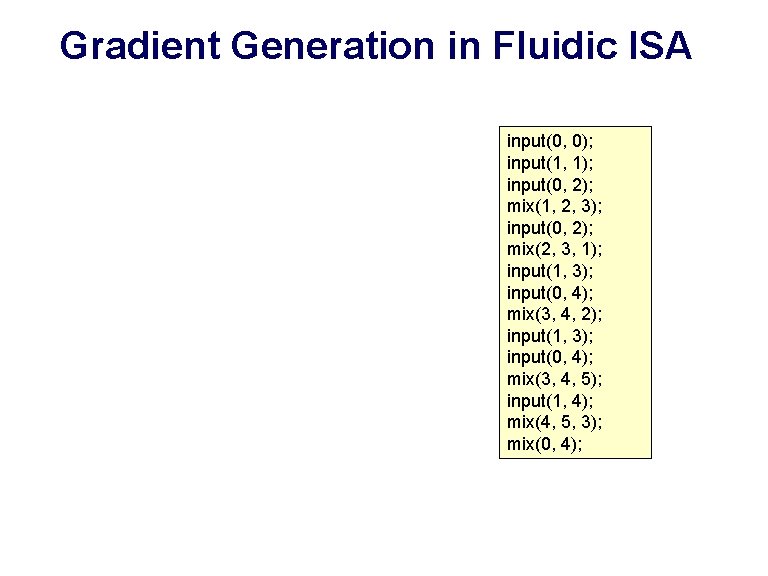
Gradient Generation in Fluidic ISA input(0, 0); input(1, 1); input(0, 2); mix(1, 2, 3); input(0, 2); mix(2, 3, 1); input(1, 3); input(0, 4); mix(3, 4, 2); input(1, 3); input(0, 4); mix(3, 4, 5); input(1, 4); mix(4, 5, 3); mix(0, 4);
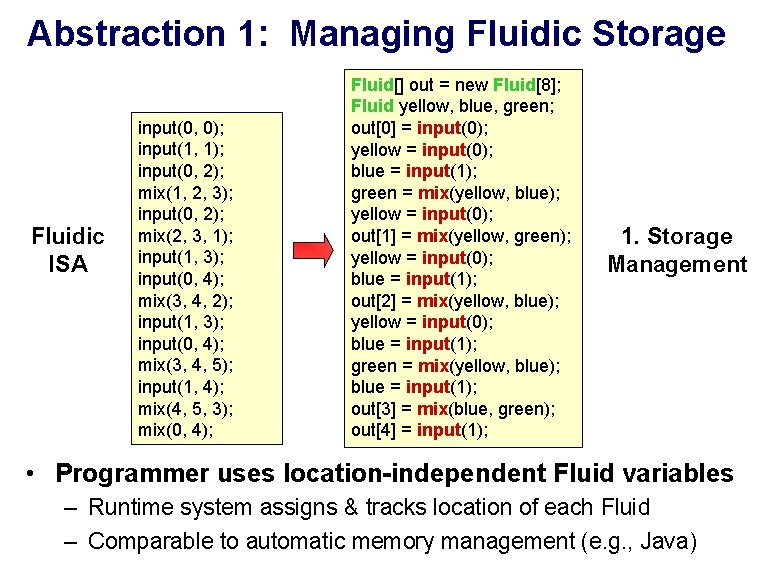
Abstraction 1: Managing Fluidic Storage Fluidic ISA input(0, 0); input(1, 1); input(0, 2); mix(1, 2, 3); input(0, 2); mix(2, 3, 1); input(1, 3); input(0, 4); mix(3, 4, 2); input(1, 3); input(0, 4); mix(3, 4, 5); input(1, 4); mix(4, 5, 3); mix(0, 4); Fluid[] out = new Fluid[8]; Fluid yellow, blue, green; out[0] = input(0); yellow = input(0); blue = input(1); green = mix(yellow, blue); yellow = input(0); out[1] = mix(yellow, green); yellow = input(0); blue = input(1); out[2] = mix(yellow, blue); yellow = input(0); blue = input(1); green = mix(yellow, blue); blue = input(1); out[3] = mix(blue, green); out[4] = input(1); 1. Storage Management • Programmer uses location-independent Fluid variables – Runtime system assigns & tracks location of each Fluid – Comparable to automatic memory management (e. g. , Java)
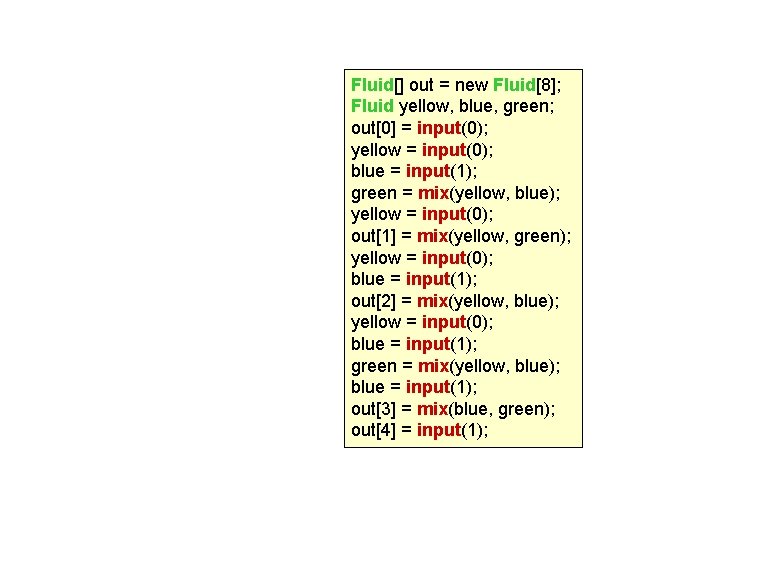
Fluid[] out = new Fluid[8]; Fluid yellow, blue, green; out[0] = input(0); yellow = input(0); blue = input(1); green = mix(yellow, blue); yellow = input(0); out[1] = mix(yellow, green); yellow = input(0); blue = input(1); out[2] = mix(yellow, blue); yellow = input(0); blue = input(1); green = mix(yellow, blue); blue = input(1); out[3] = mix(blue, green); out[4] = input(1);
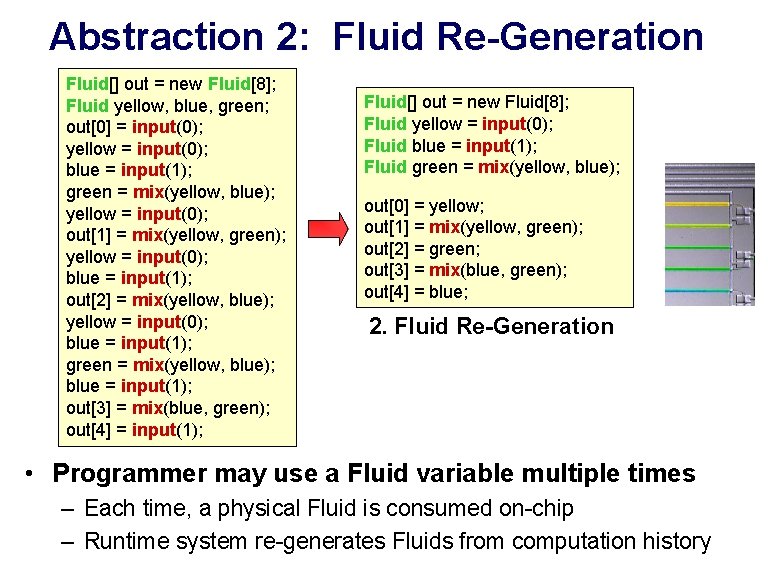
Abstraction 2: Fluid Re-Generation Fluid[] out = new Fluid[8]; Fluid yellow, blue, green; out[0] = input(0); yellow = input(0); blue = input(1); green = mix(yellow, blue); yellow = input(0); out[1] = mix(yellow, green); yellow = input(0); blue = input(1); out[2] = mix(yellow, blue); yellow = input(0); blue = input(1); green = mix(yellow, blue); blue = input(1); out[3] = mix(blue, green); out[4] = input(1); Fluid[] out = new Fluid[8]; Fluid yellow = input(0); Fluid blue = input(1); Fluid green = mix(yellow, blue); out[0] = yellow; out[1] = mix(yellow, green); out[2] = green; out[3] = mix(blue, green); out[4] = blue; 2. Fluid Re-Generation • Programmer may use a Fluid variable multiple times – Each time, a physical Fluid is consumed on-chip – Runtime system re-generates Fluids from computation history
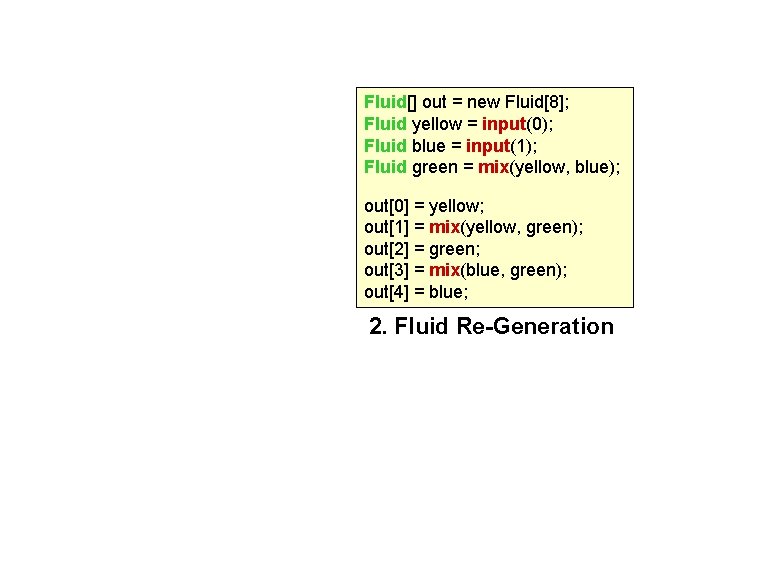
Fluid[] out = new Fluid[8]; Fluid yellow = input(0); Fluid blue = input(1); Fluid green = mix(yellow, blue); out[0] = yellow; out[1] = mix(yellow, green); out[2] = green; out[3] = mix(blue, green); out[4] = blue; 2. Fluid Re-Generation
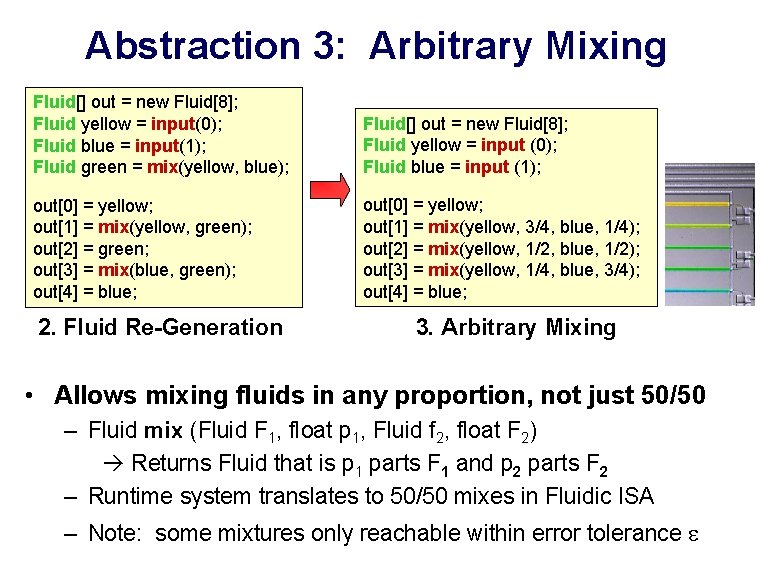
Abstraction 3: Arbitrary Mixing Fluid[] out = new Fluid[8]; Fluid yellow = input(0); Fluid blue = input(1); Fluid green = mix(yellow, blue); Fluid[] out = new Fluid[8]; Fluid yellow = input (0); Fluid blue = input (1); out[0] = yellow; out[1] = mix(yellow, green); out[2] = green; out[3] = mix(blue, green); out[4] = blue; out[0] = yellow; out[1] = mix(yellow, 3/4, blue, 1/4); out[2] = mix(yellow, 1/2, blue, 1/2); out[3] = mix(yellow, 1/4, blue, 3/4); out[4] = blue; 2. Fluid Re-Generation 3. Arbitrary Mixing • Allows mixing fluids in any proportion, not just 50/50 – Fluid mix (Fluid F 1, float p 1, Fluid f 2, float F 2) Returns Fluid that is p 1 parts F 1 and p 2 parts F 2 – Runtime system translates to 50/50 mixes in Fluidic ISA – Note: some mixtures only reachable within error tolerance
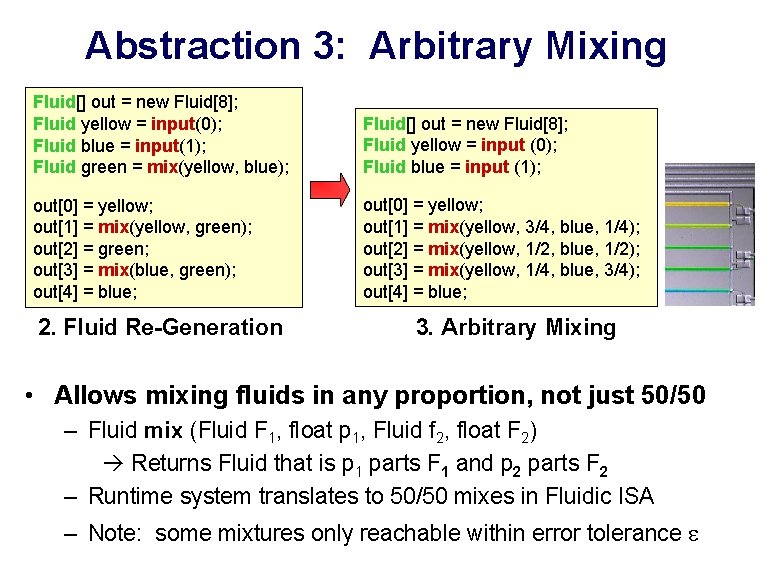
Abstraction 3: Arbitrary Mixing Fluid[] out = new Fluid[8]; Fluid yellow = input(0); Fluid blue = input(1); Fluid green = mix(yellow, blue); Fluid[] out = new Fluid[8]; Fluid yellow = input (0); Fluid blue = input (1); out[0] = yellow; out[1] = mix(yellow, green); out[2] = green; out[3] = mix(blue, green); out[4] = blue; out[0] = yellow; out[1] = mix(yellow, 3/4, blue, 1/4); out[2] = mix(yellow, 1/2, blue, 1/2); out[3] = mix(yellow, 1/4, blue, 3/4); out[4] = blue; 2. Fluid Re-Generation 3. Arbitrary Mixing • Allows mixing fluids in any proportion, not just 50/50 – Fluid mix (Fluid F 1, float p 1, Fluid f 2, float F 2) Returns Fluid that is p 1 parts F 1 and p 2 parts F 2 – Runtime system translates to 50/50 mixes in Fluidic ISA – Note: some mixtures only reachable within error tolerance
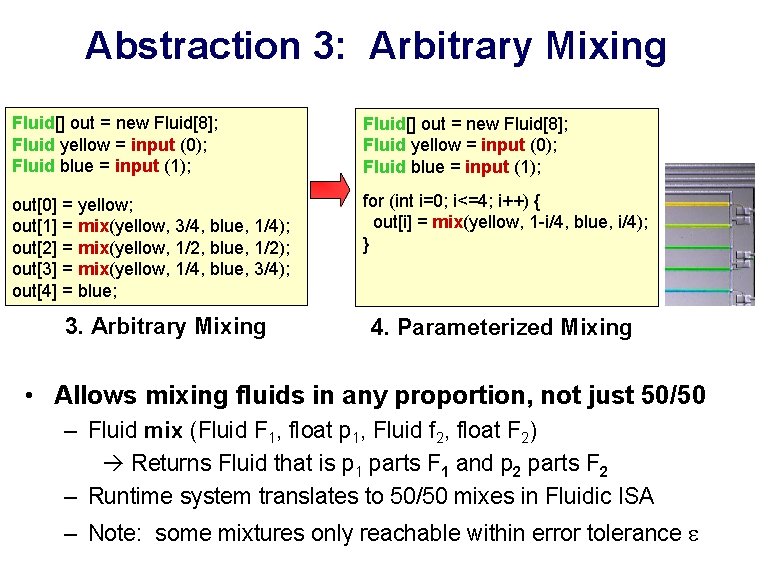
Abstraction 3: Arbitrary Mixing Fluid[] out = new Fluid[8]; Fluid yellow = input (0); Fluid blue = input (1); out[0] = yellow; out[1] = mix(yellow, 3/4, blue, 1/4); out[2] = mix(yellow, 1/2, blue, 1/2); out[3] = mix(yellow, 1/4, blue, 3/4); out[4] = blue; for (int i=0; i<=4; i++) { out[i] = mix(yellow, 1 -i/4, blue, i/4); } 3. Arbitrary Mixing 4. Parameterized Mixing • Allows mixing fluids in any proportion, not just 50/50 – Fluid mix (Fluid F 1, float p 1, Fluid f 2, float F 2) Returns Fluid that is p 1 parts F 1 and p 2 parts F 2 – Runtime system translates to 50/50 mixes in Fluidic ISA – Note: some mixtures only reachable within error tolerance
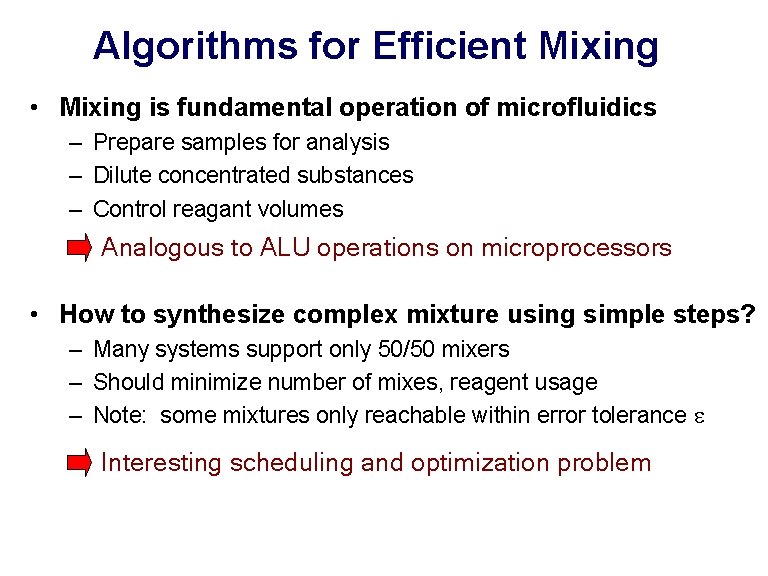
Algorithms for Efficient Mixing • Mixing is fundamental operation of microfluidics – Prepare samples for analysis – Dilute concentrated substances – Control reagant volumes Analogous to ALU operations on microprocessors • How to synthesize complex mixture using simple steps? – Many systems support only 50/50 mixers – Should minimize number of mixes, reagent usage – Note: some mixtures only reachable within error tolerance Interesting scheduling and optimization problem • N
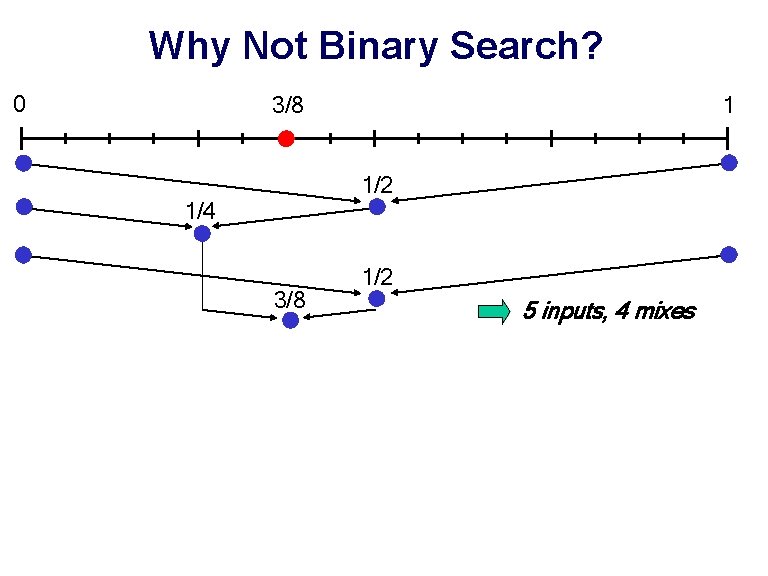
Why Not Binary Search? 0 3/8 1 1/2 1/4 3/8 1/2 5 inputs, 4 mixes
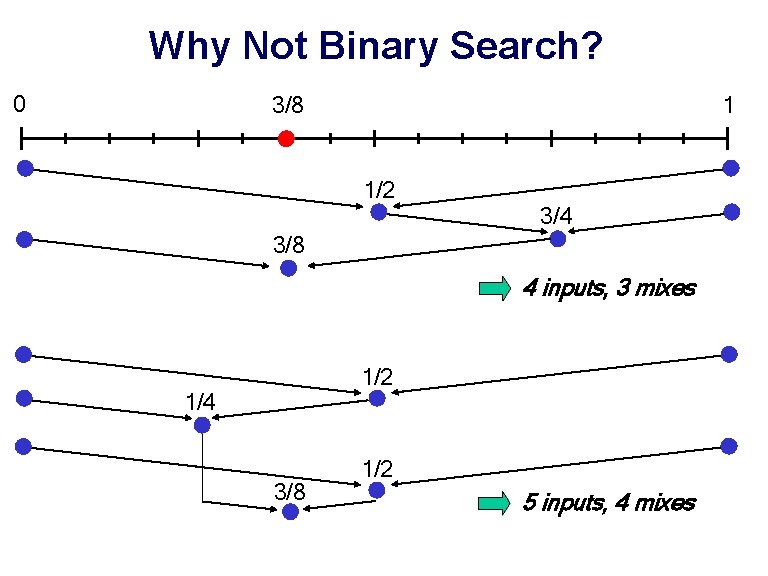
Why Not Binary Search? 0 3/8 1 1/2 3/4 3/8 4 inputs, 3 mixes 1/2 1/4 3/8 1/2 5 inputs, 4 mixes
Min-Mix Algorithm • Simple algorithm yields minimal number of mixes – For any number of reagents, to any reachable concentration – Also minimizes reagent usage on certain chips
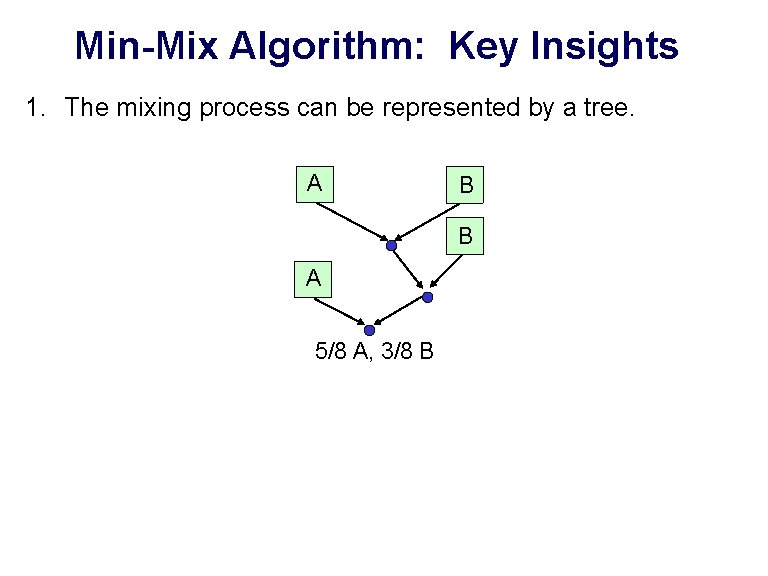
Min-Mix Algorithm: Key Insights 1. The mixing process can be represented by a tree. A B B A 5/8 A, 3/8 B
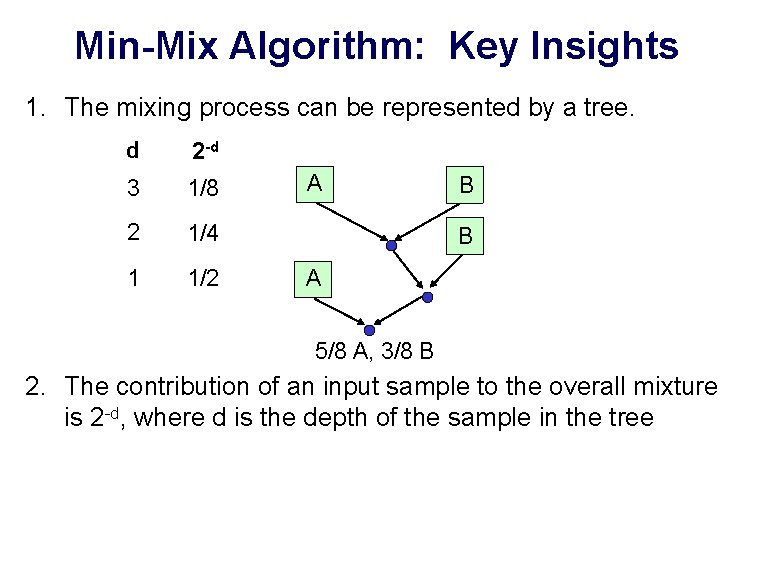
Min-Mix Algorithm: Key Insights 1. The mixing process can be represented by a tree. d 2 -d 3 1/8 2 1/4 1 1/2 A B B A 5/8 A, 3/8 B 2. The contribution of an input sample to the overall mixture is 2 -d, where d is the depth of the sample in the tree
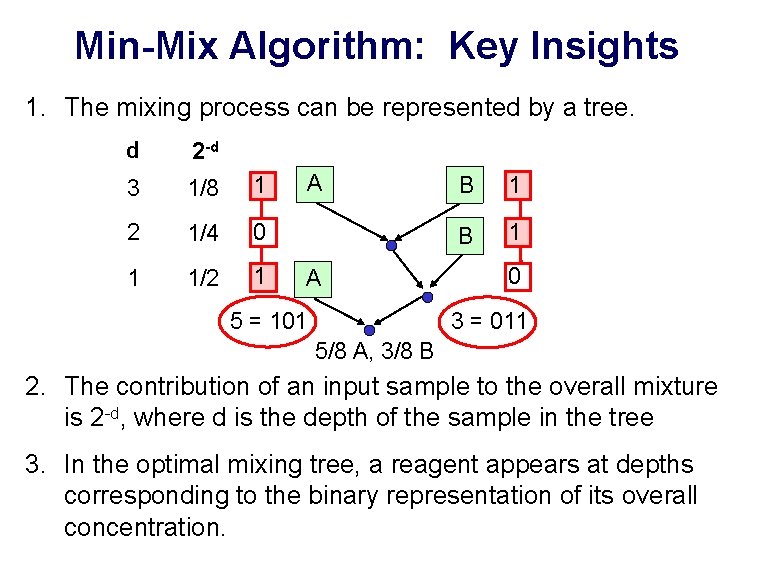
Min-Mix Algorithm: Key Insights 1. The mixing process can be represented by a tree. d 2 -d 3 1/8 1 2 1/4 0 1 1/2 1 A A 5 = 101 B 1 0 3 = 011 5/8 A, 3/8 B 2. The contribution of an input sample to the overall mixture is 2 -d, where d is the depth of the sample in the tree 3. In the optimal mixing tree, a reagent appears at depths corresponding to the binary representation of its overall concentration.
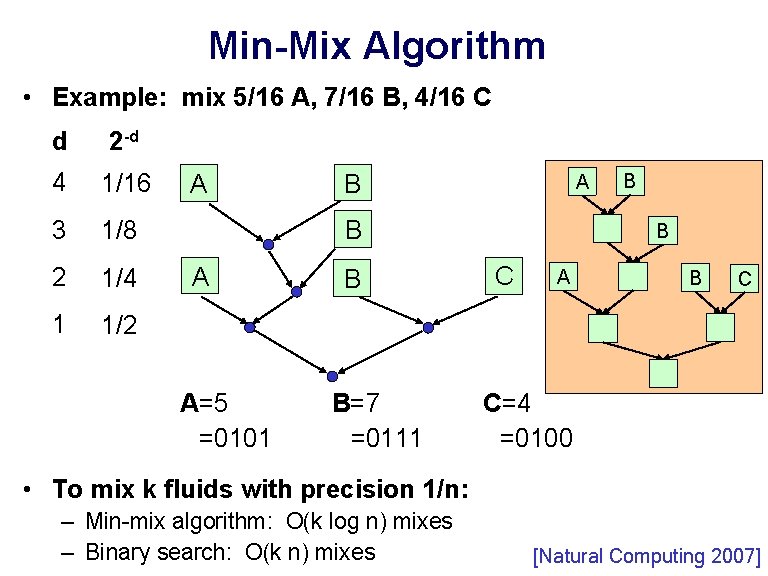
Min-Mix Algorithm • Example: mix 5/16 A, 7/16 B, 4/16 C d 2 -d 4 1/16 3 1/8 2 1/4 1 1/2 A B A A=5 =0101 B B=7 =0111 B B C A B C C=4 =0100 • To mix k fluids with precision 1/n: – Min-mix algorithm: O(k log n) mixes – Binary search: O(k n) mixes [Natural Computing 2007]
Related Work • Algorithms for microfluidic sample preparation [Sudip Roy et al. ] • Aquacore – builds on our work, ISA + architecture [Amin et al. ] • Automatic scheduling of biology protocols – EDNAC computer for automatically solving 3 -SAT [Johnson] – Compile SAT to microfluidic chips [Landweber et al. ] [van Noort] – Mapping sequence graphs to grid-based chips [Su/Chakrabarty] • Custom microfluidic chips for biological computation – DNA computing [Grover & Mathies] [van Noort et al. ] [Mc. Caskill] [Livstone, Weiss, & Landweber] [Gehani & Reif] [Farfel & Stefanovic] – Self-assembly [Somei, Kaneda, Fujii, & Murata] [Whitesides et al. ] • General-purpose microfluidic chips – Using electrowetting, with flexible mixing [Fair et al. ] – Using dialectrophoresis, with retargettable GUI [Gascoyne et al. ] – Using Braille displays as programmable actuators [Gu et al. ]
Conclusions: Fluidic ISA • Fluidic ISA gives flexibility to evolve underlying hardware – Including various device technologies • It remains to be seen to what degree the functionality of chips can be standardized – May need to reconsider abstractions for analog machines • Opportunities for future work – Rich extensions to mixing algorithms – Schedule separate protocols onto shared hardware, maximizing utilization of shared resource (e. g. , thermocycler) – Parallelize single protocol across people or chips – Dynamic optimization of slow co-processors (lazy vectorization)?
Abstraction Layers for Microfluidics Protocol Description Language - architecture-independent protocol description Fluidic Instruction Set Architecture (ISA) - primitives for I/O, storage, transport, mixing chip 1 chip 2 chip 3 Fluidic Hardware Primitives - valves, multiplexers, mixers, latches

“Immunological detection. . . was carried out as described in the Boehringer digoxigenin-nucleic acid detection kit with some modifications. ”
- Main paper - References - Ref. papers Papers from Nature, Spring 2010
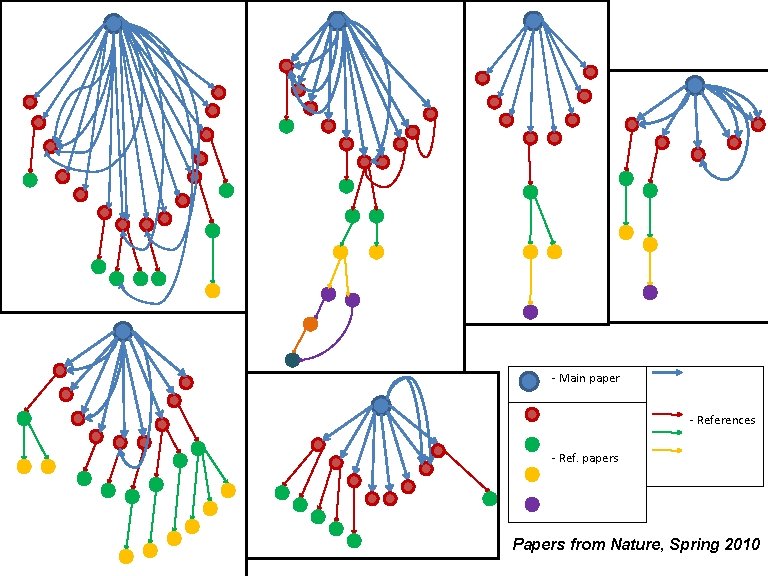
Problems with Existing Descriptions of Protocols • Incomplete – Cascading references several levels deep – Some information missing completely • Ambiguous – One word can refer to many things – E. g. , “inoculate” a culture • Non-uniform – Different words can refer to the same thing – E. g. , “harvest”, “pellet down”, “centrifuge” are equivalent • Not suitable for automation
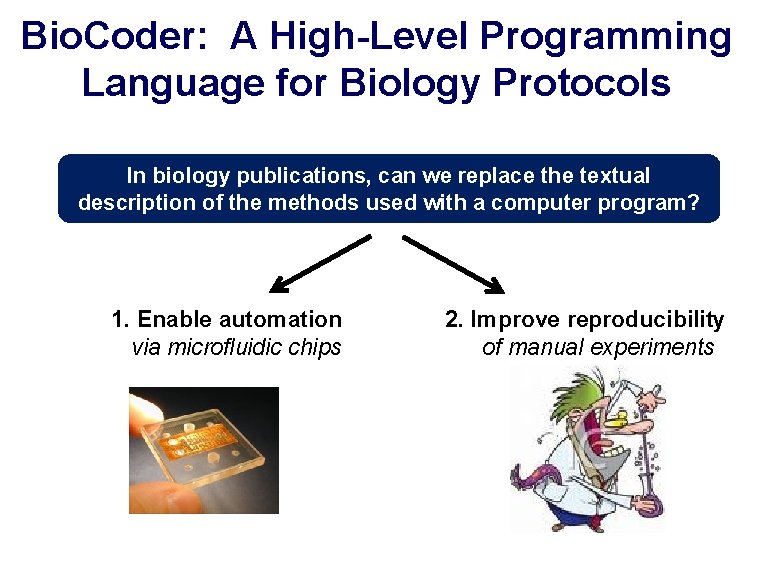
Bio. Coder: A High-Level Programming Language for Biology Protocols In biology publications, can we replace the textual description of the methods used with a computer program? 1. Enable automation via microfluidic chips 2. Improve reproducibility of manual experiments
Related Work • EXACT: EXperimental ACTions ontology as a formal representation for biology protocols [Soldatova et al. , 2009] • Robot Scientist: functional genomics driven by macroscopic laboratory automation [King et al. , 2004] • Po. Bol: RDF-based data exchange standard for Bio. Bricks
The Bio. Coder Language • Bio. Coder is a protocol language for reuse & automation – Independent of chip or laboratory setup – Initial focus: molecular biology • Implemented as a C library – Used to express 65 protocols, 5800 lines of code – Restricted backend: automatic execution on microfluidic chips – General backend: emit readable instructions for human • Validation – Used to direct actions of scientists in the lab (IISc) – Used to control microfluidic chips (MIT) – Standardizing online Wiki; interest from Berkeley, UW, UMN…
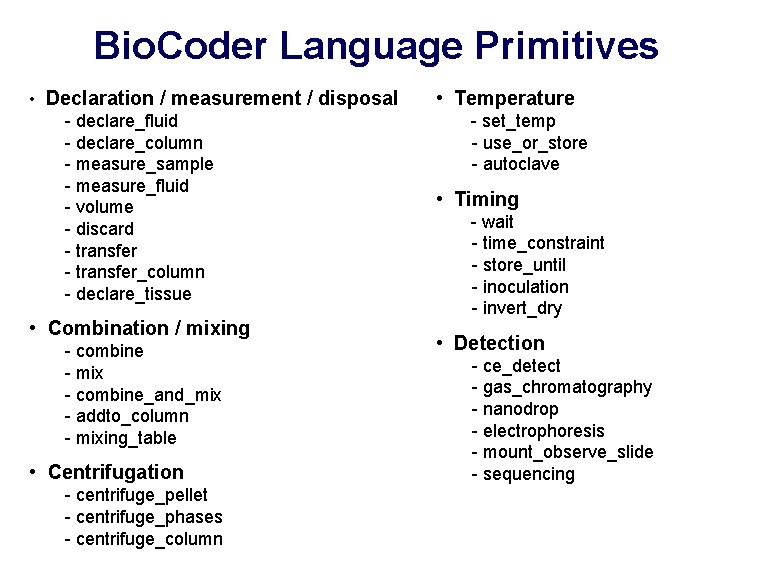
Bio. Coder Language Primitives • Declaration / measurement / disposal - declare_fluid - declare_column - measure_sample - measure_fluid - volume - discard - transfer_column - declare_tissue • Combination / mixing - combine - mix - combine_and_mix - addto_column - mixing_table • Centrifugation - centrifuge_pellet - centrifuge_phases - centrifuge_column • Temperature - set_temp - use_or_store - autoclave • Timing - wait - time_constraint - store_until - inoculation - invert_dry • Detection - ce_detect - gas_chromatography - nanodrop - electrophoresis - mount_observe_slide - sequencing
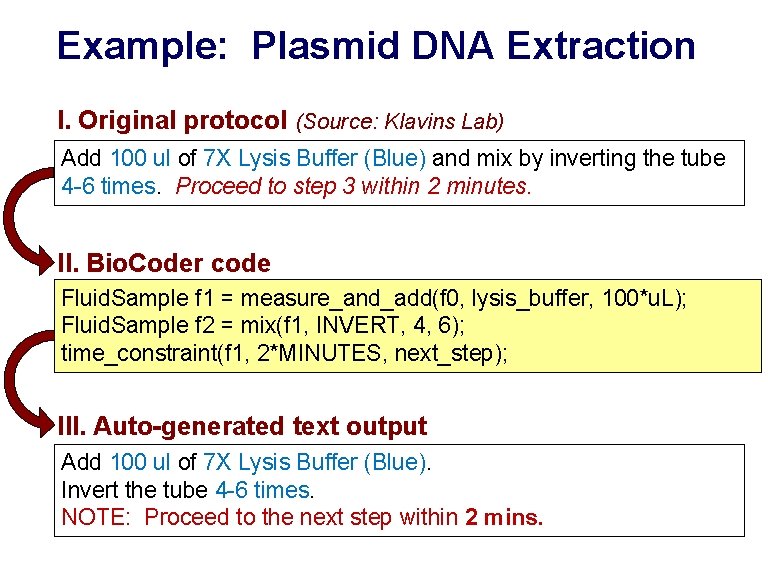
Example: Plasmid DNA Extraction I. Original protocol (Source: Klavins Lab) Add 100 ul of 7 X Lysis Buffer (Blue) and mix by inverting the tube 4 -6 times. Proceed to step 3 within 2 minutes. II. Bio. Coder code Fluid. Sample f 1 = measure_and_add(f 0, lysis_buffer, 100*u. L); Fluid. Sample f 2 = mix(f 1, INVERT, 4, 6); time_constraint(f 1, 2*MINUTES, next_step); III. Auto-generated text output Add 100 ul of 7 X Lysis Buffer (Blue). Invert the tube 4 -6 times. NOTE: Proceed to the next step within 2 mins.
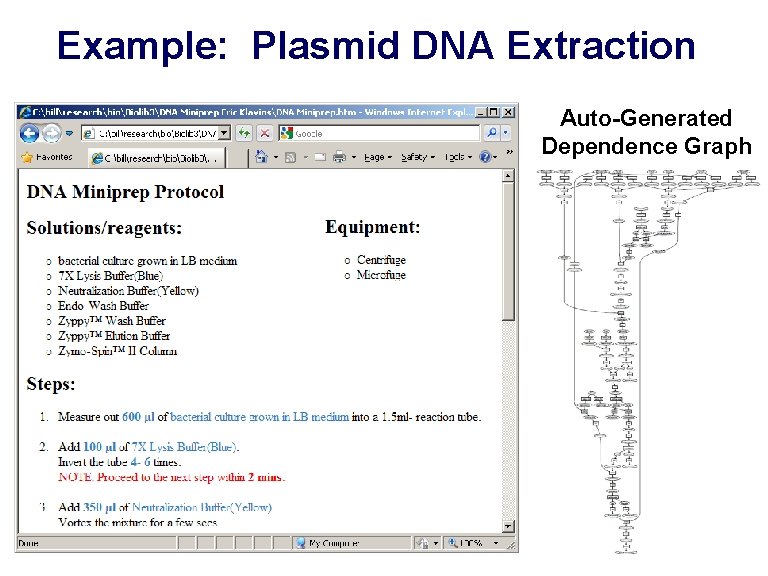
Example: Plasmid DNA Extraction Auto-Generated Dependence Graph
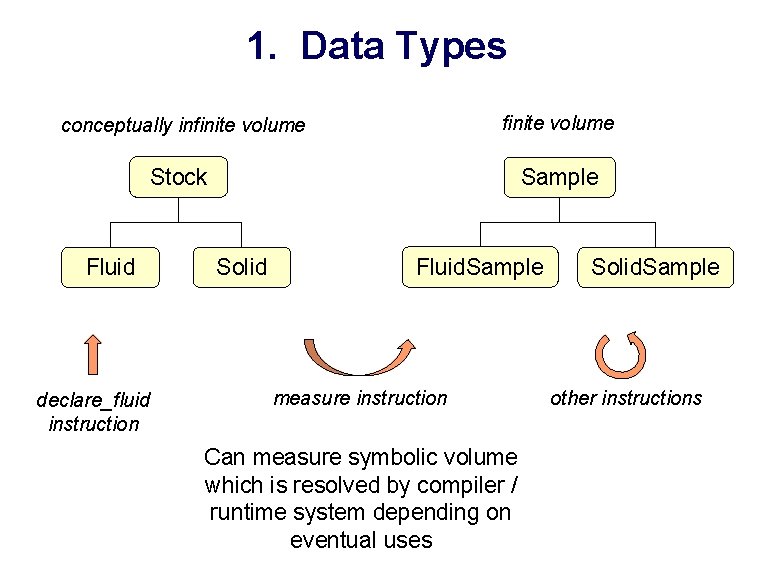
1. Data Types conceptually infinite volume Stock Sample Fluid declare_fluid instruction Solid Fluid. Sample measure instruction Can measure symbolic volume which is resolved by compiler / runtime system depending on eventual uses Solid. Sample other instructions
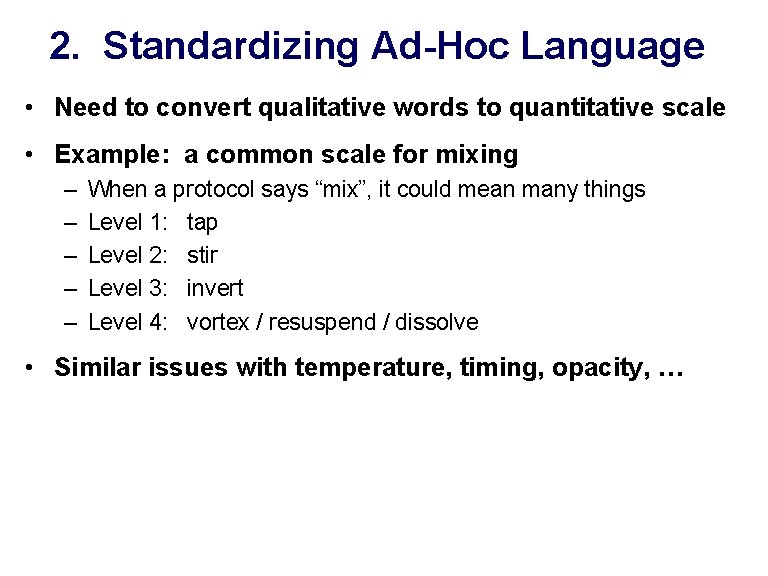
2. Standardizing Ad-Hoc Language • Need to convert qualitative words to quantitative scale • Example: a common scale for mixing – – – When a protocol says “mix”, it could mean many things Level 1: tap Level 2: stir Level 3: invert Level 4: vortex / resuspend / dissolve • Similar issues with temperature, timing, opacity, …
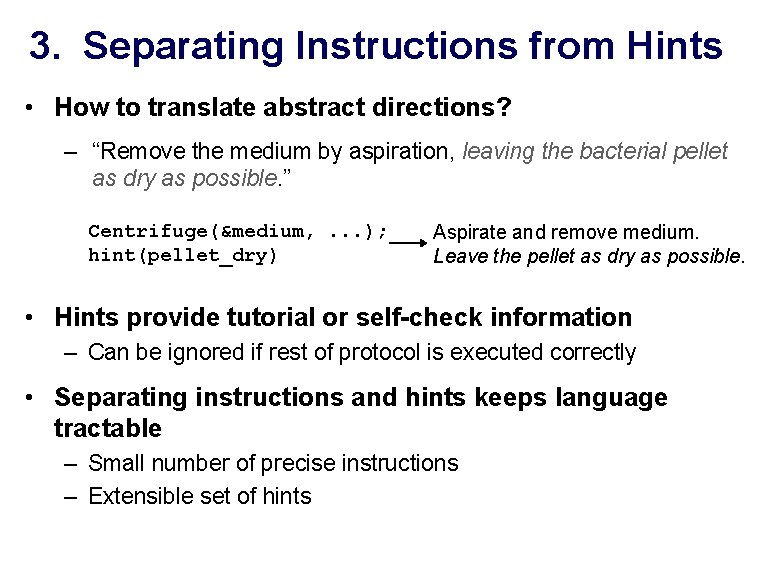
3. Separating Instructions from Hints • How to translate abstract directions? – “Remove the medium by aspiration, leaving the bacterial pellet as dry as possible. ” Centrifuge(&medium, . . . ); hint(pellet_dry) Aspirate and remove medium. Leave the pellet as dry as possible. • Hints provide tutorial or self-check information – Can be ignored if rest of protocol is executed correctly • Separating instructions and hints keeps language tractable – Small number of precise instructions – Extensible set of hints
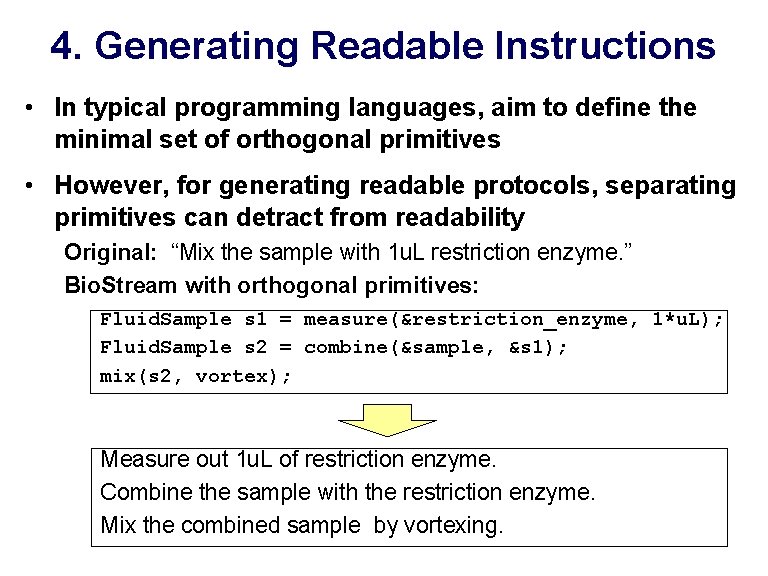
4. Generating Readable Instructions • In typical programming languages, aim to define the minimal set of orthogonal primitives • However, for generating readable protocols, separating primitives can detract from readability Original: “Mix the sample with 1 u. L restriction enzyme. ” Bio. Stream with orthogonal primitives: Fluid. Sample s 1 = measure(&restriction_enzyme, 1*u. L); Fluid. Sample s 2 = combine(&sample, &s 1); mix(s 2, vortex); Measure out 1 u. L of restriction enzyme. Combine the sample with the restriction enzyme. Mix the combined sample by vortexing.
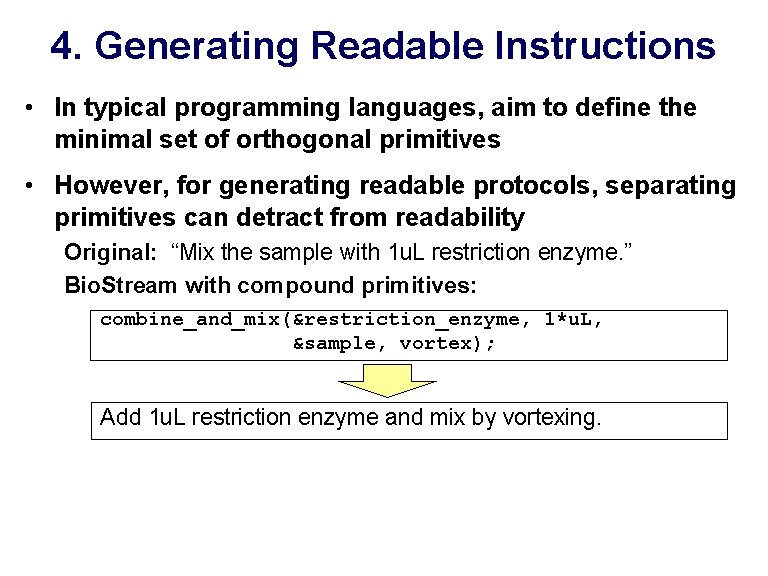
4. Generating Readable Instructions • In typical programming languages, aim to define the minimal set of orthogonal primitives • However, for generating readable protocols, separating primitives can detract from readability Original: “Mix the sample with 1 u. L restriction enzyme. ” Bio. Stream with compound primitives: combine_and_mix(&restriction_enzyme, 1*u. L, &sample, vortex); Add 1 u. L restriction enzyme and mix by vortexing.
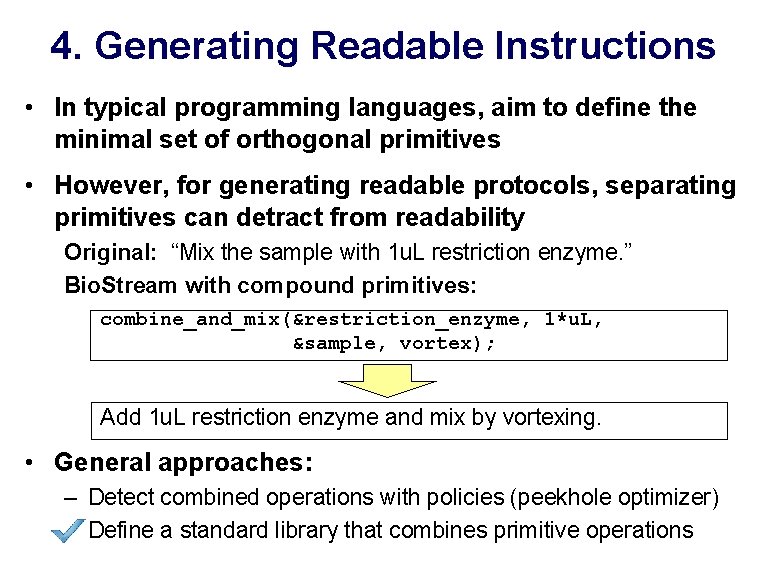
4. Generating Readable Instructions • In typical programming languages, aim to define the minimal set of orthogonal primitives • However, for generating readable protocols, separating primitives can detract from readability Original: “Mix the sample with 1 u. L restriction enzyme. ” Bio. Stream with compound primitives: combine_and_mix(&restriction_enzyme, 1*u. L, &sample, vortex); Add 1 u. L restriction enzyme and mix by vortexing. • General approaches: – Detect combined operations with policies (peekhole optimizer) – Define a standard library that combines primitive operations
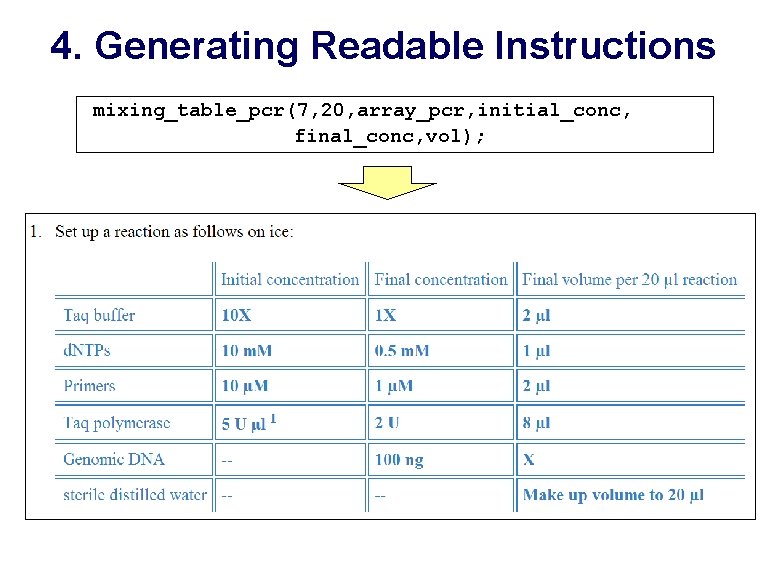
4. Generating Readable Instructions mixing_table_pcr(7, 20, array_pcr, initial_conc, final_conc, vol);
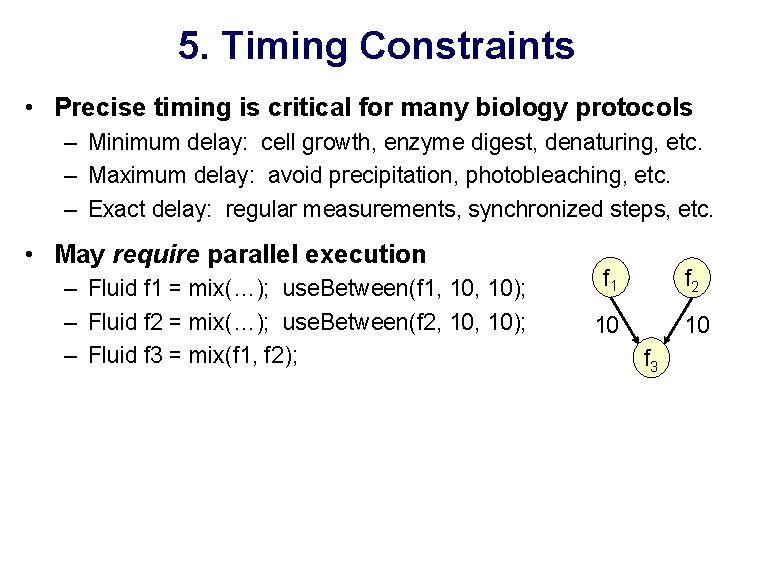
5. Timing Constraints • Precise timing is critical for many biology protocols – Minimum delay: cell growth, enzyme digest, denaturing, etc. – Maximum delay: avoid precipitation, photobleaching, etc. – Exact delay: regular measurements, synchronized steps, etc. • May require parallel execution – Fluid f 1 = mix(…); use. Between(f 1, 10); – Fluid f 2 = mix(…); use. Between(f 2, 10); – Fluid f 3 = mix(f 1, f 2); f 1 f 2 10 10 f 3
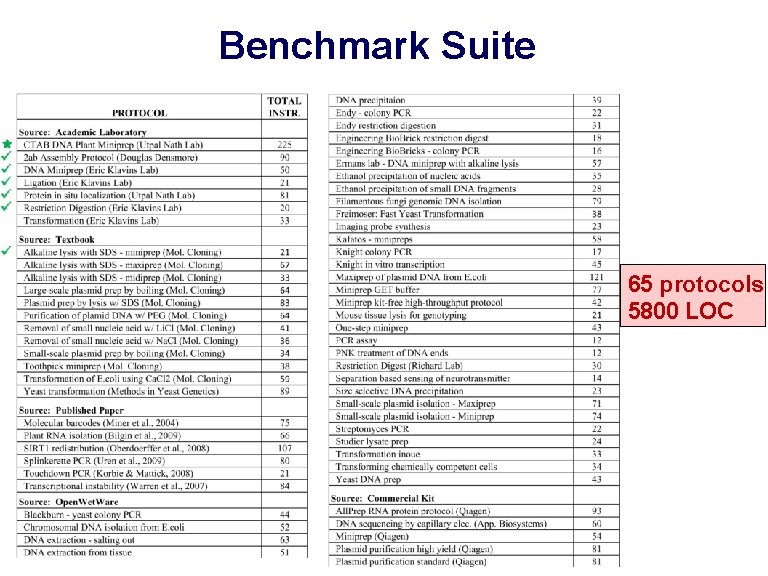
Benchmark Suite 65 protocols 5800 LOC
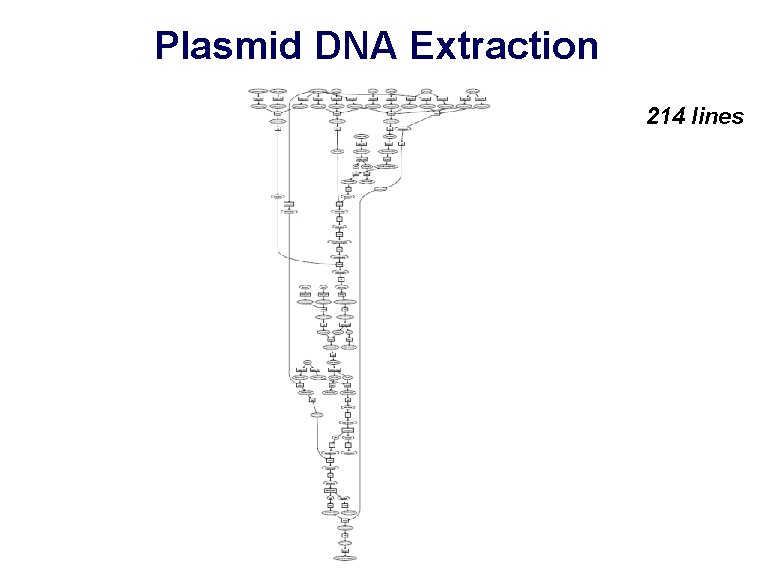
Plasmid DNA Extraction 214 lines
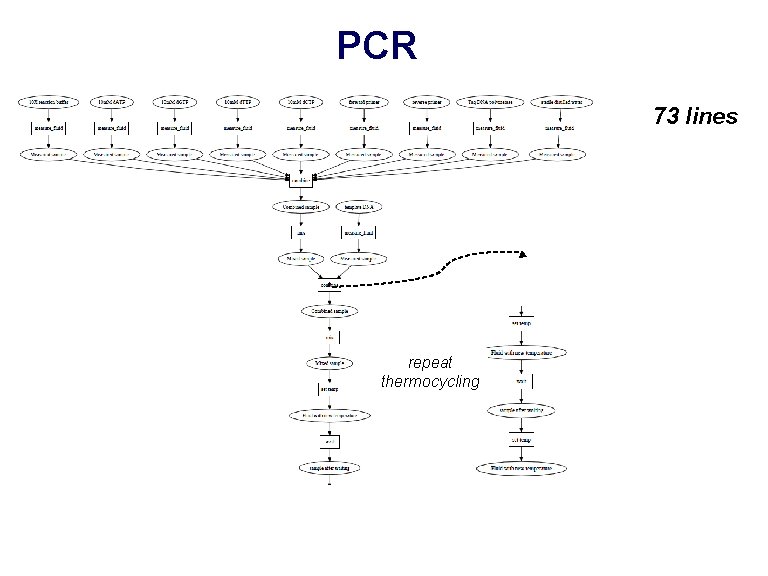
PCR 73 lines repeat thermocycling
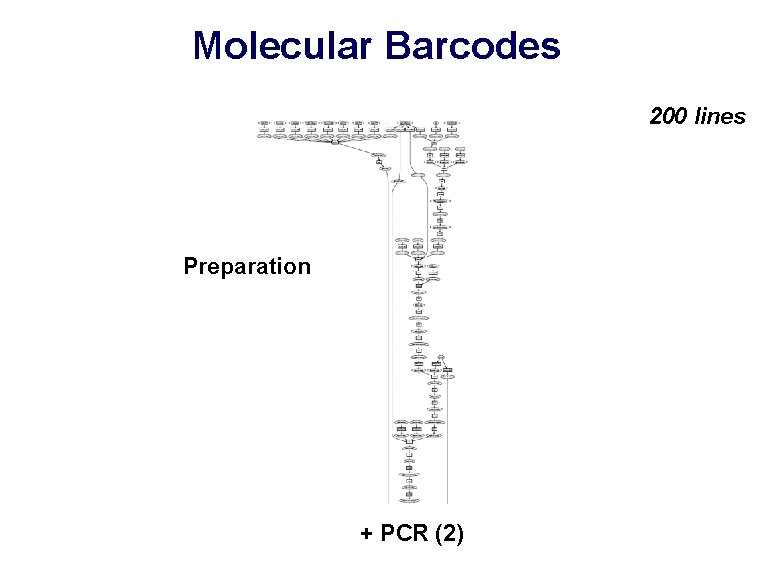
Molecular Barcodes 200 lines Preparation + PCR (2)
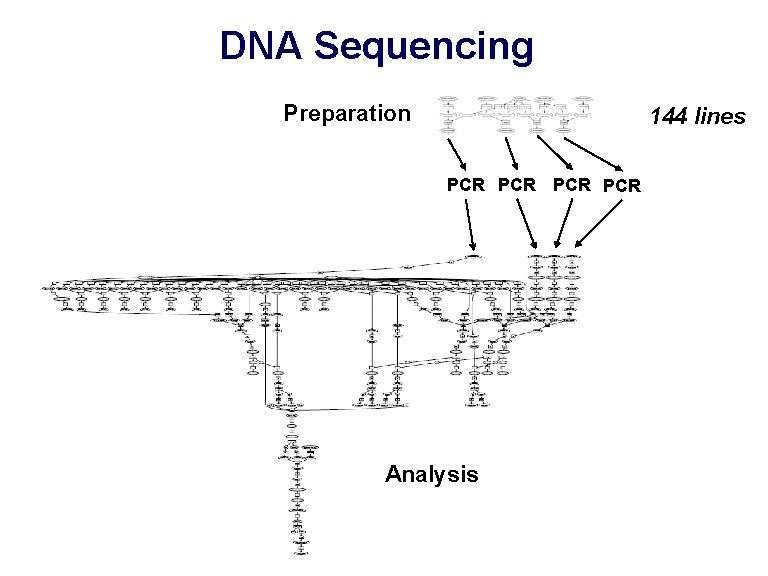
DNA Sequencing Preparation 144 lines PCR PCR Analysis
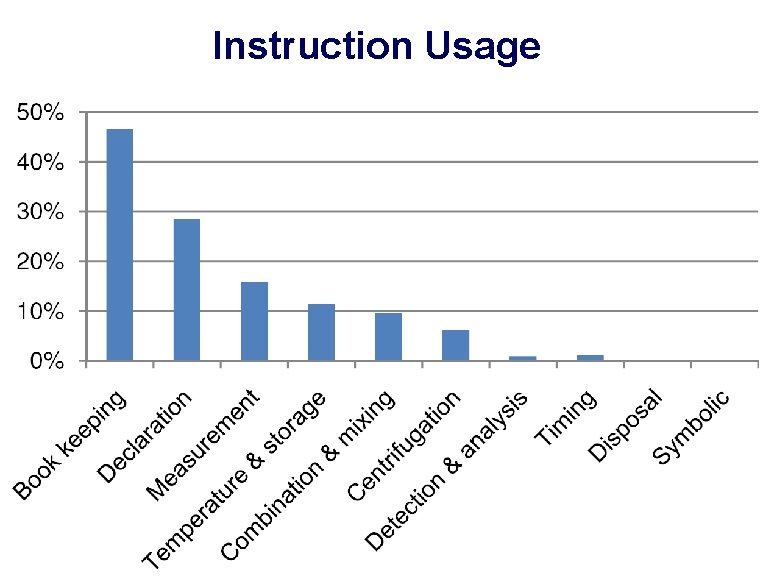
Instruction Usage
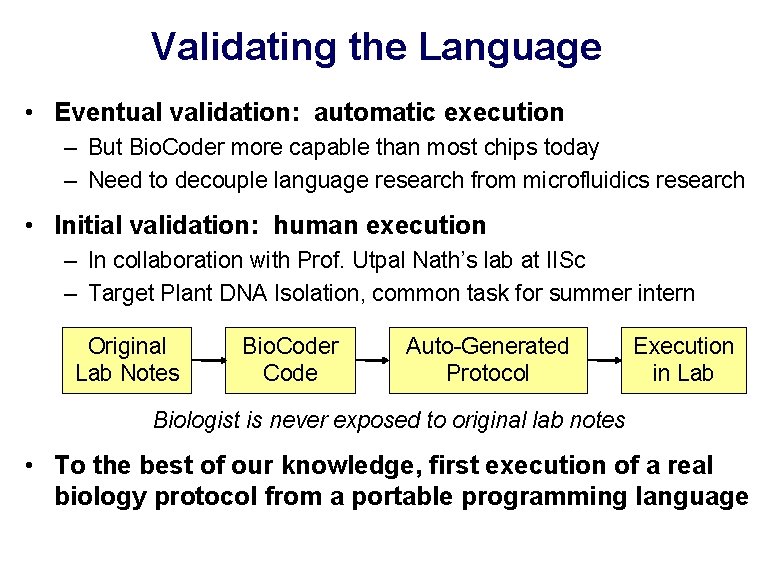
Validating the Language • Eventual validation: automatic execution – But Bio. Coder more capable than most chips today – Need to decouple language research from microfluidics research • Initial validation: human execution – In collaboration with Prof. Utpal Nath’s lab at IISc – Target Plant DNA Isolation, common task for summer intern Original Lab Notes Bio. Coder Code Auto-Generated Protocol Execution in Lab Biologist is never exposed to original lab notes • To the best of our knowledge, first execution of a real biology protocol from a portable programming language
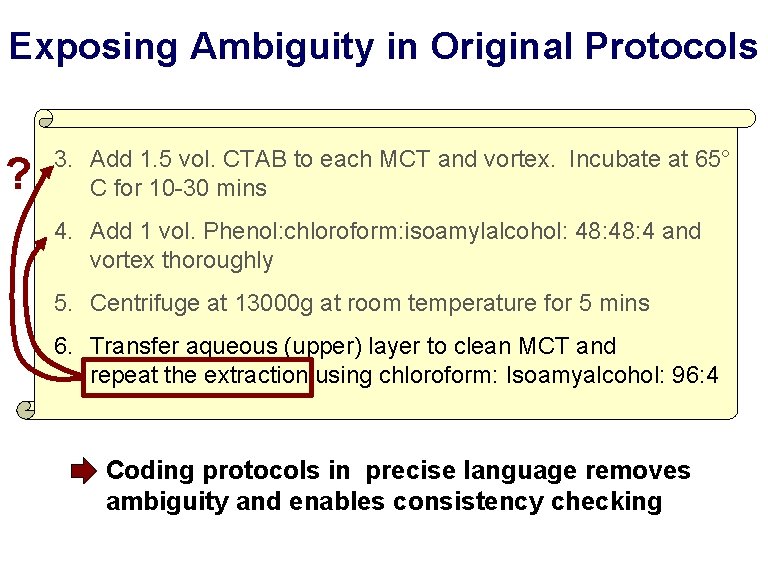
Exposing Ambiguity in Original Protocols ? 3. Add 1. 5 vol. CTAB to each MCT and vortex. Incubate at 65° C for 10 -30 mins 4. Add 1 vol. Phenol: chloroform: isoamylalcohol: 48: 4 and vortex thoroughly 5. Centrifuge at 13000 g at room temperature for 5 mins 6. Transfer aqueous (upper) layer to clean MCT and repeat the extraction using chloroform: Isoamyalcohol: 96: 4 Coding protocols in precise language removes ambiguity and enables consistency checking

Growing a Community
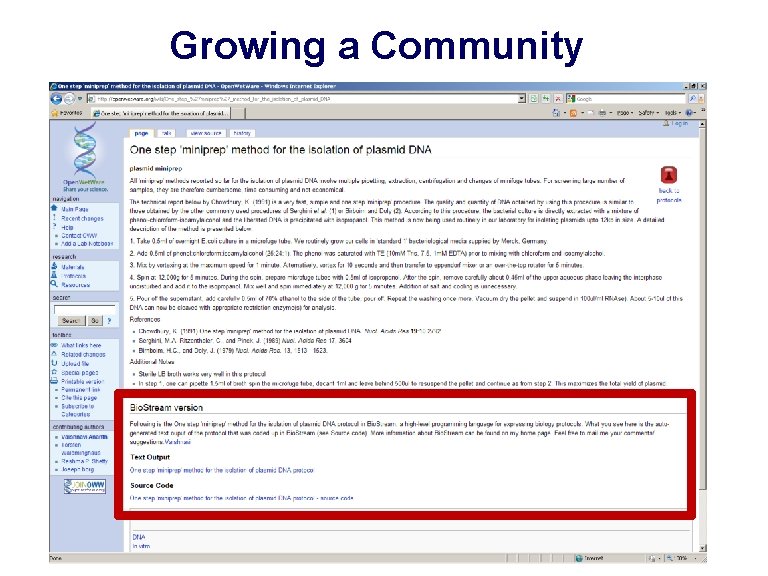
Growing a Community
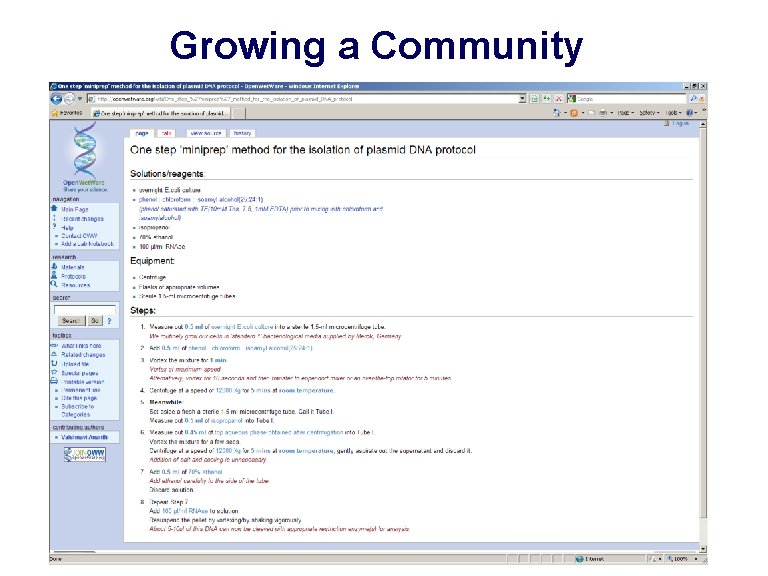
Growing a Community
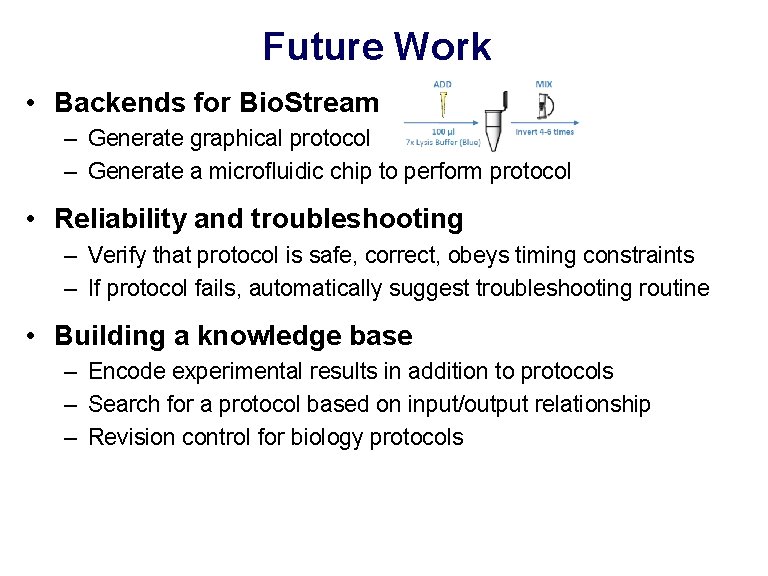
Future Work • Backends for Bio. Stream – Generate graphical protocol – Generate a microfluidic chip to perform protocol • Reliability and troubleshooting – Verify that protocol is safe, correct, obeys timing constraints – If protocol fails, automatically suggest troubleshooting routine • Building a knowledge base – Encode experimental results in addition to protocols – Search for a protocol based on input/output relationship – Revision control for biology protocols
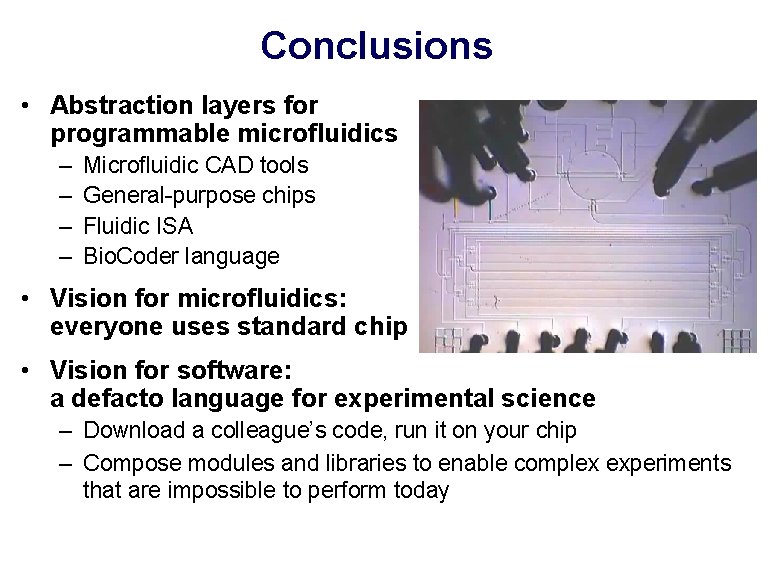
Conclusions • Abstraction layers for programmable microfluidics – – Microfluidic CAD tools General-purpose chips Fluidic ISA Bio. Coder language • Vision for microfluidics: everyone uses standard chip • Vision for software: a defacto language for experimental science – Download a colleague’s code, run it on your chip – Compose modules and libraries to enable complex experiments that are impossible to perform today
- Slides: 142