
Microevolution Posters Instructions Each group choose ONE animal
- Slides: 3
Microevolution Posters
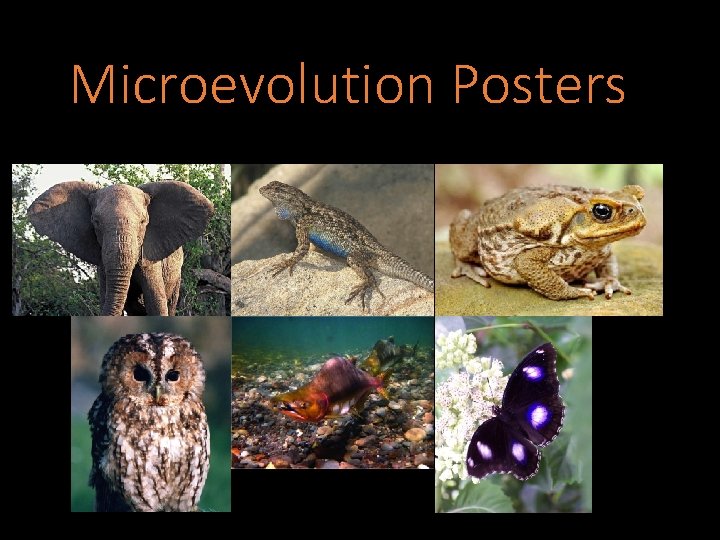
Instructions • Each group choose ONE animal below (no groups may choose the same animal) • Elephants evolving to lose tusks: http: //www. chinadaily. com. cn/english/doc/200507/16/content_460623. htm • Fence lizards evolving longer legs: http: //news. nationalgeographic. com/news/2009/01/090121 -lizard-ants-missions. html • Salmon evolving to migrate earlier: http: //www. scientificamerican. com/article/salmonevolve-to-cope-with-climate-change/ • Owls evolving from gray to brown: http: //news. bbc. co. uk/earth/hi/earth_news/newsid_9401000/9401733. stm • Cane toads evolving longer legs: http: //news. nationalgeographic. com/news/2006/02/0215_060215_cane_toads. html • Green anoles evolving bigger toe pads: http: //www. utexas. edu/news/2014/10/23/anole-lizards-evolution-florida/ • Italian wall lizards evolve on new island: http: //news. nationalgeographic. com/news/2008/04/080421 -lizard-evolution. html • Blue moon butterfly evolving to produce more males: http: //news. bbc. co. uk/2/hi/6896753. stm
For Your Poster • Posters should be colorful – no pencil! • Include the following: • An illustration of your animal • WHY is your animal evolving? (what is the cause? Environmental changes, climate change, habitat change, new location, etc. ) • HOW is your animal evolving? (in what way is your animal changing physically or genetically? ) • Give a brief description of how this is happening. For example, which members of each generation are surviving to pass on their traits? How is this changing the population/species?