
Microeconomics precourse Part 2 Academic Year 2013 2014

- Slides: 18
Microeconomics precourse – Part 2 Academic Year 2013 -2014 Course Presentation This course aims to prepare students for the Microeconomics course of the MSc in BA. It provides the essential background in microeconomics PAOLO PAESANI Office: Room B 6, 3 RD floor, Building B Telephone: 06 -72595701 E-mail: paolo. paesani@uniroma 2. it Office hours: to be agreed 1
CONSUMER THEORY • Rational agents try to get as much as they can out of resources for a given objective function and a set of constraints. • Rational consumers try to get as much satisfaction as they can out of their money spending it at market prices. • Main elements of consumer theory: • Budget constraint • Preferences and utility function • Optimal choice 2
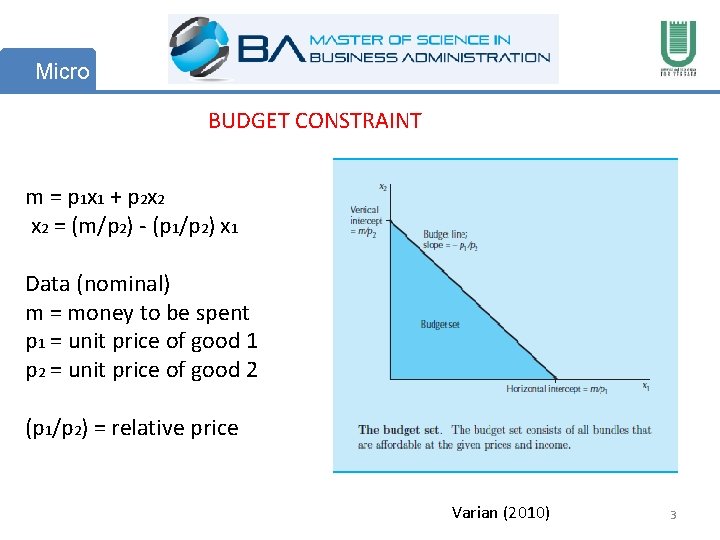
Micro BUDGET CONSTRAINT m = p 1 x 1 + p 2 x 2 = (m/p 2) - (p 1/p 2) x 1 Data (nominal) m = money to be spent p 1 = unit price of good 1 p 2 = unit price of good 2 (p 1/p 2) = relative price Varian (2010) 3
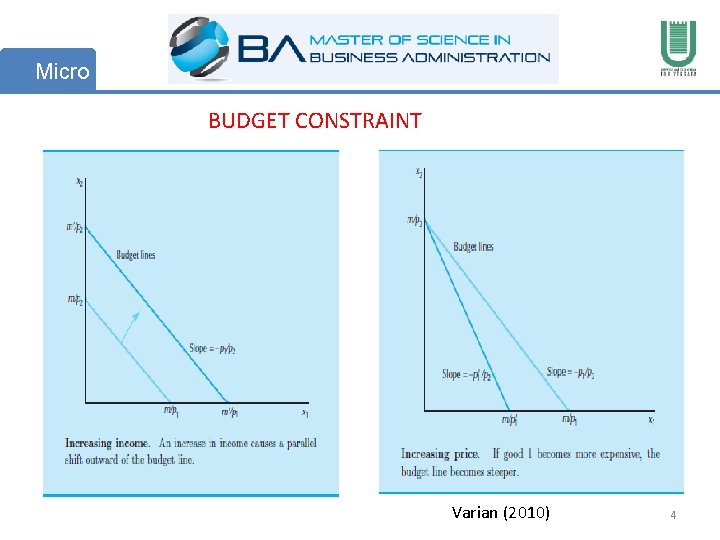
Micro BUDGET CONSTRAINT Varian (2010) 4
Micro BUDGET CONSTRAINT Points above the budget constraint indicate unaffordable bundles Points below the budget constraint indicate bundles which the consumer can afford to buy saving some money (but saving in a one period model is irrational) If income and prices change by the same factor the budget line does not move (homogeneity of degree 0) The shape of the budget constraint is affected by rationing, taxes and subsidies (on this see Varian 2010, pp. 26 -31) 5
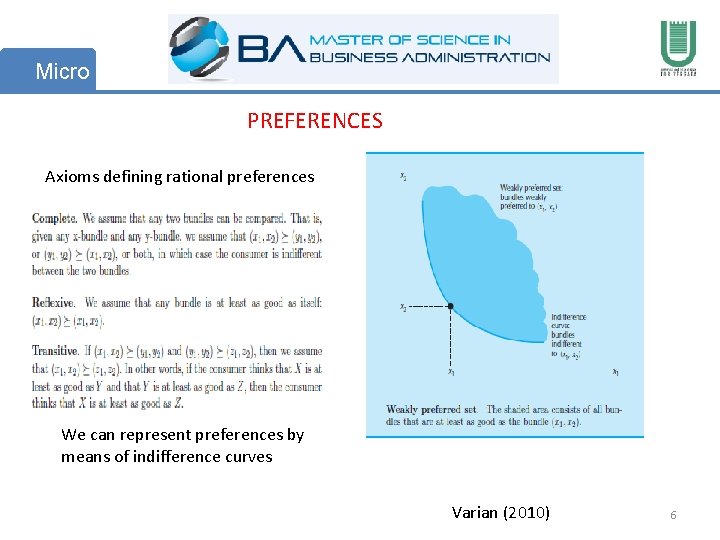
Micro PREFERENCES Axioms defining rational preferences We can represent preferences by means of indifference curves Varian (2010) 6
Micro PREFERENCES Points above the indifferent curve going through bundle A indicate bundles which the individual weakly prefers to bundle A itself Points below the indifferent curve going through bundle A indicate bundles which the individual considers weakly inferior to bundle A itself Points along the indifferent curve going through bundle A indicate bundles which the individual finds equivalent to bundle A itself Indifference curve representing rational preferences cannot intersect (on this see Varian 2010, pp. 26 -31) 7
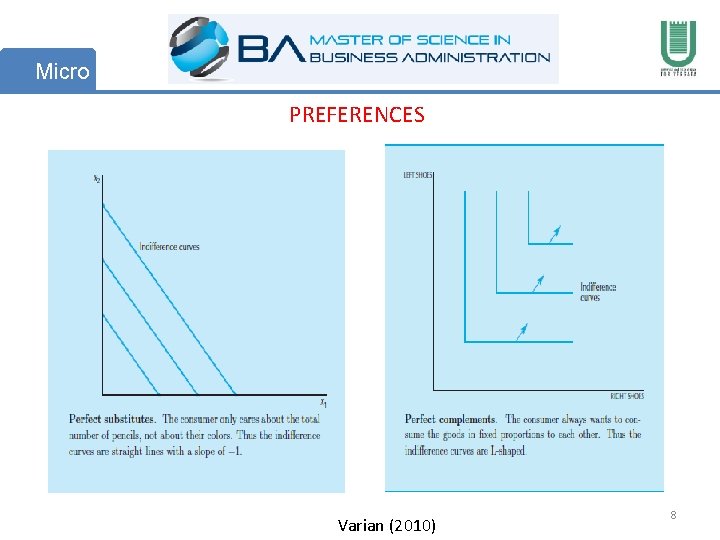
Micro PREFERENCES Varian (2010) 8
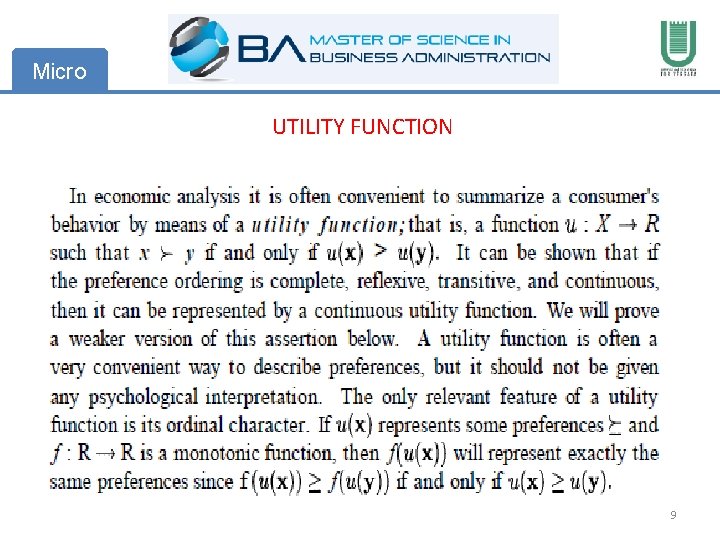
Micro UTILITY FUNCTION 9
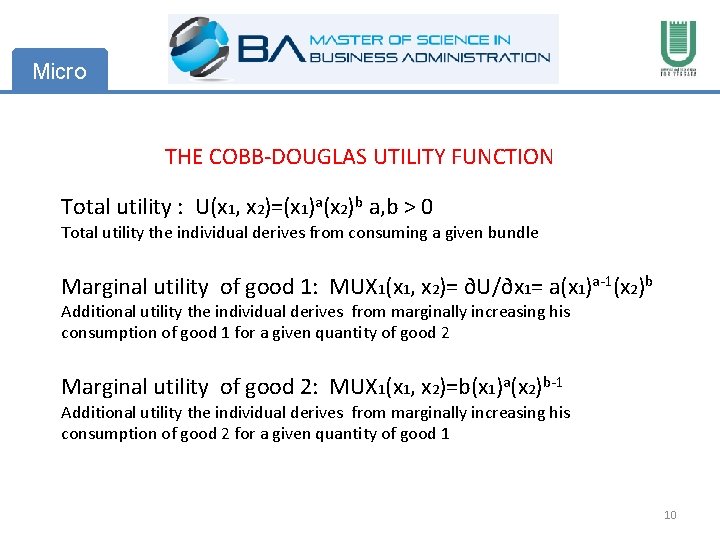
Micro THE COBB-DOUGLAS UTILITY FUNCTION Total utility : U(x 1, x 2)=(x 1)a(x 2)b a, b > 0 Total utility the individual derives from consuming a given bundle Marginal utility of good 1: MUX 1(x 1, x 2)= ∂U/∂x 1= a(x 1)a-1(x 2)b Additional utility the individual derives from marginally increasing his consumption of good 1 for a given quantity of good 2 Marginal utility of good 2: MUX 1(x 1, x 2)=b(x 1)a(x 2)b-1 Additional utility the individual derives from marginally increasing his consumption of good 2 for a given quantity of good 1 10
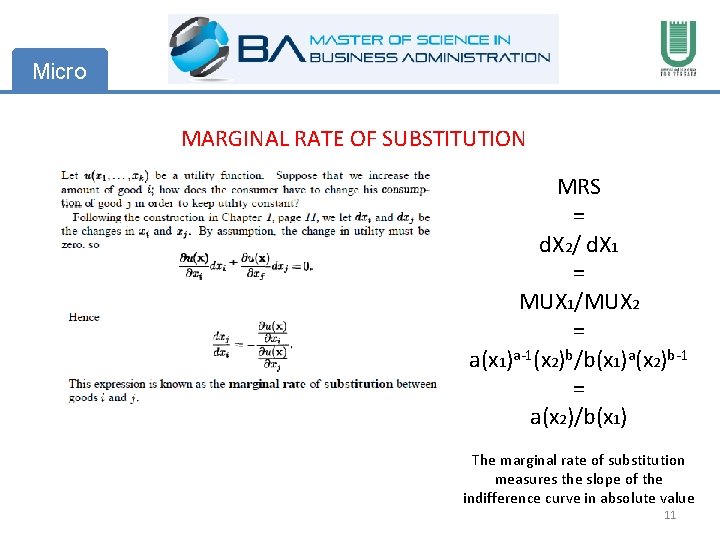
Micro MARGINAL RATE OF SUBSTITUTION MRS = d. X 2/ d. X 1 = MUX 1/MUX 2 = a(x 1)a-1(x 2)b/b(x 1)a(x 2)b-1 = a(x 2)/b(x 1) The marginal rate of substitution measures the slope of the indifference curve in absolute value 11
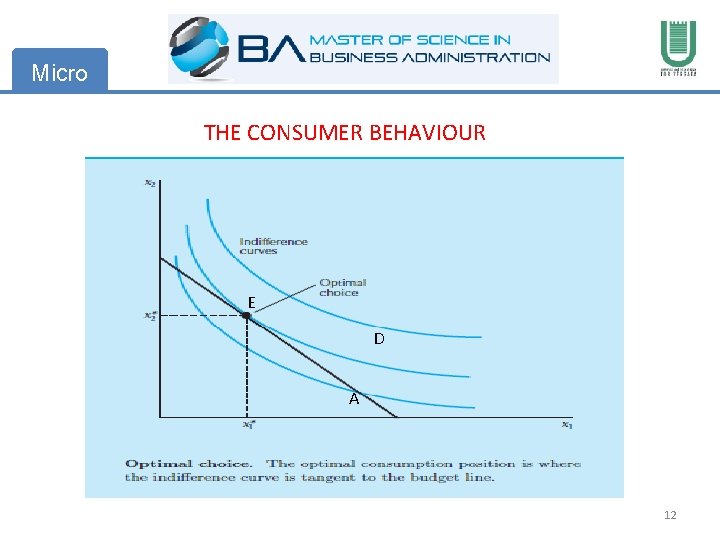
Micro THE CONSUMER BEHAVIOUR E D A 12
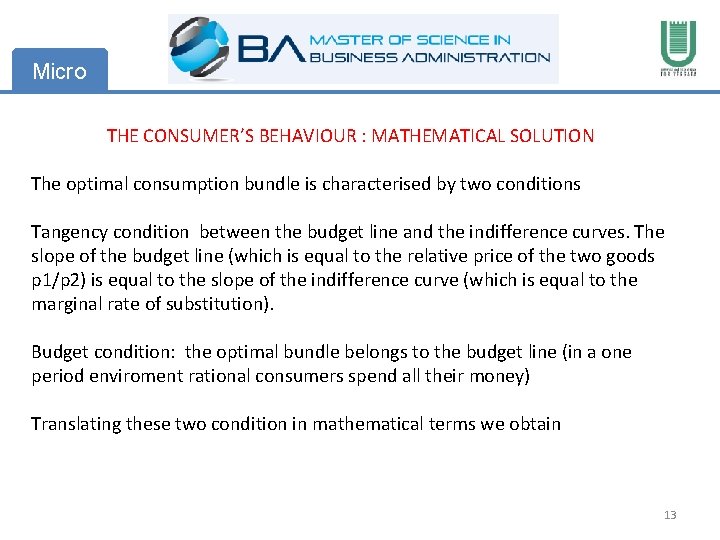
Micro THE CONSUMER’S BEHAVIOUR : MATHEMATICAL SOLUTION The optimal consumption bundle is characterised by two conditions Tangency condition between the budget line and the indifference curves. The slope of the budget line (which is equal to the relative price of the two goods p 1/p 2) is equal to the slope of the indifference curve (which is equal to the marginal rate of substitution). Budget condition: the optimal bundle belongs to the budget line (in a one period enviroment rational consumers spend all their money) Translating these two condition in mathematical terms we obtain 13
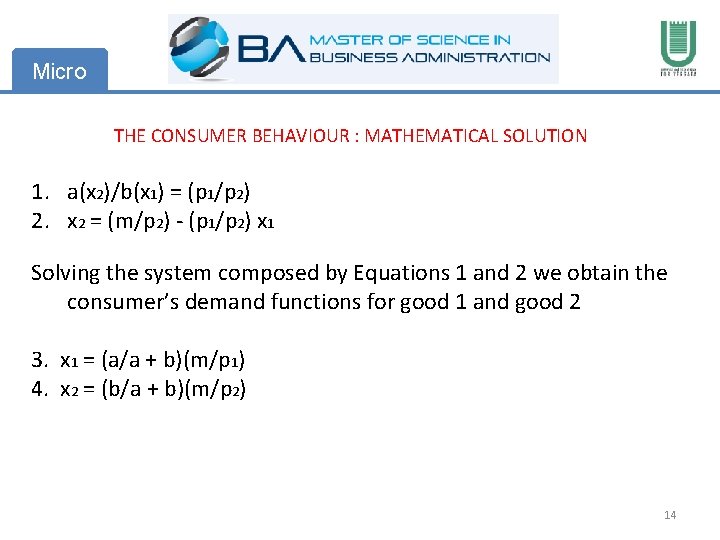
Micro THE CONSUMER BEHAVIOUR : MATHEMATICAL SOLUTION 1. a(x 2)/b(x 1) = (p 1/p 2) 2. x 2 = (m/p 2) - (p 1/p 2) x 1 Solving the system composed by Equations 1 and 2 we obtain the consumer’s demand functions for good 1 and good 2 3. x 1 = (a/a + b)(m/p 1) 4. x 2 = (b/a + b)(m/p 2) 14
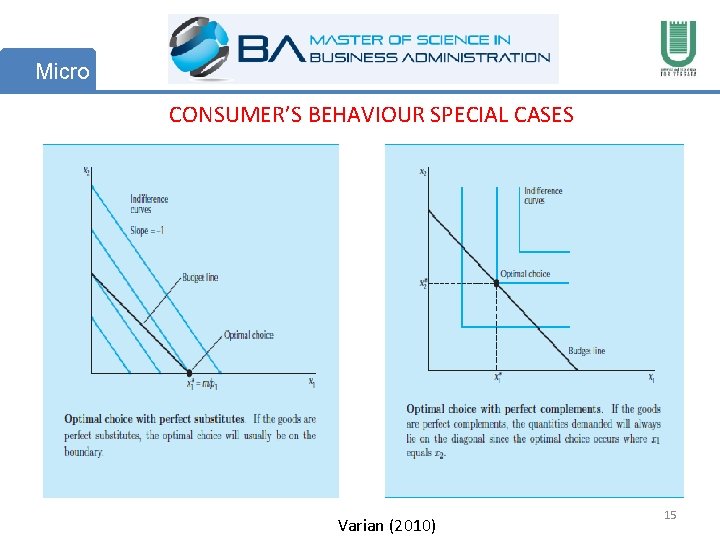
Micro CONSUMER’S BEHAVIOUR SPECIAL CASES Varian (2010) 15
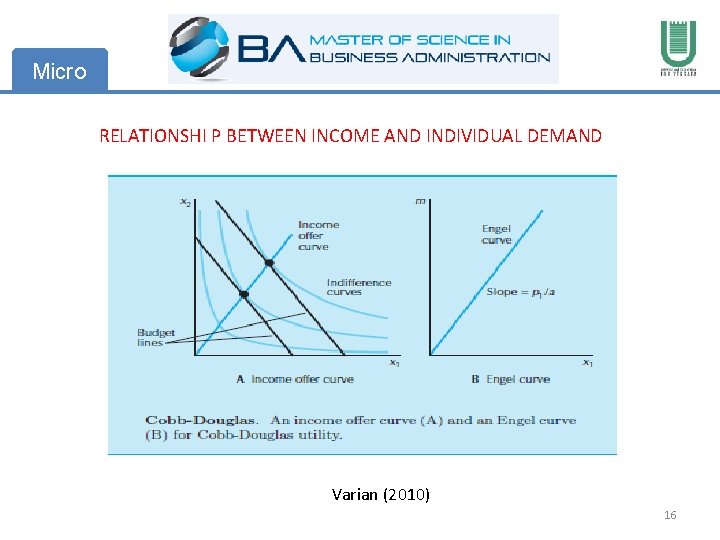
Micro RELATIONSHI P BETWEEN INCOME AND INDIVIDUAL DEMAND Varian (2010) 16
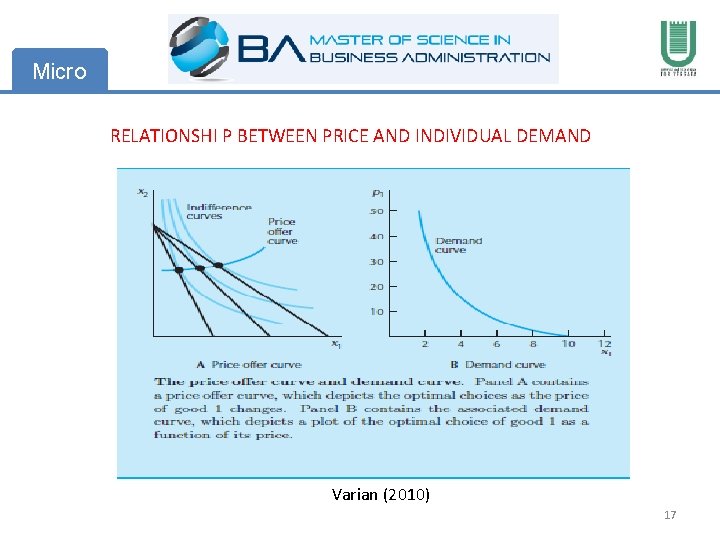
Micro RELATIONSHI P BETWEEN PRICE AND INDIVIDUAL DEMAND Varian (2010) 17
Micro REFERENCE Varian H. (1992) Microeconomic Analysis, 3 rd edition, W. W. Norton & Company Varian H. (2010) Intermediate Microeconomics, 8° edition, W. W. Norton & Company 18