
Microeconomics Module 8 Perfect Competition Why It Matters

- Slides: 23
Microeconomics Module 8: Perfect Competition
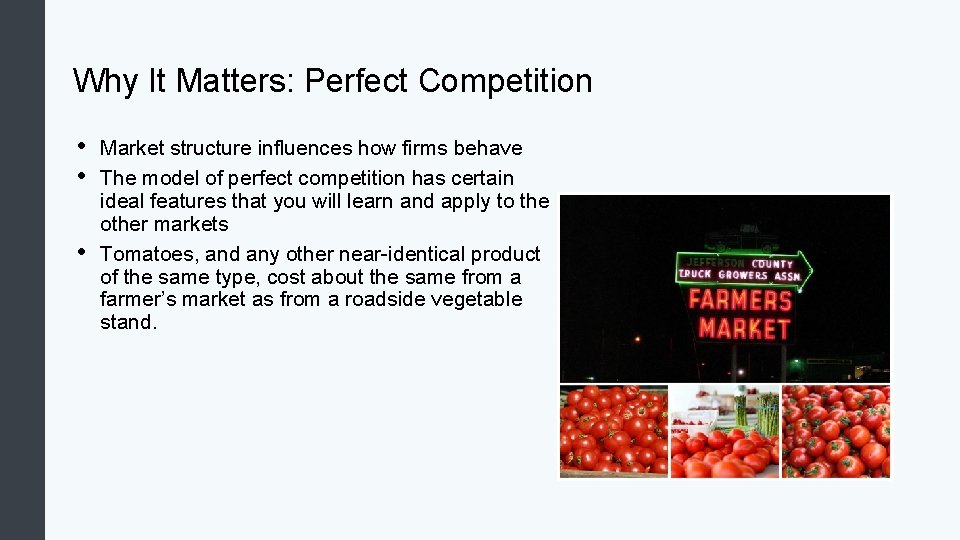
Why It Matters: Perfect Competition • • • Market structure influences how firms behave The model of perfect competition has certain ideal features that you will learn and apply to the other markets Tomatoes, and any other near-identical product of the same type, cost about the same from a farmer’s market as from a roadside vegetable stand.
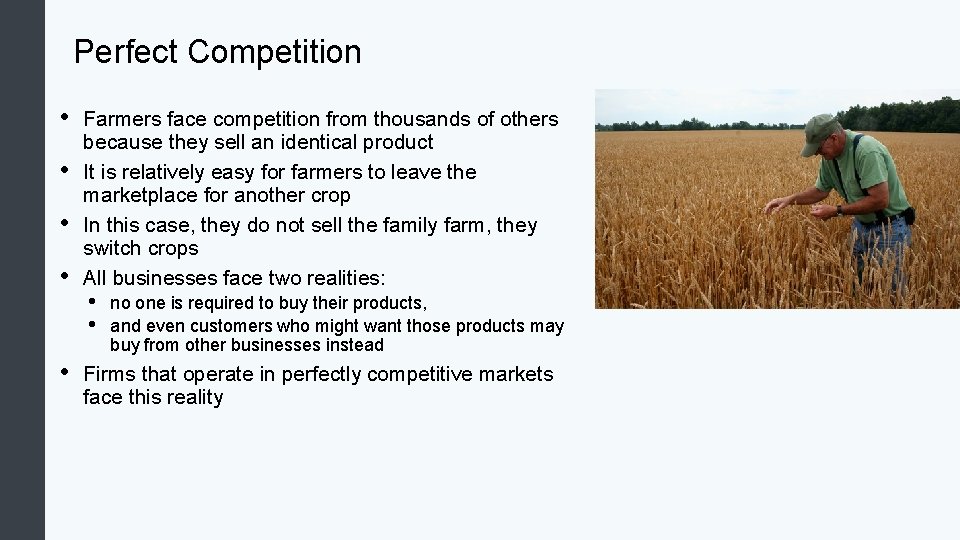
Perfect Competition • • • Farmers face competition from thousands of others because they sell an identical product It is relatively easy for farmers to leave the marketplace for another crop In this case, they do not sell the family farm, they switch crops All businesses face two realities: • • no one is required to buy their products, and even customers who might want those products may buy from other businesses instead Firms that operate in perfectly competitive markets face this reality
What is Perfect Competition? • Conditions of perfect competition: 1. the industry has many firms and many customers 2. all firms produce identical products 3. sellers and buyers have all relevant information to make rational decisions about the product being bought and sold firms can enter and leave the market without any restrictions 4. • A perfectly competitive firm is called a price taker, because the pressure of competing firms forces them to accept the prevailing equilibrium price in the market
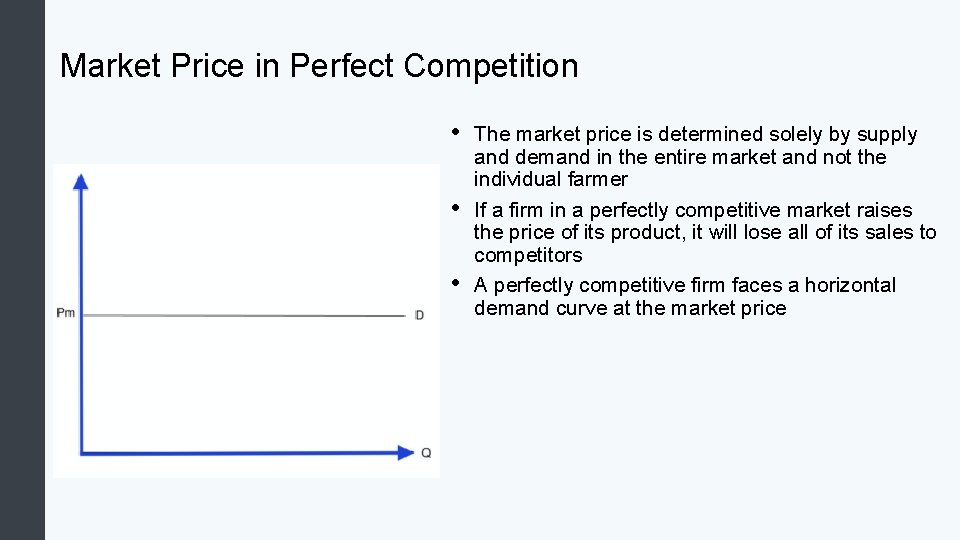
Market Price in Perfect Competition • • • The market price is determined solely by supply and demand in the entire market and not the individual farmer If a firm in a perfectly competitive market raises the price of its product, it will lose all of its sales to competitors A perfectly competitive firm faces a horizontal demand curve at the market price
Profit Maximization in a Perfectly Competitive Market • A perfectly competitive firm has only one major decision to make—namely, what quantity to produce • A perfectly competitive firm must accept the price for its output as determined by the product’s market demand supply, can’t change price the perfectly competitive firm can choose to sell any quantity of output at exactly the same price Therefore, the firm faces a perfectly elastic demand curve for its product: • • buyers are willing to buy any number of units of output from the firm at the market price When the firm chooses what quantity to produce, the quantity will determine the firm’s total revenue, total costs, and level of profits
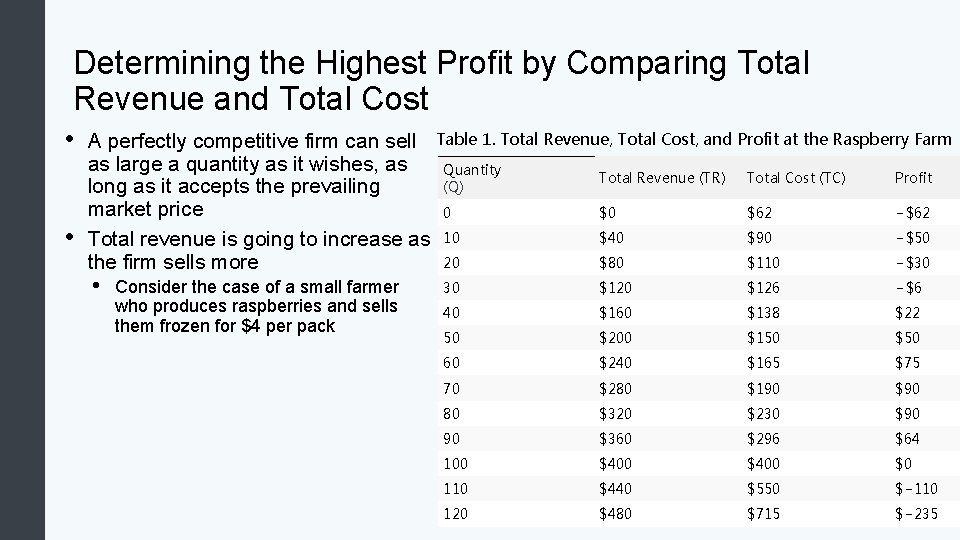
Determining the Highest Profit by Comparing Total Revenue and Total Cost • • A perfectly competitive firm can sell Table 1. Total Revenue, Total Cost, and Profit at the Raspberry Farm as large a quantity as it wishes, as Quantity Total Revenue (TR) Total Cost (TC) Profit (Q) long as it accepts the prevailing market price 0 $0 $62 −$62 $40 $90 −$50 Total revenue is going to increase as 10 20 $80 $110 −$30 the firm sells more • Consider the case of a small farmer who produces raspberries and sells them frozen for $4 per pack 30 $126 −$6 40 $160 $138 $22 50 $200 $150 $50 60 $240 $165 $75 70 $280 $190 $90 80 $320 $230 $90 90 $360 $296 $64 100 $400 $0 110 $440 $550 $− 110 120 $480 $715 $− 235
Comparing Marginal Revenue and Marginal Costs • • Firms often do not have the necessary data they need to draw a complete total cost curve for all levels of production Firms experiment with costs and profits through production or cutting production Every time one more unit is sold, the firm sells one more unit and revenue goes up by equal amount as the market price Every time the firm sells a pack of frozen raspberries, the firm’s revenue increases by $4
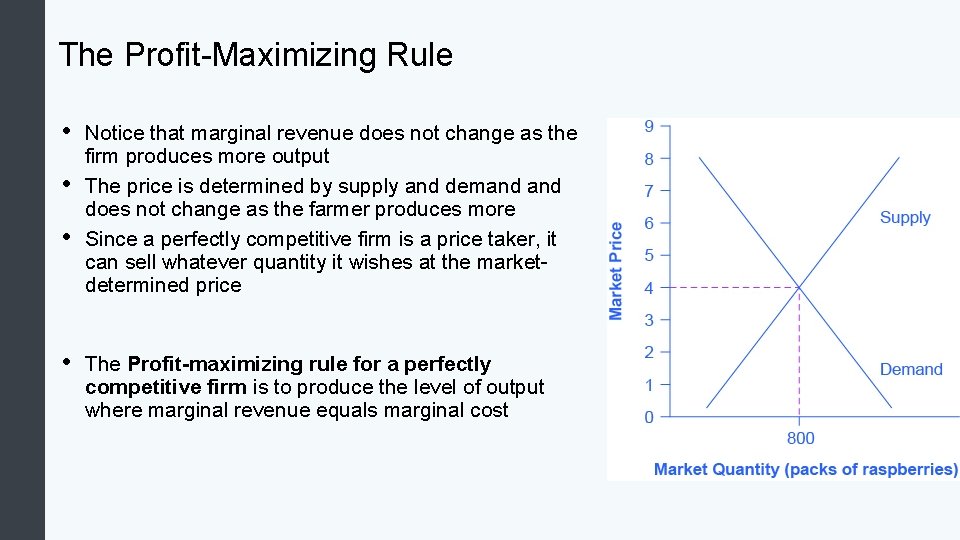
The Profit-Maximizing Rule • • Notice that marginal revenue does not change as the firm produces more output The price is determined by supply and demand does not change as the farmer produces more Since a perfectly competitive firm is a price taker, it can sell whatever quantity it wishes at the marketdetermined price The Profit-maximizing rule for a perfectly competitive firm is to produce the level of output where marginal revenue equals marginal cost
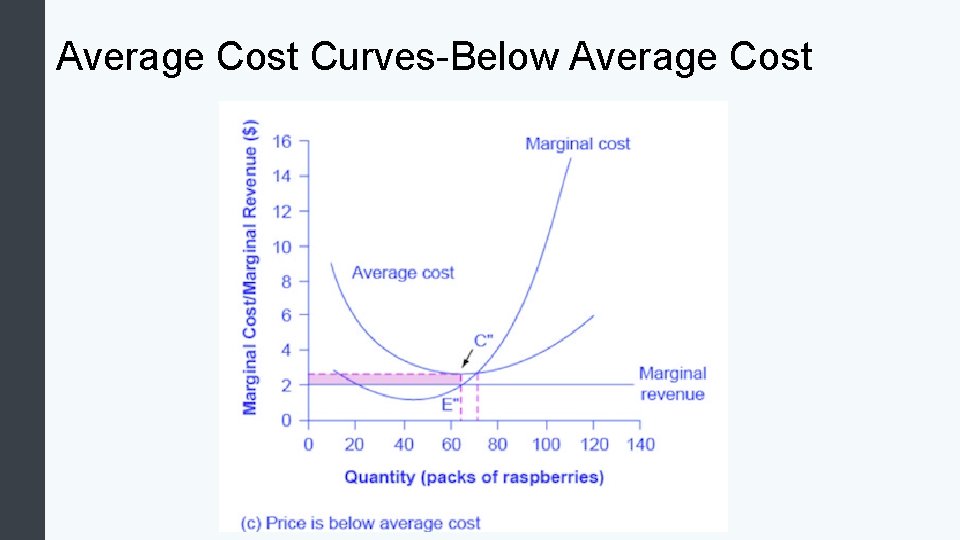
Calculating Profits and Losses • A firm’s profit margin is the average profit, or the relationship between price and average total cost • If a firm charges higher than the average cost, the firm’s profit margin is positive and is earning economic profits • If a firm charges lower than the average cost, the firm’s profit margin is negative and is suffering an economic loss
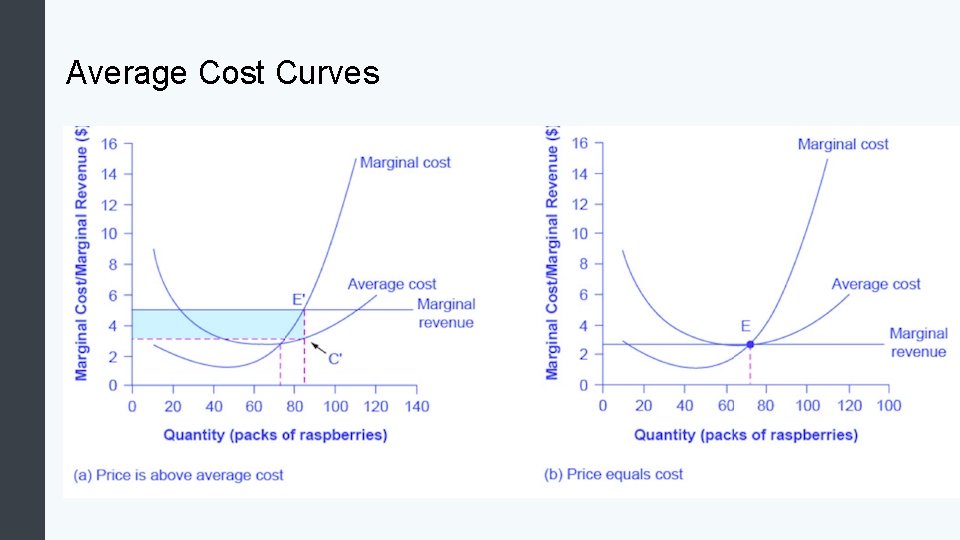
Average Cost Curves
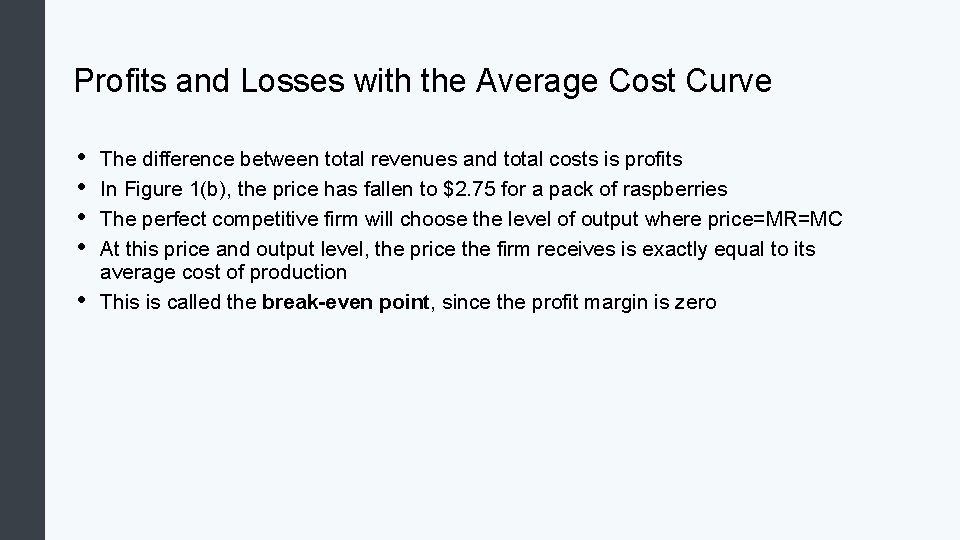
Profits and Losses with the Average Cost Curve • • • The difference between total revenues and total costs is profits In Figure 1(b), the price has fallen to $2. 75 for a pack of raspberries The perfect competitive firm will choose the level of output where price=MR=MC At this price and output level, the price the firm receives is exactly equal to its average cost of production This is called the break-even point, since the profit margin is zero
Average Cost Curves-Below Average Cost
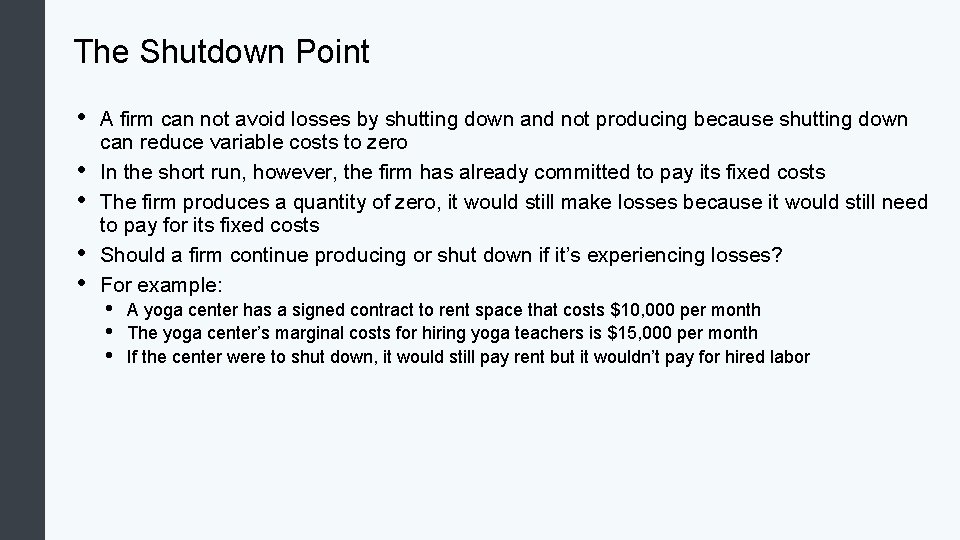
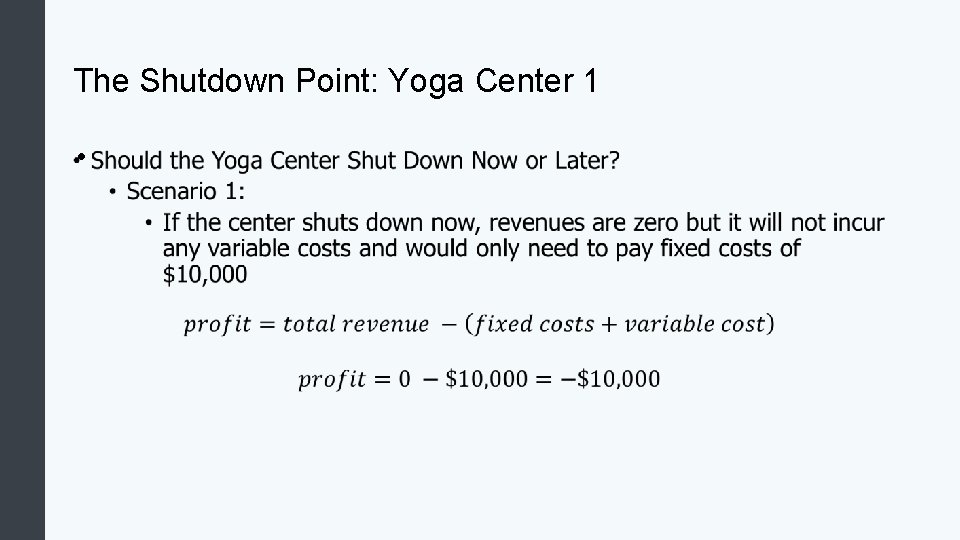
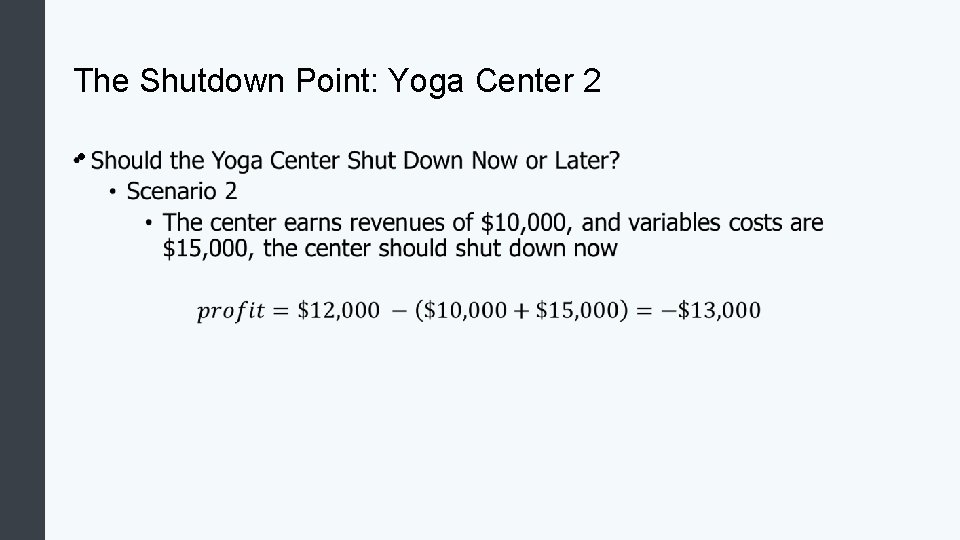
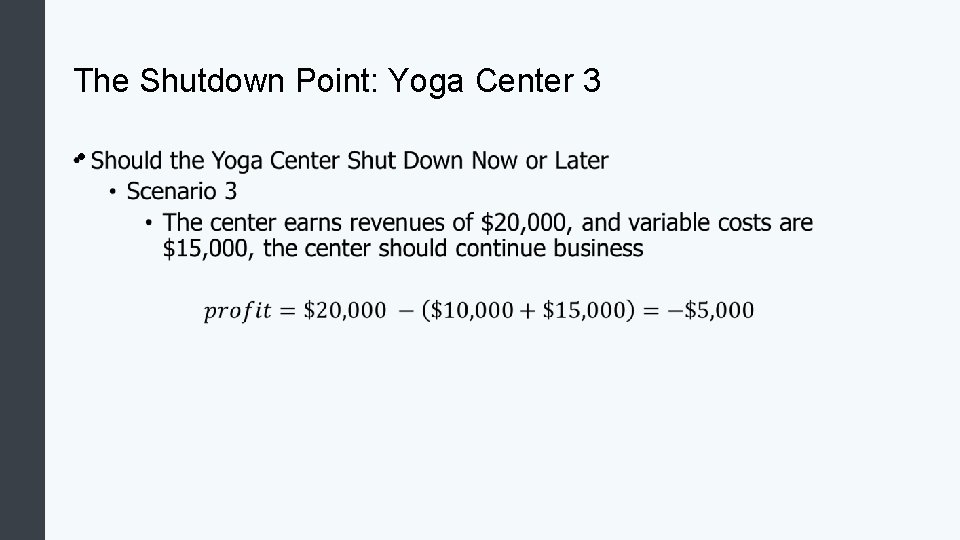
The Shutdown Point • • • A firm can not avoid losses by shutting down and not producing because shutting down can reduce variable costs to zero In the short run, however, the firm has already committed to pay its fixed costs The firm produces a quantity of zero, it would still make losses because it would still need to pay for its fixed costs Should a firm continue producing or shut down if it’s experiencing losses? For example: • • • A yoga center has a signed contract to rent space that costs $10, 000 per month The yoga center’s marginal costs for hiring yoga teachers is $15, 000 per month If the center were to shut down, it would still pay rent but it wouldn’t pay for hired labor
The Shutdown Point: Yoga Center 1 •
The Shutdown Point: Yoga Center 2 •
The Shutdown Point: Yoga Center 3 •
Entry and Exit Decisions in the Long Run • • • The line between the short run and the long run cannot be defined • • In the short run, firms cannot change the usage of fixed inputs In the long run, the firm can adjust all factors of production When businesses are making profit, in the short run, they have incentive to expand When new firms come into an industry in response to high profits, it is called entry If businesses are making losses, in the short run, they will limp along or shut down If businesses are making losses, in the long run, they will downsize, reduce their capital stock, or shut down completely When firms leave an industry due to a pattern of losses, this is called exit
How Entry and Exit Lead to Zero Profits in the Long Run • • • A perfectly competitive firm can’t alone affect the market price A combination of many firms entering and exiting the market will affect the overall supply in the market A shift in supply for the market as a whole will affect the market price Entry and exit to and from the market are the driving forces behind a process that, in the long run, pushes the price down to minimum average total costs so that all firms are earning a zero profit The long-run equilibrium is where all firms earn zero economic profits producing the output level where
Efficiency in Perfectly Competitive Markets • • • Profit-maximizing firms in perfectly competitive markets, when combined with utilitymaximizing consumers, result in quantities of outputs of goods and services that demonstrate productive and allocative efficiency Productive efficiency means producing at the lowest cost possible (i. e. producing without waste) • Goods are being produced and sold at the lowest possible average cost Allocative efficiency means that when the mix of goods being produced represents the mix that society most desires • Businesses supply what is being demanded
Efficiency in Perfectly Competitive Markets cont. • A perfectly competitive market in the long run will feature both productive and allocative efficiency, • Economists use “efficiency” in a specific sense, it is not a synonym for “desirable in every way” • Market structures like monopoly, monopolistic competition, oligopoly are more frequently observed in the real world than perfect competition
Quick Review • What are the conditions and implications of a perfectly competitive market? • What are the profits and costs by comparing total revenue and total cost? • Using marginal revenue and marginal costs, how do you find the level of output that will maximize the firm’s profits? • What is a firm’s profit margin? • Using the average cost curve, how do you calculate a firm’s profits and losses?
More Quick Review • What is a firm’s break-even point? • When should a firm continue to produce in the short run or at which point it should shutdown? • How does entry and exit lead to zero profits in the long run? • Why are perfectly competitive firms both productively efficient and allocatively efficient? • Compare the model of perfect competition to real world markets.