
Microeconomics Module 6 Utility How Do Consumers Make

- Slides: 30
Microeconomics Module 6: Utility
How Do Consumers Make Choices? • • How do you make the best choice in conditions of scarcity? • In other words, how do you get the “biggest bang for your buck? ” Consider questions like: • • Why do people purchase more of something when its price falls? Why do people buy more goods and services when their budget increases?
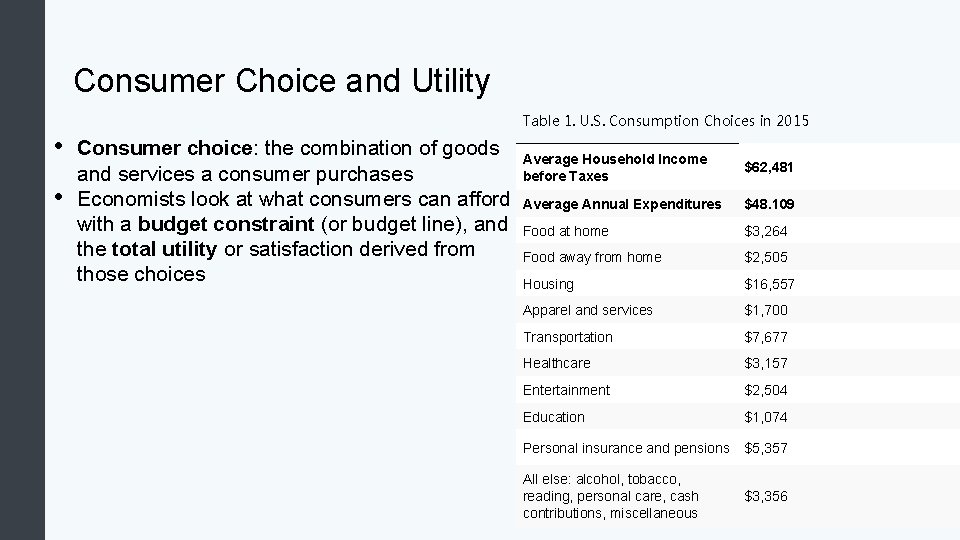
Consumer Choice and Utility Table 1. U. S. Consumption Choices in 2015 • • Consumer choice: the combination of goods Average Household Income and services a consumer purchases before Taxes Economists look at what consumers can afford Average Annual Expenditures with a budget constraint (or budget line), and Food at home the total utility or satisfaction derived from Food away from home those choices Housing $62, 481 $48. 109 $3, 264 $2, 505 $16, 557 Apparel and services $1, 700 Transportation $7, 677 Healthcare $3, 157 Entertainment $2, 504 Education $1, 074 Personal insurance and pensions $5, 357 All else: alcohol, tobacco, reading, personal care, cash contributions, miscellaneous $3, 356
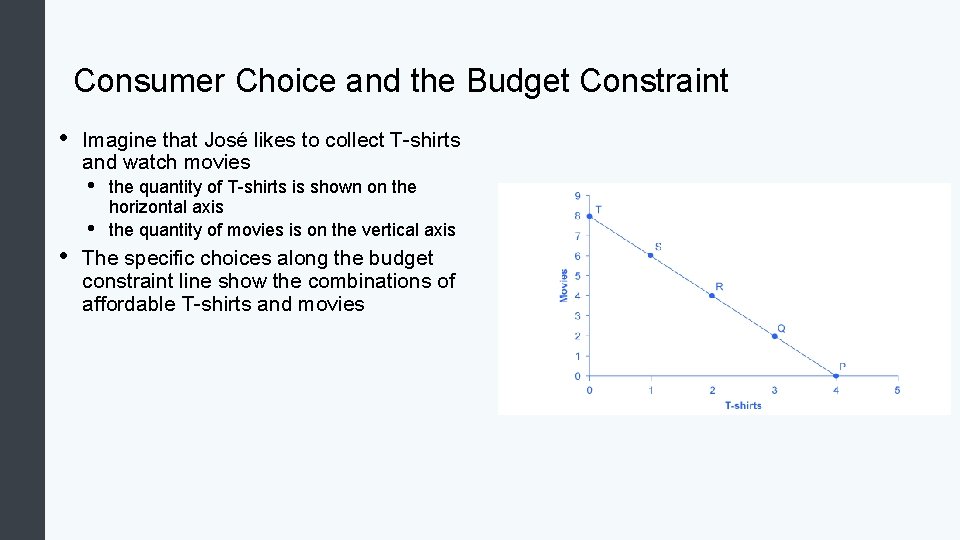
Consumer Choice and the Budget Constraint • Imagine that José likes to collect T-shirts and watch movies • • • the quantity of T-shirts is shown on the horizontal axis the quantity of movies is on the vertical axis The specific choices along the budget constraint line show the combinations of affordable T-shirts and movies
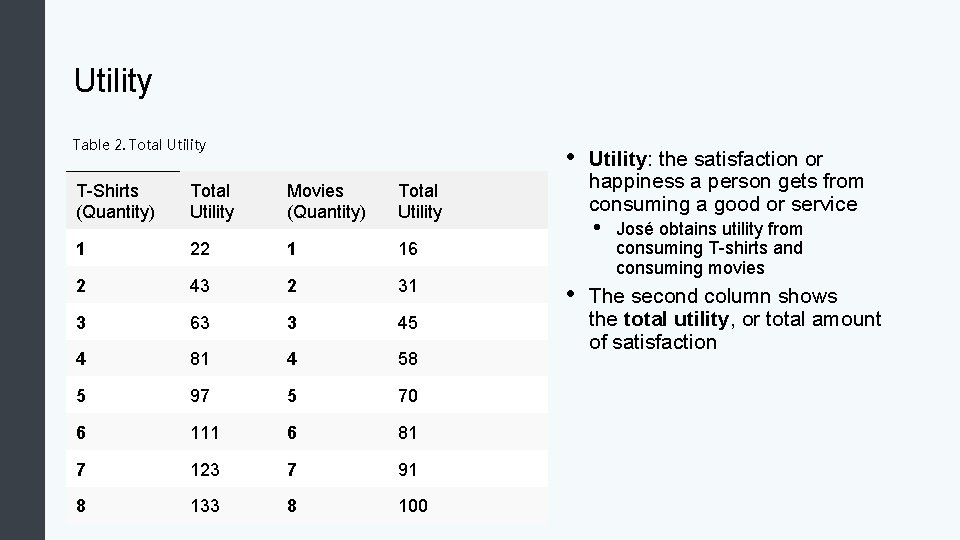
Utility Table 2. Total Utility • T-Shirts (Quantity) Total Utility Movies (Quantity) Total Utility 1 22 1 16 2 43 2 31 3 63 3 45 4 81 4 58 5 97 5 70 6 111 6 81 7 123 7 91 8 133 8 100 Utility: the satisfaction or happiness a person gets from consuming a good or service • • José obtains utility from consuming T-shirts and consuming movies The second column shows the total utility, or total amount of satisfaction
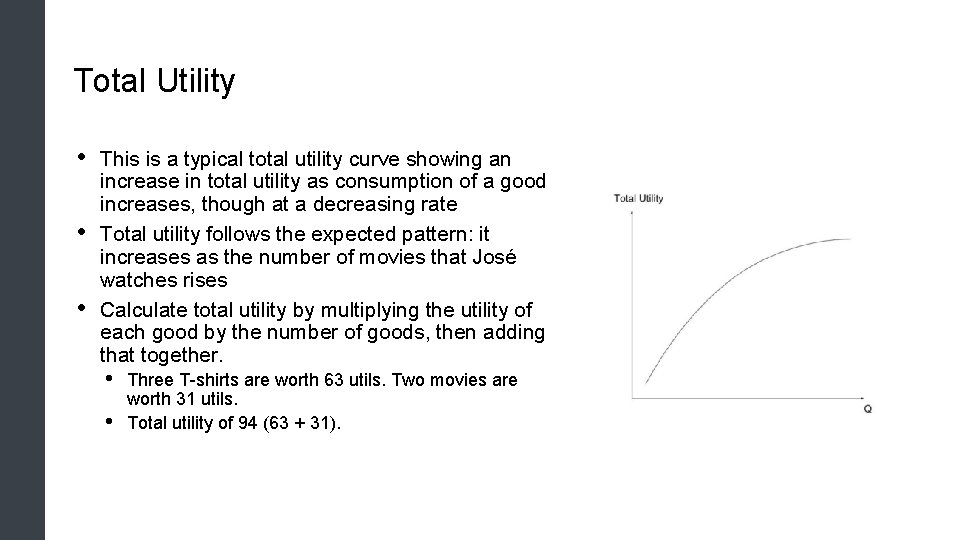
Total Utility • • • This is a typical total utility curve showing an increase in total utility as consumption of a good increases, though at a decreasing rate Total utility follows the expected pattern: it increases as the number of movies that José watches rises Calculate total utility by multiplying the utility of each good by the number of goods, then adding that together. • • Three T-shirts are worth 63 utils. Two movies are worth 31 utils. Total utility of 94 (63 + 31).
Marginal Utility versus Total Utility • • A choice at the margin is a decision to do a little more or a little less of something Marginal utility is based on the notion that individuals rarely face all-or-nothing decisions • • • The change in total utility from consuming one more or one less of an item The marginal utility of a third slice of pizza is the change in satisfaction one gets when eating the third slice instead of stopping with two Marginal thinking: “How much better will I do on an exam if I study for one more hour? ”
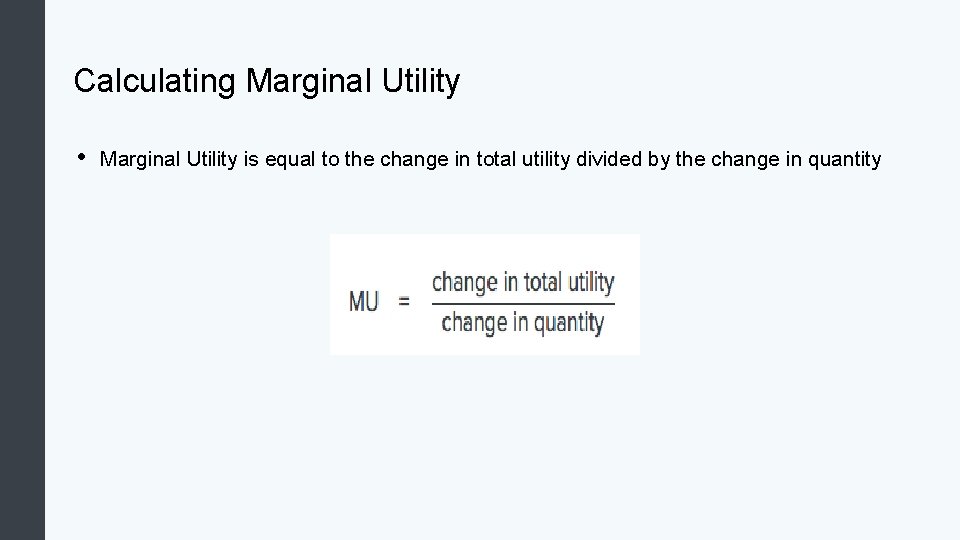
Calculating Marginal Utility • Marginal Utility is equal to the change in total utility divided by the change in quantity
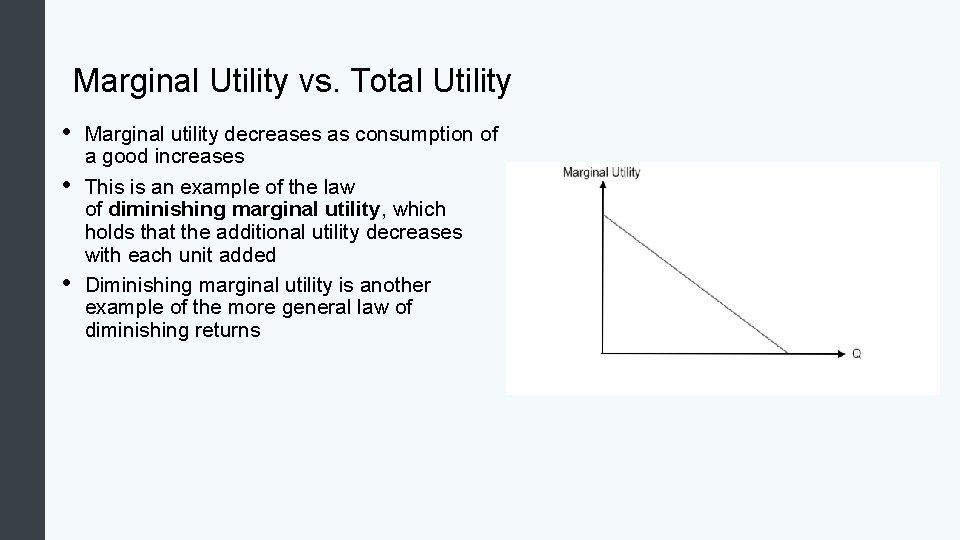
Marginal Utility vs. Total Utility • • • Marginal utility decreases as consumption of a good increases This is an example of the law of diminishing marginal utility, which holds that the additional utility decreases with each unit added Diminishing marginal utility is another example of the more general law of diminishing returns
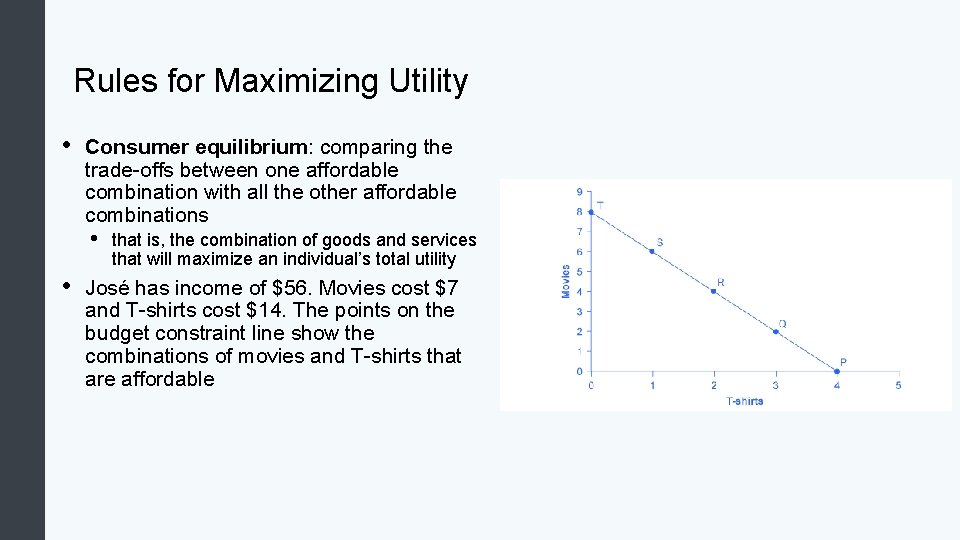
Rules for Maximizing Utility • Consumer equilibrium: comparing the trade-offs between one affordable combination with all the other affordable combinations • • that is, the combination of goods and services that will maximize an individual’s total utility José has income of $56. Movies cost $7 and T-shirts cost $14. The points on the budget constraint line show the combinations of movies and T-shirts that are affordable
Applying the Rule • • • To maximize total utility, spend each dollar on the item which yields the greatest marginal utility per dollar of expenditure José’s first purchase will be a movie. Why? • • José’s choices are to purchase either a T-shirt or a movie The first movie gives José more marginal utility per dollar than the first T-shirt, and because the movie is within his budget, he will purchase a movie first José will continue to purchase the good which gives him the highest marginal utility per dollar until he exhausts the budget
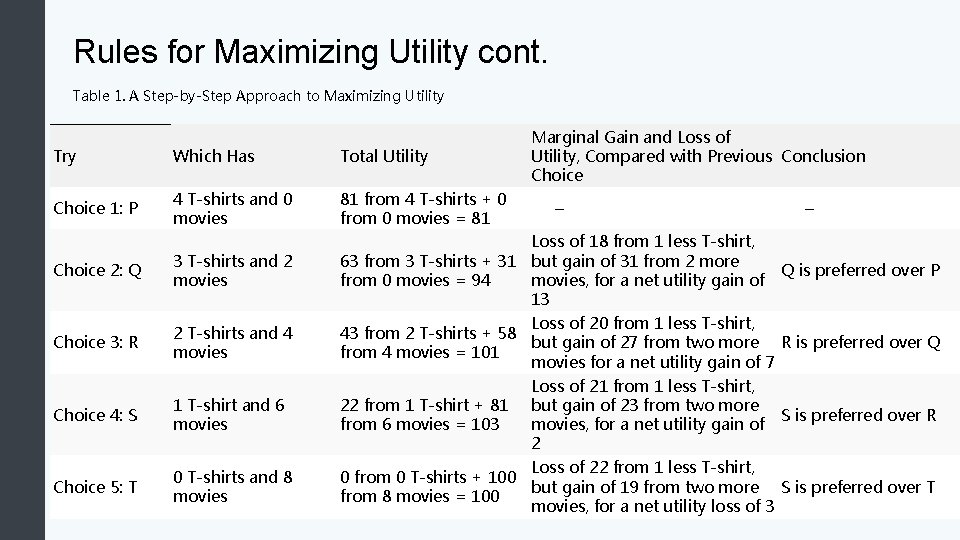
Rules for Maximizing Utility cont. Table 1. A Step-by-Step Approach to Maximizing Utility Try Which Has Total Utility Marginal Gain and Loss of Utility, Compared with Previous Conclusion Choice 1: P 4 T-shirts and 0 movies 81 from 4 T-shirts + 0 from 0 movies = 81 – Choice 2: Q 3 T-shirts and 2 movies Loss of 18 from 1 less T-shirt, 63 from 3 T-shirts + 31 but gain of 31 from 2 more Q is preferred over P from 0 movies = 94 movies, for a net utility gain of 13 Choice 3: R 2 T-shirts and 4 movies Loss of 20 from 1 less T-shirt, 43 from 2 T-shirts + 58 but gain of 27 from two more R is preferred over Q from 4 movies = 101 movies for a net utility gain of 7 – Loss of 21 from 1 less T-shirt, but gain of 23 from two more S is preferred over R movies, for a net utility gain of 2 Choice 4: S 1 T-shirt and 6 movies 22 from 1 T-shirt + 81 from 6 movies = 103 Choice 5: T 0 T-shirts and 8 movies Loss of 22 from 1 less T-shirt, 0 from 0 T-shirts + 100 but gain of 19 from two more S is preferred over T from 8 movies = 100 movies, for a net utility loss of 3
Decision Making by Comparing Marginal Utility • • • How José could use the following thought process (if he thought in utils) to make his decision regarding how many T-shirts and movies to purchase: Step 1: From Table 1, José can see that the marginal utility of the fourth T-shirt is 18. If José gives up the fourth T-shirt, then he loses 18 utils Step 2: Giving up the fourth T-shirt, however, frees up $14 (the price of a T-shirt), allowing José to buy the first two movies (at $7 each) Step 3: José knows that the marginal utility of the first movie is 16 and the marginal utility of the second movie is 15. Thus, if José moves from point P to point Q, he gives up 18 utils (from the T-shirt), but gains 31 utils (from the movies) Step 4: Gaining 31 utils and losing 18 utils is a net gain of 13. This is just another way of saying that the total utility at Q (94 according to the last column in Table 1) is 13 more than the total utility at P (81) Step 5: So, for José, it makes sense to give up the fourth T-shirt in order to buy two movies
A Rule for Maximizing Utility • • • This process of decision making described previously suggests a rule to follow when maximizing utility Since the price of T-shirts is not the same as the price of movies, it’s not enough to just compare the marginal utility of T-shirts with the marginal utility of movies We need to control for the prices of each product We can do this by computing and comparing marginal utility per dollar of expenditure for each product Marginal utility per dollar is the amount of additional utility José receives given the price of the product
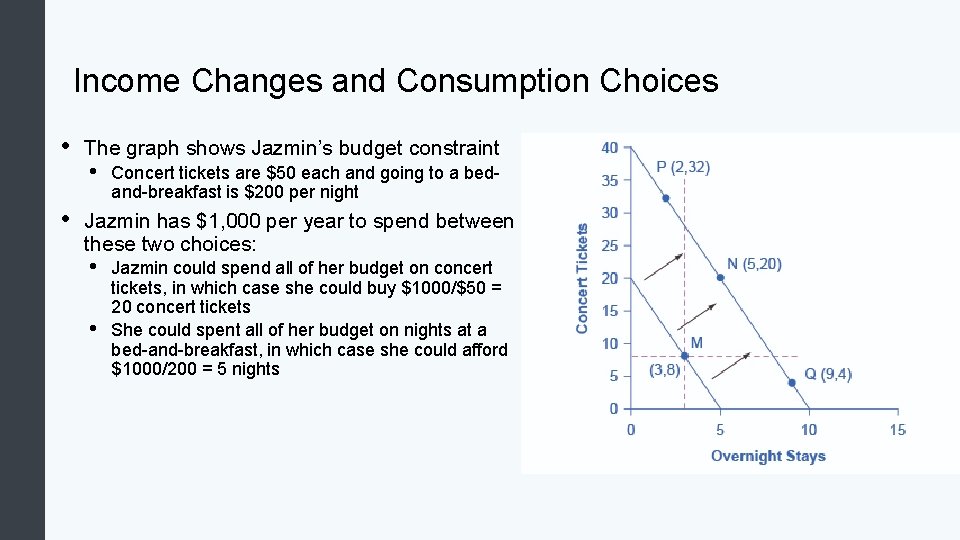
Income Changes and Consumption Choices • • The graph shows Jazmin’s budget constraint • Concert tickets are $50 each and going to a bedand-breakfast is $200 per night Jazmin has $1, 000 per year to spend between these two choices: • • Jazmin could spend all of her budget on concert tickets, in which case she could buy $1000/$50 = 20 concert tickets She could spent all of her budget on nights at a bed-and-breakfast, in which case she could afford $1000/200 = 5 nights
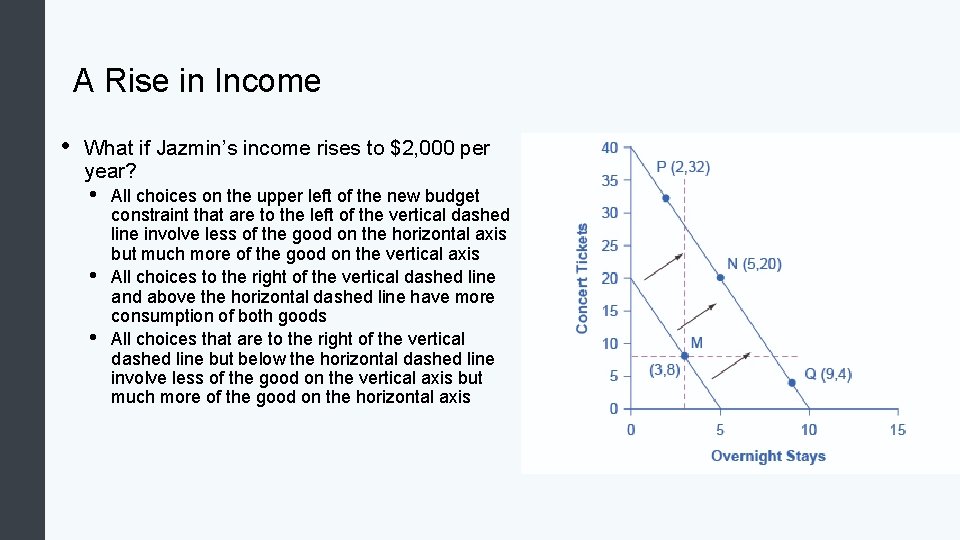
A Rise in Income • What if Jazmin’s income rises to $2, 000 per year? • • • All choices on the upper left of the new budget constraint that are to the left of the vertical dashed line involve less of the good on the horizontal axis but much more of the good on the vertical axis All choices to the right of the vertical dashed line and above the horizontal dashed line have more consumption of both goods All choices that are to the right of the vertical dashed line but below the horizontal dashed line involve less of the good on the vertical axis but much more of the good on the horizontal axis
How Changes in Income Affect Consumer Choices • Goods and services are called normal goods if a rise in income leads to a rise in the quantity consumed of that good and a fall in income leads to a fall in quantity consumed • • Depending on Jazmin’s preferences, a rise in income could cause consumption of one good to increase while consumption of the other good declines Goods where demand declines as income rises (or conversely, where the demand rises as income falls) are called inferior goods. • An inferior good occurs when people trim back on a good as income rises
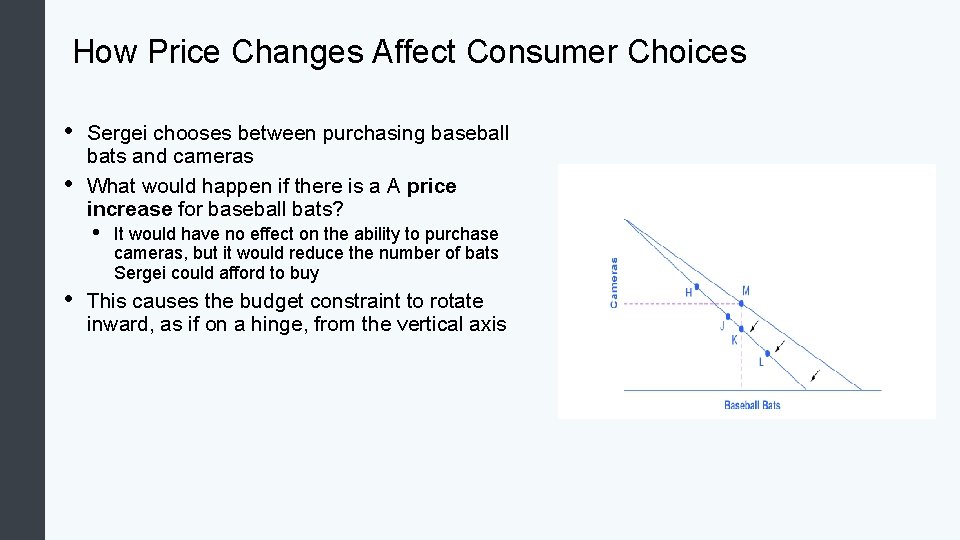
How Price Changes Affect Consumer Choices • • Sergei chooses between purchasing baseball bats and cameras What would happen if there is a A price increase for baseball bats? • • It would have no effect on the ability to purchase cameras, but it would reduce the number of bats Sergei could afford to buy This causes the budget constraint to rotate inward, as if on a hinge, from the vertical axis
How a Change in Price Affects Consumption Choices • • The substitution effect occurs when a price changes and consumers have an incentive to consume less of the good with a relatively higher price and more of the good with a relatively lower price The income effect is that a higher price means, in effect, the buying power of income has been reduced (even though actual income has not changed), which leads to buying less of the good (when the good is normal) • Both effects can occur simultaneously
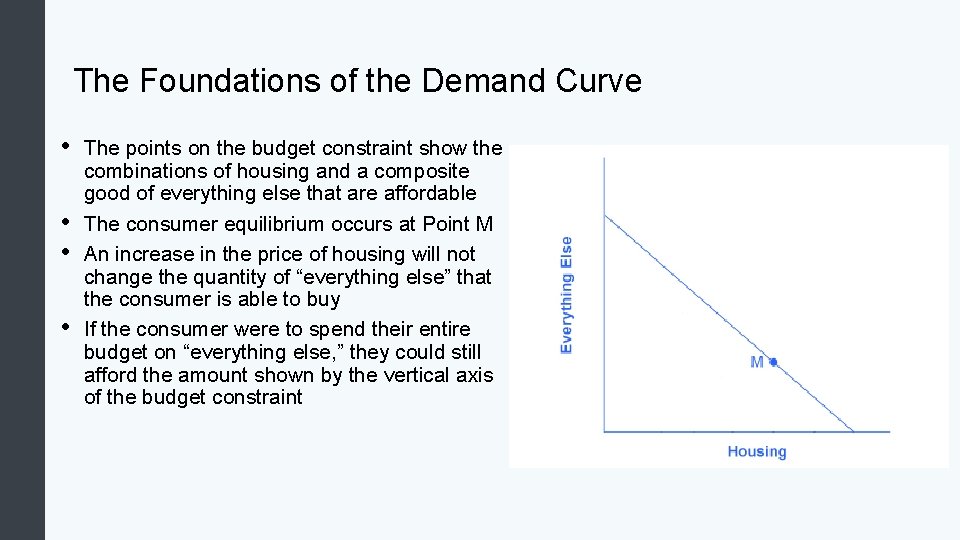
The Foundations of the Demand Curve • • The points on the budget constraint show the combinations of housing and a composite good of everything else that are affordable The consumer equilibrium occurs at Point M An increase in the price of housing will not change the quantity of “everything else” that the consumer is able to buy If the consumer were to spend their entire budget on “everything else, ” they could still afford the amount shown by the vertical axis of the budget constraint
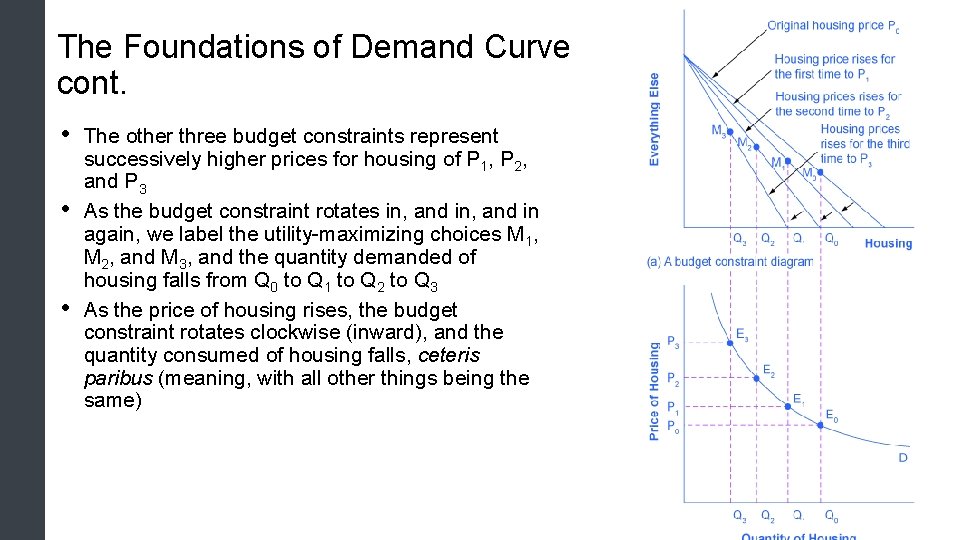
The Foundations of Demand Curve cont. • • • The other three budget constraints represent successively higher prices for housing of P 1, P 2, and P 3 As the budget constraint rotates in, and in again, we label the utility-maximizing choices M 1, M 2, and M 3, and the quantity demanded of housing falls from Q 0 to Q 1 to Q 2 to Q 3 As the price of housing rises, the budget constraint rotates clockwise (inward), and the quantity consumed of housing falls, ceteris paribus (meaning, with all other things being the same)
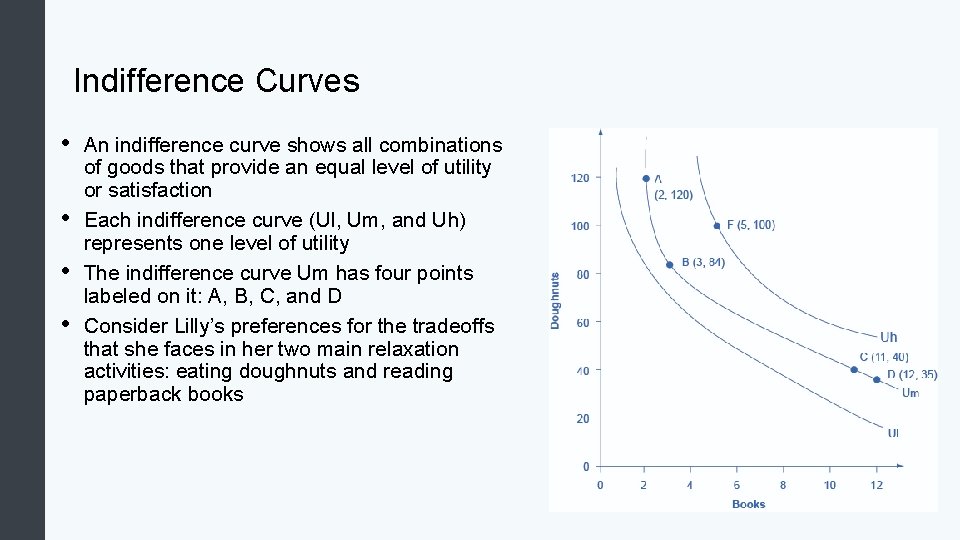
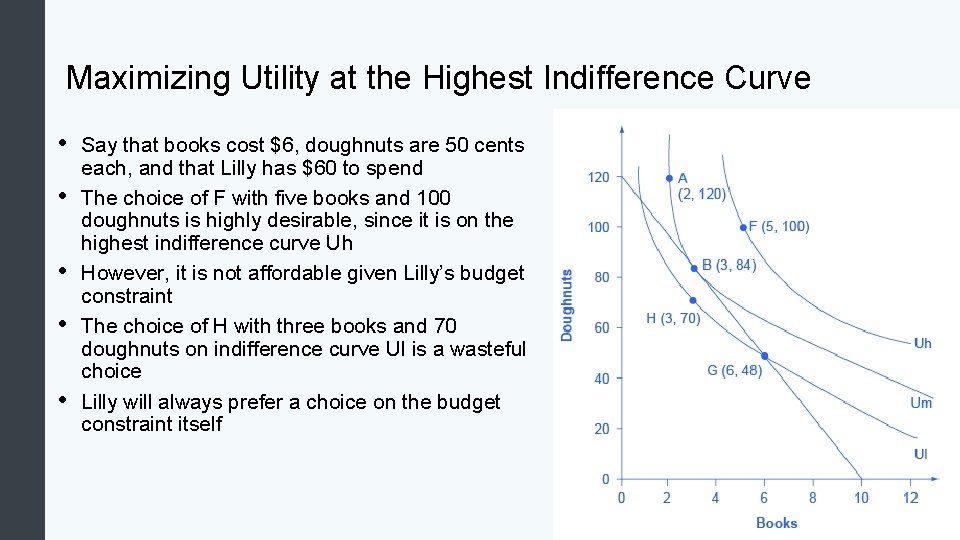
Indifference Curves • • An indifference curve shows all combinations of goods that provide an equal level of utility or satisfaction Each indifference curve (Ul, Um, and Uh) represents one level of utility The indifference curve Um has four points labeled on it: A, B, C, and D Consider Lilly’s preferences for the tradeoffs that she faces in her two main relaxation activities: eating doughnuts and reading paperback books
The Shape of an Indifference Curve • • Since an indifference curve represents a set of choices that have the same level of utility, Lilly must receive an equal amount of utility She would also receive the same utility from any of the unlabeled intermediate points along this indifference curve Indifference curves have a roughly similar shape in two ways: 1. 2. They are downward sloping from left to right They are convex with respect to the origin. In other words, they are steeper on the left and flatter on the right The downward slope of the indifference curve means that Lilly must trade off less of one good to get more of the other, while holding utility constant
The Field of Indifference Curves • • Each indifference curve represents the choices that provide a single level of utility Every level of utility will have its own indifference curve Lilly’s preferences will include an infinite number of indifference curves lying nestled together on the diagram These arguments about the shapes of indifference curves and about higher or lower levels of utility do not require any numerical estimates of utility
The Individuality of Indifference Curves • • • Each person determines his or her own preferences and utility While indifference curves have the same general shape—they slope down, and the slope is steeper on the left and flatter on the right—the specific shape of indifference curves can be different for every person People seek the highest level of utility, which means that they wish to be on the highest possible indifference curve, but people are limited by their budget constraints
Maximizing Utility at the Highest Indifference Curve • • • Say that books cost $6, doughnuts are 50 cents each, and that Lilly has $60 to spend The choice of F with five books and 100 doughnuts is highly desirable, since it is on the highest indifference curve Uh However, it is not affordable given Lilly’s budget constraint The choice of H with three books and 70 doughnuts on indifference curve Ul is a wasteful choice Lilly will always prefer a choice on the budget constraint itself
Behavioral Economics: An Alternative Viewpoint • • People sometimes make decisions that seem “irrational” and not in their own best interest People’s decisions can seem inconsistent from one day to the next and they even deliberately ignore ways to save money or time Behavioral economists argue that the traditional method, meaning that people take all available information and make consistent and informed decisions that are in their best interest omits something important: people’s state of mind Behavioral economics seeks to enrich our understanding of decision-making by integrating the insights of psychology into economics
Irrational Consumer Behavior • • Traditional economists also assume human beings have complete self control Some examples of irrational consumer behavior: • • • Buying cigarettes by the pack instead of the carton, which will save money Purchase locks for their refrigerators Overpay on taxes to force the saving of money Another area that seems illogical is the idea of mental accounting, or putting dollars in different mental categories where they take different values Economists typically consider dollars to be fungible, or having equal value to the individual, regardless of the situation
Quick Review • • • What is utility and its connection to consumer behavior? How do you calculate the total utility of a collection of goods and services? What is the difference between total and marginal utility? Contrast and compute marginal utility and total utility Why does maximizing utility require that the last unit of each item purchased must have the same marginal utility per dollar? How do you calculate the utility-maximizing choice? How do changes in income and price affect consumer choices? What is the difference between the substitution effect and the income effect? How are demand curves derived from consumer equilibrium?
More Quick Review • • • What is the purpose, use, and shape of indifference curves? How does one indifference curve differ from another? How do you find the consumer equilibrium using indifference curves and a budget constraint? What is behavior economics? What are some examples of irrational decision-making?