
Microdata and schema org Basics l Microdata is

Microdata and schema. org
Basics l Microdata is a simple semantic markup scheme that’s an alternative to RDFa l Developed by WHATWG and supported by major search companies (Google, Microsoft, Yahoo, Yandex) l Like RDFa, it uses HTML tag attributes to host metadata l Vocabularies are controlled and hosted at schema. org
What is WHATWG? l Web Hypertext Application Technology Working Group – – Community interested in evolving the Web with focus on HTML and Web API development Ian Hickson is a key person, now at Google l Founded in 2004 by individuals from Apple, Mozilla and Opera after a W 3 C workshop – Concern about W 3 C's embrace of XHTML l Current work on HTML 5 l Developed Microdata spec
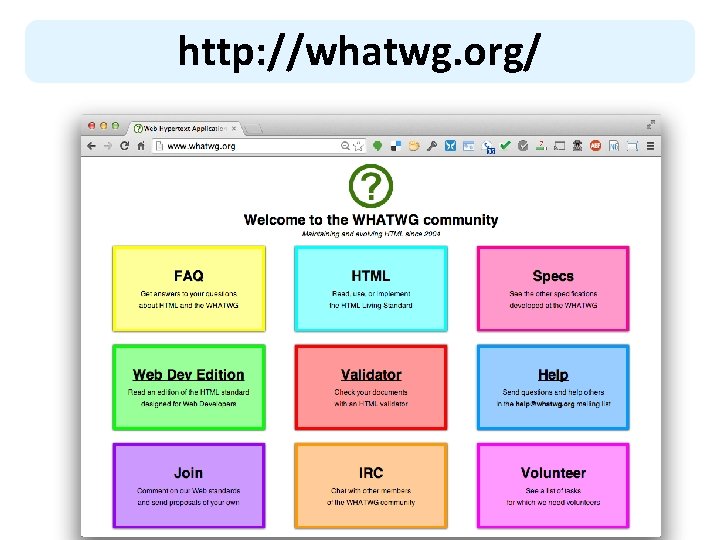
http: //whatwg. org/
HTML 5 l Started by WHATWG as an alternative to XHTML, joined by W 3 C – – A W 3 C candidate recommendation in 2012 (draft) WHATWG will evolve it as a “living standard” l HTML 5 ≈ HTML + CSS + js l Native support for graphics, video, audio, speech, semantic markup, … l Current partial support in major browsers & extensions
Microdata l The microdata effort has two parts: – – A markup scheme A set of vocabularies/ontologies l The markup is similar to RDFa in providing ways to identify subjects, types, properties & objects There’s also a standard way to encode microdata as RDFa l The sanctioned vocabularies are found at schema. org and include a small number of very useful ones: people, movies, etc.
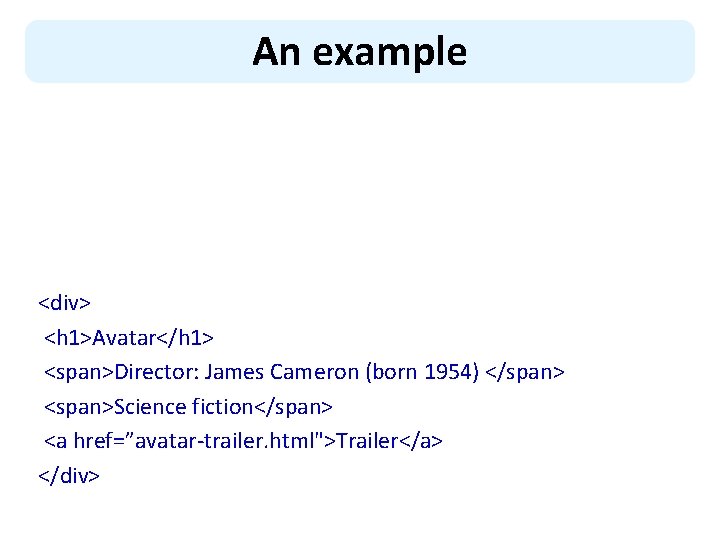
An example <div> <h 1>Avatar</h 1> <span>Director: James Cameron (born 1954) </span> <span>Science fiction</span> <a href=”avatar-trailer. html">Trailer</a> </div>
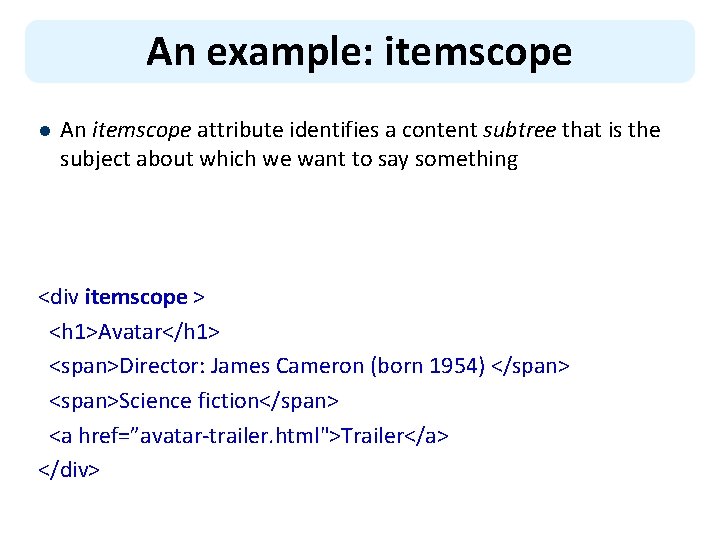
An example: itemscope l An itemscope attribute identifies a content subtree that is the subject about which we want to say something <div itemscope > <h 1>Avatar</h 1> <span>Director: James Cameron (born 1954) </span> <span>Science fiction</span> <a href=”avatar-trailer. html">Trailer</a> </div>
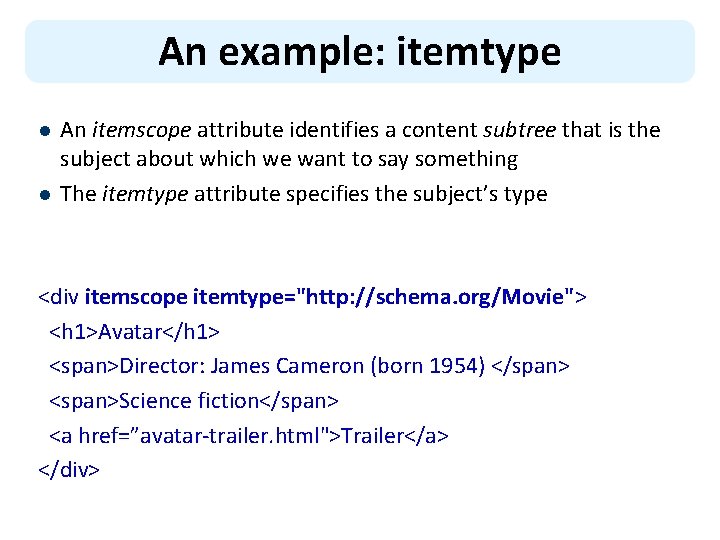
An example: itemtype l l An itemscope attribute identifies a content subtree that is the subject about which we want to say something The itemtype attribute specifies the subject’s type <div itemscope itemtype="http: //schema. org/Movie"> <h 1>Avatar</h 1> <span>Director: James Cameron (born 1954) </span> <span>Science fiction</span> <a href=”avatar-trailer. html">Trailer</a> </div>
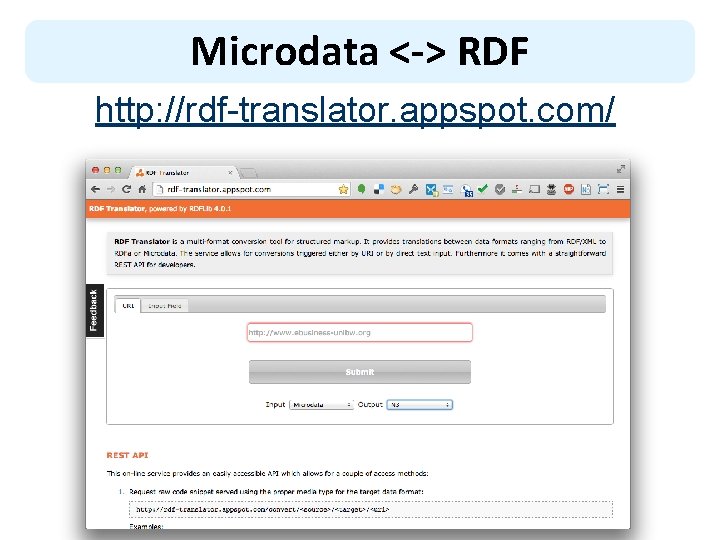
Microdata <-> RDF http: //rdf-translator. appspot. com/
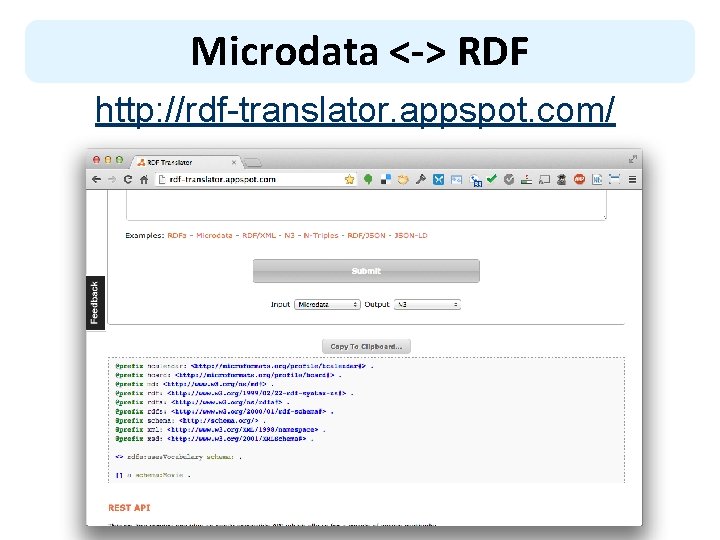
Microdata <-> RDF http: //rdf-translator. appspot. com/
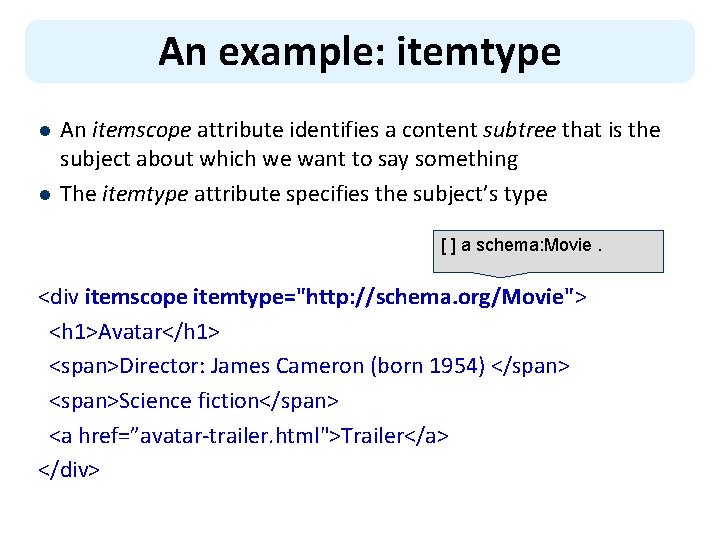
An example: itemtype l l An itemscope attribute identifies a content subtree that is the subject about which we want to say something The itemtype attribute specifies the subject’s type [ ] a schema: Movie. <div itemscope itemtype="http: //schema. org/Movie"> <h 1>Avatar</h 1> <span>Director: James Cameron (born 1954) </span> <span>Science fiction</span> <a href=”avatar-trailer. html">Trailer</a> </div>
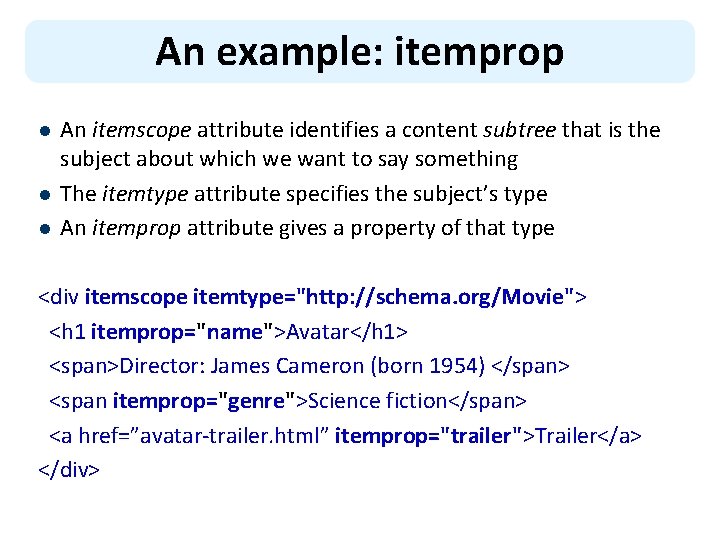
An example: itemprop l l l An itemscope attribute identifies a content subtree that is the subject about which we want to say something The itemtype attribute specifies the subject’s type An itemprop attribute gives a property of that type <div itemscope itemtype="http: //schema. org/Movie"> <h 1 itemprop="name">Avatar</h 1> <span>Director: James Cameron (born 1954) </span> <span itemprop="genre">Science fiction</span> <a href=”avatar-trailer. html” itemprop="trailer">Trailer</a> </div>
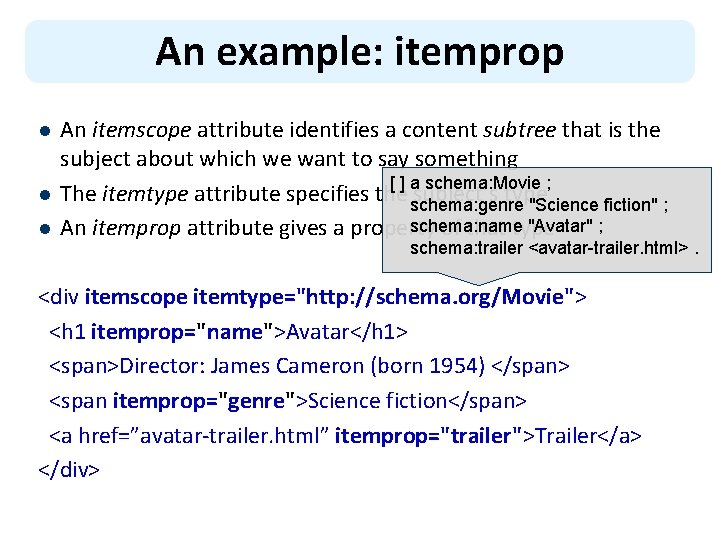
An example: itemprop l l l An itemscope attribute identifies a content subtree that is the subject about which we want to say something [ ] a schema: Movie ; The itemtype attribute specifies the subject’s type schema: genre "Science fiction" ; schema: name "Avatar" ; An itemprop attribute gives a property of that type schema: trailer <avatar-trailer. html>. <div itemscope itemtype="http: //schema. org/Movie"> <h 1 itemprop="name">Avatar</h 1> <span>Director: James Cameron (born 1954) </span> <span itemprop="genre">Science fiction</span> <a href=”avatar-trailer. html” itemprop="trailer">Trailer</a> </div>
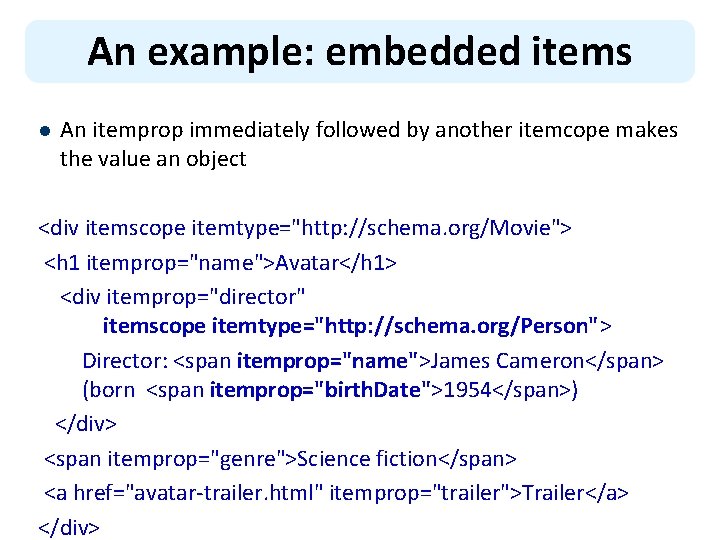
An example: embedded items l An itemprop immediately followed by another itemcope makes the value an object <div itemscope itemtype="http: //schema. org/Movie"> <h 1 itemprop="name">Avatar</h 1> <div itemprop="director" itemscope itemtype="http: //schema. org/Person"> Director: <span itemprop="name">James Cameron</span> (born <span itemprop="birth. Date">1954</span>) </div> <span itemprop="genre">Science fiction</span> <a href="avatar-trailer. html" itemprop="trailer">Trailer</a> </div>
![An example: embedded items [ ] a schema: Movie ; schema: director [ a](http://slidetodoc.com/presentation_image_h/2c17220b2db461482579df86846ba5c7/image-16.jpg "An example: embedded items [ ] a schema: Movie ; schema: director [ a")
An example: embedded items [ ] a schema: Movie ; schema: director [ a schema: Person ; schema: birth. Date "1954" ; schema: name "James Cameron" ; l An itemprop immediately followed by another itemcope]makes schema: genre "Science fiction" ; the value an object schema: name "Avatar" ; schema: trailer <avatar-trailer. html>. <div itemscope itemtype="http: //schema. org/Movie"> <h 1 itemprop="name">Avatar</h 1> <div itemprop="director" itemscope itemtype="http: //schema. org/Person"> Director: <span itemprop="name">James Cameron</span> (born <span itemprop="birth. Date">1954</span>) </div> <span itemprop="genre">Science fiction</span> <a href="avatar-trailer. html" itemprop="trailer">Trailer</a> </div>
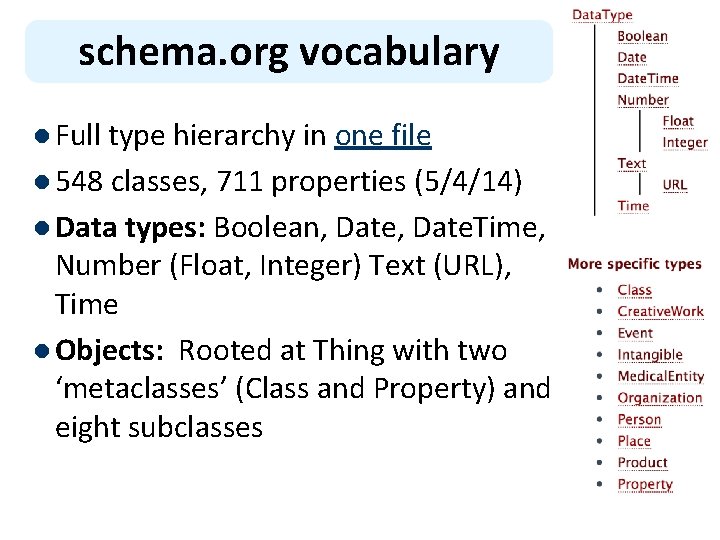
schema. org vocabulary l Full type hierarchy in one file l 548 classes, 711 properties (5/4/14) l Data types: Boolean, Date. Time, Number (Float, Integer) Text (URL), Time l Objects: Rooted at Thing with two ‘metaclasses’ (Class and Property) and eight subclasses
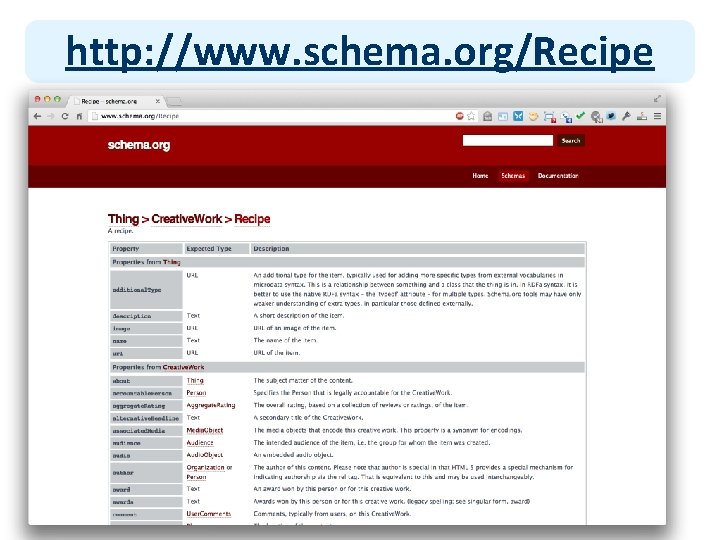
http: //www. schema. org/Recipe
Microdata as a KR language l More than RDF, less than RDFS l Properties have an – – expected type (range) Might be a string A list of types, any of which are OK l Properties attached ≥ 1 types (domain) l Classes can have multiple parents and inherit (properties) from all of them l No axioms (e. g. , disjointness, cardinality, etc. ) l No sub. Property. Of like relation
Mixing vocabularies l Microdata is intended to work with just one vocabulary – the one at schema. org l Advantages – – Simple, organized, well designed Controlled by the schema. org people l Disadvantages: too simple, controlled – – Too simple, narrow, mono-lingual Controlled by the schema. org people l Schema. rdfs. org defines mappings between schema. org and popular RDF ontologies
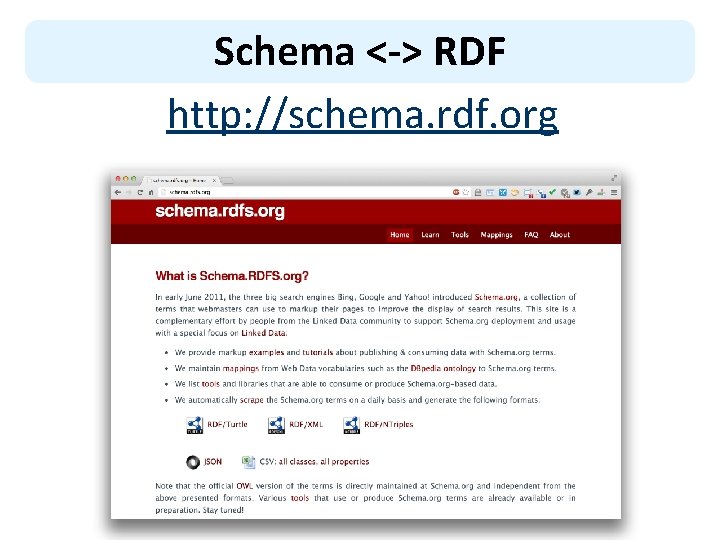
Schema <-> RDF http: //schema. rdf. org
Extending the schema. org ontology l http: //www. schema. org/docs/extension. html l You can subclass existing classes – – Person/Engineer/Electrical. Engineer l Subclass exisiting properties – music. Group. Member/lead. Vocalist – music. Group. Member/lead. Guitar 1 – music. Group. Member/lead. Guitar 2
Extension Problems l Do agreed upon meaning – – Through axioms supported by the language (e. g. , equivalence, disjointness, etc. ) No place for documentation (annotations, labels, comments) l Without a namespace mechanism, your Person/Engineer and mine can be confused and might mean different things
Serialization l Schema. org has a – – data model and serializations Microdata is the original, native sterilization RDFa is more expressive and works with the RDF stack Everyone agrees that RDFa Lite is a good encoding: as simple as Microdata but more expressive JSON-LD is also an accepted encoding l Search engines look for Microdata and RDFa encodings and are beginning to look for JSON-LD l Schema. org considers RDFa to be the “canonical machine representation of schema. org”
Conclusions l Microdata is a good effort by the search companies to use a simple semantic language l The semantics is pragmatic – e. g. , expected types: A string is accepted where a thing is expected – “some data is better than none” l The real value is in – – the supported vocabularies and their use by Search companies l => Immediate motivation for using semantic markup
- Slides: 25