
Microburst DOWNBURST CAUSES HARMFUL BURST OF OUTWARD WINDS

Microburst
DOWNBURST Ø CAUSES HARMFUL BURST OF OUTWARD WINDS AT VERY LOW ALTITUDES IS CALLED A DOWNBURST Ø FOR AVIATION Ø CLASSIFIED INTO TWO TYPES Ø

MICROBURST Ø
T MICROBURST Ø TEMPORAL DENSITY Ø SHOWED THAT Ø MICROBURSTS EVENTS WITHIN A CIRCLE OF 40 km RADIUS WITHIN A PERIOD OF 15 DAYS Ø WET MICROBURST AND OTHERS ARE TERMED DRY MICROBUST
MICROBURST l Detection due it’s small spatial dimensions and short life time. l A no. of studies have been conducted to generate a knowledge base regarding microbursts to facilitate their detection l Dedicated major co-ordinated project such as the Northern Illinois Meteorological Research on Downbursts (NIMROD) (Fujita, 1979) l Joint Airport Weather Studies (JAWS) (Fujita and Wakimoto, 1983) l Numerous other studies (e. g. Eilts and Doviak, 1987).

CLASSIFICATION Stationary Microburst Traveling Microburst The other classification is: • Wet Microburst • Dry Microburst
Dry Microbursts l When rain falls below cloud base or is mixed with dry air, it begins to evaporate and this evaporation process cools the air. l The cool air descends and accelerates as it approaches the ground. When the cool air approaches the ground, it spreads out in all directions and this divergence of the wind is the signature of the microburst. l Dry microbursts are produced by high based thunderstorms that generate nil or little surface rainfall
Wet Microbursts l l Wet microbursts are downbursts accompanied by significant precipitation at the surface (Fujita, 1985) which are warmer than their environment (Wakimoto, 1998). These downbursts rely more on the drag of precipitation for downward acceleration of parcels than negative buoyancy which tend to drive "dry" microbursts. As a result, higher mixing ratios are necessary for these downbursts to form (hence the name "wet" microbursts) Melting of ice, particularly hail, appears to play an important role in downburst formation (Wakimoto and Bringi, 1988), especially in the lowest 1 Km above ground
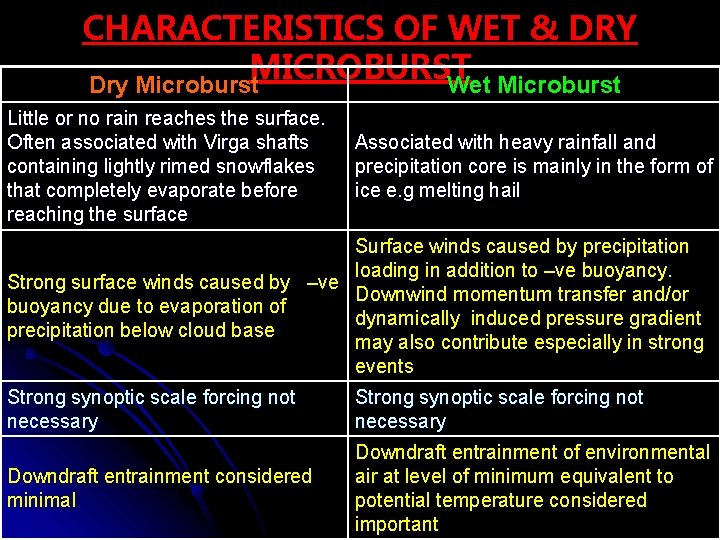
CHARACTERISTICS OF WET & DRY MICROBURST Dry Microburst Wet Microburst Little or no rain reaches the surface. Often associated with Virga shafts containing lightly rimed snowflakes that completely evaporate before reaching the surface Associated with heavy rainfall and precipitation core is mainly in the form of ice e. g melting hail Surface winds caused by precipitation loading in addition to –ve buoyancy. Strong surface winds caused by –ve Downwind momentum transfer and/or buoyancy due to evaporation of dynamically induced pressure gradient precipitation below cloud base may also contribute especially in strong events Strong synoptic scale forcing not necessary Downdraft entrainment considered minimal Downdraft entrainment of environmental air at level of minimum equivalent to potential temperature considered important

CHARACTERISTICS OF WET & DRY MICROBURST Dry Microburst Wet Microburst 5. Dry or nearly dry adiabatic sub cloud lapse rate 5. Relatively moist in the cloud layer 6. Moist at mid level sub Dry at mid level 7. Relatively weak convection/ 7. Relatively strong updraft convection / updraft 8. Relatively high cloud bases 8. Relatively low cloud bases 9. Fn of solar heating, max occurrence mid A/N local time 9. Fn of solar heating, max occurrence mid afternoon local time 10. Exhibit small lowering of surface temperature during the event 10. Exhibit relatively large lowering of surface temperature during the event
MICROBURST l l Wet microbursts can produce intense rain which may exceed rates of 200 mm h-1 over a few minutes. Although wet microbursts can be as hazardous as, or possibly more hazardous than the dry ones But Dry microbursts are of greater concern as they do not offer significant visual clues to deter pilots from entering their area. The absence of precipitation also makes dry microbursts much more difficult to detect using radars.

GEOGRAPHICAL VARIABILITY l l l Because of the projects and studies mentioned above, a fairly good knowledge base has been generated regarding microbursts within the US landmass. A good review of the characteristics of microbursts in the US has been made by Wolfson (1988). It has been found that the proportion of different types of microbursts has a geographical variability. l l JAWS programme showed that 83% of the microbursts around the city of Denver in the state of Colorado were dry NIMROD programme indicated only 36% of the microbursts in the northern parts of the state of Illinois to be dry (Fujita and Mc. Carthy, 1990).

RESULTS OF STUDIES USING JAWS Ø DATA
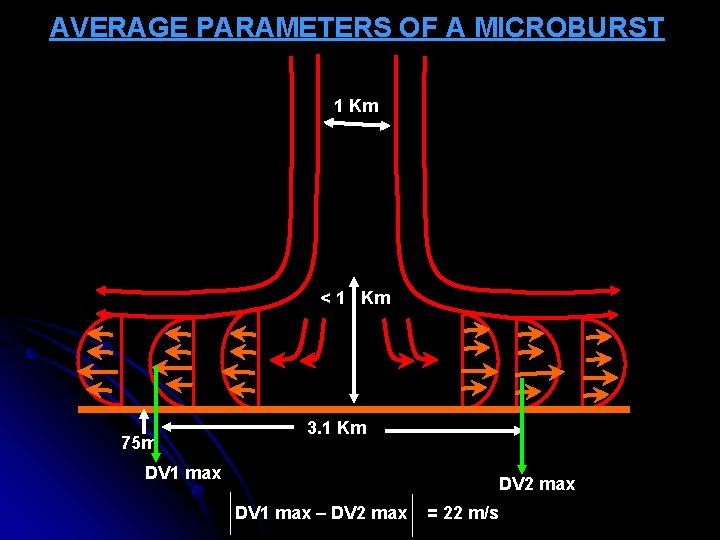
AVERAGE PARAMETERS OF A MICROBURST 1 Km < 1 Km 75 m 3. 1 Km DV 1 max DV 2 max DV 1 max – DV 2 max = 22 m/s
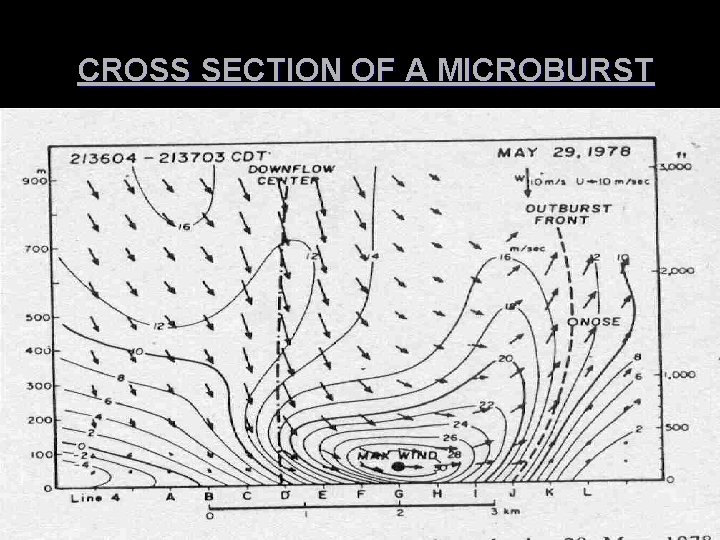
CROSS SECTION OF A MICROBURST

RESULTS OF STUDIES USING JAWS DATA Ø
RESULTS OF STUDIES USING JAWS DATA l Outflow morphology of the microbursts was independent of their associated precipitation rates. l Thus the rainfall intensity, as observed by rain-gauges or many current and older generations of weather radars, cannot offer any significant clue to the occurrence of microbursts. l Indeed, the study noted that some of the strongest microbursts (maximum differential velocity >25 ms-1) occurred with very low radar reflectivities (<0 d. BZ 1). Similar lack of correlation has also been reported by Wilson et al. (1984).
l l l RESULTS OF THE STUDY IN AUSTRALIA Two important parameters of microbursts observed in northern Australia (Potts, 1991) are presented in Fig. The peak velocity differential majority of a vast majority of the 76 microbursts detected over 15 days lay between 10 and 20 m/s, with the maximum reaching 27 m/s and the median value being 17 m/s. This median is less than the corresponding value of 22 m/s from JAWS The difference due to change in the range resolution of the observing radars
l RESULTS OF THE STUDY IN The lifetime of the phenomenon (the interval over which AUSTRALIA the radial divergence ≥ 2. 5 × 10 -3 s-1) was found to vary from 5 to 55 min (mean value 15 min), with the shorter lifetimes being more probable. l The results show that even in the tropical regions the microbursts have major characteristics similar to those studied in the USA under the JAWS programme. l Other important observations during the study were that all the microburst events were associated with thunderstorms, coincided with reflectivity maxima (which correspond to the zones of maximum rain, which were of moderate to high intensity, and occurred during the afternoon or evening, peaking between 1500 and 1700 h.
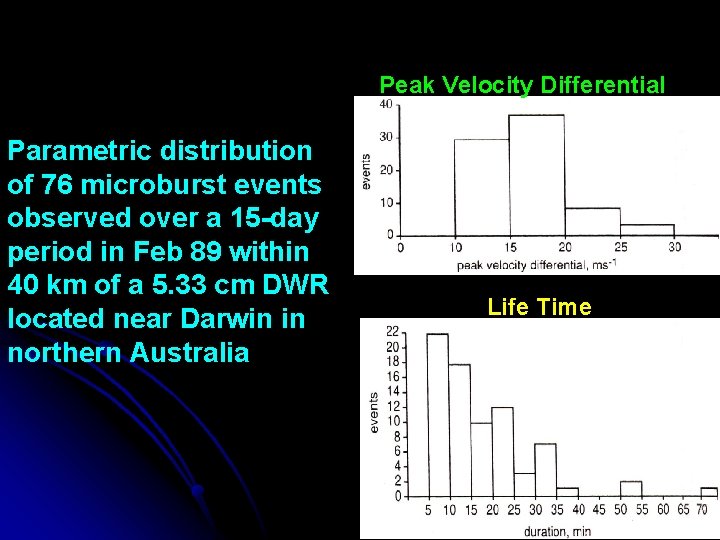
Peak Velocity Differential Parametric distribution of 76 microburst events observed over a 15 -day period in Feb 89 within 40 km of a 5. 33 cm DWR located near Darwin in northern Australia Life Time
ASYMMETRY l l A characteristic of considerable importance in the description and detection of a microburst is its asymmetry. Microbursts very often display an asymmetry, with radial outflows being stronger and more spread out in certain directions from the microburst centre (the point at which the axis of the downdraft shaft encounters the ground) than in others. The strength asymmetry of a microburst is the ratio of its maximum to its minimum strength (‘strength’ is the highest differential velocity) over all aspect angles or viewing directions, The shape asymmetry is the ratio of the longest to the shortest spatial extent of the outflow field over all such directions (Hallowell, 1990).
ASYMMETRY l l l Hjelmfelt (1988) obtained an average strength asymmetry of ~2, and shape asymmetry values of the same order. The study by Wilson et al. (1984) deduced strength asymmetry ratios up to ~6, with an average of~3 Hallowell (1993) analysed 859 cases of microburst observations and obtained generally lower values of asymmetry (range 1. 0 to 3. 0, median value 1. 34) He also found that the difference in microburst asymmetry between widely separated geographical areas (within the US) such as Orlando, FL, and Denver, CO, is minimal. The extent of asymmetry has a strong bearing on the automatic detection of microbursts and their hazard estimation based on data from single radar installations, which is the normal mode of data generation and processing.
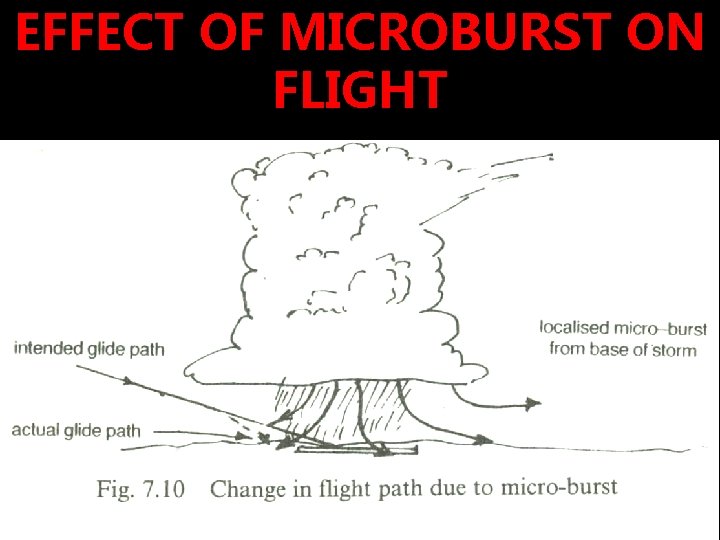
EFFECT OF MICROBURST ON FLIGHT
- Slides: 23