
Microbiology Pathology exam Year 5 MBBS Dr Joshua

Microbiology Pathology exam – Year 5 MBBS Dr Joshua Tognarelli
Microbiology – exam tips ● ● ● Clinical questions Most commonly related to most appropriate diagnosis, organism involved and treatment questions Learning the “buzzwords” is key for the pathology exam
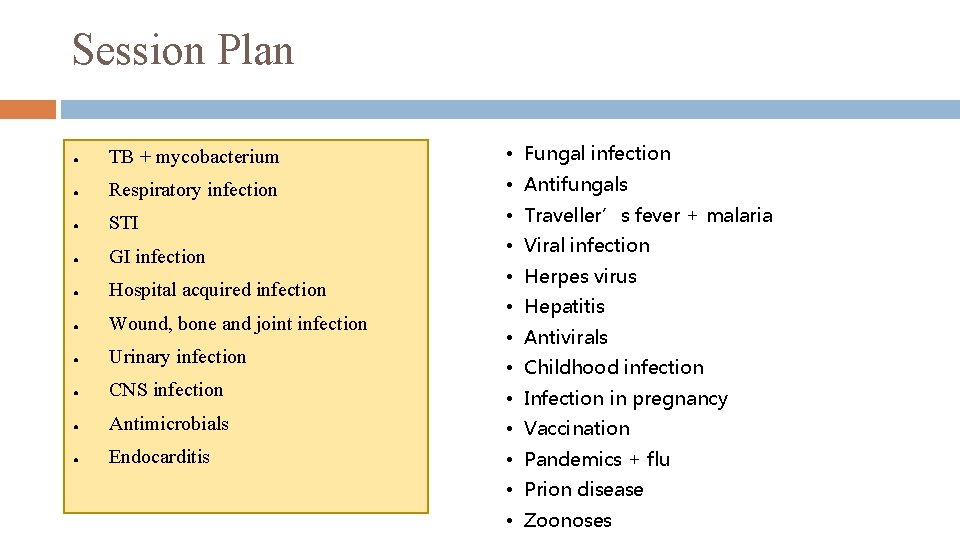
Session Plan ● TB + mycobacterium • Fungal infection ● Respiratory infection • Antifungals ● STI • Traveller’s fever + malaria ● GI infection ● Hospital acquired infection ● Wound, bone and joint infection ● Urinary infection ● CNS infection ● Antimicrobials • Vaccination ● Endocarditis • Pandemics + flu • Viral infection • Herpes virus • Hepatitis • Antivirals • Childhood infection • Infection in pregnancy • Prion disease • Zoonoses
Session Plan ● Exam-style questions with worked examples ● Interactivity ● The most relevant, frequently examined information
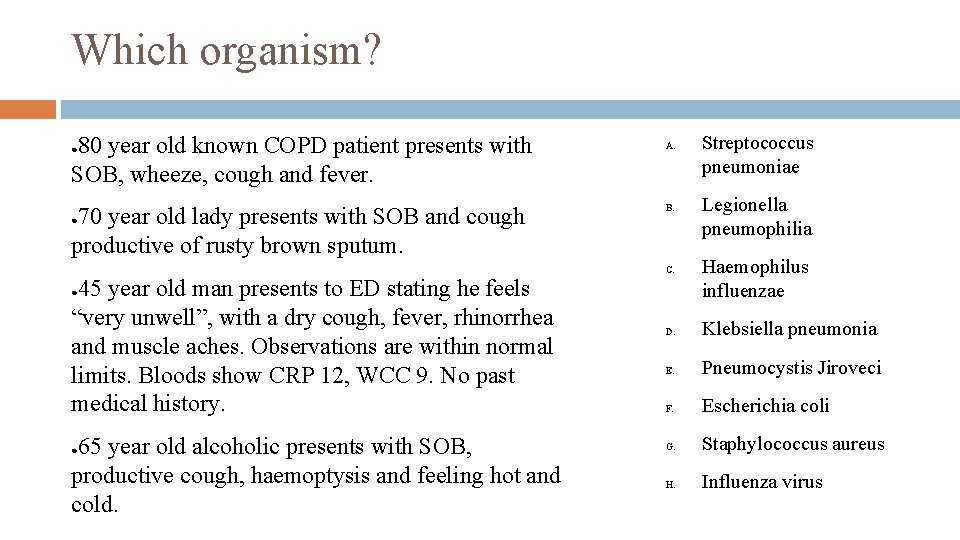
Which organism? 80 year old known COPD patient presents with SOB, wheeze, cough and fever. ● A. 70 year old lady presents with SOB and cough productive of rusty brown sputum. B. ● 45 year old man presents to ED stating he feels “very unwell”, with a dry cough, fever, rhinorrhea and muscle aches. Observations are within normal limits. Bloods show CRP 12, WCC 9. No past medical history. C. ● 65 year old alcoholic presents with SOB, productive cough, haemoptysis and feeling hot and cold. ● Streptococcus pneumoniae Legionella pneumophilia Haemophilus influenzae D. Klebsiella pneumonia E. Pneumocystis Jiroveci F. Escherichia coli G. Staphylococcus aureus H. Influenza virus
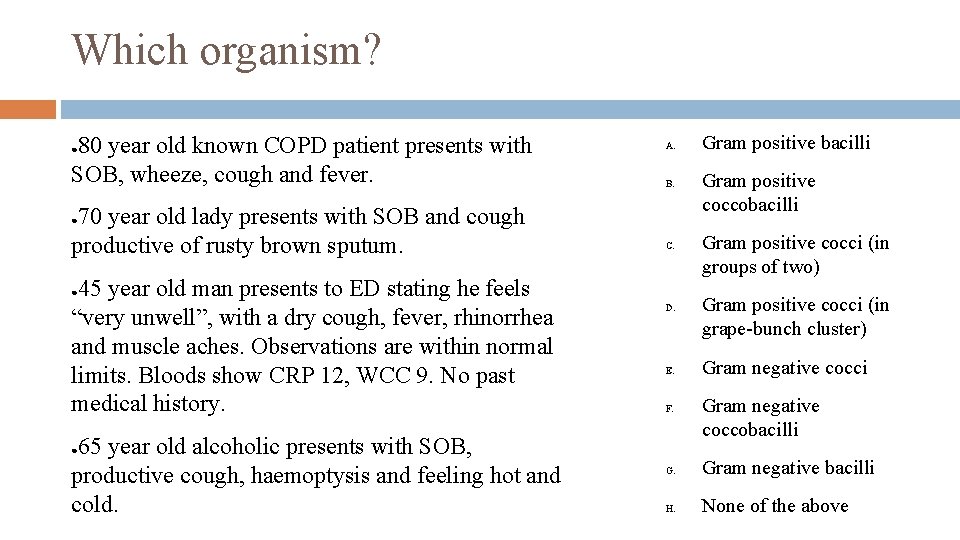
Which organism? 80 year old known COPD patient presents with SOB, wheeze, cough and fever. ● 70 year old lady presents with SOB and cough productive of rusty brown sputum. A. B. ● 45 year old man presents to ED stating he feels “very unwell”, with a dry cough, fever, rhinorrhea and muscle aches. Observations are within normal limits. Bloods show CRP 12, WCC 9. No past medical history. C. ● 65 year old alcoholic presents with SOB, productive cough, haemoptysis and feeling hot and cold. D. E. F. ● Gram positive bacilli Gram positive coccobacilli Gram positive cocci (in groups of two) Gram positive cocci (in grape-bunch cluster) Gram negative cocci Gram negative coccobacilli G. Gram negative bacilli H. None of the above
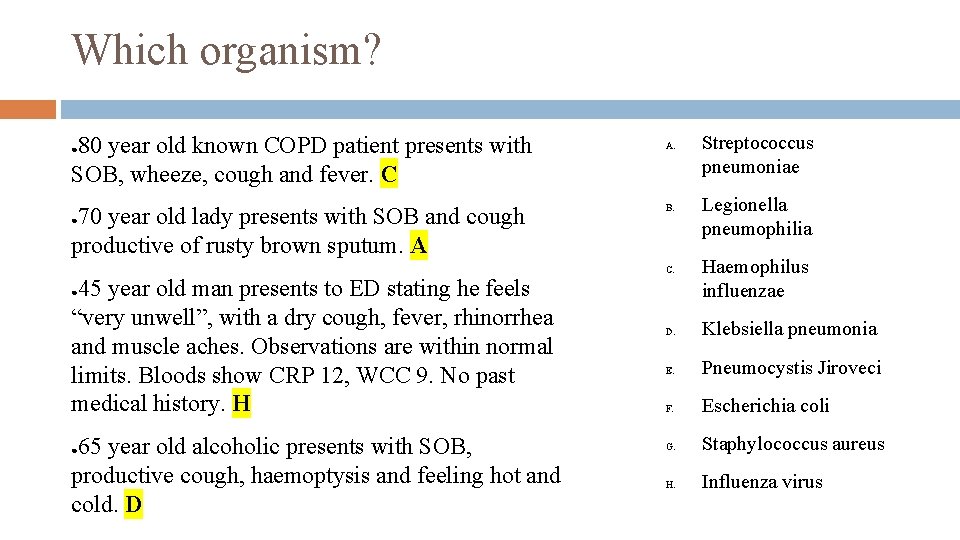
Which organism? 80 year old known COPD patient presents with SOB, wheeze, cough and fever. C ● A. 70 year old lady presents with SOB and cough productive of rusty brown sputum. A B. ● 45 year old man presents to ED stating he feels “very unwell”, with a dry cough, fever, rhinorrhea and muscle aches. Observations are within normal limits. Bloods show CRP 12, WCC 9. No past medical history. H C. ● 65 year old alcoholic presents with SOB, productive cough, haemoptysis and feeling hot and cold. D ● Streptococcus pneumoniae Legionella pneumophilia Haemophilus influenzae D. Klebsiella pneumonia E. Pneumocystis Jiroveci F. Escherichia coli G. Staphylococcus aureus H. Influenza virus
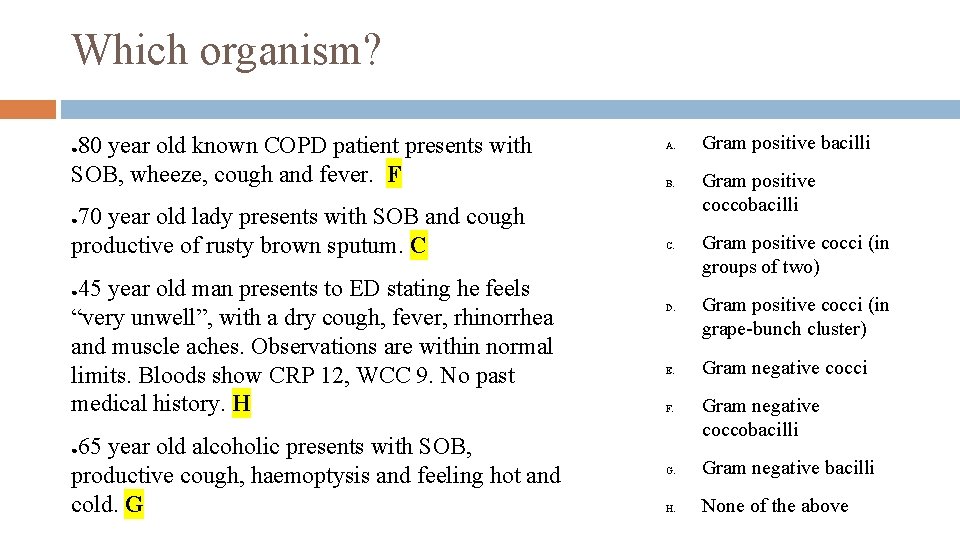
Which organism? 80 year old known COPD patient presents with SOB, wheeze, cough and fever. F ● 70 year old lady presents with SOB and cough productive of rusty brown sputum. C A. B. ● 45 year old man presents to ED stating he feels “very unwell”, with a dry cough, fever, rhinorrhea and muscle aches. Observations are within normal limits. Bloods show CRP 12, WCC 9. No past medical history. H C. ● 65 year old alcoholic presents with SOB, productive cough, haemoptysis and feeling hot and cold. G D. E. F. ● Gram positive bacilli Gram positive coccobacilli Gram positive cocci (in groups of two) Gram positive cocci (in grape-bunch cluster) Gram negative cocci Gram negative coccobacilli G. Gram negative bacilli H. None of the above
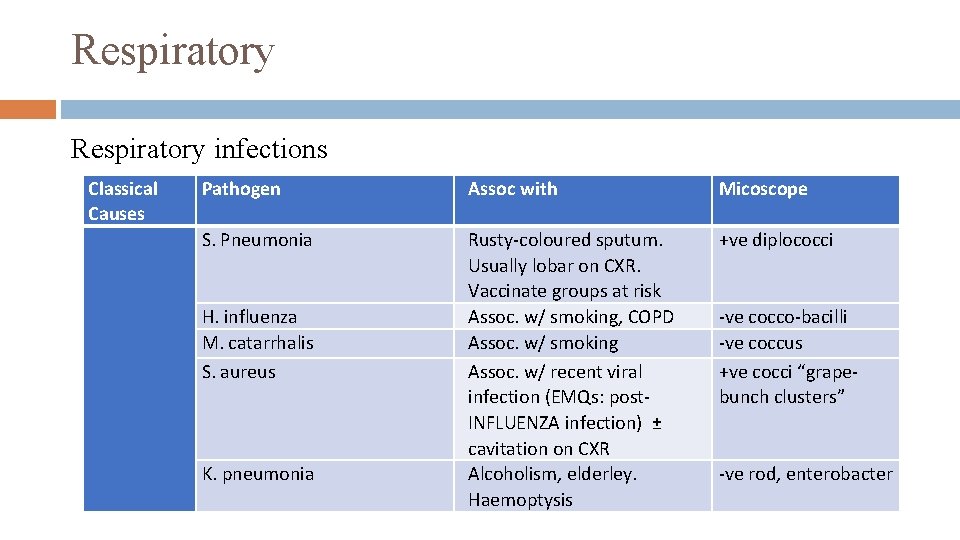
Respiratory infections Classical Causes Pathogen Assoc with Micoscope S. Pneumonia Rusty-coloured sputum. Usually lobar on CXR. Vaccinate groups at risk Assoc. w/ smoking, COPD Assoc. w/ smoking Assoc. w/ recent viral infection (EMQs: post. INFLUENZA infection) ± cavitation on CXR Alcoholism, elderley. Haemoptysis +ve diplococci H. influenza M. catarrhalis S. aureus K. pneumonia -ve cocco-bacilli -ve coccus +ve cocci “grapebunch clusters” -ve rod, enterobacter
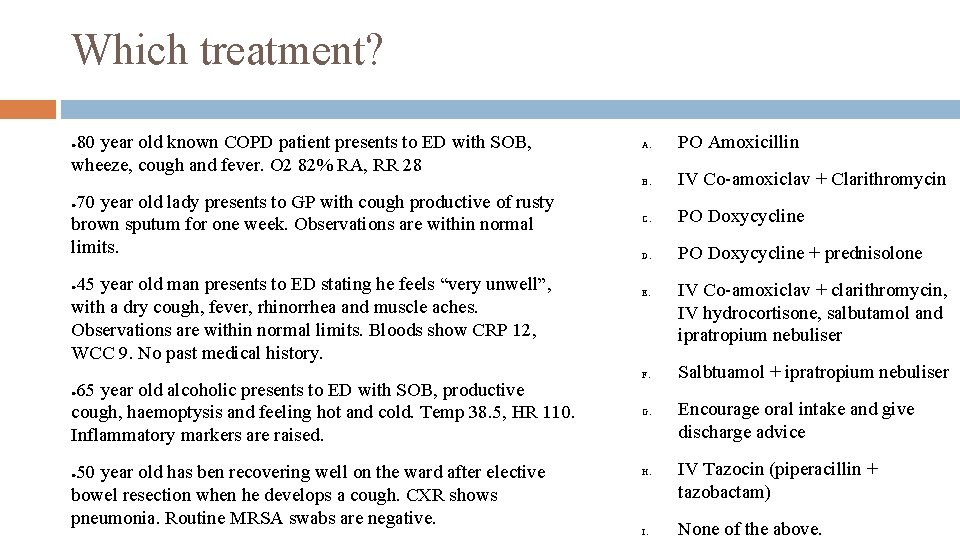
Which treatment? 80 year old known COPD patient presents to ED with SOB, wheeze, cough and fever. O 2 82% RA, RR 28 ● 70 year old lady presents to GP with cough productive of rusty brown sputum for one week. Observations are within normal limits. A. PO Amoxicillin B. IV Co-amoxiclav + Clarithromycin C. PO Doxycycline D. PO Doxycycline + prednisolone ● 45 year old man presents to ED stating he feels “very unwell”, with a dry cough, fever, rhinorrhea and muscle aches. Observations are within normal limits. Bloods show CRP 12, WCC 9. No past medical history. ● 65 year old alcoholic presents to ED with SOB, productive cough, haemoptysis and feeling hot and cold. Temp 38. 5, HR 110. Inflammatory markers are raised. E. F. IV Co-amoxiclav + clarithromycin, IV hydrocortisone, salbutamol and ipratropium nebuliser Salbtuamol + ipratropium nebuliser ● 50 year old has ben recovering well on the ward after elective bowel resection when he develops a cough. CXR shows pneumonia. Routine MRSA swabs are negative. ● G. H. I. Encourage oral intake and give discharge advice IV Tazocin (piperacillin + tazobactam) None of the above.
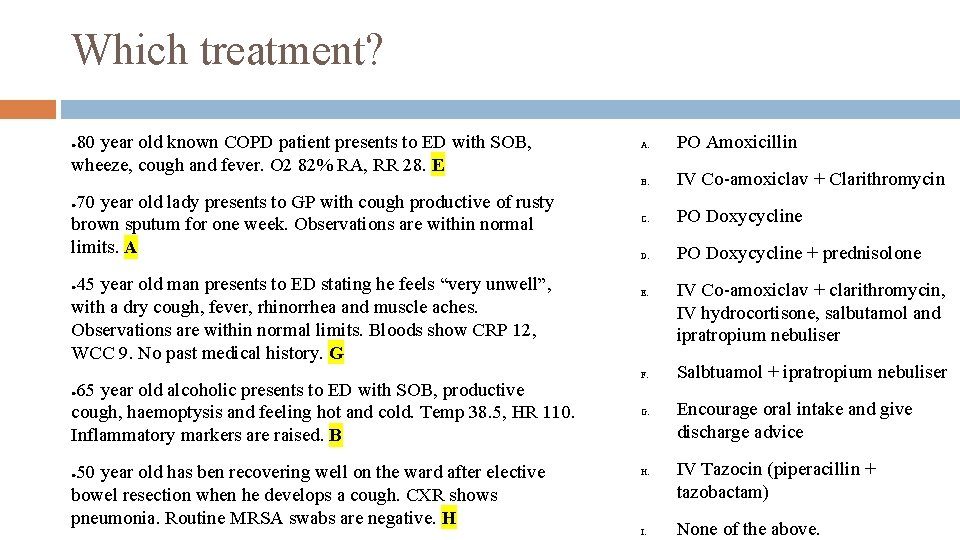
Which treatment? 80 year old known COPD patient presents to ED with SOB, wheeze, cough and fever. O 2 82% RA, RR 28. E ● 70 year old lady presents to GP with cough productive of rusty brown sputum for one week. Observations are within normal limits. A A. PO Amoxicillin B. IV Co-amoxiclav + Clarithromycin C. PO Doxycycline D. PO Doxycycline + prednisolone ● 45 year old man presents to ED stating he feels “very unwell”, with a dry cough, fever, rhinorrhea and muscle aches. Observations are within normal limits. Bloods show CRP 12, WCC 9. No past medical history. G ● 65 year old alcoholic presents to ED with SOB, productive cough, haemoptysis and feeling hot and cold. Temp 38. 5, HR 110. Inflammatory markers are raised. B E. F. IV Co-amoxiclav + clarithromycin, IV hydrocortisone, salbutamol and ipratropium nebuliser Salbtuamol + ipratropium nebuliser ● 50 year old has ben recovering well on the ward after elective bowel resection when he develops a cough. CXR shows pneumonia. Routine MRSA swabs are negative. H ● G. H. I. Encourage oral intake and give discharge advice IV Tazocin (piperacillin + tazobactam) None of the above.
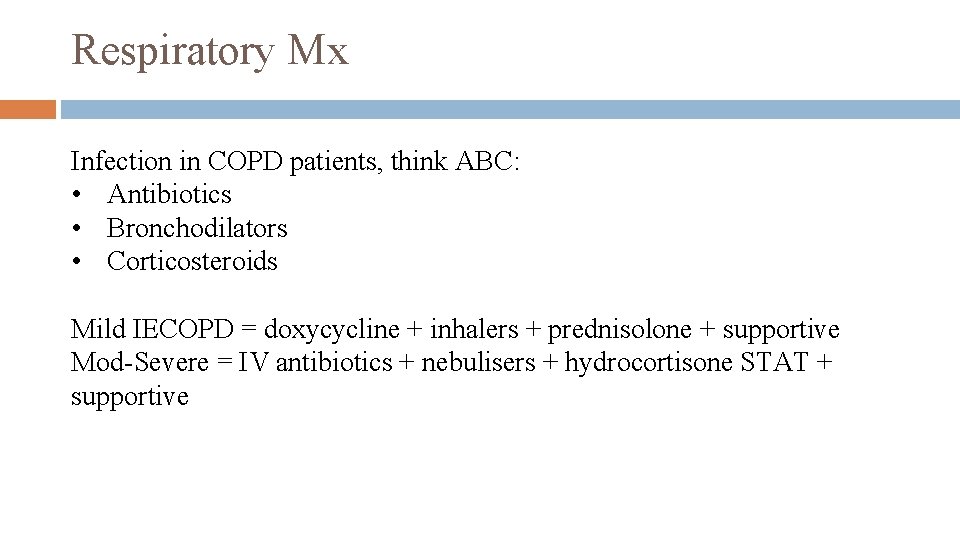
Respiratory Mx Infection in COPD patients, think ABC: • Antibiotics • Bronchodilators • Corticosteroids Mild IECOPD = doxycycline + inhalers + prednisolone + supportive Mod-Severe = IV antibiotics + nebulisers + hydrocortisone STAT + supportive
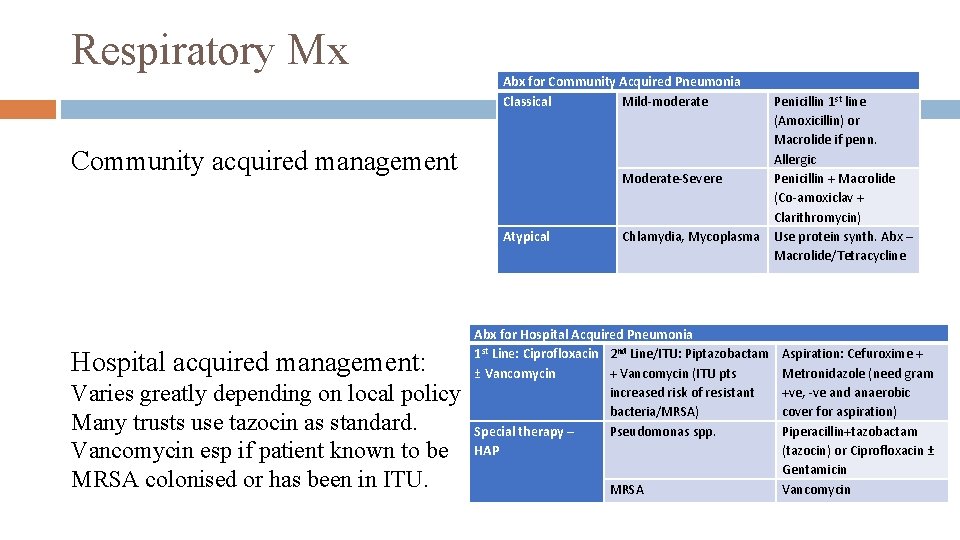
Respiratory Mx Abx for Community Acquired Pneumonia Classical Mild-moderate Community acquired management Atypical Hospital acquired management: Varies greatly depending on local policy Many trusts use tazocin as standard. Vancomycin esp if patient known to be MRSA colonised or has been in ITU. Penicillin 1 st line (Amoxicillin) or Macrolide if penn. Allergic Moderate-Severe Penicillin + Macrolide (Co-amoxiclav + Clarithromycin) Chlamydia, Mycoplasma Use protein synth. Abx – Macrolide/Tetracycline Abx for Hospital Acquired Pneumonia 1 st Line: Ciprofloxacin 2 nd Line/ITU: Piptazobactam ± Vancomycin + Vancomycin (ITU pts increased risk of resistant bacteria/MRSA) Special therapy – Pseudomonas spp. HAP MRSA Aspiration: Cefuroxime + Metronidazole (need gram +ve, -ve and anaerobic cover for aspiration) Piperacillin+tazobactam (tazocin) or Ciprofloxacin ± Gentamicin Vancomycin
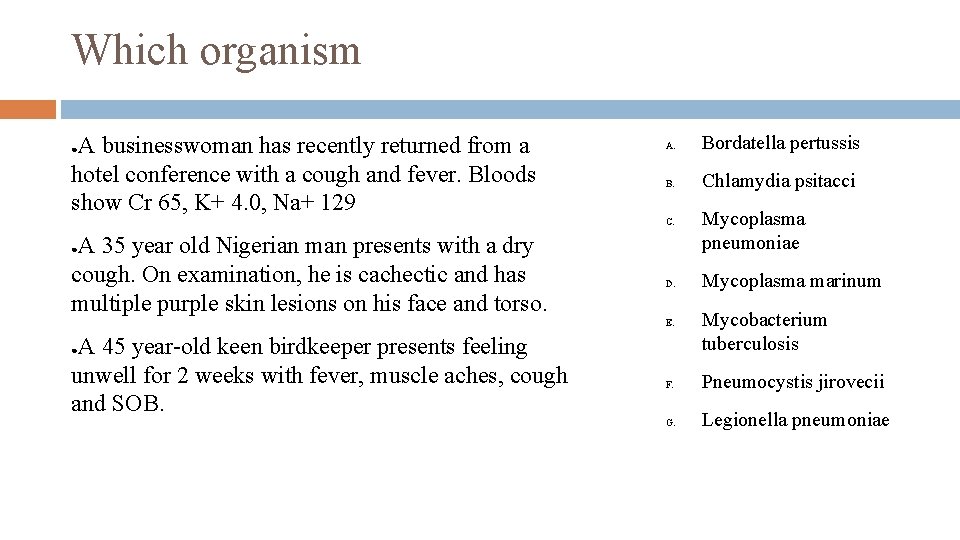
Which organism A businesswoman has recently returned from a hotel conference with a cough and fever. Bloods show Cr 65, K+ 4. 0, Na+ 129 ● A. Bordatella pertussis B. Chlamydia psitacci C. A 35 year old Nigerian man presents with a dry cough. On examination, he is cachectic and has multiple purple skin lesions on his face and torso. ● D. E. A 45 year-old keen birdkeeper presents feeling unwell for 2 weeks with fever, muscle aches, cough and SOB. ● Mycoplasma pneumoniae Mycoplasma marinum Mycobacterium tuberculosis F. Pneumocystis jirovecii G. Legionella pneumoniae
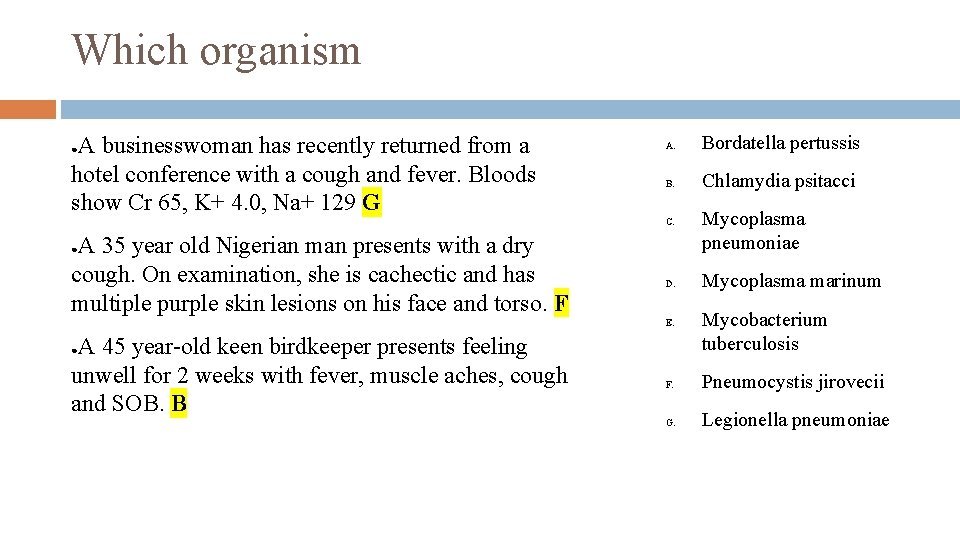
Which organism A businesswoman has recently returned from a hotel conference with a cough and fever. Bloods show Cr 65, K+ 4. 0, Na+ 129 G ● A. Bordatella pertussis B. Chlamydia psitacci C. A 35 year old Nigerian man presents with a dry cough. On examination, she is cachectic and has multiple purple skin lesions on his face and torso. F ● D. E. A 45 year-old keen birdkeeper presents feeling unwell for 2 weeks with fever, muscle aches, cough and SOB. B ● Mycoplasma pneumoniae Mycoplasma marinum Mycobacterium tuberculosis F. Pneumocystis jirovecii G. Legionella pneumoniae
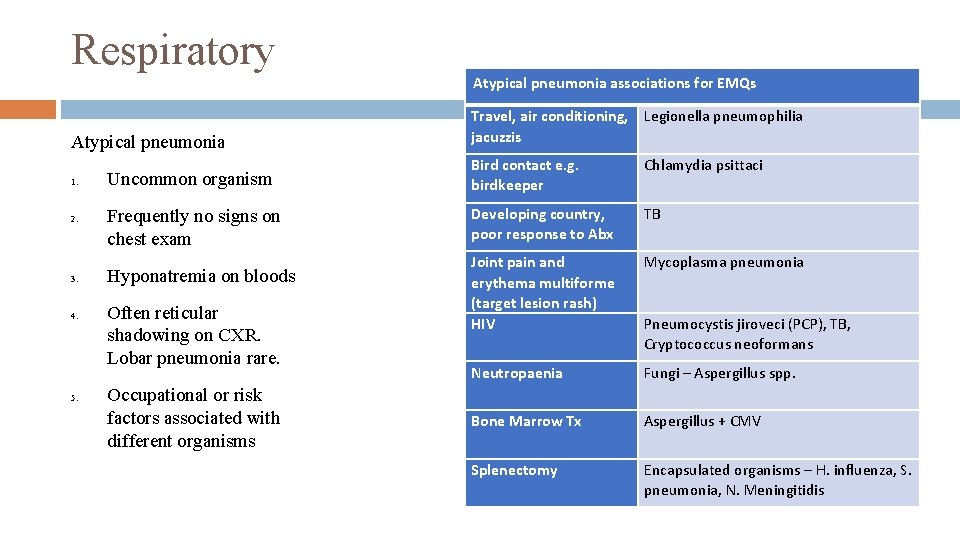
Respiratory Atypical pneumonia 1. 2. 3. 4. 5. Atypical pneumonia associations for EMQs Travel, air conditioning, Legionella pneumophilia jacuzzis Uncommon organism Bird contact e. g. birdkeeper Chlamydia psittaci Frequently no signs on chest exam Developing country, poor response to Abx TB Joint pain and erythema multiforme (target lesion rash) HIV Mycoplasma pneumonia Neutropaenia Fungi – Aspergillus spp. Bone Marrow Tx Aspergillus + CMV Splenectomy Encapsulated organisms – H. influenza, S. pneumonia, N. Meningitidis Hyponatremia on bloods Often reticular shadowing on CXR. Lobar pneumonia rare. Occupational or risk factors associated with different organisms Pneumocystis jiroveci (PCP), TB, Cryptococcus neoformans
Respiratory Key points: 1. 2. 3. Common organism shapes under microscopy Associations with occupations/risk factors and certain pathogens Treatment of CAP/HAP/IECOPD
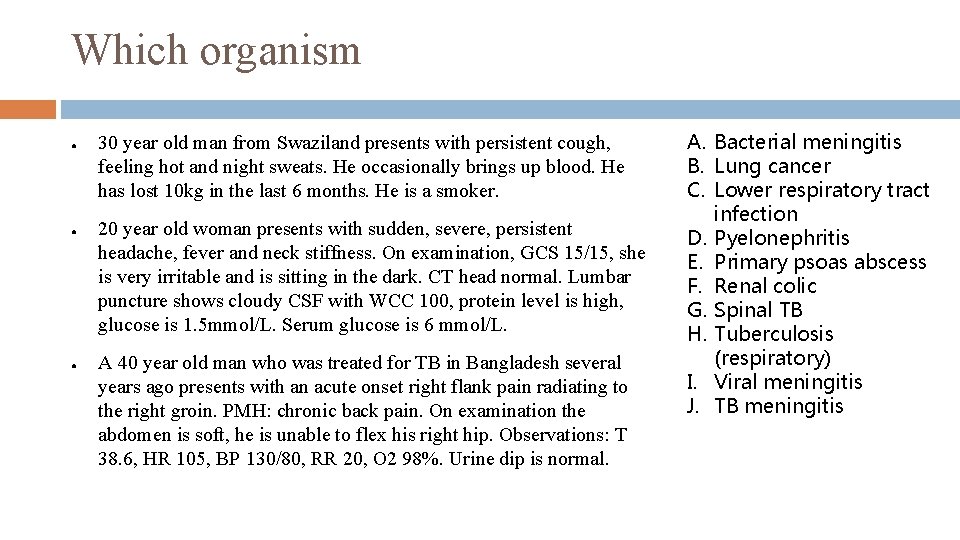
Which organism ● ● ● 30 year old man from Swaziland presents with persistent cough, feeling hot and night sweats. He occasionally brings up blood. He has lost 10 kg in the last 6 months. He is a smoker. 20 year old woman presents with sudden, severe, persistent headache, fever and neck stiffness. On examination, GCS 15/15, she is very irritable and is sitting in the dark. CT head normal. Lumbar puncture shows cloudy CSF with WCC 100, protein level is high, glucose is 1. 5 mmol/L. Serum glucose is 6 mmol/L. A 40 year old man who was treated for TB in Bangladesh several years ago presents with an acute onset right flank pain radiating to the right groin. PMH: chronic back pain. On examination the abdomen is soft, he is unable to flex his right hip. Observations: T 38. 6, HR 105, BP 130/80, RR 20, O 2 98%. Urine dip is normal. A. Bacterial meningitis B. Lung cancer C. Lower respiratory tract infection D. Pyelonephritis E. Primary psoas abscess F. Renal colic G. Spinal TB H. Tuberculosis (respiratory) I. Viral meningitis J. TB meningitis
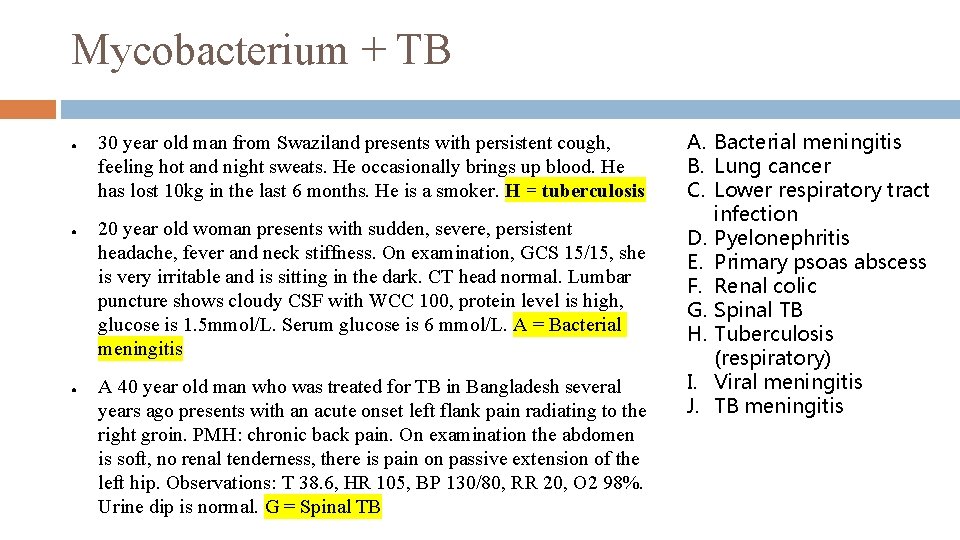
Mycobacterium + TB ● ● ● 30 year old man from Swaziland presents with persistent cough, feeling hot and night sweats. He occasionally brings up blood. He has lost 10 kg in the last 6 months. He is a smoker. H = tuberculosis 20 year old woman presents with sudden, severe, persistent headache, fever and neck stiffness. On examination, GCS 15/15, she is very irritable and is sitting in the dark. CT head normal. Lumbar puncture shows cloudy CSF with WCC 100, protein level is high, glucose is 1. 5 mmol/L. Serum glucose is 6 mmol/L. A = Bacterial meningitis A 40 year old man who was treated for TB in Bangladesh several years ago presents with an acute onset left flank pain radiating to the right groin. PMH: chronic back pain. On examination the abdomen is soft, no renal tenderness, there is pain on passive extension of the left hip. Observations: T 38. 6, HR 105, BP 130/80, RR 20, O 2 98%. Urine dip is normal. G = Spinal TB A. Bacterial meningitis B. Lung cancer C. Lower respiratory tract infection D. Pyelonephritis E. Primary psoas abscess F. Renal colic G. Spinal TB H. Tuberculosis (respiratory) I. Viral meningitis J. TB meningitis
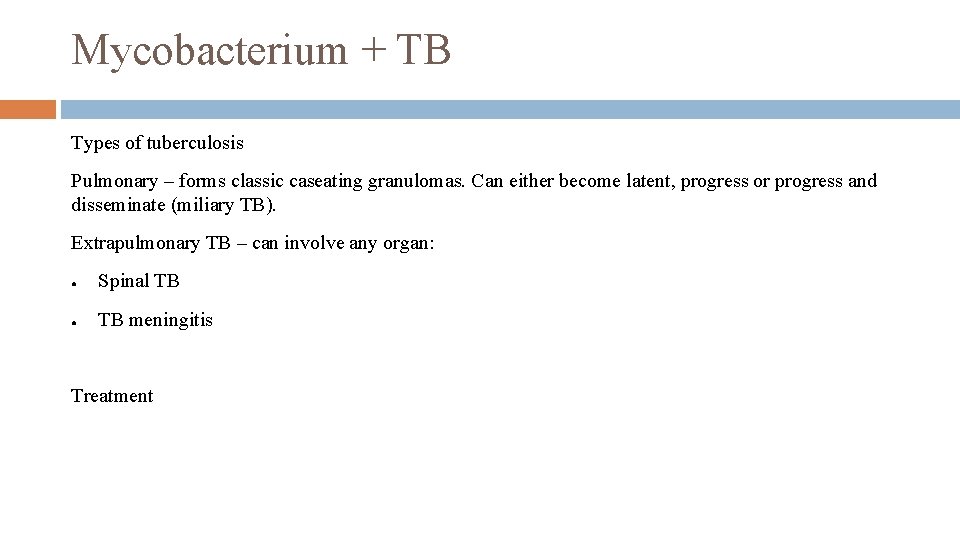
Mycobacterium + TB Types of tuberculosis Pulmonary – forms classic caseating granulomas. Can either become latent, progress or progress and disseminate (miliary TB). Extrapulmonary TB – can involve any organ: ● Spinal TB ● TB meningitis Treatment
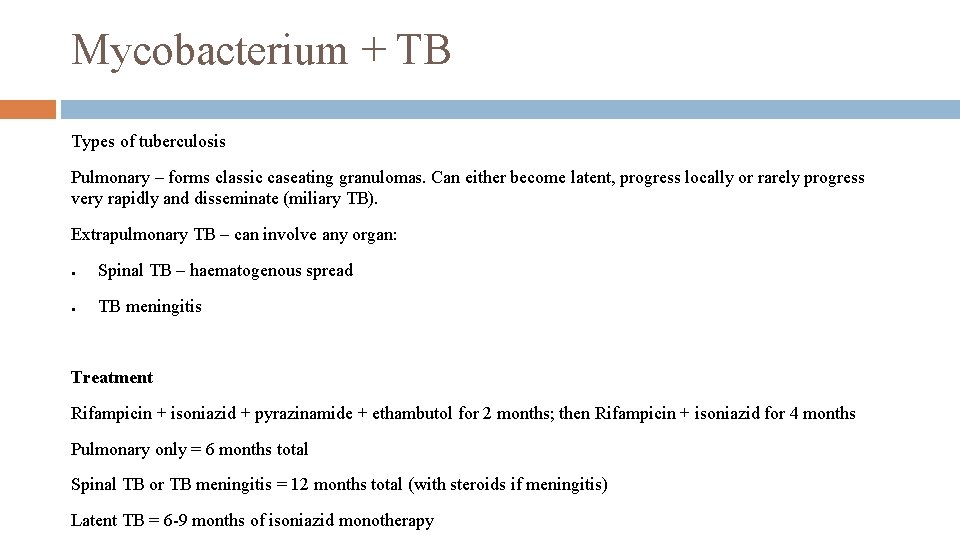
Mycobacterium + TB Types of tuberculosis Pulmonary – forms classic caseating granulomas. Can either become latent, progress locally or rarely progress very rapidly and disseminate (miliary TB). Extrapulmonary TB – can involve any organ: ● Spinal TB – haematogenous spread ● TB meningitis Treatment Rifampicin + isoniazid + pyrazinamide + ethambutol for 2 months; then Rifampicin + isoniazid for 4 months Pulmonary only = 6 months total Spinal TB or TB meningitis = 12 months total (with steroids if meningitis) Latent TB = 6 -9 months of isoniazid monotherapy
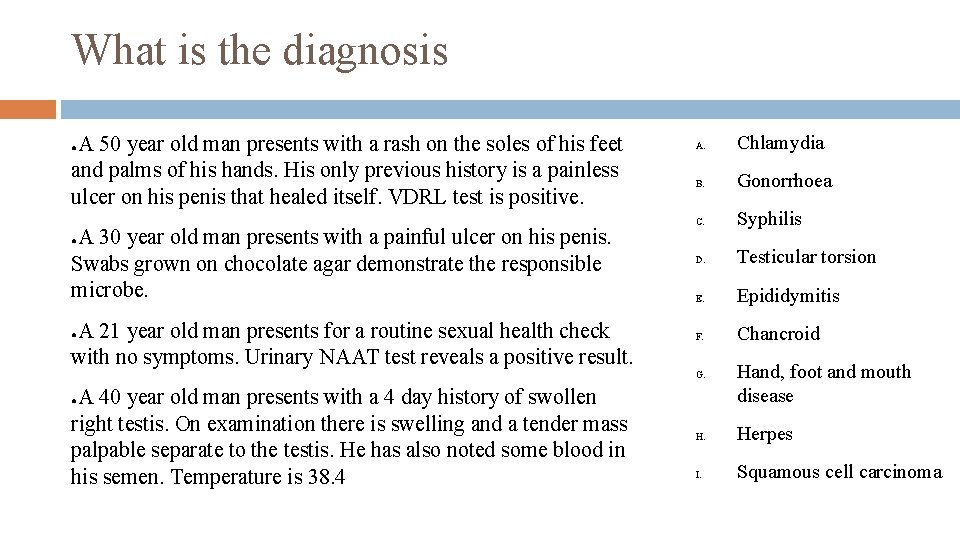
What is the diagnosis A 50 year old man presents with a rash on the soles of his feet and palms of his hands. His only previous history is a painless ulcer on his penis that healed itself. VDRL test is positive. ● A 30 year old man presents with a painful ulcer on his penis. Swabs grown on chocolate agar demonstrate the responsible microbe. A. Chlamydia B. Gonorrhoea C. Syphilis D. Testicular torsion E. Epididymitis F. Chancroid ● A 21 year old man presents for a routine sexual health check with no symptoms. Urinary NAAT test reveals a positive result. ● G. A 40 year old man presents with a 4 day history of swollen right testis. On examination there is swelling and a tender mass palpable separate to the testis. He has also noted some blood in his semen. Temperature is 38. 4 ● Hand, foot and mouth disease H. Herpes I. Squamous cell carcinoma
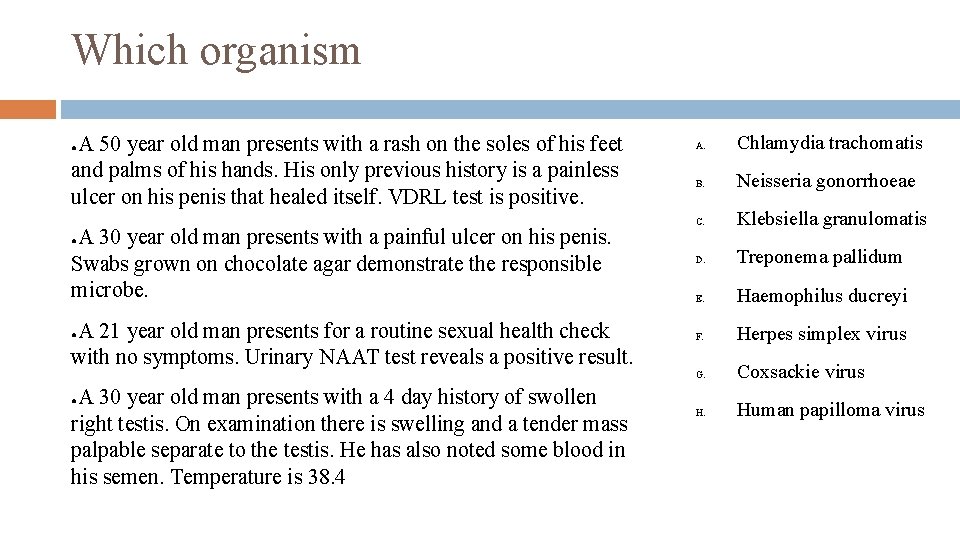
Which organism A 50 year old man presents with a rash on the soles of his feet and palms of his hands. His only previous history is a painless ulcer on his penis that healed itself. VDRL test is positive. ● A 30 year old man presents with a painful ulcer on his penis. Swabs grown on chocolate agar demonstrate the responsible microbe. A. Chlamydia trachomatis B. Neisseria gonorrhoeae C. Klebsiella granulomatis D. Treponema pallidum E. Haemophilus ducreyi F. Herpes simplex virus G. Coxsackie virus H. Human papilloma virus ● A 21 year old man presents for a routine sexual health check with no symptoms. Urinary NAAT test reveals a positive result. ● A 30 year old man presents with a 4 day history of swollen right testis. On examination there is swelling and a tender mass palpable separate to the testis. He has also noted some blood in his semen. Temperature is 38. 4 ●
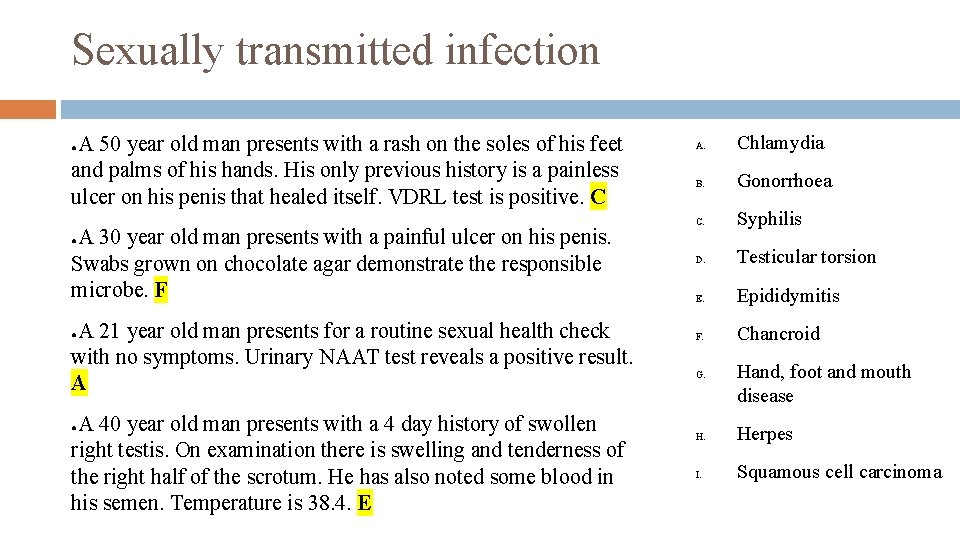
Sexually transmitted infection A 50 year old man presents with a rash on the soles of his feet and palms of his hands. His only previous history is a painless ulcer on his penis that healed itself. VDRL test is positive. C ● A 30 year old man presents with a painful ulcer on his penis. Swabs grown on chocolate agar demonstrate the responsible microbe. F A. Chlamydia B. Gonorrhoea C. Syphilis D. Testicular torsion E. Epididymitis F. Chancroid ● A 21 year old man presents for a routine sexual health check with no symptoms. Urinary NAAT test reveals a positive result. A ● A 40 year old man presents with a 4 day history of swollen right testis. On examination there is swelling and tenderness of the right half of the scrotum. He has also noted some blood in his semen. Temperature is 38. 4. E ● G. Hand, foot and mouth disease H. Herpes I. Squamous cell carcinoma
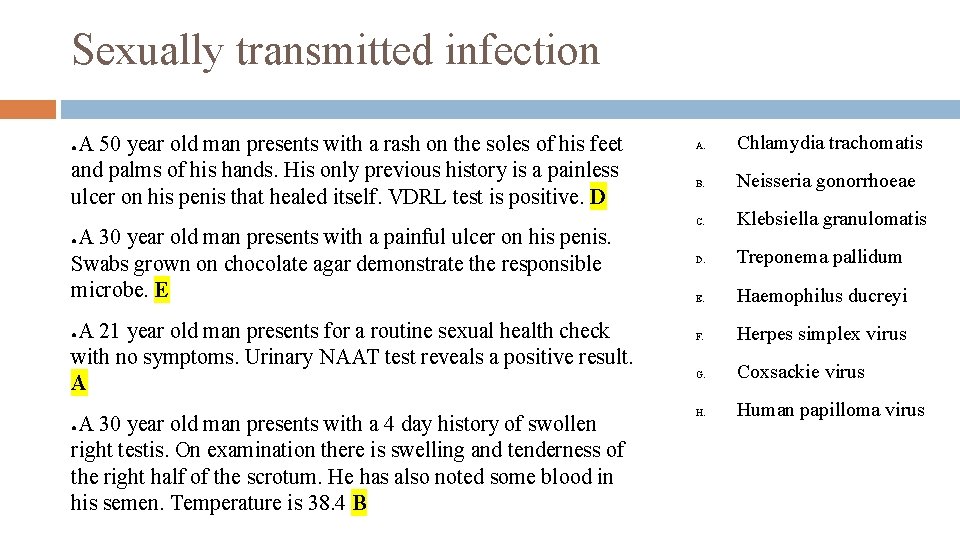
Sexually transmitted infection A 50 year old man presents with a rash on the soles of his feet and palms of his hands. His only previous history is a painless ulcer on his penis that healed itself. VDRL test is positive. D ● A 30 year old man presents with a painful ulcer on his penis. Swabs grown on chocolate agar demonstrate the responsible microbe. E A. Chlamydia trachomatis B. Neisseria gonorrhoeae C. Klebsiella granulomatis D. Treponema pallidum E. Haemophilus ducreyi F. Herpes simplex virus G. Coxsackie virus H. Human papilloma virus ● A 21 year old man presents for a routine sexual health check with no symptoms. Urinary NAAT test reveals a positive result. A ● A 30 year old man presents with a 4 day history of swollen right testis. On examination there is swelling and tenderness of the right half of the scrotum. He has also noted some blood in his semen. Temperature is 38. 4 B ●
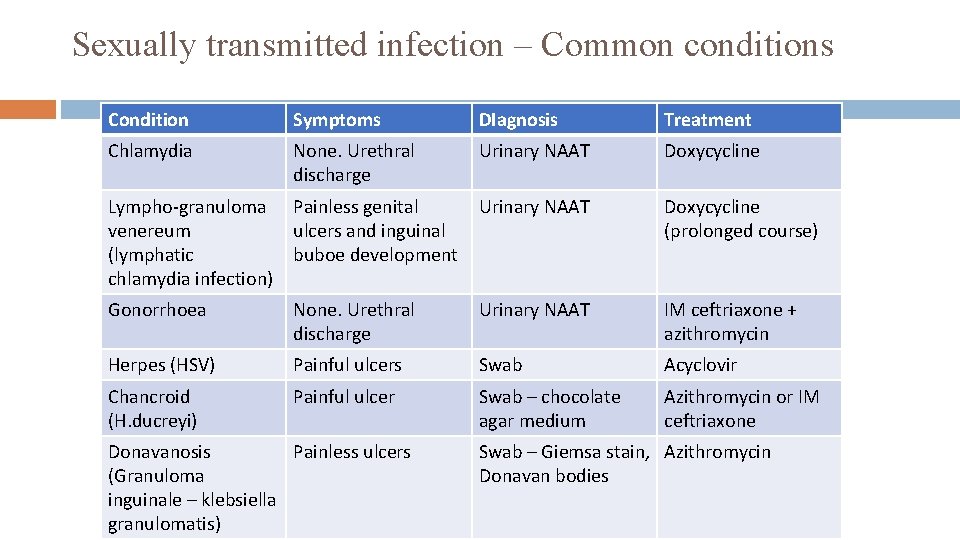
Sexually transmitted infection – Common conditions Condition Symptoms DIagnosis Treatment Chlamydia None. Urethral discharge Urinary NAAT Doxycycline Lympho-granuloma venereum (lymphatic chlamydia infection) Painless genital ulcers and inguinal buboe development Urinary NAAT Doxycycline (prolonged course) Gonorrhoea None. Urethral discharge Urinary NAAT IM ceftriaxone + azithromycin Herpes (HSV) Painful ulcers Swab Acyclovir Chancroid (H. ducreyi) Painful ulcer Swab – chocolate agar medium Azithromycin or IM ceftriaxone Donavanosis Painless ulcers (Granuloma inguinale – klebsiella granulomatis) Swab – Giemsa stain, Azithromycin Donavan bodies
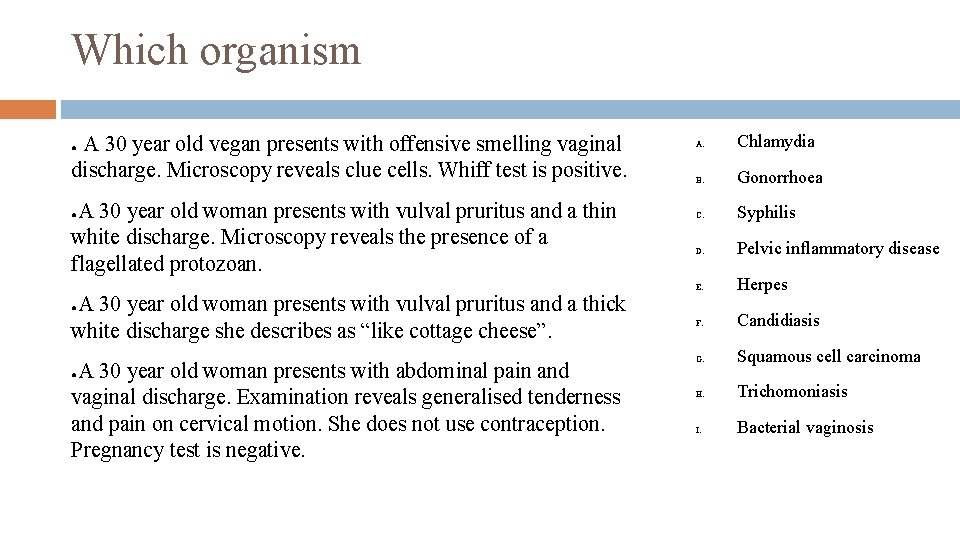
Which organism A 30 year old vegan presents with offensive smelling vaginal discharge. Microscopy reveals clue cells. Whiff test is positive. ● A 30 year old woman presents with vulval pruritus and a thin white discharge. Microscopy reveals the presence of a flagellated protozoan. ● A 30 year old woman presents with vulval pruritus and a thick white discharge she describes as “like cottage cheese”. A. Chlamydia B. Gonorrhoea C. Syphilis D. Pelvic inflammatory disease E. Herpes F. Candidiasis G. Squamous cell carcinoma H. Trichomoniasis I. Bacterial vaginosis ● A 30 year old woman presents with abdominal pain and vaginal discharge. Examination reveals generalised tenderness and pain on cervical motion. She does not use contraception. Pregnancy test is negative. ●
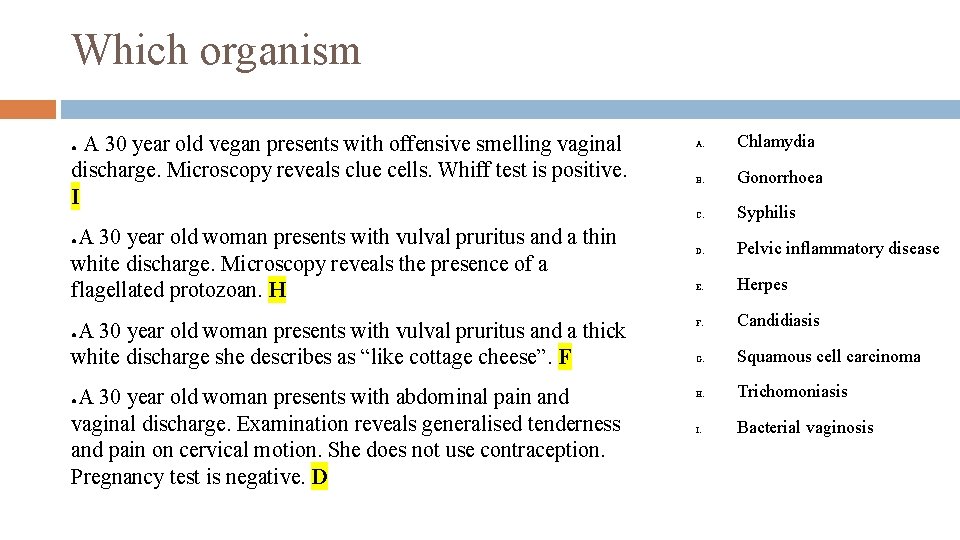
Which organism A 30 year old vegan presents with offensive smelling vaginal discharge. Microscopy reveals clue cells. Whiff test is positive. I ● A 30 year old woman presents with vulval pruritus and a thin white discharge. Microscopy reveals the presence of a flagellated protozoan. H A. Chlamydia B. Gonorrhoea C. Syphilis D. Pelvic inflammatory disease E. Herpes F. Candidiasis G. Squamous cell carcinoma H. Trichomoniasis I. Bacterial vaginosis ● A 30 year old woman presents with vulval pruritus and a thick white discharge she describes as “like cottage cheese”. F ● A 30 year old woman presents with abdominal pain and vaginal discharge. Examination reveals generalised tenderness and pain on cervical motion. She does not use contraception. Pregnancy test is negative. D ●
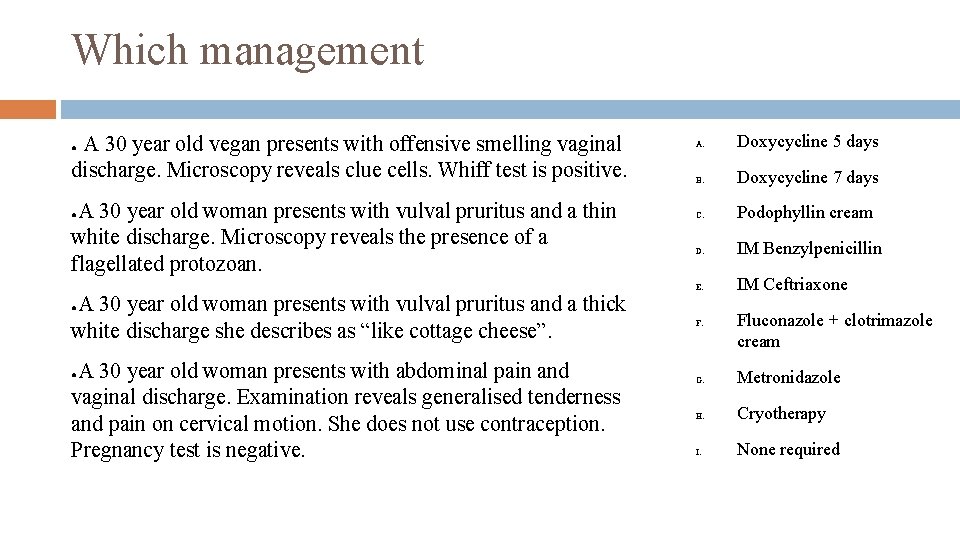
Which management A 30 year old vegan presents with offensive smelling vaginal discharge. Microscopy reveals clue cells. Whiff test is positive. ● A 30 year old woman presents with vulval pruritus and a thin white discharge. Microscopy reveals the presence of a flagellated protozoan. ● A 30 year old woman presents with vulval pruritus and a thick white discharge she describes as “like cottage cheese”. A. Doxycycline 5 days B. Doxycycline 7 days C. Podophyllin cream D. IM Benzylpenicillin E. IM Ceftriaxone ● A 30 year old woman presents with abdominal pain and vaginal discharge. Examination reveals generalised tenderness and pain on cervical motion. She does not use contraception. Pregnancy test is negative. ● F. Fluconazole + clotrimazole cream G. Metronidazole H. Cryotherapy I. None required
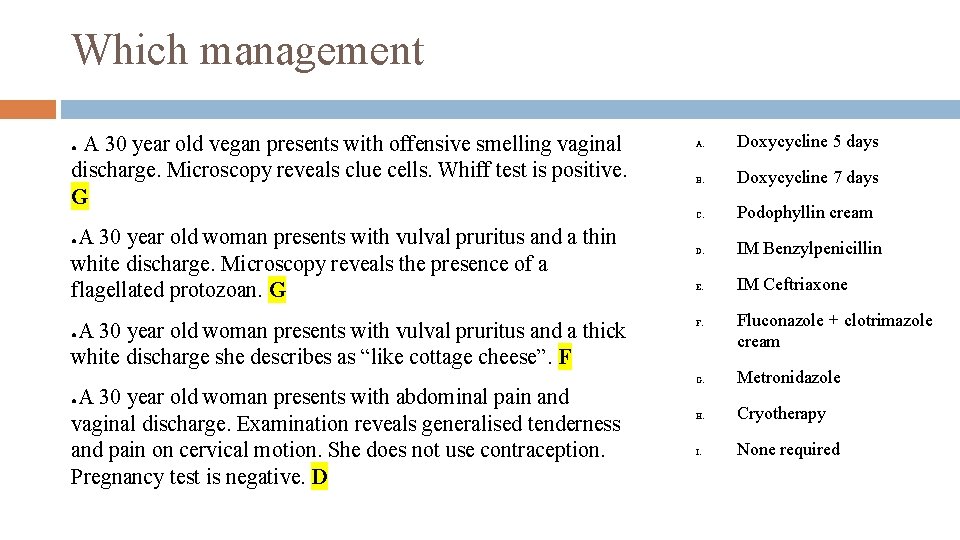
Which management A 30 year old vegan presents with offensive smelling vaginal discharge. Microscopy reveals clue cells. Whiff test is positive. G ● A 30 year old woman presents with vulval pruritus and a thin white discharge. Microscopy reveals the presence of a flagellated protozoan. G A. Doxycycline 5 days B. Doxycycline 7 days C. Podophyllin cream D. IM Benzylpenicillin E. IM Ceftriaxone ● A 30 year old woman presents with vulval pruritus and a thick white discharge she describes as “like cottage cheese”. F F. ● A 30 year old woman presents with abdominal pain and vaginal discharge. Examination reveals generalised tenderness and pain on cervical motion. She does not use contraception. Pregnancy test is negative. D Fluconazole + clotrimazole cream G. Metronidazole H. Cryotherapy I. None required ●
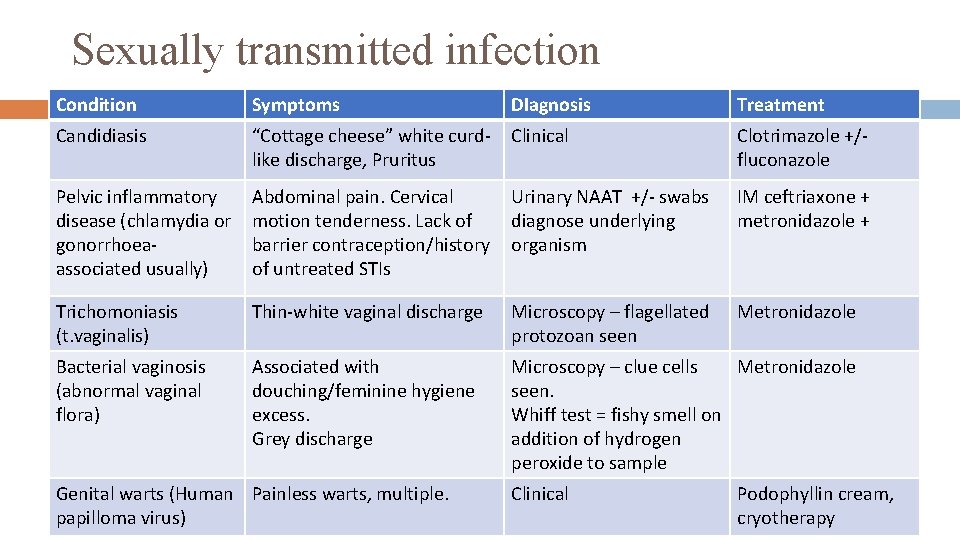
Sexually transmitted infection Condition Symptoms DIagnosis Treatment Candidiasis “Cottage cheese” white curdlike discharge, Pruritus Clinical Clotrimazole +/fluconazole Pelvic inflammatory disease (chlamydia or gonorrhoeaassociated usually) Abdominal pain. Cervical motion tenderness. Lack of barrier contraception/history of untreated STIs Urinary NAAT +/- swabs diagnose underlying organism IM ceftriaxone + metronidazole + Trichomoniasis (t. vaginalis) Thin-white vaginal discharge Microscopy – flagellated protozoan seen Metronidazole Bacterial vaginosis (abnormal vaginal flora) Associated with douching/feminine hygiene excess. Grey discharge Microscopy – clue cells Metronidazole seen. Whiff test = fishy smell on addition of hydrogen peroxide to sample Genital warts (Human Painless warts, multiple. papilloma virus) Clinical Podophyllin cream, cryotherapy
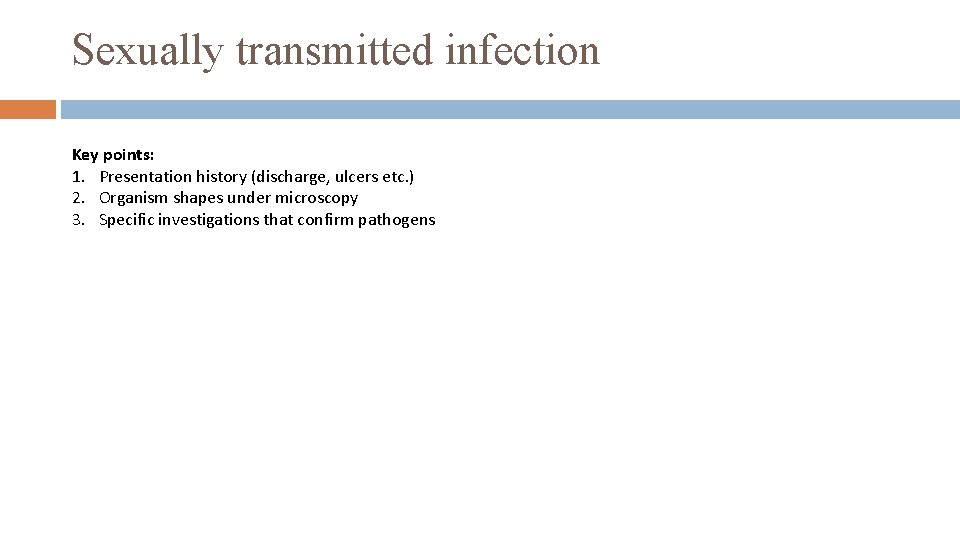
Sexually transmitted infection Key points: 1. Presentation history (discharge, ulcers etc. ) 2. Organism shapes under microscopy 3. Specific investigations that confirm pathogens
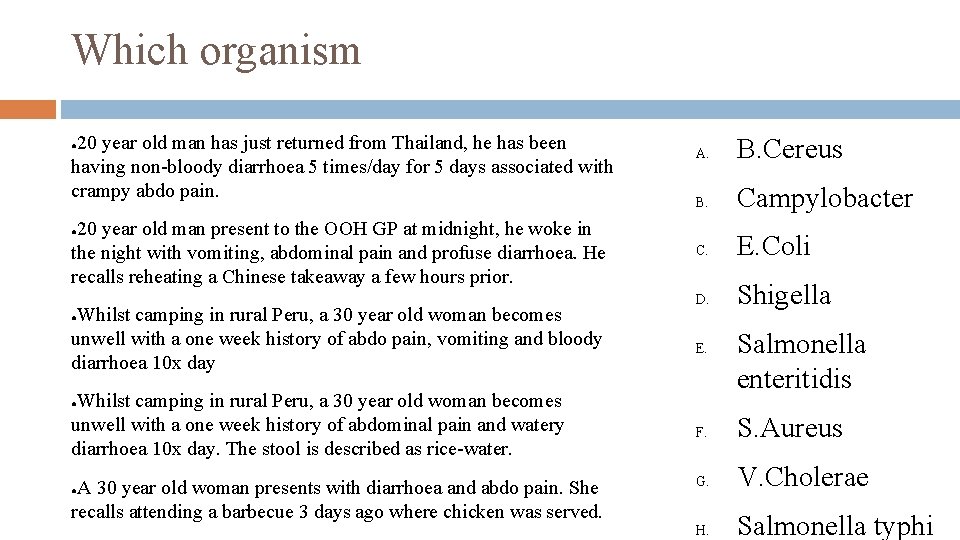
Which organism 20 year old man has just returned from Thailand, he has been having non-bloody diarrhoea 5 times/day for 5 days associated with crampy abdo pain. ● 20 year old man present to the OOH GP at midnight, he woke in the night with vomiting, abdominal pain and profuse diarrhoea. He recalls reheating a Chinese takeaway a few hours prior. A. B. Cereus B. Campylobacter C. E. Coli D. Shigella ● Whilst camping in rural Peru, a 30 year old woman becomes unwell with a one week history of abdo pain, vomiting and bloody diarrhoea 10 x day ● Whilst camping in rural Peru, a 30 year old woman becomes unwell with a one week history of abdominal pain and watery diarrhoea 10 x day. The stool is described as rice-water. E. Salmonella enteritidis ● A 30 year old woman presents with diarrhoea and abdo pain. She recalls attending a barbecue 3 days ago where chicken was served. ● F. S. Aureus G. V. Cholerae H. Salmonella typhi
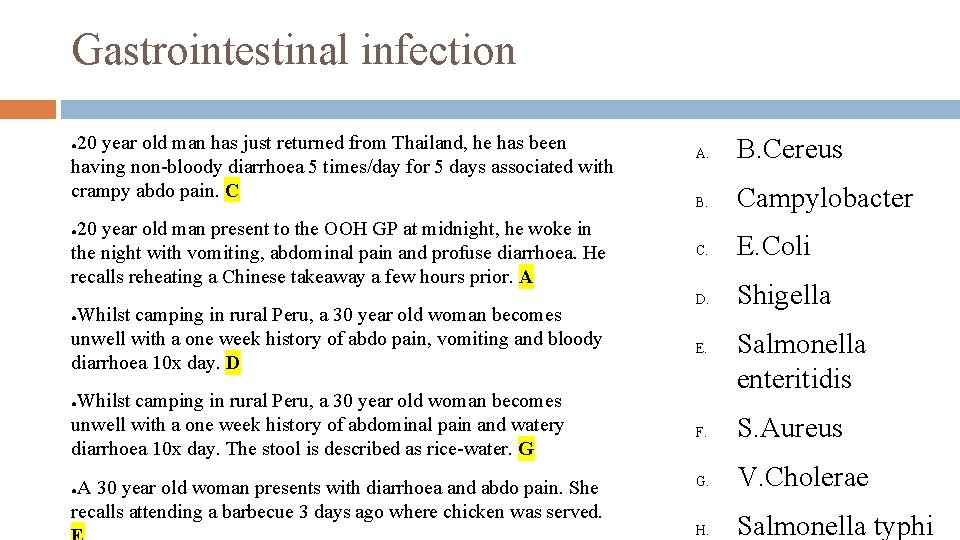
Gastrointestinal infection 20 year old man has just returned from Thailand, he has been having non-bloody diarrhoea 5 times/day for 5 days associated with crampy abdo pain. C ● 20 year old man present to the OOH GP at midnight, he woke in the night with vomiting, abdominal pain and profuse diarrhoea. He recalls reheating a Chinese takeaway a few hours prior. A A. B. Cereus B. Campylobacter C. E. Coli D. Shigella ● Whilst camping in rural Peru, a 30 year old woman becomes unwell with a one week history of abdo pain, vomiting and bloody diarrhoea 10 x day. D ● Whilst camping in rural Peru, a 30 year old woman becomes unwell with a one week history of abdominal pain and watery diarrhoea 10 x day. The stool is described as rice-water. G E. Salmonella enteritidis ● A 30 year old woman presents with diarrhoea and abdo pain. She recalls attending a barbecue 3 days ago where chicken was served. ● F. S. Aureus G. V. Cholerae H. Salmonella typhi
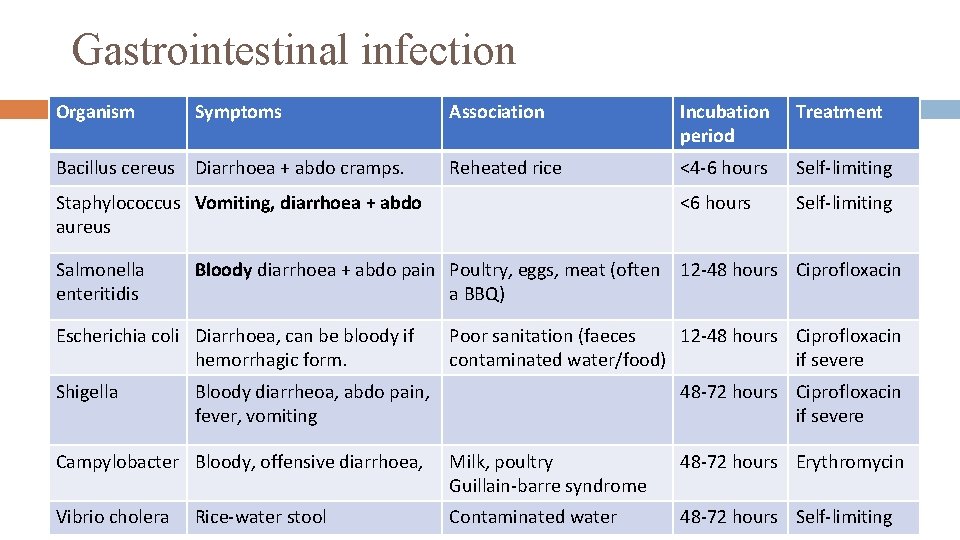
Gastrointestinal infection Organism Symptoms Association Incubation period Treatment Reheated rice <4 -6 hours Self-limiting Incubation. Vomiting, periodsdiarrhoea + abdo Staphylococcus aureus <6 hours Self-limiting Salmonella Bloody diarrhoea + abdo pain Poultry, eggs, meat (often enteritidis a BBQ) Stool culture results 12 -48 hours Ciprofloxacin Key points: Bacillus cereus Diarrhoea + abdo cramps. Bloody diarrhoea Escherichia coli Diarrhoea, can be bloody if hemorrhagic form. Shigella Poor sanitation (faeces 12 -48 hours Ciprofloxacin contaminated water/food) if severe Bloody diarrheoa, abdo pain, fever, vomiting 48 -72 hours Ciprofloxacin if severe Campylobacter Bloody, offensive diarrhoea, Milk, poultry Guillain-barre syndrome 48 -72 hours Erythromycin Vibrio cholera Contaminated water 48 -72 hours Self-limiting Rice-water stool
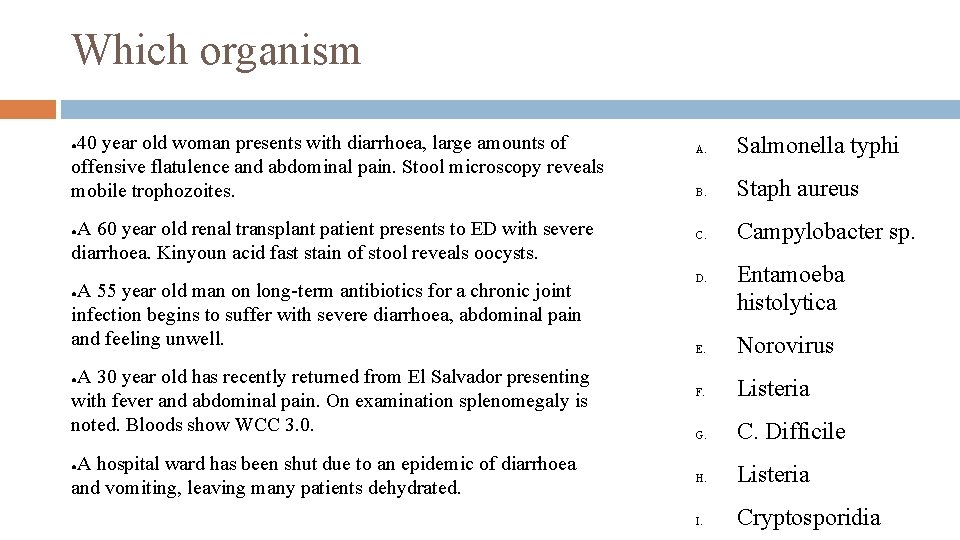
Which organism 40 year old woman presents with diarrhoea, large amounts of offensive flatulence and abdominal pain. Stool microscopy reveals mobile trophozoites. ● A 60 year old renal transplant patient presents to ED with severe diarrhoea. Kinyoun acid fast stain of stool reveals oocysts. ● A 55 year old man on long-term antibiotics for a chronic joint infection begins to suffer with severe diarrhoea, abdominal pain and feeling unwell. A. Salmonella typhi B. Staph aureus C. Campylobacter sp. D. ● A 30 year old has recently returned from El Salvador presenting with fever and abdominal pain. On examination splenomegaly is noted. Bloods show WCC 3. 0. E. Norovirus F. Listeria G. C. Difficile H. Listeria I. Cryptosporidia ● A hospital ward has been shut due to an epidemic of diarrhoea and vomiting, leaving many patients dehydrated. Entamoeba histolytica ●
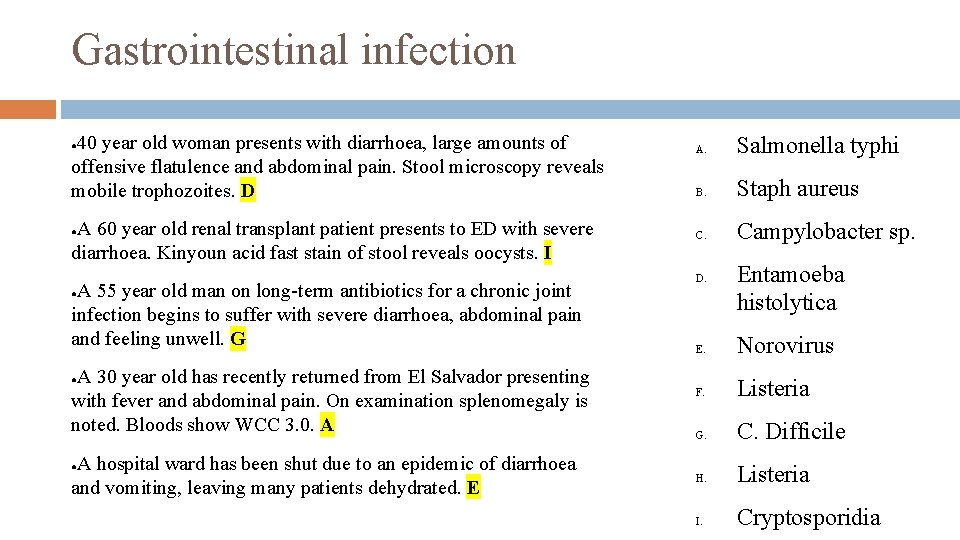
Gastrointestinal infection 40 year old woman presents with diarrhoea, large amounts of offensive flatulence and abdominal pain. Stool microscopy reveals mobile trophozoites. D ● A 60 year old renal transplant patient presents to ED with severe diarrhoea. Kinyoun acid fast stain of stool reveals oocysts. I ● A 55 year old man on long-term antibiotics for a chronic joint infection begins to suffer with severe diarrhoea, abdominal pain and feeling unwell. G A. Salmonella typhi B. Staph aureus C. Campylobacter sp. D. ● A 30 year old has recently returned from El Salvador presenting with fever and abdominal pain. On examination splenomegaly is noted. Bloods show WCC 3. 0. A E. Norovirus F. Listeria G. C. Difficile H. Listeria I. Cryptosporidia ● A hospital ward has been shut due to an epidemic of diarrhoea and vomiting, leaving many patients dehydrated. E Entamoeba histolytica ●
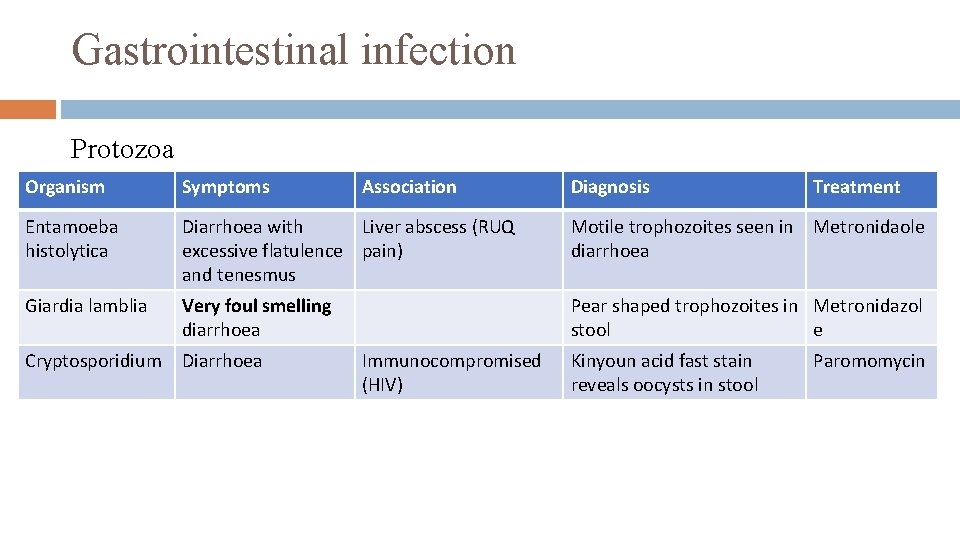
Gastrointestinal infection Protozoa Organism Symptoms Association Entamoeba histolytica Diarrhoea with Liver abscess (RUQ excessive flatulence pain) and tenesmus Motile trophozoites seen in Metronidaole diarrhoea Giardia lamblia Very foul smelling diarrhoea Pear shaped trophozoites in Metronidazol stool e Cryptosporidium Diarrhoea Immunocompromised (HIV) Diagnosis Kinyoun acid fast stain reveals oocysts in stool Treatment Paromomycin
Gastrointestinal infection Salmonella enteritidis Salmonella typhi Salmonella paratyphi
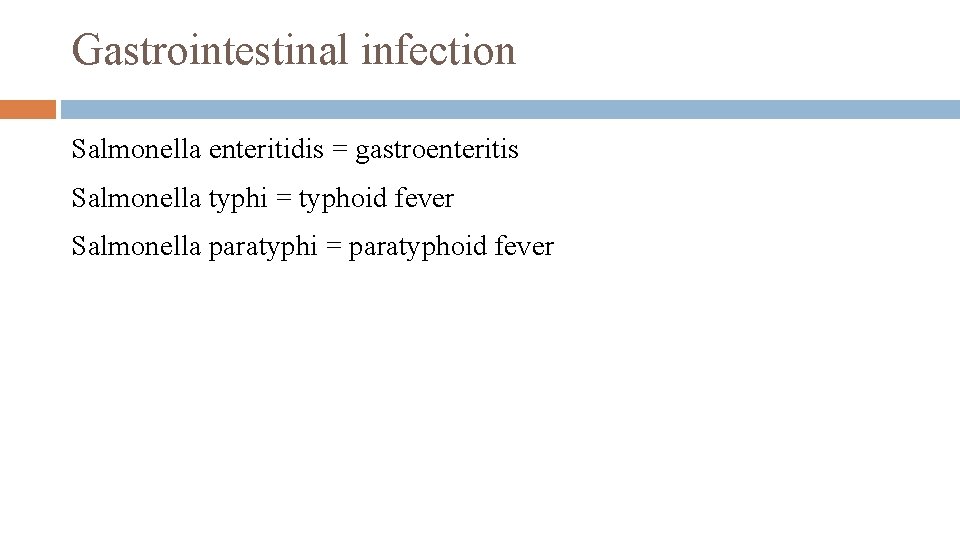
Gastrointestinal infection Salmonella enteritidis = gastroenteritis Salmonella typhi = typhoid fever Salmonella paratyphi = paratyphoid fever
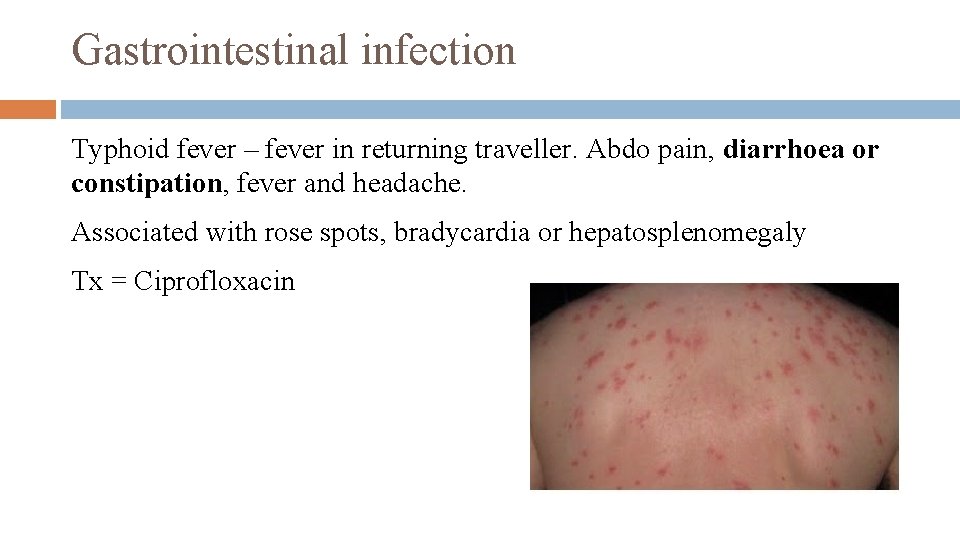
Gastrointestinal infection Typhoid fever – fever in returning traveller. Abdo pain, diarrhoea or constipation, fever and headache. Associated with rose spots, bradycardia or hepatosplenomegaly Tx = Ciprofloxacin
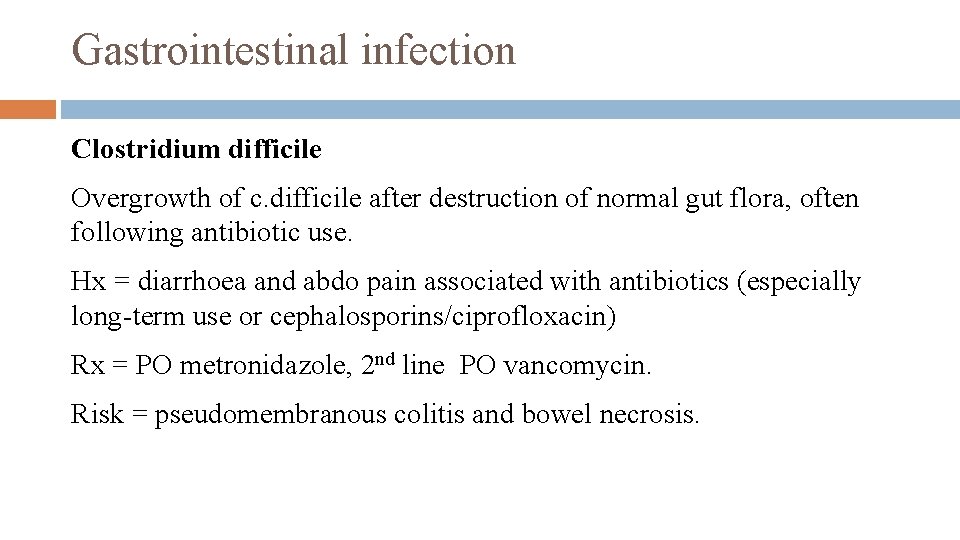
Gastrointestinal infection Clostridium difficile Overgrowth of c. difficile after destruction of normal gut flora, often following antibiotic use. Hx = diarrhoea and abdo pain associated with antibiotics (especially long-term use or cephalosporins/ciprofloxacin) Rx = PO metronidazole, 2 nd line PO vancomycin. Risk = pseudomembranous colitis and bowel necrosis.
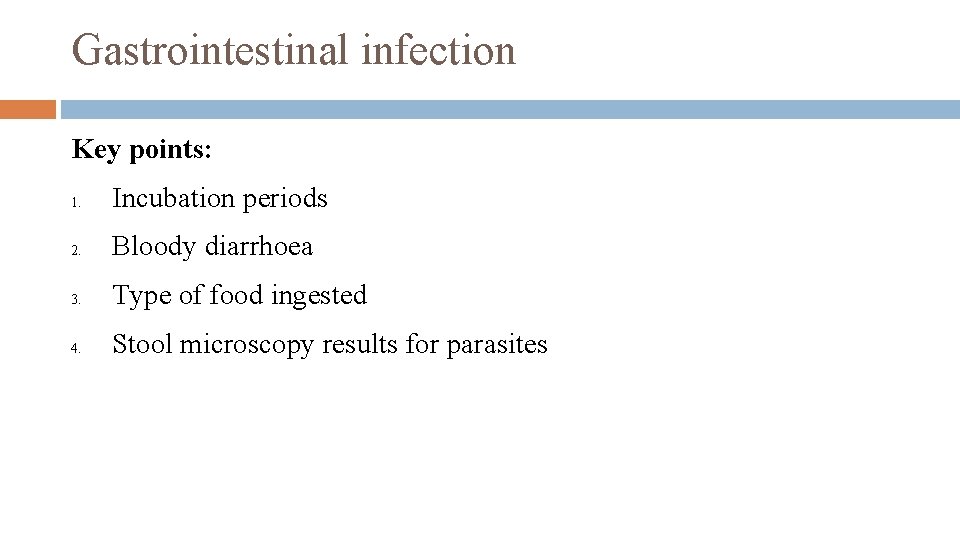
Gastrointestinal infection Key points: 1. Incubation periods 2. Bloody diarrhoea 3. Type of food ingested 4. Stool microscopy results for parasites
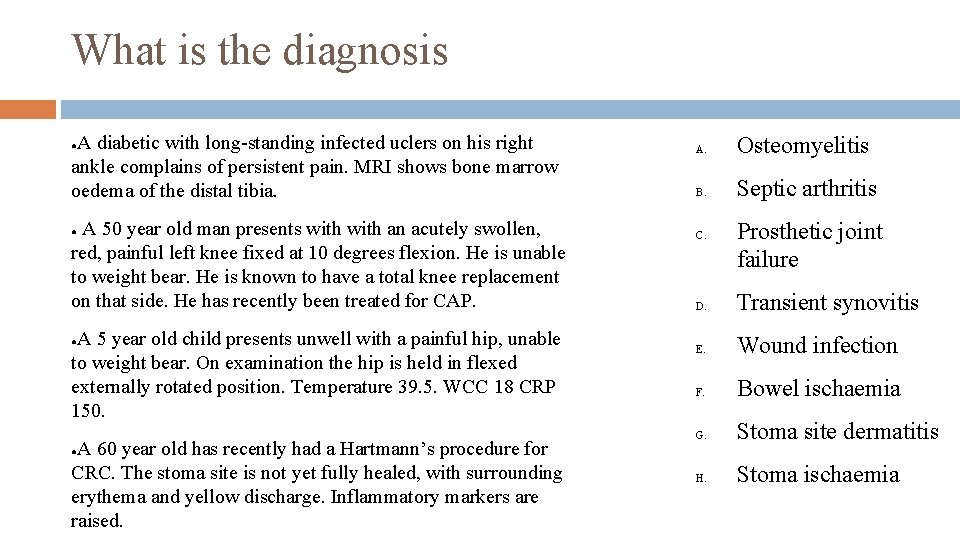
What is the diagnosis A diabetic with long-standing infected uclers on his right ankle complains of persistent pain. MRI shows bone marrow oedema of the distal tibia. ● A 50 year old man presents with an acutely swollen, red, painful left knee fixed at 10 degrees flexion. He is unable to weight bear. He is known to have a total knee replacement on that side. He has recently been treated for CAP. ● A 5 year old child presents unwell with a painful hip, unable to weight bear. On examination the hip is held in flexed externally rotated position. Temperature 39. 5. WCC 18 CRP 150. ● A 60 year old has recently had a Hartmann’s procedure for CRC. The stoma site is not yet fully healed, with surrounding erythema and yellow discharge. Inflammatory markers are raised. A. Osteomyelitis B. Septic arthritis C. Prosthetic joint failure D. Transient synovitis E. Wound infection F. Bowel ischaemia G. Stoma site dermatitis H. Stoma ischaemia ●
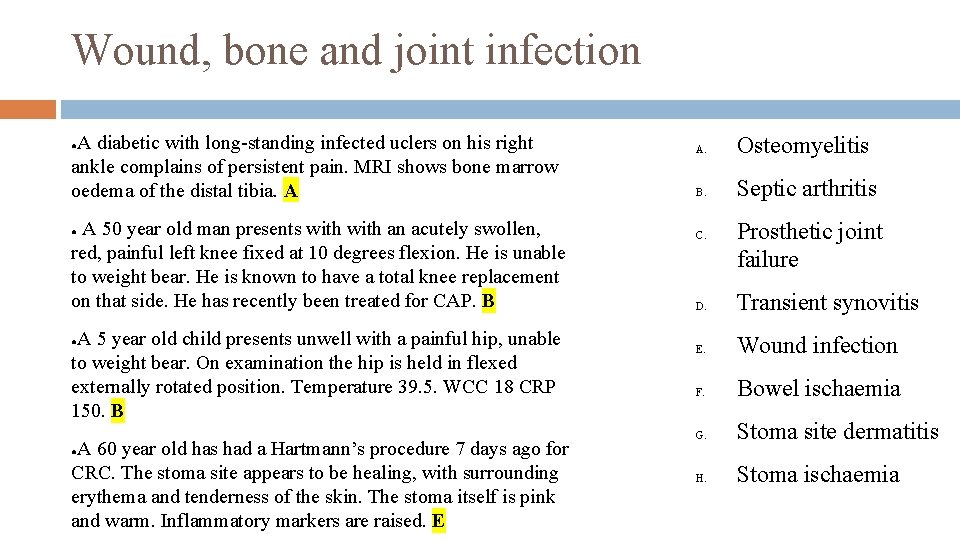
Wound, bone and joint infection A diabetic with long-standing infected uclers on his right ankle complains of persistent pain. MRI shows bone marrow oedema of the distal tibia. A ● A 50 year old man presents with an acutely swollen, red, painful left knee fixed at 10 degrees flexion. He is unable to weight bear. He is known to have a total knee replacement on that side. He has recently been treated for CAP. B ● A 5 year old child presents unwell with a painful hip, unable to weight bear. On examination the hip is held in flexed externally rotated position. Temperature 39. 5. WCC 18 CRP 150. B ● A 60 year old has had a Hartmann’s procedure 7 days ago for CRC. The stoma site appears to be healing, with surrounding erythema and tenderness of the skin. The stoma itself is pink and warm. Inflammatory markers are raised. E A. Osteomyelitis B. Septic arthritis C. Prosthetic joint failure D. Transient synovitis E. Wound infection F. Bowel ischaemia G. Stoma site dermatitis H. Stoma ischaemia ●
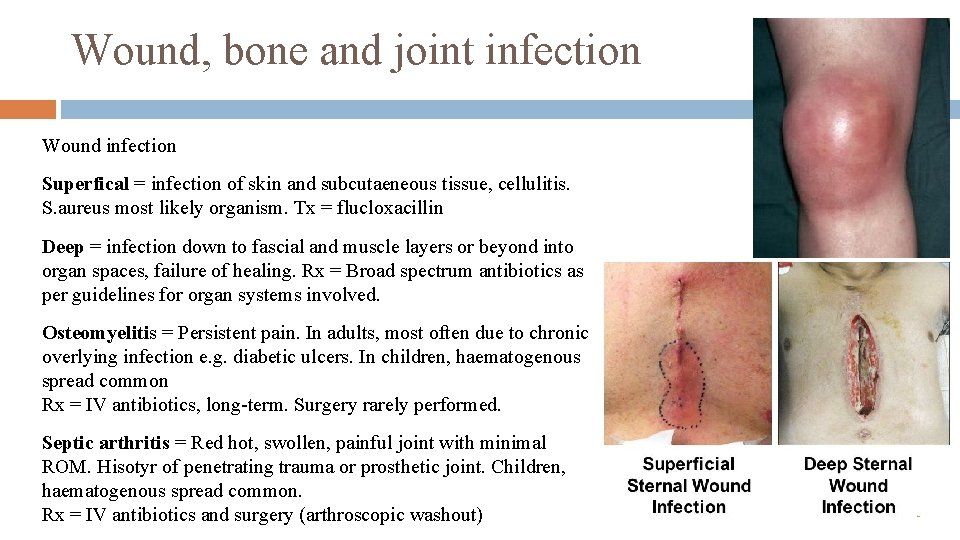
Wound, bone and joint infection Wound infection Superfical = infection of skin and subcutaeneous tissue, cellulitis. S. aureus most likely organism. Tx = flucloxacillin Deep = infection down to fascial and muscle layers or beyond into organ spaces, failure of healing. Rx = Broad spectrum antibiotics as per guidelines for organ systems involved. Osteomyelitis = Persistent pain. In adults, most often due to chronic overlying infection e. g. diabetic ulcers. In children, haematogenous spread common Rx = IV antibiotics, long-term. Surgery rarely performed. Septic arthritis = Red hot, swollen, painful joint with minimal ROM. Hisotyr of penetrating trauma or prosthetic joint. Children, haematogenous spread common. Rx = IV antibiotics and surgery (arthroscopic washout)
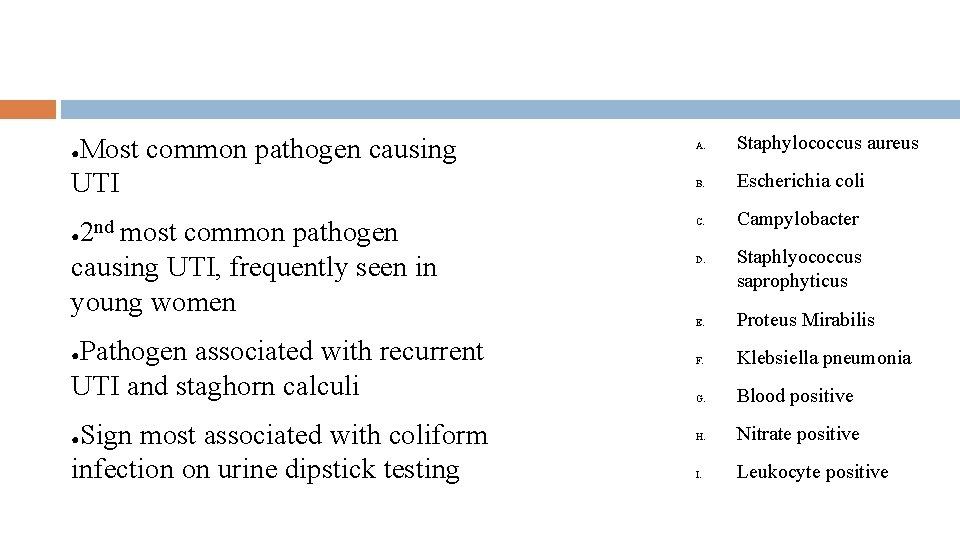
Most common pathogen causing UTI ● nd ● 2 most common pathogen causing UTI, frequently seen in young women Pathogen associated with recurrent UTI and staghorn calculi ● Sign most associated with coliform infection on urine dipstick testing ● A. Staphylococcus aureus B. Escherichia coli C. Campylobacter D. Staphlyococcus saprophyticus E. Proteus Mirabilis F. Klebsiella pneumonia G. Blood positive H. Nitrate positive I. Leukocyte positive
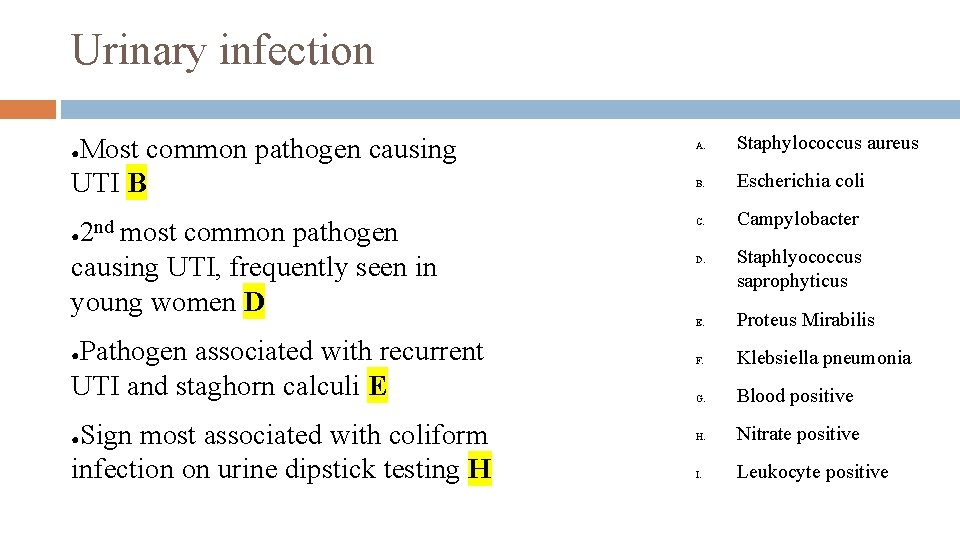
Urinary infection Most common pathogen causing UTI B ● nd ● 2 most common pathogen causing UTI, frequently seen in young women D Pathogen associated with recurrent UTI and staghorn calculi E ● Sign most associated with coliform infection on urine dipstick testing H ● A. Staphylococcus aureus B. Escherichia coli C. Campylobacter D. Staphlyococcus saprophyticus E. Proteus Mirabilis F. Klebsiella pneumonia G. Blood positive H. Nitrate positive I. Leukocyte positive
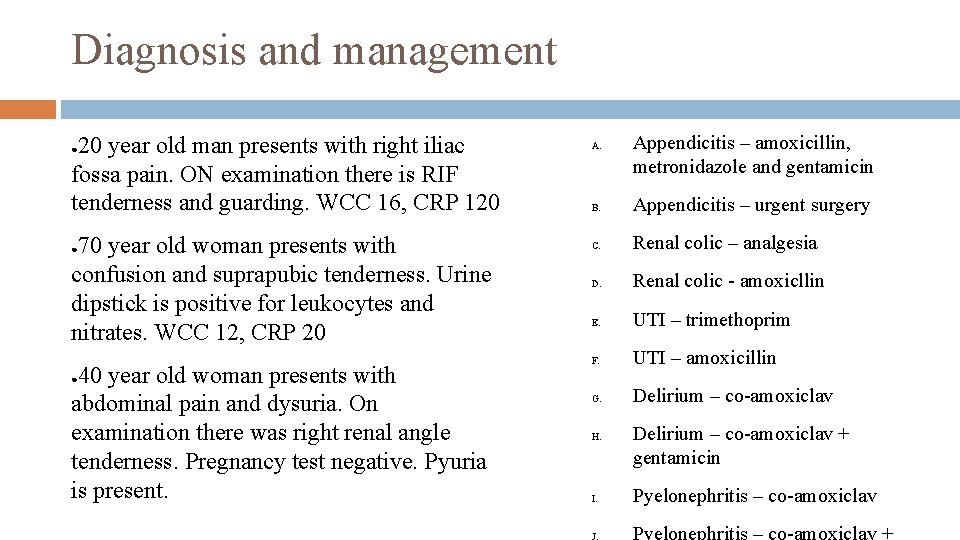
Diagnosis and management 20 year old man presents with right iliac fossa pain. ON examination there is RIF tenderness and guarding. WCC 16, CRP 120 ● 70 year old woman presents with confusion and suprapubic tenderness. Urine dipstick is positive for leukocytes and nitrates. WCC 12, CRP 20 ● 40 year old woman presents with abdominal pain and dysuria. On examination there was right renal angle tenderness. Pregnancy test negative. Pyuria is present. Appendicitis – amoxicillin, metronidazole and gentamicin B. Appendicitis – urgent surgery C. Renal colic – analgesia D. Renal colic - amoxicllin E. UTI – trimethoprim F. UTI – amoxicillin G. Delirium – co-amoxiclav ● H. I. Delirium – co-amoxiclav + gentamicin Pyelonephritis – co-amoxiclav
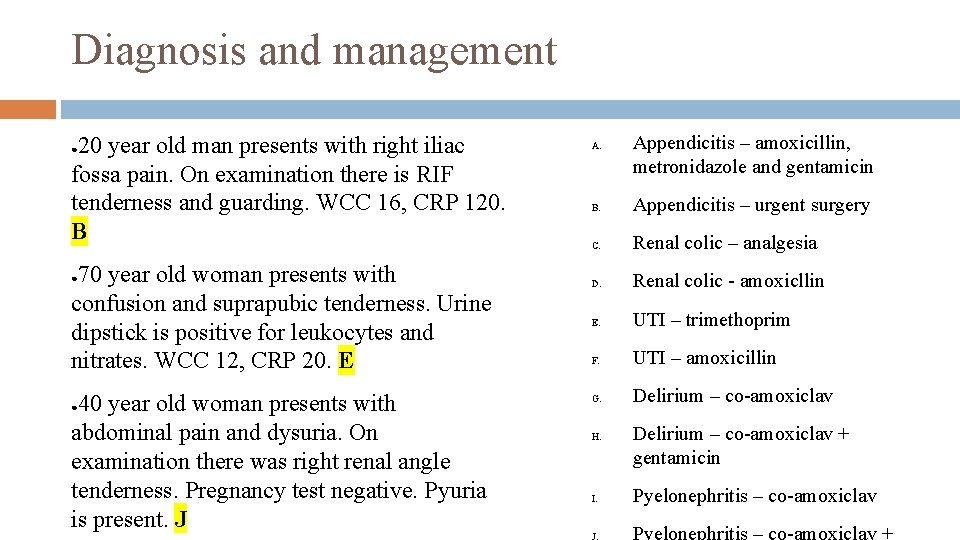
Diagnosis and management 20 year old man presents with right iliac fossa pain. On examination there is RIF tenderness and guarding. WCC 16, CRP 120. B ● 70 year old woman presents with confusion and suprapubic tenderness. Urine dipstick is positive for leukocytes and nitrates. WCC 12, CRP 20. E ● 40 year old woman presents with abdominal pain and dysuria. On examination there was right renal angle tenderness. Pregnancy test negative. Pyuria is present. J ● A. Appendicitis – amoxicillin, metronidazole and gentamicin B. Appendicitis – urgent surgery C. Renal colic – analgesia D. Renal colic - amoxicllin E. UTI – trimethoprim F. UTI – amoxicillin G. Delirium – co-amoxiclav H. I. Delirium – co-amoxiclav + gentamicin Pyelonephritis – co-amoxiclav
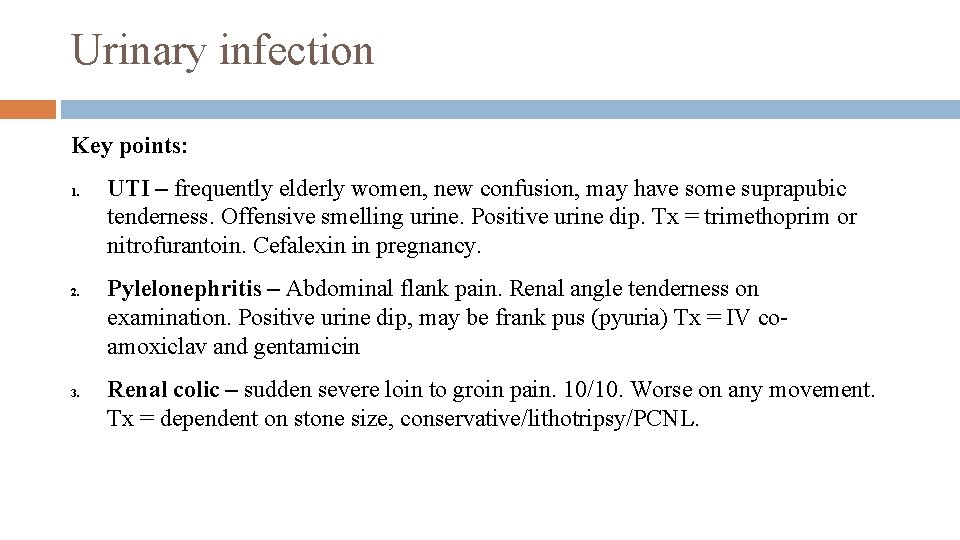
Urinary infection Key points: 1. 2. 3. UTI – frequently elderly women, new confusion, may have some suprapubic tenderness. Offensive smelling urine. Positive urine dip. Tx = trimethoprim or nitrofurantoin. Cefalexin in pregnancy. Pylelonephritis – Abdominal flank pain. Renal angle tenderness on examination. Positive urine dip, may be frank pus (pyuria) Tx = IV coamoxiclav and gentamicin Renal colic – sudden severe loin to groin pain. 10/10. Worse on any movement. Tx = dependent on stone size, conservative/lithotripsy/PCNL.
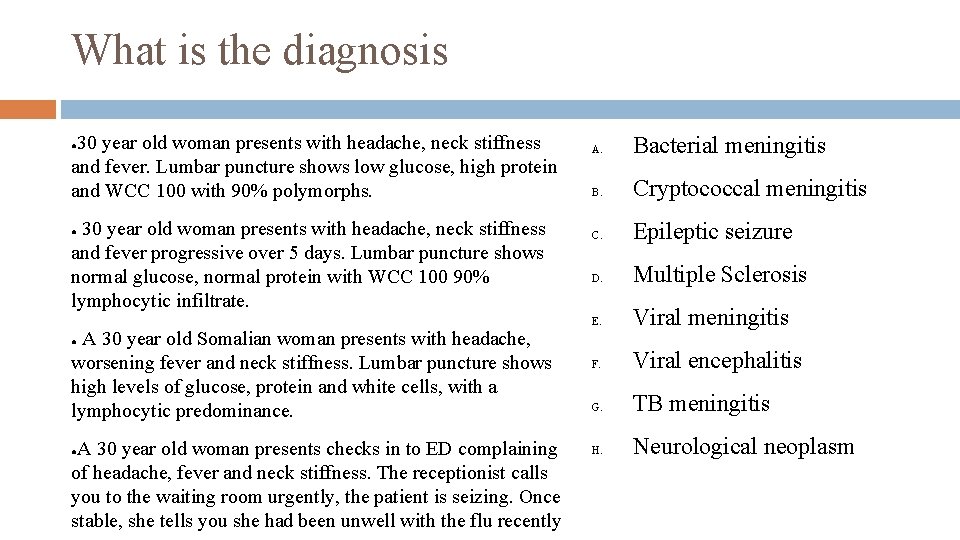
What is the diagnosis 30 year old woman presents with headache, neck stiffness and fever. Lumbar puncture shows low glucose, high protein and WCC 100 with 90% polymorphs. ● 30 year old woman presents with headache, neck stiffness and fever progressive over 5 days. Lumbar puncture shows normal glucose, normal protein with WCC 100 90% lymphocytic infiltrate. ● A 30 year old Somalian woman presents with headache, worsening fever and neck stiffness. Lumbar puncture shows high levels of glucose, protein and white cells, with a lymphocytic predominance. A. Bacterial meningitis B. Cryptococcal meningitis C. Epileptic seizure D. Multiple Sclerosis E. Viral meningitis F. Viral encephalitis G. TB meningitis H. Neurological neoplasm ● A 30 year old woman presents checks in to ED complaining of headache, fever and neck stiffness. The receptionist calls you to the waiting room urgently, the patient is seizing. Once stable, she tells you she had been unwell with the flu recently ●
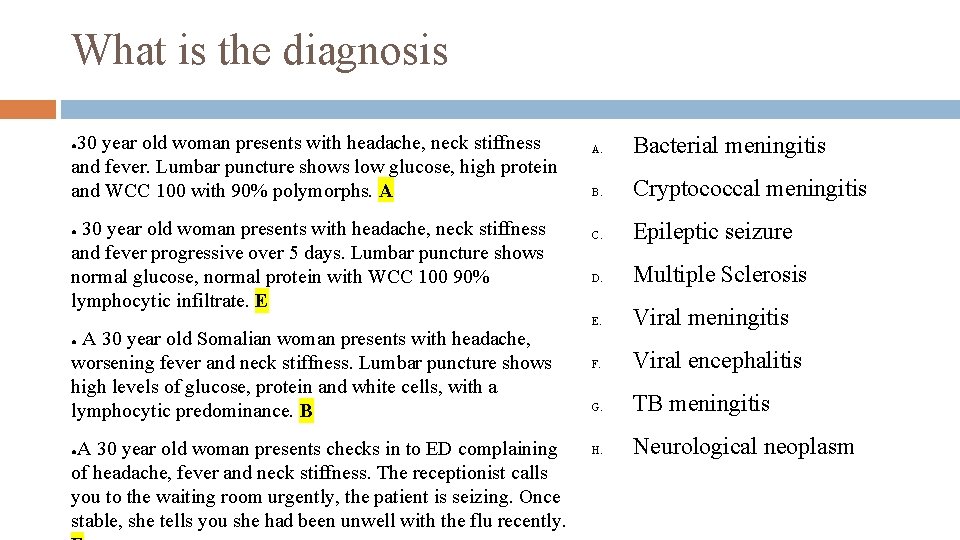
What is the diagnosis 30 year old woman presents with headache, neck stiffness and fever. Lumbar puncture shows low glucose, high protein and WCC 100 with 90% polymorphs. A ● 30 year old woman presents with headache, neck stiffness and fever progressive over 5 days. Lumbar puncture shows normal glucose, normal protein with WCC 100 90% lymphocytic infiltrate. E ● A 30 year old Somalian woman presents with headache, worsening fever and neck stiffness. Lumbar puncture shows high levels of glucose, protein and white cells, with a lymphocytic predominance. B A. Bacterial meningitis B. Cryptococcal meningitis C. Epileptic seizure D. Multiple Sclerosis E. Viral meningitis F. Viral encephalitis G. TB meningitis H. Neurological neoplasm ● A 30 year old woman presents checks in to ED complaining of headache, fever and neck stiffness. The receptionist calls you to the waiting room urgently, the patient is seizing. Once stable, she tells you she had been unwell with the flu recently. ●
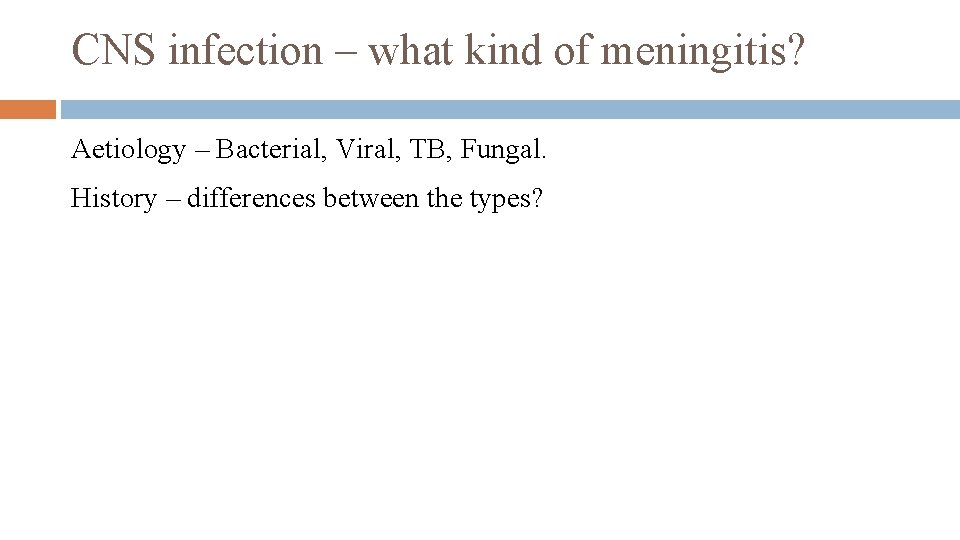
CNS infection – what kind of meningitis? Aetiology – Bacterial, Viral, TB, Fungal. History – differences between the types?
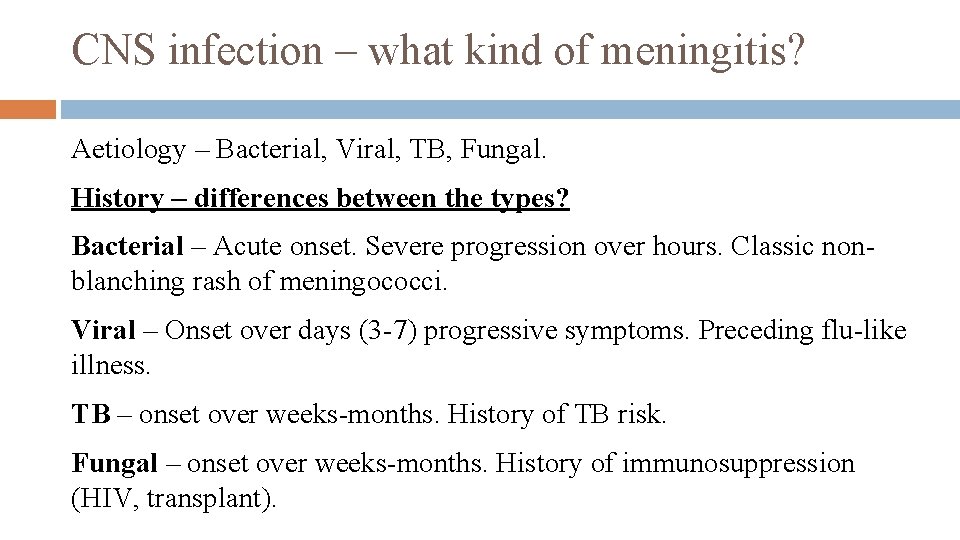
CNS infection – what kind of meningitis? Aetiology – Bacterial, Viral, TB, Fungal. History – differences between the types? Bacterial – Acute onset. Severe progression over hours. Classic nonblanching rash of meningococci. Viral – Onset over days (3 -7) progressive symptoms. Preceding flu-like illness. TB – onset over weeks-months. History of TB risk. Fungal – onset over weeks-months. History of immunosuppression (HIV, transplant).
CNS infection Meningitis aetiology – Bacterial, Viral, TB, Fungal. History – timing of onset and risk factors. Examination ? Bloods ? CT head – rarely helpful, may see tuberculomas (contrast required). Lumbar puncture
CNS infection Meningitis aetiology – Bacterial, Viral, TB, Fungal. History – timing of onset and risk factors. Examination Bloods CT head – rarely helpful, may see tuberculomas (contrast required). Lumbar puncture – key to differentiate
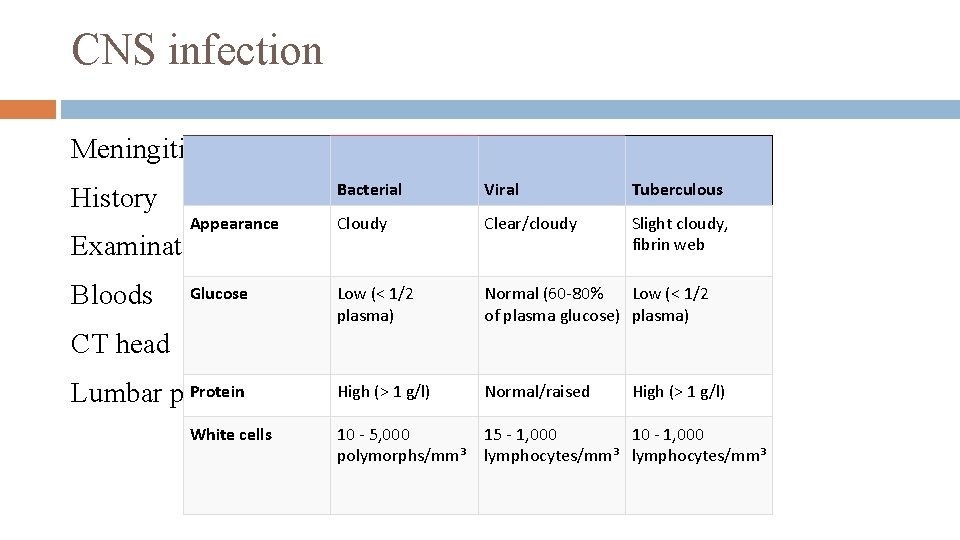
CNS infection Meningitis aetiology – Bacterial, Viral, TB, Fungal. History Bacterial Viral Tuberculous Appearance Cloudy Clear/cloudy Slight cloudy, fibrin web Glucose Low (< 1/2 plasma) Normal (60 -80% Low (< 1/2 of plasma glucose) plasma) High (> 1 g/l) Normal/raised 10 - 5, 000 polymorphs/mm³ 15 - 1, 000 10 - 1, 000 lymphocytes/mm³ Examination Bloods CT head Protein Lumbar puncture White cells High (> 1 g/l)
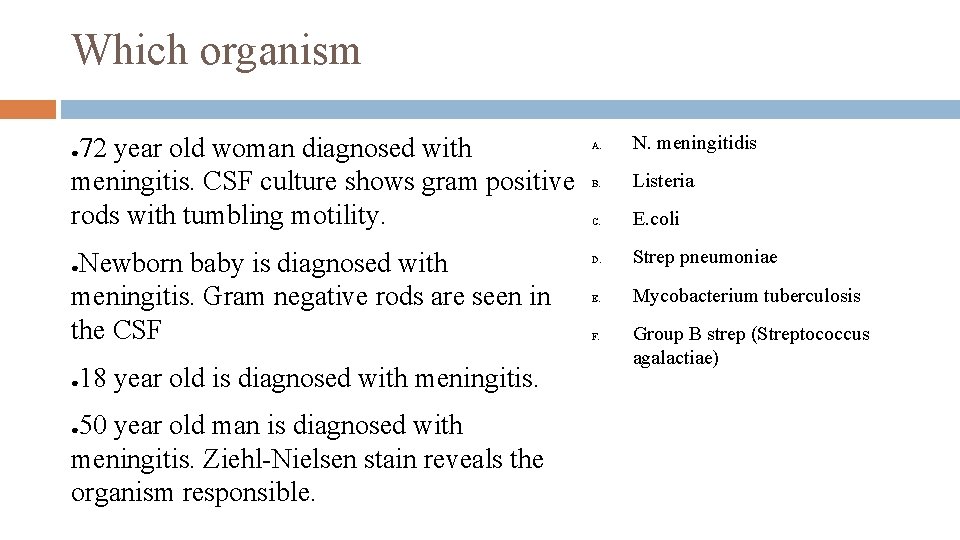
Which organism 72 year old woman diagnosed with meningitis. CSF culture shows gram positive rods with tumbling motility. ● Newborn baby is diagnosed with meningitis. Gram negative rods are seen in the CSF ● 18 year old is diagnosed with meningitis. ● 50 year old man is diagnosed with meningitis. Ziehl-Nielsen stain reveals the organism responsible. ● A. N. meningitidis B. Listeria C. E. coli D. Strep pneumoniae E. Mycobacterium tuberculosis F. Group B strep (Streptococcus agalactiae)
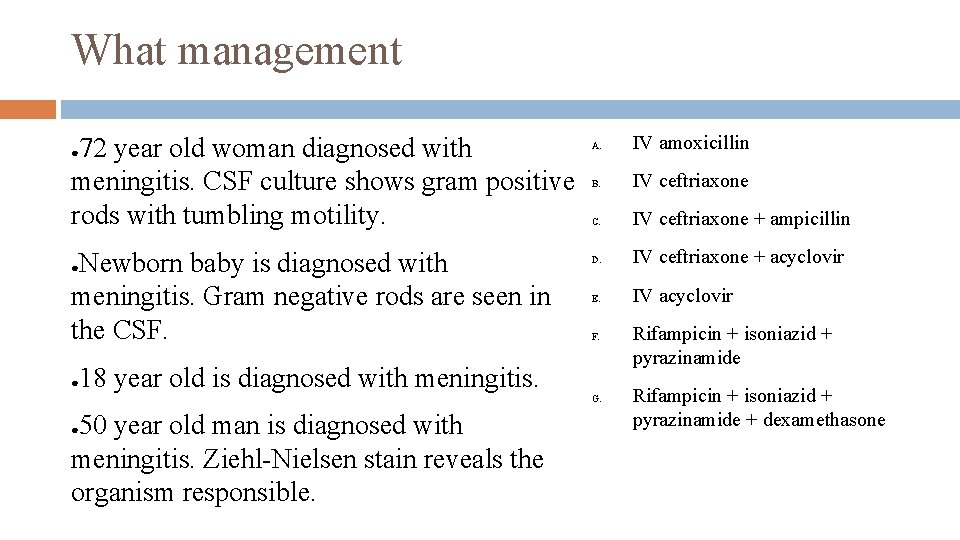
What management 72 year old woman diagnosed with meningitis. CSF culture shows gram positive rods with tumbling motility. ● Newborn baby is diagnosed with meningitis. Gram negative rods are seen in the CSF. ● A. IV amoxicillin B. IV ceftriaxone C. IV ceftriaxone + ampicillin D. IV ceftriaxone + acyclovir E. IV acyclovir F. 18 year old is diagnosed with meningitis. ● G. 50 year old man is diagnosed with meningitis. Ziehl-Nielsen stain reveals the organism responsible. ● Rifampicin + isoniazid + pyrazinamide + dexamethasone
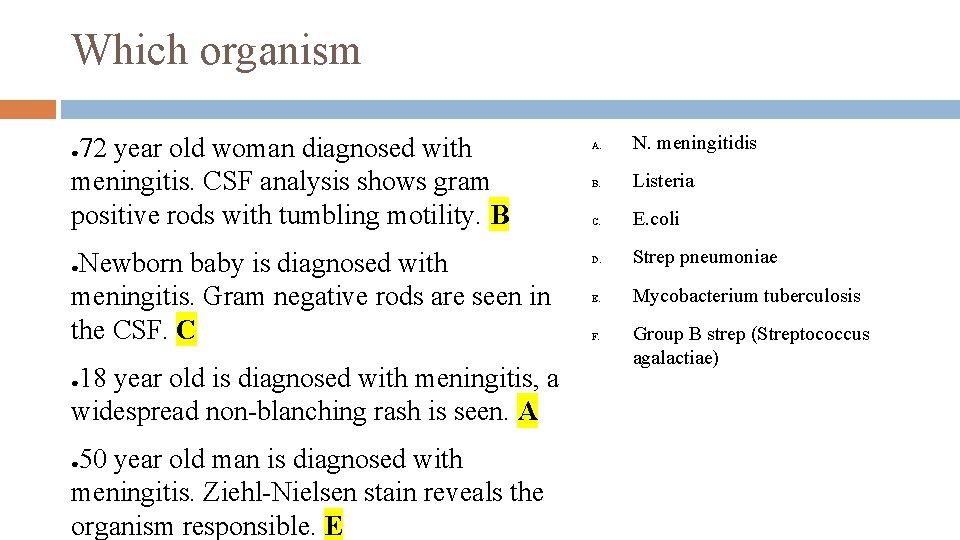
Which organism 72 year old woman diagnosed with meningitis. CSF analysis shows gram positive rods with tumbling motility. B ● Newborn baby is diagnosed with meningitis. Gram negative rods are seen in the CSF. C ● 18 year old is diagnosed with meningitis, a widespread non-blanching rash is seen. A ● 50 year old man is diagnosed with meningitis. Ziehl-Nielsen stain reveals the organism responsible. E ● A. N. meningitidis B. Listeria C. E. coli D. Strep pneumoniae E. Mycobacterium tuberculosis F. Group B strep (Streptococcus agalactiae)
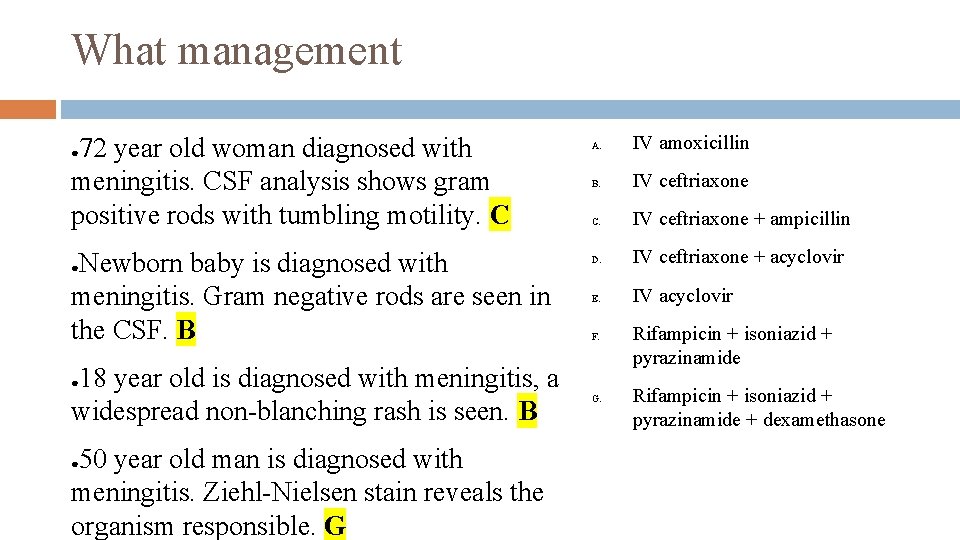
What management 72 year old woman diagnosed with meningitis. CSF analysis shows gram positive rods with tumbling motility. C ● Newborn baby is diagnosed with meningitis. Gram negative rods are seen in the CSF. B ● 18 year old is diagnosed with meningitis, a widespread non-blanching rash is seen. B A. IV amoxicillin B. IV ceftriaxone C. IV ceftriaxone + ampicillin D. IV ceftriaxone + acyclovir E. IV acyclovir F. ● 50 year old man is diagnosed with meningitis. Ziehl-Nielsen stain reveals the organism responsible. G ● G. Rifampicin + isoniazid + pyrazinamide + dexamethasone
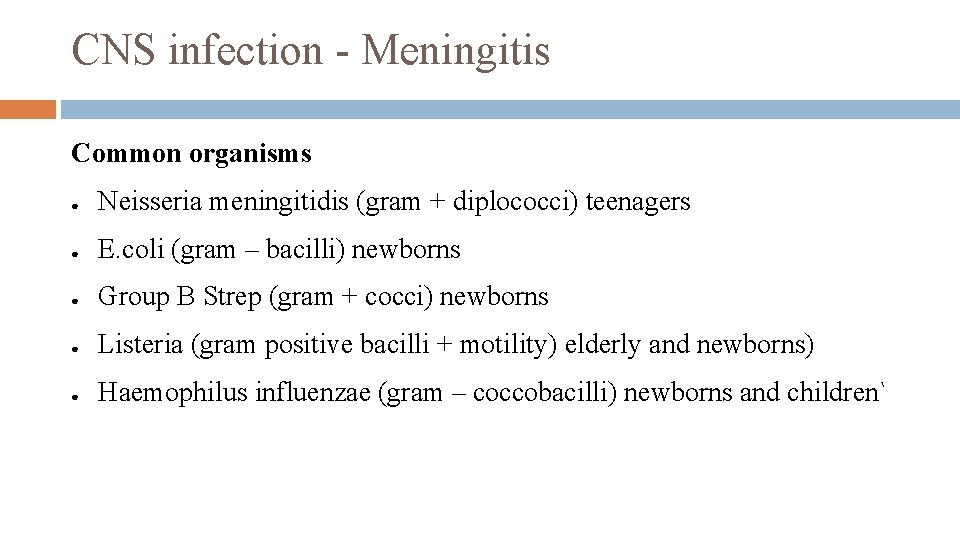
CNS infection - Meningitis Common organisms ● Neisseria meningitidis (gram + diplococci) teenagers ● E. coli (gram – bacilli) newborns ● Group B Strep (gram + cocci) newborns ● Listeria (gram positive bacilli + motility) elderly and newborns) ● Haemophilus influenzae (gram – coccobacilli) newborns and children`
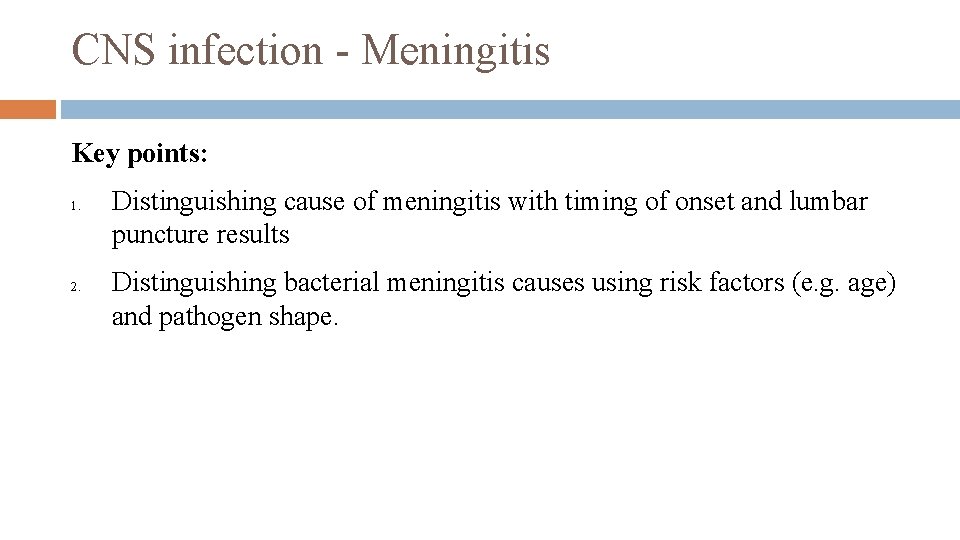
CNS infection - Meningitis Key points: 1. 2. Distinguishing cause of meningitis with timing of onset and lumbar puncture results Distinguishing bacterial meningitis causes using risk factors (e. g. age) and pathogen shape.
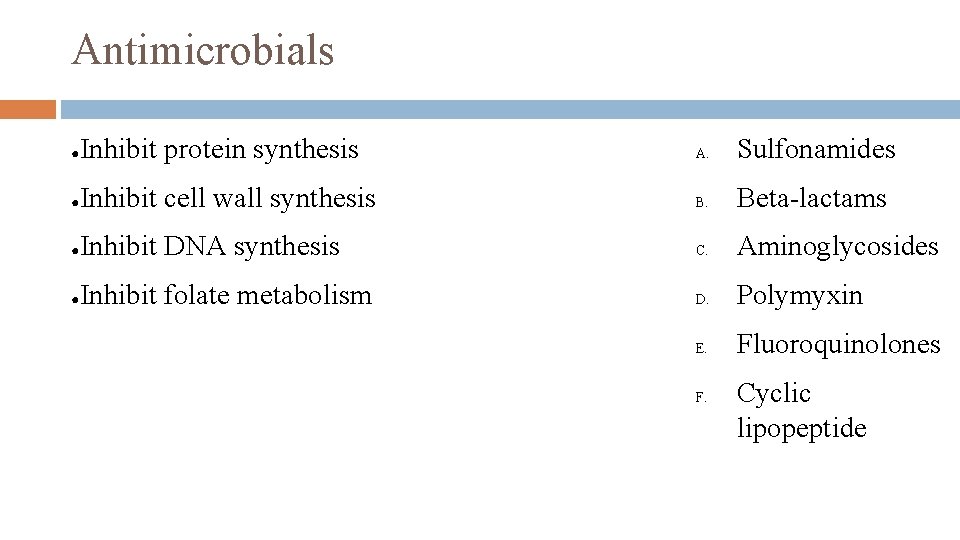
Antimicrobials ● Inhibit protein synthesis A. Sulfonamides ● Inhibit cell wall synthesis B. Beta-lactams ● Inhibit DNA synthesis C. Aminoglycosides ● Inhibit folate metabolism D. Polymyxin E. Fluoroquinolones F. Cyclic lipopeptide
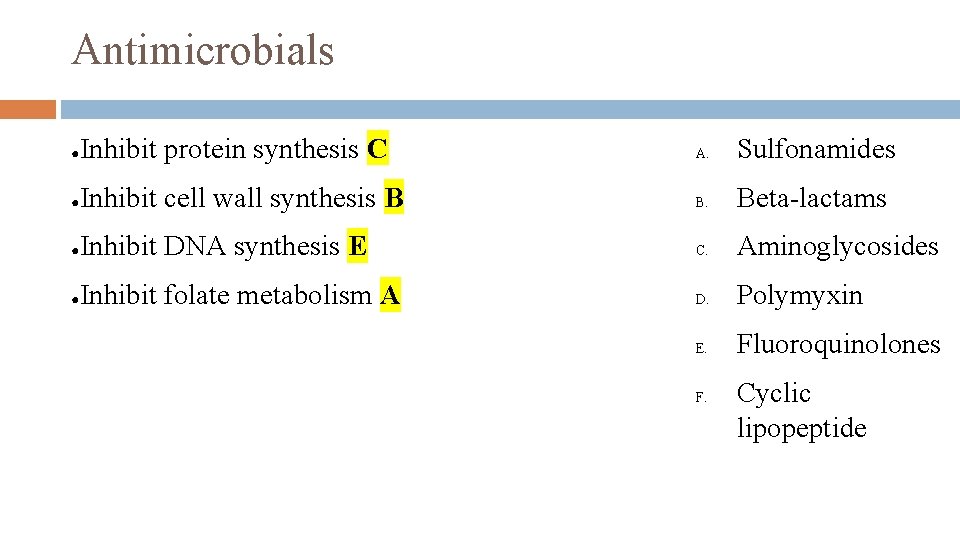
Antimicrobials ● Inhibit protein synthesis C A. Sulfonamides ● Inhibit cell wall synthesis B B. Beta-lactams ● Inhibit DNA synthesis E C. Aminoglycosides ● Inhibit folate metabolism A D. Polymyxin E. Fluoroquinolones F. Cyclic lipopeptide
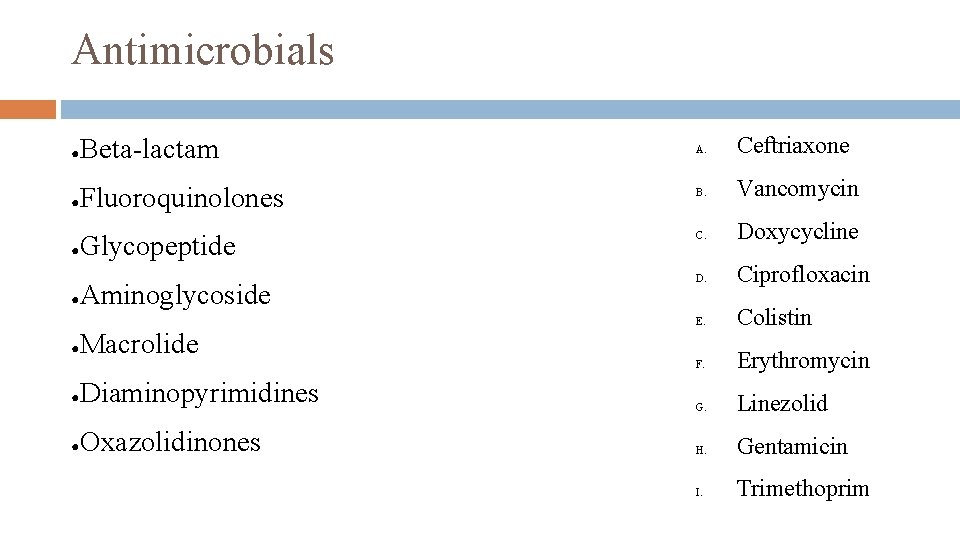
Antimicrobials ● Beta-lactam A. Ceftriaxone ● Fluoroquinolones B. Vancomycin Glycopeptide C. Doxycycline D. Ciprofloxacin E. Colistin F. Erythromycin ● ● ● Aminoglycoside Macrolide ● Diaminopyrimidines G. Linezolid ● Oxazolidinones H. Gentamicin I. Trimethoprim
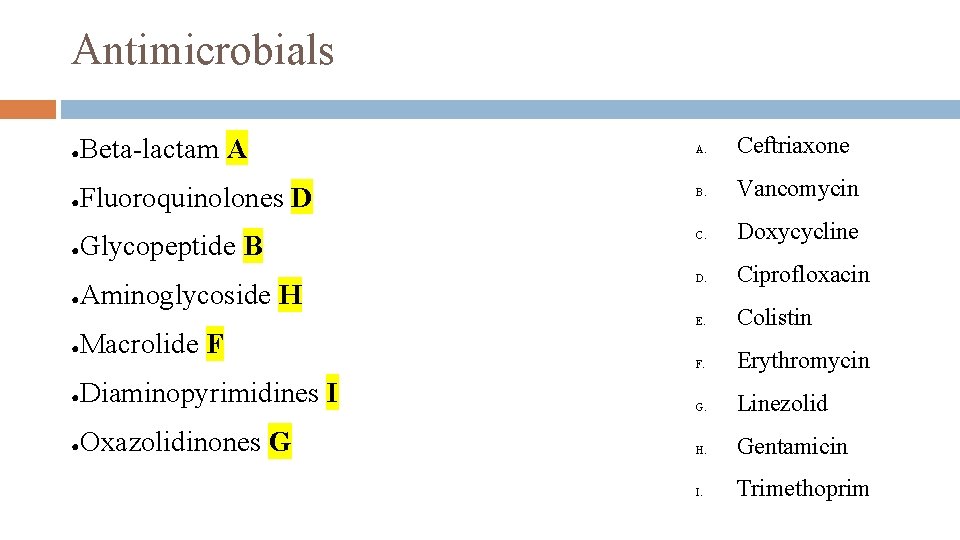
Antimicrobials ● Beta-lactam A A. Ceftriaxone ● Fluoroquinolones D B. Vancomycin Glycopeptide B C. Doxycycline D. Ciprofloxacin E. Colistin F. Erythromycin ● ● ● Aminoglycoside H Macrolide F ● Diaminopyrimidines I G. Linezolid ● Oxazolidinones G H. Gentamicin I. Trimethoprim
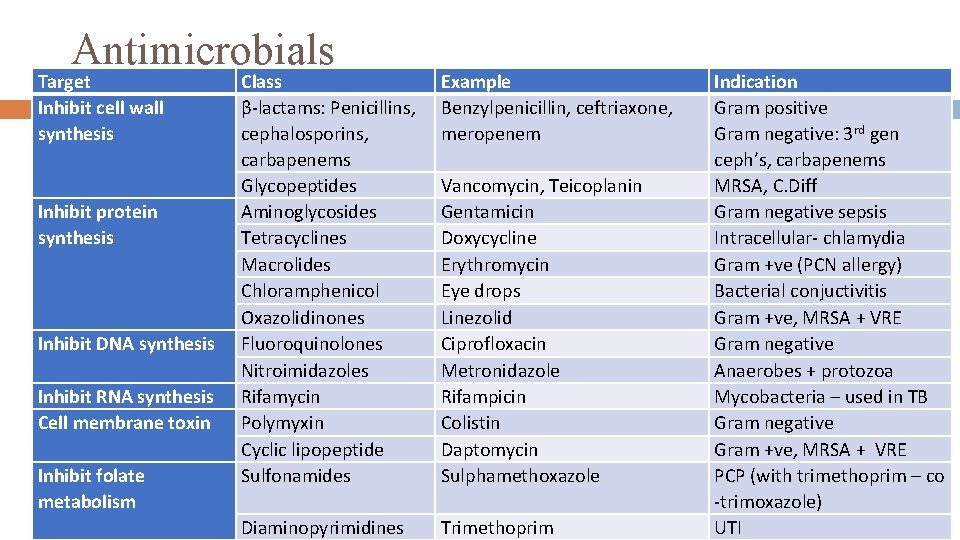
Antimicrobials Target Inhibit cell wall synthesis Inhibit protein synthesis Inhibit DNA synthesis Inhibit RNA synthesis Cell membrane toxin Inhibit folate metabolism Class β-lactams: Penicillins, cephalosporins, carbapenems Glycopeptides Aminoglycosides Tetracyclines Macrolides Chloramphenicol Oxazolidinones Fluoroquinolones Nitroimidazoles Rifamycin Polymyxin Cyclic lipopeptide Sulfonamides Example Benzylpenicillin, ceftriaxone, meropenem Diaminopyrimidines Trimethoprim Vancomycin, Teicoplanin Gentamicin Doxycycline Erythromycin Eye drops Linezolid Ciprofloxacin Metronidazole Rifampicin Colistin Daptomycin Sulphamethoxazole Indication Gram positive Gram negative: 3 rd gen ceph’s, carbapenems MRSA, C. Diff Gram negative sepsis Intracellular- chlamydia Gram +ve (PCN allergy) Bacterial conjuctivitis Gram +ve, MRSA + VRE Gram negative Anaerobes + protozoa Mycobacteria – used in TB Gram negative Gram +ve, MRSA + VRE PCP (with trimethoprim – co -trimoxazole) UTI

Close Questions please Feedback tinyurl. com/y 8 fu 7 gzp,
- Slides: 70