
Microbiology of Water People died due to bacterial
Microbiology of Water Ø People died due to bacterial infectious diseases transmitted through water vig: cholera, typhoid fever and bacillary dysentery. Ø Escherichia coli strains is the indicator organism used to indicate faecal contamination. Ø EPA guidelines for coliforms in drinking water are < 1 CFU/100 ml. Ø Microbiological water analysis is mainly based on the concept of faecal indicator bacteria. Ø The main bacteria present in human and animal faecal coliform determinations should be complemented with the quantification of enterococci.
Most Probable Number (MPN) is a method used to estimate the concentration of viable microorganisms in a sample by means of replicate liquid broth growth in ten-fold dilutions. It is commonly used in estimating microbial populations in soils, waters, agricultural products and is particularly useful with samples that contain particulate material that interferes with plate count enumeration methods.
Importance of MPN Method Ø MPN is most commonly applied for quality testing of water i. e to ensure whether the water is safe or not in terms of bacteria present in it. Ø The presence of very few faecal coliform bacteria would indicate that a water probably contains no disease‑ causing organisms. Ø while the presence of large numbers of faecal coliform bacteria would indicate a very high probability that the water could contain disease ‑producing organisms making the water unsafe for consumption.
Principle ØWater to be tested is diluted serially and inoculated in lactose broth. ØColiforms if present in water utilize the lactose present in the medium to produce acid and gas. ØThe presence of acid is indicated by color change of the medium and the presence of gas is detected as gas bubbles collected in the inverted durham tube present in the medium. ØThe number of total coliforms is determined by counting the number of tubes giving positive reaction (i. e both color change and gas production) and comparing the pattern of positive results (the number of tubes showing growth at each dilution) with standard statistical tables.
MPN test is performed in 3 steps Ø Presumptive test. Ø Confirmatory test. Ø Completed test
Presumptive test: Ø It is a screening test to sample water for the presence of coliform organisms. Ø If the presumptive test is negative, no further testing is performed, and the water source is considered microbiologically safe. Ø If, however, any tube in the series shows acid and gas, the water is considered unsafe and the confirmed test is performed on the tube displaying a positive reaction.
The method of presumptive test varies for treated and untreated water. • Requirements : • Medium: Lactose broth or Mac Conkey Broth or Lauryl tryptose (lactose) broth • Glasswares: Test tubes of various capacities (20 ml, 10 ml, 5 ml), Durham tube • Others: Sterile pipettes • • Preparation of the Medium Prepare medium (either mac conkey broth or Lactose broth)in single and double strength concentration. •
• For untreated or polluted water : Dispense the double strength medium in 10 tubes (10 ml in each tube) and single strength medium in 5 tubes (10 ml in each tube)and add an durham tube in inverted position. • For treated water: – Dispense the double strength medium in 5 tubes (10 ml in each tube) and 50 ml single strength medium in 1 bottle and add an durham tube in inverted position. Examine the tubes to make sure that the inner vial is full of liquid with no air bubbles. Sterilize by autoclaving at 15 lbs pressure (121°C) for 15 minutes. • •
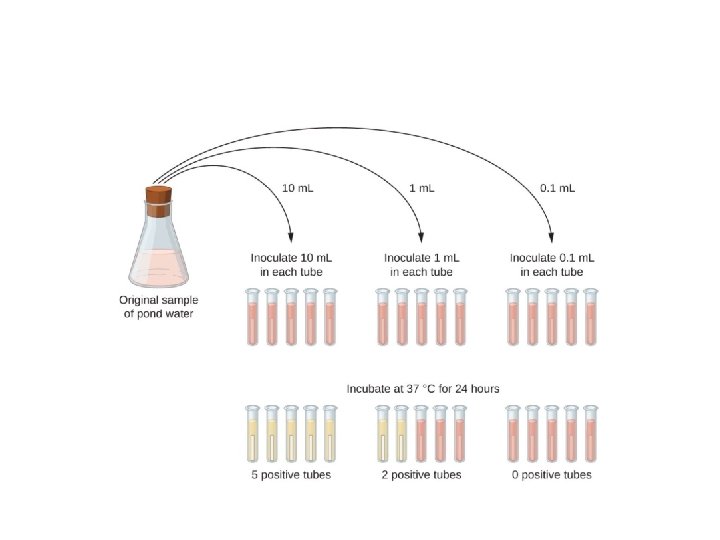
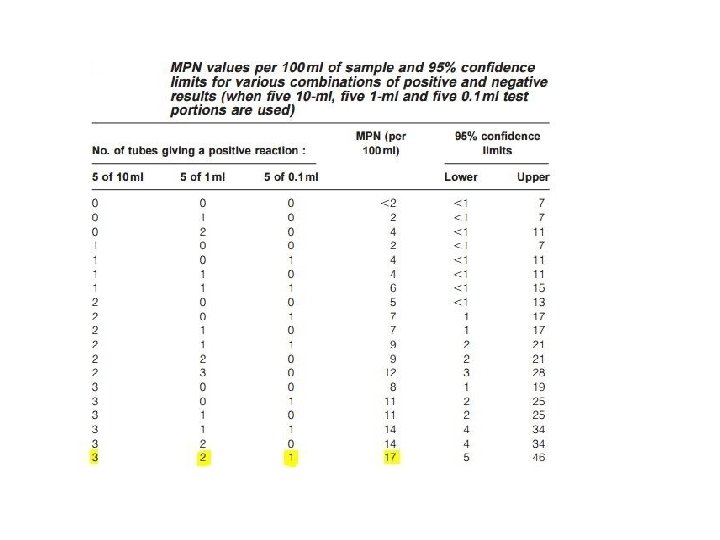
Untreated Water • Take 5 tubes of double strength and 10 tubes of single strength for each water sample to be tested. • Using a sterile pipette add 10 ml of water to 5 tubes containing 10 ml double strength medium. • Similarly add 1 ml of water to 5 tubes containing 10 ml double strength medium and 0. 1 ml water to remaining 5 tubes containing 10 ml double strength medium. • Incubate all the tubes at 37°C for 24 hrs. If no tubes appear positive re-incubate up to 48 hrs. • Compare the number of tubes giving positive reaction to a standard chart and record the number of bacteria present in it. For example: a water sample tested shows a result of 3– 2– 1 (3 × 10 ml positive, 2 × 1 ml positive, 1 × 0. 1 ml positive) gives an MPN value of 17, i. e. the water sample contains an estimated 17 coliforms per 100 ml •
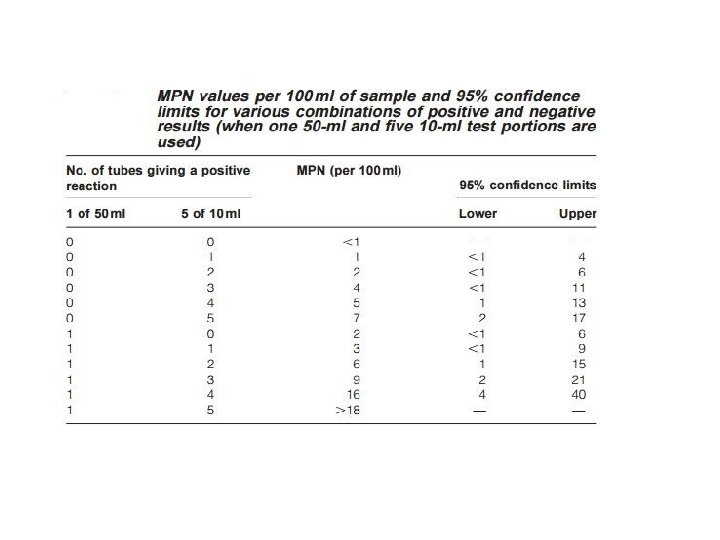
For treated water Ø Take 1 tube of single strength (50 ml) and 5 tubes of double strength (10 ml) for each water sample to be tested. Ø Using a sterile pipette add 50 ml of water to the tubes containing 50 ml single strength medium. Ø Similarly add 10 ml of water to 5 tubes containing 10 ml double strength medium Incubate the tubes at 37°C for 24 hrs. If no tubes appear positive re-incubate up to 48 hrs. Ø Compare the number of tube giving positive reaction to a standard chart and record the number of bacteria present in it. For example: a water sample tested shows a result of 1 -4 (1 × 50 ml positive, 4 × 10 ml positive) gives an MPN value of 16, i. e. the water sample contains an estimated 16 coliforms per 100 ml •
Confirmed test: Ø Some microrganisms other than coliforms also produce acid and gas from lactose fermentation. In order to confirm the presence of coliform, confirmatory test is done. Ø From each of the fermentation tubes with positive results transfer one loopful of medium to: Ø 3 ml lactose-broth or brilliant green lactose fermentation tube, to an agar slant and 3 ml tryptone water. Ø Incubate the inoculated lactose-broth fermentation tubes at 37°C and inspect gas formation after 24 ± 2 hours. If no gas production is seen, further incubate up to maximum of 48 ± 3 hours to check gas production. •
Ø The agar slants should be incubated at 37°C for 24± 2 hours and Gram-stained preparations made from the slants should be examined microscopically. Ø The formation of gas in lactose broth and the demonstration of Gram negative, non-spore-forming bacilli in the corresponding agar indicates the presence of a member of the coliform group in the sample examined. Ø The absence of gas formation in lactose broth or the failure to demonstrate Gram-negative, non-spore-forming bacilli in the corresponding agar slant constitutes a negative test (absence of coliforms in the tested sample).
Tryptone water Test • Incubate the tryptone water at (44. 5 ± 0. 2°C) for 18 -24 hours. • Following incubation, add approximately 0. 1 ml of Kovacs reagent and mix gently. • The presence of indole is indicated by a red colour in the Kovacs reagent, forming a film over the aqueous phase of the medium. A. Confirmatory tests positive for indole, growth, and gas production show the presence of thermotolerant E. coli. B. Growth and gas production in the absence of indole confirm thermotolerant coliforms. •
Completed test: Ø Since some of the positive results from the confirmatory test may be false, it is desirable to do completed tests. For this inoculum from each positive tube of the confirmatory test is streaked on a plate of EMB or Endo agar. Ø In this process, a loopful of sample from each positive BGLB tubes is streaked onto selective medium like Eosin Methylene Blue agar or Endo’s medium. One plate each is incubated at 37°C and another at 44. 5± 0. 2°C for 24 hours. Ø High temperature incubation (44. 5 ± 0. 2) is for detection of thermotolerant E. coli. Ø Following incubation, all plates are examined for presence of typical colonies. Ø Coliforms produce colonies with greenish metallic sheen which differentiates it from noncoliform colonies (show no sheen). Presence of typical colonies on high temperature (44. 5 ± 0. 2) indicate presence of thermotolerant E. coli. •
Advantages of MPN : Ø Ease of interpretation, either by observation or gas emission Sample toxins are diluted. Ø Effective method of analyzing highly turbid samples such as sediments, sludge, mud, etc. that cannot be analysed by membrane filtration. Disadvantages of MPN: Ø It takes a long time to get the results. Ø Results are not very accurate. Ø Requires more hardware (glassware) and media Ø Probability of false positives
- Slides: 18