
Microbiology Microbiology Phase 2 a Revision Session Adam

Microbiology
Microbiology Phase 2 a Revision Session Adam Temple and Dami Arewa 10/3/2017 The Peer Teaching Society is not liable for false or misleading information…
What we’ll cover • The basics: staining + differentiating bacteria • Infections of each system • Tips + quiz The Peer Teaching Society is not liable for false or misleading information…
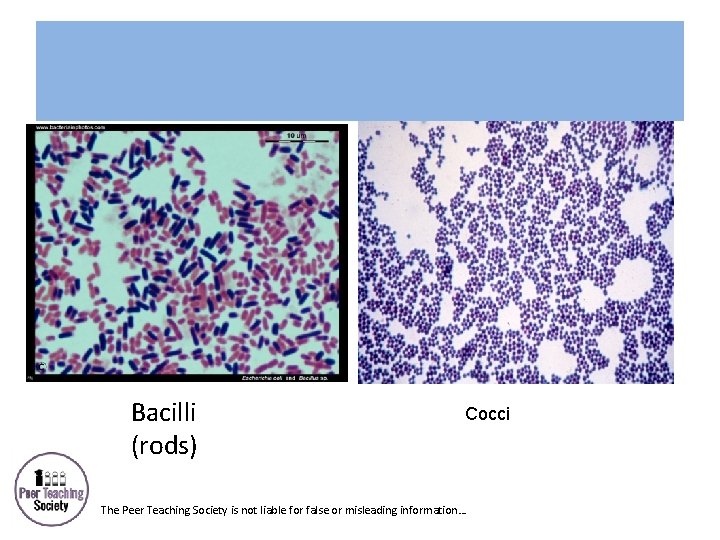
Bacilli (rods) Cocci The Peer Teaching Society is not liable for false or misleading information…
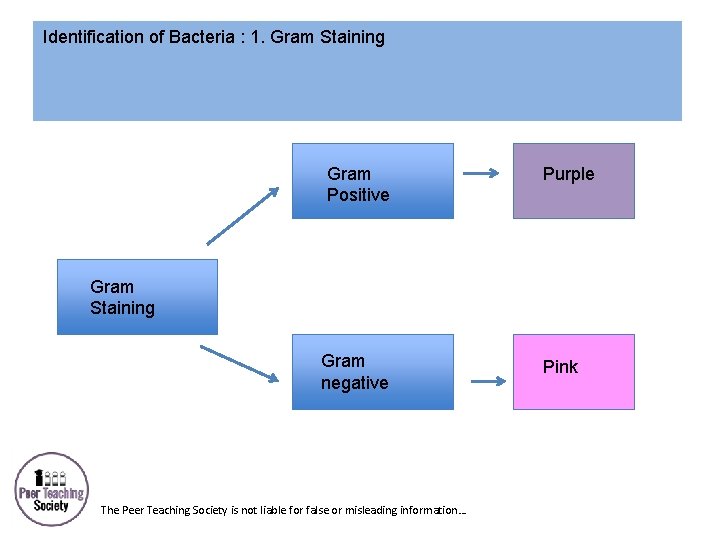
Identification of Bacteria : 1. Gram Staining Gram Positive Purple Gram Staining Gram negative The Peer Teaching Society is not liable for false or misleading information… Pink
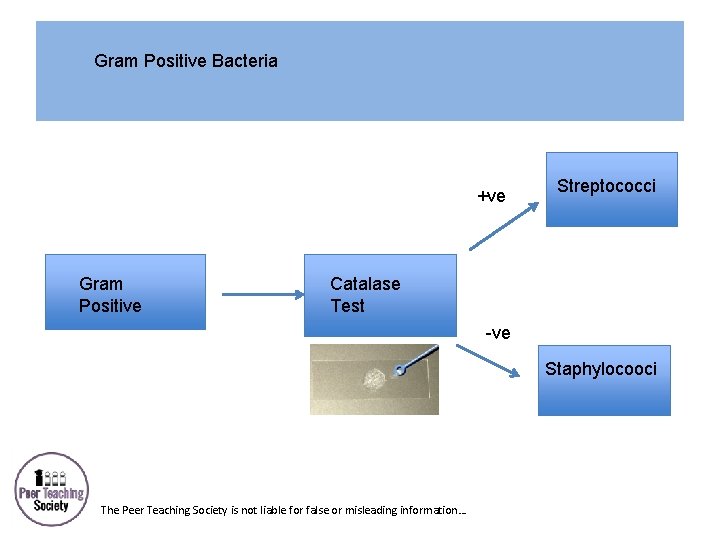
Gram Positive Bacteria +ve Gram Positive Streptococci Catalase Test -ve Staphylocooci The Peer Teaching Society is not liable for false or misleading information…
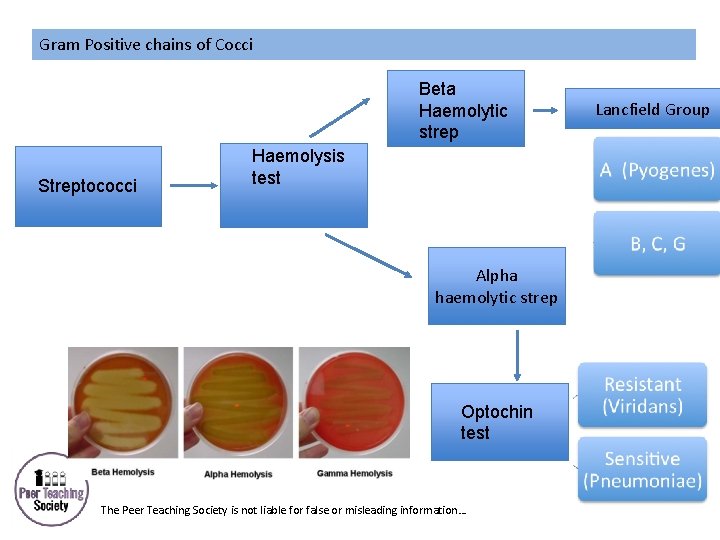
Gram Positive chains of Cocci Beta Haemolytic strep Streptococci Haemolysis test Alpha haemolytic strep Optochin test The Peer Teaching Society is not liable for false or misleading information… Lancfield Group
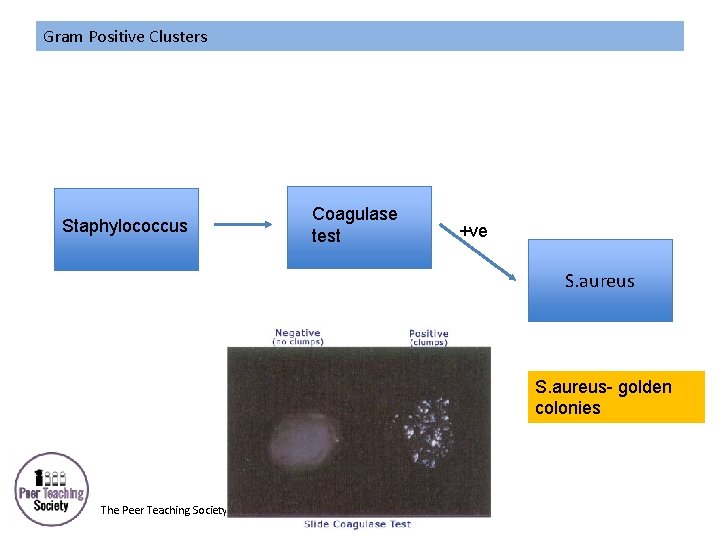
Gram Positive Clusters Staphylococcus Coagulase test +ve S. aureus- golden colonies The Peer Teaching Society is not liable for false or misleading information…
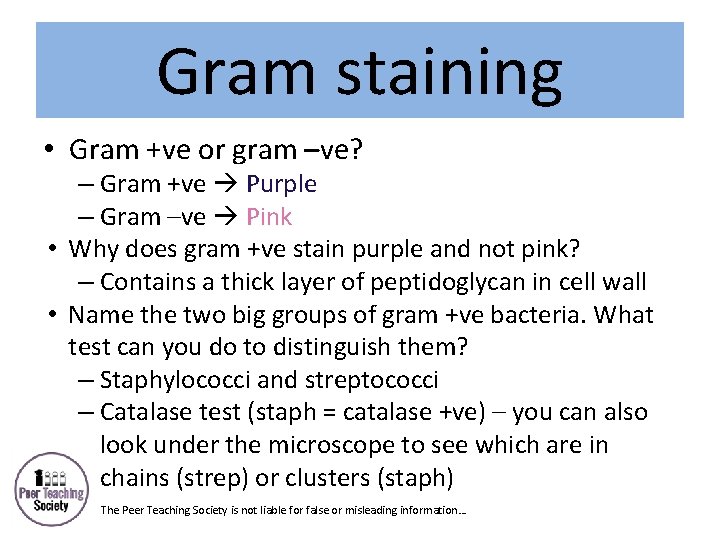
Gram staining • Gram +ve or gram –ve? – Gram +ve Purple – Gram –ve Pink • Why does gram +ve stain purple and not pink? – Contains a thick layer of peptidoglycan in cell wall • Name the two big groups of gram +ve bacteria. What test can you do to distinguish them? – Staphylococci and streptococci – Catalase test (staph = catalase +ve) – you can also look under the microscope to see which are in chains (strep) or clusters (staph) The Peer Teaching Society is not liable for false or misleading information…
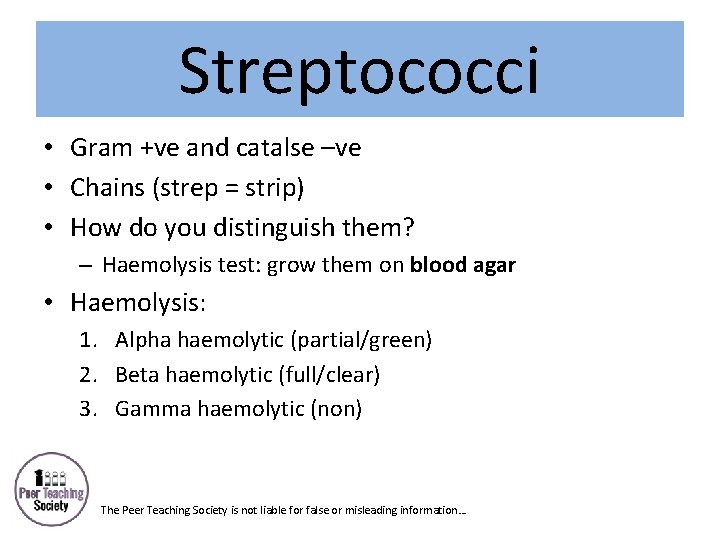
Streptococci • Gram +ve and catalse –ve • Chains (strep = strip) • How do you distinguish them? – Haemolysis test: grow them on blood agar • Haemolysis: 1. Alpha haemolytic (partial/green) 2. Beta haemolytic (full/clear) 3. Gamma haemolytic (non) The Peer Teaching Society is not liable for false or misleading information…
Streptococci • Lancefield grouping? What organism is in group A that is resistant to optochin? – Beta haemolytic streptococci differentiation – Group A: strep. pyogenes The Peer Teaching Society is not liable for false or misleading information…
Staphylococci • Gram +ve and catalase +ve • Clusters • How do you distinguish them? – Coagulase test – Results: • Coagulase +ve = staphylococcus blood agar) • Coagulase –ve = staph. Epidermidis The Peer Teaching Society is not liable for false or misleading information… aureus (GOLD on
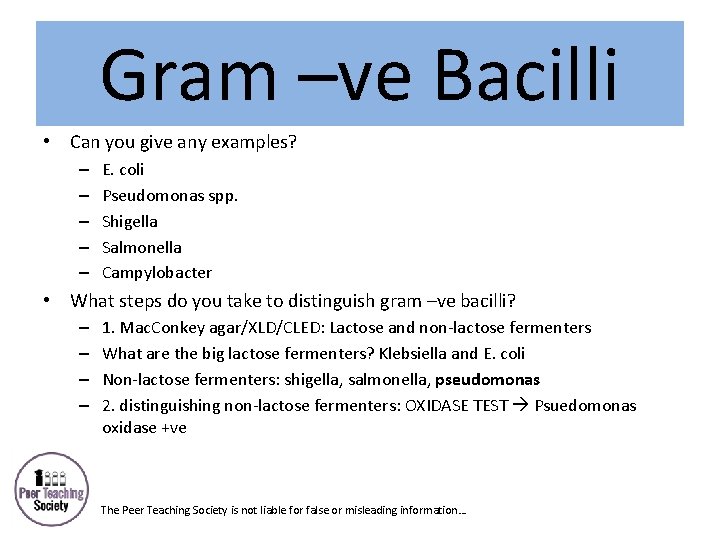
Gram –ve Bacilli • Can you give any examples? – – – E. coli Pseudomonas spp. Shigella Salmonella Campylobacter • What steps do you take to distinguish gram –ve bacilli? – – 1. Mac. Conkey agar/XLD/CLED: Lactose and non-lactose fermenters What are the big lactose fermenters? Klebsiella and E. coli Non-lactose fermenters: shigella, salmonella, pseudomonas 2. distinguishing non-lactose fermenters: OXIDASE TEST Psuedomonas oxidase +ve The Peer Teaching Society is not liable for false or misleading information…
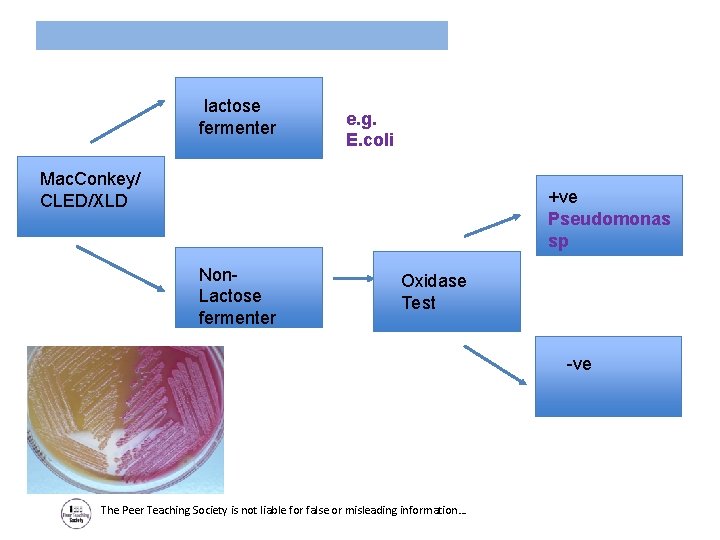
lactose fermenter e. g. E. coli Mac. Conkey/ CLED/XLD +ve Pseudomonas sp Non. Lactose fermenter Oxidase Test -ve The Peer Teaching Society is not liable for false or misleading information…
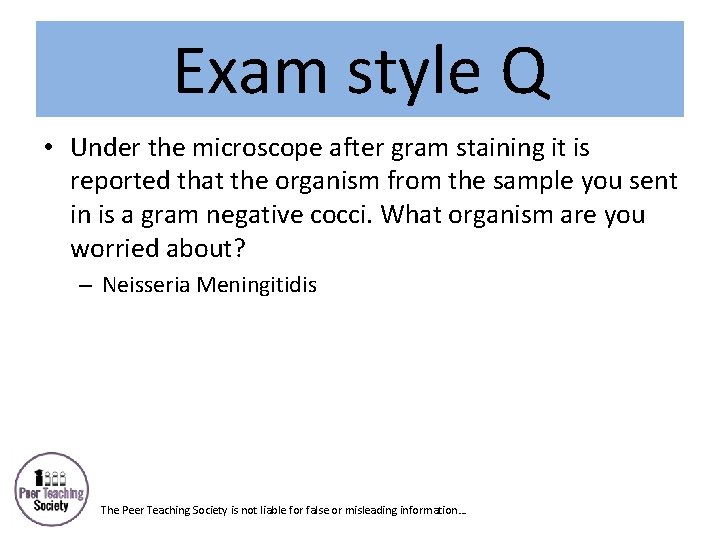
Exam style Q • Under the microscope after gram staining it is reported that the organism from the sample you sent in is a gram negative cocci. What organism are you worried about? – Neisseria Meningitidis The Peer Teaching Society is not liable for false or misleading information…
• A 57 year old women is referred to hospital with a 6 week history of night sweats and malaise. She is noted to have a new cardiac murmur and some marks on her nails. She has a frequent history of dental problems and last visited the dentist 2 months ago. • What is going on here? The Peer Teaching Society is not liable for false or misleading information…
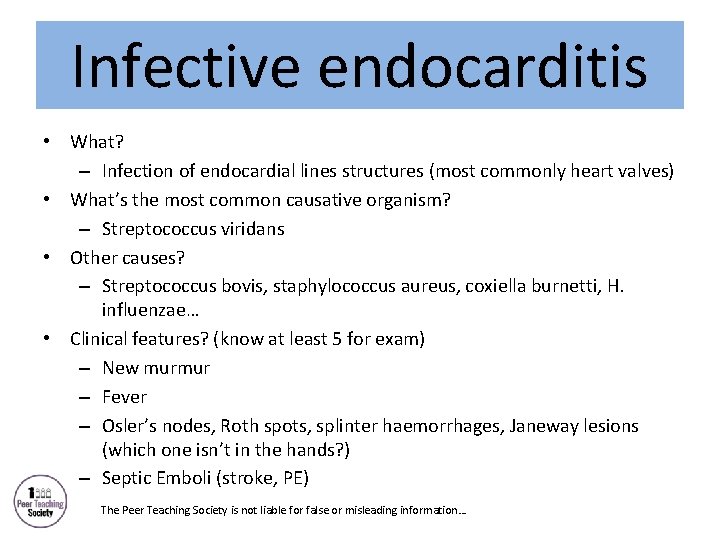
Infective endocarditis • What? – Infection of endocardial lines structures (most commonly heart valves) • What’s the most common causative organism? – Streptococcus viridans • Other causes? – Streptococcus bovis, staphylococcus aureus, coxiella burnetti, H. influenzae… • Clinical features? (know at least 5 for exam) – New murmur – Fever – Osler’s nodes, Roth spots, splinter haemorrhages, Janeway lesions (which one isn’t in the hands? ) – Septic Emboli (stroke, PE) The Peer Teaching Society is not liable for false or misleading information…
- Slides: 17