
Microbiology Chapter 7 Microbial Genetics 2018 Pearson Education
Microbiology Chapter 7 Microbial Genetics © 2018 Pearson Education, Inc.
The Structure and Replication of Genomes • Genetics • Study of • how traits are expressed in organisms, and • how they are propagated from: • One organism to other organisms (uncommon) or • One organism to their progeny (very common) • Genome • The entire genetic complement of an organism • Includes: • Its nucleotide sequences • Its genes • How genes are housed and protected: • chromosomes (all organisms; large) and • plasmids (for microbes; small) © 2018 Pearson Education, Inc.
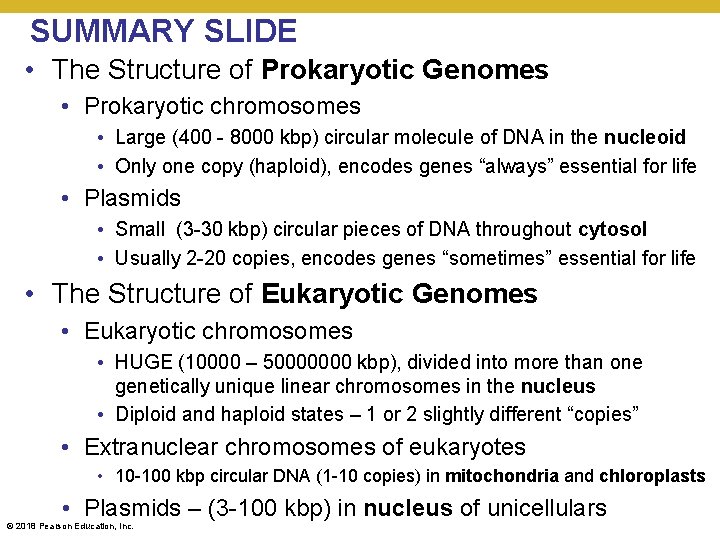
SUMMARY SLIDE • The Structure of Prokaryotic Genomes • Prokaryotic chromosomes • Large (400 - 8000 kbp) circular molecule of DNA in the nucleoid • Only one copy (haploid), encodes genes “always” essential for life • Plasmids • Small (3 -30 kbp) circular pieces of DNA throughout cytosol • Usually 2 -20 copies, encodes genes “sometimes” essential for life • The Structure of Eukaryotic Genomes • Eukaryotic chromosomes • HUGE (10000 – 50000000 kbp), divided into more than one genetically unique linear chromosomes in the nucleus • Diploid and haploid states – 1 or 2 slightly different “copies” • Extranuclear chromosomes of eukaryotes • 10 -100 kbp circular DNA (1 -10 copies) in mitochondria and chloroplasts • Plasmids – (3 -100 kbp) in nucleus of unicellulars © 2018 Pearson Education, Inc.
The Structure of Prokaryotic Genomes • Prokaryotic chromosomes • Large (>400 kbp) circular molecule of DNA in the nucleoid • Most of genome encodes genes and their regulatory regions • Very little DNA has no apparent function • Single copy of the genome – always haploid • Rarely, second copies of some genes are TRANSIENTLY acquired through horizontal gene transfer • These extra copies are often “shuffled” with a nearly exact gene in the genome in a process called recombination • Improved genes survive to progeny • Deteriorated genes result in obsolescence or death • Extra gene copies are degraded soon afterward © 2018 Pearson Education, Inc.
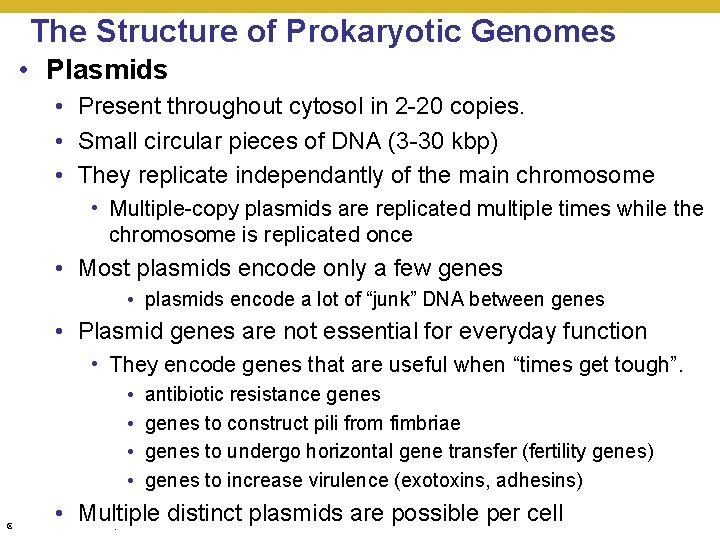
The Structure of Prokaryotic Genomes • Plasmids • Present throughout cytosol in 2 -20 copies. • Small circular pieces of DNA (3 -30 kbp) • They replicate independantly of the main chromosome • Multiple-copy plasmids are replicated multiple times while the chromosome is replicated once • Most plasmids encode only a few genes • plasmids encode a lot of “junk” DNA between genes • Plasmid genes are not essential for everyday function • They encode genes that are useful when “times get tough”. • • antibiotic resistance genes to construct pili from fimbriae genes to undergo horizontal gene transfer (fertility genes) genes to increase virulence (exotoxins, adhesins) • Multiple distinct plasmids are possible per cell © 2018 Pearson Education, Inc.
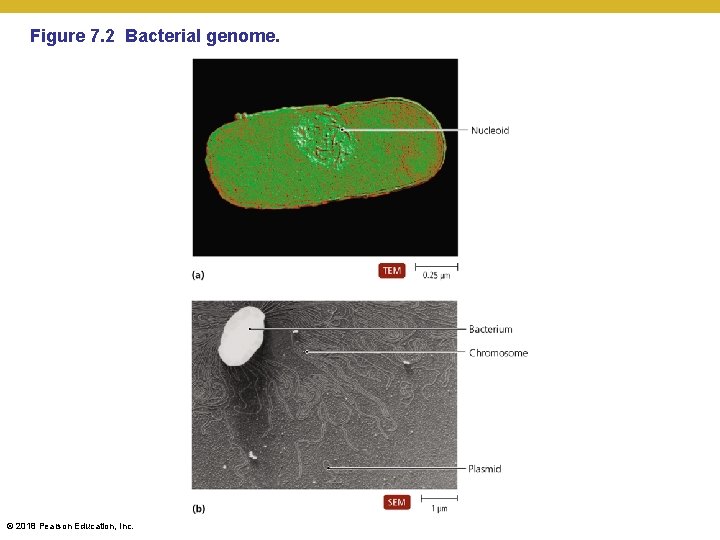
Figure 7. 2 Bacterial genome. © 2018 Pearson Education, Inc.
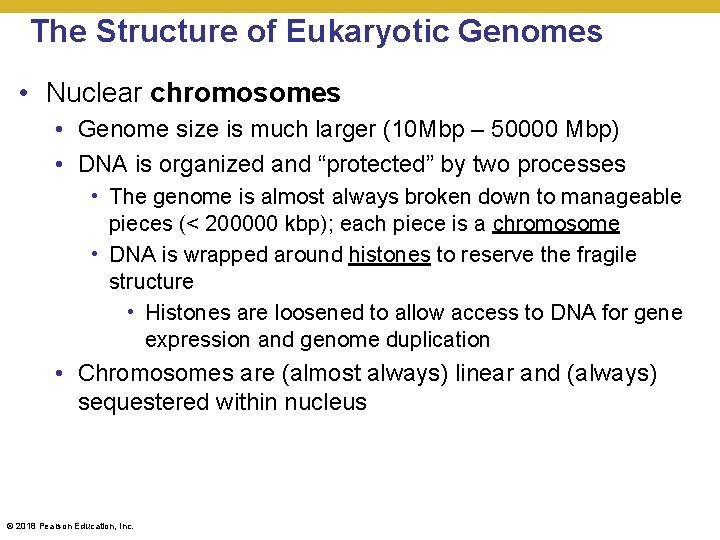
The Structure of Eukaryotic Genomes • Nuclear chromosomes • Genome size is much larger (10 Mbp – 50000 Mbp) • DNA is organized and “protected” by two processes • The genome is almost always broken down to manageable pieces (< 200000 kbp); each piece is a chromosome • DNA is wrapped around histones to reserve the fragile structure • Histones are loosened to allow access to DNA for gene expression and genome duplication • Chromosomes are (almost always) linear and (always) sequestered within nucleus © 2018 Pearson Education, Inc.
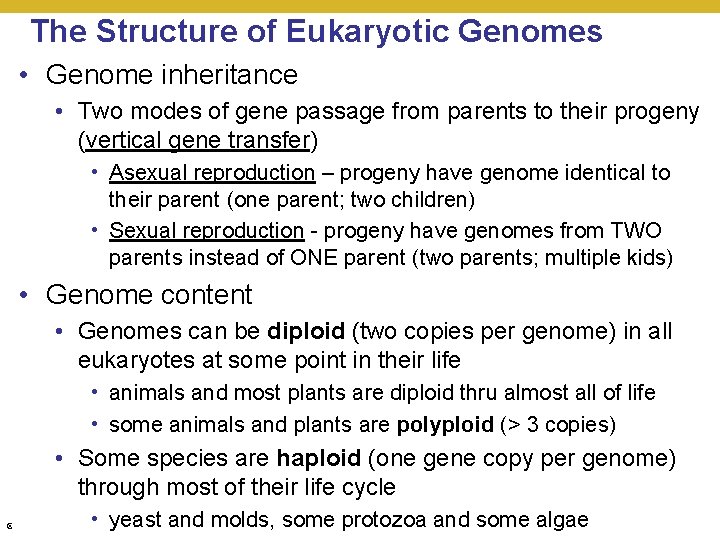
The Structure of Eukaryotic Genomes • Genome inheritance • Two modes of gene passage from parents to their progeny (vertical gene transfer) • Asexual reproduction – progeny have genome identical to their parent (one parent; two children) • Sexual reproduction - progeny have genomes from TWO parents instead of ONE parent (two parents; multiple kids) • Genome content • Genomes can be diploid (two copies per genome) in all eukaryotes at some point in their life • animals and most plants are diploid thru almost all of life • some animals and plants are polyploid (> 3 copies) • Some species are haploid (one gene copy per genome) through most of their life cycle • yeast and molds, some protozoa and some algae © 2018 Pearson Education, Inc.
The Structure of Eukaryotic Genomes • Diploid genomes have two very similar but NOT identical chromosome copies after sexual reproduction • One copy from father, and one copy from mother • Mother’s and father’s two chromosome copies are segregated to single copies per cell during meiosis • Genomes split into chromosomes are shuffled among progeny • Improves genetic diversity among children • There are 2 N possible varieties of haploid chromosomes in gametes after meiosis • 3 chromosomes – 23 = 8 varieties • 23 chromosomes – 223 = 8 million varieties • 33 chromosomes – 233 = 8 billion varieties © 2018 Pearson Education, Inc.
The Structure of Eukaryotic Genomes • Extranuclear DNA of eukaryotes • Mitochondrial DNA • Resembles prokaryotic genomic DNA • 2 -10 circular copies (usually 10 -30 kbp) per mitochondria ; all genetically identical (and thus haploid) in each mitochondrion • 10 -1000 mitochondria per cell (most microbes have < 100 per cell) • In some species, mitochondria can come from mother and father and can be distinct; most species’ mitochondria are from only one parent • Mitochondria replicate independently in cells with metabolic needs • Only code for about 5% of RNA and proteins • Chloroplast DNA • • • Resembles prokaryotic genomic DNA 2 -20 circular copies (100 -500 kbp), all genetically identical Most species’ chloroplasts are from only one parent (usually “mom”) Chloroplast replicate independently in cells with metabolic needs Only code for about 5% of RNA and proteins © 2018 Pearson Education, Inc.
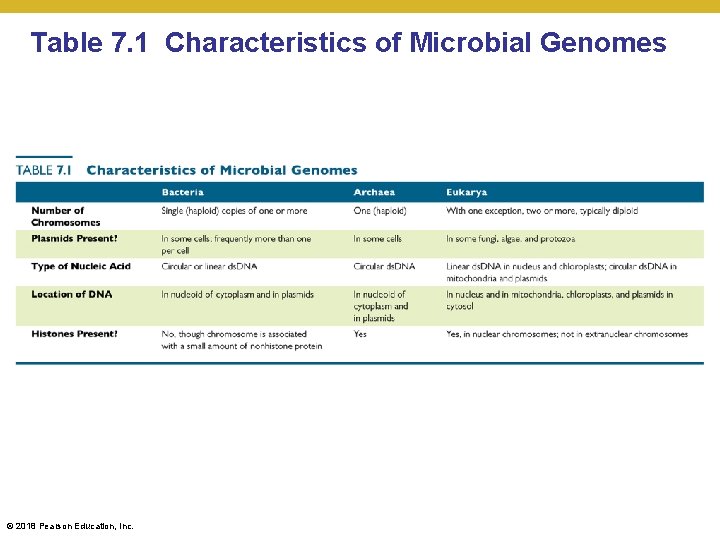
Table 7. 1 Characteristics of Microbial Genomes © 2018 Pearson Education, Inc.
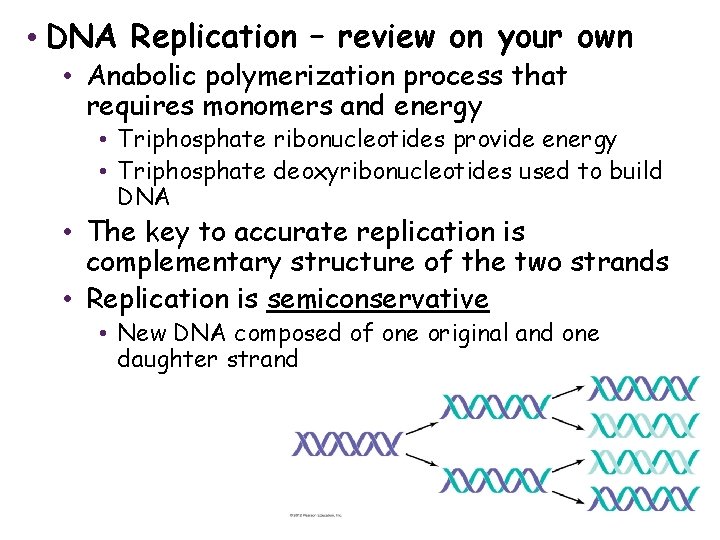
• DNA Replication – review on your own • Anabolic polymerization process that requires monomers and energy • Triphosphate ribonucleotides provide energy • Triphosphate deoxyribonucleotides used to build DNA • The key to accurate replication is complementary structure of the two strands • Replication is semiconservative • New DNA composed of one original and one daughter strand
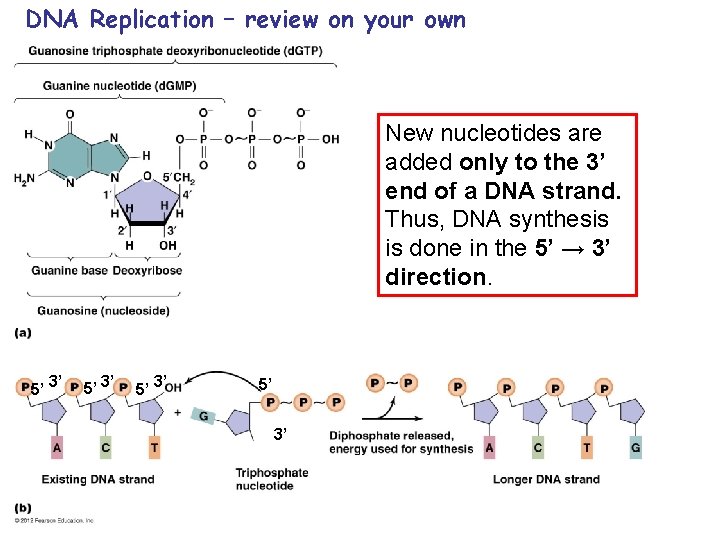
DNA Replication – review on your own New nucleotides are added only to the 3’ end of a DNA strand. Thus, DNA synthesis is done in the 5’ → 3’ direction. 5’ 3’
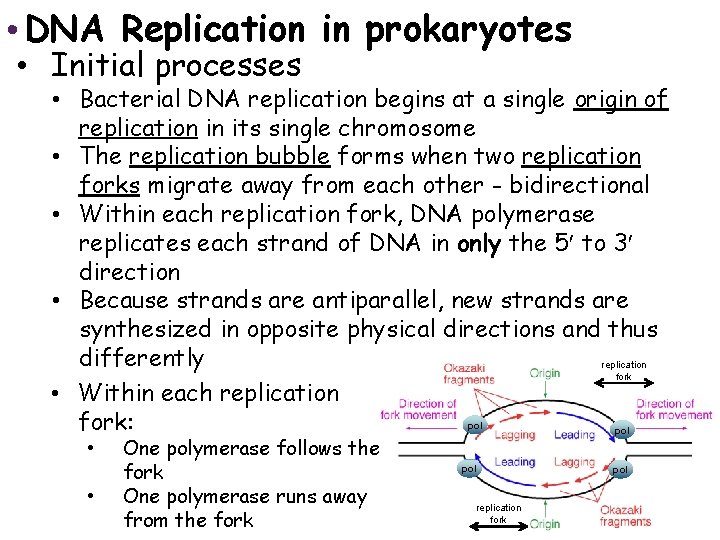
Structure and Replication of Genomes • The DNA Replication in prokaryotes • Initial processes • Bacterial DNA replication begins at a single origin of replication in its single chromosome • The replication bubble forms when two replication forks migrate away from each other - bidirectional • Within each replication fork, DNA polymerase replicates each strand of DNA in only the 5 to 3 direction • Because strands are antiparallel, new strands are synthesized in opposite physical directions and thus differently replication fork • Within each replication pol fork: pol One polymerase follows the fork • One polymerase runs away from © 2012 Pearson Education Inc. the fork • pol replication fork pol
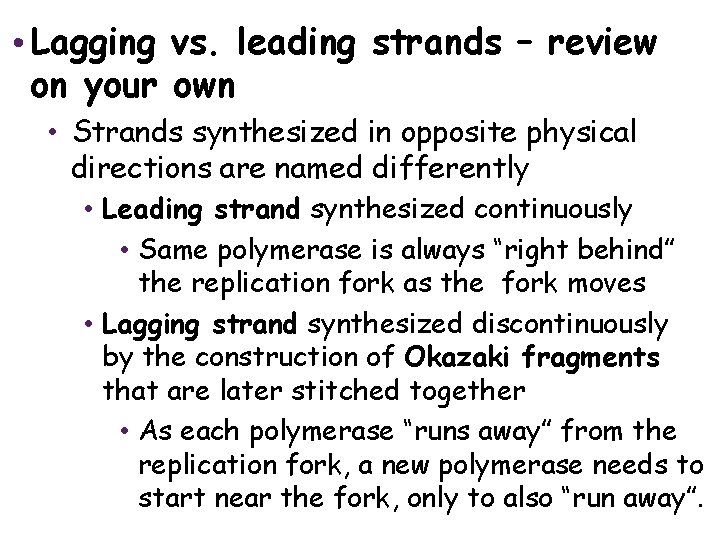
The Structure and Replication of Genomes • Lagging vs. leading strands – review on your own • Strands synthesized in opposite physical directions are named differently • Leading strand synthesized continuously • Same polymerase is always “right behind” the replication fork as the fork moves • Lagging strand synthesized discontinuously by the construction of Okazaki fragments that are later stitched together • As each polymerase “runs away” from the replication fork, a new polymerase needs to start near the fork, only to also “run away”. © 2012 Pearson Education Inc.
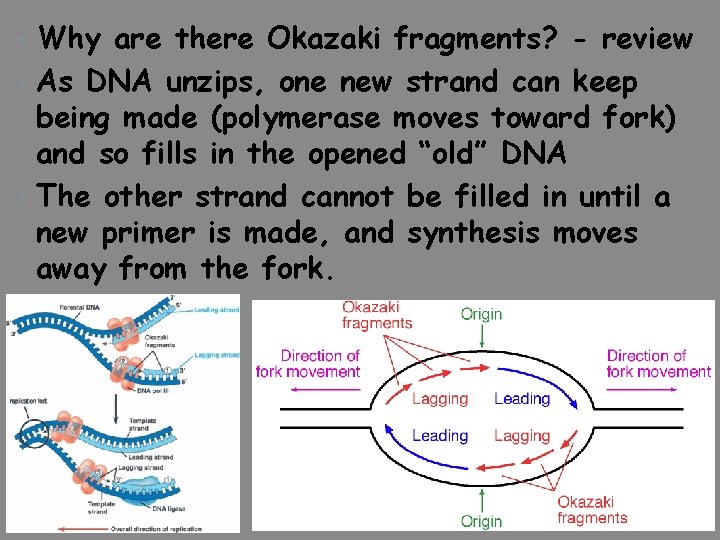
Why are there Okazaki fragments? - review As DNA unzips, one new strand can keep being made (polymerase moves toward fork) and so fills in the opened “old” DNA The other strand cannot be filled in until a new primer is made, and synthesis moves away from the fork. © 2012 Pearson Education Inc.
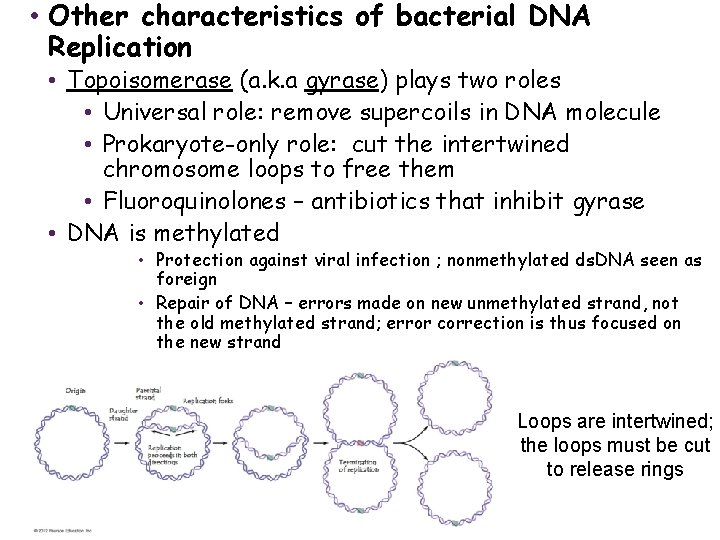
• Other characteristics of bacterial DNA Replication • Topoisomerase (a. k. a gyrase) plays two roles • Universal role: remove supercoils in DNA molecule • Prokaryote-only role: cut the intertwined chromosome loops to free them • Fluoroquinolones – antibiotics that inhibit gyrase • DNA is methylated • Protection against viral infection ; nonmethylated ds. DNA seen as foreign • Repair of DNA – errors made on new unmethylated strand, not the old methylated strand; error correction is thus focused on the new strand Loops are intertwined; the loops must be cut to release rings © 2012 Pearson Education Inc.
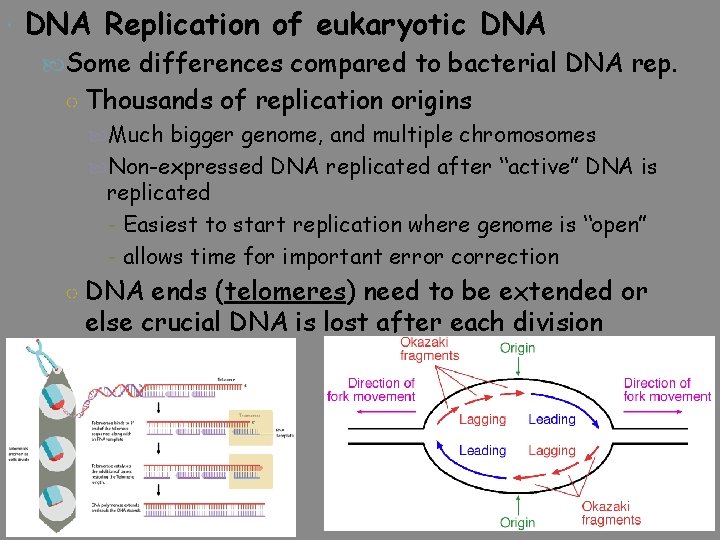
DNA Replication of eukaryotic DNA Some differences compared to bacterial DNA rep. ○ Thousands of replication origins Much bigger genome, and multiple chromosomes Non-expressed DNA replicated after “active” DNA is replicated - Easiest to start replication where genome is “open” - allows time for important error correction ○ DNA ends (telomeres) need to be extended or else crucial DNA is lost after each division © 2012 Pearson Education Inc.
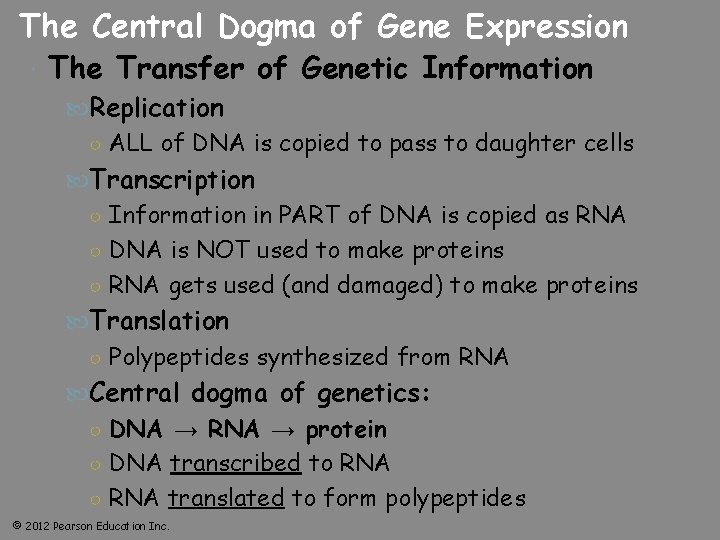
The Central Dogma of Gene Expression The Transfer of Genetic Information Replication ○ ALL of DNA is copied to pass to daughter cells Transcription ○ Information in PART of DNA is copied as RNA ○ DNA is NOT used to make proteins ○ RNA gets used (and damaged) to make proteins Translation ○ Polypeptides synthesized from RNA Central dogma of genetics: ○ DNA → RNA → protein ○ DNA transcribed to RNA ○ RNA translated to form polypeptides © 2012 Pearson Education Inc.
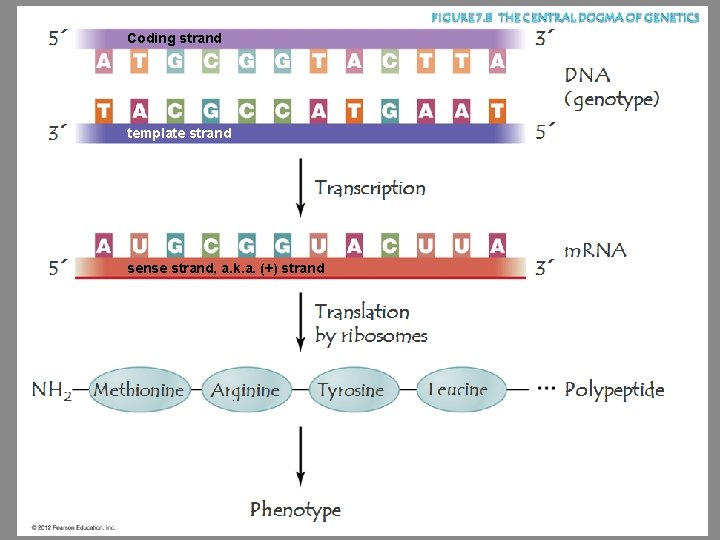
Coding strand template strand sense strand, a. k. a. (+) strand
The Events in Transcription – review on your own Four types of RNA transcribed from DNA ○ RNA primers – start DNA strand synthesis; removed later ○ m. RNA – to express protein-encoding genes ○ r. RNA – for ribosome structure, mechanics and function ○ t. RNA – to match a specific RNA triplet codon sequence to a specific and correct amino acid RNA is synthesized in nucleoid of prokaryotes, or the nucleus of eukaryotes Three steps of transcription ○ Initiation – most regulation controls this step ○ Elongation – builds the RNA ○ Termination – releases the finished RNA © 2012 Pearson Education Inc.
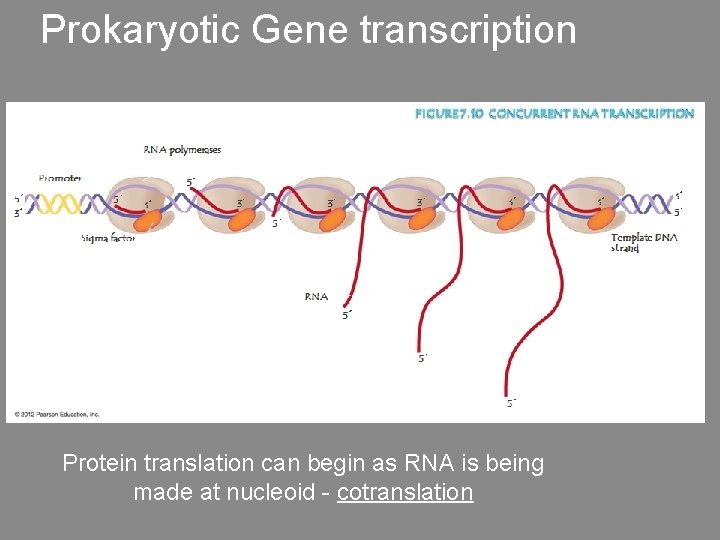
Prokaryotic Gene transcription Protein translation can begin as RNA is being made at nucleoid - cotranslation
Translation – to review on your own Occurs in the cytosol in both prokaryotes and eukaryotes Process where ribosomes use genetic information of nucleotide sequences in m. RNA to synthesize polypeptides Nucleotide triplets are translated to amino acid monomers through the genetic code Participants in translation Messenger RNA – dictates the protein sequence via a series of nucleotide triplet codons Transfer RNA – contains the amino acids to be inserted into the protein Ribosomes and ribosomal RNA – organizes ribosome and m. RNA; catalyzes the production of a protein consistent with the m. RNA sequence © 2012 Pearson Education Inc.
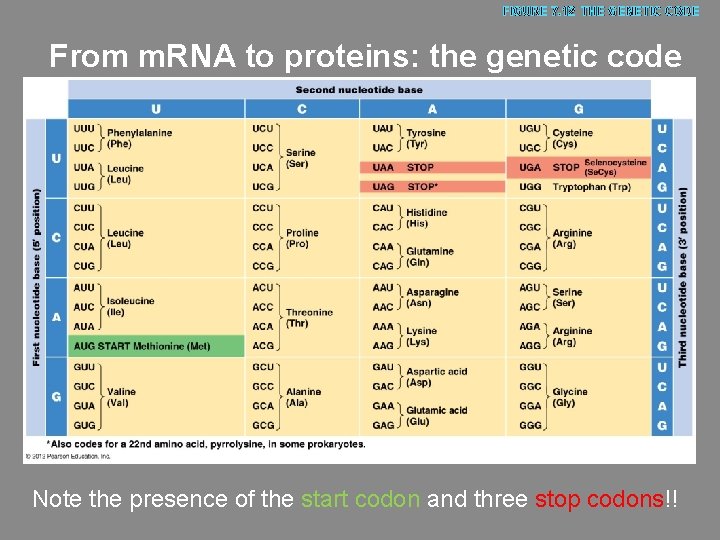
FIGURE 7. 12 THE GENETIC CODE From m. RNA to proteins: the genetic code Note the presence of the start codon and three stop codons!!
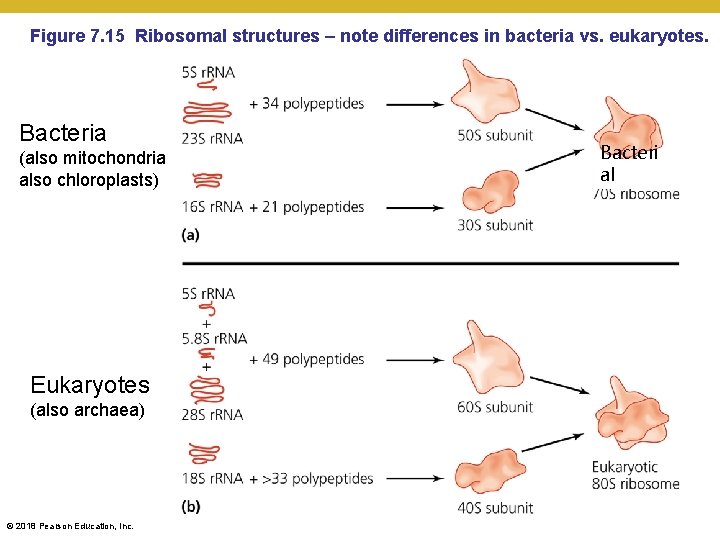
Figure 7. 15 Ribosomal structures – note differences in bacteria vs. eukaryotes. Bacteria (also mitochondria also chloroplasts) Eukaryotes (also archaea) © 2018 Pearson Education, Inc. Bacteri al
Mutations of Genes • Mutation • Change in the nucleotide base sequence of a gene in the genome • Rare event (1: 104 during DNA replication; 1: 108 after error correction (error correction 99. 99% effective) • Almost always deleterious • Rarely leads to a protein that improves ability of organism to survive • How often are changes to a car bad (flat tire, old brakes) • How often are changes to a car good (does oil in car get better with time) • Ribosomes do not know m. RNA is altered; it must remain dumb to what it is making © 2018 Pearson Education, Inc.

RIBSOMES ARE DUMB, AND ONLY READ WHAT THEY ARE TOLD……
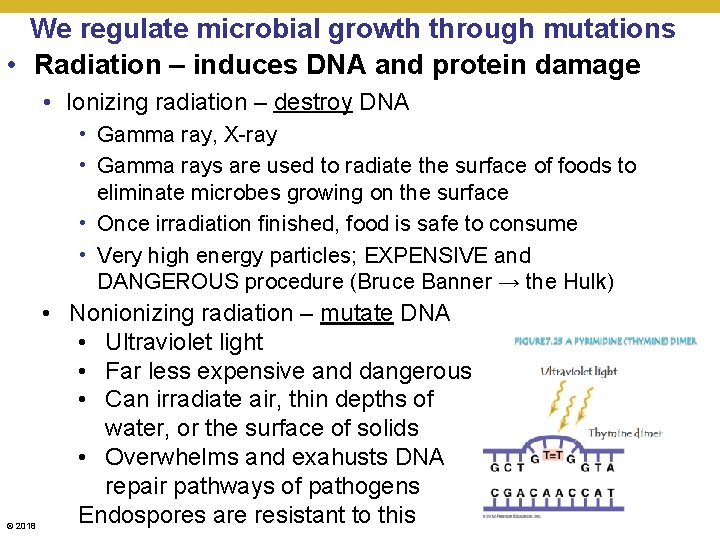
We regulate microbial growth through mutations • Radiation – induces DNA and protein damage • Ionizing radiation – destroy DNA • Gamma ray, X-ray • Gamma rays are used to radiate the surface of foods to eliminate microbes growing on the surface • Once irradiation finished, food is safe to consume • Very high energy particles; EXPENSIVE and DANGEROUS procedure (Bruce Banner → the Hulk) • Nonionizing radiation – mutate DNA • Ultraviolet light • Far less expensive and dangerous • Can irradiate air, thin depths of water, or the surface of solids • Overwhelms and exahusts DNA repair pathways of pathogens Endospores are resistant to this © 2018 Pearson Education, Inc.
Horizontal Gene Transfer • Recipient cell incorporates DNA from a “donor” • Occurs independant of cell division, mitosis or meiosis • Occurs independant of sexual or asexual reproduction • These are most commonly seen among prokaryotes, but has been observed in fungi and some protozoa • This is how new strains within a species of microbes most commonly appear or evolve • Gain antibiotic resistance • Acquire virulence factors © 2018 Pearson Education, Inc.
Horizontal Gene Transfer – SUMMARY SLIDE • There are three common modes of horizontal gene transfer. All involve taking up DNA: • Transformation – take up DNA from surroundings (dead cells or cell debris? ) • Transduction – take up DNA from a pathogenic infection (most often viral) • Conjugation – take up DNA from an intact cell (involves specialized structures like pili) © 2018 Pearson Education, Inc.
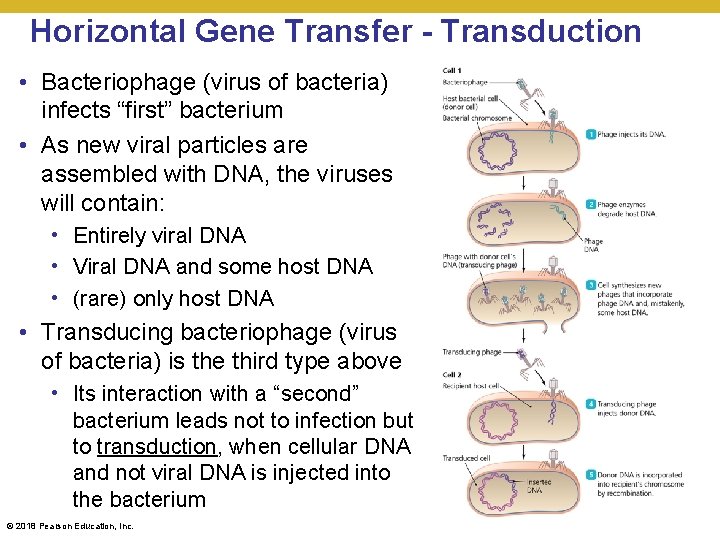
Horizontal Gene Transfer - Transduction • Bacteriophage (virus of bacteria) infects “first” bacterium • As new viral particles are assembled with DNA, the viruses will contain: • Entirely viral DNA • Viral DNA and some host DNA • (rare) only host DNA • Transducing bacteriophage (virus of bacteria) is the third type above • Its interaction with a “second” bacterium leads not to infection but to transduction, when cellular DNA and not viral DNA is injected into the bacterium © 2018 Pearson Education, Inc.
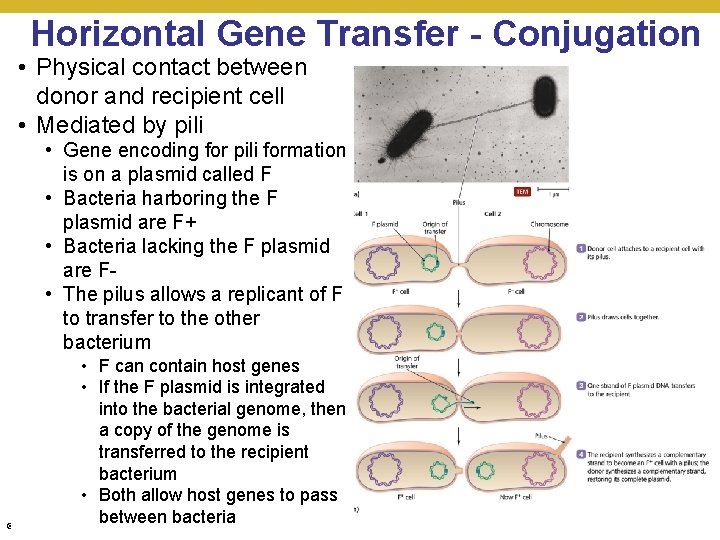
Horizontal Gene Transfer - Conjugation • Physical contact between donor and recipient cell • Mediated by pili • Gene encoding for pili formation is on a plasmid called F • Bacteria harboring the F plasmid are F+ • Bacteria lacking the F plasmid are F • The pilus allows a replicant of F to transfer to the other bacterium • F can contain host genes • If the F plasmid is integrated into the bacterial genome, then a copy of the genome is transferred to the recipient bacterium • Both allow host genes to pass between bacteria © 2018 Pearson Education, Inc.
Genetic Recombination after Gene Transfer • Genetic Recombination • Exchange of nucleotide sequences often occurs between homologous sequences within a single cell • Usually occurs after microbial cells obtain new DNA molecules with potentially new nucleotide sequences (most often from horizontal gene transfer) • Shuffling the deck with new cards…some times you get a better hand, most of the time you do not. • Surviving cells (or those who gained an advantage) pass these rearranged or modified genomes to their descendants • This is a major mechanism explaining how many bacteria evolve to become more resistant to antibiotics © 2018 Pearson Education, Inc.
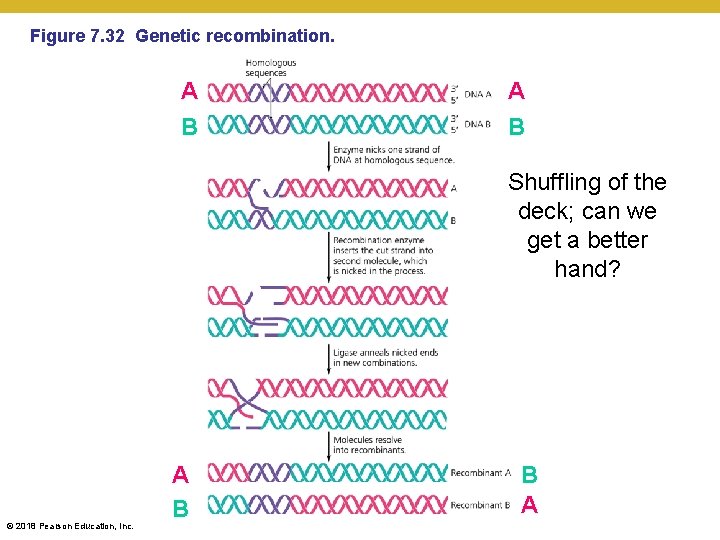
Figure 7. 32 Genetic recombination. A B Shuffling of the deck; can we get a better hand? © 2018 Pearson Education, Inc. A B B A
- Slides: 34