
MICROBIOLOGY Chapter 16 Nonspecific Defenses of the Host
MICROBIOLOGY Chapter 16 Nonspecific Defenses of the Host Dr. Abdelraouf A. Elmanama Ph. D Microbiology Medical Technology Department, Faculty of Science, Islamic University-Gaza 2008
Nonspecific Defenses of the Host • Susceptibility Lack of resistance to a disease • Resistance Ability to ward off disease • Nonspecific resistance Defenses against any pathogen • Specific resistance Immunity, resistance to a specific pathogen 2008
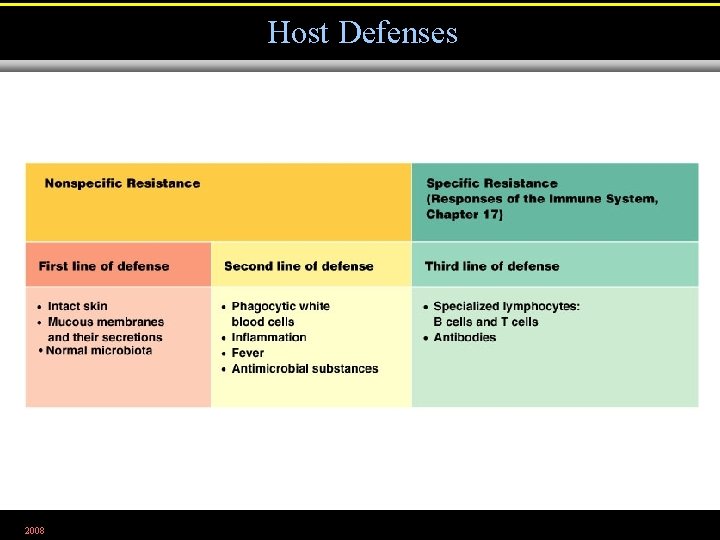
Host Defenses 2008 Figure 16. 1
Mechanical Factors • Skin • Epidermis consists of tightly packed cells with • Keratin, a protective protein 2008

Mechanical Factors • Mucous membranes • Ciliary escalator: Microbes trapped in mucus are transported away from the lungs • Lacrimal apparatus: Washes eye • Saliva: Washes microbes off • Urine: Flows out • Vaginal secretions: Flow out 2008

Chemical Factors • Fungistatic fatty acid in sebum • Low p. H (3 -5) of skin • Lysozyme in perspiration, tears, saliva, and tissue fluids • Low p. H (1. 2 -3. 0) of gastric juice • Transferrins in blood find iron • NO inhibits ATP production 2008
Normal Microbiota • Microbial antagonism/competitive exclusion: Normal microbiota compete with pathogens. 2008

Formed Elements In Blood 2008 Table 16. 1

Differential White Cell Count • Percentage of each type of white cell in a sample of 100 white blood cells 2008 Neutrophils 60 -70% Basophils 0. 5 -1% Eosinophils 2 -4% Monocytes 3 -8% Lymphocytes 20 -25%
White Blood Cells • Neutrophils: Phagocytic • Basophils: Produce histamine • Eosinophils: Toxic to parasites, some phagocytosis • Monocytes: Phagocytic as mature macrophages • Fixed macrophages in lungs, liver, bronchi • Wandering macrophages roam tissues • Lymphocytes: Involved in specific immunity 2008

Phagocytosis • Phago: eat • Cyte: cell • Ingestion of microbes or particles by a cell, performed by phagocytes 2008
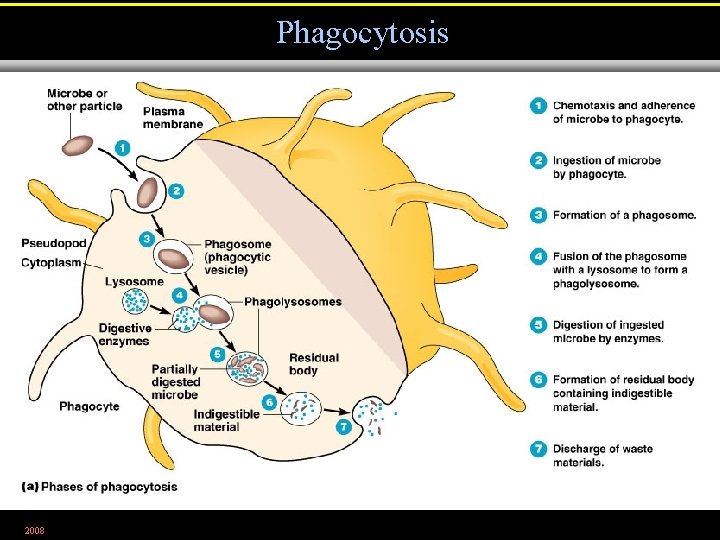
Phagocytosis 2008 Figure 16. 8 a

Microbial Evasion of Phagocytosis • Inhibit adherence: M protein, capsules • Kill phagocytes: Leukocidins Streptococcus pyogenes, S. pneumoniae • Lyse phagocytes: Membrane attack complex • Escape phagosome Listeriamonocytogenes • Prevent phagosome-lysosome fusion • Survive in phagolysosome HIV 2008 Staphylococcus aureus Shigella Coxiella burnetti

Inflammation • Redness • Pain • Heat • Swelling (edema( • Acute-phase proteins activated (complement, cytokine, kinins( • Vasodilation (histamine, kinins, prostaglandins, leukotrienes( • Margination and emigration of WBCs • Tissue repair 2008

Chemicals Released by Damaged Cells • Histamine • Kinins • Prostaglandins • Leukotrienes 2008 Vasodilation, increased permeability of blood vessels Intensity histamine and kinin effect Increased permeability of blood vessels, phagocytic attachment

Inflammation 2008 Figure 16. 9 a, b

Inflammation 2008 Figure 16. 9 c, d

Fever: Abnormally High Body Temperature • Hypothalamus normally set at 37°C • Gram-negative endotoxin cause phagocytes to release interleukin 1 • Hypothalamus releases prostaglandins that reset the hypothalamus to a high temperature • Body increases rate of metabolism and shivering to raise temperature • When IL-1 is eliminated, body temperature falls. (Crisis( 2008

The Complement System • Serum proteins activated in a cascade. 2008 Figure 16. 10

Effects of Complement Activation • Opsonization or immune adherence: enhanced phagocytosis • Membrane attack complex: cytolysis • Attract phagocytes 2008 Figure 16. 11

Effects of Complement Activation 2008 Figure 16. 12

Classical Pathway 2008 Figure 16. 13

Alternative Pathway 2008 Figure 16. 14

Lectin Pathway 2008 Figure 16. 15

Some bacteria evade complement • Capsules prevent C activation • Surface lipid-carbohydrates prevent MAC formation • Enzymatic digestion of C 5 a 2008

Interferons (IFNs) • Alpha IFN & Beta IFN: Cause cells to produce antiviral proteins that inhibit viral replication • Gamma IFN: Causes neutrophils and macrophages to phagocytize bacteria 2008

Interferons (IFNs) 2 The infecting virus replicates into new viruses. 1 Viral RNA from an infecting virus enters the cell. 5 New viruses released by the virus-infected host cell infect neighboring host cells. 6 AVPs degrade viral m-RNA and inhibit protein synthesis and thus interfere with viral replication. 3 The infecting virus also induces the host cell to produce interferon on RNA (IFN-m. RNA), which is translated into alpha and beta interferons. 4 Interferons released by the virus-infected host cell bind to plasma membrane or nuclear membrane receptors on uninfected neighboring host cells, inducing them to synthesize antiviral proteins ( AVPs). These include oligoadenylate synthetase, and protein kinase. 2008 Figure 16. 16
- Slides: 27