
MICROBIOLOGY Biotechnology II LETS REVIEW THE BASICS Gram

MICROBIOLOGY Biotechnology II
LET’S REVIEW THE BASICS • Gram stain procedure • Examples of Gram + and – organisms • Terms – Pathogens – Nosocomial – Normal flora – Opportunistic – Pleomorphic
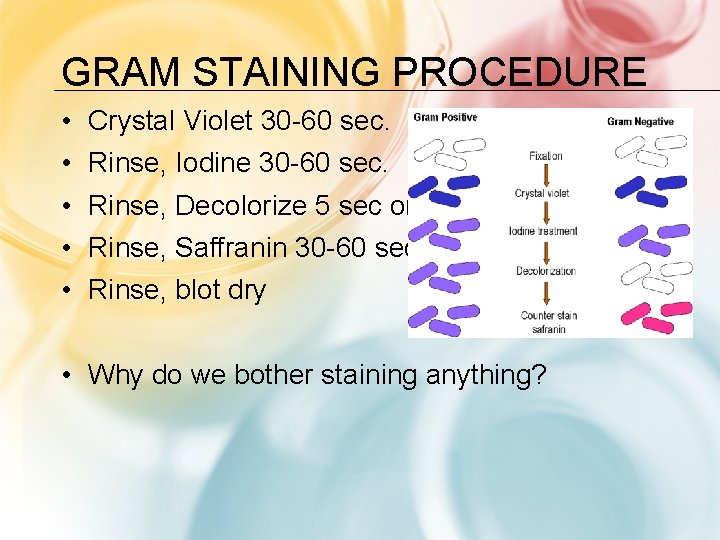
GRAM STAINING PROCEDURE • • • Crystal Violet 30 -60 sec. Rinse, Iodine 30 -60 sec. Rinse, Decolorize 5 sec or flash Rinse, Saffranin 30 -60 sec. Rinse, blot dry • Why do we bother staining anything?
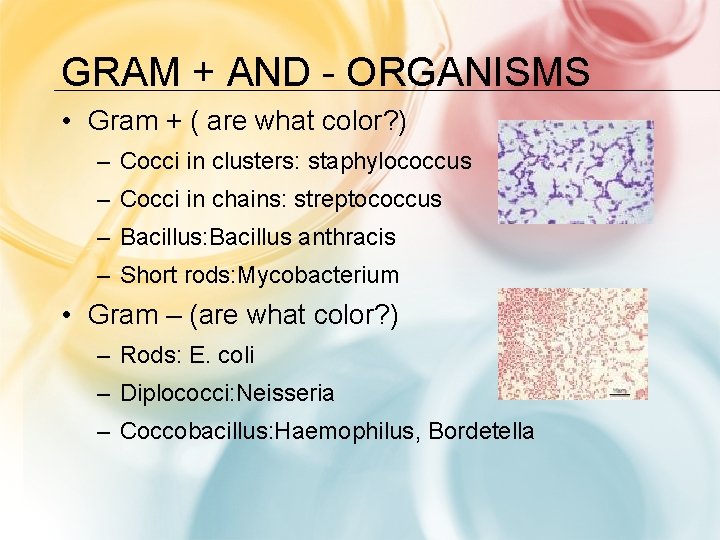
GRAM + AND - ORGANISMS • Gram + ( are what color? ) – Cocci in clusters: staphylococcus – Cocci in chains: streptococcus – Bacillus: Bacillus anthracis – Short rods: Mycobacterium • Gram – (are what color? ) – Rods: E. coli – Diplococci: Neisseria – Coccobacillus: Haemophilus, Bordetella
OUTER MEMBRANE Gram negative bacteria • major permeability barrier • space between inner and outer membrane – periplasmic space vstore degradative enzymes • Gram positive bacteria • no periplasmic space
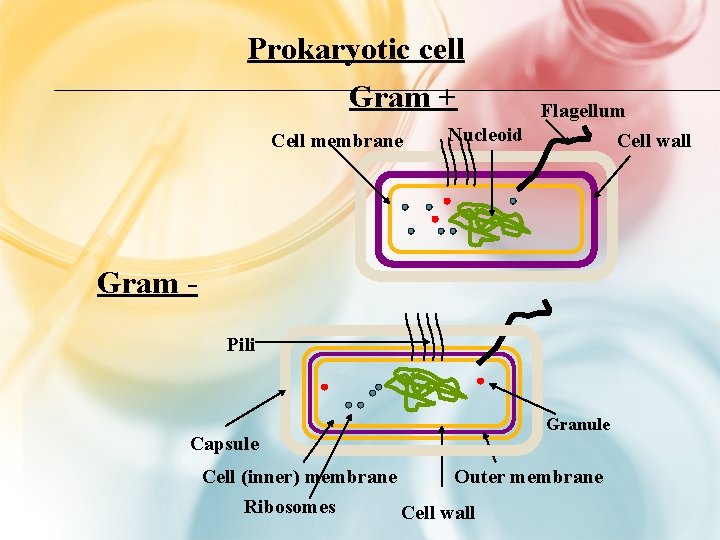
Prokaryotic cell Gram + Cell membrane Flagellum Nucleoid Cell wall Gram Pili Capsule Granule Cell (inner) membrane Outer membrane Ribosomes Cell wall
TERMS • • Normal flora Nosocomial Opportunistic Pleomorphic Resistance Sensitivity Inhibition Broad Spectrum
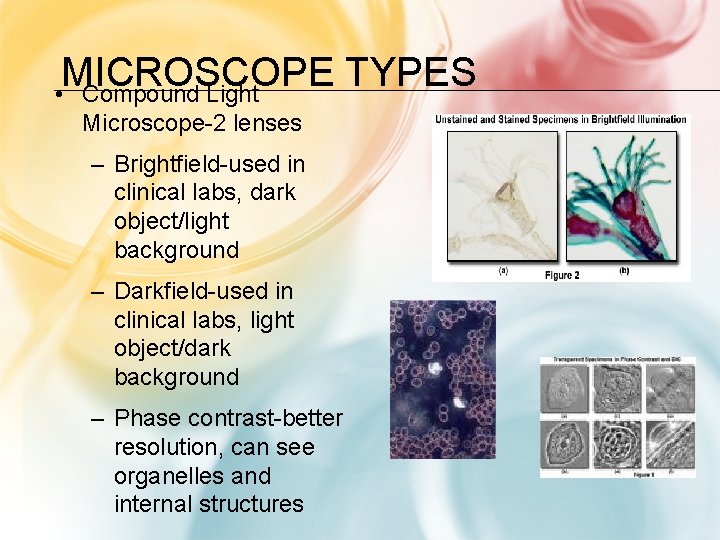
MICROSCOPE TYPES • Compound Light Microscope-2 lenses – Brightfield-used in clinical labs, dark object/light background – Darkfield-used in clinical labs, light object/dark background – Phase contrast-better resolution, can see organelles and internal structures
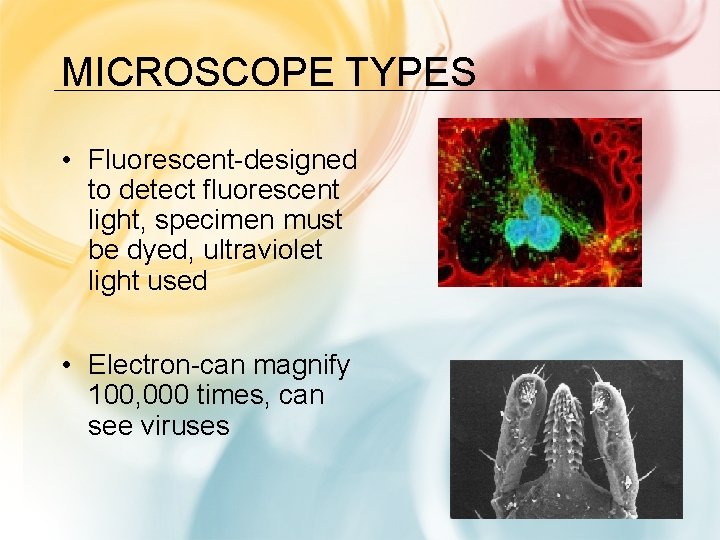
MICROSCOPE TYPES • Fluorescent-designed to detect fluorescent light, specimen must be dyed, ultraviolet light used • Electron-can magnify 100, 000 times, can see viruses
STAINING • Allows for: – Observing bacterial morphology and arrangements – Other critical information such as cell wall structure
STAINING • Types of Stains – Simple-look at morphology and arrangement – Differential-structure – Special-specific structures of bacteria • Before staining you must fix specimen to slide – Procedure: • Place specimen on slide • Dry • Fix on slide with heat-not too hot should be able
STAINING • Simple stain – Good for observing morphology – Result-all bacterial cells stain the same color – Stains might include methylene blue, basic fuchsin, crystal violet • Differential stain – Used to examine morphological features – Involves exposing cells to more than on stain • Ex. Gram Stain, Acid-Fast stain, Capsule stain, Endospore stain • Gram stain – Separates bacteria into two groups • Gram Positive (G+)-deep violet, thick cell wall
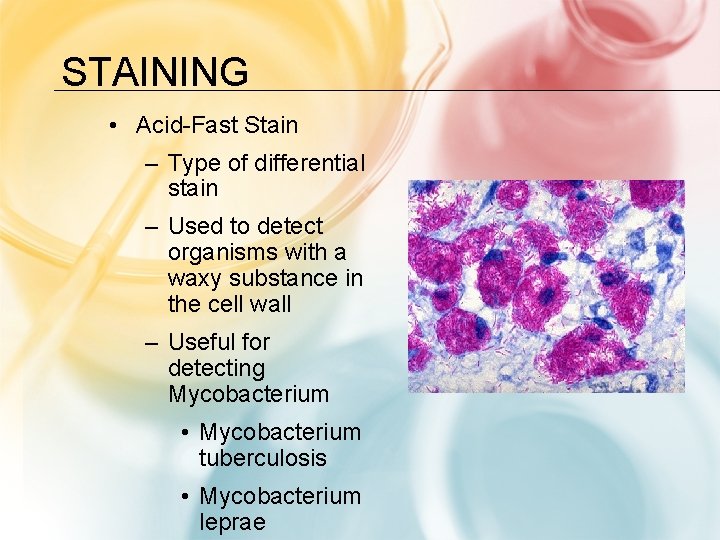
STAINING • Acid-Fast Stain – Type of differential stain – Used to detect organisms with a waxy substance in the cell wall – Useful for detecting Mycobacterium • Mycobacterium tuberculosis • Mycobacterium leprae
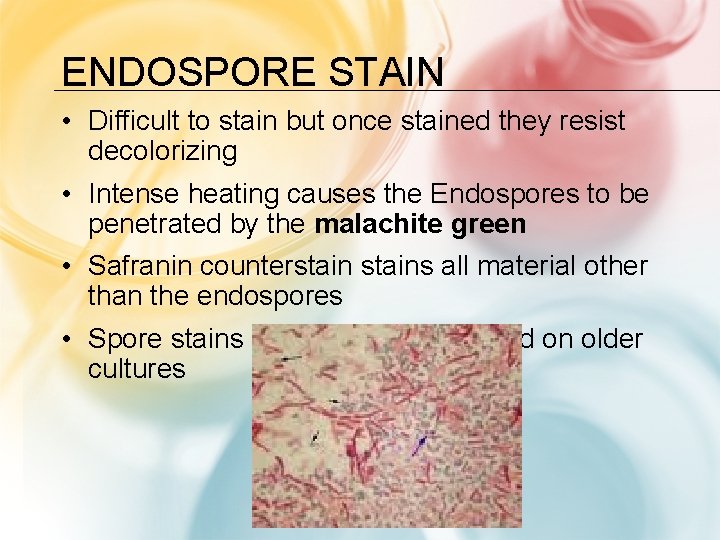
ENDOSPORE STAIN • Difficult to stain but once stained they resist decolorizing • Intense heating causes the Endospores to be penetrated by the malachite green • Safranin counterstains all material other than the endospores • Spore stains are typically performed on older cultures
- Slides: 14