
Microbiology Biochemical Changes and Biogas Production During Composition
Microbiology, Biochemical Changes and Biogas Production During Composition of Oil Palm Empty Fruit Bunch Chinyere C. Anagoba and Alfred Y. Itah* Department of Microbiology University of Uyo, Akwa Ibom State, Nigeria. 1
Background of the Study § Oil palm is a tropical plant that grows in warm climate at altitudes below 500 meters above sea level. § In Nigeria, the tree is widely grown as valuable economic crop to provide employment and yield revenue to farmers. It is a smajor source of vegetable oil and palm oil extracted from fruits for food and marketing § Mills generate a large amount of solid wastes, chiefly lignocellulosic materials e. g. fronds, trunks, palm kernel and OPEFB. § The residues comprise 7. 0 million tones of oil palm trunks, 26. 2 million tonnes of oil palm fronds and 23% of OPEFB per tonne of Fresh Fruit Bunch processed in oil palm mill industry § Oil palm wastes cause environmental pollution problems and spread diseases. § Incineration of OPEFB is now prohibited by regulations to prevent air pollution § Due to labor shortage, the transportation and distribution of OPEFB in the field is becoming more expensive. Biomassproject. blogspot. com § There is a growing interest in composting EFB, in order to add value and reduce the volume of waste. 2
Background of the Study Cont’d Palm oil Mulch materials: to control weeds, prevent erosion and maintain soil moisture Harvesting Yisanigeria. org Oil palm tree Stripping Imagestack. com Ripe oil palm fruit bunch Biomassproject. blogspot. com Empty fruit bunches (lignocellulosic material) 3
Objectives v A quantitative and qualitative microbiological assessment of OPEFB during composting and anaerobic digestion v Determine the physicochemical and proximate composition of the OPEFB v Assess the biogas production potential of OPEFB without pretreatment using Anagitah Anaerobic Digester 4
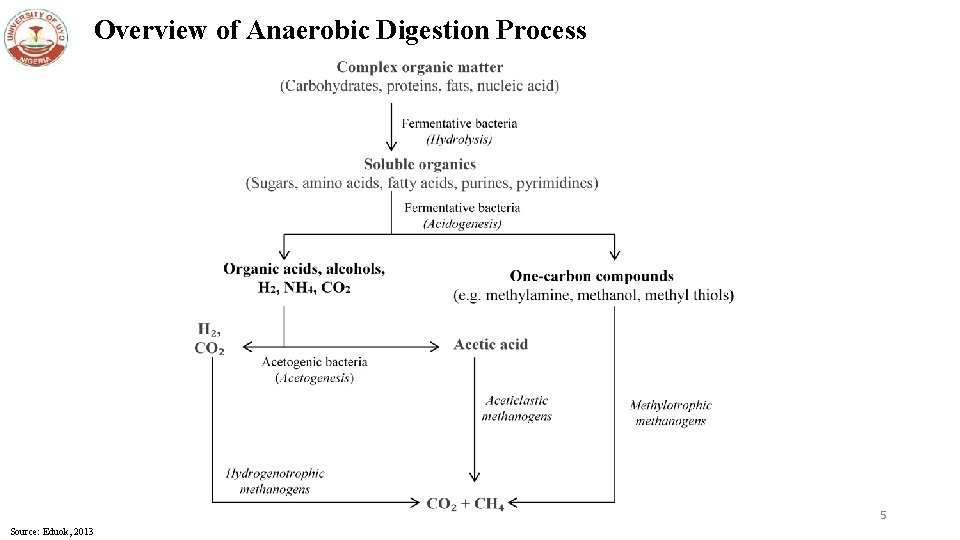
Overview of Anaerobic Digestion Process 5 Source: Eduok, 2013
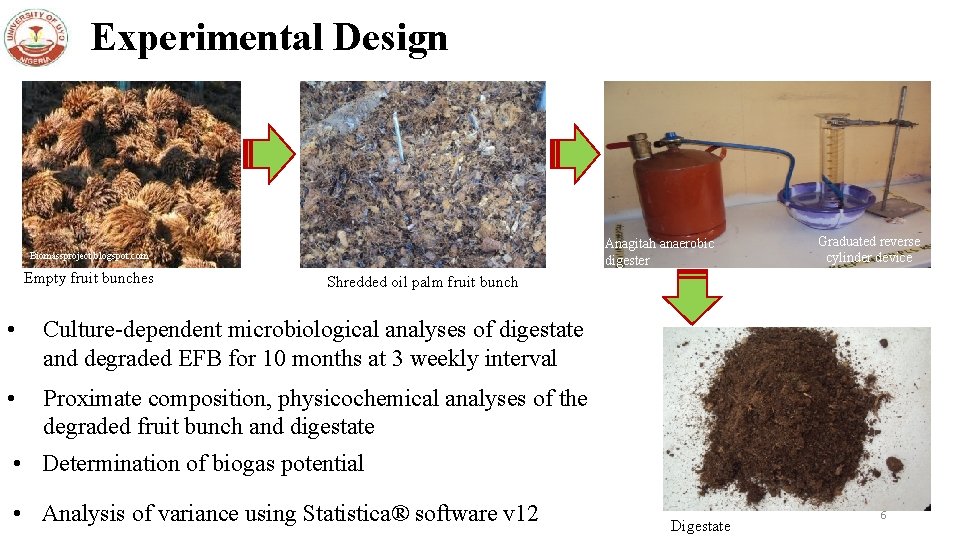
Experimental Design Anagitah anaerobic digester Biomassproject. blogspot. com Empty fruit bunches Graduated reverse cylinder device Shredded oil palm fruit bunch • Culture-dependent microbiological analyses of digestate and degraded EFB for 10 months at 3 weekly interval • Proximate composition, physicochemical analyses of the degraded fruit bunch and digestate • Determination of biogas potential • Analysis of variance using Statistica® software v 12 Digestate 6
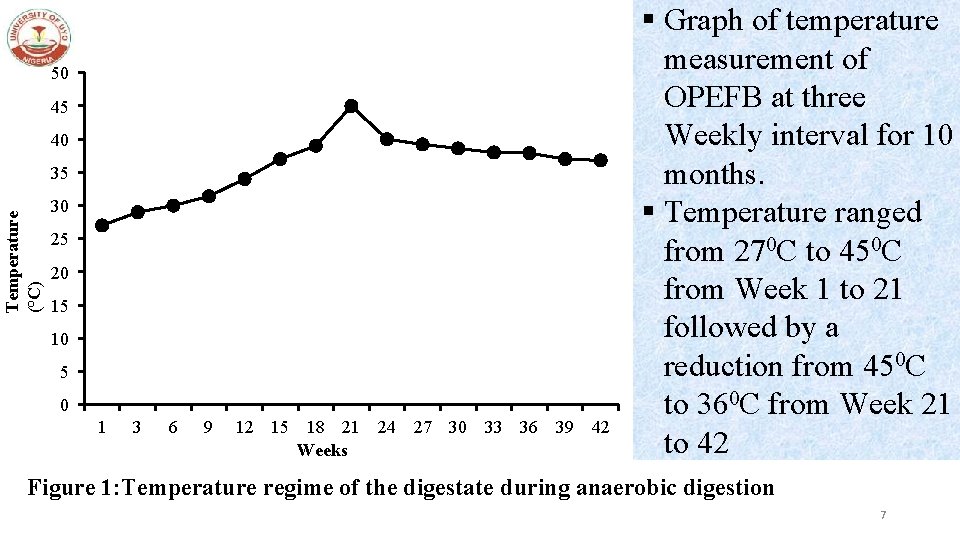
50 45 40 Temperature (°C) 35 30 25 20 15 10 5 0 1 3 6 9 12 15 18 21 24 27 30 33 36 39 42 Weeks § Graph of temperature measurement of OPEFB at three Weekly interval for 10 months. § Temperature ranged from 270 C to 450 C from Week 1 to 21 followed by a reduction from 450 C to 360 C from Week 21 to 42 Figure 1: Temperature regime of the digestate during anaerobic digestion 7
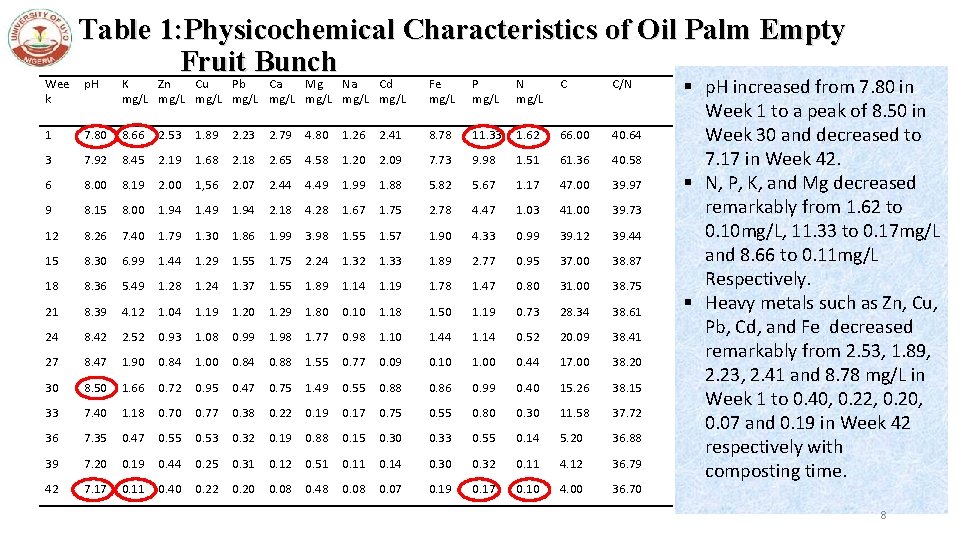
Wee k Table 1: Physicochemical Characteristics of Oil Palm Empty Fruit Bunch p. H K Zn Cu Pb Ca Mg Na Cd mg/L mg/L Fe mg/L P mg/L N mg/L C C/N 1 7. 80 8. 66 2. 53 1. 89 2. 23 2. 79 4. 80 1. 26 2. 41 8. 78 11. 33 1. 62 66. 00 40. 64 3 7. 92 8. 45 2. 19 1. 68 2. 18 2. 65 4. 58 1. 20 2. 09 7. 73 9. 98 1. 51 61. 36 40. 58 6 8. 00 8. 19 2. 00 1, 56 2. 07 2. 44 4. 49 1. 99 1. 88 5. 82 5. 67 1. 17 47. 00 39. 97 9 8. 15 8. 00 1. 94 1. 49 1. 94 2. 18 4. 28 1. 67 1. 75 2. 78 4. 47 1. 03 41. 00 39. 73 12 8. 26 7. 40 1. 79 1. 30 1. 86 1. 99 3. 98 1. 55 1. 57 1. 90 4. 33 0. 99 39. 12 39. 44 15 8. 30 6. 99 1. 44 1. 29 1. 55 1. 75 2. 24 1. 32 1. 33 1. 89 2. 77 0. 95 37. 00 38. 87 18 8. 36 5. 49 1. 28 1. 24 1. 37 1. 55 1. 89 1. 14 1. 19 1. 78 1. 47 0. 80 31. 00 38. 75 21 8. 39 4. 12 1. 04 1. 19 1. 20 1. 29 1. 80 0. 10 1. 18 1. 50 1. 19 0. 73 28. 34 38. 61 24 8. 42 2. 52 0. 93 1. 08 0. 99 1. 98 1. 77 0. 98 1. 10 1. 44 1. 14 0. 52 20. 09 38. 41 27 8. 47 1. 90 0. 84 1. 00 0. 84 0. 88 1. 55 0. 77 0. 09 0. 10 1. 00 0. 44 17. 00 38. 20 30 8. 50 1. 66 0. 72 0. 95 0. 47 0. 75 1. 49 0. 55 0. 88 0. 86 0. 99 0. 40 15. 26 38. 15 33 7. 40 1. 18 0. 70 0. 77 0. 38 0. 22 0. 19 0. 17 0. 75 0. 55 0. 80 0. 30 11. 58 37. 72 36 7. 35 0. 47 0. 55 0. 53 0. 32 0. 19 0. 88 0. 15 0. 30 0. 33 0. 55 0. 14 5. 20 36. 88 39 7. 20 0. 19 0. 44 0. 25 0. 31 0. 12 0. 51 0. 14 0. 30 0. 32 0. 11 4. 12 36. 79 42 7. 17 0. 11 0. 40 0. 22 0. 20 0. 08 0. 48 0. 07 0. 19 0. 17 0. 10 4. 00 36. 70 § p. H increased from 7. 80 in Week 1 to a peak of 8. 50 in Week 30 and decreased to 7. 17 in Week 42. § N, P, K, and Mg decreased remarkably from 1. 62 to 0. 10 mg/L, 11. 33 to 0. 17 mg/L and 8. 66 to 0. 11 mg/L Respectively. § Heavy metals such as Zn, Cu, Pb, Cd, and Fe decreased remarkably from 2. 53, 1. 89, 2. 23, 2. 41 and 8. 78 mg/L in Week 1 to 0. 40, 0. 22, 0. 20, 0. 07 and 0. 19 in Week 42 respectively with composting time. 8
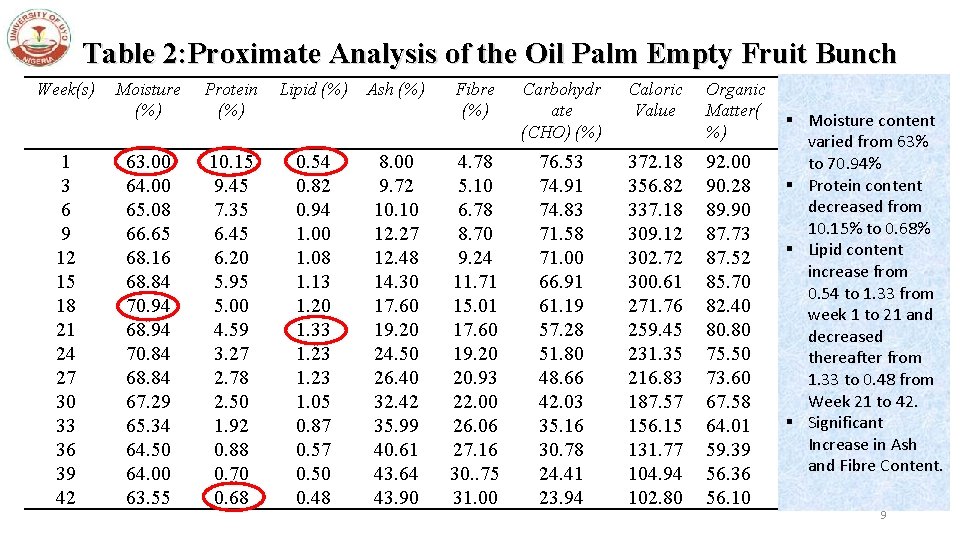
Table 2: Proximate Analysis of the Oil Palm Empty Fruit Bunch Week(s) 1 3 6 9 12 15 18 21 24 27 30 33 36 39 42 Moisture (%) Protein (%) Lipid (%) 63. 00 64. 00 65. 08 66. 65 68. 16 68. 84 70. 94 68. 94 70. 84 68. 84 67. 29 65. 34 64. 50 64. 00 63. 55 10. 15 9. 45 7. 35 6. 45 6. 20 5. 95 5. 00 4. 59 3. 27 2. 78 2. 50 1. 92 0. 88 0. 70 0. 68 0. 54 0. 82 0. 94 1. 00 1. 08 1. 13 1. 20 1. 33 1. 23 1. 05 0. 87 0. 50 0. 48 Ash (%) 8. 00 9. 72 10. 10 12. 27 12. 48 14. 30 17. 60 19. 20 24. 50 26. 40 32. 42 35. 99 40. 61 43. 64 43. 90 Fibre (%) Carbohydr ate (CHO) (%) Caloric Value Organic Matter( %) 4. 78 5. 10 6. 78 8. 70 9. 24 11. 71 15. 01 17. 60 19. 20 20. 93 22. 00 26. 06 27. 16 30. . 75 31. 00 76. 53 74. 91 74. 83 71. 58 71. 00 66. 91 61. 19 57. 28 51. 80 48. 66 42. 03 35. 16 30. 78 24. 41 23. 94 372. 18 356. 82 337. 18 309. 12 302. 72 300. 61 271. 76 259. 45 231. 35 216. 83 187. 57 156. 15 131. 77 104. 94 102. 80 92. 00 90. 28 89. 90 87. 73 87. 52 85. 70 82. 40 80. 80 75. 50 73. 60 67. 58 64. 01 59. 39 56. 36 56. 10 § Moisture content varied from 63% to 70. 94% § Protein content decreased from 10. 15% to 0. 68% § Lipid content increase from 0. 54 to 1. 33 from week 1 to 21 and decreased thereafter from 1. 33 to 0. 48 from Week 21 to 42. § Significant Increase in Ash and Fibre Content. 9
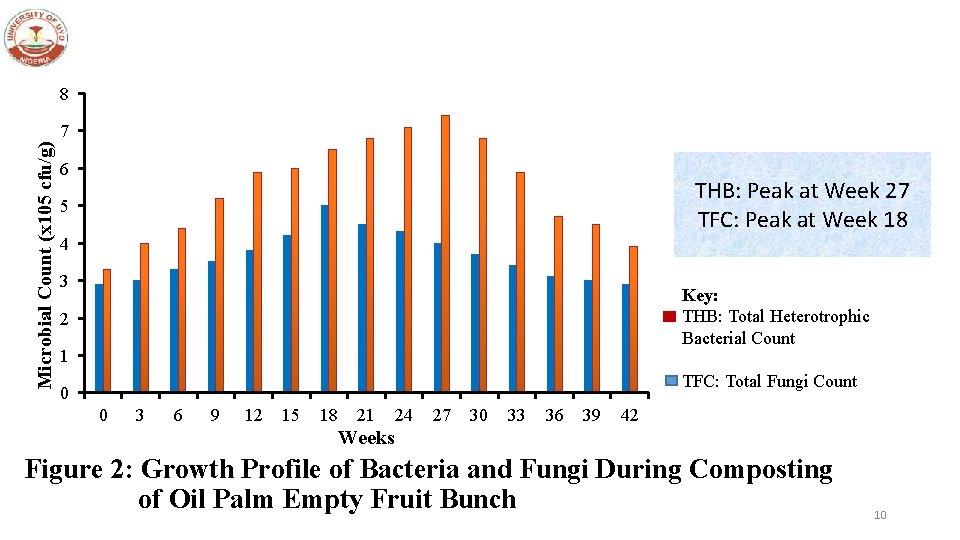
Microbial Count (x 105 cfu/g) 8 7 6 THB: Peak at Week 27 TFC: Peak at Week 18 5 4 3 Key: THB: Total Heterotrophic Bacterial Count 2 1 TFC: Total Fungi Count 0 0 3 6 9 12 15 18 21 24 27 30 33 36 39 42 Weeks Figure 2: Growth Profile of Bacteria and Fungi During Composting of Oil Palm Empty Fruit Bunch 10
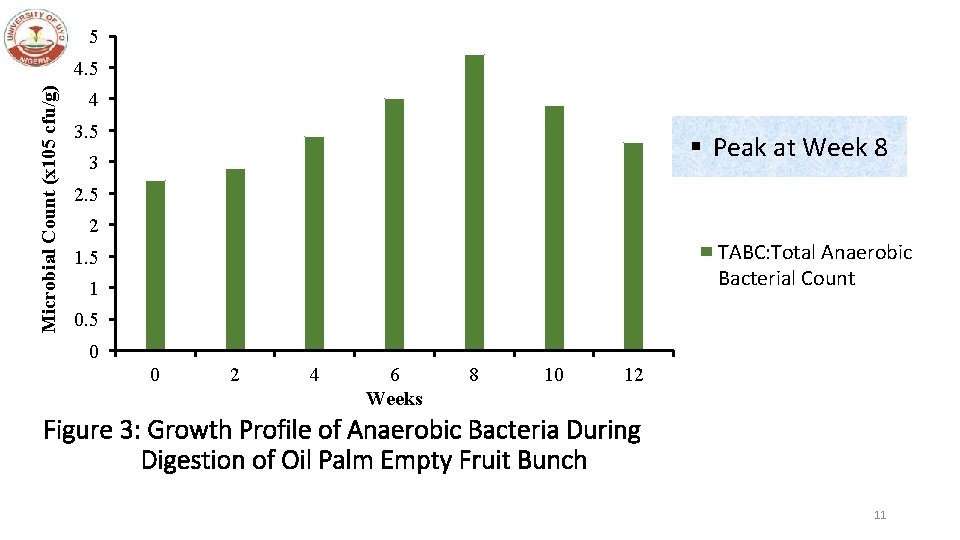
5 Microbial Count (x 105 cfu/g) 4. 5 4 3. 5 § Peak at Week 8 3 2. 5 2 TABC: Total Anaerobic Bacterial Count 1. 5 1 0. 5 0 0 2 4 6 Weeks 8 10 12 Figure 3: Growth Profile of Anaerobic Bacteria During Digestion of Oil Palm Empty Fruit Bunch 11
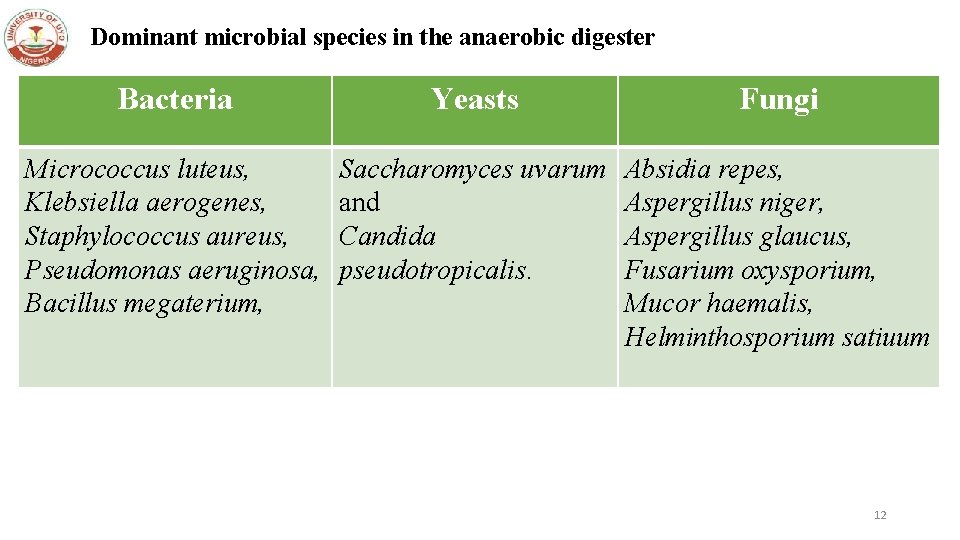
Dominant microbial species in the anaerobic digester Bacteria Yeasts Fungi Micrococcus luteus, Klebsiella aerogenes, Staphylococcus aureus, Pseudomonas aeruginosa, Bacillus megaterium, Saccharomyces uvarum and Candida pseudotropicalis. Absidia repes, Aspergillus niger, Aspergillus glaucus, Fusarium oxysporium, Mucor haemalis, Helminthosporium satiuum 12
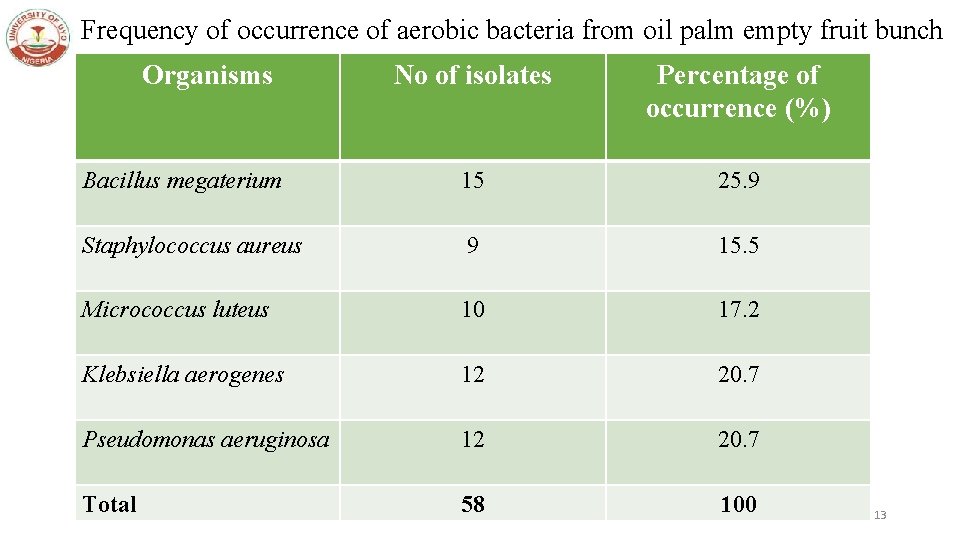
Frequency of occurrence of aerobic bacteria from oil palm empty fruit bunch Organisms No of isolates Percentage of occurrence (%) Bacillus megaterium 15 25. 9 Staphylococcus aureus 9 15. 5 Micrococcus luteus 10 17. 2 Klebsiella aerogenes 12 20. 7 Pseudomonas aeruginosa 12 20. 7 Total 58 100 13
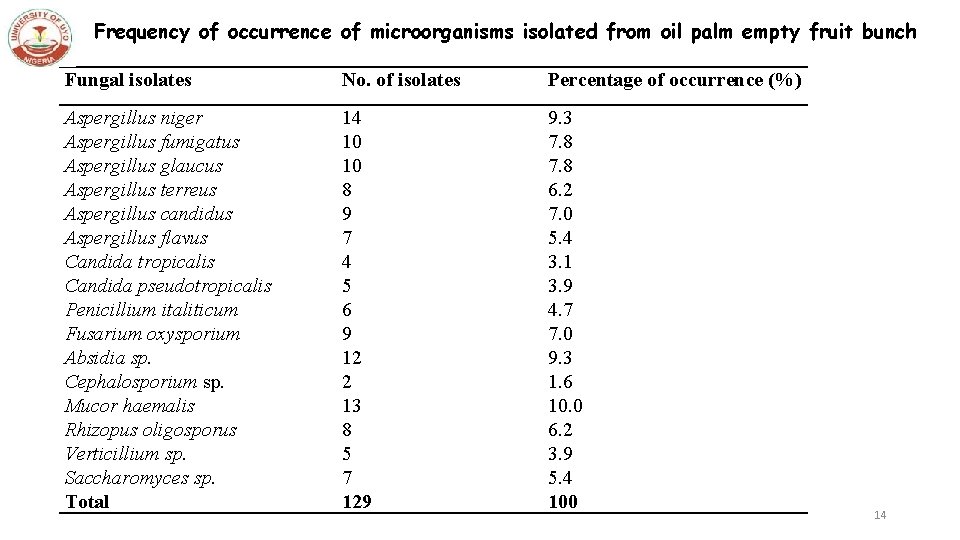
Frequency of occurrence of microorganisms isolated from oil palm empty fruit bunch Fungal isolates No. of isolates Percentage of occurrence (%) Aspergillus niger Aspergillus fumigatus Aspergillus glaucus Aspergillus terreus Aspergillus candidus Aspergillus flavus Candida tropicalis Candida pseudotropicalis Penicillium italiticum Fusarium oxysporium Absidia sp. Cephalosporium sp. Mucor haemalis Rhizopus oligosporus Verticillium sp. Saccharomyces sp. Total 14 10 10 8 9 7 4 5 6 9 12 2 13 8 5 7 129 9. 3 7. 8 6. 2 7. 0 5. 4 3. 1 3. 9 4. 7 7. 0 9. 3 1. 6 10. 0 6. 2 3. 9 5. 4 100 14
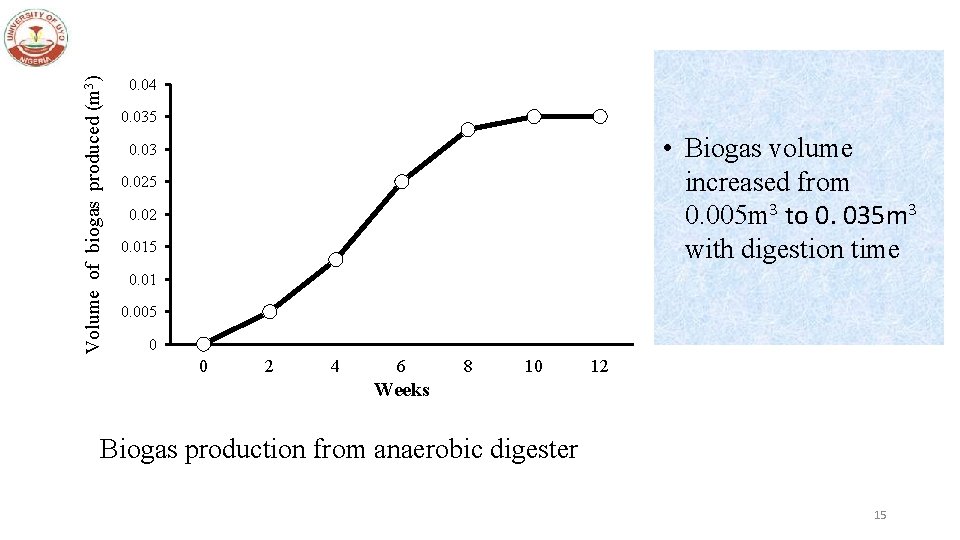
Volume of biogas produced (m 3) 0. 04 0. 035 • Biogas volume increased from 0. 005 m 3 to 0. 035 m 3 with digestion time 0. 03 0. 025 0. 02 0. 015 0. 01 0. 005 0 0 2 4 6 8 10 12 Weeks Biogas production from anaerobic digester 15
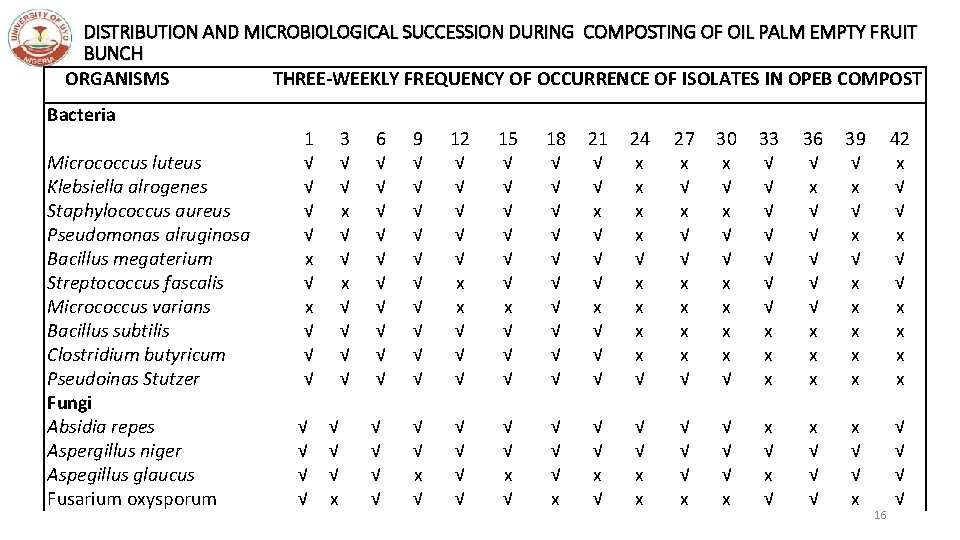
DISTRIBUTION AND MICROBIOLOGICAL SUCCESSION DURING COMPOSTING OF OIL PALM EMPTY FRUIT BUNCH ORGANISMS THREE-WEEKLY FREQUENCY OF OCCURRENCE OF ISOLATES IN OPEB COMPOST Bacteria Micrococcus luteus Klebsiella alrogenes Staphylococcus aureus Pseudomonas alruginosa Bacillus megaterium Streptococcus fascalis Micrococcus varians Bacillus subtilis Clostridium butyricum Pseudoinas Stutzer Fungi Absidia repes Aspergillus niger Aspegillus glaucus Fusarium oxysporum 1 √ √ x √ √ √ √ 3 √ √ x √ √ √ √ x 6 √ √ √ √ √ 9 √ √ √ √ √ 12 √ √ √ x x √ √ √ 15 √ √ √ x √ √ √ 18 √ √ √ √ √ 21 √ √ x √ √ √ 24 x x x x √ 27 x √ √ x x √ 30 x √ √ x x √ 33 √ √ √ √ x x x 36 √ x √ √ √ x x x 39 √ x √ x x x 42 x √ √ x x √ √ √ x √ √ √ √ x x √ √ √ x x √ x √ √ 16
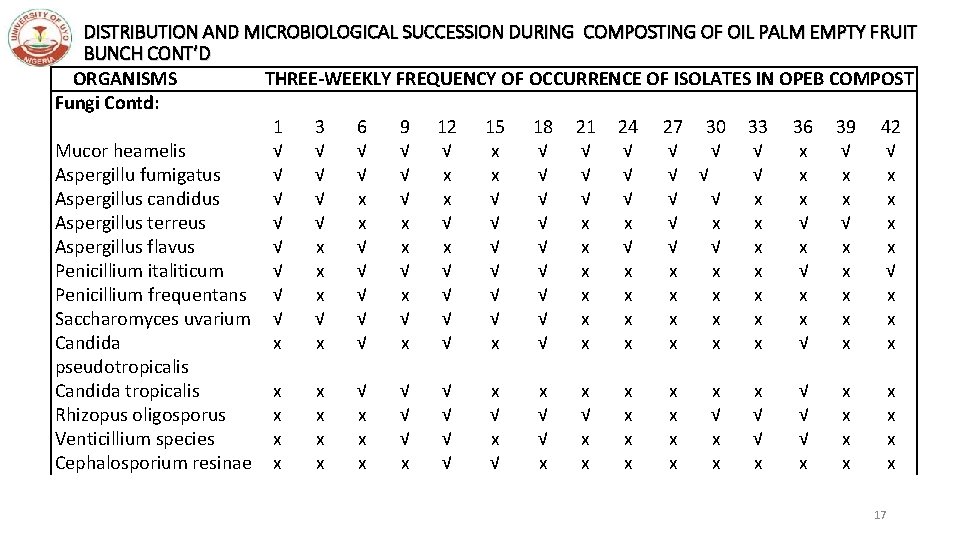
DISTRIBUTION AND MICROBIOLOGICAL SUCCESSION DURING COMPOSTING OF OIL PALM EMPTY FRUIT BUNCH CONT’D ORGANISMS THREE-WEEKLY FREQUENCY OF OCCURRENCE OF ISOLATES IN OPEB COMPOST Fungi Contd: 1 3 6 9 12 15 18 21 24 27 30 33 36 39 42 Mucor heamelis √ √ √ √ √ x √ √ Aspergillu fumigatus √ √ x x √ √ √ x x x Aspergillus candidus √ √ x √ √ √ x x Aspergillus terreus √ √ x x √ √ x Aspergillus flavus √ x x √ √ √ x x Penicillium italiticum √ x √ √ √ x x x √ Penicillium frequentans √ x √ √ √ x x x x Saccharomyces uvarium √ √ √ √ x x x x Candida x x √ x √ x x pseudotropicalis Candida tropicalis x x √ √ √ x x x x √ x x Rhizopus oligosporus x x x √ √ √ x x Venticillium species x x x √ √ x x Cephalosporium resinae x x √ √ x x x x x 17
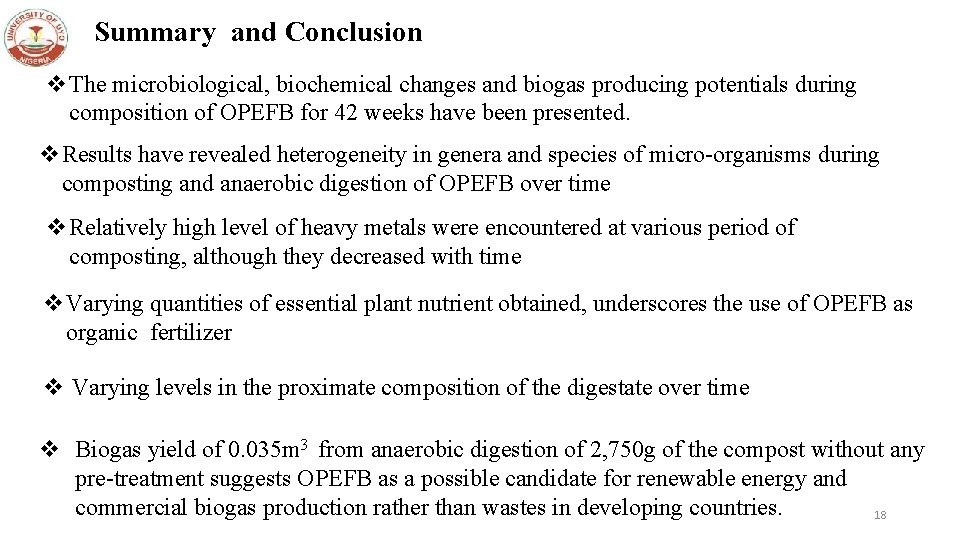
Summary and Conclusion v. The microbiological, biochemical changes and biogas producing potentials during composition of OPEFB for 42 weeks have been presented. v. Results have revealed heterogeneity in genera and species of micro-organisms during composting and anaerobic digestion of OPEFB over time v. Relatively high level of heavy metals were encountered at various period of composting, although they decreased with time v. Varying quantities of essential plant nutrient obtained, underscores the use of OPEFB as organic fertilizer v Varying levels in the proximate composition of the digestate over time v Biogas yield of 0. 035 m 3 from anaerobic digestion of 2, 750 g of the compost without any pre-treatment suggests OPEFB as a possible candidate for renewable energy and commercial biogas production rather than wastes in developing countries. 18

THANK YOU FOR LISTENING 19
- Slides: 19