
Microbiological Media Terms and Concepts Forms of culture
Microbiological Media Terms and Concepts
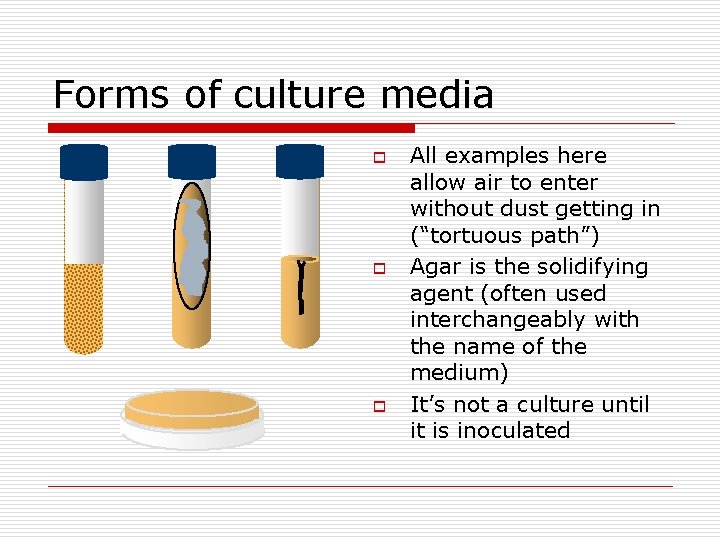
Forms of culture media o o o All examples here allow air to enter without dust getting in (“tortuous path”) Agar is the solidifying agent (often used interchangeably with the name of the medium) It’s not a culture until it is inoculated

Forms of culture media - Broth o o Liquid form of medium – no agar present Very “spillable” Allows movement of bacteria – not good for obtaining pure cultures TSB, NB, APT broth, LB Broth, etc.
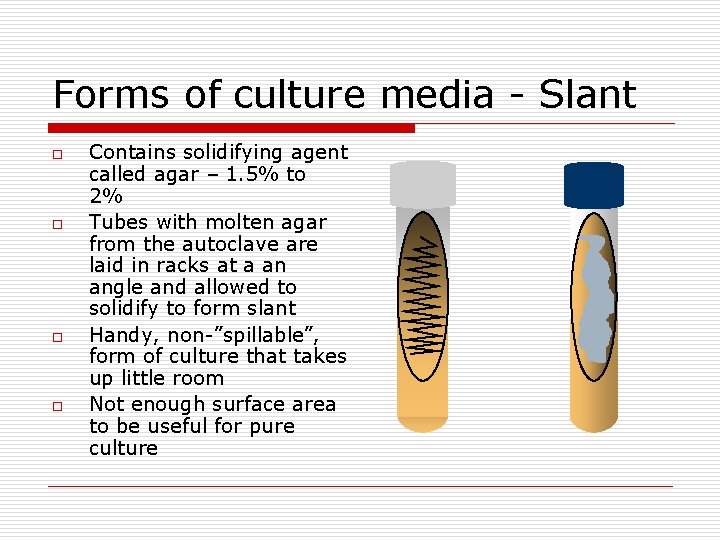
Forms of culture media - Slant o o Contains solidifying agent called agar – 1. 5% to 2% Tubes with molten agar from the autoclave are laid in racks at a an angle and allowed to solidify to form slant Handy, non-”spillable”, form of culture that takes up little room Not enough surface area to be useful for pure culture
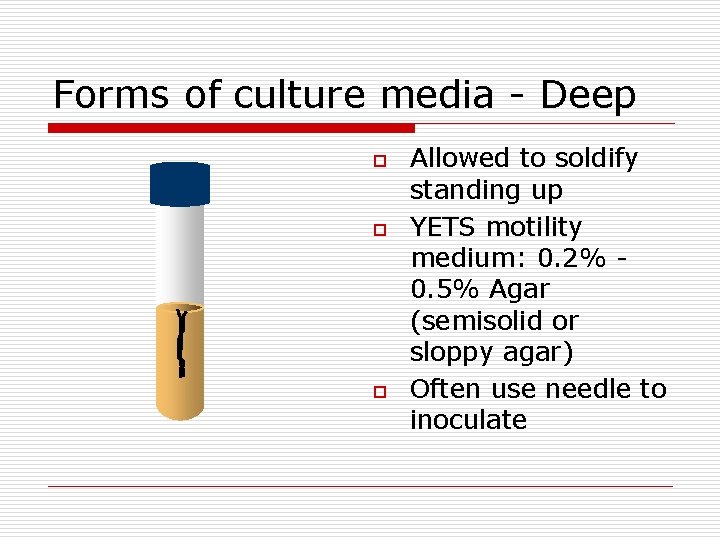
Forms of culture media - Deep o o o Allowed to soldify standing up YETS motility medium: 0. 2% 0. 5% Agar (semisolid or sloppy agar) Often use needle to inoculate
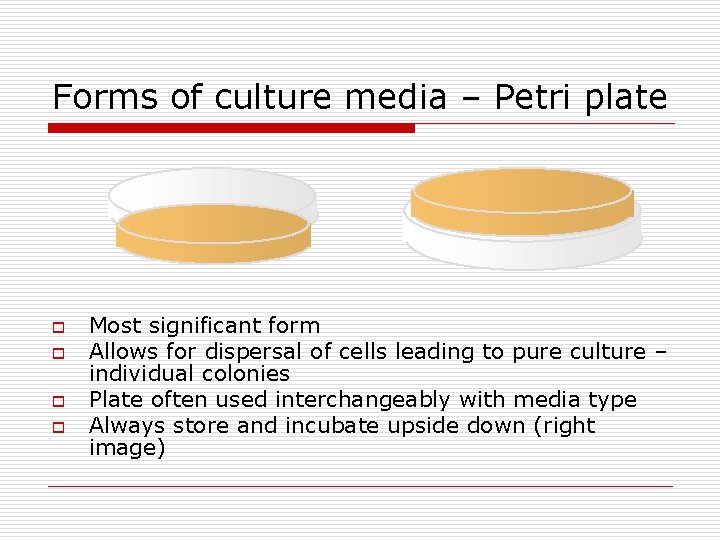
Forms of culture media – Petri plate o o Most significant form Allows for dispersal of cells leading to pure culture – individual colonies Plate often used interchangeably with media type Always store and incubate upside down (right image)

Synthetic vs. Complex o o o Synthetic (defined) All reagent grade chemicals. Exact composition is known. Used to assess nutritional requirements of organisms In genetics – prototroph vs. auxotroph M 9 Minimal Media
Synthetic vs. Complex o o o Complex (undefined) Contains “raw ingredients” whose composition is not known precisely (e. g. milk, yeast extract, casein, soy digest, etc. ) Used to culture a wide variety of organisms Most widely used in the laboratory Tryptic Soy Agar, Nutrient Agar, Luria. Bertrani Agar

Selective, Enrichment, and Differential Media o o Selective (counterselective) Contains some poison or inhibitor that prevents the growth of certain organisms and allows for growth of the rest APT with Azide – Azide is a potent inhibitor of respiration. Aerobes and facultatives die, while fermentative bacteria flourish MSA – 7. 5% salt inhibits gram negative bacteria and allows gram positive bacteria to grow
Selective, Enrichment, and Differential Media o o o Enrichment (positive selection) Contains nutrients that favor the growth of certain organisms and fails to support for growth of the rest Sulfate deeps – contains lactate and sulfate in deep form – favors sulfate reducing bacteria n n n No glucose or other fermentable sugar Deep form prevents oxygen from getting to bottom of tube Sulfate only available electron acceptor
Selective, Enrichment, and Differential Media o o Allows you to distinguish one phenotype from another (all organisms still grow, but they look different) Usual combination is some sugar and a p. H indicator that will turn color if fermentation acids are produced MSA – Mannitol fermentation is indicated by phenol red turning yellow (Man +/-) EMB – Methylene Blue turns dark purple when lactose is fermented to acid endproducts (Lac +/-)

Provision of Primary Macronutrients Element (Macronutrient) Cell need Form provided Hydrogen H 2 O, Organics Oxygen O 2, H 2 O, Organics Nitrogen Amino acids, NH 4 Cl Carbon Glucose, acetate, amino acids
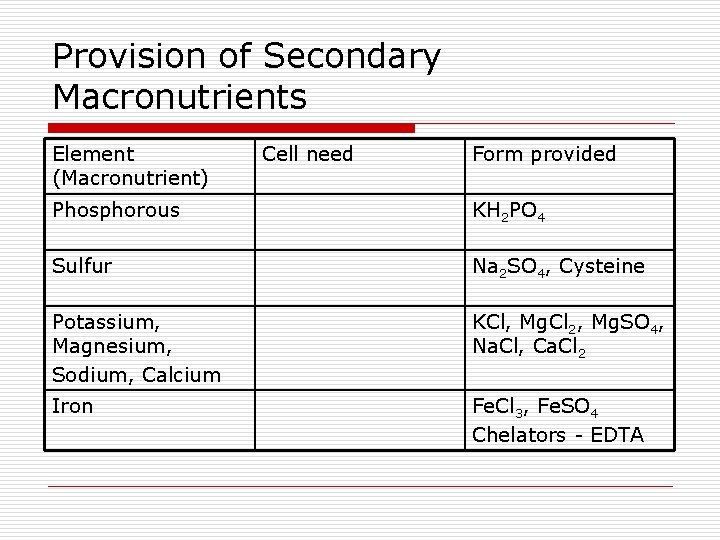
Provision of Secondary Macronutrients Element (Macronutrient) Cell need Form provided Phosphorous KH 2 PO 4 Sulfur Na 2 SO 4, Cysteine Potassium, Magnesium, Sodium, Calcium KCl, Mg. Cl 2, Mg. SO 4, Na. Cl, Ca. Cl 2 Iron Fe. Cl 3, Fe. SO 4 Chelators - EDTA
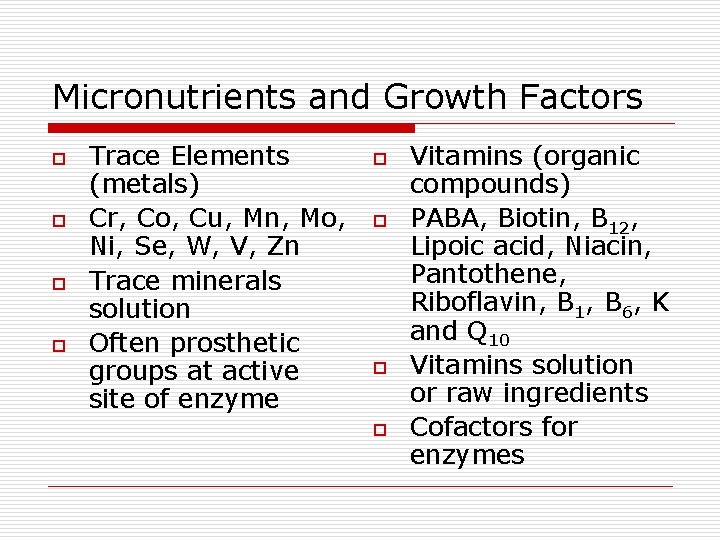
Micronutrients and Growth Factors o o Trace Elements (metals) Cr, Co, Cu, Mn, Mo, Ni, Se, W, V, Zn Trace minerals solution Often prosthetic groups at active site of enzyme o o Vitamins (organic compounds) PABA, Biotin, B 12, Lipoic acid, Niacin, Pantothene, Riboflavin, B 1, B 6, K and Q 10 Vitamins solution or raw ingredients Cofactors for enzymes
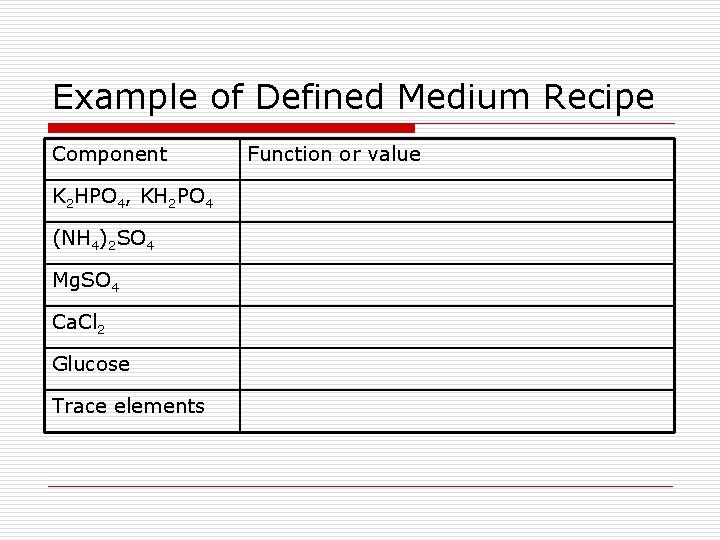
Example of Defined Medium Recipe Component K 2 HPO 4, KH 2 PO 4 (NH 4)2 SO 4 Mg. SO 4 Ca. Cl 2 Glucose Trace elements Function or value
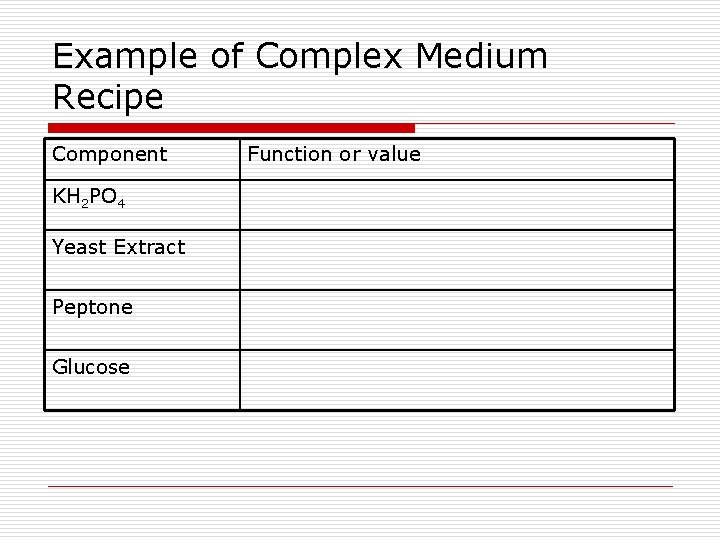
Example of Complex Medium Recipe Component KH 2 PO 4 Yeast Extract Peptone Glucose Function or value
- Slides: 16